
Foundations in Microbiology Chapter 1 Microbiology The study
Foundations in Microbiology Chapter 1

Microbiology • The study of of organisms too small to be seen without magnification • bacteria • viruses • fungi • protozoa • helminths (worms) • algae

Branches of study within microbiology • Immunology-the bodies defense mechanisms • Epidemiology-the study of diseases • Bacteriology-the study of bacteria • Virology-the study of viruses • Mycology-the study of fungi • Protozoology-the study of protist • Parasitology-the study of parasites • Phycology-the study of algae
What is a microbe? • Any “thing” smaller than 0. 1 micro-meters falling into the category of viruses, protozoan, bacteria, microscopic animals, viroids, and prions • Microbes are often times used in research facilities because • Easy to grow • Biochemistry is essentially the same • Simple and easy to study

Why study Microbiology • Microbes are related to all life. • In all environments • Many beneficial aspects • production of foods, drugs & vaccines • Related to life processes (food web, nutrient cycling) • Only a minority are pathogenic (disease causing). • Most of our problems are caused by microbes (Food spoilage and water contamination)

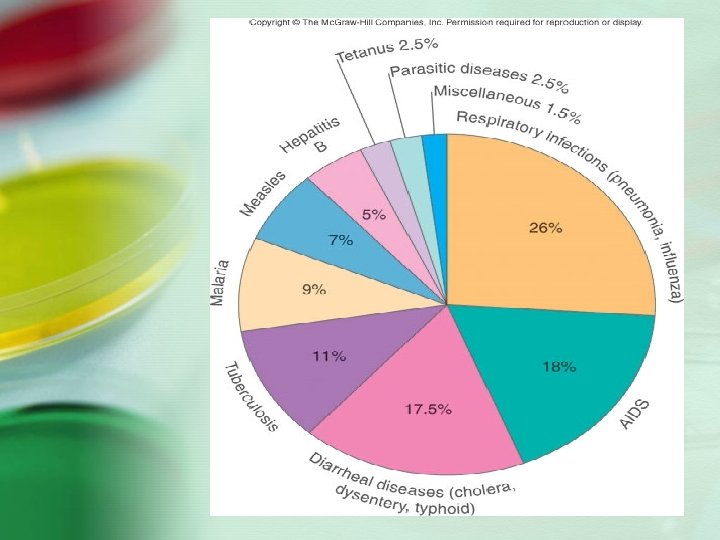
Impact of pathogens • Nearly 2, 000 different microbes cause diseases • 10 billion infections/year worldwide • 13 million deaths from infections/year worldwide
Key scientist in the history of Microbiology
Girolamo Frascatori 1546 • Suggested that invisible organisms cause disease. His idea was accepted for three centuries before turning into the Germ Theory.

Antonie van Leeuwenhoek • First to observe living microbes in 1676 • He called these microbes “animalcules” or little animals • His homemade singlelens microscope magnified up to 300 X
Francesco Redi 1688 • Preformed an experiment with rotting meat and fly eggs to disprove theory of spontaneous generation. He was the first scientist to “defy” the church and his results were overlooked for years.
Semmelweis and Lister 1850 -1865 • Semmelweis (1850) suggested that to eliminate child birth fever, medical professionals should wash their hands. He was committed to an asylum as a lunatic. • Lister (1864) notices that certain chemicals were effective in killing microbes and could cut down on infections during surgery. He preformed the first antiseptic surgery (1865) using these chemicals to reduce the risk of infection.
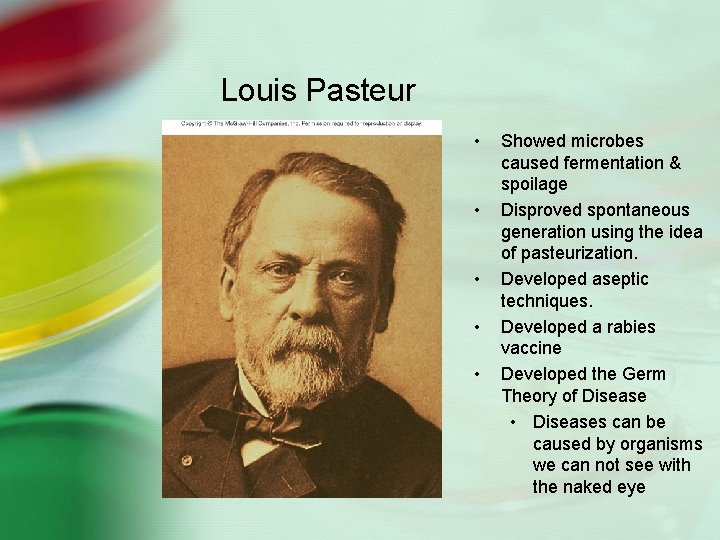
Louis Pasteur • • • Showed microbes caused fermentation & spoilage Disproved spontaneous generation using the idea of pasteurization. Developed aseptic techniques. Developed a rabies vaccine Developed the Germ Theory of Disease • Diseases can be caused by organisms we can not see with the naked eye
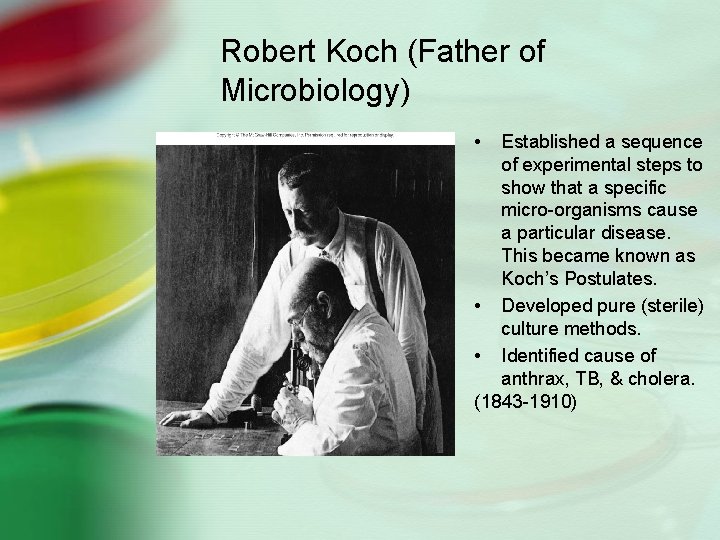
Robert Koch (Father of Microbiology) • Established a sequence of experimental steps to show that a specific micro-organisms cause a particular disease. This became known as Koch’s Postulates. • Developed pure (sterile) culture methods. • Identified cause of anthrax, TB, & cholera. (1843 -1910)
Christian Gram 1884 • Invented the Gram Staining technique. This technique allows scientist to differentiate between different types of bacteria.
Microbiology in the 1900’s • Walter Reed shows that mosquitos carry yellow fever • Alexander Fleming discovers penicillin and Howard Florey transofrms the drug penicillin for medical use. • The 1 st genetic sequence of a bacterium is published
- Slides: 16