
Foundations and Strategies Attention Investment CS 352 Announcements

- Slides: 25
Foundations and Strategies Attention Investment CS 352
Announcements • Notice upcoming due dates (web page). • Where we are in PRICPE: – Predispositions: Did this in Project Proposal. – RI: Research was studying users. Hopefully led to Insights. – CP: Concept and initial (very low-fi) Prototypes. – Evaluate throughout, repeat iteratively!! 2
Attention Investment • Explains how users behave in computer problem-solving situations. • Deals with “deeper” problem-solving issues. – Not how a user finds the right button or etc. • One example of “deep” problemsolving is programming.
Attention Investment (cont. ) • In using computers to get things done, attention (not info) is a scarce resource. • Cost is in attention units (~ time). – Some costs are investments, with (hopefully) payoff of reduced future cost of your work. – Not all costs are investments, e. g. reading flashing advertisements that appear while I’m doing something else. • Risk: probability the cost will be lost (no payoff after all).
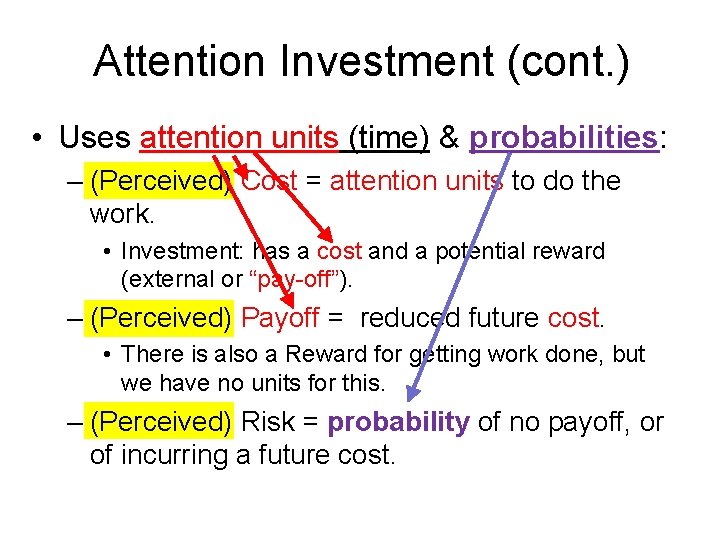
Attention Investment (cont. ) • Uses attention units (time) & probabilities: – (Perceived) Cost = attention units to do the work. • Investment: has a cost and a potential reward (external or “pay-off”). – (Perceived) Payoff = reduced future cost. • There is also a Reward for getting work done, but we have no units for this. – (Perceived) Risk = probability of no payoff, or of incurring a future cost.
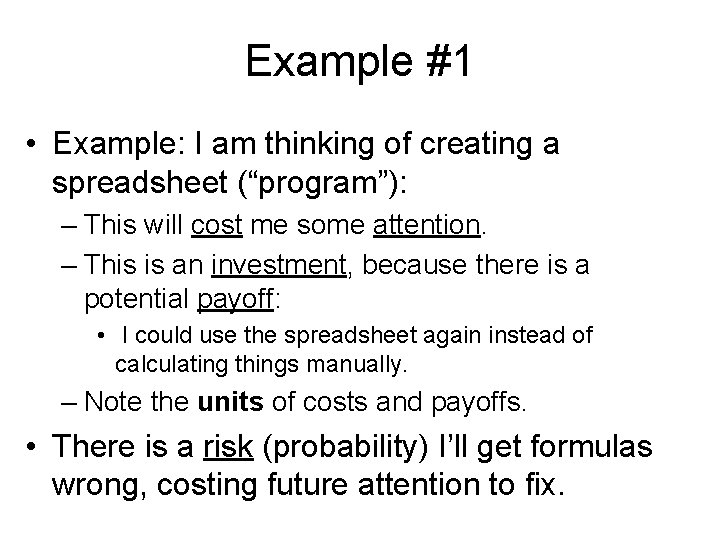
Example #1 • Example: I am thinking of creating a spreadsheet (“program”): – This will cost me some attention. – This is an investment, because there is a potential payoff: • I could use the spreadsheet again instead of calculating things manually. – Note the units of costs and payoffs. • There is a risk (probability) I’ll get formulas wrong, costing future attention to fix.
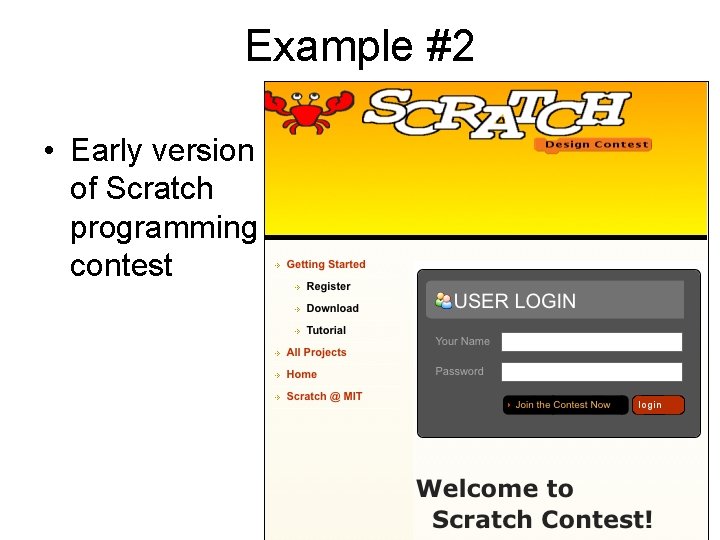
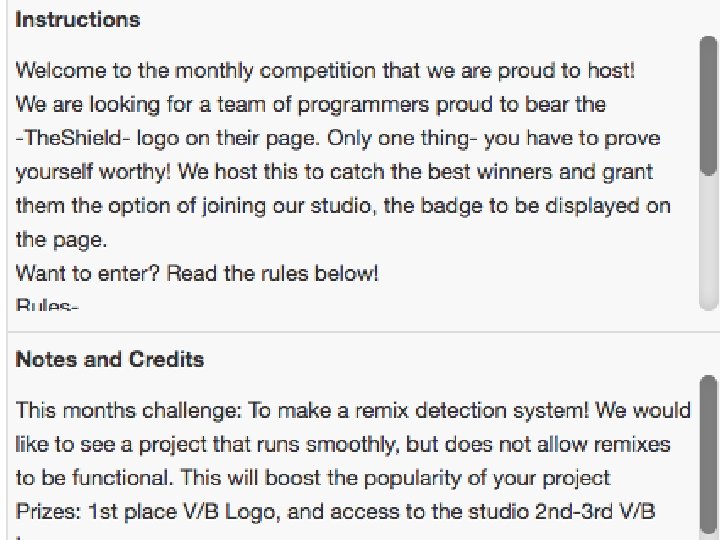
Example #2 • Early version of Scratch programming contest
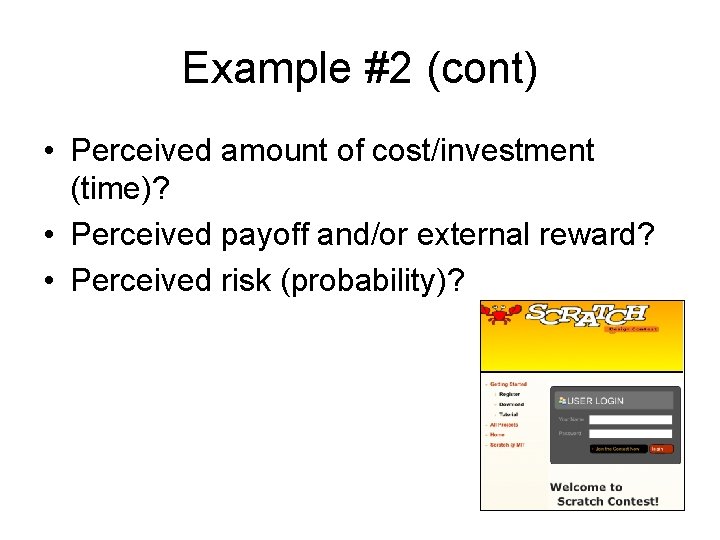
Example #2 (cont) • Perceived amount of cost/investment (time)? • Perceived payoff and/or external reward? • Perceived risk (probability)?
Example #2 (cont) • To solve these problems, they changed the contest entry screen. – What do you think they changed?
Activity • In your teams: – Use • your prototype (or resketch them) • or a web-based version of the online grocery – to walk through a user conducting some task. – At EACH step at which user has a choice, list: • potential PERCEIVED cost of each choice. – Is it an outright cost or an investment? • potential PERCEIVED payoff and/or external reward. • potential PERCEIVED risk.
More Examples: End-User Software Engineering • A lot of end-user-created software in the real world (mostly spreadsheets): – Entering a formula is “programming”. • Errors exist in up to 90% of “production” spreadsheets. • Our goal: To reduce this error rate. • How: Design an approach to assertions under the guidance of attention economics.
If we ignore attention investment. . . • Designing for end users in spreadsheets. • If we get it wrong, they’ll just ignore our new features in the spreadsheet. – Thus, thinking about attention investment is critical to this approach ever working.
Using Attention Investment for Design-Time Guidance • Will show this on 3 aspects of the end-user software engineering work on assertions: – Aspect 1: System’s communications to the user. – Aspect 2: User’s motivation to enter assertions. – Aspect 3: Choosing research questions for a human study to understand productivity effects.
Aspect 1: System’s Communication with User • (1) Respect user’s right to control their own attention focus. (Wresting control away adds context switch attention costs. ) – Example: Uninvited dialog boxes popping up. • (2) Our design decisions could impose unproductive attention costs through learning curves, etc. – Example: Asking them questions about things they do not have the background to know.
Answers to Aspect 1: Communication • Respect user control (point 1): – The user is always in control of how attention is spent. – Results of reasoning must not distract attention. • But, results of reasoning should not require user manually retrieving them: – Costs attention to do – Also costs attention (context switch) to detour from what otherwise doing.
Aspect 2: Motivation to Enter Assertions • “If we build it, they will come”, right? (Traditional CS view). • But, will users really ever enter any assertions? Why should they? – It costs attention to go explore what these things are, and I need all my attention to get my work done! – Further, there is risk that exploring assertions will be a waste of attention.
Aspect 2: Motivation (cont. ) • Strategy: – Encourage entry (requires attention investment, but smaller due to timely assistance) • At an appropriate time consistent with a userinitiated activity. – Reward (pay off +) the investment.
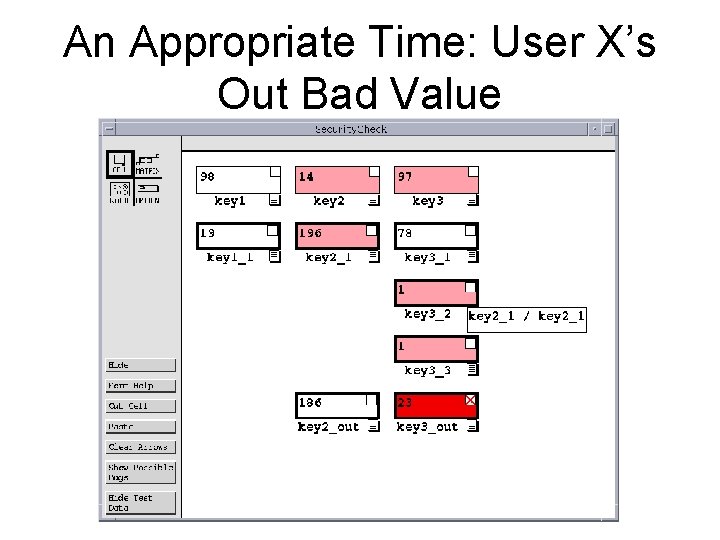
An Appropriate Time: User X’s Out Bad Value
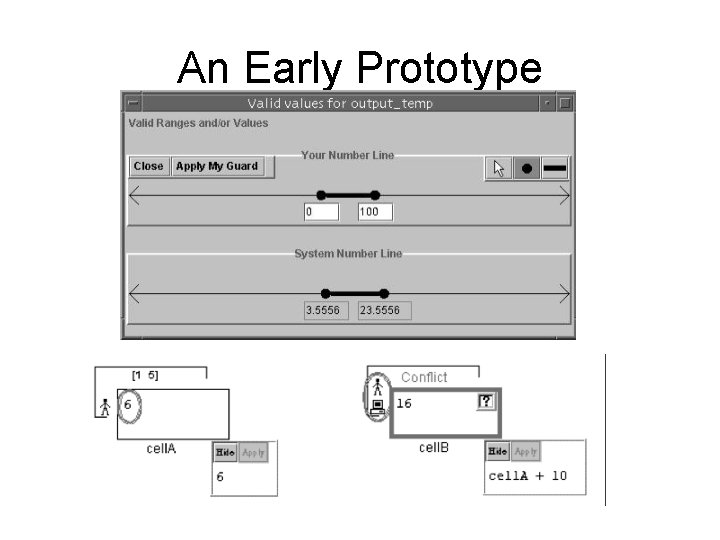
An Early Prototype
The Rewards • The bad value will be circled – Rewards: getting useful information (external), and payoff of not having to scan for the bad value myself in the future. • When the user eventually fixes the bad formula, the circle goes away. • If the value ever again violates the assertion, the circle will reappear. – Reduces risk that values may be wrong and that I wouldn’t notice.
Aspect 3: Choosing Our Study’s Research Questions • In a human study, we must try to learn a little and learn it well. – Background: If we try to learn too much, often there is too much noise to learn anything at all. – Goal: We want to learn things relevant to whether assertions will truly help users’ productivity. – The issue: How can attention investment help us choose the right questions?
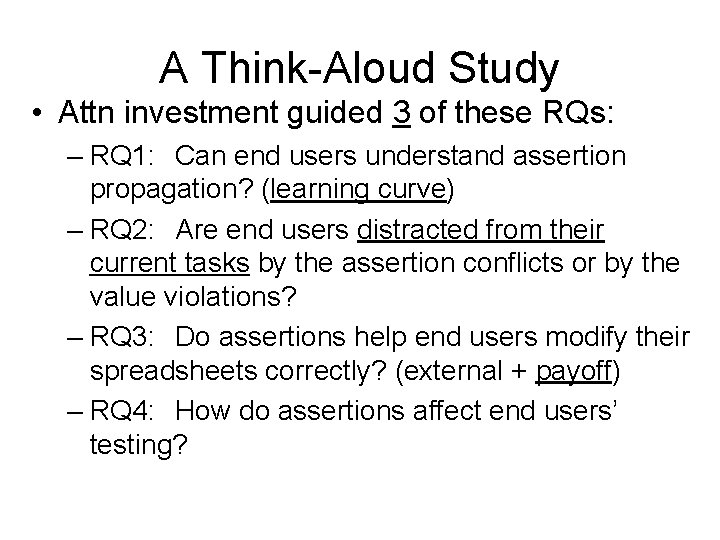
A Think-Aloud Study • Attn investment guided 3 of these RQs: – RQ 1: Can end users understand assertion propagation? (learning curve) – RQ 2: Are end users distracted from their current tasks by the assertion conflicts or by the value violations? – RQ 3: Do assertions help end users modify their spreadsheets correctly? (external + payoff) – RQ 4: How do assertions affect end users’ testing?
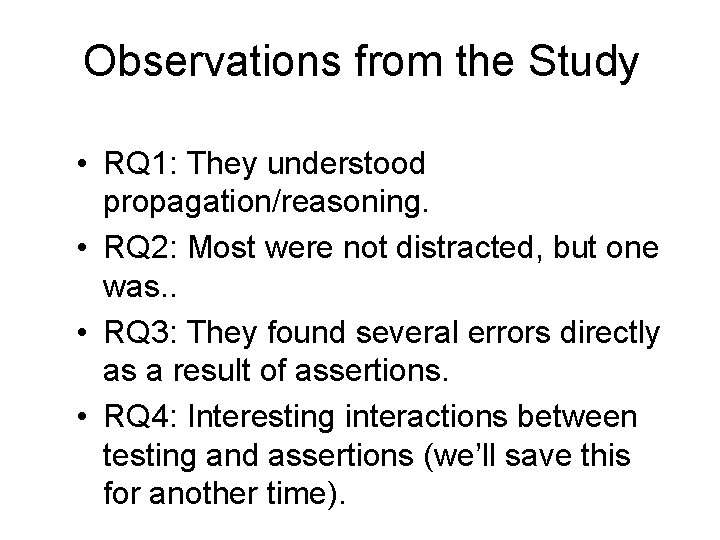
Observations from the Study • RQ 1: They understood propagation/reasoning. • RQ 2: Most were not distracted, but one was. . • RQ 3: They found several errors directly as a result of assertions. • RQ 4: Interesting interactions between testing and assertions (we’ll save this for another time).
Conclusion: Attention Investment is… • A way to understand user’s action choices. • A design-time mechanism for making informed design choices. – Much cheaper than finding problems after building a system.