
Foundational Theories H 607 Ethnicity Context Family Dynamics
- Slides: 18
Foundational Theories H 607: Ethnicity, Context, & Family Dynamics
Overview • Religious Holidays – Email me or Ross – Class is recorded for your review – Share notes – Come see me with questions • Theories and frameworks – Integrative Model for minority child development – Ecological Models – Dynamic Interaction Models
Challenges for Research on Diverse Families • Absence of longitudinal, normative research • Emphasis on outcomes instead of processes • Lack of attention to within group variations • Emphasis of the effects of social stratification • Lack of attention to migration histories • Cultural influences have not been specified
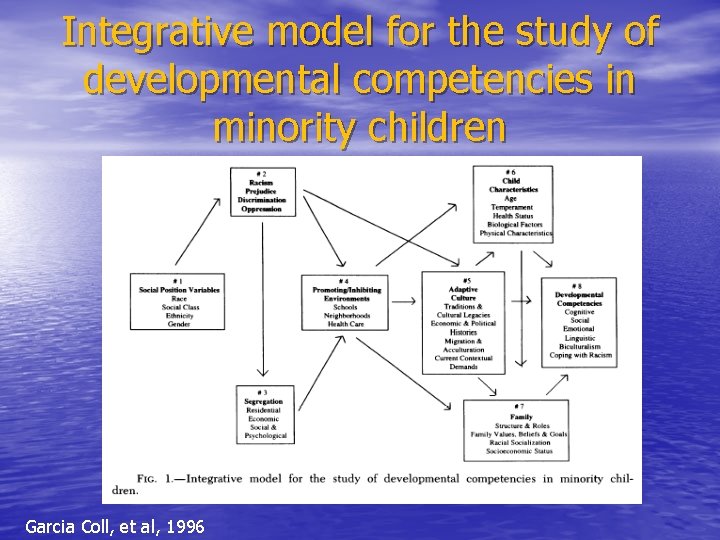
Integrative model for the study of developmental competencies in minority children Garcia Coll, et al, 1996
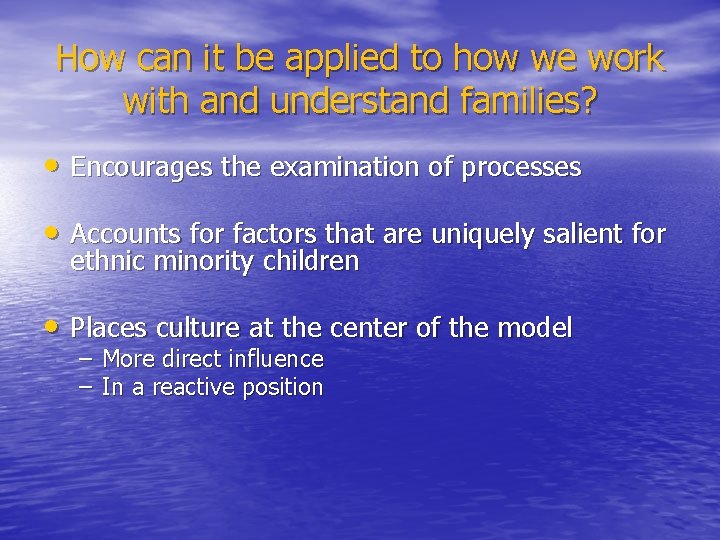
How can it be applied to how we work with and understand families? • Encourages the examination of processes • Accounts for factors that are uniquely salient for ethnic minority children • Places culture at the center of the model – More direct influence – In a reactive position
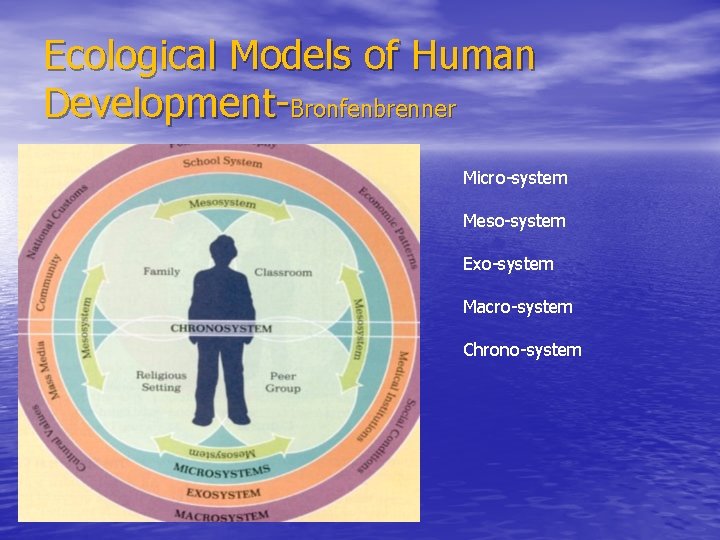
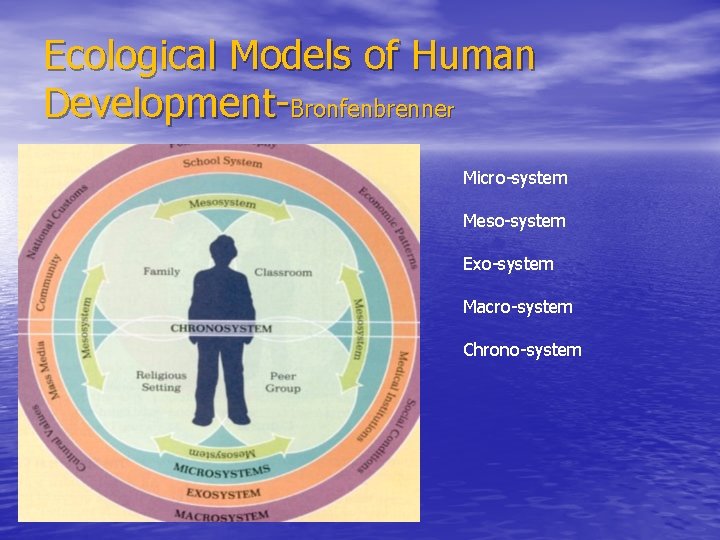
Ecological Models of Human Development-Bronfenbrenner Micro-system Meso-system Exo-system Macro-system Chrono-system
Microsystems • Any context that directly influences the child
Meso-system Relations between micro systems • Setting transition and feedback • Dissonance and complementarity • Linkages between settings • Changes in one setting effect another • Diversity in roles and role models
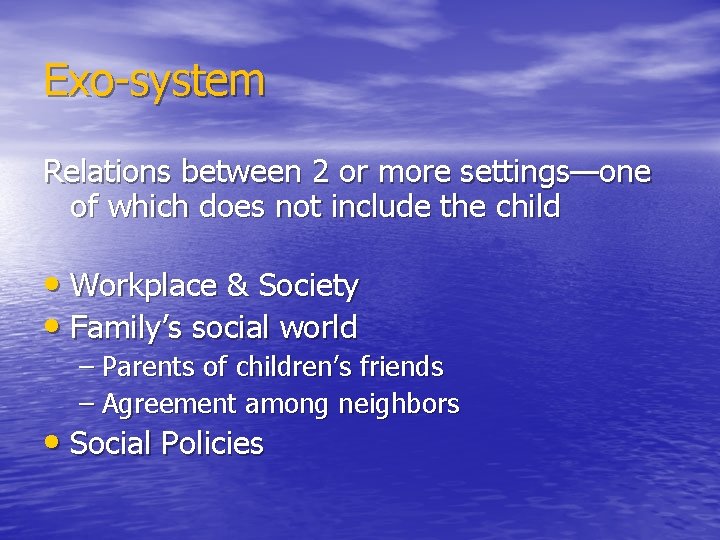
Exo-system Relations between 2 or more settings—one of which does not include the child • Workplace & Society • Family’s social world – Parents of children’s friends – Agreement among neighbors • Social Policies
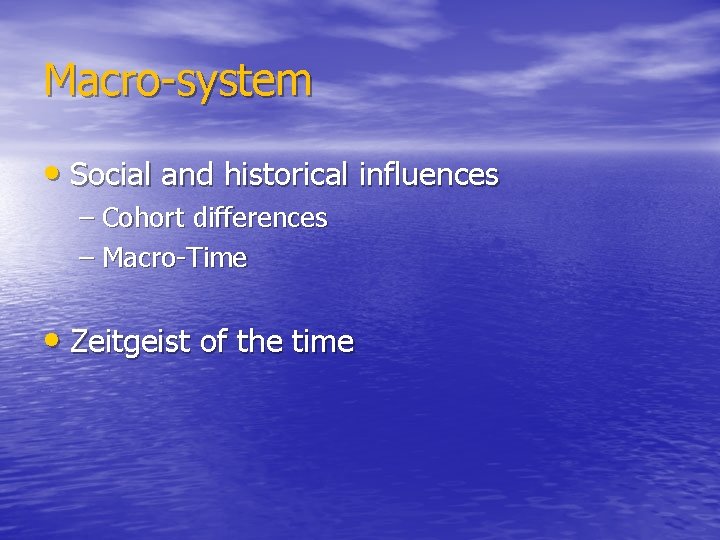
Macro-system • Social and historical influences – Cohort differences – Macro-Time • Zeitgeist of the time
Ecological Models of Human Development-Bronfenbrenner Micro-system Meso-system Exo-system Macro-system Chrono-system
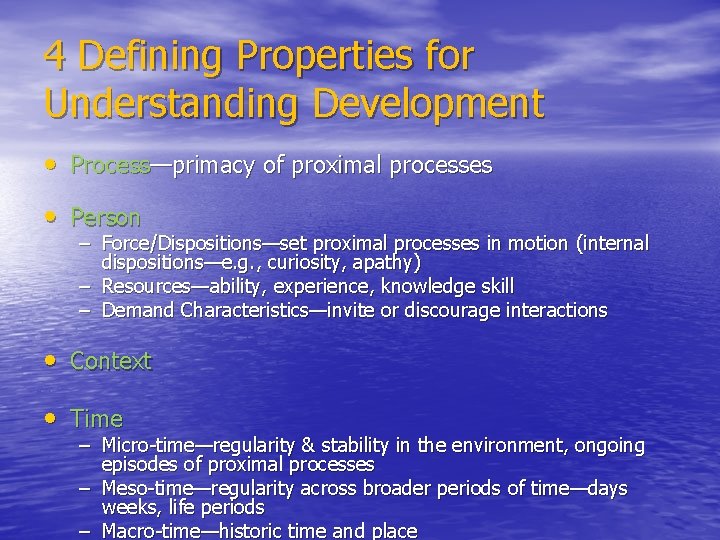
4 Defining Properties for Understanding Development • Process—primacy of proximal processes • Person – Force/Dispositions—set proximal processes in motion (internal dispositions—e. g. , curiosity, apathy) – Resources—ability, experience, knowledge skill – Demand Characteristics—invite or discourage interactions • Context • Time – Micro-time—regularity & stability in the environment, ongoing episodes of proximal processes – Meso-time—regularity across broader periods of time—days weeks, life periods – Macro-time—historic time and place
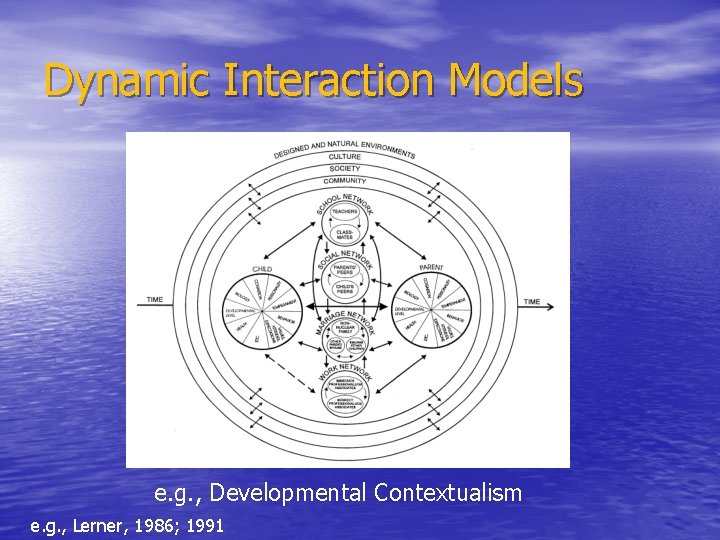
Dynamic Interaction Models e. g. , Developmental Contextualism e. g. , Lerner, 1986; 1991
Summary of ecological and dynamic models • What is similar in their models? • What’s distinguishes them? • What are their strengths? • How do they conceptualize culture?
Usefulness of the model… • View of child – Child and context are fused and interactive – Child effects on parent – “Goodness of fit” with context • Challenges: Dispersive – – – Cannot test the entire model Generalizability beyond the individual Cannot make testable hypotheses or predictions • Advantages to research: – Developmental Science in Discovery Mode – Broaden your thinking • Conceptualization of the nature of the attributes of population studied • Conceptualization of the context—why and how it is salient • Conceptualization of the fusion between the individual and the context.
Application to Prevention & Intervention? • Context for Sustainability • Context for Community “Buy In” • Context for Program Evaluation
“I believe that a developmental systems view of the historical and developmental ecology of individual and family life helps reduce the incidence of “blindness to social history and context”. ” --Lerner (1998)
Coming up next… Conceptualizations of Race, Ethnicity and Culture