
Foundational Concepts for Building System Models SEWG MBSE
Foundational Concepts for Building System Models SEWG MBSE Training Module 3 https: //nen. nasa. gov/web/se/mbse/documents Todd Bayer, Daniel Dvorak, Sanford Friedenthal, Steven Jenkins, Chi Lin, Sanda Mandutianu Jet Propulsion Laboratory, California Institute of Technology Copyright 2012 California Institute of Technology. U. S. Government sponsorship acknowledged.

Objective and Intended Audience Model-Based Systems Engineering Objectives: • Understand how systems engineering concepts are expressed in the JPL Foundation profiles of Sys. ML – Note: Sys. ML representations are not entirely mature; subject to change • Understand how automated analysis enhances design integrity Intended Audience: • Systems engineers, especially model developers Prerequisites: • Systems engineering background • Basic Sys. ML knowledge assumed • MBSE Module 2: Introduction to System Modeling Non-Objectives: • Not Sys. ML training or tool training Developing and Working with System Models 2
Acknowledgements Model-Based Systems Engineering Funding: NASA SEWG MBSE Initiative (Joseph Smith) JPL ESD Integrated Model-Centric Engineering (Chi Lin) JPL Formulation & Systems Engineering Division (David Nichols) Contributors (in alphabetical order): Todd Bayer, Daniel Dvorak, Sanford Friedenthal, Steven Jenkins, Chi Lin, Sanda Mandutianu Other Sources: JPL Europa pre-project modeling efforts JPL Modeling Early Adopters (MEA) Developing and Working with System Models 3
Outline Model-Based Systems Engineering 1. Takeaways from MBSE training modules 1 and 2 2. Extending Sys. ML with ontologies § The role of OWL vs. Sys. ML § Reasoning on models 3. The systems engineering ontologies § Mission concepts: mission, objective, requirement, component, … § Analysis concepts: analysis, characterization § Project concepts: program, project, work package, product, process, … 4. Analysis/reasoning on models (examples) 5. Overview of the modeling tool environment and its integration with CM, Requirements Management, Analysis, and a Query Generation tool such as one supported by SPARQL 6. Relationship of model to NASA SE lifecycle and gate products Summary Developing and Working with System Models 4
Takeaways from Module 1 “Systems Engineering with Models” Model-Based Systems Engineering • MBSE is systems engineering … with models – MBSE formalizes part of systems engineering • MBSE addresses SE problems of complexity, architecture, integration, reuse, and technical/programmatic coupling • A system model … – integrates info from discipline models – becomes part of the technical baseline – serves team as single source of authoritative information • Needed infrastructure … – Tools, training, standards, methodology • Multi-pronged, evolutionary infusion strategy recommended – Culture change takes time Developing and Working with System Models 5

Takeaways from Module 2: “Introduction to Modeling” Model-Based Systems Engineering • A system model is both descriptive and analytical • A system model integrates information from many discipline models • A good model has unambiguous semantics • A good model narrows the risky and expensive gap between describing a design and analyzing it • Sys. ML, as a language, can be extended with profiles for domain-specific languages • MBSE doesn’t change NASA’s SE processes – Doesn’t change what is done, but can change how it is done Developing and Working with System Models 6

Model-Based Systems Engineering EXTENDING SYSML FOR SYSTEMS ENGINEERING • The role of OWL and Sys. ML Developing and Working with System Models 7

Extending Sys. ML Model-Based Systems Engineering “Sys. ML is a general-purpose systems modeling language intended to support a wide range of domain-specific applications such as the modeling of automotive or aerospace systems. Sys. ML has been designed to enable extensions that support these specialized domains. An example may be a customization of Sys. ML for the automotive domain that includes specific automotive concepts …” Chapter 14, A Practical Guide to Sys. ML Friedenthal, Moore and Steiner • Sys. ML permits user-defined extensions called stereotypes • Stereotypes extend existing Sys. ML concepts with additional properties and constraints • Stereotypes are grouped into special packages called profiles • The new concepts, and the grammar for using them in well-formed constructions, can be represented in an ontology Developing and Working with System Models 8
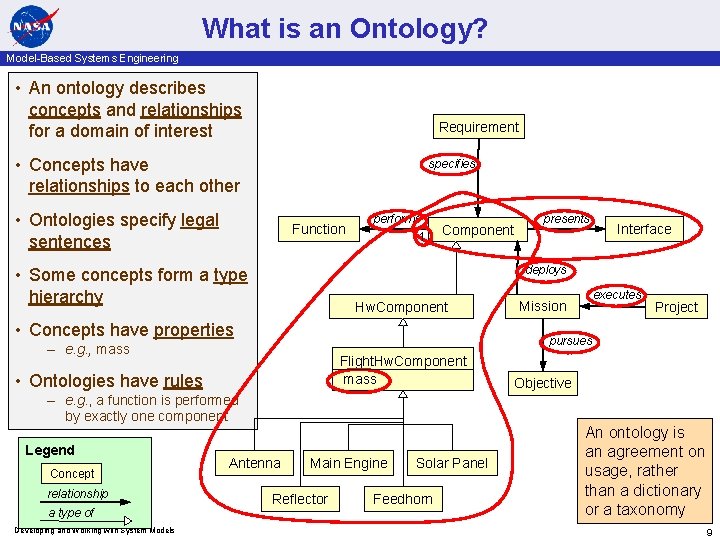
What is an Ontology? Model-Based Systems Engineering • An ontology describes concepts and relationships for a domain of interest Requirement • Concepts have relationships to each other specifies • Ontologies specify legal sentences Function performs 1 Component Hw. Component • Concepts have properties Flight. Hw. Component mass • Ontologies have rules – e. g. , a function is performed by exactly one component relationship a type of Developing and Working with System Models executes Mission Project pursues – e. g. , mass Concept Interface deploys • Some concepts form a type hierarchy Legend presents Antenna Main Engine Reflector Solar Panel Feedhorn Objective An ontology is an agreement on usage, rather than a dictionary or a taxonomy 9
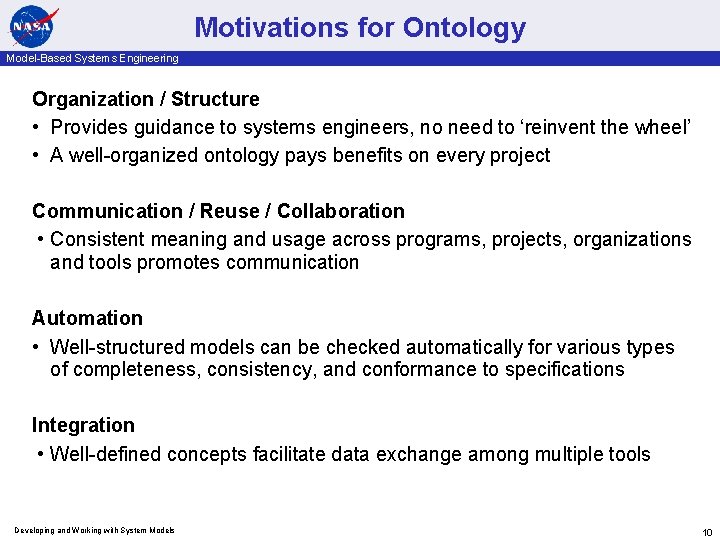
Motivations for Ontology Model-Based Systems Engineering Organization / Structure • Provides guidance to systems engineers, no need to ‘reinvent the wheel’ • A well-organized ontology pays benefits on every project Communication / Reuse / Collaboration • Consistent meaning and usage across programs, projects, organizations and tools promotes communication Automation • Well-structured models can be checked automatically for various types of completeness, consistency, and conformance to specifications Integration • Well-defined concepts facilitate data exchange among multiple tools Developing and Working with System Models 10
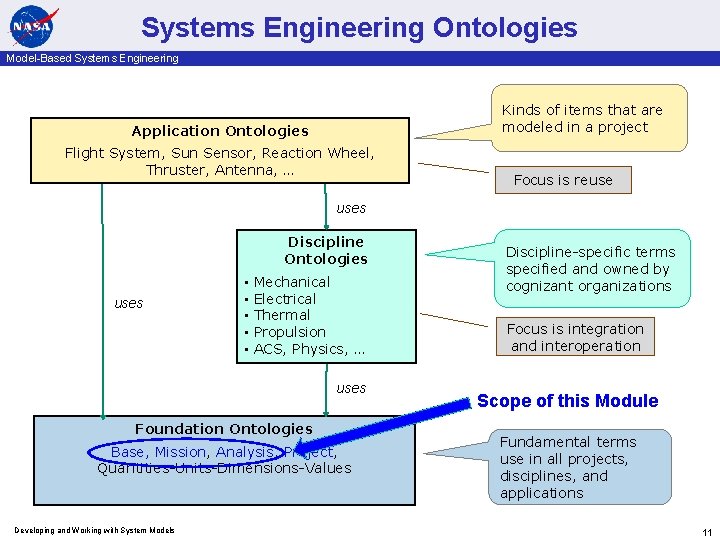
Systems Engineering Ontologies Model-Based Systems Engineering Kinds of items that are modeled in a project Application Ontologies Flight System, Sun Sensor, Reaction Wheel, Thruster, Antenna, … Focus is reuse uses Discipline Ontologies uses • Mechanical • Electrical • Thermal • Propulsion • ACS, Physics, … uses Foundation Ontologies Base, Mission, Analysis, Project, Quantities-Units-Dimensions-Values Developing and Working with System Models Discipline-specific terms specified and owned by cognizant organizations Focus is integration and interoperation Scope of this Module Fundamental terms use in all projects, disciplines, and applications 11
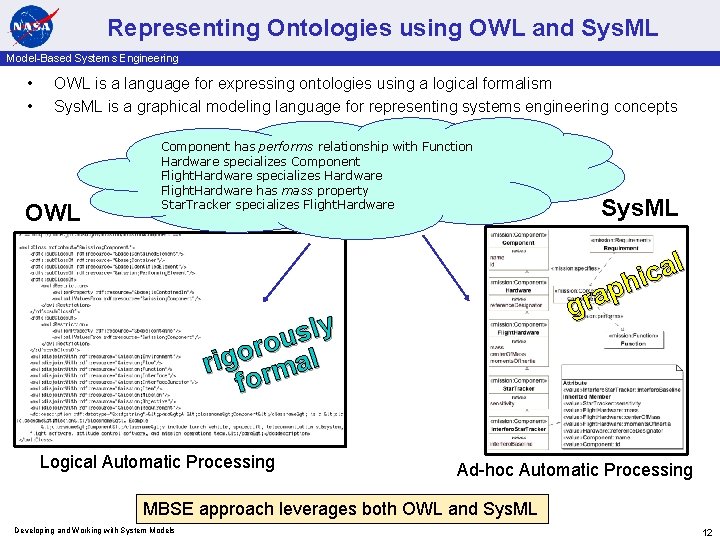
Representing Ontologies using OWL and Sys. ML Model-Based Systems Engineering • • OWL is a language for expressing ontologies using a logical formalism Sys. ML is a graphical modeling language for representing systems engineering concepts OWL Component has performs relationship with Function Hardware specializes Component Flight. Hardware specializes Hardware Flight. Hardware has mass property Star. Tracker specializes Flight. Hardware l a c i h p gra y l s ou r o rig rmal fo Logical Automatic Processing Sys. ML Ad-hoc Automatic Processing MBSE approach leverages both OWL and Sys. ML Developing and Working with System Models 12
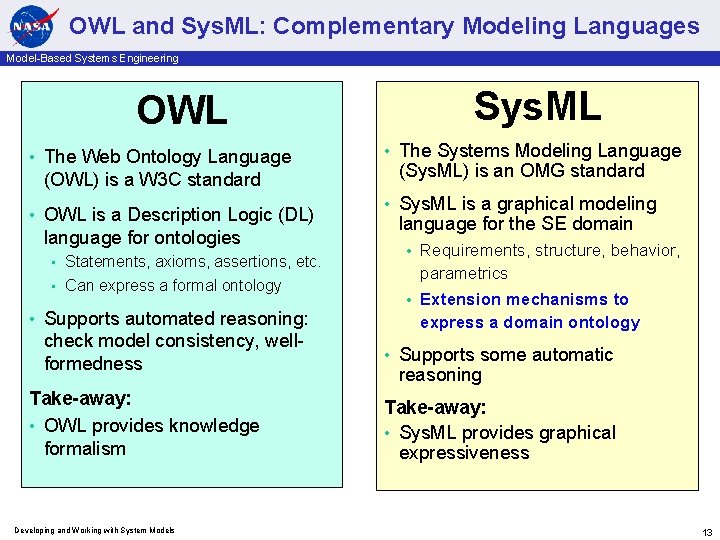
OWL and Sys. ML: Complementary Modeling Languages Model-Based Systems Engineering OWL • The Web Ontology Language (OWL) is a W 3 C standard • OWL is a Description Logic (DL) language for ontologies • Statements, axioms, assertions, etc. • Can express a formal ontology • Supports automated reasoning: check model consistency, wellformedness Take-away: • OWL provides knowledge formalism Developing and Working with System Models Sys. ML • The Systems Modeling Language (Sys. ML) is an OMG standard • Sys. ML is a graphical modeling language for the SE domain • Requirements, structure, behavior, parametrics • Extension mechanisms to express a domain ontology • Supports some automatic reasoning Take-away: • Sys. ML provides graphical expressiveness 13
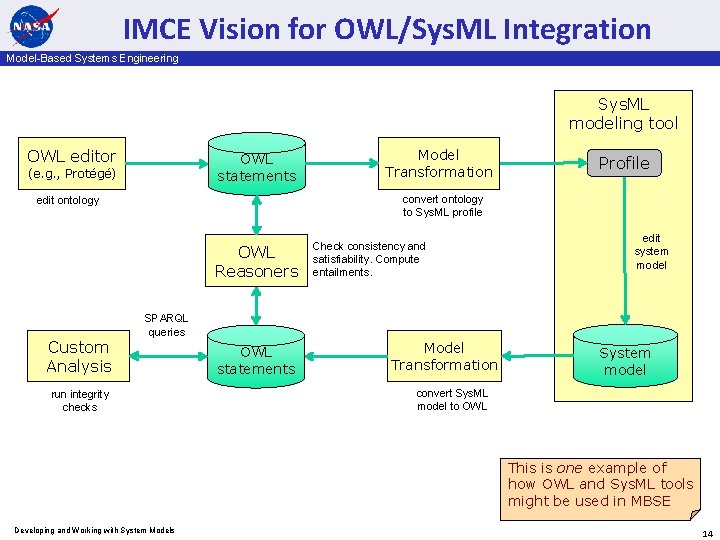
IMCE Vision for OWL/Sys. ML Integration Model-Based Systems Engineering Sys. ML modeling tool OWL editor OWL statements (e. g. , Protégé) Profile convert ontology to Sys. ML profile edit ontology OWL Reasoners Custom Analysis Model Transformation Check consistency and satisfiability. Compute entailments. edit system model SPARQL queries run integrity checks OWL statements Model Transformation System model convert Sys. ML model to OWL This is one example of how OWL and Sys. ML tools might be used in MBSE Developing and Working with System Models 14
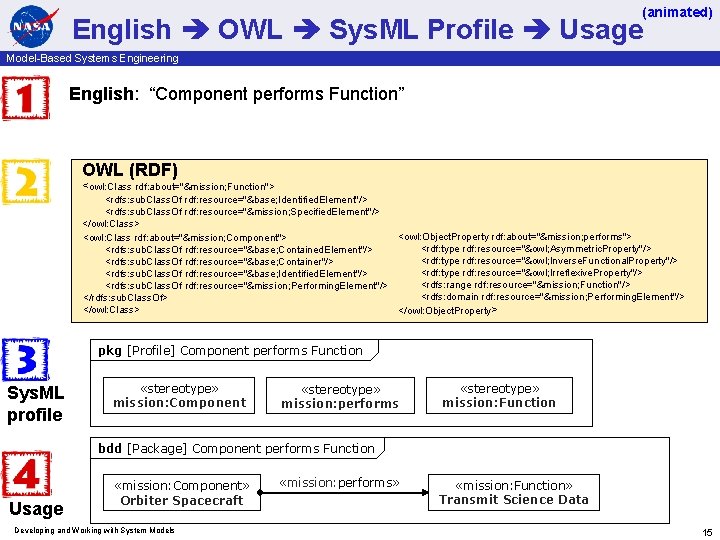
(animated) English OWL Sys. ML Profile Usage Model-Based Systems Engineering English: “Component performs Function” OWL (RDF) <owl: Class rdf: about="&mission; Function"> <rdfs: sub. Class. Of rdf: resource="&base; Identified. Element"/> <rdfs: sub. Class. Of rdf: resource="&mission; Specified. Element"/> </owl: Class> <owl: Class rdf: about="&mission; Component"> <rdfs: sub. Class. Of rdf: resource="&base; Contained. Element"/> <rdfs: sub. Class. Of rdf: resource="&base; Container"/> <rdfs: sub. Class. Of rdf: resource="&base; Identified. Element"/> <rdfs: sub. Class. Of rdf: resource="&mission; Performing. Element"/> </rdfs: sub. Class. Of> </owl: Class> <owl: Object. Property rdf: about="&mission; performs"> <rdf: type rdf: resource="&owl; Asymmetric. Property"/> <rdf: type rdf: resource="&owl; Inverse. Functional. Property"/> <rdf: type rdf: resource="&owl; Irreflexive. Property"/> <rdfs: range rdf: resource="&mission; Function"/> <rdfs: domain rdf: resource="&mission; Performing. Element"/> </owl: Object. Property> pkg [Profile] Component performs Function Sys. ML profile «stereotype» mission: Component «stereotype» mission: performs «stereotype» mission: Function bdd [Package] Component performs Function Usage «mission: Component» Orbiter Spacecraft Developing and Working with System Models «mission: performs» «mission: Function» Transmit Science Data 15
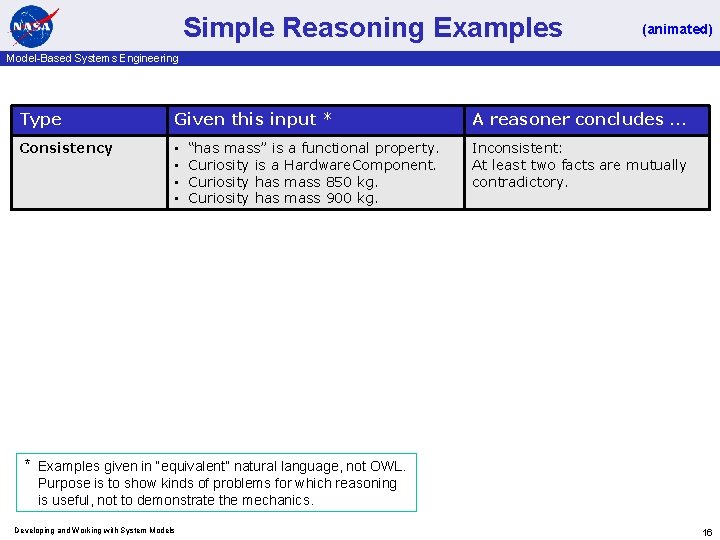
Simple Reasoning Examples (animated) Model-Based Systems Engineering Type Given this input * Consistency • • Satisfiability • • “has mass” is a functional property. Curiosity is a Hardware. Component. Curiosity has mass 850 kg. Curiosity has mass 900 kg. Work Package and Organization are disjoint concepts. Every Project is both a Work Package and an Organization. A reasoner concludes … Inconsistent: At least two facts are mutually contradictory. Unsatisfiable: no Project can exists that satisfies all rules. Rules Entailment • Every Spacecraft is a Component. • Every Orbiter is a Spacecraft. Every Orbiter is a Component. (Therefore, all Component rules and Spacecraft rules apply to every Orbiter. ) Facts Entailment • Every Spacecraft is a Component. • MSL Rover (an individual, not a class) is a Spacecraft. MSL Rover is a Component. * Examples given in “equivalent” natural language, not OWL. Purpose is to show kinds of problems for which reasoning is useful, not to demonstrate the mechanics. Developing and Working with System Models 16
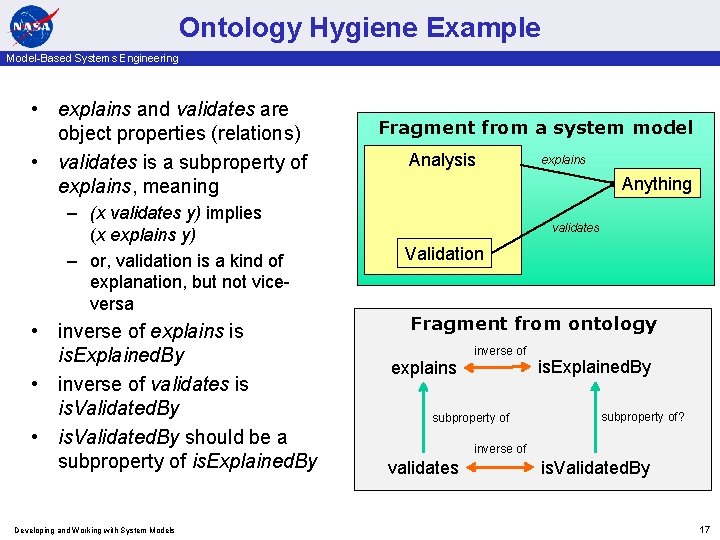
Ontology Hygiene Example Model-Based Systems Engineering • explains and validates are object properties (relations) • validates is a subproperty of explains, meaning – (x validates y) implies (x explains y) – or, validation is a kind of explanation, but not viceversa • inverse of explains is is. Explained. By • inverse of validates is is. Validated. By • is. Validated. By should be a subproperty of is. Explained. By Developing and Working with System Models Fragment from a system model Analysis explains Anything validates Validation Fragment from ontology inverse of explains subproperty of is. Explained. By subproperty of? inverse of validates is. Validated. By 17
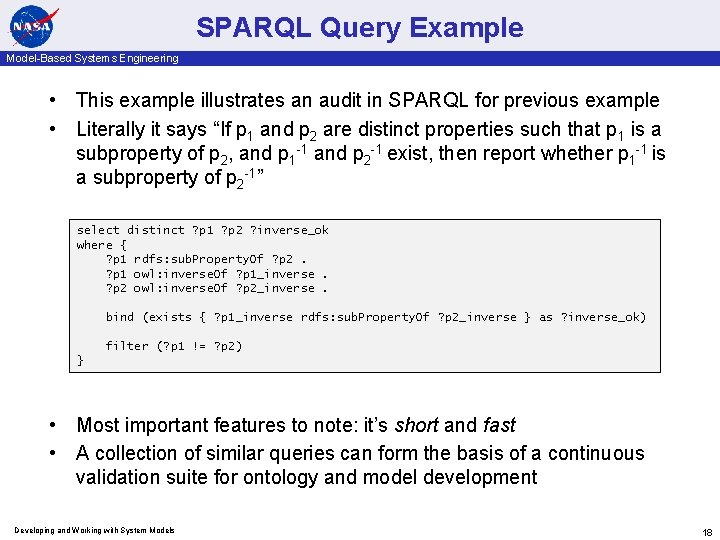
SPARQL Query Example Model-Based Systems Engineering • This example illustrates an audit in SPARQL for previous example • Literally it says “If p 1 and p 2 are distinct properties such that p 1 is a subproperty of p 2, and p 1 -1 and p 2 -1 exist, then report whether p 1 -1 is a subproperty of p 2 -1” select distinct ? p 1 ? p 2 ? inverse_ok where { ? p 1 rdfs: sub. Property. Of ? p 2. ? p 1 owl: inverse. Of ? p 1_inverse. ? p 2 owl: inverse. Of ? p 2_inverse. bind (exists { ? p 1_inverse rdfs: sub. Property. Of ? p 2_inverse } as ? inverse_ok) filter (? p 1 != ? p 2) } • Most important features to note: it’s short and fast • A collection of similar queries can form the basis of a continuous validation suite for ontology and model development Developing and Working with System Models 18
Model-Based Systems Engineering OVERVIEW OF SYSTEMS ENGINEERING ONTOLOGIES Developing and Working with System Models 19
Introduction Model-Based Systems Engineering • The purpose of the Systems Engineering Ontologies is to encompass key concepts and associate vocabulary for modeling systems in the space system domain • The emphasis in this training module is on the ontology concepts and how they appear in Sys. ML models • Examples are given representing a fanciful mission to the extrasolar planet Kepler-16 b Developing and Working with System Models 20
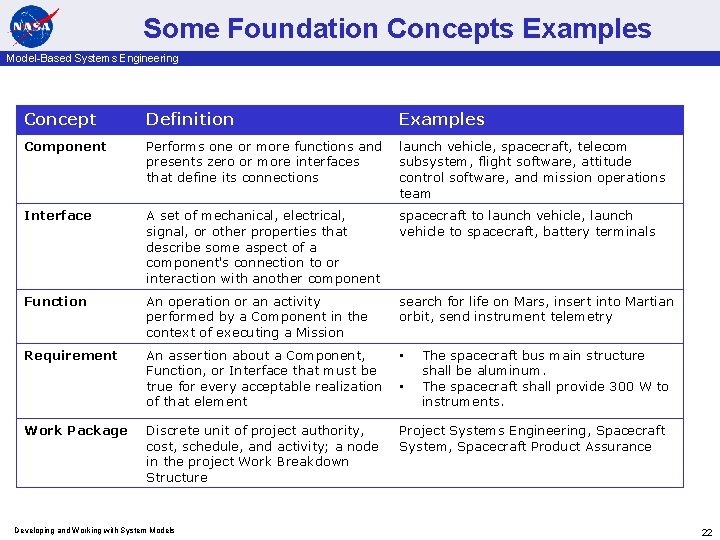
Some Foundation Concepts Examples Model-Based Systems Engineering Concept Definition Examples Component Performs one or more functions and presents zero or more interfaces that define its connections launch vehicle, spacecraft, telecom subsystem, flight software, attitude control software, and mission operations team Interface A set of mechanical, electrical, signal, or other properties that describe some aspect of a component's connection to or interaction with another component spacecraft to launch vehicle, launch vehicle to spacecraft, battery terminals Function An operation or an activity performed by a Component in the context of executing a Mission search for life on Mars, insert into Martian orbit, send instrument telemetry Requirement An assertion about a Component, Function, or Interface that must be true for every acceptable realization of that element • Discrete unit of project authority, cost, schedule, and activity; a node in the project Work Breakdown Structure Project Systems Engineering, Spacecraft System, Spacecraft Product Assurance Work Package Developing and Working with System Models • The spacecraft bus main structure shall be aluminum. The spacecraft shall provide 300 W to instruments. 22
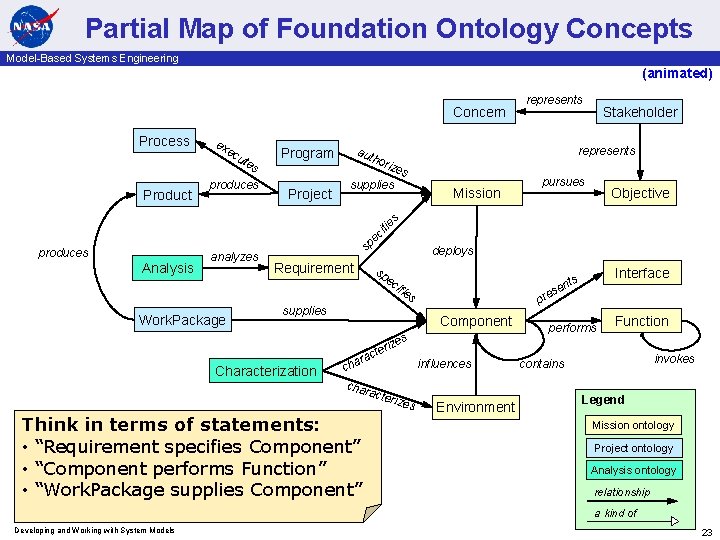
Partial Map of Foundation Ontology Concepts Model-Based Systems Engineering (animated) Concern Process cu tes produces Program Project aut Stakeholder represents hor ize s supplies Mission pursues Objective produces Analysis analyzes Work. Package sp e ci fie s Product ex e represents Requirement sp deploys ec ifie pre s supplies Component es riz cte Characterization ra char acte rizes Think in terms of statements: • “Requirement specifies Component” • “Component performs Function” • “Work. Package supplies Component” influences Environment Interface ts en s performs Function invokes contains Legend Mission ontology Project ontology Analysis ontology relationship a kind of Developing and Working with System Models 23
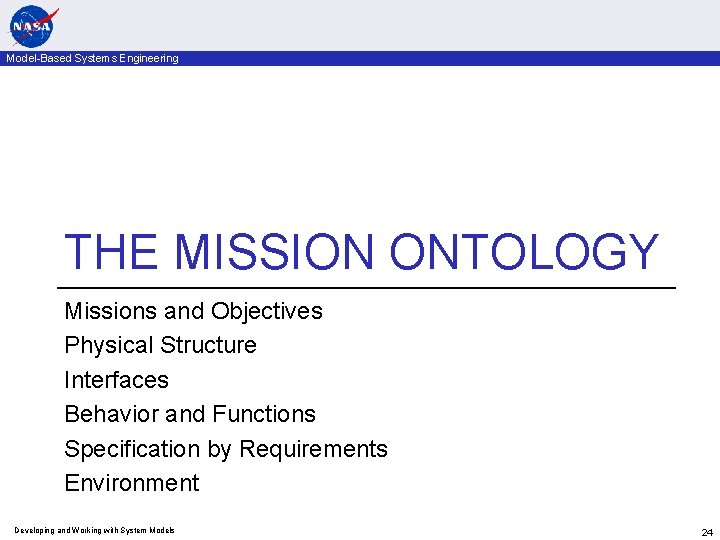
Model-Based Systems Engineering THE MISSION ONTOLOGY Missions and Objectives Physical Structure Interfaces Behavior and Functions Specification by Requirements Environment Developing and Working with System Models 24
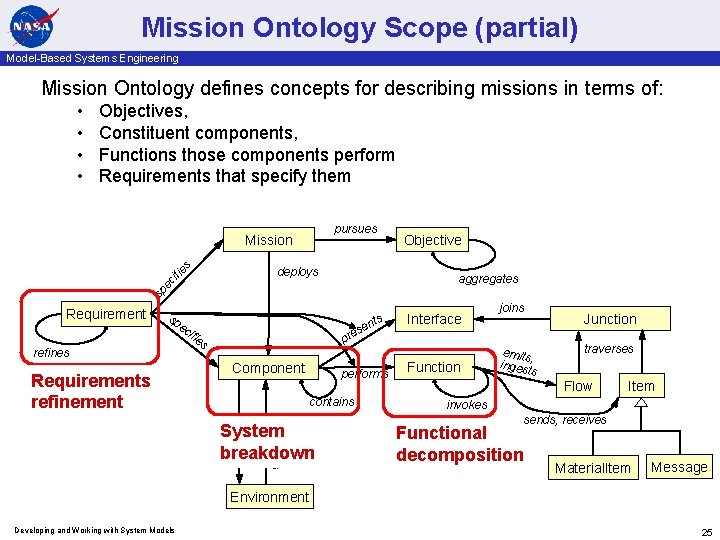
Mission Ontology Scope (partial) Model-Based Systems Engineering Mission Ontology defines concepts for describing missions in terms of: • • Objectives, Constituent components, Functions those components perform Requirements that specify them pursues Mission aggregates sp ec ifi es deploys Objective Requirement sp refines Requirements refinement ec nts se pre ifie s Component performs contains influences induces System breakdown Interface Function joins emits inges , ts Junction traverses Flow Item invokes sends, receives Functional decomposition Material. Item Message Environment Developing and Working with System Models 25
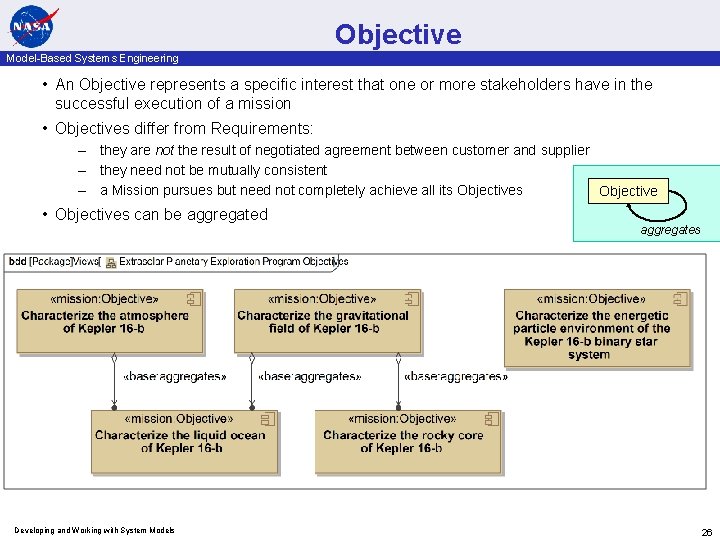
Objective Model-Based Systems Engineering • An Objective represents a specific interest that one or more stakeholders have in the successful execution of a mission • Objectives differ from Requirements: – they are not the result of negotiated agreement between customer and supplier – they need not be mutually consistent – a Mission pursues but need not completely achieve all its Objective • Objectives can be aggregated Developing and Working with System Models aggregates 26
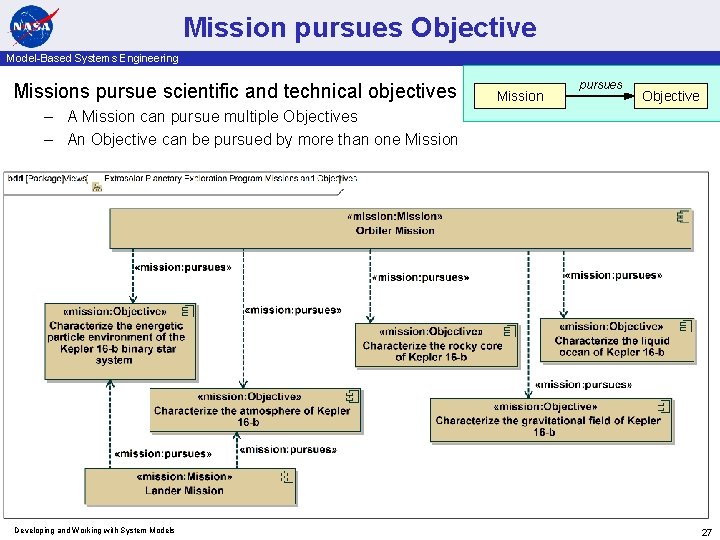
Mission pursues Objective Model-Based Systems Engineering Missions pursue scientific and technical objectives Mission pursues Objective – A Mission can pursue multiple Objectives – An Objective can be pursued by more than one Mission Developing and Working with System Models 27
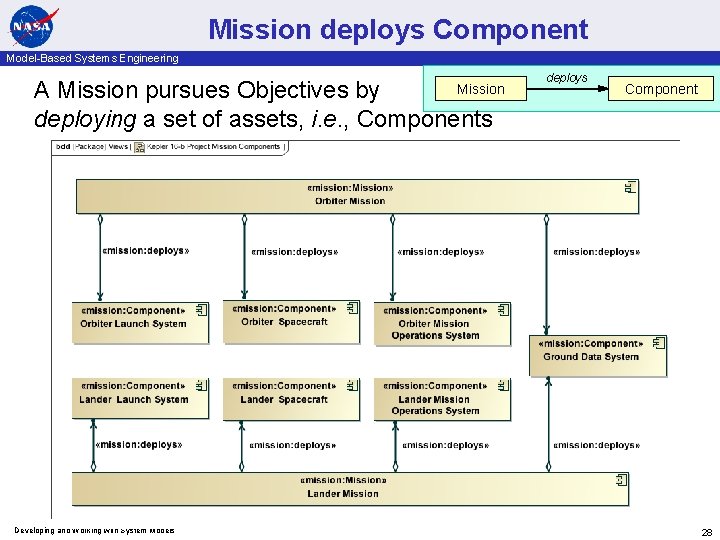
Mission deploys Component Model-Based Systems Engineering A Mission pursues Objectives by deploying a set of assets, i. e. , Components Mission Developing and Working with System Models deploys Component 28
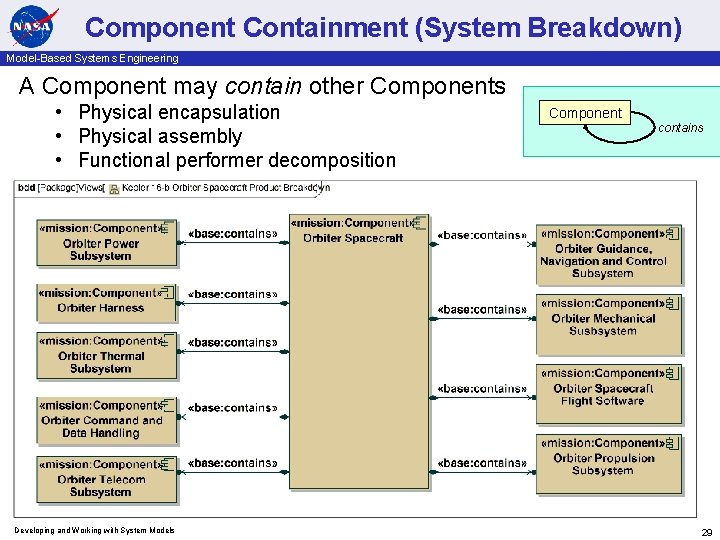
Component Containment (System Breakdown) Model-Based Systems Engineering A Component may contain other Components • Physical encapsulation • Physical assembly • Functional performer decomposition Developing and Working with System Models Component contains 29
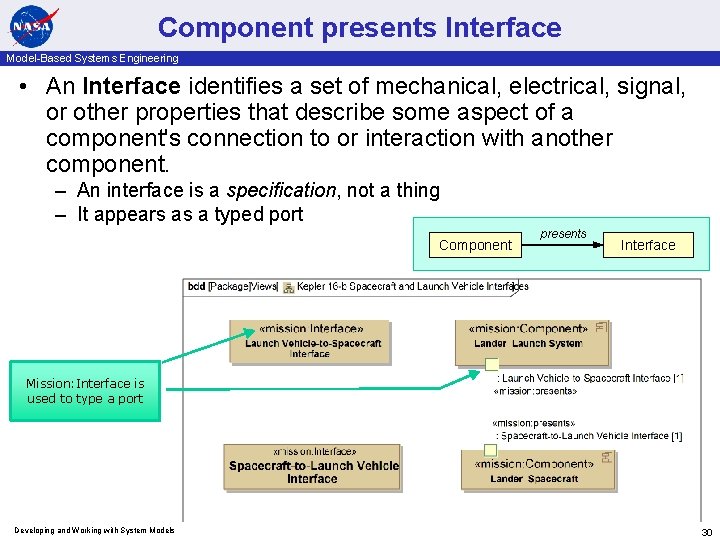
Component presents Interface Model-Based Systems Engineering • An Interface identifies a set of mechanical, electrical, signal, or other properties that describe some aspect of a component's connection to or interaction with another component. – An interface is a specification, not a thing – It appears as a typed port Component presents Interface Mission: Interface is used to type a port Developing and Working with System Models 30
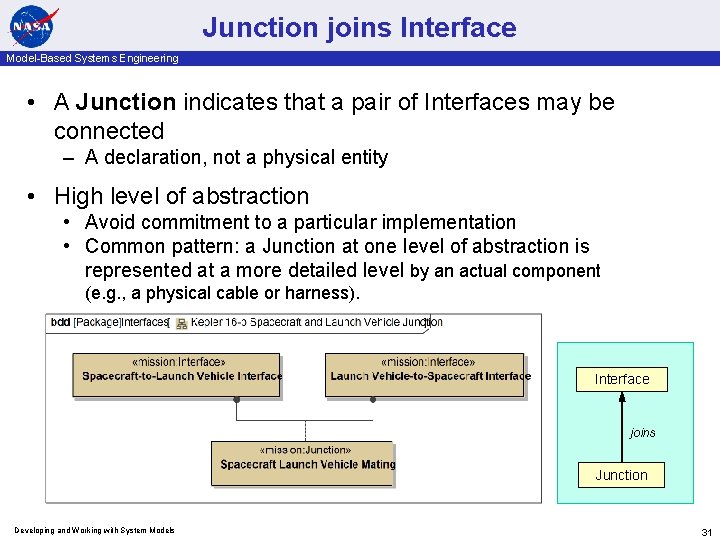
Junction joins Interface Model-Based Systems Engineering • A Junction indicates that a pair of Interfaces may be connected – A declaration, not a physical entity • High level of abstraction • Avoid commitment to a particular implementation • Common pattern: a Junction at one level of abstraction is represented at a more detailed level by an actual component (e. g. , a physical cable or harness). Interface joins Junction Developing and Working with System Models 31
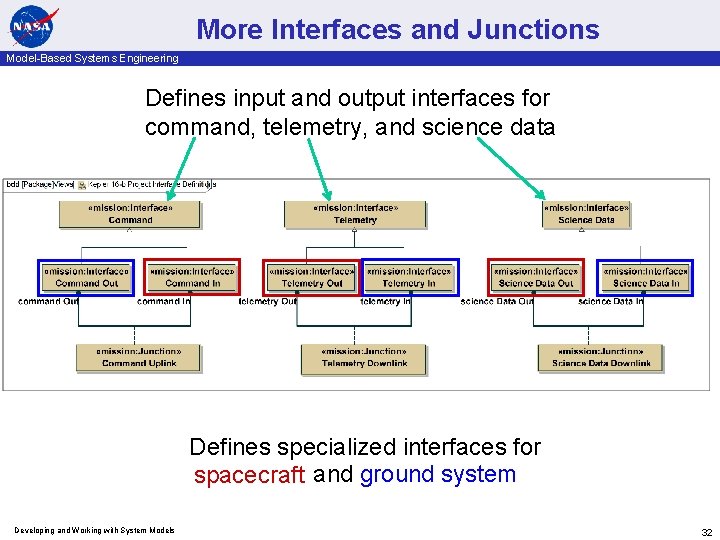
More Interfaces and Junctions Model-Based Systems Engineering Defines input and output interfaces for command, telemetry, and science data Defines specialized interfaces for spacecraft and ground system Developing and Working with System Models 32
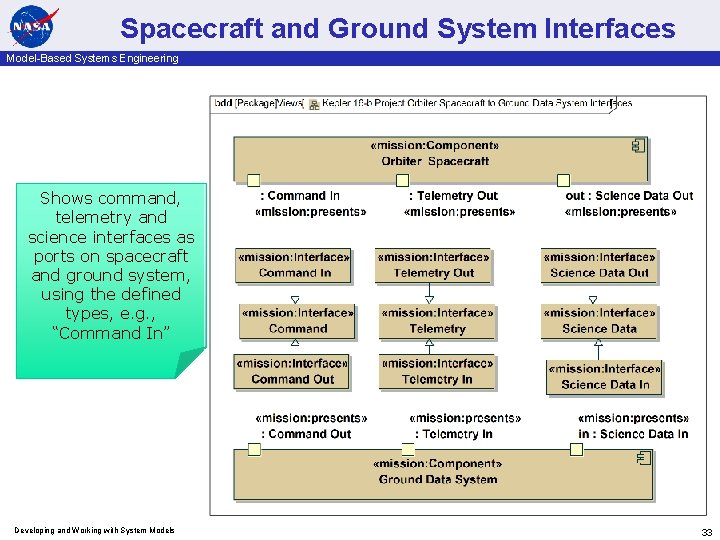
Spacecraft and Ground System Interfaces Model-Based Systems Engineering Shows command, telemetry and science interfaces as ports on spacecraft and ground system, using the defined types, e. g. , “Command In” Developing and Working with System Models 33
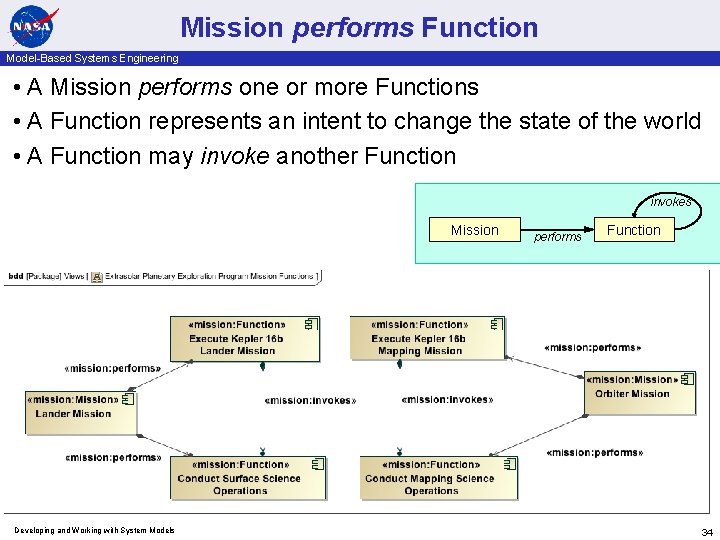
Mission performs Function Model-Based Systems Engineering • A Mission performs one or more Functions • A Function represents an intent to change the state of the world • A Function may invoke another Function invokes Mission Developing and Working with System Models performs Function 34
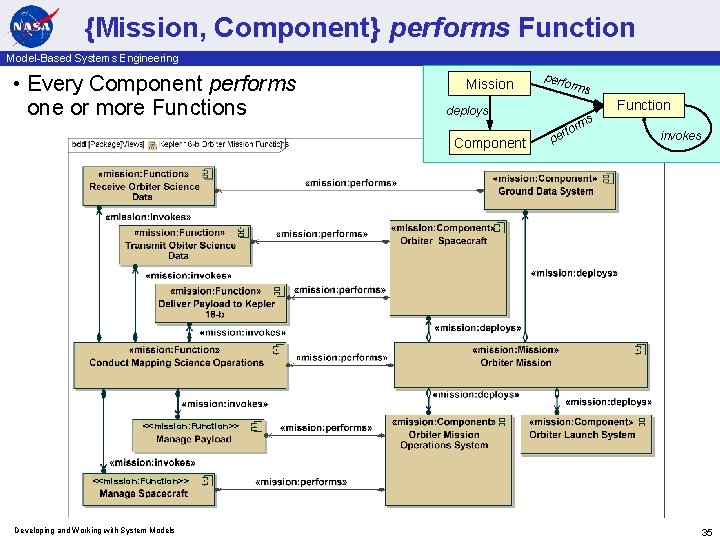
{Mission, Component} performs Function Model-Based Systems Engineering • Every Component performs one or more Functions Mission perfo rms deploys Component rm p o erf s Function invokes <<mission: Function>> Developing and Working with System Models 35
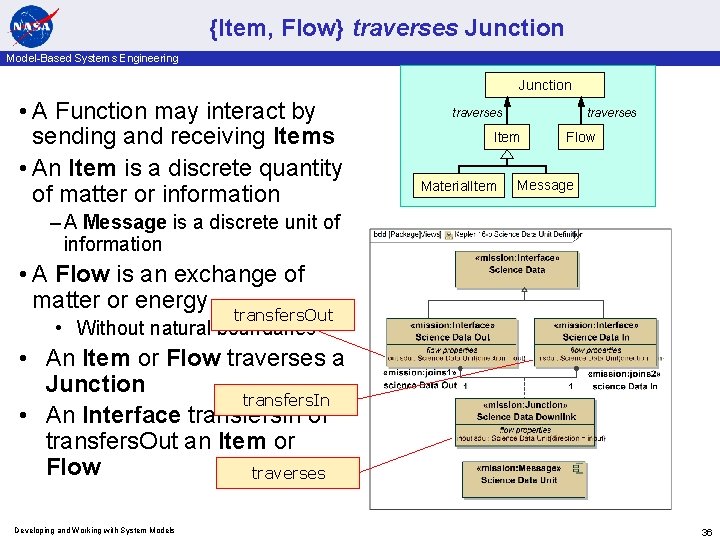
{Item, Flow} traverses Junction Model-Based Systems Engineering Junction • A Function may interact by sending and receiving Items • An Item is a discrete quantity of matter or information traverses Item Material. Item Flow Message – A Message is a discrete unit of information • A Flow is an exchange of matter or energy transfers. Out • Without natural boundaries • An Item or Flow traverses a Junction transfers. In • An Interface transfers. In or transfers. Out an Item or Flow traverses Developing and Working with System Models 36
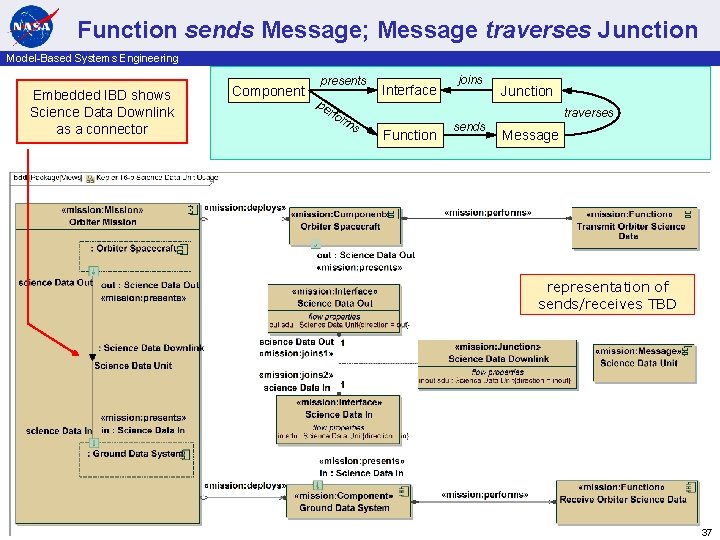
Function sends Message; Message traverses Junction Model-Based Systems Engineering Embedded IBD shows Science Data Downlink as a connector Component presents pe rfo Interface joins Junction traverses rm s Function sends Message representation of sends/receives TBD Developing and Working with System Models 37
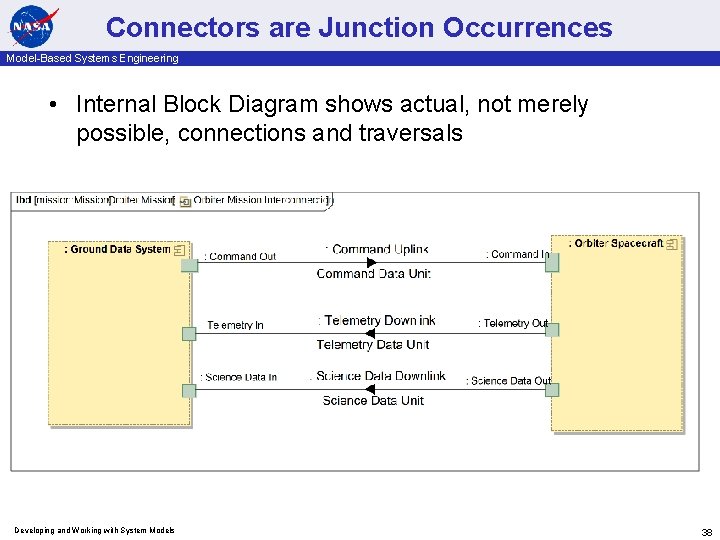
Connectors are Junction Occurrences Model-Based Systems Engineering • Internal Block Diagram shows actual, not merely possible, connections and traversals Developing and Working with System Models 38
Requirement Model-Based Systems Engineering • A Requirement is an assertion that must be true of every acceptable realization of an entity • Requirements are traditionally grouped in ad-hoc categories (functional, performance, etc. ) • Without semantic rigor, not very useful • Every Requirement specifies at most one entity • Component • The performs relationship between Component and Function • The presents relationship between Component and Interface • A Requirement always binds a Component (directly or transitively) • A lower-level Requirement refines a higher-level Requirement Developing and Working with System Models 39
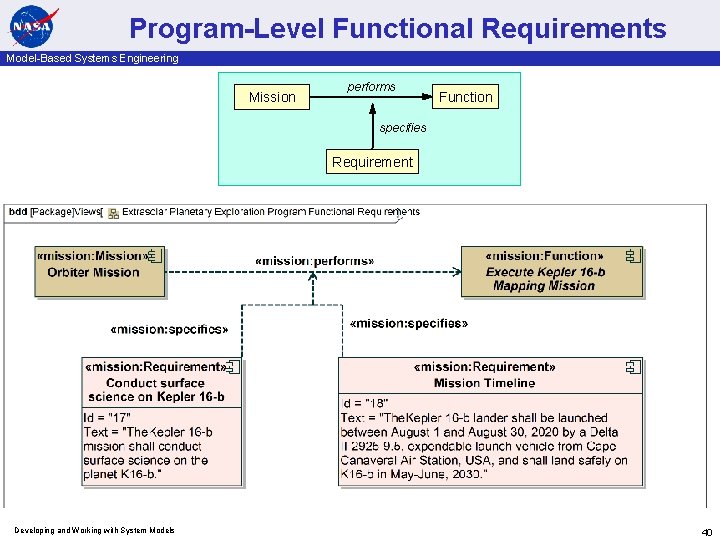
Program-Level Functional Requirements Model-Based Systems Engineering Mission performs Function specifies Requirement Developing and Working with System Models 40
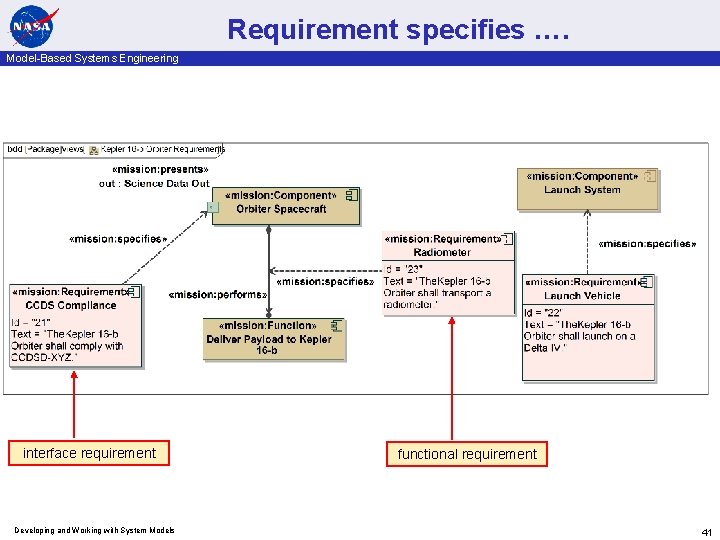
Requirement specifies …. Model-Based Systems Engineering interface requirement Developing and Working with System Models functional requirement 41
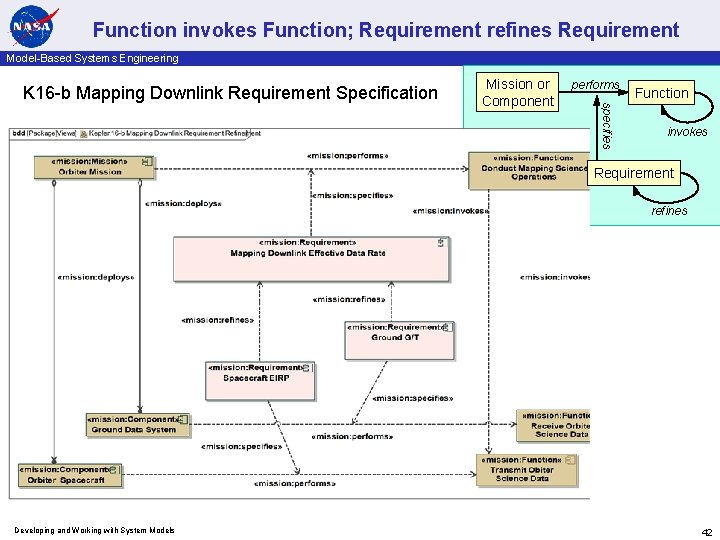
Function invokes Function; Requirement refines Requirement Model-Based Systems Engineering Mission or Component performs specifies K 16 -b Mapping Downlink Requirement Specification Function invokes Requirement refines Developing and Working with System Models 42
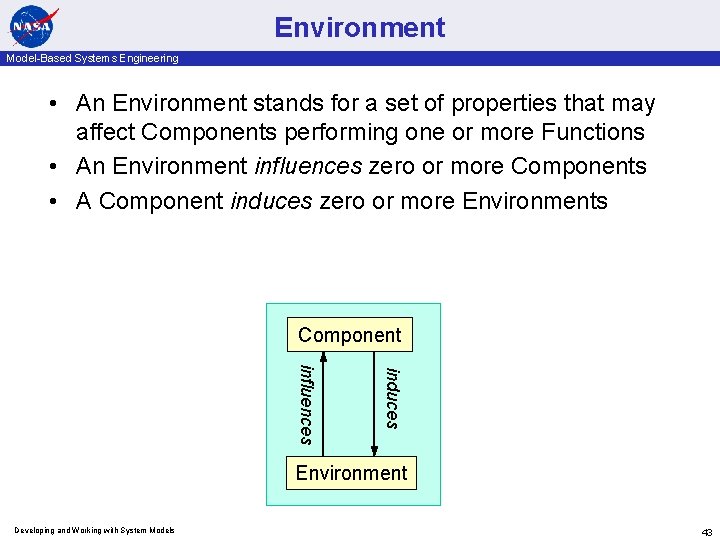
Environment Model-Based Systems Engineering • An Environment stands for a set of properties that may affect Components performing one or more Functions • An Environment influences zero or more Components • A Component induces zero or more Environments Component induces influences Environment Developing and Working with System Models 43
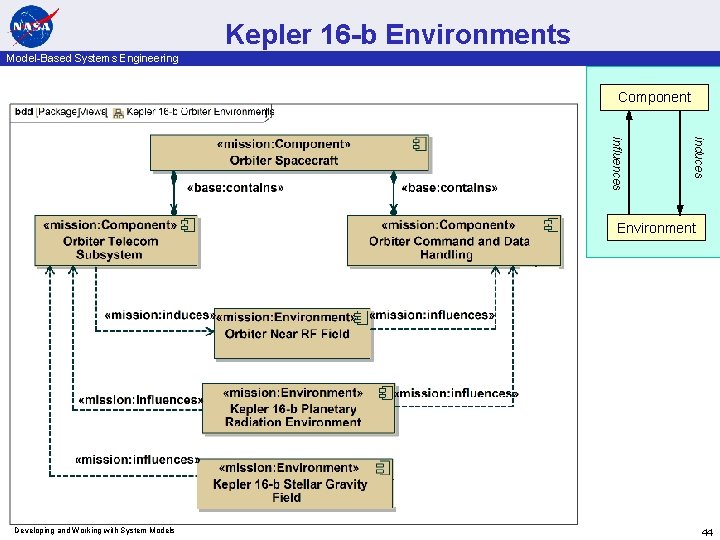
Kepler 16 -b Environments Model-Based Systems Engineering Component induces influences Environment Developing and Working with System Models 44
Model-Based Systems Engineering Foundation Ontologies Mission, Project, Analysis, Quantities-Units-Dimensions-Values, Artifact THE ANALYSIS ONTOLOGY Analysis Characterization Developing and Working with System Models 45
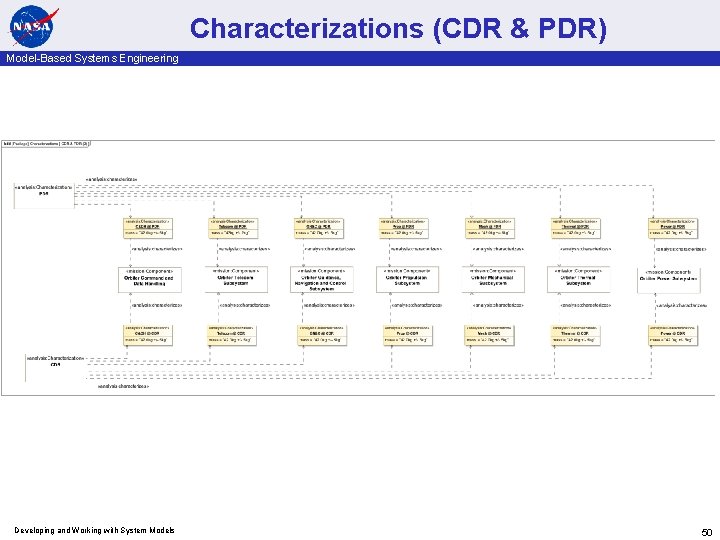
The Analysis Profile Scope Model-Based Systems Engineering • The Analysis Ontology defines general concepts and relationships for analyses such as trade studies, cost estimates, etc. • The Analysis Profile defines classes and properties that describe characterization and analysis of model elements. • One of the key principles of Analysis is to separate identity from description – We don’t necessarily say a spacecraft has “a mass” – We might say it is characterized by one or more mass property characterizations • e. g. , as estimated, as measured, with contingency, etc. – These characterizations represent choice about description Developing and Working with System Models 46
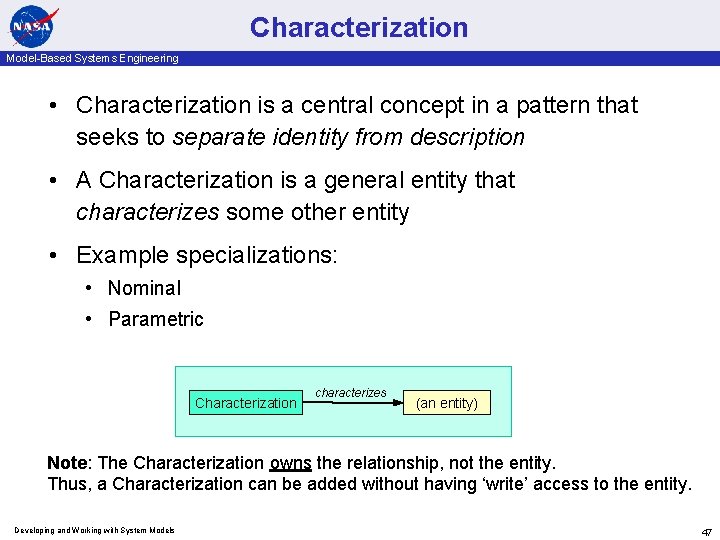
Characterization Model-Based Systems Engineering • Characterization is a central concept in a pattern that seeks to separate identity from description • A Characterization is a general entity that characterizes some other entity • Example specializations: • Nominal • Parametric Characterization characterizes (an entity) Note: The Characterization owns the relationship, not the entity. Thus, a Characterization can be added without having ‘write’ access to the entity. Developing and Working with System Models 47
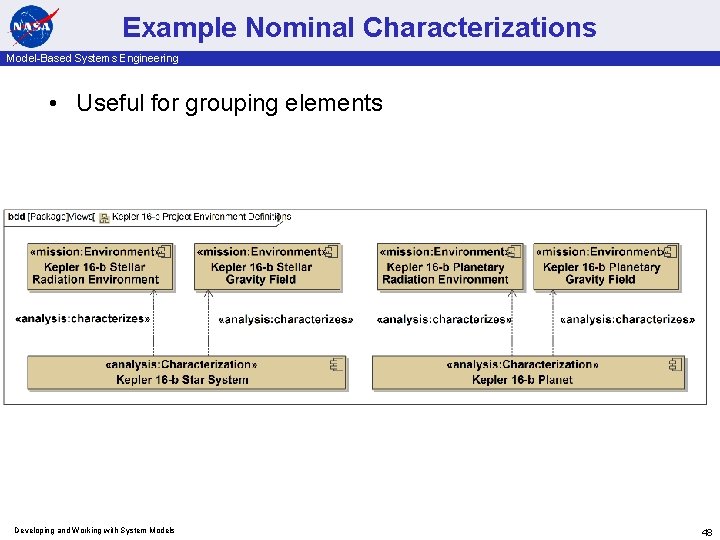
Example Nominal Characterizations Model-Based Systems Engineering • Useful for grouping elements Developing and Working with System Models 48
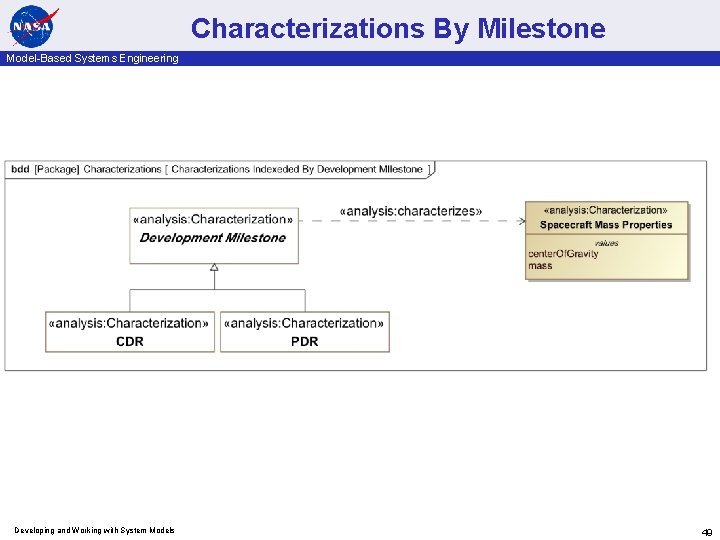
Characterizations By Milestone Model-Based Systems Engineering Developing and Working with System Models 49
Characterizations (CDR & PDR) Model-Based Systems Engineering Developing and Working with System Models 50
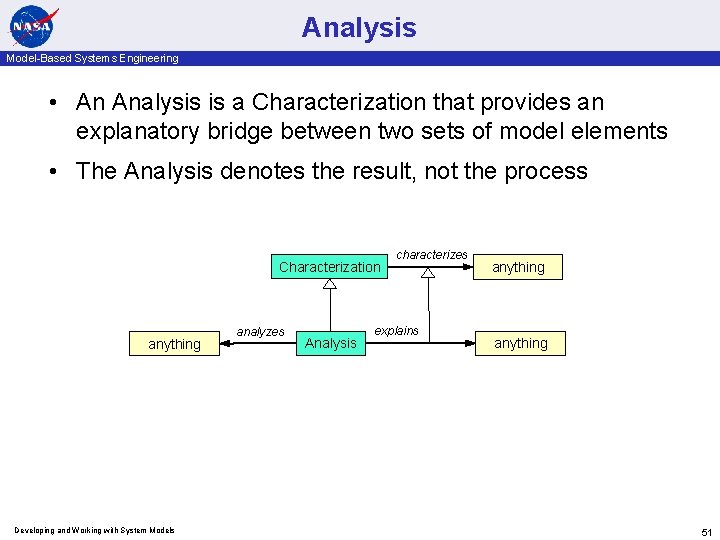
Analysis Model-Based Systems Engineering • An Analysis is a Characterization that provides an explanatory bridge between two sets of model elements • The Analysis denotes the result, not the process Characterization anything Developing and Working with System Models analyzes Analysis characterizes explains anything 51
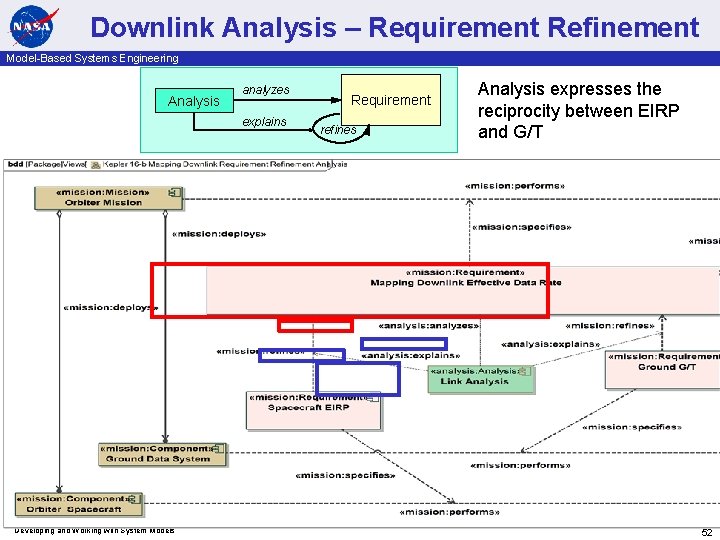
Downlink Analysis – Requirement Refinement Model-Based Systems Engineering Analysis analyzes explains Developing and Working with System Models Requirement refines Analysis expresses the reciprocity between EIRP and G/T 52
- Slides: 51