
Foundation Skills in Integrated Product Development By S
Foundation Skills in Integrated Product Development By S. P. Siddique Ibrahim Assistant Professor Department of CSE Kumaraguru College of Technology
Introduction What is Product? Product is defined as any object exchanged by a customer/consumer in exchange of anything. Generally, Money… I. e: Pen or travelling by a bus.
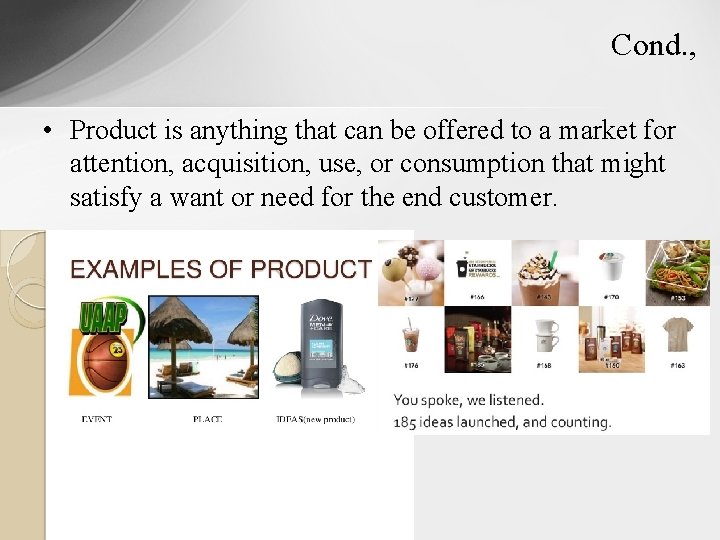
Cond. , • Product is anything that can be offered to a market for attention, acquisition, use, or consumption that might satisfy a want or need for the end customer.
• Also include services, events, persons, place, organizations, ideas, or a mixture of the above.
• Product development can be simply defined as the creation of products and services which may have new or different characteristics that can offer new or added benefits to a customer.
• It may involve modification of a prevailing product/service or their presentation, or • Design of an entirely a new product or service that satisfies a newly defined customer need or demand of the market.
Exercise No : 3 Identify New and Added Flavo v Iphone Touch Screen v Finger print unlock v Google car v Uber Eats/ Swiggy v OLA /Uber v Smart TV v Amazon’s Alexa in Ford Car v Smart Watch v Amazon Air TV v HTC Vive v Smart Search v Amazon smart Lock
Added Flavors Exercise No: 3 v Iphone Touch Screen v Finger print unlock v Google car v Uber Eats/ Swiggy v OLA /Uber v Smart TV v Amazon’s Alexa in Ford Car v Smart Watch v Amazon Air TV v HTC Vive v Smart Search v Amazon smart Lock v Google Voice search
Added Flavors Exercise No: 3 v Colgate Salt v Google car v Uber Eats/ Swiggy v OLA /Uber v Smart TV v Amazon’s Alexa in Ford Car v Smart Watch v Amazon Air TV v HTC Vive v Smart Search v Amazon smart Lock v Google Voice search
Market poor Analysis • • • Lays Wow Samsung 3 D TV Netflix Sunnxt Coke icecream Pepsi Blue
• In the field of engineering and business new product development (NPD) is a process to bring a product, which is completely new to the market.
NPD q Market research and market analysis q Generation of idea/s, q Design of the product, detail engineering and then q Launching the new product in the market. • The growth potential of any company highly depends on product development. • Thus it plays a vital role in a company’s future.
how to approach towards the launch of a new product? § Needs of the customer § Activity of the competitor § Stability of the market etc.
how to approach towards the launch of a new product? • Analysis of the potential of the organisation to support the development and launch of an innovative concept has to be done. • Investing on the development and prototyping of approved innovative concepts has to take effect and then • The preparation for the commercialization of a product is the final stage.
Innovation • Is innovation just a convenient buzzword? Or, • is it a paradigm-changing force that allows companies to compete on the global stage? The true answer might be a little bit of both. •
• • • Local shop 1 Rs pocket product Redbus Whatsapp etc Google Advertisement Google classroom
Level One • The first level emphasizes minimal changes to existing products, a low amount of new investment, and very low risk
• Examples at this level would be changing the color of a product or putting a new logo design on a label. • Essentially all companies are capable of achieving this level, as it does not require unique skills.
• Think of the classic American Coca-Cola has changed its packaging and updated its look many times over the years, and often the company launches different flavors and types (i. e. Coke Zero, vitamin-enhanced Diet Coke, Vanilla Coke), but the classic recipe remains the same
Level Two • Level Two changes include integrating new features into existing products on the market or creating differentiated versions of the same new product to sell to various demographic groups.
• These new features require what can be considered a medium level of investment and risk.
• Think of an automobile company that debuts a standard model and then decides to come out with a deluxe version of the same car with a few additional features. Or, that same automobile company takes the standard car design, then renames it, adding different features for each world market—the Americas, Europe, and Asia for example—that the company sells to
• Pulsar models • Yamaha R 15 2. 0 and 3. 0, Fazer face lift and 2. 0 • Yamaha RX series
• Company leaders are typically comfortable with this medium level of investment, because they are simply making improvements on an existing product that has already proven its worth in the market, and adding features that consumers desire
Level Three • The third level is the beginning of large financial and product risk, but it is also where the rewards are potentially larger. Before delving into this level of risk, executives will want to determine how large a market exists for their innovation so that a forecast of sales can be made to calculate return of investment curves for given levels of capital outlay.
• Examples of product development at this stage are auto companies realizing that SUV’s were a larger market than station wagons, or smart phones being more desirable than regular cell phones. As you can see, this level of innovation requires substantial resources—a research and development team, extensive market knowledge and analysis, design talent, and executive leadership, to name a few.
Level Four • The highest level of innovation is where companies are able to create innovations that change how people live. If the third level can be described as evolutionary development, than the fourth stage is the revolutionary step
• The 20 th century has seen many examples of products that have changed the world, such as the gas-powered automobile, the radio, the airplane, television, personal computers, and the Internet, just to name a few. •
• The highest level of innovation also brings the highest level of risk, as many times this level of innovation involves products or services that no one has thought of and customers do not know they want
• Uber Eats/Swiggy • Facebook, google • Amazon’s prime, grocery

– Technology companies triggering a paradigm shift by impacting industries • A. Apple – changed music and consumer electronics • B. Uber – changing the taxi business • C. Airbnb – changing the accommodation industry • D. Amazon – changing retailing •
– Technology companies creating new markets / industries • A. Google – with ” Search, etc. ” for a much better online experience • – changed the Advertising world with Adwords • – impacting the mobile, car, utility, etc. industries • B. Facebook – established the ” social network ” market • C. Whats. App – established the personal communications market • D. Steam – established the online market for
- Slides: 33