
Foundation GPC Part 3 Gel Permeation Chromatography Instrumentation








- Slides: 71
Foundation GPC Part 3 – Gel Permeation Chromatography Instrumentation
Introduction § This presentation introduces the equipment used in gel permeation chromatography (GPC) § The role of each device shall be discussed, including troubleshooting information § The idea of integrated GPC systems shall be presented 2
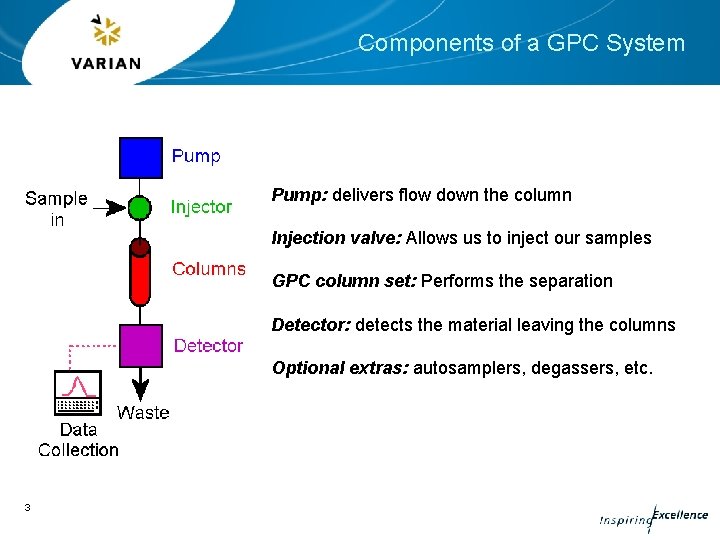
Components of a GPC System Pump: delivers flow down the column Injection valve: Allows us to inject our samples GPC column set: Performs the separation Detector: detects the material leaving the columns Optional extras: autosamplers, degassers, etc. 3
Pump § Required to maintain a constant, steady liquid flow through the columns § Isocratic pump (single channel) § Pulseless or low pulse flow required to ensure good detector baselines § Typically a reciprocating dual piston pump § Fairly inexpensive, reliable and suitable for use in a number of solvents § Service typically includes replacement of worn check valves and piston seals 4
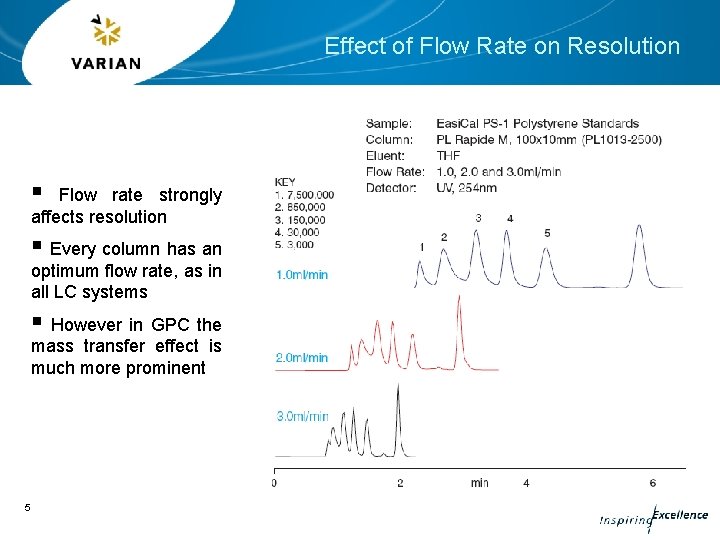
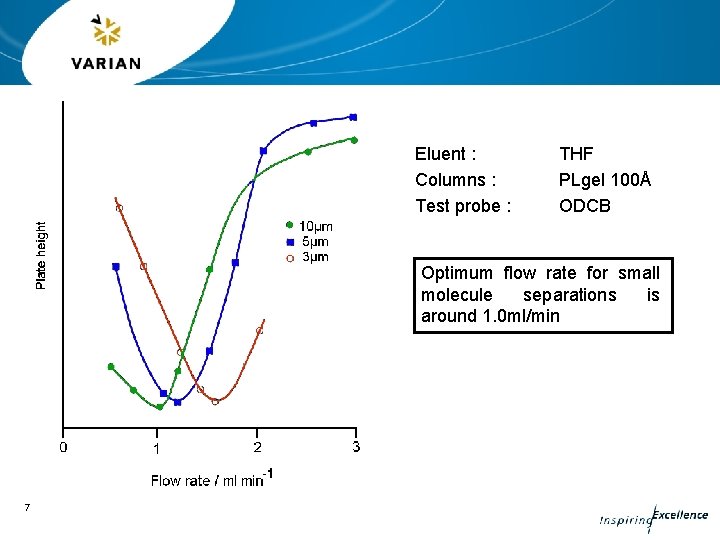
Effect of Flow Rate on Resolution § Flow rate strongly affects resolution § Every column has an optimum flow rate, as in all LC systems § However in GPC the mass transfer effect is much more prominent 5
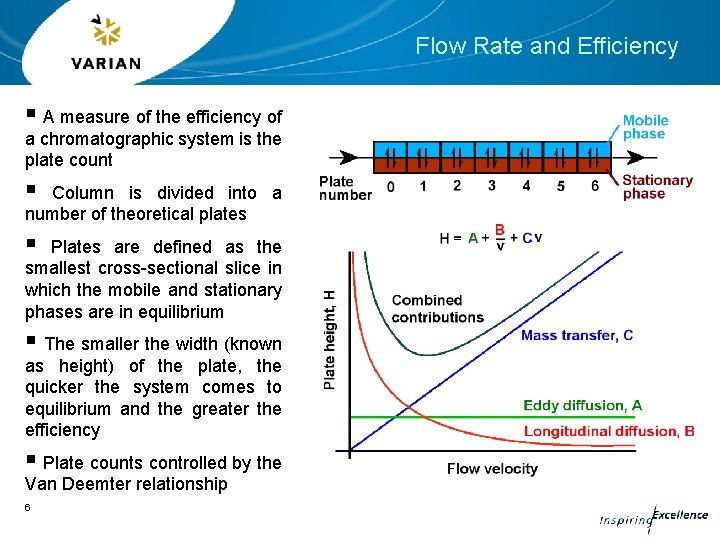
Flow Rate and Efficiency § A measure of the efficiency of a chromatographic system is the plate count § Column is divided into a number of theoretical plates § Plates are defined as the smallest cross-sectional slice in which the mobile and stationary phases are in equilibrium § The smaller the width (known as height) of the plate, the quicker the system comes to equilibrium and the greater the efficiency § Plate counts controlled by the Van Deemter relationship 6
Eluent : Columns : Test probe : THF PLgel 100Å ODCB Optimum flow rate for small molecule separations is around 1. 0 ml/min 7
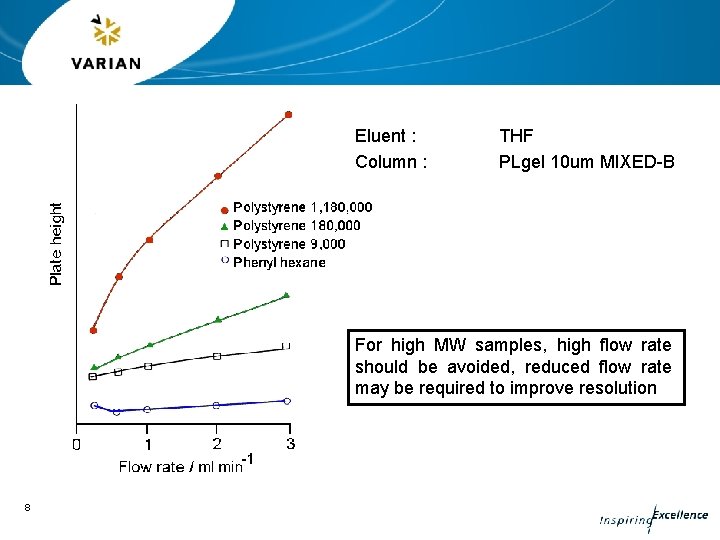
Eluent : Column : THF PLgel 10 um MIXED-B For high MW samples, high flow rate should be avoided, reduced flow rate may be required to improve resolution 8
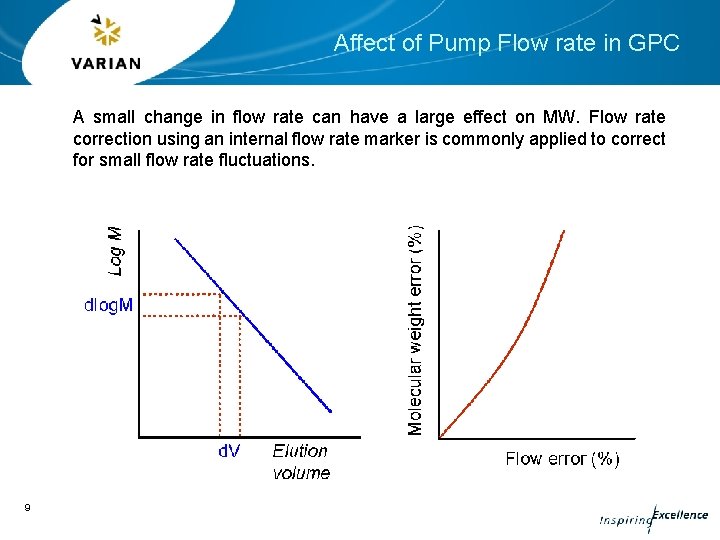
Affect of Pump Flow rate in GPC A small change in flow rate can have a large effect on MW. Flow rate correction using an internal flow rate marker is commonly applied to correct for small flow rate fluctuations. 9
Pump Issues - Variable Retention Time Increasing retention times - Lab temperature changes may result in retention time changes § Overcome by thermostatting the columns Insufficient equilibration time for the column may give unstable retention behavior § Allow at least 2 GPC column volumes through the column(s) Decreasing retention times - Usually a result of the flow rate speeding up § Check the pump and reset the flow if necessary 10
Increasing Retention Times Usually a result of the flow rate slowing down § Check for the presence of bubbles in pump head Retention beyond total permeation volume will be observed if there are specific interactions between the sample and the with stationary phase § Interactions can be Inhibited by adding modifiers to mobile phase Adsorption of sample can occur if you are using a poor solvent, for instance analysing polystyrenes in DMF § Change eluent so that samples, standards and solvent are of similar polarity 11
Pump Pressure Variations Pressure increasing – Can be caused by build-up of particulates in the sample § can be avoided by filtering the samples and mobile phase With certain solvents, solvent freezing in GPC tubing can cause pressure problems § For these solvents e. g. TCB elevate the temperature of the system Pressure falling - Can be caused by pump cavitation § Make sure you thoroughly degas solvents If the pressure is low it could be due to insufficient flow to column § Clear any blocked solvent lines § Loosen cap of eluent reservoir to prevent pressure problems 12
High Pressure A high pressure will result if the flow rate is too high § Check pump flow rate independently by measuring with flow with stopwatch High pressure will also result if the column has a blockage § Filter samples to avoid this problem § Use a guard column to improve the column lifetime High pressure may be due to a blocked inlet frit on the column § Reverse flow through column to clear any blockage § Replace frit to repair the column 13
Pressure Fluctuation will be caused by a leaking check-valve or pump seal § Replace or clean the check-valve A bubble in pump head will also cause fluctuations § Remove the bubble by purging the pump head § Degas solvents thoroughly to avoid bubble build-up Insufficient liquid flow to pump will cause pressure problems § Mobile phase inlet may be blocked - remove and clean it! § Elevate reservoir above pump head to help siphoning 14
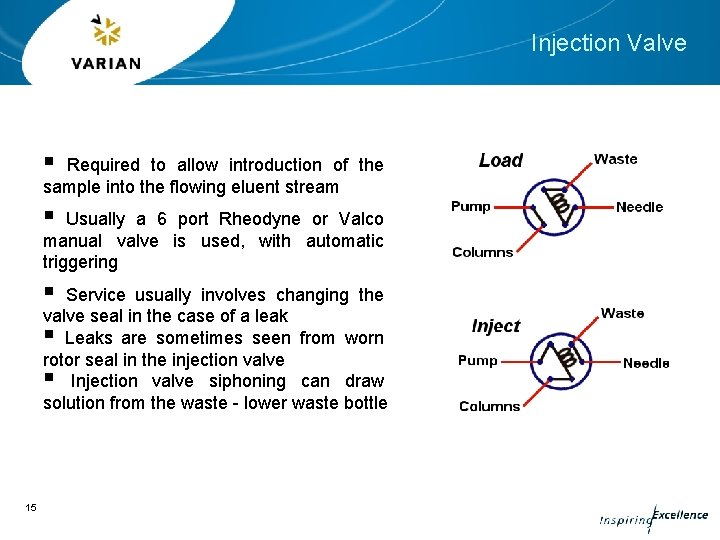
Injection Valve § Required to allow introduction of the sample into the flowing eluent stream § Usually a 6 port Rheodyne or Valco manual valve is used, with automatic triggering § Service usually involves changing the valve seal in the case of a leak § Leaks are sometimes seen from worn rotor seal in the injection valve § Injection valve siphoning can draw solution from the waste - lower waste bottle 15
Injection Volume 16 § § § GPC columns have a relatively large volume (typically 300 x 7. 5 mm) § Minimise injection volume for high efficiency separations (e. g. 3 um columns) to avoid band broadening which will decrease resolution Injection volumes for GPC can therefore be higher than for HPLC As a rule of thumb, 50 ul per 300 x 7. 5 mm column length will have little effect on band broadening
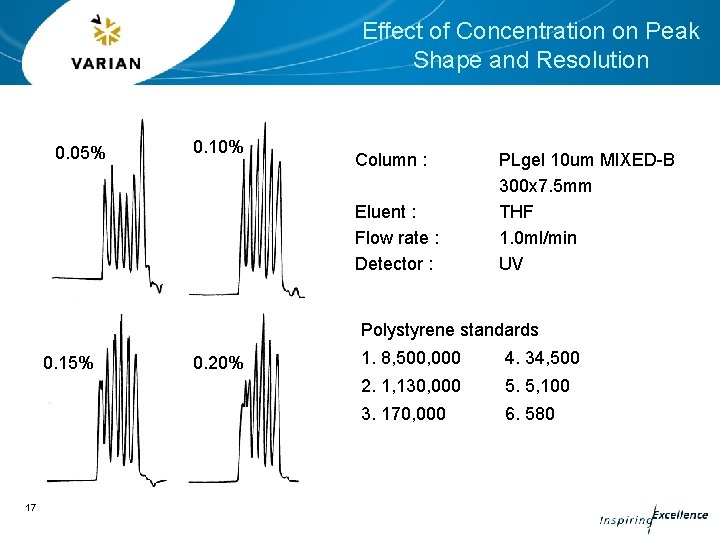
Effect of Concentration on Peak Shape and Resolution 0. 05% 0. 10% Column : Eluent : Flow rate : Detector : PLgel 10 um MIXED-B 300 x 7. 5 mm THF 1. 0 ml/min UV Polystyrene standards 0. 15% 17 0. 20% 1. 8, 500, 000 4. 34, 500 2. 1, 130, 000 5. 5, 100 3. 170, 000 6. 580
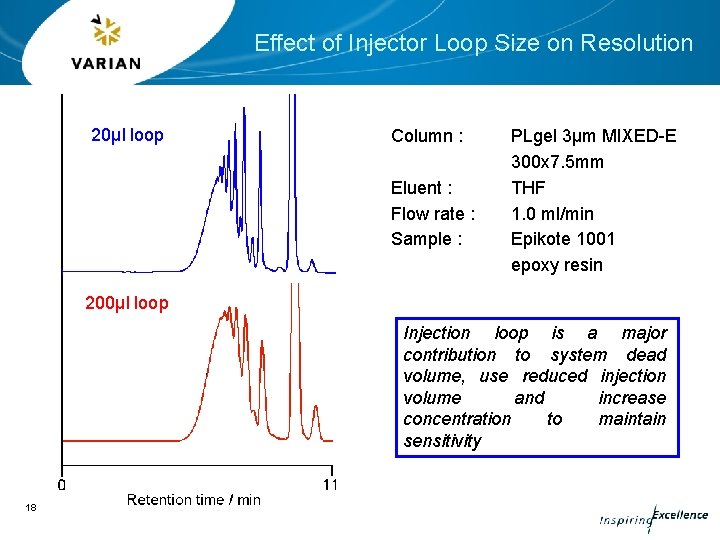
Effect of Injector Loop Size on Resolution 20µl loop Column : Eluent : Flow rate : Sample : PLgel 3µm MIXED-E 300 x 7. 5 mm THF 1. 0 ml/min Epikote 1001 epoxy resin 200µl loop Injection loop is a major contribution to system dead volume, use reduced injection volume and increase concentration to maintain sensitivity 18
Columns § The columns perform the separation § The choice and care of columns is critical to good chromatography § Columns will be the focus of the next presentation 19
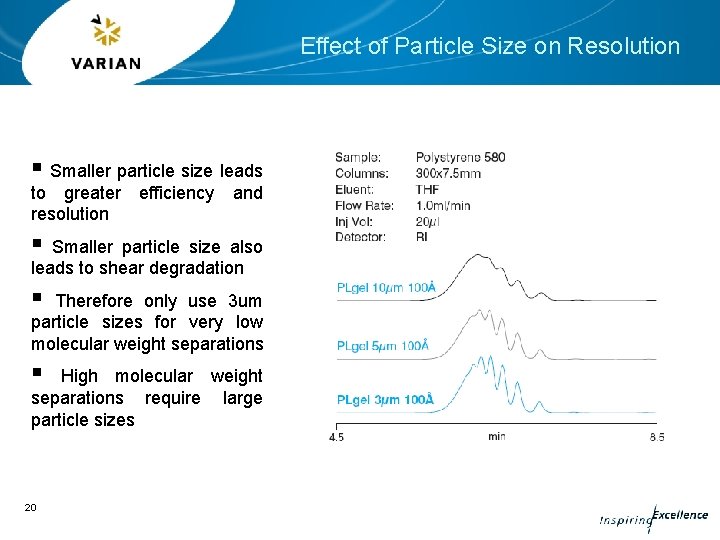
Effect of Particle Size on Resolution § Smaller particle size leads to greater resolution efficiency and § Smaller particle size also leads to shear degradation § Therefore only use 3 um particle sizes for very low molecular weight separations § High molecular weight separations require large particle sizes 20
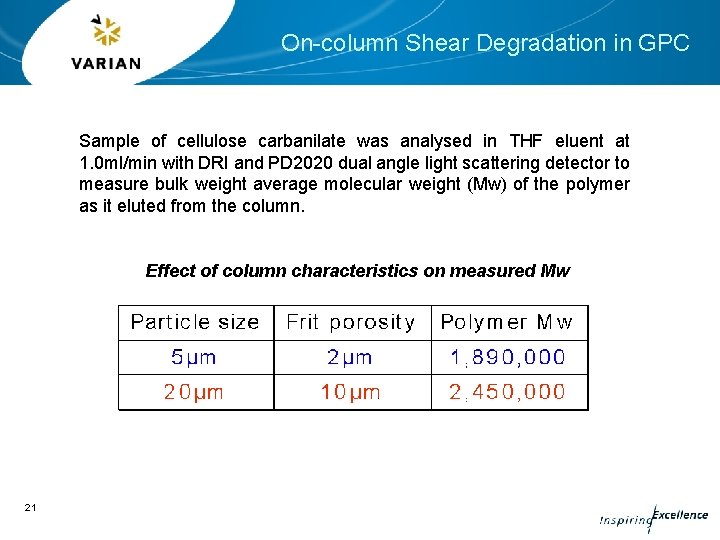
On-column Shear Degradation in GPC Sample of cellulose carbanilate was analysed in THF eluent at 1. 0 ml/min with DRI and PD 2020 dual angle light scattering detector to measure bulk weight average molecular weight (Mw) of the polymer as it eluted from the column. Effect of column characteristics on measured Mw 21
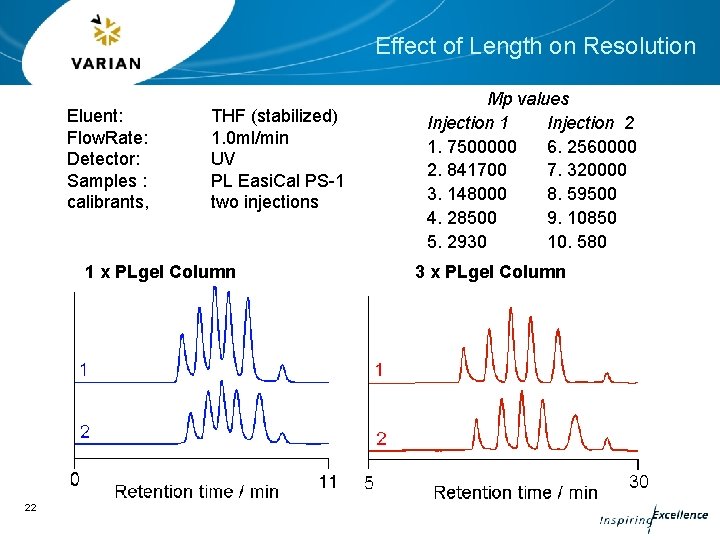
Effect of Length on Resolution Eluent: Flow. Rate: Detector: Samples : calibrants, THF (stabilized) 1. 0 ml/min UV PL Easi. Cal PS-1 two injections 1 x PLgel Column 22 Mp values Injection 1 Injection 2 1. 7500000 6. 2560000 2. 841700 7. 320000 3. 148000 8. 59500 4. 28500 9. 10850 5. 2930 10. 580 3 x PLgel Column
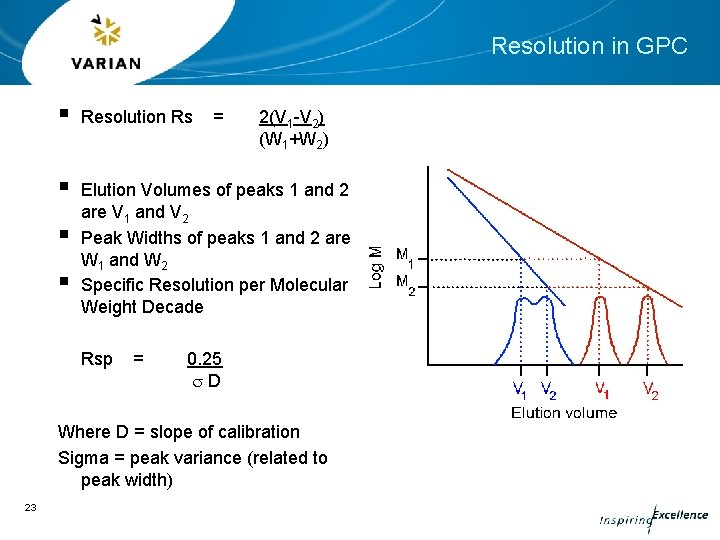
Resolution in GPC § Resolution Rs § Elution Volumes of peaks 1 and 2 are V 1 and V 2 Peak Widths of peaks 1 and 2 are W 1 and W 2 Specific Resolution per Molecular Weight Decade § § Rsp = = 2(V 1 -V 2) (W 1+W 2) 0. 25 s. D Where D = slope of calibration Sigma = peak variance (related to peak width) 23
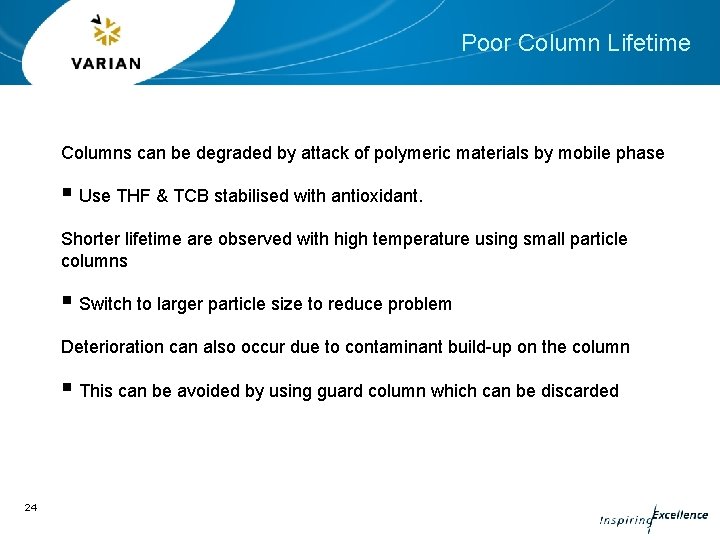
Poor Column Lifetime Columns can be degraded by attack of polymeric materials by mobile phase § Use THF & TCB stabilised with antioxidant. Shorter lifetime are observed with high temperature using small particle columns § Switch to larger particle size to reduce problem Deterioration can also occur due to contaminant build-up on the column § This can be avoided by using guard column which can be discarded 24
Column Ovens § Ovens are used to heat and maintain the temperature in a GPC separation § They come in a range of specifications, from low temperature all the way up to very high temperatures § Temperature can be important in GPC § Some GPC experiments are impossible temperature 25 without working at elevated
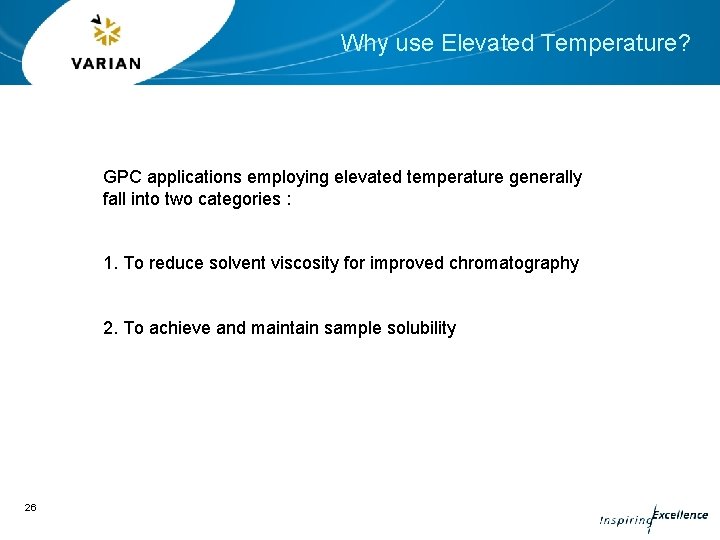
Why use Elevated Temperature? GPC applications employing elevated temperature generally fall into two categories : 1. To reduce solvent viscosity for improved chromatography 2. To achieve and maintain sample solubility 26
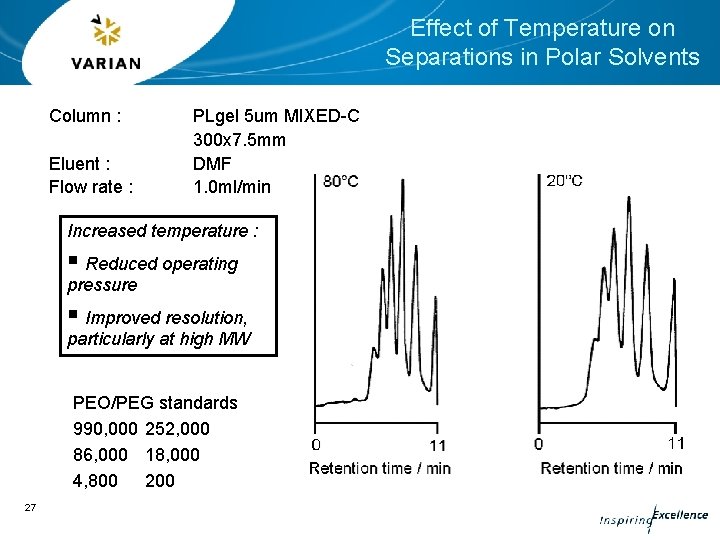
Effect of Temperature on Separations in Polar Solvents Column : Eluent : Flow rate : PLgel 5 um MIXED-C 300 x 7. 5 mm DMF 1. 0 ml/min Increased temperature : § Reduced operating pressure § Improved resolution, particularly at high MW PEO/PEG standards 990, 000 252, 000 86, 000 18, 000 4, 800 27
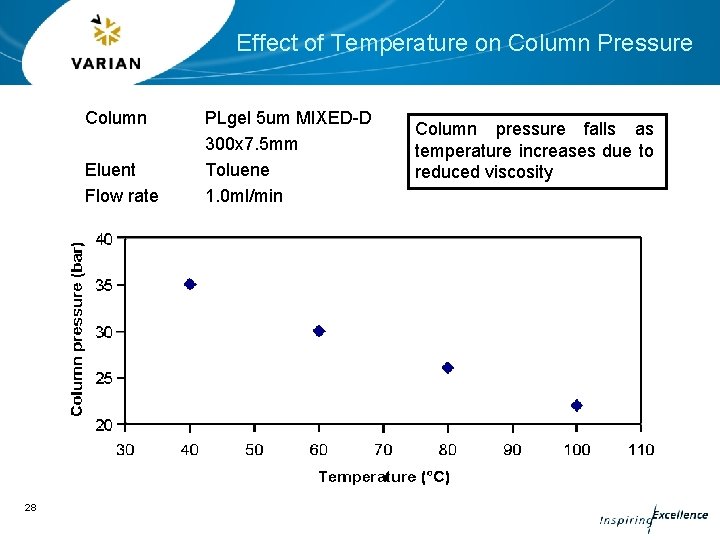
Effect of Temperature on Column Pressure Column Eluent Flow rate 28 PLgel 5 um MIXED-D 300 x 7. 5 mm Toluene 1. 0 ml/min Column pressure falls as temperature increases due to reduced viscosity
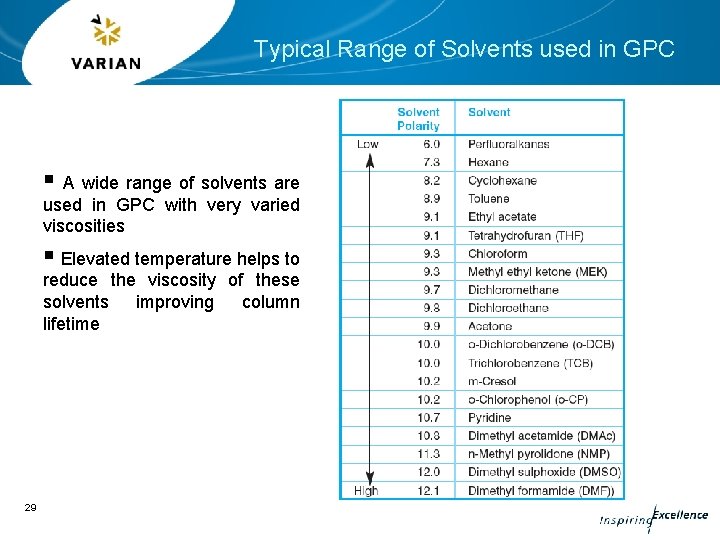
Typical Range of Solvents used in GPC § A wide range of solvents are used in GPC with very varied viscosities § Elevated temperature helps to reduce the viscosity of these solvents improving column lifetime 29
Leaks in a GPC System Most common caused by loose connections between columns and detectors § Check all the connectors and tighten if necessary § If the leak persists, disassemble and replace the leaking connector Internal Detector Leak can be seen in the detector, injection valve or pump § Often due to solvent spillage near the instruments solvent sensor § Can be due to failed detector seal or cracked cell – these must be replaced § Leaks are sometimes seen from worn rotor seal in the injection valve § Injection valve siphoning can draw solution from the waste - lower waste bottle § Pump purge valve failure will cause leaks – tighten the valve or replace § Pump seal and gasket failure will result in leaks - these must be replaced Leaking can be seen in from the column end-fittings § The end-fitting may be loose - tighten as necessary § The frit & spreader in the column may need to be replaced 30
Concentration Detectors for GPC § There are several concentration detectors that are used in conventional GPC § Differential refractive index (DRI) § UV § Infra-red § Evaporative light scattering (ELSD) § We will look at these in turn 31
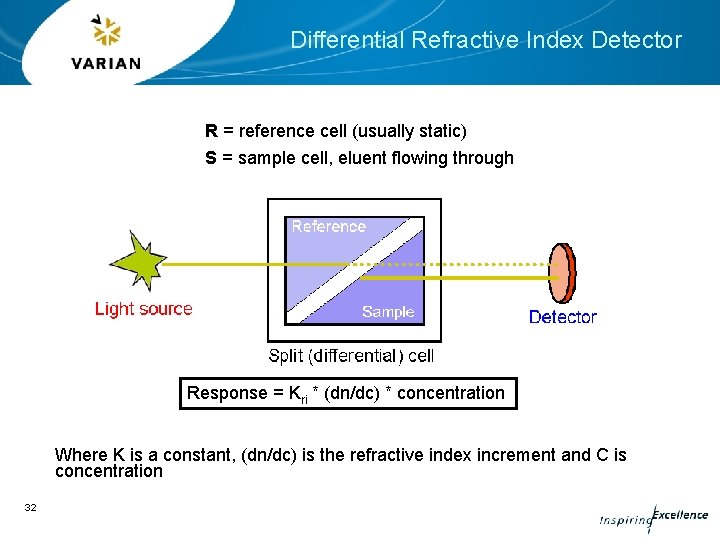
Differential Refractive Index Detector R = reference cell (usually static) S = sample cell, eluent flowing through Response = Kri * (dn/dc) * concentration Where K is a constant, (dn/dc) is the refractive index increment and C is concentration 32
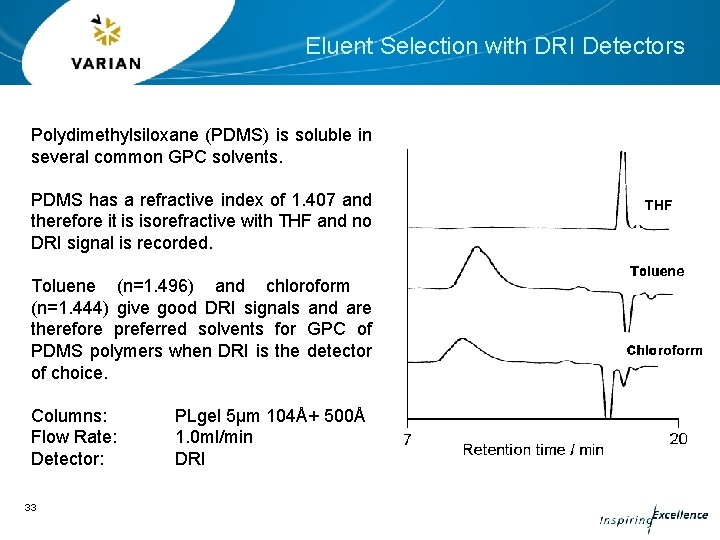
Eluent Selection with DRI Detectors Polydimethylsiloxane (PDMS) is soluble in several common GPC solvents. PDMS has a refractive index of 1. 407 and therefore it is isorefractive with THF and no DRI signal is recorded. Toluene (n=1. 496) and chloroform (n=1. 444) give good DRI signals and are therefore preferred solvents for GPC of PDMS polymers when DRI is the detector of choice. Columns: Flow Rate: Detector: 33 PLgel 5µm 104Å+ 500Å 1. 0 ml/min DRI
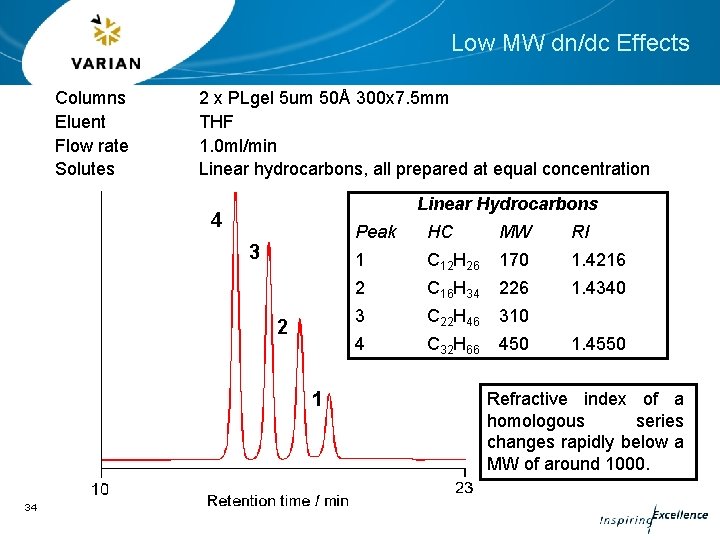
Low MW dn/dc Effects Columns Eluent Flow rate Solutes 2 x PLgel 5 um 50Å 300 x 7. 5 mm THF 1. 0 ml/min Linear hydrocarbons, all prepared at equal concentration Linear Hydrocarbons 4 3 2 1 34 Peak HC MW RI 1 C 12 H 26 170 1. 4216 2 C 16 H 34 226 1. 4340 3 C 22 H 46 310 4 C 32 H 66 450 1. 4550 Refractive index of a homologous series changes rapidly below a MW of around 1000.
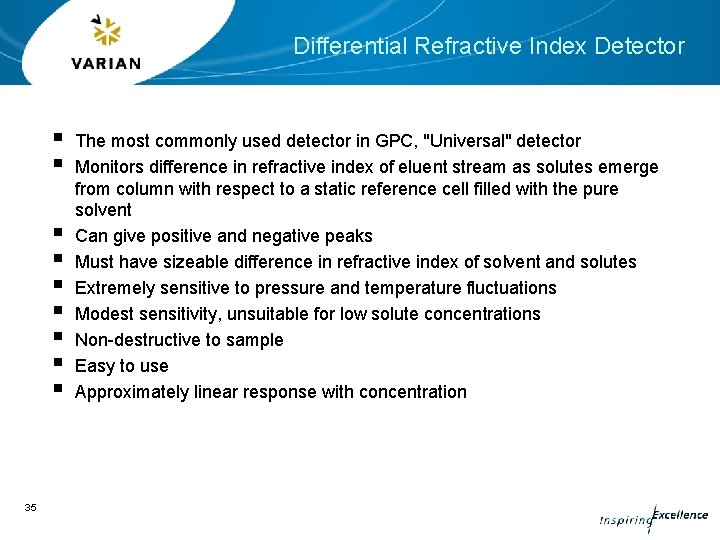
Differential Refractive Index Detector § § § § § 35 The most commonly used detector in GPC, "Universal" detector Monitors difference in refractive index of eluent stream as solutes emerge from column with respect to a static reference cell filled with the pure solvent Can give positive and negative peaks Must have sizeable difference in refractive index of solvent and solutes Extremely sensitive to pressure and temperature fluctuations Modest sensitivity, unsuitable for low solute concentrations Non-destructive to sample Easy to use Approximately linear response with concentration
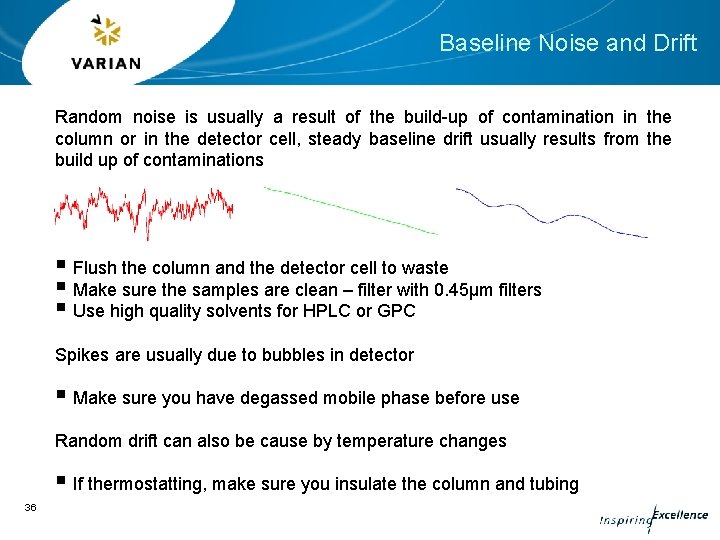
Baseline Noise and Drift Random noise is usually a result of the build-up of contamination in the column or in the detector cell, steady baseline drift usually results from the build up of contaminations § Flush the column and the detector cell to waste § Make sure the samples are clean – filter with 0. 45µm filters § Use high quality solvents for HPLC or GPC Spikes are usually due to bubbles in detector § Make sure you have degassed mobile phase before use Random drift can also be cause by temperature changes § If thermostatting, make sure you insulate the column and tubing 36
Baseline Drift at Start of Operation Usually caused by the column settling down § Make sure you allow sufficient time for column to equilibrate Can be caused by the detector equilibrating § Allow time to reach stability - very common for RI detectors § Ensure detector is not in a draught or direct sunlight Baseline variations can also be cause by RI Reference cell contents decaying or degrading, especially at temperature § Regularly flush the reference cell with mobile phase 37
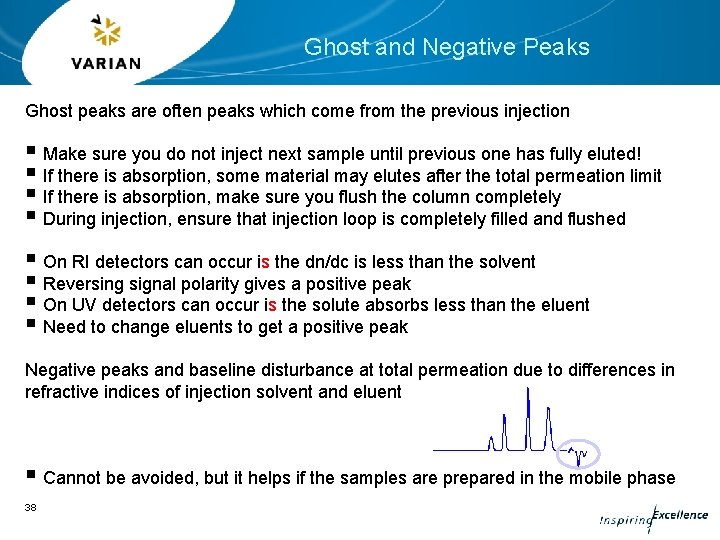
Ghost and Negative Peaks Ghost peaks are often peaks which come from the previous injection § Make sure you do not inject next sample until previous one has fully eluted! § If there is absorption, some material may elutes after the total permeation limit § If there is absorption, make sure you flush the column completely § During injection, ensure that injection loop is completely filled and flushed § On RI detectors can occur is the dn/dc is less than the solvent § Reversing signal polarity gives a positive peak § On UV detectors can occur is the solute absorbs less than the eluent § Need to change eluents to get a positive peak Negative peaks and baseline disturbance at total permeation due to differences in refractive indices of injection solvent and eluent § Cannot be avoided, but it helps if the samples are prepared in the mobile phase 38
UV Detectors § § § § 39 Relies on UV absorbing groups being present in solute Very sensitive detector with small cell volumes and therefore low system dispersion Good linearity Insensitive to temperature and pressure fluctuations Many polymers do not have chromaphores Many solvents or solvent additives absorb UV and either prevent use or cause decrease in sensitivity. Sometimes used in conjunction with RI for copolymer analysis when only one of the monomers has UV chromaphore.
Infrared Detectors § § § § Relies on infrared absorbing groups in solute Sensitivity low to moderate Cell volumes tend to be much larger than other detectors and time constants longer Many solvents absorb IR and either prevent use or decrease sensitivity Insensitive to temperature fluctuations Niche market for polyolefin analysis at high temperature but with moderate sensitivity Can be used with RI for copolymer analysis Note : GPC-FTIR using special flow cell (e. g. the PL-HTGPC/FTIR interface) or eluent collection device (e. g. Lab Connections) has great potential for identification of solutes by measuring complete FTIR spectrum as a function of elution time. 40
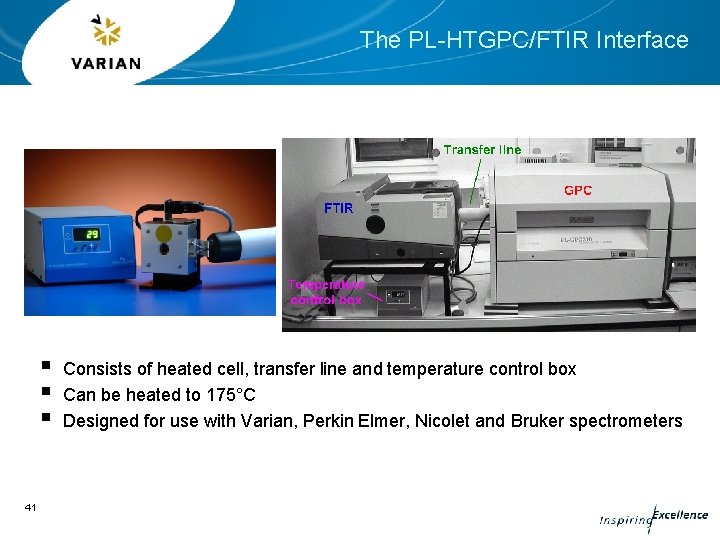
The PL-HTGPC/FTIR Interface § § § 41 Consists of heated cell, transfer line and temperature control box Can be heated to 175°C Designed for use with Varian, Perkin Elmer, Nicolet and Bruker spectrometers
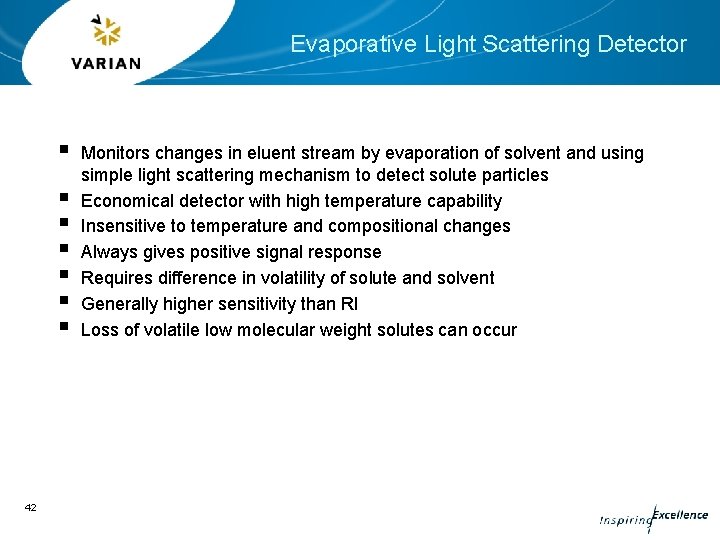
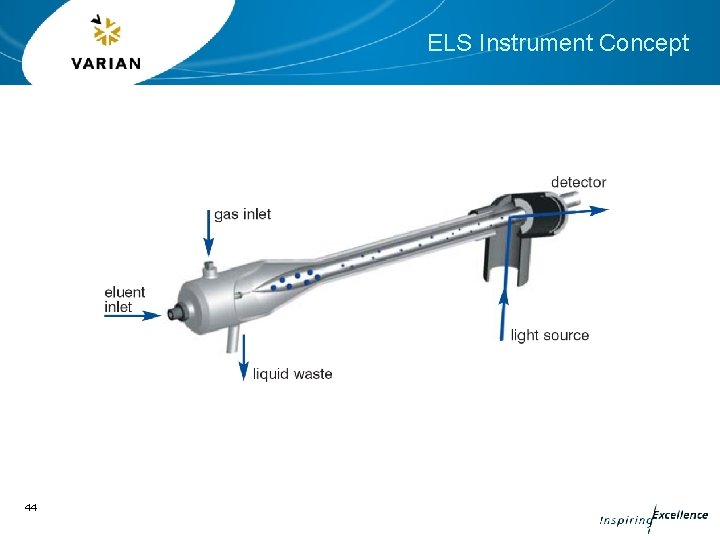
Evaporative Light Scattering Detector § § § § 42 Monitors changes in eluent stream by evaporation of solvent and using simple light scattering mechanism to detect solute particles Economical detector with high temperature capability Insensitive to temperature and compositional changes Always gives positive signal response Requires difference in volatility of solute and solvent Generally higher sensitivity than RI Loss of volatile low molecular weight solutes can occur
Varian 380 -LC Evaporative Light Scattering Detector 43
ELS Instrument Concept 44
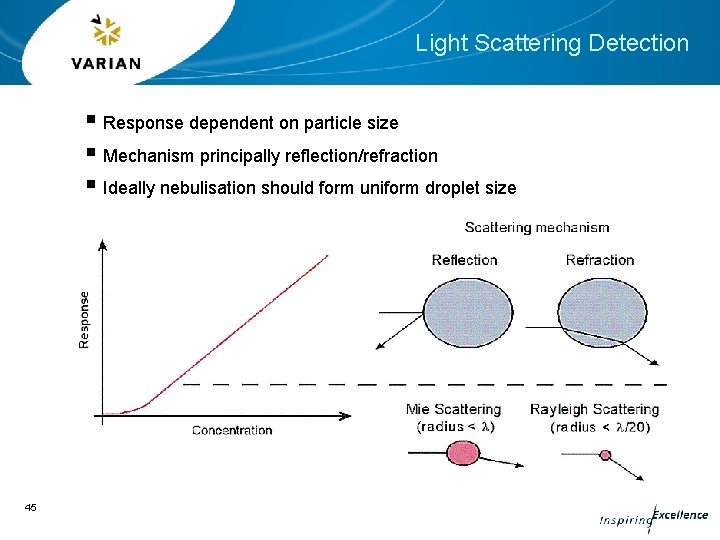
Light Scattering Detection § Response dependent on particle size § Mechanism principally reflection/refraction § Ideally nebulisation should form uniform droplet size 45
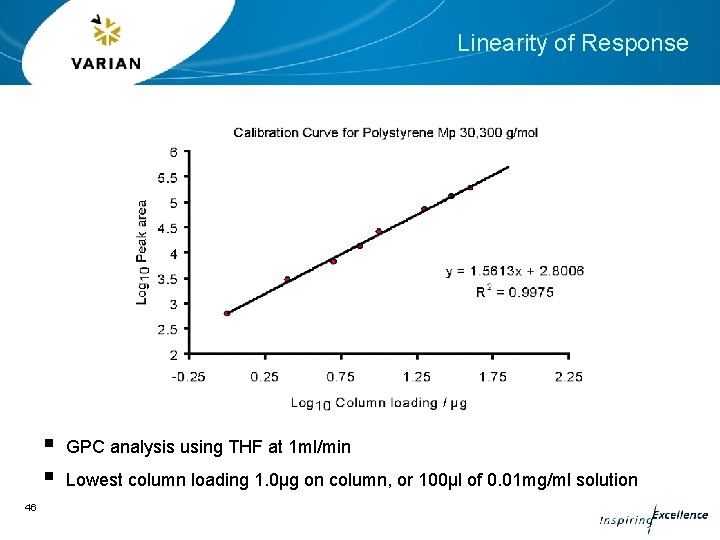
Linearity of Response § § 46 GPC analysis using THF at 1 ml/min Lowest column loading 1. 0µg on column, or 100µl of 0. 01 mg/ml solution
Sensitivity of DRI Versus ELS Columns Eluent Flow rate Loading Mp values 2 x PLgel 5 um MIXED-C 300 x 7. 5 mm THF 1. 0 ml/min ELS is essentially independent of dn/dc, improvement in 0. 1%, 20 ul sensitivity will depend on a number of solute parameters 3 1. 7, 500, 000 4 2. 841, 700 3. 148, 000 4. 28, 500 5. 2, 930 47 2 1 5
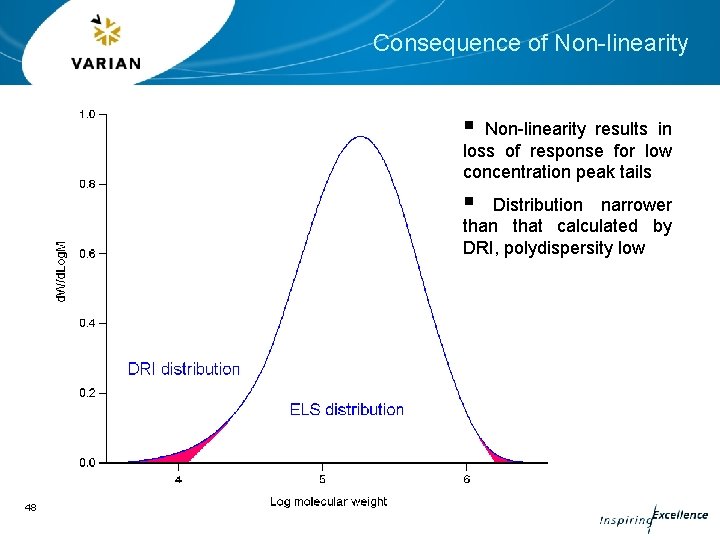
Consequence of Non-linearity § Non-linearity results in loss of response for low concentration peak tails § Distribution narrower than that calculated by DRI, polydispersity low 48
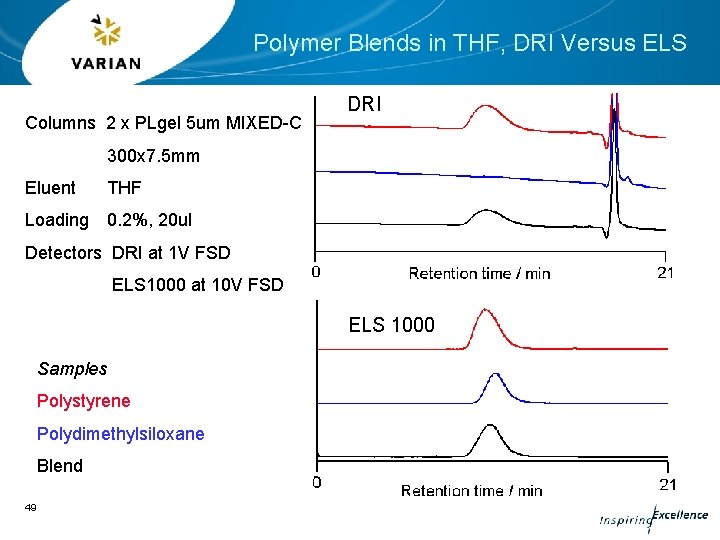
Polymer Blends in THF, DRI Versus ELS Columns 2 x PLgel 5 um MIXED-C DRI 300 x 7. 5 mm Eluent THF Loading 0. 2%, 20 ul Detectors DRI at 1 V FSD ELS 1000 at 10 V FSD ELS 1000 Samples Polystyrene Polydimethylsiloxane Blend 49
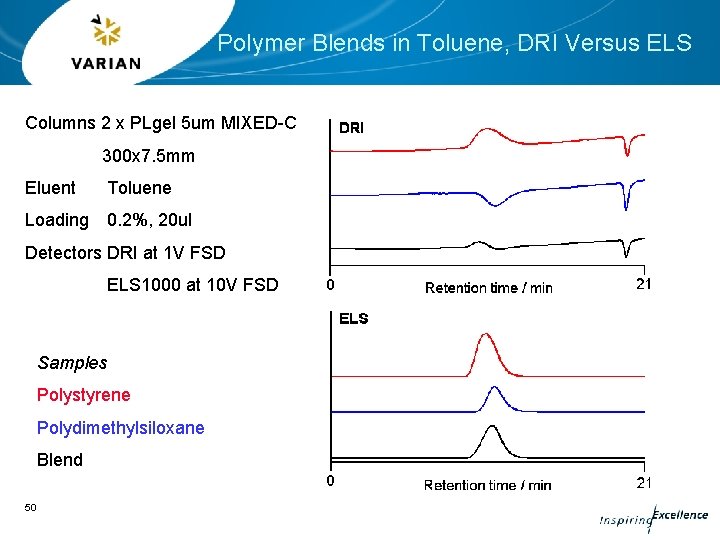
Polymer Blends in Toluene, DRI Versus ELS Columns 2 x PLgel 5 um MIXED-C 300 x 7. 5 mm Eluent Toluene Loading 0. 2%, 20 ul Detectors DRI at 1 V FSD ELS 1000 at 10 V FSD Samples Polystyrene Polydimethylsiloxane Blend 50
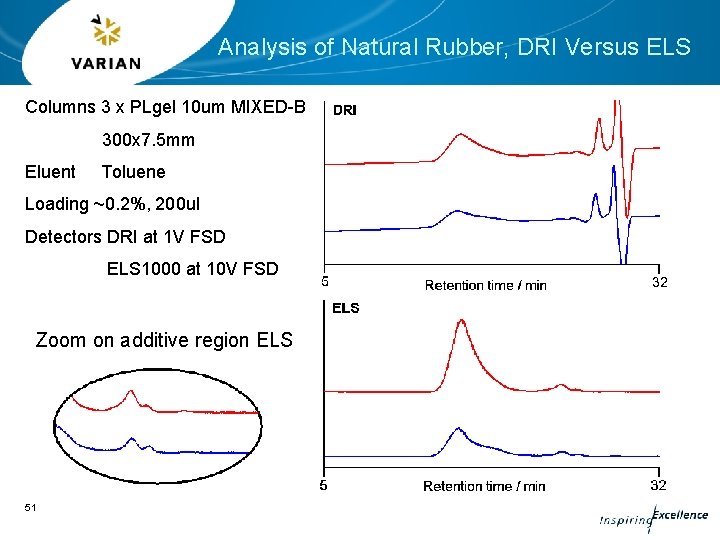
Analysis of Natural Rubber, DRI Versus ELS Columns 3 x PLgel 10 um MIXED-B 300 x 7. 5 mm Eluent Toluene Loading ~0. 2%, 200 ul Detectors DRI at 1 V FSD ELS 1000 at 10 V FSD Zoom on additive region ELS 51
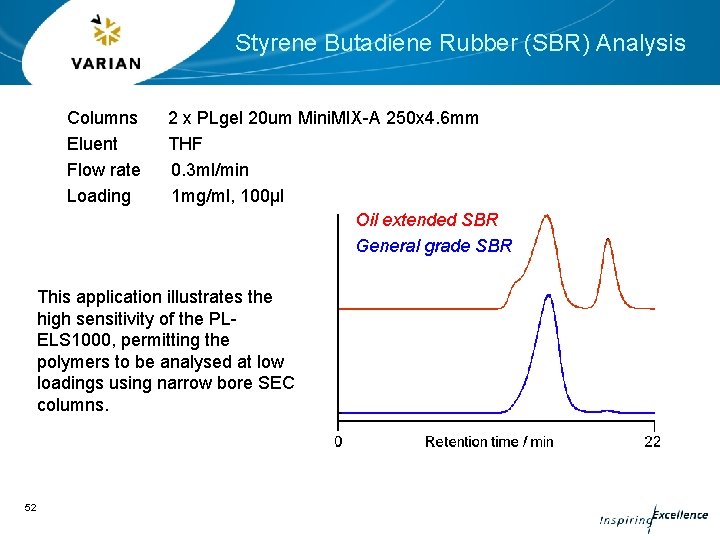
Styrene Butadiene Rubber (SBR) Analysis Columns Eluent Flow rate Loading 2 x PLgel 20 um Mini. MIX-A 250 x 4. 6 mm THF 0. 3 ml/min 1 mg/ml, 100µl Oil extended SBR General grade SBR This application illustrates the high sensitivity of the PLELS 1000, permitting the polymers to be analysed at low loadings using narrow bore SEC columns. 52
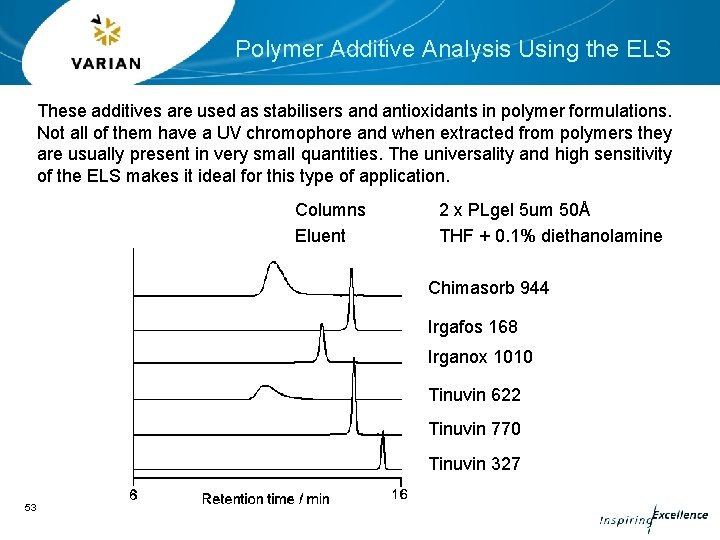
Polymer Additive Analysis Using the ELS These additives are used as stabilisers and antioxidants in polymer formulations. Not all of them have a UV chromophore and when extracted from polymers they are usually present in very small quantities. The universality and high sensitivity of the ELS makes it ideal for this type of application. Columns Eluent 2 x PLgel 5 um 50Å THF + 0. 1% diethanolamine Chimasorb 944 Irgafos 168 Irganox 1010 Tinuvin 622 Tinuvin 770 Tinuvin 327 53
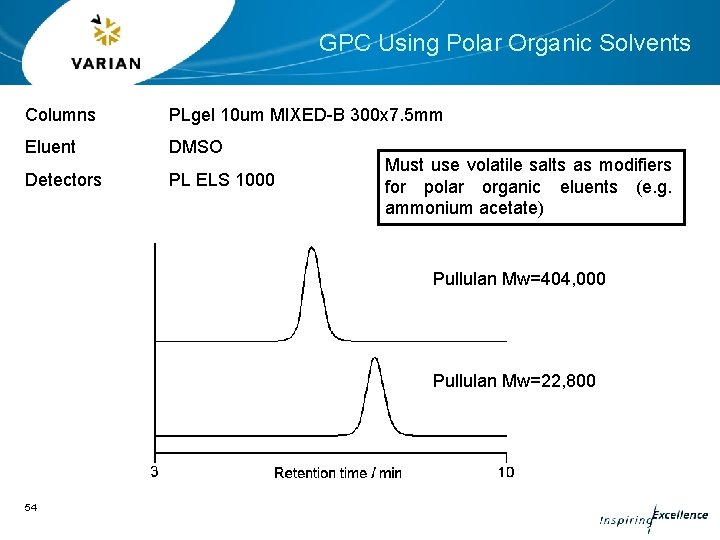
GPC Using Polar Organic Solvents Columns PLgel 10 um MIXED-B 300 x 7. 5 mm Eluent DMSO Detectors PL ELS 1000 Must use volatile salts as modifiers for polar organic eluents (e. g. ammonium acetate) Pullulan Mw=404, 000 Pullulan Mw=22, 800 54
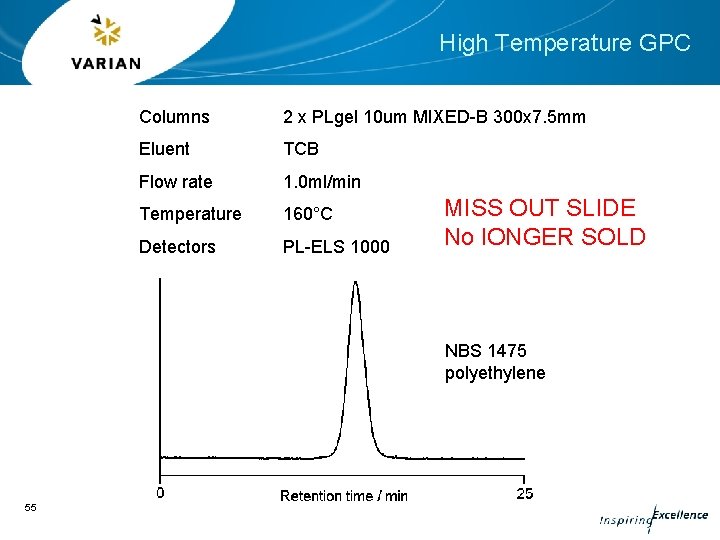
High Temperature GPC Columns 2 x PLgel 10 um MIXED-B 300 x 7. 5 mm Eluent TCB Flow rate 1. 0 ml/min Temperature 160°C Detectors PL-ELS 1000 MISS OUT SLIDE No l. ONGER SOLD NBS 1475 polyethylene 55
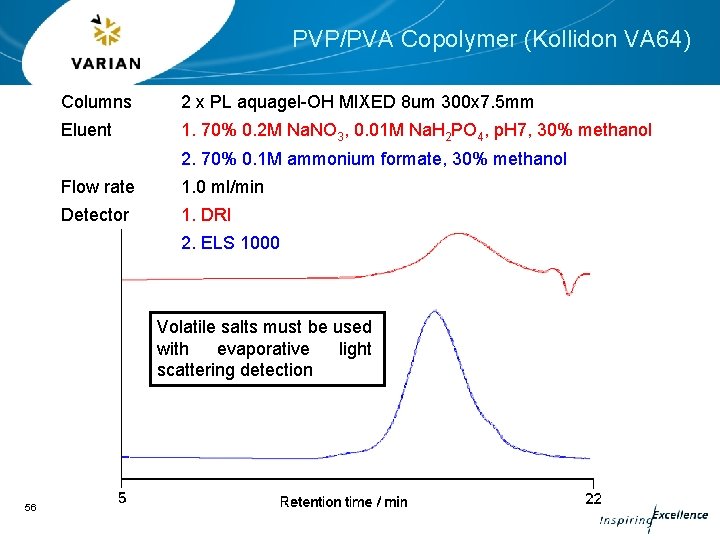
PVP/PVA Copolymer (Kollidon VA 64) Columns 2 x PL aquagel-OH MIXED 8 um 300 x 7. 5 mm Eluent 1. 70% 0. 2 M Na. NO 3, 0. 01 M Na. H 2 PO 4, p. H 7, 30% methanol 2. 70% 0. 1 M ammonium formate, 30% methanol Flow rate 1. 0 ml/min Detector 1. DRI 2. ELS 1000 Volatile salts must be used with evaporative light scattering detection 56
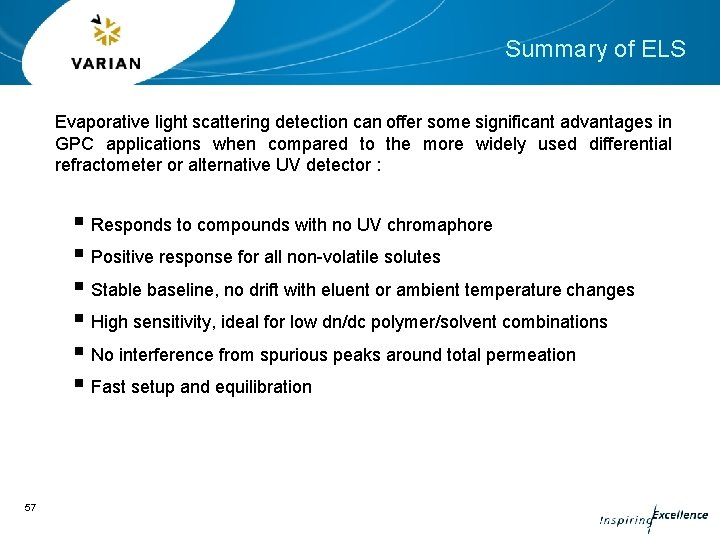
Summary of ELS Evaporative light scattering detection can offer some significant advantages in GPC applications when compared to the more widely used differential refractometer or alternative UV detector : § Responds to compounds with no UV chromaphore § Positive response for all non-volatile solutes § Stable baseline, no drift with eluent or ambient temperature changes § High sensitivity, ideal for low dn/dc polymer/solvent combinations § No interference from spurious peaks around total permeation § Fast setup and equilibration 57
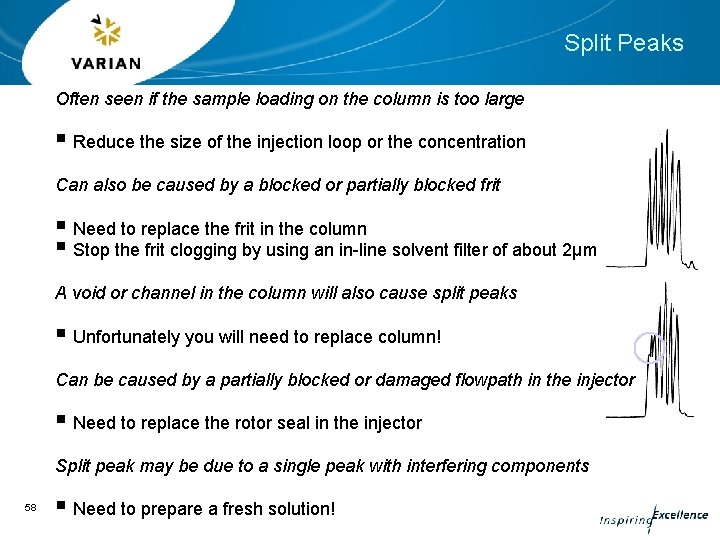
Split Peaks Often seen if the sample loading on the column is too large § Reduce the size of the injection loop or the concentration Can also be caused by a blocked or partially blocked frit § Need to replace the frit in the column § Stop the frit clogging by using an in-line solvent filter of about 2µm A void or channel in the column will also cause split peaks § Unfortunately you will need to replace column! Can be caused by a partially blocked or damaged flowpath in the injector § Need to replace the rotor seal in the injector Split peak may be due to a single peak with interfering components 58 § Need to prepare a fresh solution!
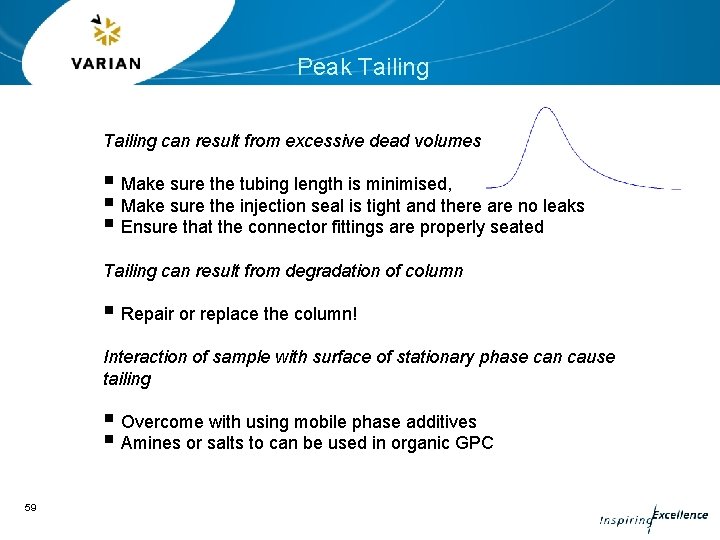
Peak Tailing can result from excessive dead volumes § Make sure the tubing length is minimised, § Make sure the injection seal is tight and there are no leaks § Ensure that the connector fittings are properly seated Tailing can result from degradation of column § Repair or replace the column! Interaction of sample with surface of stationary phase can cause tailing § Overcome with using mobile phase additives § Amines or salts to can be used in organic GPC 59
Peak Broadening Large dead volumes will contribute significantly to peak broadening § Always use LDV end fittings and connectors § Minimise lengths and diameters of tubing wherever possible Broadening will result if the eluent is too viscous § May need to increase operational temperature Broadening may result if the detector cell volume is too large § If possible, use a smaller cell volume Broadening will result if the column is not performing § Repair or replace the column 60
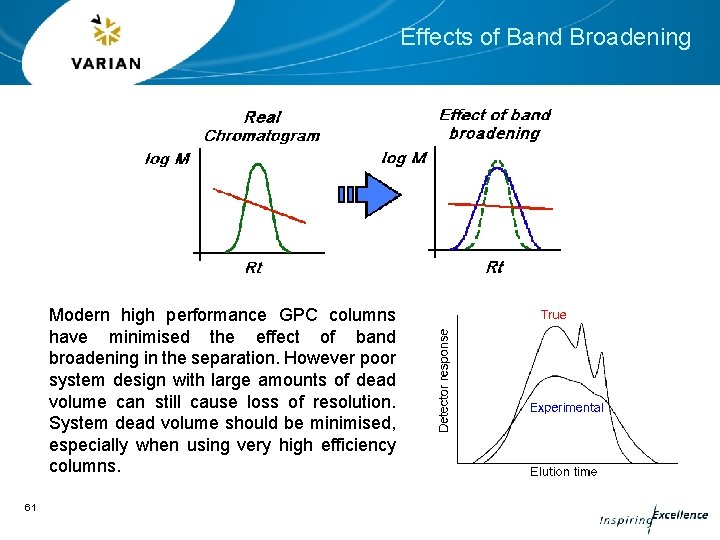
Effects of Band Broadening Modern high performance GPC columns have minimised the effect of band broadening in the separation. However poor system design with large amounts of dead volume can still cause loss of resolution. System dead volume should be minimised, especially when using very high efficiency columns. 61
Poor Detector Sensitivity The sample will not be observed if it is injected at a concentration below the minimum detectable level § Increase concentration or sample volume to get a good response Sometimes a small peak will be observed for the first few sample injections due to adsorption of sample onto the column § Condition column with concentrated sample will reduce effect Injecting an underfilled injection loop will give small peaks § Ensure at least 3 times the sample loop volume is injected 62
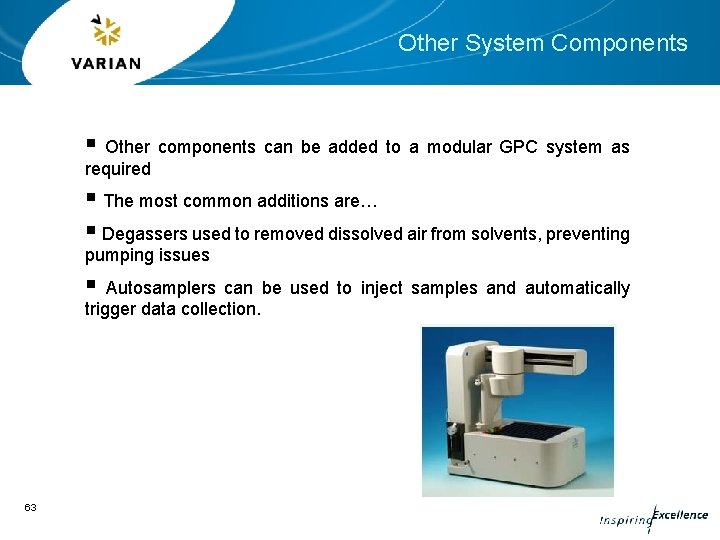
Other System Components § Other components can be added to a modular GPC system as required § The most common additions are… § Degassers used to removed dissolved air from solvents, preventing pumping issues § Autosamplers can be used to inject samples and automatically trigger data collection. 63
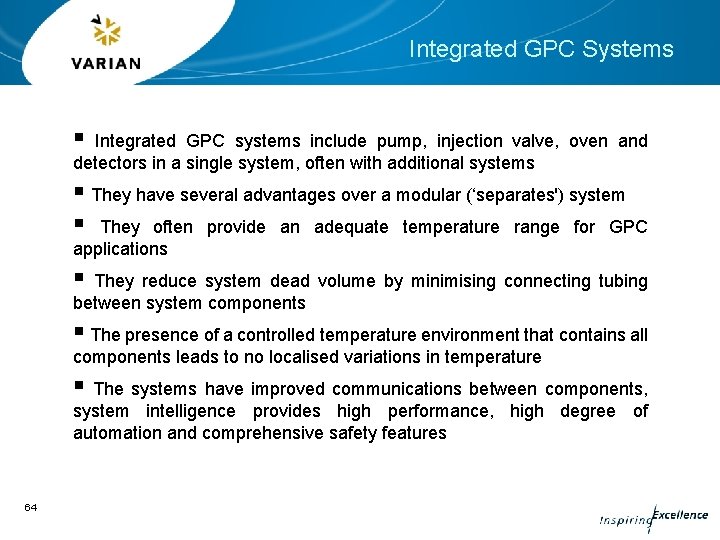
Integrated GPC Systems § Integrated GPC systems include pump, injection valve, oven and detectors in a single system, often with additional systems § They have several advantages over a modular (‘separates') system § They often provide an adequate temperature range for GPC applications § They reduce system dead volume by minimising connecting tubing between system components § The presence of a controlled temperature environment that contains all components leads to no localised variations in temperature § The systems have improved communications between components, system intelligence provides high performance, high degree of automation and comprehensive safety features 64
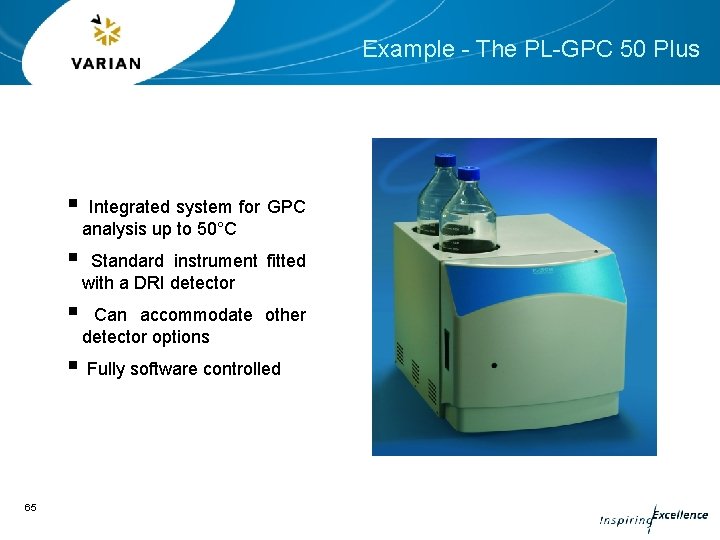
Example - The PL-GPC 50 Plus § Integrated system for GPC analysis up to 50°C § Standard instrument fitted with a DRI detector § Can accommodate other detector options § Fully software controlled 65
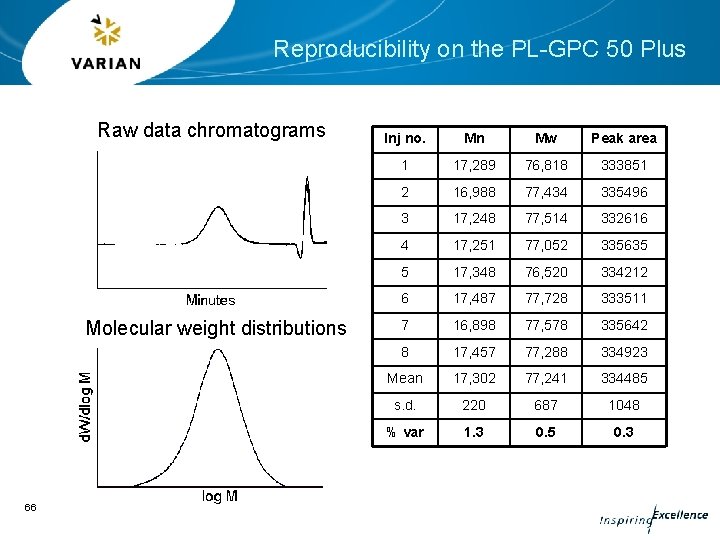
Reproducibility on the PL-GPC 50 Plus Raw data chromatograms Molecular weight distributions 66 Inj no. Mn Mw Peak area 1 17, 289 76, 818 333851 2 16, 988 77, 434 335496 3 17, 248 77, 514 332616 4 17, 251 77, 052 335635 5 17, 348 76, 520 334212 6 17, 487 77, 728 333511 7 16, 898 77, 578 335642 8 17, 457 77, 288 334923 Mean 17, 302 77, 241 334485 s. d. 220 687 1048 % var 1. 3 0. 5 0. 3
Example - PL-GPC 220 Integrated GPC 67
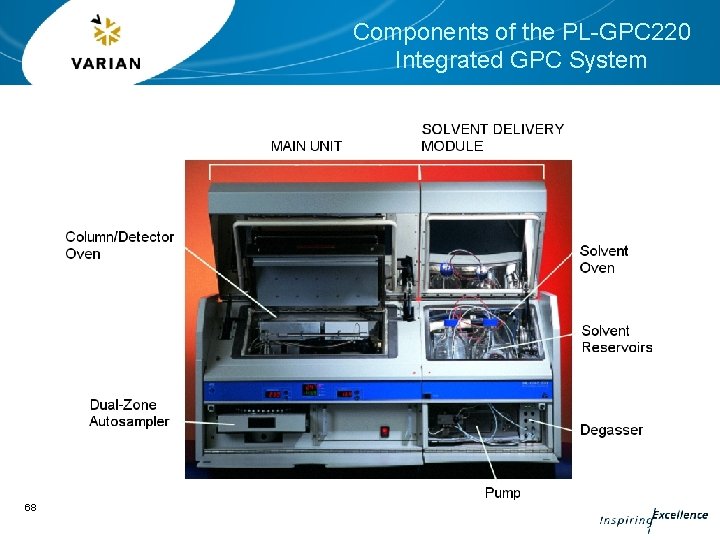
Components of the PL-GPC 220 Integrated GPC System PUMP AND DEGASSER 68
HTGPC Analysis of Crystalline Polymers Additional system requirements for these difficult applications § Adequate temperature capability (30 -220°C) § Consistency of solvent delivery in continuous use § High temperature autosampler/injection system § DRI performance (sensitivity and stability) 69
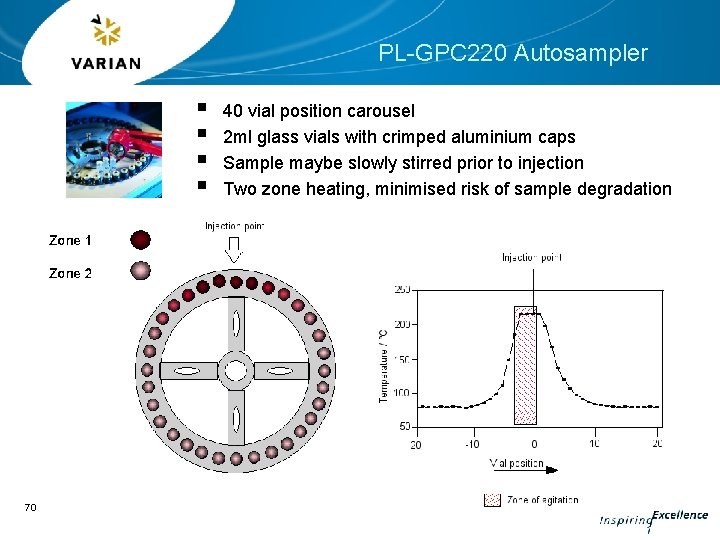
PL-GPC 220 Autosampler § § 70 40 vial position carousel 2 ml glass vials with crimped aluminium caps Sample maybe slowly stirred prior to injection Two zone heating, minimised risk of sample degradation
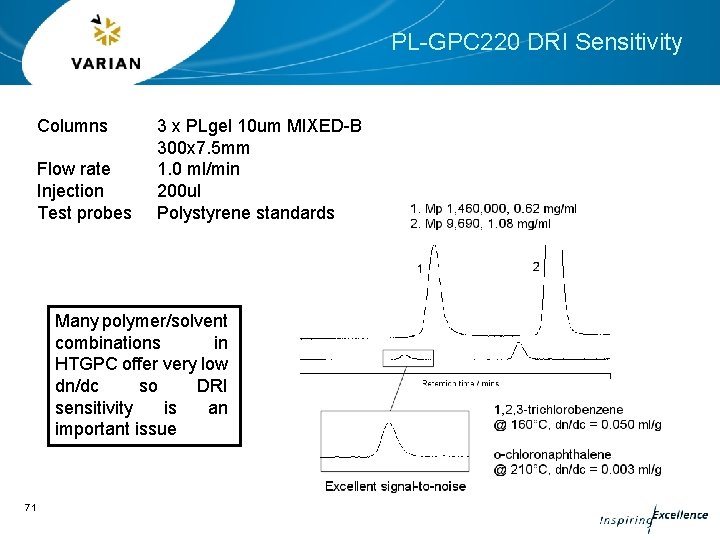
PL-GPC 220 DRI Sensitivity Columns Flow rate Injection Test probes 3 x PLgel 10 um MIXED-B 300 x 7. 5 mm 1. 0 ml/min 200 ul Polystyrene standards Many polymer/solvent combinations in HTGPC offer very low dn/dc so DRI sensitivity is an important issue 71