
FOUNDARY AND CASTING The shop where moulding casting
- Slides: 72
FOUNDARY AND CASTING • The shop where moulding, casting and related processes are carried out is called foundry shop • Mould is a container in which molten metal is poured to cool into desired shape • Casting is the process of pouring molten metal into a mould and allowing it to solidify. Soldified object is called casting • The whole process of producing castings may be divided into four stages(1)Pattern making(2)Mould and core making(3)Melting and casting(4)fettling(cleaning)
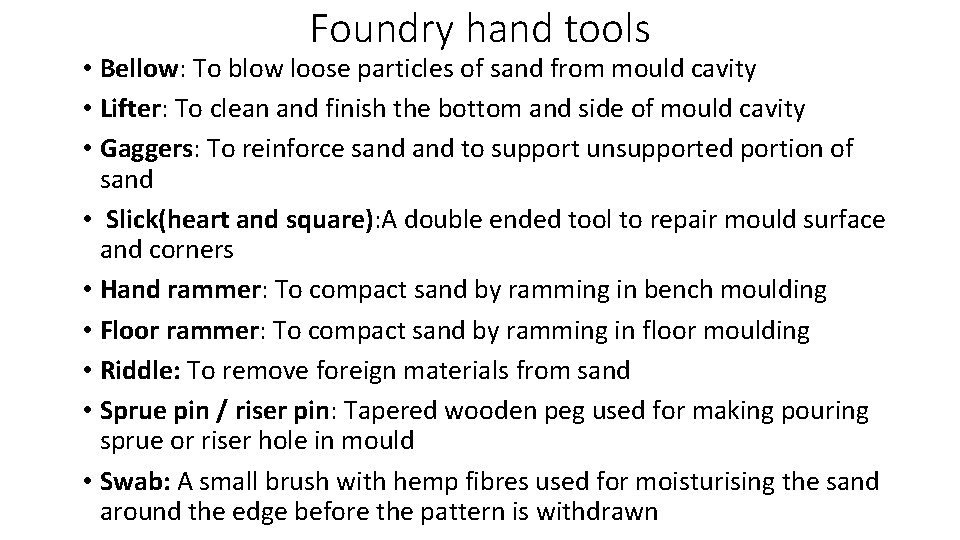
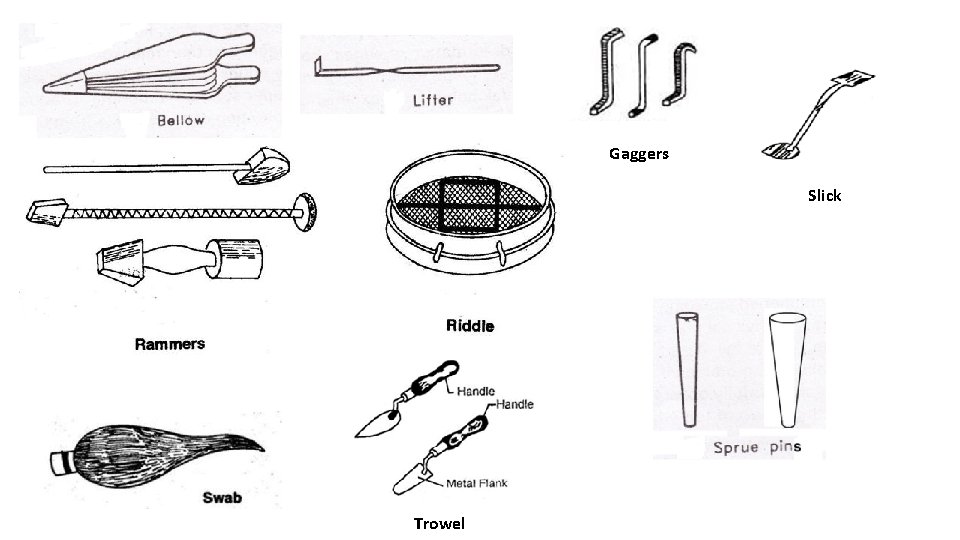
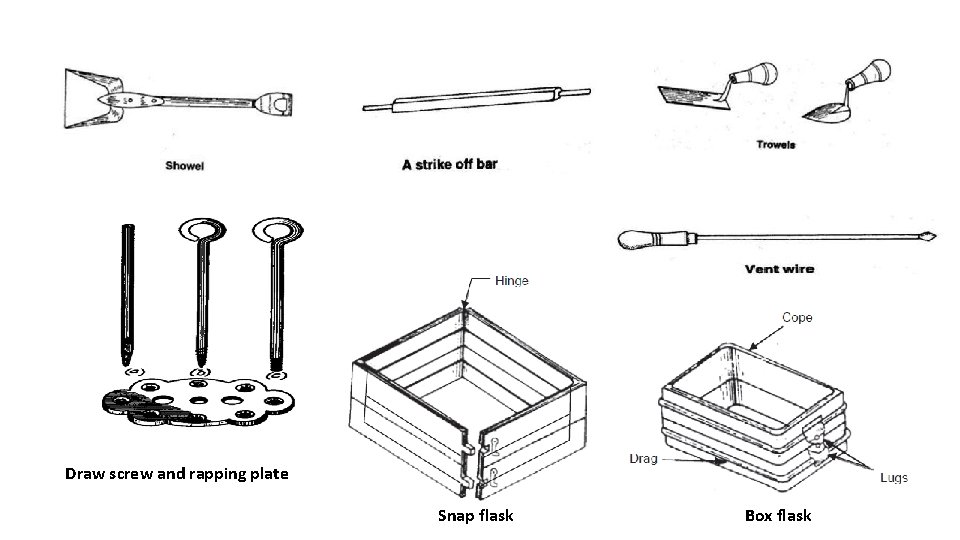
Foundry hand tools • Bellow: To blow loose particles of sand from mould cavity • Lifter: To clean and finish the bottom and side of mould cavity • Gaggers: To reinforce sand to support unsupported portion of sand • Slick(heart and square): A double ended tool to repair mould surface and corners • Hand rammer: To compact sand by ramming in bench moulding • Floor rammer: To compact sand by ramming in floor moulding • Riddle: To remove foreign materials from sand • Sprue pin / riser pin: Tapered wooden peg used for making pouring sprue or riser hole in mould • Swab: A small brush with hemp fibres used for moisturising the sand around the edge before the pattern is withdrawn
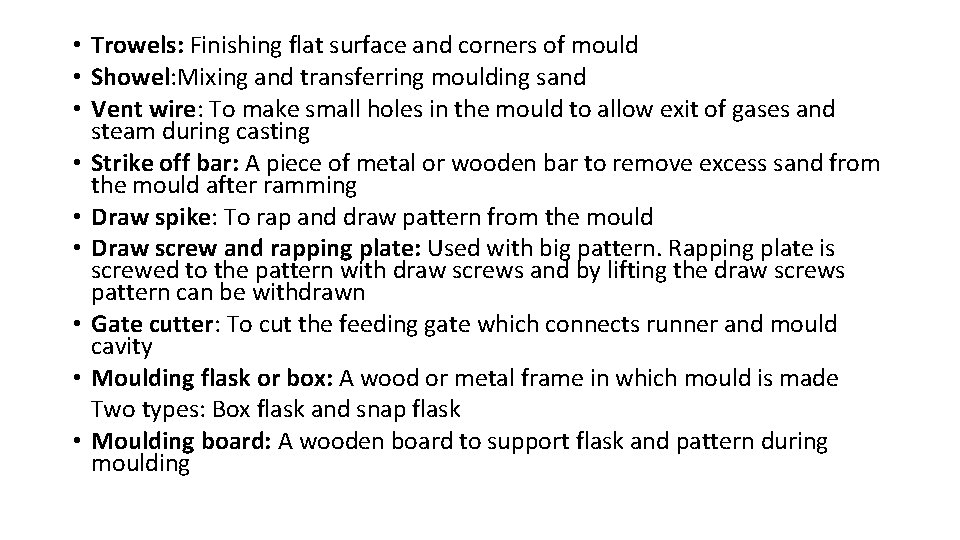
• Trowels: Finishing flat surface and corners of mould • Showel: Mixing and transferring moulding sand • Vent wire: To make small holes in the mould to allow exit of gases and steam during casting • Strike off bar: A piece of metal or wooden bar to remove excess sand from the mould after ramming • Draw spike: To rap and draw pattern from the mould • Draw screw and rapping plate: Used with big pattern. Rapping plate is screwed to the pattern with draw screws and by lifting the draw screws pattern can be withdrawn • Gate cutter: To cut the feeding gate which connects runner and mould cavity • Moulding flask or box: A wood or metal frame in which mould is made Two types: Box flask and snap flask • Moulding board: A wooden board to support flask and pattern during moulding
Gaggers Slick Trowel
Draw screw and rapping plate Snap flask Box flask
PROPERTIES OF MOULDING SAND 1. Permeability or Porosity • Property of moulding sand which allows escape of gases and steam when molten metal is poured into it • Absence of permeability results in defects like blowholes, mould blast etc. • Coarse sand grains, low clay content and soft ramming increases permeability 2. Refractoriness • Ability of moulding sand to withstand high temperatures without fusion or any physical change 3. Adhesiveness • It is the property of moulding sand due to which it adheres to the surface of the moulding boxes and thus makes it possible to mould cope and drag
4. Cohesiveness • It is ability of sand particles to stick together • It is due to this property that the patterns can be removed without breaking the mould and mould retain its shape even after pouring of molten metal 5. Collapsibility • It is the property of moulding sand due to which it automatically gets collapse after solidification of the casting allowing free contraction of metal 6. Plasticity Or Flowability • It is the property of moulding sand due to which it flows during ramming to all portions of the moulding flask and packs around the pattern to acquire desired shape
PATTERN • Pattern is the replica or model of the object to be cast Functions of the Pattern : • It prepares a mould cavity for the purpose of making a casting. • A pattern may contain projection known as core prints if the casting requires a core. • Runner, gates, and risers may form a part of the pattern. • Pattern properly made and having finished surface reduce casting defects • It helps to position core in proper place • It helps to establish parting line and parting surface in the mould • It helps in establishing locating points on the mould and there fore on the casting to check casting dimensions
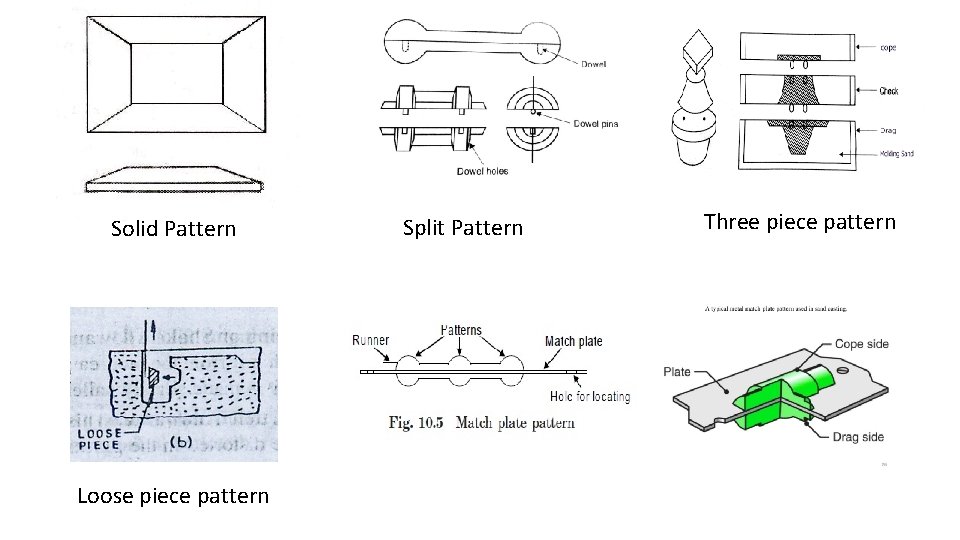
Types of pattern 1. Single piece pattern (solid) pattern: • Made from one piece and does not contain loose pieces or joints. • Inexpensive. Used for large size simple castings. • Pattern is accommodated either in the cope or in the drag. Examples: Stuffing box of steam engine 2. Split piece pattern: • Pattern with complex shape cannot be made in single piece due to difficulty in mould making and withdrawal of pattern from mould. Such pattern are made as split or two piece pattern • The upper and the lower parts of the split piece patterns are accommodated in the cope and drag portions of the mould respectively. • Dowel pins are used for keeping the alignment between the two parts of the pattern. • Examples: Taps, water stop cocks etc.
3. Loose piece pattern • Certain pattern cannot be withdrawn once they are embedded in the mould cavity. • Such patterns are usually made with one or more loose pieces for facilitating their removal from the moulding box • The main body of the pattern is drawn first from the moulding box and thereafter the loose parts are removed, the result is the mould cavity 4. Match plate pattern • Patterns are made in two pieces one piece mounted on one side and the other on other side of plate called match plate • Plate may carry one or group of patterns mounted on match plate • Gating system (Runner, riser, gates etc. ) are also attached to plate • Applications: Piston rings of I. C. engines
Solid Pattern Loose piece pattern Split Pattern Three piece pattern
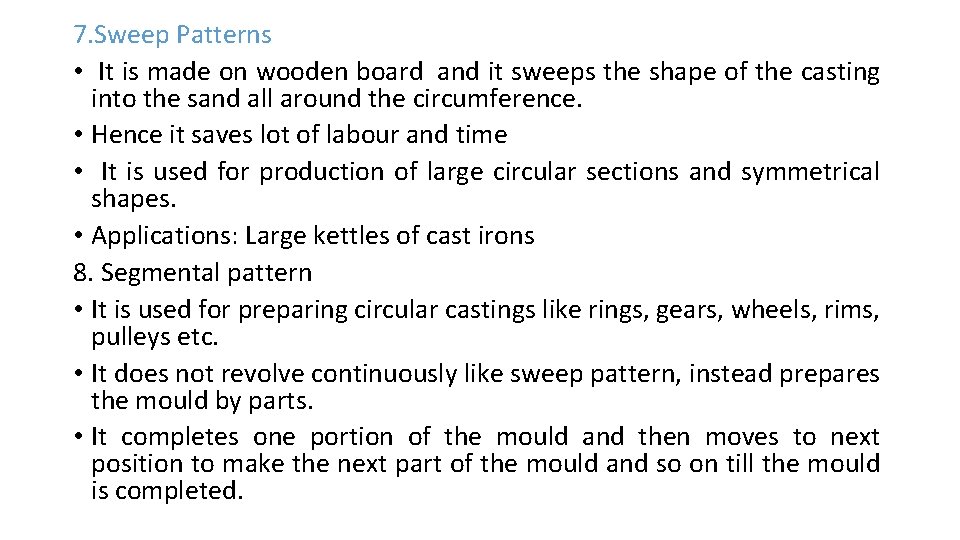
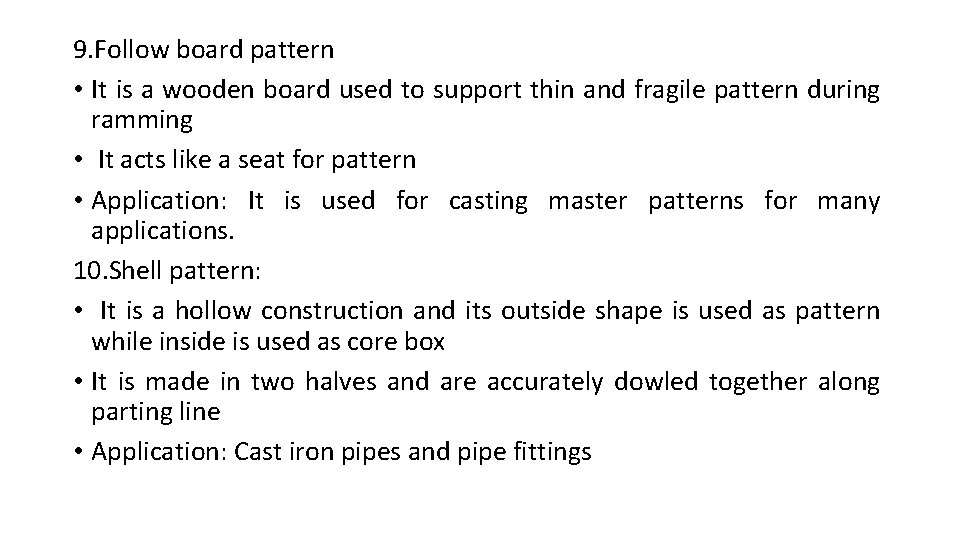
5. Gated Pattern • A group of patterns attached with a common gating system • Sections connecting different pattern serves as gate and runner. • Can produce many castings at one time and hence saves time as well as cost. Applications: Used for small castings • 6. Skeleton pattern : • It consists of a wooden skeleton frame • Moulding sand is used to fill the space between the wooden pieces on the frame • Then a strickle board is used for strickling the sand • Application: Large castings such as turbines, water pipes, L- bends etc.
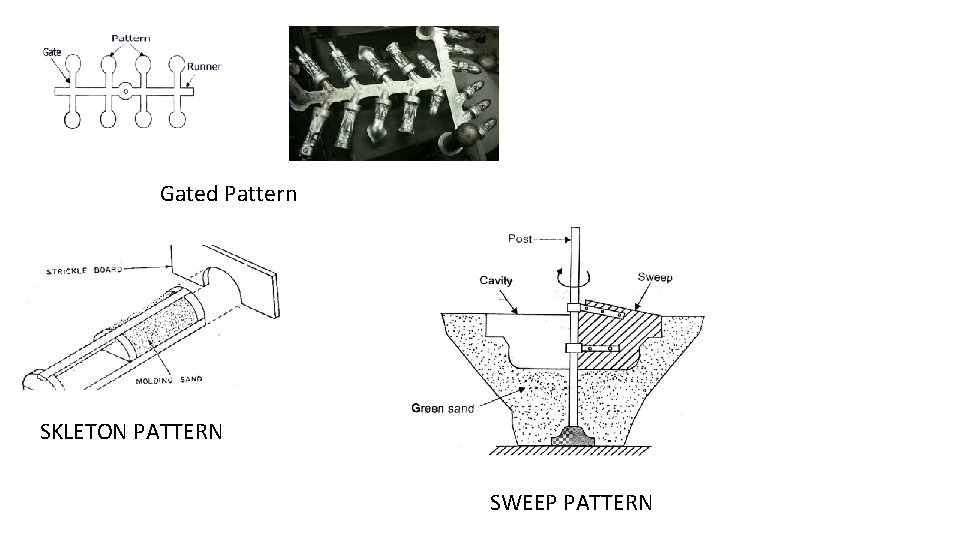
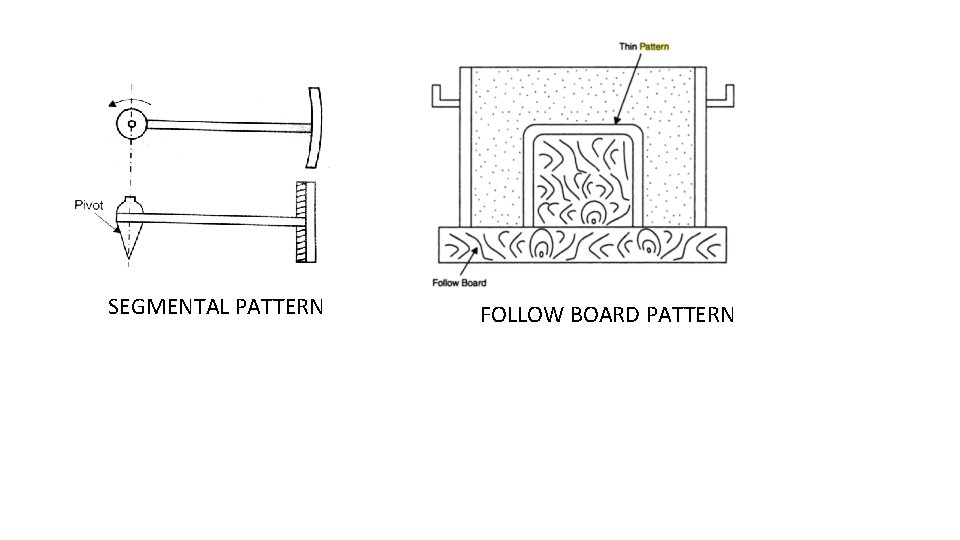
7. Sweep Patterns • It is made on wooden board and it sweeps the shape of the casting into the sand all around the circumference. • Hence it saves lot of labour and time • It is used for production of large circular sections and symmetrical shapes. • Applications: Large kettles of cast irons 8. Segmental pattern • It is used for preparing circular castings like rings, gears, wheels, rims, pulleys etc. • It does not revolve continuously like sweep pattern, instead prepares the mould by parts. • It completes one portion of the mould and then moves to next position to make the next part of the mould and so on till the mould is completed.
9. Follow board pattern • It is a wooden board used to support thin and fragile pattern during ramming • It acts like a seat for pattern • Application: It is used for casting master patterns for many applications. 10. Shell pattern: • It is a hollow construction and its outside shape is used as pattern while inside is used as core box • It is made in two halves and are accurately dowled together along parting line • Application: Cast iron pipes and pipe fittings
Gated Pattern SKLETON PATTERN SWEEP PATTERN
SEGMENTAL PATTERN FOLLOW BOARD PATTERN
Pattern Materials • The pattern is made from the following materials. Wood, Metal , Plastic , Plaster Wax Wood Patterns: • These are used where the no. of castings to be produced is small and pattern size is large. Commonly used woods for making patterns: Teak , Pine , Mahogany Deodar etc. . • Advantages: • Inexpensive, Easily available in large quantities, Easy to fabricate, Light in weight They can be repaired easily, Easy to obtain good surface finish • Limitations : • Susceptible to shrinkage and swelling, Possess poor wear resistance, Abraded easily by sand action, Absorb moisture and consequently get wrapped, Cannot withstand rough handling, Life is very short
• Metal Patterns: • These are employed where large no. of castings have to be produced from same patterns. Commonly used metals for making patterns: Cast iron Aluminium and its alloys, Steel, White metal, Brass etc. . • Advantages : • Do not absorb moisture, More stronger, Possess much longer life, Do not wrap, can retain their shape, Greater resistance to abrasion, Accurate and smooth surface finish, Good machinability • Limitations : • Expensive, Require a lot of machining for accuracy, Not easily repaired Ferrous patterns get rusted, Heavy weight , thus difficult to handle • Common metals used as pattern are a)Steel Advantages: possess good strength, machinability, wear resistance, repairability Limitation: High weight and poor resistance to rust and corrosion
b)Cast iron Advantages: Cheap, cast to any shape, good machinability, resistance to abration, strength and good surface finish Limitations: Excessive weight, hard, brittle and easy to break c)Brass(Cu-Zn alloys) Advantage: High strength, resistance to corrosion, good machinability, joined easily by soldering or brazing, used for small cast parts Limitations: High cost d)Al and its alloys Advantages: Light in weight, resistance to corrosion, good strength, machinability and surface finish Limitation: Do not withstand rough handling, subjected to wear by abrasive action of sand
• Plastic Patterns: Advantages: Moisture resistant, strong, light weight dimensionally stable, resistance to wear, corrosion and chemical attack, smooth surface finish Limitations: Fragile, so light section requires metal reinforcement, not suitable when subject to severe shock as in machine moulding (jolting). The most generally used plastics are Epoxy resins • Plaster Patterns: • Made out of Plaster of Paris or Gypsum cement. • Advantages: It can be easily worked by using wood working tools, Intricate shapes can be cast • • • , high compressive strength. Limitation: It cannot be used for mass production of casting Wax patterns: Wax patterns find applications in Investment casting process. Wax patterns are produced form paraffin wax, shellac wax and bees wax. Advantage: Possess good surface finish, dimensional accuracy Limitation: Since wax pattern are removed by heating, hence a pattern can be used once
PATTERN ALLOWANCE • A pattern is always made larger than the required size of the casting considering various allowance due to mechanical(machining, draft, distortion, shake allowance) and metallurgical reasons(shrinkage). 1. SHRINKAGE(CONTRACTION) ALLOWANCE : • To compensate for volumetric contraction during solidification of metal. • A wooden pattern used to make metal patterns are given double allowance; one for the shrinkage of the metal of the pattern and other for the metal to be cast • Shrinkage allowance for various metals are Cast iron and Malleable iron : 10 mm per meter Steel : 20 mm per meter Brass, Copper, Aluminium : 15 mm per meter
PATTERN ALLOWANCE 2. DRAFT or TAPER ALLOWANCE : • The allowance given for easy removal of pattern from sand without damaging mould cavity. • Slight taper or draft is provided to all vertical surface of pattern • Amount of taper varies from 10 to 25 mm/metre for external surface; 40 to 65 mm/metre for internal surface 3. MACHINING ALLOWANCE : • To remove surface roughness and other imperfections from casting • Allowance is given to provide compensation during machining. • Depends on finish requirement, product complexity and type of material to be cast. Amount of this allowance varies from 1. 5 to 12 mm
4. DISTORTION(CAMBER) ALLOWANCE: • For casting having irregular shape or uneven thickness, the contraction is not uniform throughout; will tend to wrap or distort during cooling • Distortion can be practically eliminated by constructing the pattern initially distorted in opposite direction. Eg: For U or V shaped castings the leg will diverge. To compensate this, the legs of pattern are made converging so that after casting, the product will have the legs parallel 5. SHAKE or RAPPING ALLOWANCE: • When pattern is rapped or shaked before it is withdrawn, the mould cavity is slightly enlarged. • A negative allowance is provided by making the pattern slightly smaller in size to compensate for this
TYPES OF SAND USED IN MOULD 1. Green sand • Sand in natural or moist condition • It is a mixture of silica sand with 5 to 20 % clay, having total amount of water from 5 to 8 % • Used for small size casting of ferrous and non ferrous alloys 2. Dry sand • Green sand moulds when baked or dried before pouring the molten metal are called dry sand moulds • It possess greater strength, rigidity and thermal stability than green sand moulds • The dry sand moulds are used for making large and heavy casting
3. Loam Sand • It is a mixture of 50% sand 50% clay • Moulds for casting large bells, cylinders etc. are made up of brick framework and lined with loam sand dried 4. Facing sand • It is a specially prepared moulding sand which covers the pattern from all around • Since it comes in contact with the molten metal when poured, it should possess high strength and refractoriness 5. Backing sand or flour sand • Sand used to back up the facing sand not used next to pattern • Old repeatedly used moulding sand is used for this purpose
6. System Sand • Reclaimed sand used in mechanised foundries • Here used sand is cleaned and reactivated by the addition of water, binder and special additives 7. Parting Sand • It is sprinkled on the pattern and pattern surface of the mould so that the sand masses of cope and drag separates without clinging and do not stick to the pattern 8. Core sand(Oil sand) • It used for the preparation of cores • It is prepared by mixing silica sand core oil composed of linseed oil, resin and other binding materials • It possess high strength, permeability, refractoriness and collapsibility
Composition of moulding sand 1. Silica sand: • Major constituent of moulding sand(80 to 82 %) • It is product of breaking up of quartz rocks • It is essentially silicon dioxide (Si 02) found in nature on the bottoms and banks of rivers, lakes and seashore. • Pure silica sand lacks binding quality 2. Binders: • Holds the sand grains together, impart strength, resistance to erosion and breakage • Organic binders : Linseed oil, Dextrin, Resin etc. • Inorganic binders: Fire clay, Bentonite, Illite, Kaolinite etc.
3. Additives: • Materials other than binders to develop certain desirable properties in moulding sand • Sea coal, silica flour, wood flour and iron oxide are a few commonly used additives. • Sea coal improves surface finish; Silica flour increases hot strength and resists metal penetration; Graphite increases mouldability and improves surface finish; Wood flour increases flowability and collapsibility of sand 4. Water: It is responsible for moulding action of clays, the amount of which may vary from 1. 5% to 8 %
CORES • Cores are materials used for producing holes and interior cavities in casting • Core is an obstruction positioned in the mould, which does not permit molten metal to fill the space occupied by the core, thus produce hollow casting • Cores are placed in the mould in specially created cavities called core prints • Cores must possess sufficient strength to resist erosion during filling of metal, high permeability, refractoriness and collapsibility, dimensional stability with minimum expansion and contraction • They are made up of sand, metal, plaster or ceramics • Cores are used to form air space between the cooling fins of an air cooled engine, to make water cooling chamber in IC engines etc.
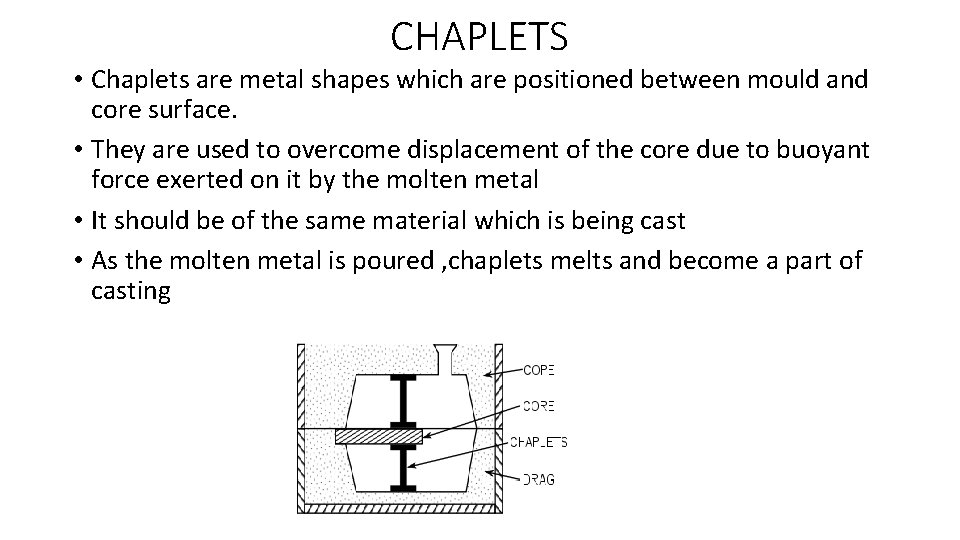
CHAPLETS • Chaplets are metal shapes which are positioned between mould and core surface. • They are used to overcome displacement of the core due to buoyant force exerted on it by the molten metal • It should be of the same material which is being cast • As the molten metal is poured , chaplets melts and become a part of casting
MOULDING PROCESS I. According to the method used a) Bench molding • It is carried out in benches of convenient height • It is used for making small molds • Both green and dry sand molds can be made by bench molding b) Floor molding • Molding work is carried out on foundry floor • It is used for making medium and large-sized castings • Mold has its drag portion in the floor and cope portion may be rammed in a flask and inverted on the drag. • Both green and dry sand moulds can be made by floor molding
c) Pit molding • Very big castings which cannot be made in flasks are moulded in pits dug on the floor. • The mold has its drag part in the pit and a separate cope is rammed and used above the (pit) drag. • In pit molding, the molder may enter the drag and prepare it. • The sides of the (pit) drag are lined with brick and the bottom is covered with molding sand. • The cope (a separate flask) is rammed over the pit (drag) with pattern in position. • The mold is dried by means of a stove(heater) placed in the pit.
d) Machine molding • In bench, floor and pit molding, the different molding operations are carried out manually by the hands of the molder, whereas in machine molding, various molding operations like sand ramming, forming gate, withdrawing the pattern etc. are done by machines. • Machines performs these operations much faster, more efficiently and in a much better way. • Molding machines produce identical and consistent castings of better quality and at lower costs. • Molding machines are preferred for mass production of the castings whereas hand molding (bench, pit and floor) is used for limited production. • A few different types of molding machines are listed below: • Jolt machine • Squeeze machine • Jolt-squeeze machine • Sand Slinger
II. According to the mould materials used (A)Sand moulding a. Green sand moulding • It consists of silica sand, clay, water and other additives • The mould is not dried and metal is poured while the mould cavity is still green • Used for casting small and medium size casting of ferrous and non ferrous alloys • Advantages: least expensive method, require less time to prepare, does not require drying or baking, moulding flask are ready to use in minimum time • Disadvantages: Lower strength, less permeable, more chances of defects like blow holes, more chance for mould erosion, less surface finish
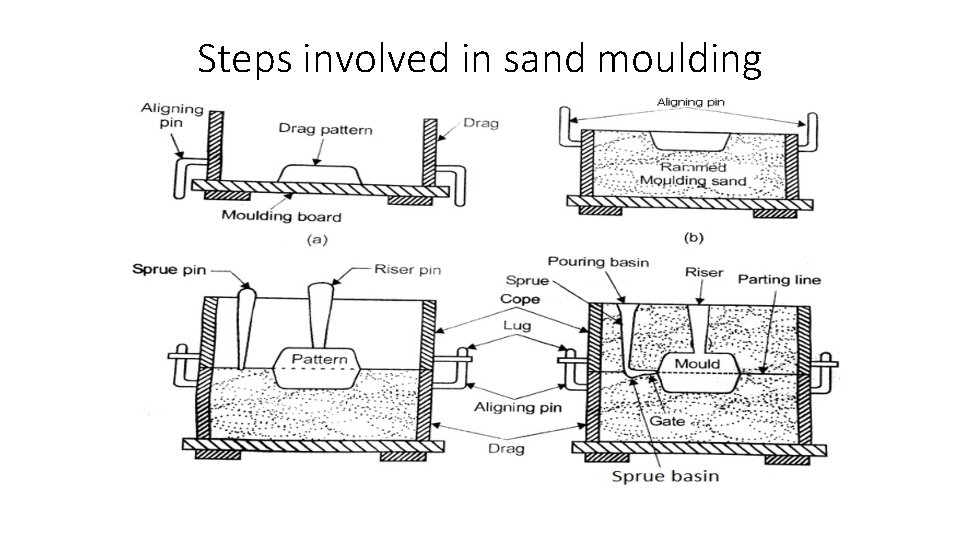
STEPS INVOLVED IN SAND MOULDING(Turn over method) • Drag is placed upside down on a moulding board • Pattern half is kept centrally on the board inside the flask • Ram up the sand in drag • Excess sand is levelled off with a strike of bar • Invert the drag and fix the second half of the pattern in position • Place cope over the drag • Ram up sand in the cope after placing the sprue and riser pins in position. • Strike off the excess sand
STEPS INVOLVED IN SAND MOULDING(Turn over method) • Remove the sprue and riser pins • Lift the cope from the drag • Remove the split pattern • Repair mould if necessary and cut gate in the drag • Invert cope over drag and are aligned with the help of pins • Vent holes are made to allow the free escape of gases from the mould during pouring. • The mould is ready for pouring
Steps involved in sand moulding
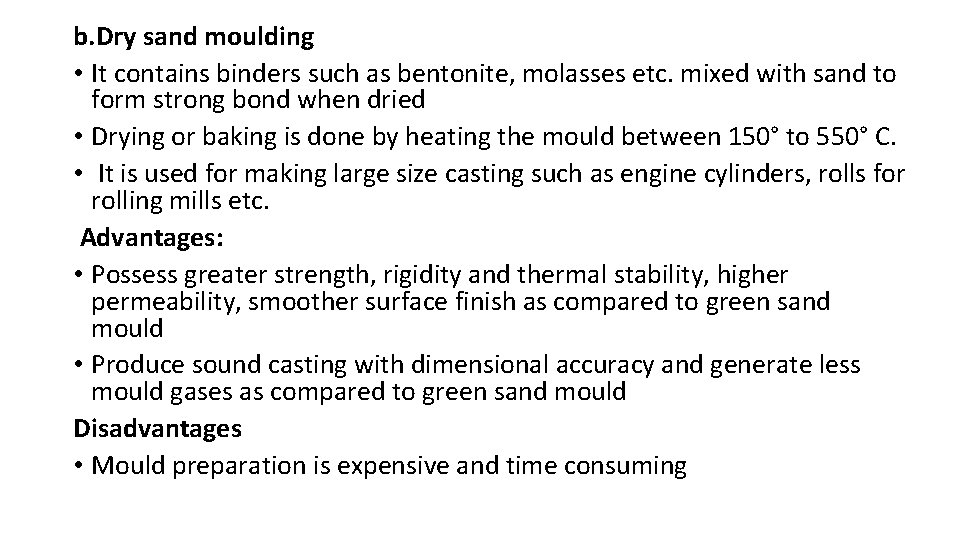
b. Dry sand moulding • It contains binders such as bentonite, molasses etc. mixed with sand to form strong bond when dried • Drying or baking is done by heating the mould between 150° to 550° C. • It is used for making large size casting such as engine cylinders, rolls for rolling mills etc. Advantages: • Possess greater strength, rigidity and thermal stability, higher permeability, smoother surface finish as compared to green sand mould • Produce sound casting with dimensional accuracy and generate less mould gases as compared to green sand mould Disadvantages • Mould preparation is expensive and time consuming
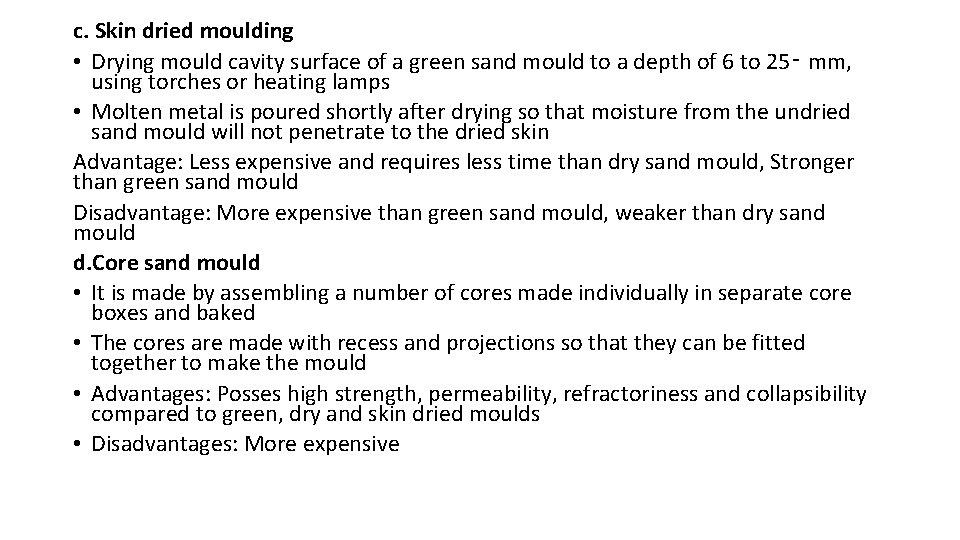
c. Skin dried moulding • Drying mould cavity surface of a green sand mould to a depth of 6 to 25‑ mm, using torches or heating lamps • Molten metal is poured shortly after drying so that moisture from the undried sand mould will not penetrate to the dried skin Advantage: Less expensive and requires less time than dry sand mould, Stronger than green sand mould Disadvantage: More expensive than green sand mould, weaker than dry sand mould d. Core sand mould • It is made by assembling a number of cores made individually in separate core boxes and baked • The cores are made with recess and projections so that they can be fitted together to make the mould • Advantages: Posses high strength, permeability, refractoriness and collapsibility compared to green, dry and skin dried moulds • Disadvantages: More expensive
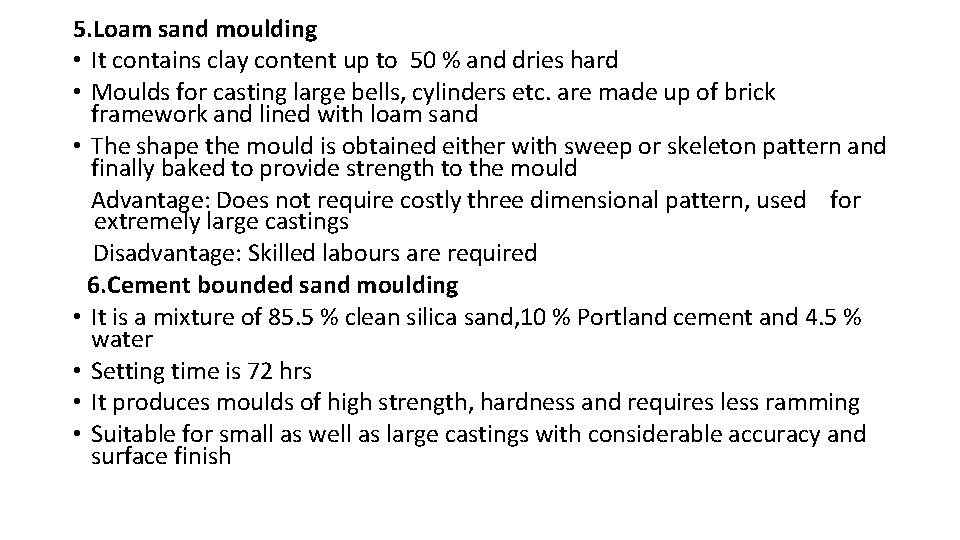
5. Loam sand moulding • It contains clay content up to 50 % and dries hard • Moulds for casting large bells, cylinders etc. are made up of brick framework and lined with loam sand • The shape the mould is obtained either with sweep or skeleton pattern and finally baked to provide strength to the mould Advantage: Does not require costly three dimensional pattern, used for extremely large castings Disadvantage: Skilled labours are required 6. Cement bounded sand moulding • It is a mixture of 85. 5 % clean silica sand, 10 % Portland cement and 4. 5 % water • Setting time is 72 hrs • It produces moulds of high strength, hardness and requires less ramming • Suitable for small as well as large castings with considerable accuracy and surface finish
7. Carbon dioxide (CO 2) moulding(Sodium silicate process) • It employs a mixture of sand 2 to 6 % liquid silicate binder such as sodium silicate (Na 2 Si. O 3). • Moulding mixture is hardened by blowing CO 2 gas through it for 15 -30 sec • The sand immediately becomes extremely strong bond because of the formation of silica gel • The gel is responsible for giving necessary strength to mould • Advantages Disadvantages Instantaneous strength development, Since the process uses relatively safe carbon dioxide gas, it does not present any odour while mixing and pouring, hence safe to human operators. Very little gas evolution during pouring of molten metal. • Disadvantages: Poor collapsibility of moulds, poor flowability, significant loss in the strength and hardness on extended storage. Over gassing and under gassing adversely affects the properties of cured sand.
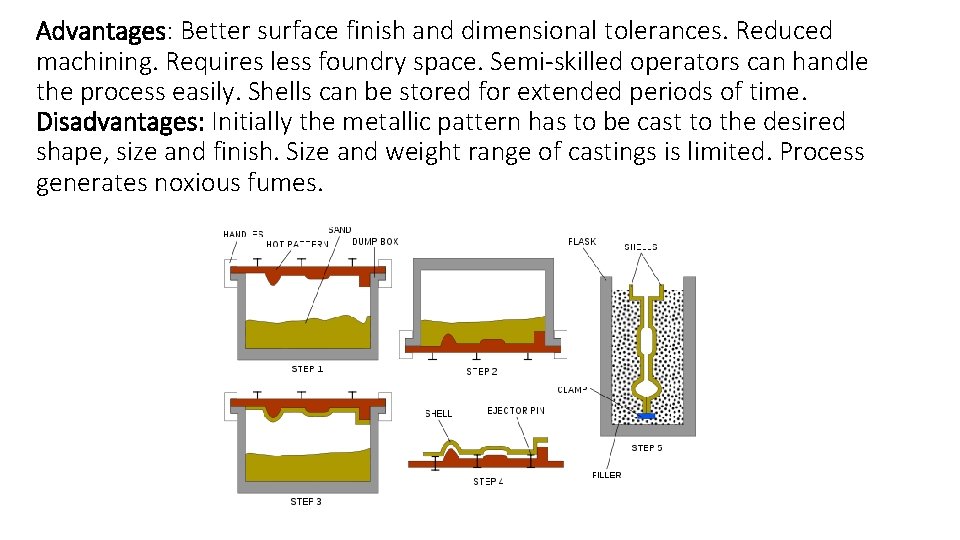
8. Shell Moulding • Known as Corning or C process • A metallic pattern having the profile of the required casting is heated to 250 C in an oven , is turned face down and clamped over the open end of the dump box containing sand resin mixture • The dump box is inverted so that the sand resin mixture falls on to the pattern, gets heated up and form a uniform shell of 4 to 6 mm • As the dump box is turned to its original position the excess sand falls down. Pattern with shell is baked in an oven • The shell is stripped from the pattern plate with the help of ejector pins • Two such shells are joined together to form a complete mould
Advantages: Better surface finish and dimensional tolerances. Reduced machining. Requires less foundry space. Semi-skilled operators can handle the process easily. Shells can be stored for extended periods of time. Disadvantages: Initially the metallic pattern has to be cast to the desired shape, size and finish. Size and weight range of castings is limited. Process generates noxious fumes.
B. Plaster moulding • Slurry is made of plaster of Paris (gypsum ‑ Ca. SO 4‑ 2 H 2 O) and ingredients such as talc, asbestos fibre, silica flour and water • Slurry is poured over the pattern and allowed to set • The pattern is withdrawn and backed in an oven at about 200 C • Two mould half are made separately and assembled for pouring • Advantages of plaster mold casting: • Good accuracy and surface finish • Capability to make thin cross‑sections • Disadvantages: • Mold must be baked to remove moisture, which can cause problems in casting • Mold strength is lost if over-baked • Plaster molds cannot stand high temperatures, so limited to lower melting point alloys
C. Ceramic moulding • Aggregate consists of silica grains, ethyl silicate, water, alchol and gelling agent such as HCL • The slurry is poured around the pattern and allowed to gel in about 4 to 7 minutes • Pattern is removed and baked before pouring Advantages: Good accuracy and surface finish Disadvantages: Process is expensive D. Metallic Moulding • Made up of metals. Can be reused many times • Also called permanent mould casting or die casting • Two types • Gravity die casting – molten metal is poured into mould cavity under gravity • Pressure die casting - molten metal is forced into mould cavity under pressure
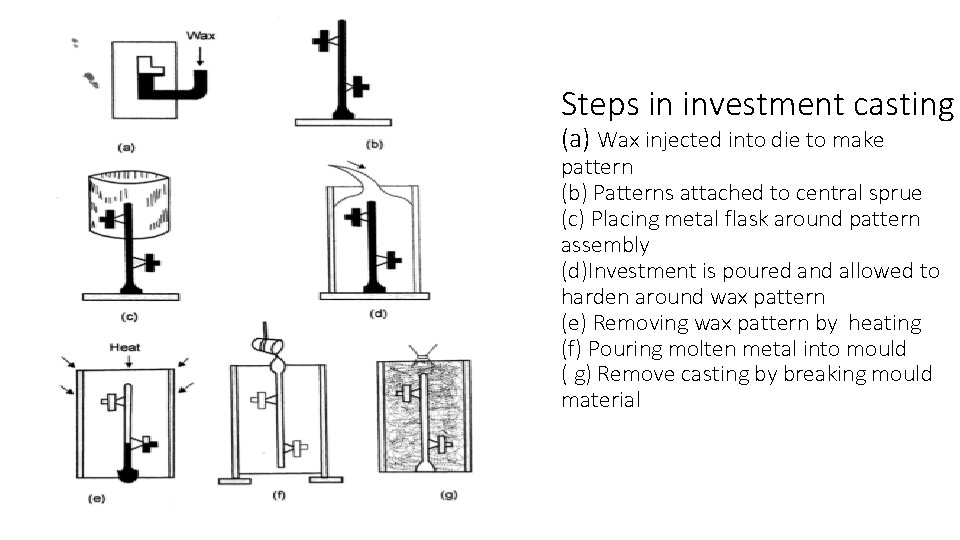
E. Investment casting(lost wax casting or precision casting) • The pattern is made of wax and is coated with refractory slurry(known as investment) • Once the ceramic material solidifies, the wax replica is melted and drained out from the mould and the metal is poured into the mould cavity • Advantages: Good surface finish and dimensional tolerances, eliminates machining of cast parts. Wax can be reused. • Disadvantages: Process is expensive, Size and weight range of castings is limited
Steps in investment casting (a) Wax injected into die to make pattern (b) Patterns attached to central sprue (c) Placing metal flask around pattern assembly (d)Investment is poured and allowed to harden around wax pattern (e) Removing wax pattern by heating (f) Pouring molten metal into mould ( g) Remove casting by breaking mould material
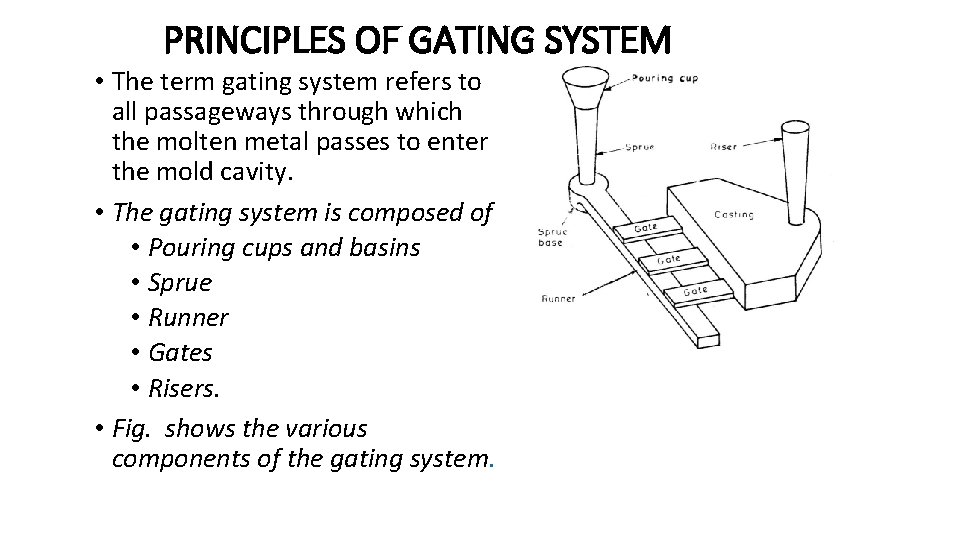
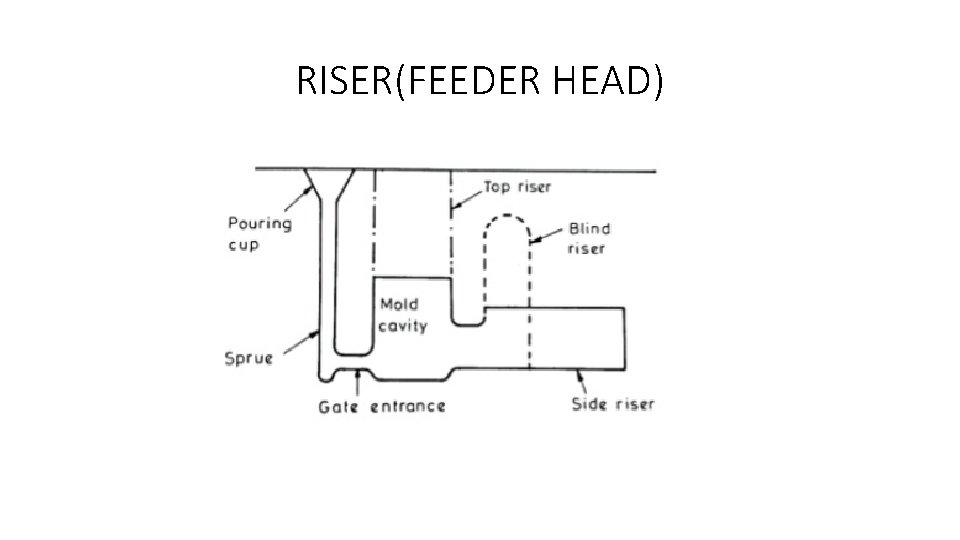
PRINCIPLES OF GATING SYSTEM • The term gating system refers to all passageways through which the molten metal passes to enter the mold cavity. • The gating system is composed of • Pouring cups and basins • Sprue • Runner • Gates • Risers. • Fig. shows the various components of the gating system.
REQUIREMENTS, PURPOSES OR FUNCTIONS OF THE GATING SYSTEM • A Gating system should, • fill the mold cavity completely before freezing; • introduce the liquid metal into the mold cavity with low velocity , so that mold erosion, metal oxidation and gas pickup is prevented; • incorporate traps for the separation of non metallic inclusions which are either introduced with the molten metal • regulate the rate at which liquid metal enters into the mold; • be practicable and economical to make and; • consume least metal. In other words, the metal solidified in sprue, runner, gates and risers should be minimum because gates, risers etc. , are removed from the final casting
Elements of Gating system (a) POURING CUP • It is a funnel shaped cup which forms the top portion of the sprue • Reduces turbulence at the sprue entrance • Prevent entry of slag or dirt etc. before it enters the sprue. (b) SPRUE • A Vertical passage which connects the pouring basin with runner. A sprue is tapered with its bigger end at top to receive the liquid metal. The smaller end is connected to runner. (c) SPRUE BASE(SPRUE WELL) • It act as a reservoir for molten metal • Trap loose sand other undesirable particles
(d)Runner • Passage provided in large castings through which molten metal is carried from sprue base to gates • For small casting with single gate, runner is not provided. Molten metal directly enters the gate (e)gates(in gates) • A gate is a channel which connects runner with the mould cavity and through which molten metal flows to fill the mould cavity. • Types : Top gate, Bottom gate, Parting line side gate
• Riser(Feeder head) • Riser is a source of extra metal which flows from riser to mould cavity to compensate for shrinkage which takes place in the casting when it starts solidifying. Without a riser heavier parts of the casting will have shrinkage defects, either on the surface or internally. • Risers are of two types; open riser and blind riser • Open riser is exposed to atmosphere where as blind riser is closed at its top • A riser should be provided close to heaviest portion of casting preferably on top • It should be large enough so that its solidification takes place last after complete solidification of casting • Functions of Risers • Provide extra metal to compensate for the volumetric shrinkage • Allow mould gases to escape • Promotes directional solidification • Applies sufficient feeding pressure so that mould is completely filled
RISER(FEEDER HEAD)
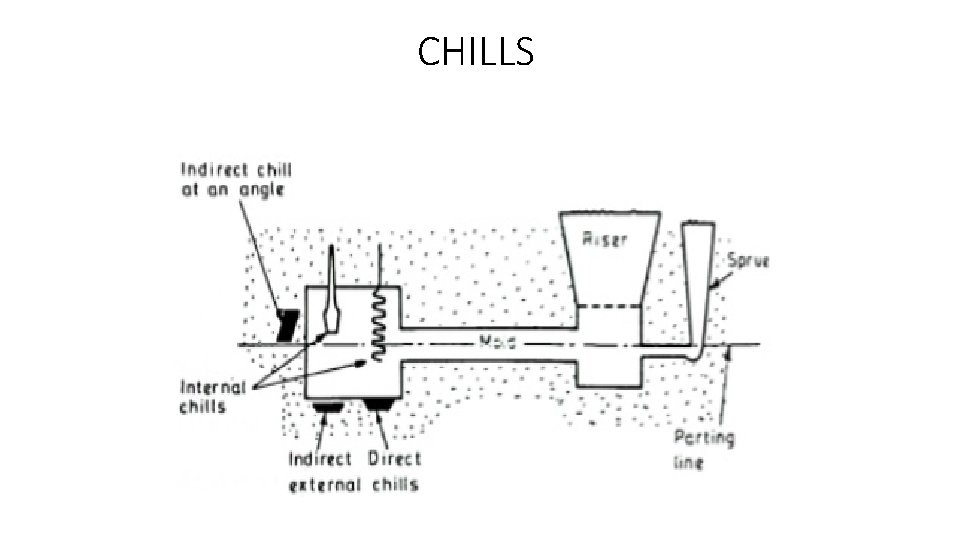
CHILLS • Metal pieces inserted in casting which promotes directional solidification • Thinner section cools faster than thicker ones resulting in uneven contraction and distortion • This can be over come by inserting metal chills in thicker section to accelerate cooling rate • Chills are of two types: Internal and External 1. Internal chills: Placed in the mould cavity and forms a part of casting. Made of same metal as the casting. 2. External chills: Placed adjacent to mould cavity. Two types(a)Direct external chill is flush with the mould cavity wall and comes in direct contact with molten metal. (b)Indirect external chills does not come in direct contact with the molten metal. They are rammed and embedded behind the mold cavity wall
CHILLS
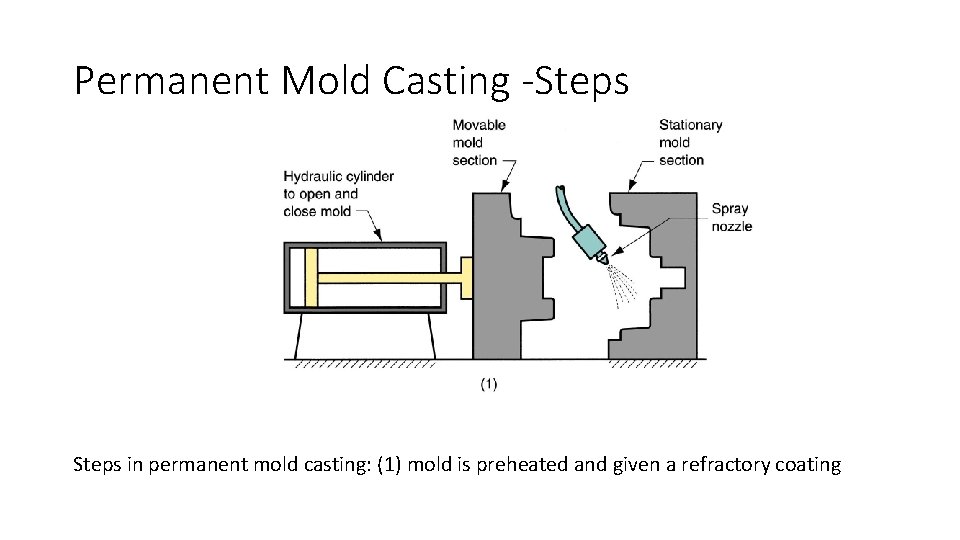
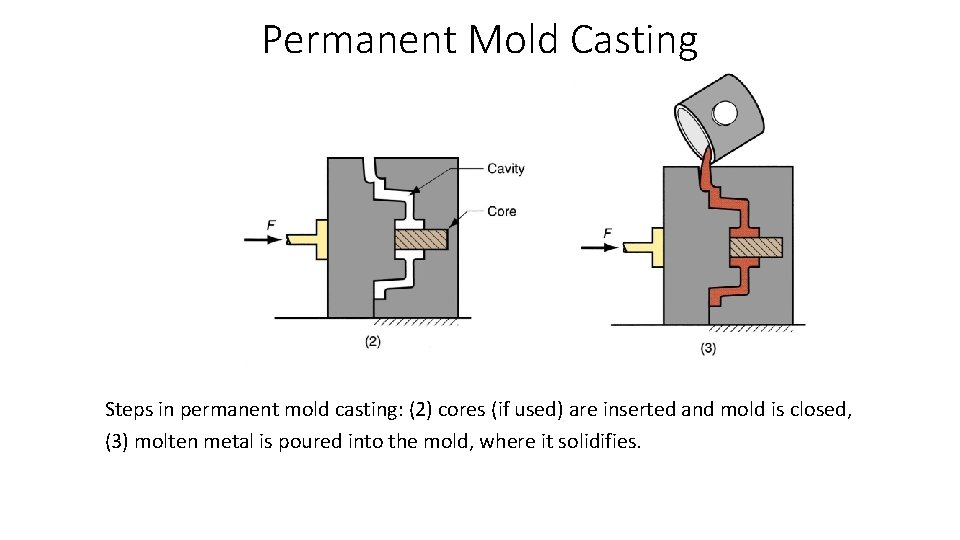
Permanent mould casting or Gravity Die Casting • Molten metal is poured under gravity into a refractory coated permanent mould or die made up of cast iron • These moulds are made in two halves and can be reused many times • Pouring cup, sprue, gates and riser are built in the mould halves itself • The mould is preheated and coated with refractory materials • Mould halves are closed and liquid metal is poured into it under gravity • Casting are ejected from the mould after solidification • The process is mainly used for aluminium, magnesium, copper alloys and grey cast iron • Application: Carburator bodies, Automotive piston, Hydraulic brake cylinders, Oil pump bodies etc
Permanent Mold Casting -Steps in permanent mold casting: (1) mold is preheated and given a refractory coating
Permanent Mold Casting Steps in permanent mold casting: (2) cores (if used) are inserted and mold is closed, (3) molten metal is poured into the mold, where it solidifies.
Advantages and Limitations • Advantages of permanent mold casting: • Good surface finish and close dimensional control. • More rapid solidification, finer grain structure, stronger castings. • Casting are free from defects Limitations: • Generally limited to metals of lower melting point • Simpler part geometries compared to sand casting • High cost of mould
Die Casting • Use permanent metal moulds or dies • Molten metal is injected into mold cavity under pressure • Pressure is maintained during solidification, then mold is opened and part is removed • Suitable for making small and medium size castings of non ferrous metals such as zinc, aluminium, magnesium, lead, tin and their alloys. • Advantages: • • • Economical for large production quantities Good accuracy and surface finish Close dimensional tolerance Thin sections are possible Life of die is long Less floor space needed Labour cost is low Free from casting defects Rapid cooling provides small grain size and good strength to casting
Die Casting • Disadvantages: • Generally limited to metals with low metal points(Only non ferrous metal can be cast) • Not suitable for low production • Limitation in size of casting to be made(Heavy section cannot be cast) • Special skill is required for operating machine • Die casting unit are costly
DIE CASTING MACHINE A. Hot‑chamber (goose neck machine) 1. Operated by plunger 2. Operated by compressed air(Air injection type) B. Cold‑chamber machine
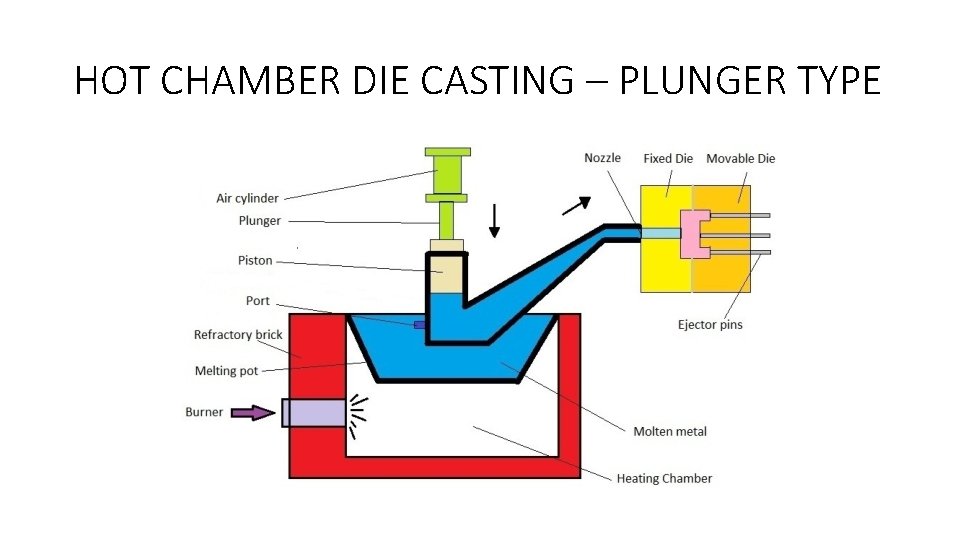
Hot chamber Die Casting machine • Melting unit is an integral part of machine • Consists of a hot chamber and a gooseneck type metal container Plunger type : • Operated by pneumatically operated plunger • Plunger acts inside a cylinder connected to one end of a gooseneck container and is submerged in the metal • When plunger is in up position metal enters the cylinder through a port • As plunger moves down, the port get closed and molten metal is forced into the die cavity at a pressure of 70 to 140 bar • When metal is solidified die is opened and casting is ejected • Die is then closed, plunger is drawn to up position and cycle is repeated
HOT CHAMBER DIE CASTING – PLUNGER TYPE
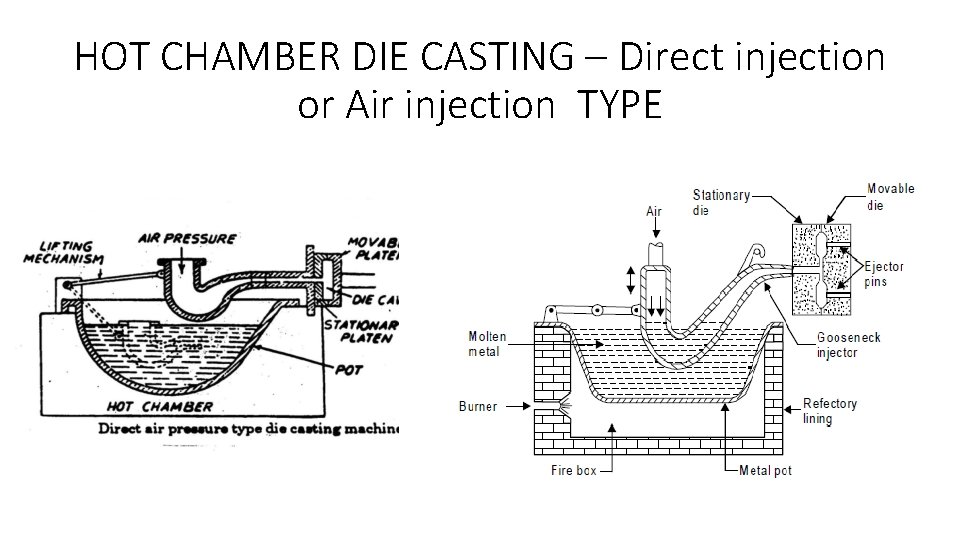
Air injection or Direct injection type • Molten metal is forced into the die cavity at a pressure of 30 to 45 bar • Provided with suitable mechanism raise or lower the gooseneck • When gooseneck is lowered it receives the molten metal from the pot • Then it is raised and held in position against nozzle • Compressed air is blown in to the gooseneck which forces the metal to fill the die cavity • After solidification casting is ejected • The gooseneck is again lowered, die is closed and whole cycle is repeated • This type of machine is simple in construction, no moving parts like plunger
HOT CHAMBER DIE CASTING – Direct injection or Air injection TYPE
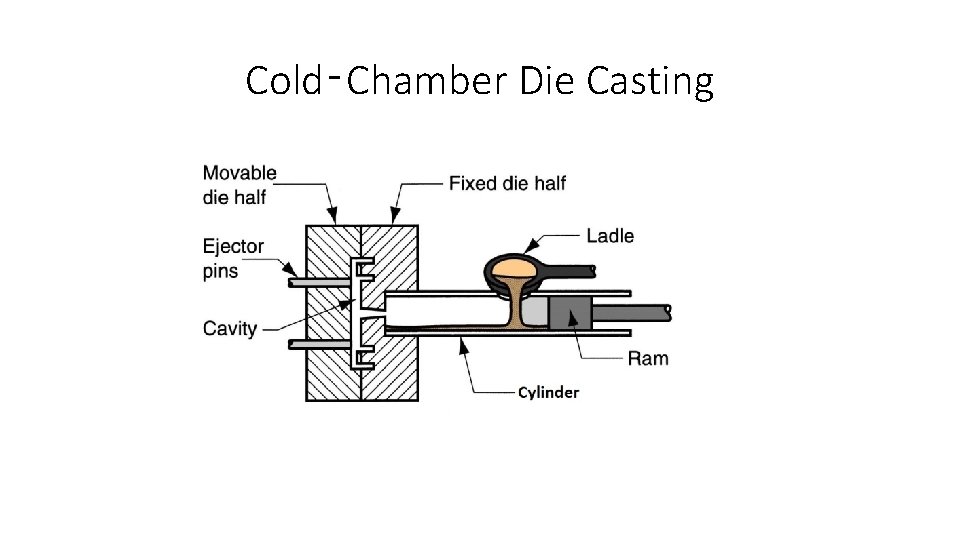
Cold‑Chamber Die Casting Machine • Metal is melted in a separate furnace, then transferred to the die casting machine where a measured quantity is fed into injection cylinder • The plunger is pushed hydraulically to force molten metal into the die cavity at a pressure of 200 to 2000 bar • After solidification die is opened and casting is ejected • Casting metals: Aluminum, copper, and magnesium alloys • Casting produced are of great density and dimensional accuracy, but production rate is low
Cold‑Chamber Die Casting
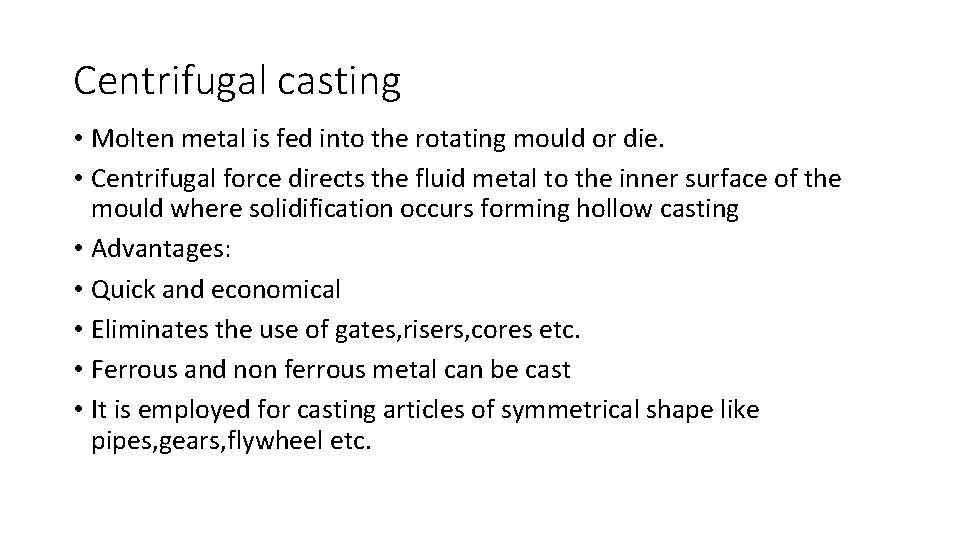
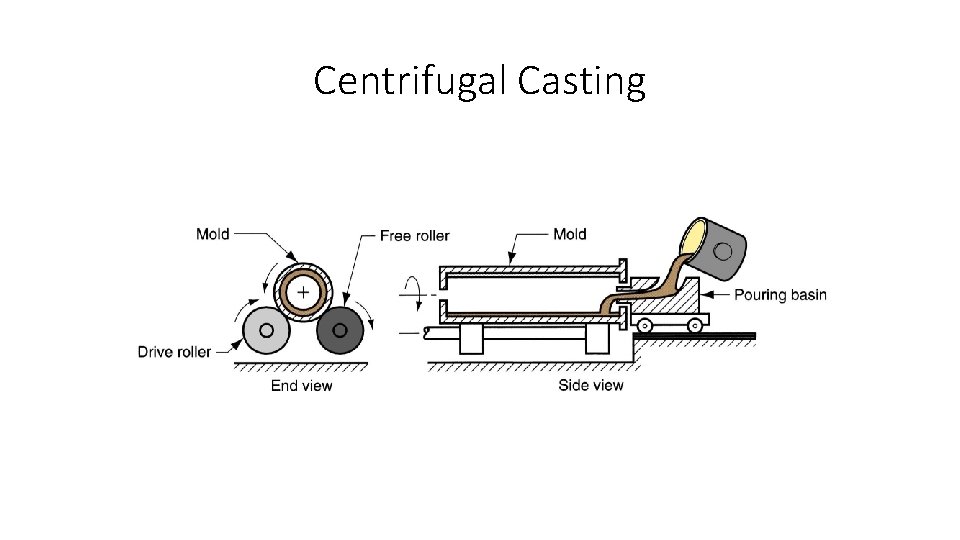
Centrifugal casting • Molten metal is fed into the rotating mould or die. • Centrifugal force directs the fluid metal to the inner surface of the mould where solidification occurs forming hollow casting • Advantages: • Quick and economical • Eliminates the use of gates, risers, cores etc. • Ferrous and non ferrous metal can be cast • It is employed for casting articles of symmetrical shape like pipes, gears, flywheel etc.
Centrifugal Casting
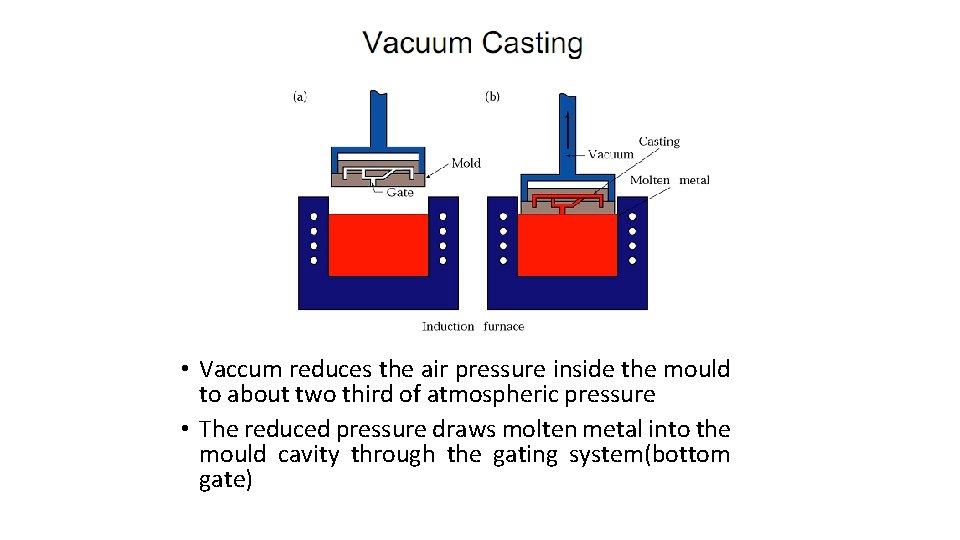
• Vaccum reduces the air pressure inside the mould to about two third of atmospheric pressure • The reduced pressure draws molten metal into the mould cavity through the gating system(bottom gate)
CLEANING AND FINISHING EQUIPMENT • Fettling is the operation of cleaning and finishing of castings • It includes(a) removal of cores and surface cleaning of casting(by using hand tools like hammers, files, wire brush and machines for hydro blasting and shot blasting) • (b) removal of gates, risers, runners, fins and other unwanted projection from castings(shearing machine, hand saws, band saws, grinding machines, oxy-acetylene cutting torch etc. are used for this purpose)