
Fostering Transfer Student Success Through Cross Campus Collaboration
Fostering Transfer Student Success Through Cross Campus Collaboration Russell Morrow, M. Ed, Program Coordinator, The Ohio State University Maia Randle, Ph. D. , PI and Program Coordinator, Columbus State Community College
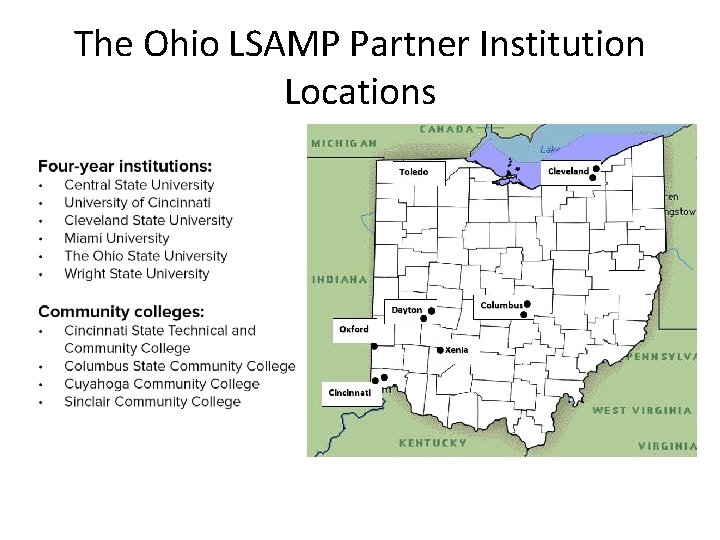
The Ohio LSAMP Partner Institution Locations
National Statistics for Community College Transfer • Approximately 1 out 4 students transfer to a 4 -yr institution in 5 years. • Whereas, approximately 1 out of 6 African. American and Latino students transfer after 7 years.
Underrepresented Transfer Students • Barriers to Success –Lack of Early Momentum –Transfer Paths are Unclear –Transfer Credit Loss –Imposter Syndrome –Over competitive and unfriendly classmates –Unsupportive faculty and staff –Bigger classes –Lack sense of belonging –Rigorous (and often unclear) requirements –Little to no individualized support/attention
Essential Practices • Research based practices for supporting transfer students • • • Outreach Credit Transfer & Application Pathways/Partnerships Web and social media FYE (First Year Experience) & Orientation Advising Environment Partner Collaboration Financial Assistance Data Sharing
Potential Solutions • What can be done to increase the number of URM (underrepresented minority) students transferring from community colleges to 4 -yr institutions? • Two pathways 1) Student Centered Solutions 2) Institutional Based Solutions
Student Centered Solutions • Using community college outreach to motivate and guide URM’s in high schools • Involving URM community college students (ambassadors) in the outreach to high schools • Establish learning communities to help commuters meet other students with similar academic and career goals • Establish peer tutoring and other academic supports for URMs • Creating a “sense of belonging” by hosting various cultural events
Institutional Based Solutions Institutional Changes for Community Colleges • Establishing Transfer Centers • Provide academic and financial counseling • Develop different models of developmental education to reduce the time spent in developmental courses so students have a quicker path to taking courses for college credit (e. g. ) MATH 1099 Bridge to College Math (Columbus State) http: //www. cscc. edu/academics/courses 1617/math. shtml • Facilitating campus visits to local 4 -yr institutions
Institutional Based Solutions Institutional Changes for 4 -yr Institutions • Build strong partnerships between community colleges and universities by utilizing 1) Financial Aid Specifically for URM Transfer Students (could be department/college specific) 2) Transfer Student Orientations 3) Providing transfer students with university peers in similar disciplines 4) Connecting transfer students to faculty/staff who are sensitive to the needs and problems of URM transfer students
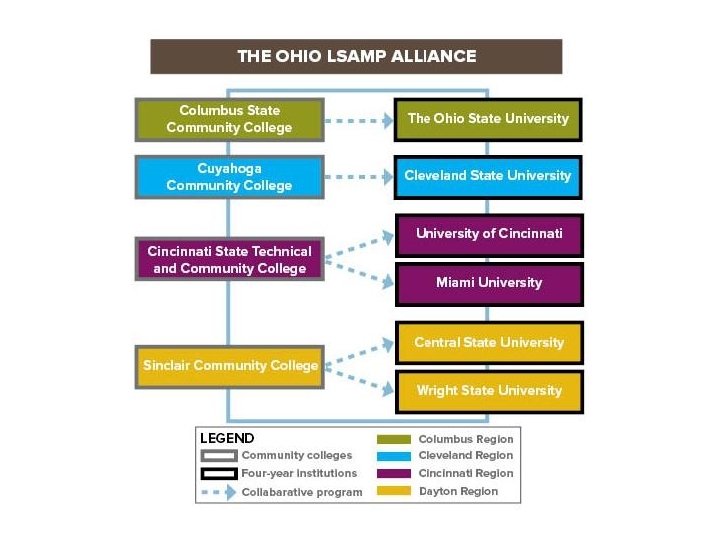

The Ohio LSAMP Alliance Collaborative Initiatives • Peer Mentoring Program – alliance wide program • Shared Bridge Programs – in addition, OSU has a transfer bridge program for CSCC students which provides knowledge of campus resources • Research Experiences for Undergraduates (REUs) • Community College Pathways Task Force a) Keeps track of current articulations and transfer agreements in the alliance b) Uses the Transfer Planning Tool (3 -step guide to transfer planning and worksheet) • Program Coordinator Retreat
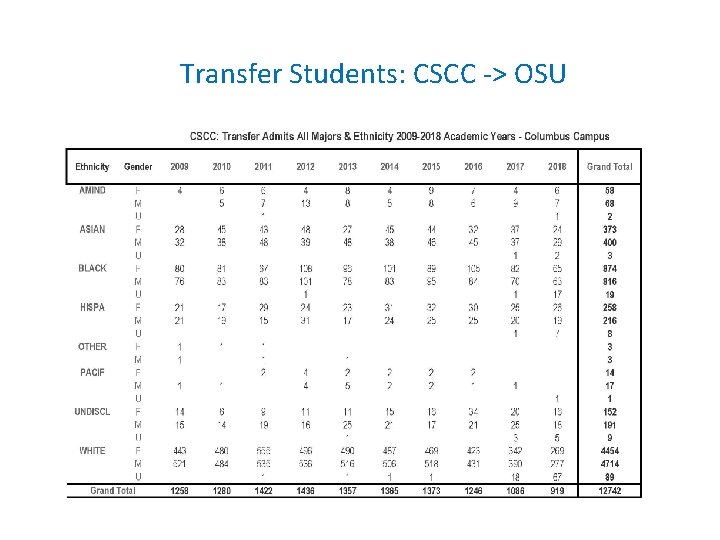
Transfer Students: CSCC -> OSU
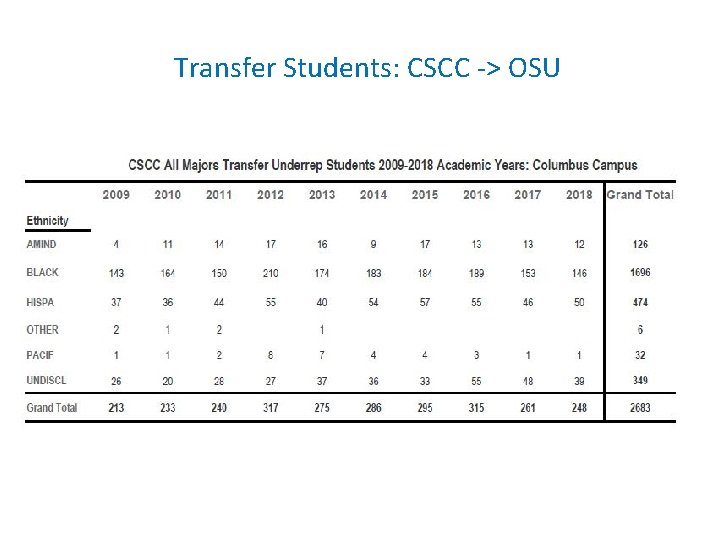
Transfer Students: CSCC -> OSU
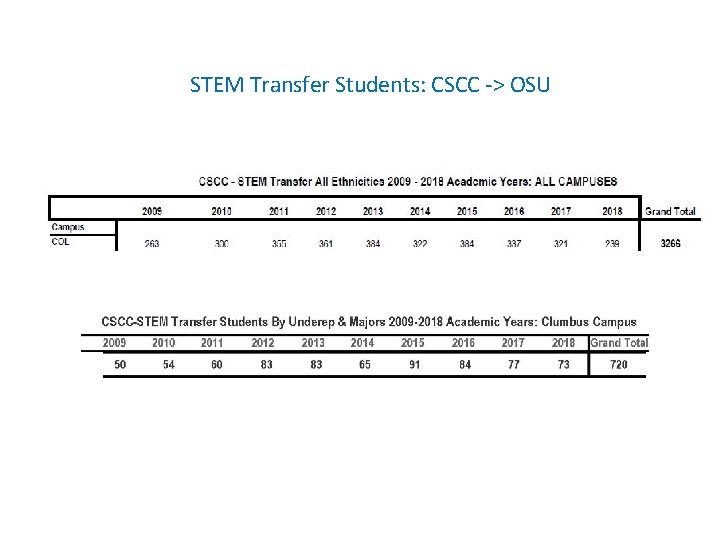
STEM Transfer Students: CSCC -> OSU
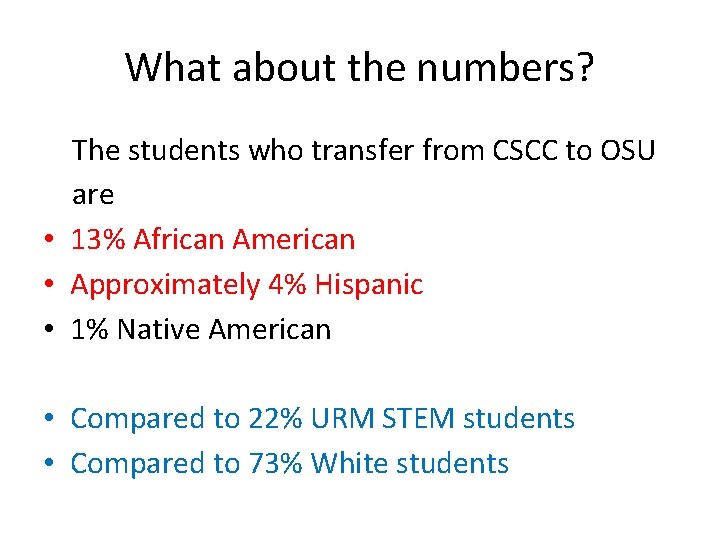
What about the numbers? The students who transfer from CSCC to OSU are • 13% African American • Approximately 4% Hispanic • 1% Native American • Compared to 22% URM STEM students • Compared to 73% White students
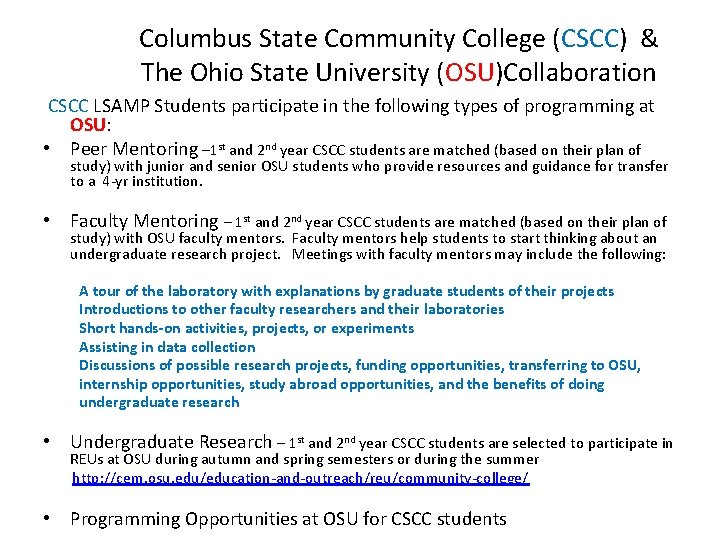
Columbus State Community College (CSCC) & The Ohio State University (OSU)Collaboration CSCC LSAMP Students participate in the following types of programming at OSU: • Peer Mentoring – 1 st and 2 nd year CSCC students are matched (based on their plan of study) with junior and senior OSU students who provide resources and guidance for transfer to a 4 -yr institution. • Faculty Mentoring – 1 st and 2 nd year CSCC students are matched (based on their plan of study) with OSU faculty mentors. Faculty mentors help students to start thinking about an undergraduate research project. Meetings with faculty mentors may include the following: A tour of the laboratory with explanations by graduate students of their projects Introductions to other faculty researchers and their laboratories Short hands-on activities, projects, or experiments Assisting in data collection Discussions of possible research projects, funding opportunities, transferring to OSU, internship opportunities, study abroad opportunities, and the benefits of doing undergraduate research • Undergraduate Research – 1 st and 2 nd year CSCC students are selected to participate in REUs at OSU during autumn and spring semesters or during the summer http: //cem. osu. edu/education-and-outreach/reu/community-college/ • Programming Opportunities at OSU for CSCC students
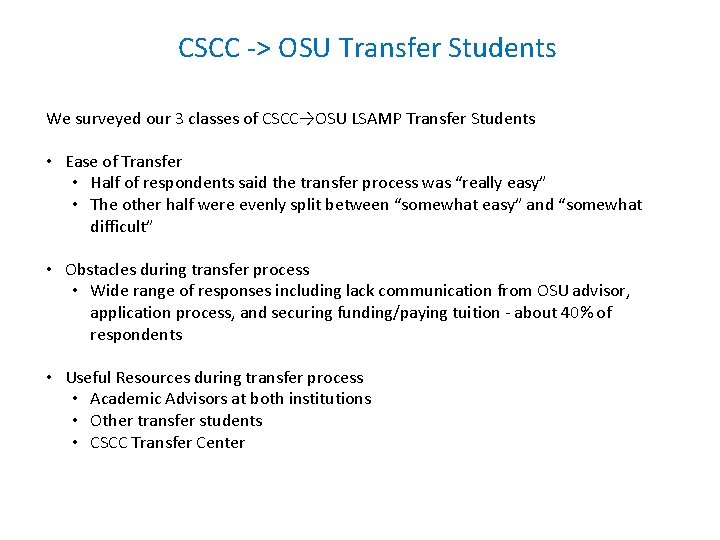
CSCC -> OSU Transfer Students We surveyed our 3 classes of CSCC→OSU LSAMP Transfer Students • Ease of Transfer • Half of respondents said the transfer process was “really easy” • The other half were evenly split between “somewhat easy” and “somewhat difficult” • Obstacles during transfer process • Wide range of responses including lack communication from OSU advisor, application process, and securing funding/paying tuition - about 40% of respondents • Useful Resources during transfer process • Academic Advisors at both institutions • Other transfer students • CSCC Transfer Center
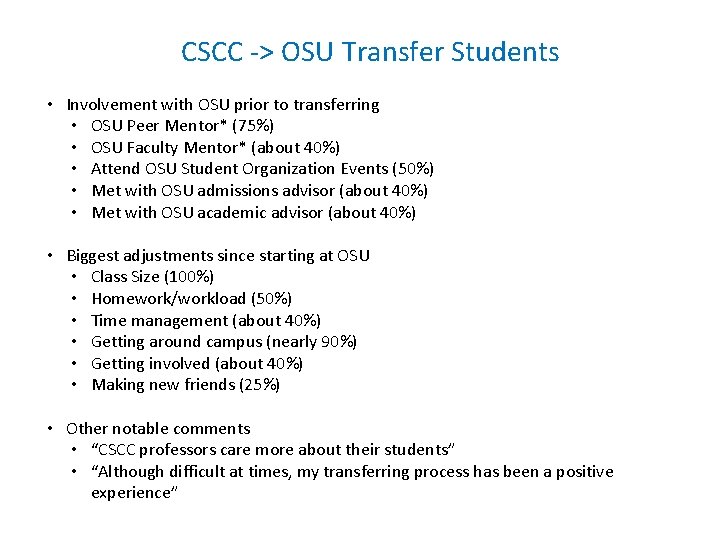
CSCC -> OSU Transfer Students • Involvement with OSU prior to transferring • OSU Peer Mentor* (75%) • OSU Faculty Mentor* (about 40%) • Attend OSU Student Organization Events (50%) • Met with OSU admissions advisor (about 40%) • Met with OSU academic advisor (about 40%) • Biggest adjustments since starting at OSU • Class Size (100%) • Homework/workload (50%) • Time management (about 40%) • Getting around campus (nearly 90%) • Getting involved (about 40%) • Making new friends (25%) • Other notable comments • “CSCC professors care more about their students” • “Although difficult at times, my transferring process has been a positive experience”
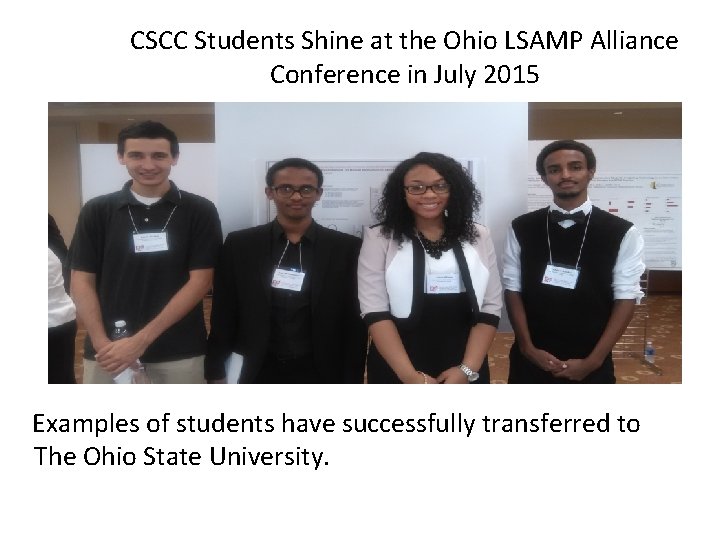
CSCC Students Shine at the Ohio LSAMP Alliance Conference in July 2015 Examples of students have successfully transferred to The Ohio State University.
Sources • Eaton, Judith S. (1991). Encouraging Transfer: Its Impact on Community Colleges. Education Digest, Vol. 57, Issue 1, page 62. 4 p. • Mc. Glynn & Provitera, A. (2013). Creating Better Pathways for Minority Student Transfer. Education Digest, Vol. 78, Issue 7, p 60 -64. 5 p. • https: //ccrc. tc. columbia. edu/media/k 2/attachments/what-we-know-about-transfer. pdf • http: //www. aacc. nche. edu/Publications/Briefs/Documents/04052006 faesbrief. pdf • http: //journals. sagepub. com/doi/pdf/10. 1177/0013124589021003006 • http: //mysite. du. edu/~cdlovell/05 -Inst. Respto. Barriers. pdf • https: //ccrc. tc. columbia. edu/media/k 2/attachments/low-income-minority-completion. pdf • 8. https: //www. durhamtech. edu/reap/atd/Wassmer%20 et%20 al. pdf
Russell Morrow, M. Ed, Program Coordinator The Ohio State University morrow. 307@osu. edu Maia Randle, Ph. D. , PI and Program Coordinator Columbus State Community College mrandle 2@cscc. edu
LSAMP Programming LSAMP Students participate in the following types of programming at CSCC: • Tutoring – students are tutored by CSCC STEM faculty. • STEM Club – exposes students to STEM careers and provides professional development opportunities. • STEM Bridge Program – 1 week program for 1 st yr students which focuses on time management and study skills, knowledge of campus resources, the development of faculty-student relationships, hands-on science labs, engineering activities, and identifying and remediating fundamental misconceptions in chemistry and math. • Community Service Events: We are STEM – CSCC hosts STEM activities for area high schools. Young Men of Color STEM Career Conference – CSCC and COSI co-host science related activities and experiences for 6 -8 th grade young men from area schools. • Individual advising from STEM advisors
- Slides: 22