
Fostering psychological flexibility and nurturing communities through acceptance
Fostering psychological flexibility and nurturing communities through acceptance and mindfulness-based approaches Jennifer Block-Lerner, Ph. D. Amanda Aster, Psy. D. Paola Ricardo, B. A. Morris County Psychological Association May 9, 2018
Important considerations for continuing education Diversity – these types of approaches are being studied across the globe. We will do our best to address issues relevant to individuals from diverse backgrounds and with a variety of demographic characteristics (with diversity defined broadly to include age and life cycle stage, gender identity, race, ethnicity, culture, national origin, religion, sexual orientation, ability status, language, socioeconomic status, immigration status, and level of acculturation, as well as the intersection of these characteristics and implications with regard to power and privilege) Accuracy and utility of materials presented - MCPA/NJPA does not endorse the presented material as the only approach to a given area of study or therapeutic approach. Identification of conflicts of interest and commercial support - One presenter (JBL) is the co-editor of a book on mindfulness-based interventions within the higher education setting. No other conflicts of interest have been identified.
Objectives and intentions Objectives Describe components of the psychological flexibility model Explore ways to model and promote a therapeutic stance consistent with ACT and other mindfulness- and acceptance-based approaches Develop practices consistent with ACT and other mindfulness- and acceptance-based approaches that aim to foster psychological flexibility and nurturing communities with a wide range of populations Intentions and stance
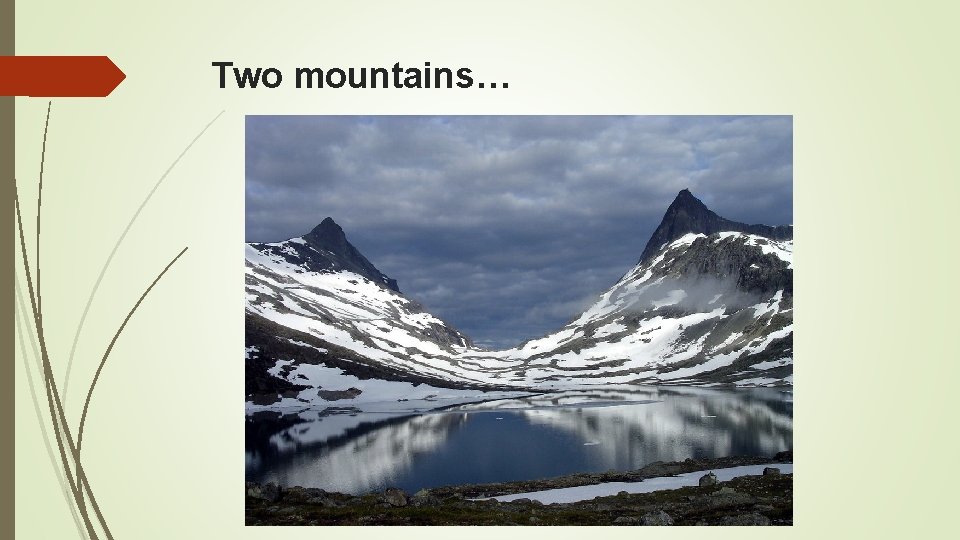
Two mountains…
The path ahead this morning Psychological flexibility Definitions Processes Flexibility about flexibility Glimpses into processes Branching out – fostering nurturing communities Just a taste – sharing resources

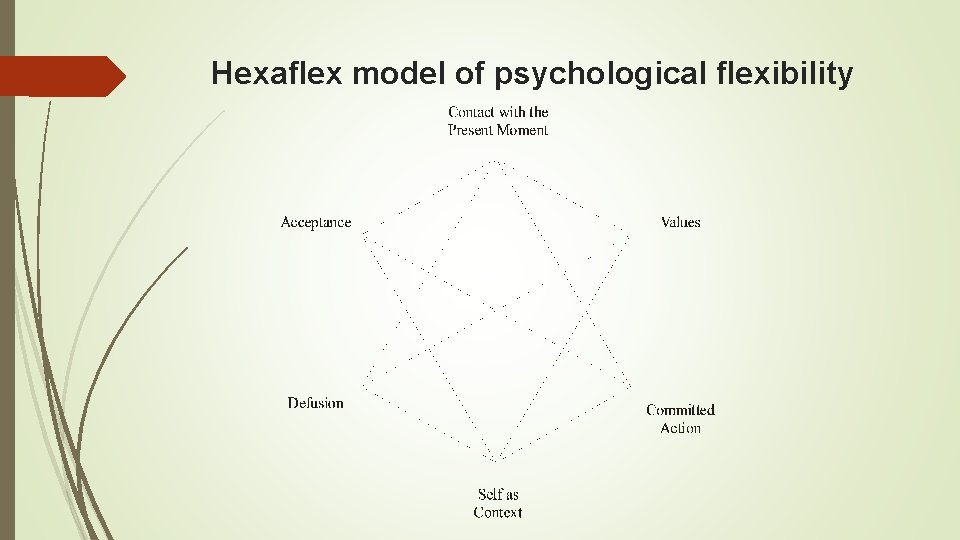
Psychological flexibility (PF) Working definition - the capacity to fully contact the present moment and continuing or changing behavior in the service of one’s values (Bond et al. , 2011) Interconnected elements Flexibility about flexibility Elements not set in stone, one way of “cutting the pie” Many ways of fostering these processes Most closely connected with acceptance and commitment therapy (ACT); overlap with mindfulness-based stress reduction, mindfulness-based cognitive therapy, dialectical behavior therapy Overlap/consistency/synergy with other orientations/perspectives
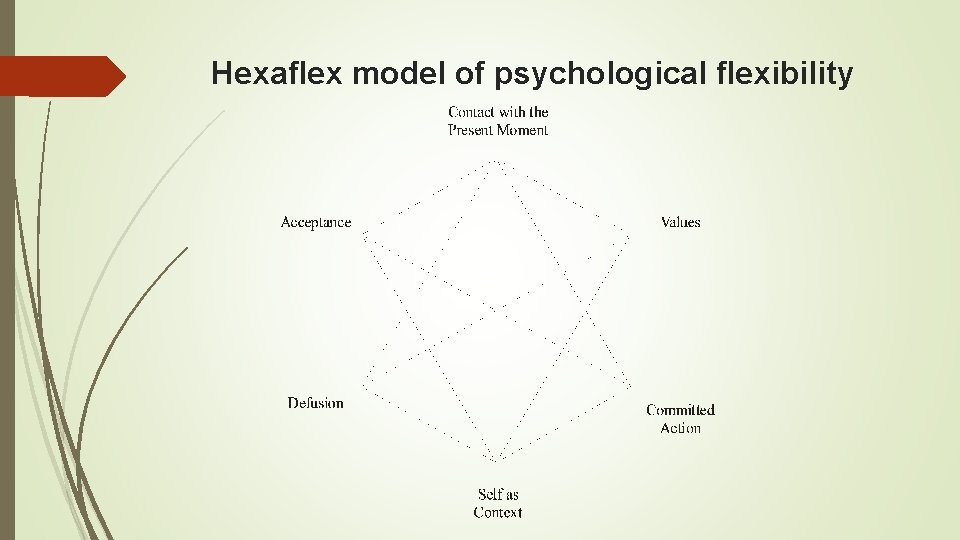
Hexaflex model of psychological flexibility
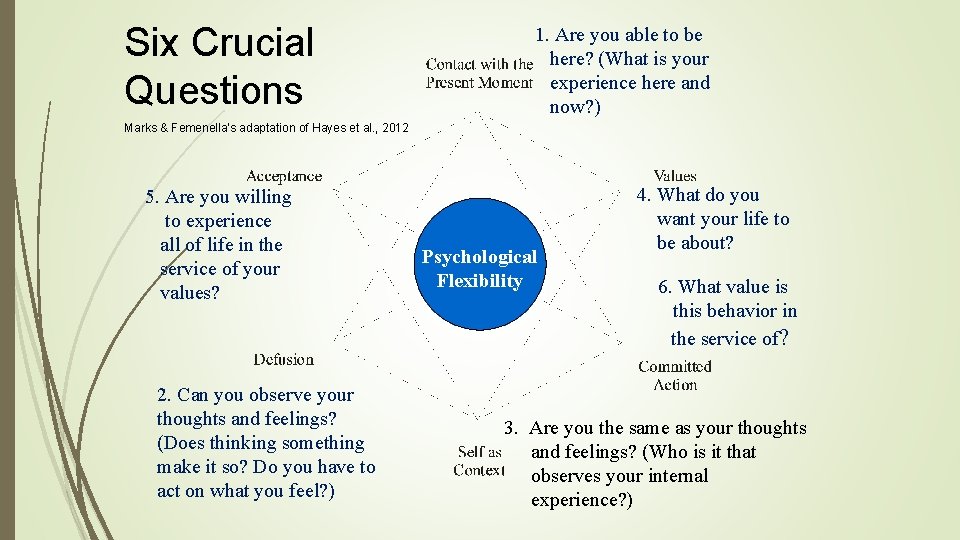
Six Crucial Questions 1. Are you able to be here? (What is your experience here and now? ) Marks & Femenella’s adaptation of Hayes et al. , 2012 5. Are you willing to experience all of life in the service of your values? 2. Can you observe your thoughts and feelings? (Does thinking something make it so? Do you have to act on what you feel? ) Psychological Flexibility 4. What do you want your life to be about? 6. What value is this behavior in the service of? 3. Are you the same as your thoughts and feelings? (Who is it that observes your internal experience? )
Glimpses into these processes…
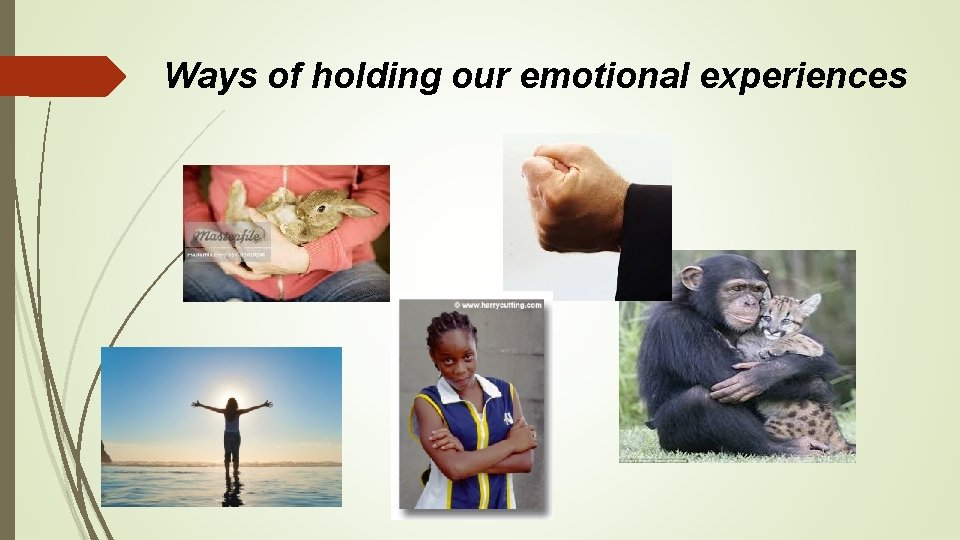
Ways of holding our emotional experiences
Hexaflex model of psychological flexibility
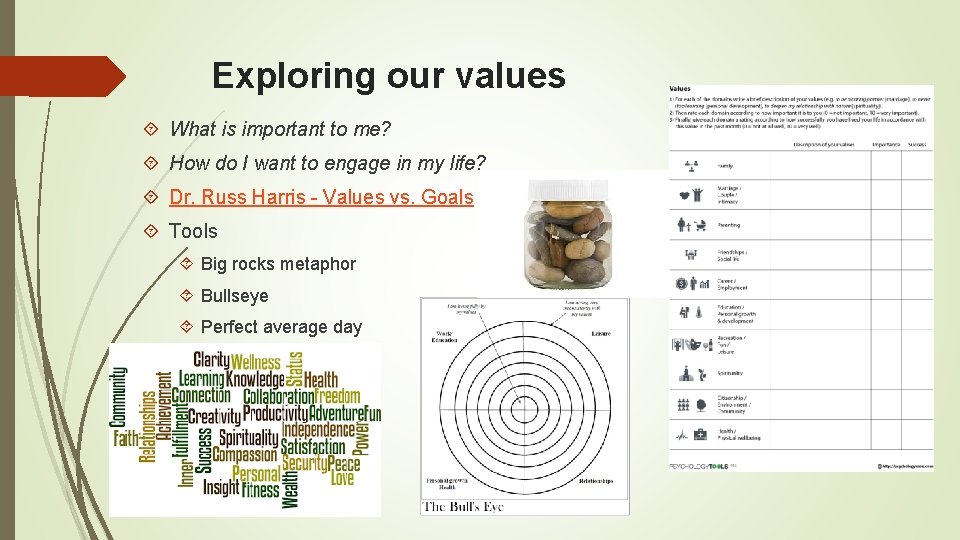
Exploring our values What is important to me? How do I want to engage in my life? Dr. Russ Harris - Values vs. Goals Tools Big rocks metaphor Bullseye Perfect average day

Nurturing community Role of these approaches in cultivating compassionate, positive, nurturing environments in all aspects of society (Biglan, 2015) Individuals within communities Higher education-based work Curriculum-based workshops Drop-in practice sessions Work with faculty Pathways to PF framework
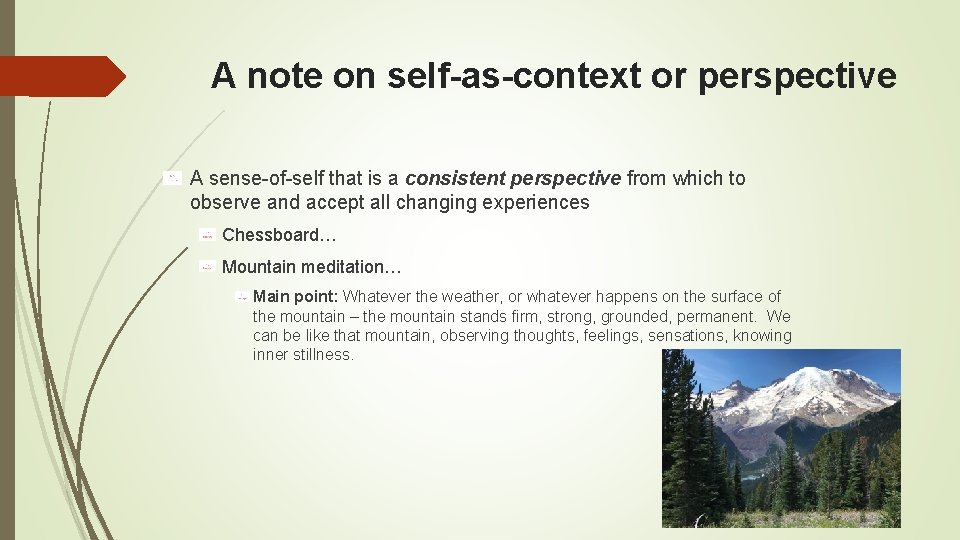
A note on self-as-context or perspective A sense-of-self that is a consistent perspective from which to observe and accept all changing experiences Chessboard… Mountain meditation… Main point: Whatever the weather, or whatever happens on the surface of the mountain – the mountain stands firm, strong, grounded, permanent. We can be like that mountain, observing thoughts, feelings, sensations, knowing inner stillness.
Relevance of these processes in/to our clinical work (from Wilson & Du. Frene, 2008) Acceptance What are the biggest things I avoid in session? What behavioral repertoires do I use to keep these hard things away? What have the consequences of these choices been? Defusion What thoughts often occur to me in therapy room? What is my client typically doing when these thoughts come up? What would it look like if I could have these thoughts and still do what I value in the room?
Relevance of these processes in/to our clinical work (from Wilson & Du. Frene, 2008) Self-as-context What stories do I tell myself about who I am as I sit in therapy room? How do I think these stories might affect my clients? What behaviors do I engage in to reinforce these stories or suppress them? Contact with the present moment At what times do I tend to lose contact with the present in therapy sessions? How might these moments affect my clients? What it might look like if I could remain in the room during these moments? How might my presence be of service to my clients?
Relevance of these processes in/to our clinical work (from Wilson & Du. Frene, 2008) Values What matters to me as a therapist? What comes up for me as I write down those words, as I claim this possibility? What might it mean both to me and to my clients if I could act to further this value? Committed action What kinds of actions am I committed to in therapy sessions? When do I notice myself turning away from these commitments? Can I gently return to them? What does that look like for me?
Thank you for sharing this time with us Select resources https: //contextualscience. org/clinical_resources https: //www. actmindfully. com. au/free_resources https: //mindfulwaythroughanxiety. com/resources/ http: //www. drluoma. com/actresources. html Contact information Jennifer Block Lerner – jlerner@kean. edu Amanda Aster - amandamaster 88@gmail. com Paola Ricardo – ricardop@kean. edu
Select references Biglan, A. (2015). The nurture effect: How the science of human behavior can improve our lives and the world. Oakland, CA: New Harbinger. Biglan, A. , & Prinz, R. (2017). Progress in nurturing human well-being. Clinical Child and Family Psychology Review, 20, 1 -2. Bond, F. W. , Hayes, S. C. , Baer, R. A. , Carpenter, K. C. , Guenole, N. , Orcutt, H. K…. Zettle, R. D. (2011). Preliminary psychometric properties of the Acceptance and Action Questionnaire – II: A revised measure of psychological flexibility and acceptance. Behavior Therapy, 42, 676 -688. Hayes, S. C. , Strosahl, K. , & Wilson, K. G. (2012). Acceptance and commitment therapy: The process and practice of mindful change (2 nd edition). New York, NY: The Guilford Press. Hayes-Skelton, S. A. , Calloway, A. , Roemer, L. , & Orsillo, S. M. (2015). Decentering as a potential common mechanism across two therapies for generalized anxiety disorder. Journal of Consulting and Clinical Psychology, 83, 395 -404. Levin, M. E. , Mac. Lane, C. , Daflos, S. , Seeley, J. R. , Hayes, S. C. , Biglan, A. , & Pistorello, J. (2014). Examining psychological inflexibility as a transdiagnostic process across psychological disorders. Journal of Contextual Behavioral Science, 3, 155 -163. Twohig, M. P. , & Levin, M. E. (2017). Acceptance and commitment therapy as a treatment for anxiety and depression: A review. Psychiatric Clinics of North America, 40, 751 -770. Williston, M. , Block-Lerner, J. , Wolanin, A. , Gardner, F. (2014). Brief acceptance-based intervention for reducing missed first appointments at a community mental health center. Psychological Services, 11, 324332. Wilson, K. G. , & Du. Frene, T. (2008). Mindfulness for two. Oakland, CA: New Harbinger Publications.
Two mountains metaphor It’s like you’re in the process of climbing up a big mountain that has lots of dangerous places on it. My job is to watch out for you and shout directions if I can see places you might slip or hurt yourself. But I’m not able to do this because I’m standing at the top of your mountain, looking down at you. If I’m able to help you climb your mountain, it’s because I’m on my own mountain, just across a valley. I don’t have to know anything about exactly what it feels like to climb your mountain to see where you are about to step, and what might be a better path for you to take. From Twohig (2004)
- Slides: 20