
FOSTERING HEALTHY DISABILITY IDENTITY DEVELOPMENT AMONG COLLEGE STUDENTS
FOSTERING HEALTHY DISABILITY IDENTITY DEVELOPMENT AMONG COLLEGE STUDENTS C Graduate Assistant: Lauren Andrulewich Supervising Faculty Member: Dr. Vickie Ann Mc. Coy
Disability Identity Development • Disability is both a functional difference and an important component of cultural identity • Can occur at any point in an individual’s life • Shapes how an individual looks at themselves and interacts with the world (Forber-Pratt & Zape, 2017) • Related literature about healthy disability identity development on campuses is scarce but emergent
Importance of Intersectionality • Originated from African American Feminist theory and became popular among LGBTQ and other minority populations (Crenshaw, 1991; Cho, Crenshaw, & Mc. Call, 2013) • Disability identity does not develop in isolation • Outcome is much more complicated than the sum of its parts • Looking at privilege and marginalization one label at a time does not allow us to see the complexities of identity development • Understanding student identity development through intersectionality reflects meaning found at the intersection of multiple identities
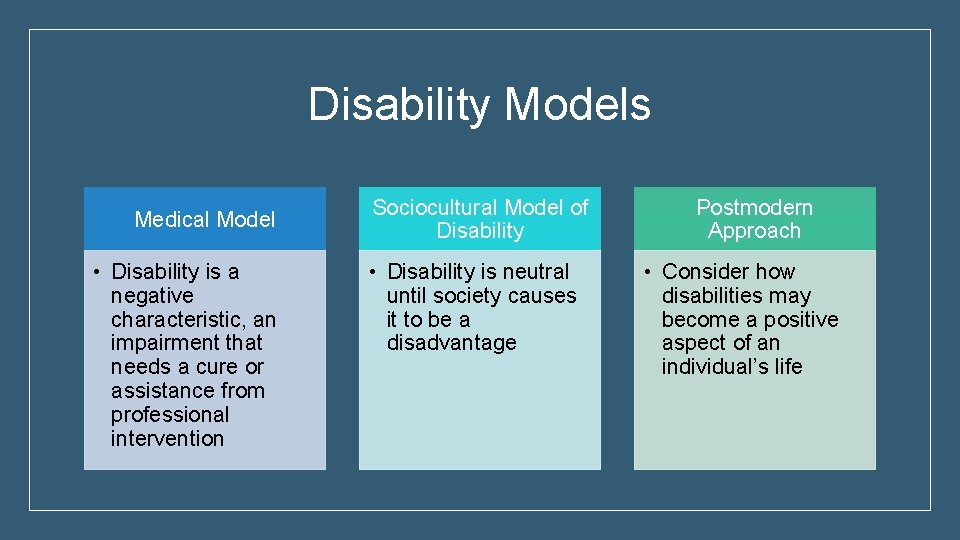
Disability Models Medical Model • Disability is a negative characteristic, an impairment that needs a cure or assistance from professional intervention Sociocultural Model of Disability • Disability is neutral until society causes it to be a disadvantage Postmodern Approach • Consider how disabilities may become a positive aspect of an individual’s life
Critical Disability Theory (CDT) • Disability is not seen as a personal limitation, but analyzed as a cultural, historical, relative, social, and political phenomenon (Hall, 2019) • Promotes activism and social justice • “Anyone can enter at any time, and we will all join it if we live long enough” (Garland-Thomson, 2002, p. 20)
Ableism • Defined as the privileging of able bodies and minds that renders others abnormal and less worthy (Linton, 1998) • College students with disabilities faced ableism despite receiving appropriate accommodations under Americans with Disabilities Act • Taking an intersectional approach to ableism allows higher education professions to see intersecting systems of oppression on campus (Peña, Stapleton, & Schaffer, 2016) • Resistance to ableism can help their psychological health and foster healthy psychosocial and identity development (Forber-Pratt & Zape, 2017)
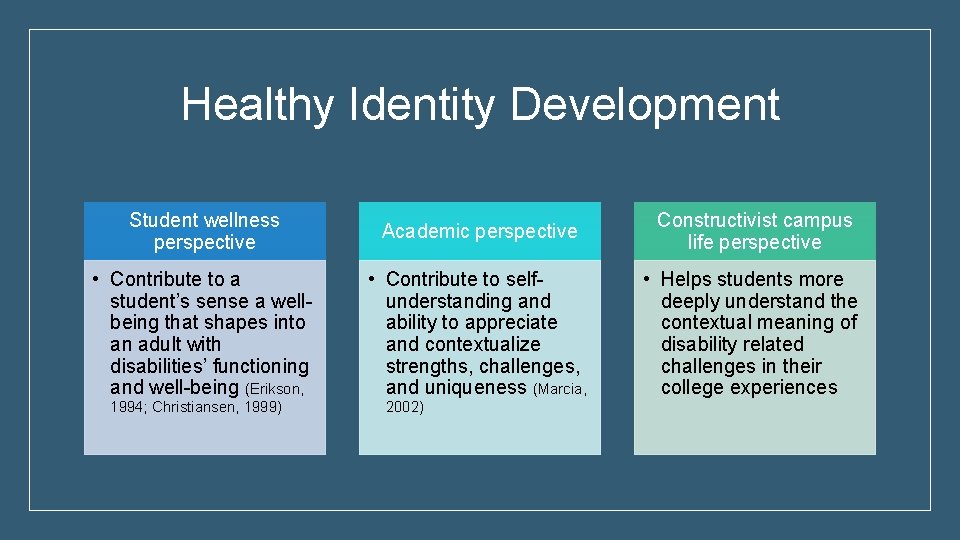
Healthy Identity Development Student wellness perspective Academic perspective Constructivist campus life perspective • Contribute to a student’s sense a wellbeing that shapes into an adult with disabilities’ functioning and well-being (Erikson, • Contribute to selfunderstanding and ability to appreciate and contextualize strengths, challenges, and uniqueness (Marcia, • Helps students more deeply understand the contextual meaning of disability related challenges in their college experiences 1994; Christiansen, 1999) 2002)
Model of Social & Psychosocial Disability Identity Development (Forber-Pratt & Zape, 2017) • Emerged from a qualitative study • Contains four developmental statuses, they are not linear • It is not necessary to move through the statuses at any given point, or ever • Possible for an individual to simultaneously be in more than one status at a time • Unlike racial identity, individuals may not have anyone in their family or community that shares their experience • Meeting others with disabilities and forming relationships is important in the identity developing process
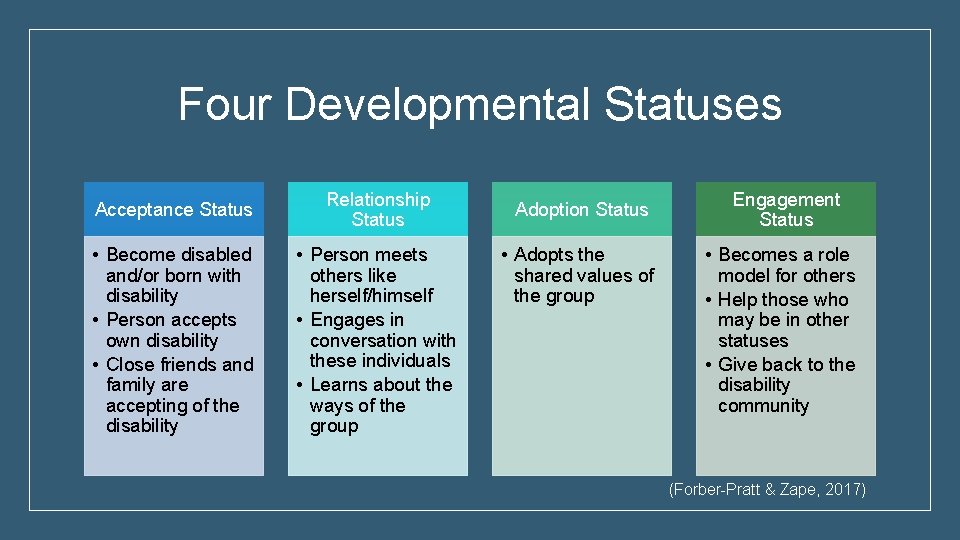
Four Developmental Statuses Acceptance Status Relationship Status • Become disabled and/or born with disability • Person accepts own disability • Close friends and family are accepting of the disability • Person meets others like herself/himself • Engages in conversation with these individuals • Learns about the ways of the group Adoption Status • Adopts the shared values of the group Engagement Status • Becomes a role model for others • Help those who may be in other statuses • Give back to the disability community (Forber-Pratt & Zape, 2017)
Transition to College • Millennial college students with disabilities may be used to having support from parents and the K-12 system • Transitioning from K-12 system to college is a time of change and growth • On campus, disability disclosure and use of accommodations is optional which may lead to students downplaying their disabilities or embracing the new freedom • Students with disabilities are faced with additional layers of adjustment (Brinckerhoff, Mc. Guire, & Shaw 2002; Janiga & Costenbader 2002; Milsom & Hartley 2005)
Importance in Higher Education • Helpful for higher education professionals to understand where each student is in developing their disability identity when working with them (Forber-Pratt & Zape, 2017) • Each individual may be deciding how much they identify with the disability community, so it is important to not push too hard • Recognize that not every individual with a disability has accepted it
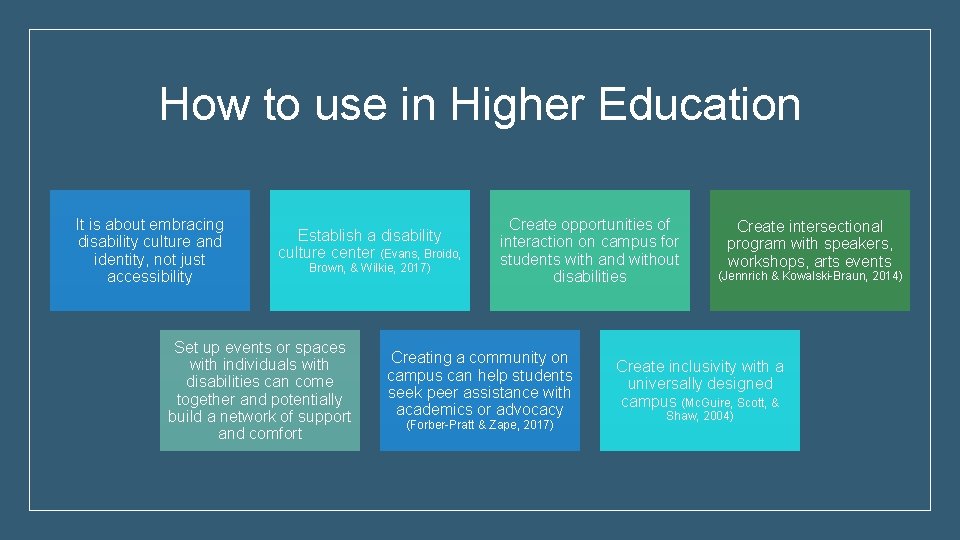
How to use in Higher Education It is about embracing disability culture and identity, not just accessibility Establish a disability culture center (Evans, Broido, Brown, & Wilkie, 2017) Set up events or spaces with individuals with disabilities can come together and potentially build a network of support and comfort Create opportunities of interaction on campus for students with and without disabilities Creating a community on campus can help students seek peer assistance with academics or advocacy (Forber-Pratt & Zape, 2017) Create intersectional program with speakers, workshops, arts events (Jennrich & Kowalski-Braun, 2014) Create inclusivity with a universally designed campus (Mc. Guire, Scott, & Shaw, 2004)
References Brinckerhoff, L. C. , Mc. Guire, J. M. , & Shaw, S. F. (2002). Postsecondary education and transition for students with learning disabilities. PRO-ED, Inc. , Austin, TX. Cho, S. , Crenshaw, K. W. , & Mc. Call, L. (2013). Toward a field of intersectionality studies: Theory, applications, and praxis. Signs, 38, 785– 810. doi: 10. 1086/669608. Christiansen C. H. (1999). Defining lives: Occupation as identity: An essay on competence, coherence, and the creation of meaning. American Journal of Occupational Therapy, 53(6), 547– 558. https: //doi. org/10. 5014/ajot. 53. 6. 547 Crenshaw, K. (1991). Mapping the margins: Intersectionality, identity politics, and violence against women of color. Stanford Law Review, 43(6), 1241 -1299. doi: 10. 2307/1229039 Erikson, E. H. (1968). Identity. New York, NY: Norton Evans, N. J. , Broido, E. M. , Brown, K. R. , & Wilkie, A. K. (2017). Disability in Higher Education: A Social Justice Approach. San Francisco, CA: Jossey Bass. Finkelstein (1993). Forber-Pratt, A. J. , & Zape, M. P. (2017). Disability identity development model: Voices from the ADA-generation. Disability and Health Journal, 10(2), 350– 355. https: //doi. org/10. 1016/j. dhjo. 2016. 12. 013 Fornauf, B. S. , & Erickson, J. D. (2020). Toward an inclusive pedagogy through universal design for learning in higher education: A review of the literature. Journal of Postsecondary Education and Disability, 33(2), 183 -199. Garland-Thomson, R. (2002). Integrating disability, transforming feminist theory. NWSA Journal, 14(3), 1 -32. Retrieved October 12, 2020, from http: //www. jstor. org/stable/4316922 Hadley, W. M. (2011). College students with disabilities: A student development perspective. New Directions for Higher Education, 2011 (154), 77– 81. https: //doi. org/10. 1002/he. 436 Hall, M. C. (2019). Critical disability theory. The Stanford Encyclopedia of Philosophy (Winter 2019). https: //plato. stanford. edu/archives/win 2019/entries/disability-critical
Hamraie, A. (2016). Universal design and the problem of “post-disability” ideology. Design and Culture, 8(3), 285 -309. https: //doi. org/10. 1080/17547075. 2016. 1218714 Janiga, S. J. , & Costenbader, V. (2002). The transition from high school to postsecondary education for students with learning disabilities: A survey of college service coordinators. Journal of Learning Disabilities, 35(5): 462– 68. http: //www. ahead-archive. org/uploads/publications/JPED/jped 25_2/JPED 25_2_Full. Document. pdf Jennrich, J. , & Kowalski-Braun, M. (2014). My head is spinning: Doing authentic identity work in identity centers. Journal of Progressive Policy & Practice, 2, 199 -212. Linton, S. (1998). Claiming Disability: Knowledge and Identity. New York, NY: New York University Press. Marcia, J. E. (2002) Identity and psychosocial development in adulthood, Identity, 2(1), 7 -28. https: //doi. org/10. 1207/S 1532706 XID 0201_02 Mc. Guire, J. M. , Scott, S. S. & Shaw, S. F. (2004) Universal Design for Instruction: The Paradigm, Its Principles, and Products for Enhancing Instructional Access. Journal of Postsecondary Education and Disability, 17(1), 10– 20. https: //eric. ed. gov/? id=EJ 875999 Milsom, A. , & M. T. Hartley. (2005). Assisting students with learning disabilities transitioning to college: What school counselors should know. Professional School Counseling, 8(5), 436– 41. Retrieved October 13, 2020, from http: //www. jstor. org/stable/42732520 Peña, E. V. , Stapleton, L. D. , & Schaffer, L. M. (2016). Critical Perspectives on Disability Identity. New Directions for Student Services, 154, 85 -96. http: //dx. doi. org/10. 1002/ss. 20177 Schlossberg, N. K. , Lynch, A. Q. , & Chickering, A. W. (1989). Improving Higher Education Environments for Adults: Responsive Programs and Services from Entry to Departure. San Francisco: Jossey-Bass. Tinto, V. (1993). Leaving College: Rethinking the Causes and Cures of Student Attrition (2 nd ed. ). Chicago: University of Chicago Press.
- Slides: 14