
Foster Care Informational Summit Roundtable Discussion Brittany Hamner
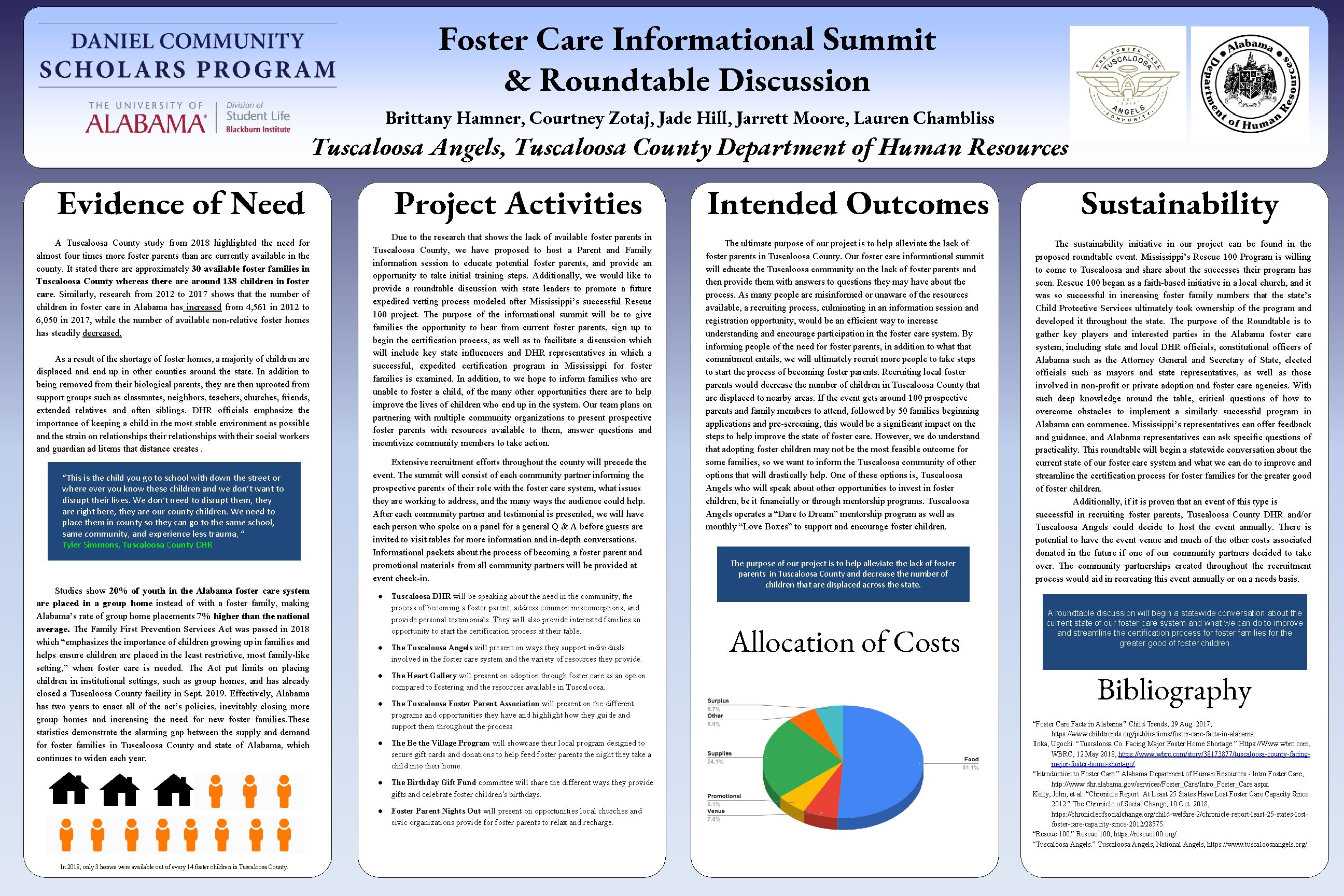
Foster Care Informational Summit & Roundtable Discussion Brittany Hamner, Courtney Zotaj, Jade Hill, Jarrett Moore, Lauren Chambliss Tuscaloosa Angels, Tuscaloosa County Department of Human Resources Evidence of Need A Tuscaloosa County study from 2018 highlighted the need for almost four times more foster parents than are currently available in the county. It stated there approximately 30 available foster families in Tuscaloosa County whereas there around 138 children in foster care. Similarly, research from 2012 to 2017 shows that the number of children in foster care in Alabama has increased from 4, 561 in 2012 to 6, 050 in 2017, while the number of available non-relative foster homes has steadily decreased. As a result of the shortage of foster homes, a majority of children are displaced and end up in other counties around the state. In addition to being removed from their biological parents, they are then uprooted from support groups such as classmates, neighbors, teachers, churches, friends, extended relatives and often siblings. DHR officials emphasize the importance of keeping a child in the most stable environment as possible and the strain on relationships their relationships with their social workers and guardian ad litems that distance creates. “This is the child you go to school with down the street or where ever you know these children and we don’t want to disrupt their lives. We don’t need to disrupt them, they are right here, they are our county children. We need to place them in county so they can go to the same school, same community, and experience less trauma, “ Tyler Simmons, Tuscaloosa County DHR Studies show 20% of youth in the Alabama foster care system are placed in a group home instead of with a foster family, making Alabama’s rate of group home placements 7% higher than the national average. The Family First Prevention Services Act was passed in 2018 which “emphasizes the importance of children growing up in families and helps ensure children are placed in the least restrictive, most family-like setting, ” when foster care is needed. The Act put limits on placing children in institutional settings, such as group homes, and has already closed a Tuscaloosa County facility in Sept. 2019. Effectively, Alabama has two years to enact all of the act’s policies, inevitably closing more group homes and increasing the need for new foster families. These statistics demonstrate the alarming gap between the supply and demand for foster families in Tuscaloosa County and state of Alabama, which continues to widen each year. In 2018, only 3 homes were available out of every 14 foster children in Tuscaloosa County. Project Activities Due to the research that shows the lack of available foster parents in Tuscaloosa County, we have proposed to host a Parent and Family information session to educate potential foster parents, and provide an opportunity to take initial training steps. Additionally, we would like to provide a roundtable discussion with state leaders to promote a future expedited vetting process modeled after Mississippi’s successful Rescue 100 project. The purpose of the informational summit will be to give families the opportunity to hear from current foster parents, sign up to begin the certification process, as well as to facilitate a discussion which will include key state influencers and DHR representatives in which a successful, expedited certification program in Mississippi for foster families is examined. In addition, to we hope to inform families who are unable to foster a child, of the many other opportunities there are to help improve the lives of children who end up in the system. Our team plans on partnering with multiple community organizations to present prospective foster parents with resources available to them, answer questions and incentivize community members to take action. Extensive recruitment efforts throughout the county will precede the event. The summit will consist of each community partner informing the prospective parents of their role with the foster care system, what issues they are working to address, and the many ways the audience could help. After each community partner and testimonial is presented, we will have each person who spoke on a panel for a general Q & A before guests are invited to visit tables for more information and in-depth conversations. Informational packets about the process of becoming a foster parent and promotional materials from all community partners will be provided at event check-in. ● Tuscaloosa DHR will be speaking about the need in the community, the process of becoming a foster parent, address common misconceptions, and provide personal testimonials. They will also provide interested families an opportunity to start the certification process at their table. ● The Tuscaloosa Angels will present on ways they support individuals involved in the foster care system and the variety of resources they provide. ● The Heart Gallery will present on adoption through foster care as an option compared to fostering and the resources available in Tuscaloosa. ● The Tuscaloosa Foster Parent Association will present on the different programs and opportunities they have and highlight how they guide and support them throughout the process. ● The Be the Village Program will showcase their local program designed to secure gift cards and donations to help feed foster parents the night they take a child into their home. ● The Birthday Gift Fund committee will share the different ways they provide gifts and celebrate foster children's birthdays. ● Foster Parent Nights Out will present on opportunities local churches and civic organizations provide for foster parents to relax and recharge. Intended Outcomes The ultimate purpose of our project is to help alleviate the lack of foster parents in Tuscaloosa County. Our foster care informational summit will educate the Tuscaloosa community on the lack of foster parents and then provide them with answers to questions they may have about the process. As many people are misinformed or unaware of the resources available, a recruiting process, culminating in an information session and registration opportunity, would be an efficient way to increase understanding and encourage participation in the foster care system. By informing people of the need for foster parents, in addition to what that commitment entails, we will ultimately recruit more people to take steps to start the process of becoming foster parents. Recruiting local foster parents would decrease the number of children in Tuscaloosa County that are displaced to nearby areas. If the event gets around 100 prospective parents and family members to attend, followed by 50 families beginning applications and pre-screening, this would be a significant impact on the steps to help improve the state of foster care. However, we do understand that adopting foster children may not be the most feasible outcome for some families, so we want to inform the Tuscaloosa community of other options that will drastically help. One of these options is, Tuscaloosa Angels who will speak about other opportunities to invest in foster children, be it financially or through mentorship programs. Tuscaloosa Angels operates a “Dare to Dream” mentorship program as well as monthly “Love Boxes” to support and encourage foster children. The purpose of our project is to help alleviate the lack of foster parents in Tuscaloosa County and decrease the number of children that are displaced across the state. Allocation of Costs Sustainability The sustainability initiative in our project can be found in the proposed roundtable event. Mississippi’s Rescue 100 Program is willing to come to Tuscaloosa and share about the successes their program has seen. Rescue 100 began as a faith-based initiative in a local church, and it was so successful in increasing foster family numbers that the state’s Child Protective Services ultimately took ownership of the program and developed it throughout the state. The purpose of the Roundtable is to gather key players and interested parties in the Alabama foster care system, including state and local DHR officials, constitutional officers of Alabama such as the Attorney General and Secretary of State, elected officials such as mayors and state representatives, as well as those involved in non-profit or private adoption and foster care agencies. With such deep knowledge around the table, critical questions of how to overcome obstacles to implement a similarly successful program in Alabama can commence. Mississippi’s representatives can offer feedback and guidance, and Alabama representatives can ask specific questions of practicality. This roundtable will begin a statewide conversation about the current state of our foster care system and what we can do to improve and streamline the certification process for foster families for the greater good of foster children. Additionally, if it is proven that an event of this type is successful in recruiting foster parents, Tuscaloosa County DHR and/or Tuscaloosa Angels could decide to host the event annually. There is potential to have the event venue and much of the other costs associated donated in the future if one of our community partners decided to take over. The community partnerships created throughout the recruitment process would aid in recreating this event annually or on a needs basis. A roundtable discussion will begin a statewide conversation about the current state of our foster care system and what we can do to improve and streamline the certification process for foster families for the greater good of foster children. Bibliography “Foster Care Facts in Alabama. ” Child Trends, 29 Aug. 2017, https: //www. childtrends. org/publications/foster-care-facts-in-alabama. Iloka, Ugochi. “Tuscaloosa Co. Facing Major Foster Home Shortage. ” Https: //Www. wbrc. com, WBRC, 12 May 2018, https: //www. wbrc. com/story/38173877/tuscaloosa-county-facingmajor-foster-home-shortage/. “Introduction to Foster Care. ” Alabama Department of Human Resources - Intro Foster Care, http: //www. dhr. alabama. gov/services/Foster_Care/Intro_Foster_Care. aspx. Kelly, John, et al. “Chronicle Report: At Least 25 States Have Lost Foster Care Capacity Since 2012. ” The Chronicle of Social Change, 10 Oct. 2018, https: //chronicleofsocialchange. org/child-welfare-2/chronicle-report-least-25 -states-lostfoster-care-capacity-since-2012/28575. “Rescue 100. ” Rescue 100, https: //rescue 100. org/. “Tuscaloosa Angels. ” Tuscaloosa Angels, National Angels, https: //www. tuscaloosaangels. org/.
- Slides: 1