
Foster a Dynamic Learning Mindset Actively develop a
- Slides: 9
Foster a Dynamic Learning Mindset Actively develop a dynamic learning mindset across the organization to promote innovation, resilience, and development. SAMPLE Learn about becoming a member Mc. Lean & Company is a research and advisory firm providing practical solutions to human resources challenges via executable research, tools and advice that have a clear and measurable impact on your business. © 1997 -2016 Mc. Lean & Company is a division of Info-Tech Research Group Mc. Lean & Company 1
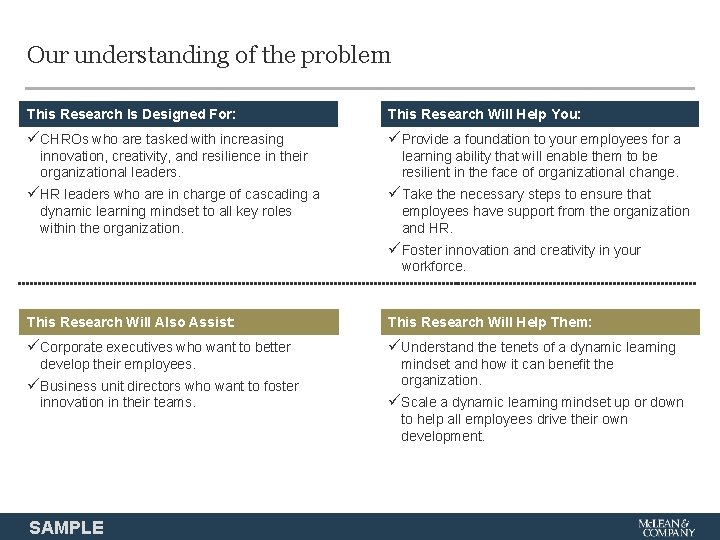
Our understanding of the problem This Research is Is Designed For: This Research Will Help You: CHROs who are tasked with increasing Provide a foundation to your employees for a innovation, creativity, and resilience in their organizational leaders. HR leaders who are in charge of cascading a dynamic learning mindset to all key roles within the organization. learning ability that will enable them to be resilient in the face of organizational change. Take the necessary steps to ensure that employees have support from the organization and HR. Foster innovation and creativity in your workforce. This Research Will Also Assist: This Research Will Help You: Them: Corporate executives who want to better Understand the tenets of a dynamic learning develop their employees. Business unit directors who want to foster innovation in their teams. mindset and how it can benefit the organization. Scale a dynamic learning mindset up or down to help all employees drive their own development. SAMPLE Mc. Lean & Company 2
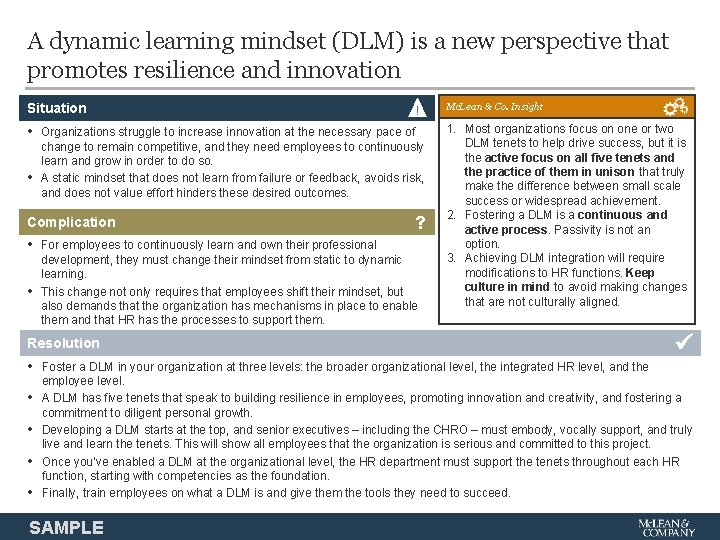
A dynamic learning mindset (DLM) is a new perspective that promotes resilience and innovation Situation ! • Organizations struggle to increase innovation at the necessary pace of • change to remain competitive, and they need employees to continuously learn and grow in order to do so. A static mindset that does not learn from failure or feedback, avoids risk, and does not value effort hinders these desired outcomes. Complication ? • For employees to continuously learn and own their professional • development, they must change their mindset from static to dynamic learning. This change not only requires that employees shift their mindset, but also demands that the organization has mechanisms in place to enable them and that HR has the processes to support them. Mc. Lean & Co. Insight 1. Most organizations focus on one or two DLM tenets to help drive success, but it is the active focus on all five tenets and the practice of them in unison that truly make the difference between small scale success or widespread achievement. 2. Fostering a DLM is a continuous and active process. Passivity is not an option. 3. Achieving DLM integration will require modifications to HR functions. Keep culture in mind to avoid making changes that are not culturally aligned. Resolution • Foster a DLM in your organization at three levels: the broader organizational level, the integrated HR level, and the • • employee level. A DLM has five tenets that speak to building resilience in employees, promoting innovation and creativity, and fostering a commitment to diligent personal growth. Developing a DLM starts at the top, and senior executives – including the CHRO – must embody, vocally support, and truly live and learn the tenets. This will show all employees that the organization is serious and committed to this project. Once you’ve enabled a DLM at the organizational level, the HR department must support the tenets throughout each HR function, starting with competencies as the foundation. Finally, train employees on what a DLM is and give them the tools they need to succeed. SAMPLE Mc. Lean & Company 3
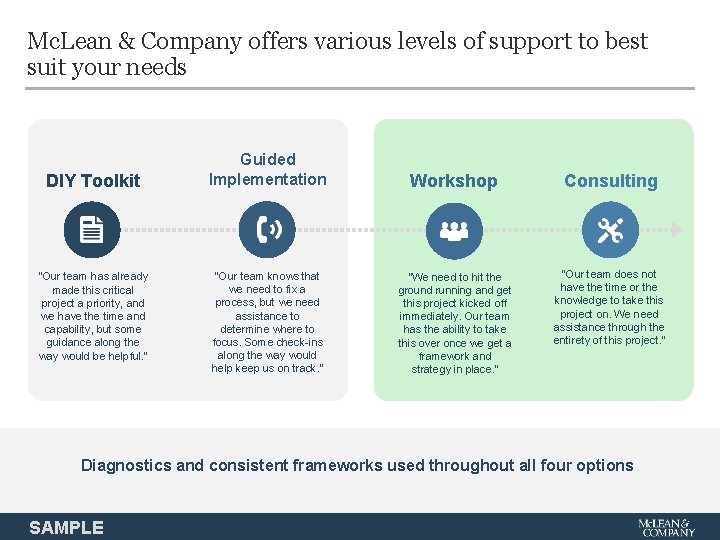
Mc. Lean & Company offers various levels of support to best suit your needs DIY Toolkit “Our team has already made this critical project a priority, and we have the time and capability, but some guidance along the way would be helpful. ” Guided Implementation Workshop Consulting “Our team knows that we need to fix a process, but we need assistance to determine where to focus. Some check-ins along the way would help keep us on track. ” “We need to hit the ground running and get this project kicked off immediately. Our team has the ability to take this over once we get a framework and strategy in place. ” “Our team does not have the time or the knowledge to take this project on. We need assistance through the entirety of this project. ” Diagnostics and consistent frameworks used throughout all four options SAMPLE Mc. Lean & Company 4
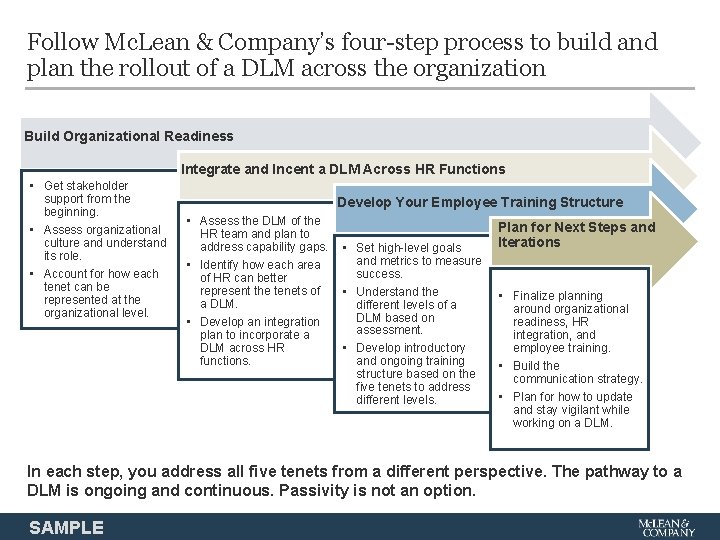
Follow Mc. Lean & Company’s four-step process to build and plan the rollout of a DLM across the organization Build Organizational Readiness Integrate and Incent a DLM Across HR Functions • Get stakeholder support from the beginning. • Assess organizational culture and understand its role. • Account for how each tenet can be represented at the organizational level. Develop Your Employee Training Structure • Assess the DLM of the HR team and plan to address capability gaps. • Identify how each area of HR can better represent the tenets of a DLM. • Develop an integration plan to incorporate a DLM across HR functions. • Set high-level goals and metrics to measure success. • Understand the different levels of a DLM based on assessment. • Develop introductory and ongoing training structure based on the five tenets to address different levels. Plan for Next Steps and Iterations • Finalize planning around organizational readiness, HR integration, and employee training. • Build the communication strategy. • Plan for how to update and stay vigilant while working on a DLM. In each step, you address all five tenets from a different perspective. The pathway to a DLM is ongoing and continuous. Passivity is not an option. SAMPLE Mc. Lean & Company 5
Sample Slides SAMPLE Mc. Lean & Company 6
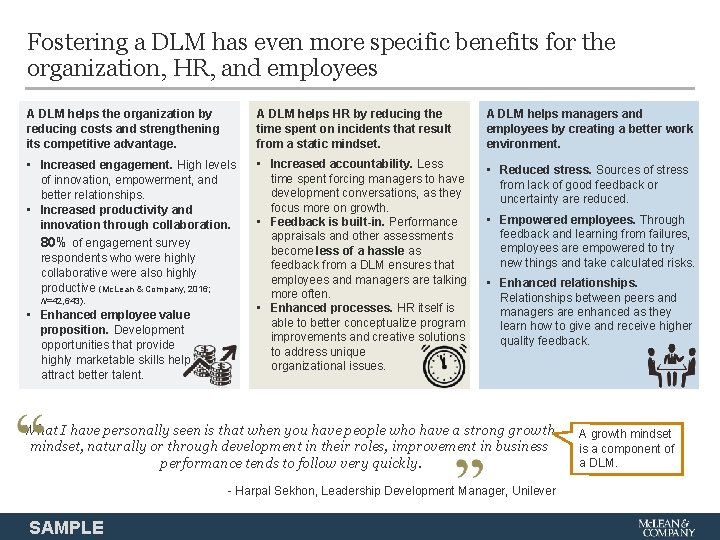
Fostering a DLM has even more specific benefits for the organization, HR, and employees A DLM helps the organization by reducing costs and strengthening its competitive advantage. A DLM helps HR by reducing the time spent on incidents that result from a static mindset. A DLM helps managers and employees by creating a better work environment. • Increased engagement. High levels of innovation, empowerment, and better relationships. • Increased productivity and innovation through collaboration. 80% of engagement survey respondents who were highly collaborative were also highly productive (Mc. Lean & Company, 2016; • Increased accountability. Less time spent forcing managers to have development conversations, as they focus more on growth. • Feedback is built-in. Performance appraisals and other assessments become less of a hassle as feedback from a DLM ensures that employees and managers are talking more often. • Enhanced processes. HR itself is able to better conceptualize program improvements and creative solutions to address unique organizational issues. • Reduced stress. Sources of stress from lack of good feedback or uncertainty are reduced. N=42, 643). • Enhanced employee value proposition. Development opportunities that provide highly marketable skills help attract better talent. • Empowered employees. Through feedback and learning from failures, employees are empowered to try new things and take calculated risks. • Enhanced relationships. Relationships between peers and managers are enhanced as they learn how to give and receive higher quality feedback. What I have personally seen is that when you have people who have a strong growth mindset, naturally or through development in their roles, improvement in business performance tends to follow very quickly. A growth mindset is a component of a DLM. - Harpal Sekhon, Leadership Development Manager, Unilever SAMPLE Mc. Lean & Company 7
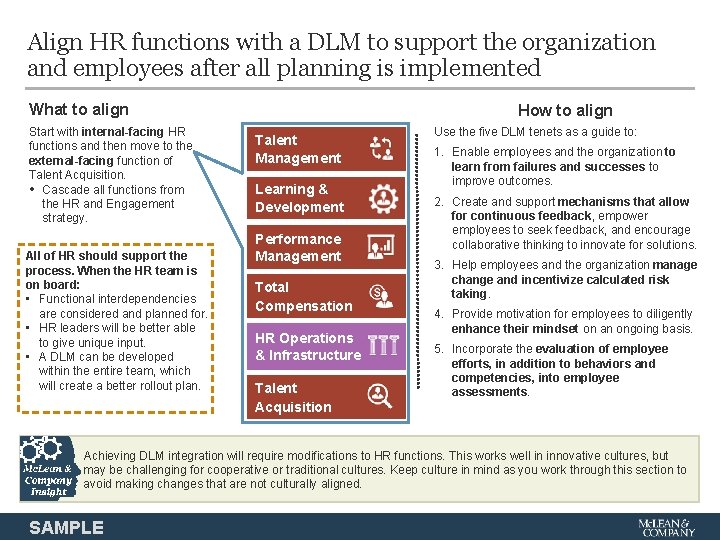
Align HR functions with a DLM to support the organization and employees after all planning is implemented What to align Start with internal-facing HR functions and then move to the external-facing function of Talent Acquisition. • Cascade all functions from the HR and Engagement strategy. All of HR should support the process. When the HR team is on board: • Functional interdependencies are considered and planned for. • HR leaders will be better able to give unique input. • A DLM can be developed within the entire team, which will create a better rollout plan. How to align Talent Management Learning & Development Performance Management Total Compensation HR Operations & Infrastructure Talent Acquisition Use the five DLM tenets as a guide to: 1. Enable employees and the organization to learn from failures and successes to improve outcomes. 2. Create and support mechanisms that allow for continuous feedback, empower employees to seek feedback, and encourage collaborative thinking to innovate for solutions. 3. Help employees and the organization manage change and incentivize calculated risk taking. 4. Provide motivation for employees to diligently enhance their mindset on an ongoing basis. 5. Incorporate the evaluation of employee efforts, in addition to behaviors and competencies, into employee assessments. Achieving DLM integration will require modifications to HR functions. This works well in innovative cultures, but may be challenging for cooperative or traditional cultures. Keep culture in mind as you work through this section to avoid making changes that are not culturally aligned. SAMPLE Mc. Lean & Company 8
Mc. Lean & Company Helps HR Professionals To: Empower management to apply HR best practices Maintain a progressive set of HR policies & procedures Develop effective talent acquisition & retention strategies Demonstrate the business impact of HR Build a high performance culture Stay abreast of HR trends & technologies Sign up to have access to our extensive selection of practical solutions for your HR challenges Learn About Becoming a Member • "Now, more than ever, HR leaders need to help their organizations maximize the value of their people. Mc. Lean & Company offers the tools, diagnostics and programs to drive measurable results. " – Jennifer Rozon, Vice President, Mc. Lean & Company Toll Free: 1 -877 -281 -0480 SAMPLE hr. mcleanco. com