
Fostemsavir Rukobia Prepared by David H Spach MD
Fostemsavir (Rukobia) Prepared by: David H. Spach, MD Brian R. Wood, MD Last Updated: July 9, 2020
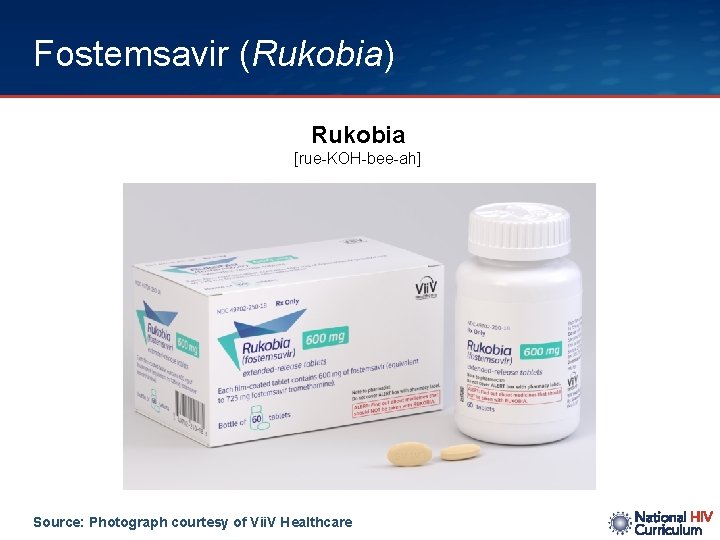
Fostemsavir (Rukobia) Rukobia [rue-KOH-bee-ah] Source: Photograph courtesy of Vii. V Healthcare
Fostemsavir (Rukobia) • Indication: - Heavily treatment-experienced adults with multidrug resistant HIV-1 failing their current antiretroviral regimen • Dosing: - 600 mg orally twice daily, with or without food • Contraindications - Hypersensitivity to fostemsavir - Coadministration with strong cytochrome P 450 (CYP) 3 A inducers • Use During Pregnancy - Insufficient data • Common Adverse Events (≥ 5%) - Nausea (10%) Source: Rukobia Prescribing Information
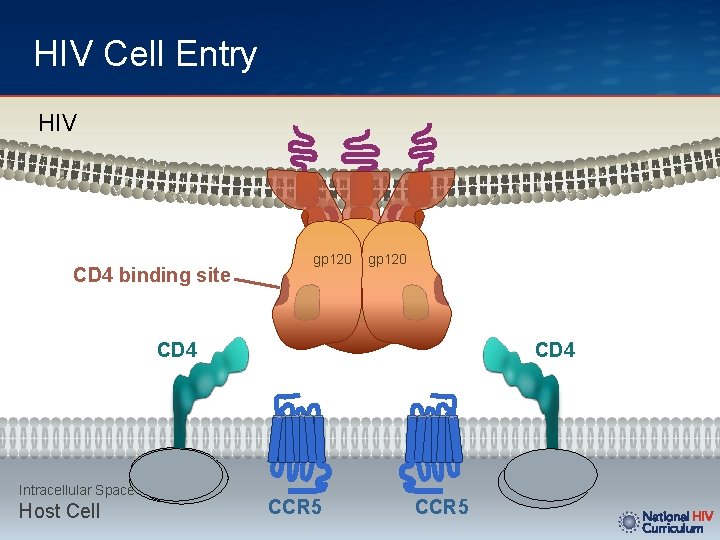
HIV Cell Entry HIV CD 4 binding site gp 120 CD 4 Intracellular Space Host Cell CD 4 CCR 5
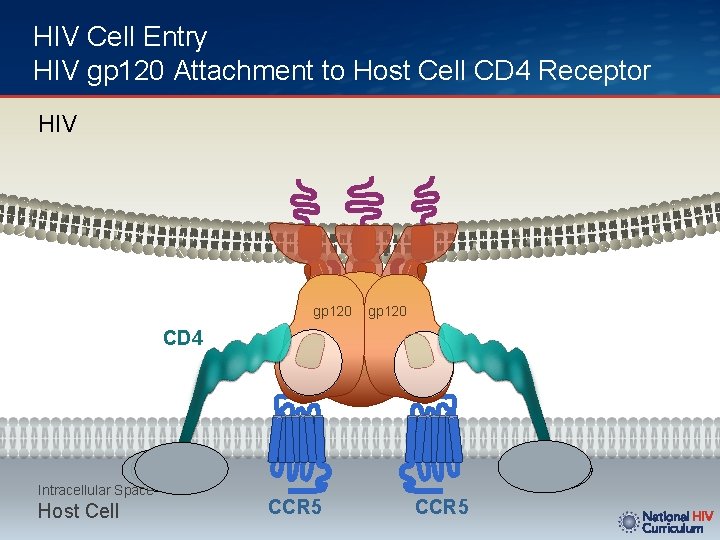
HIV Cell Entry HIV gp 120 Attachment to Host Cell CD 4 Receptor HIV gp 120 CD 4 Intracellular Space Host Cell CCR 5

HIV Entry Inhibitors: Attachment Inhibitors Fostemsavir—prodrug converted to Temsavir HIV Temsavir Binds near CD 4 binding site and prevents gp 120 conformational change required for attachment gp 120 CD 4 Intracellular Space Host Cell CD 4 binding site CD 4 CCR 5
Fostemsavir in Treatment-Experienced Patients BRIGHTE Study
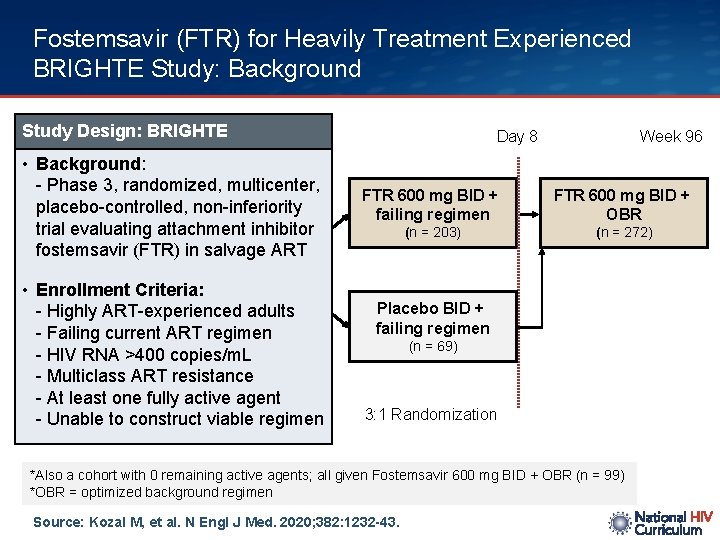
Fostemsavir (FTR) for Heavily Treatment Experienced BRIGHTE Study: Background Study Design: BRIGHTE • Background: - Phase 3, randomized, multicenter, placebo-controlled, non-inferiority trial evaluating attachment inhibitor fostemsavir (FTR) in salvage ART • Enrollment Criteria: - Highly ART-experienced adults - Failing current ART regimen - HIV RNA >400 copies/m. L - Multiclass ART resistance - At least one fully active agent - Unable to construct viable regimen Week 96 Day 8 FTR 600 mg BID + failing regimen FTR 600 mg BID + OBR (n = 203) (n = 272) Placebo BID + failing regimen (n = 69) 3: 1 Randomization *Also a cohort with 0 remaining active agents; all given Fostemsavir 600 mg BID + OBR (n = 99) *OBR = optimized background regimen Source: Kozal M, et al. N Engl J Med. 2020; 382: 1232 -43.
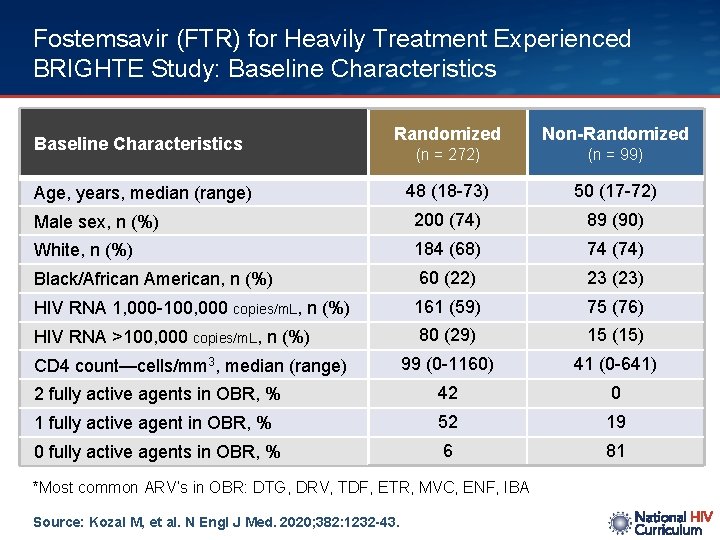
Fostemsavir (FTR) for Heavily Treatment Experienced BRIGHTE Study: Baseline Characteristics Randomized Non-Randomized (n = 272) (n = 99) 48 (18 -73) 50 (17 -72) Male sex, n (%) 200 (74) 89 (90) White, n (%) 184 (68) 74 (74) Black/African American, n (%) 60 (22) 23 (23) HIV RNA 1, 000 -100, 000 copies/m. L, n (%) 161 (59) 75 (76) HIV RNA >100, 000 copies/m. L, n (%) 80 (29) 15 (15) 99 (0 -1160) 41 (0 -641) 2 fully active agents in OBR, % 42 0 1 fully active agent in OBR, % 52 19 0 fully active agents in OBR, % 6 81 Baseline Characteristics Age, years, median (range) CD 4 count—cells/mm 3, median (range) *Most common ARV’s in OBR: DTG, DRV, TDF, ETR, MVC, ENF, IBA Source: Kozal M, et al. N Engl J Med. 2020; 382: 1232 -43.
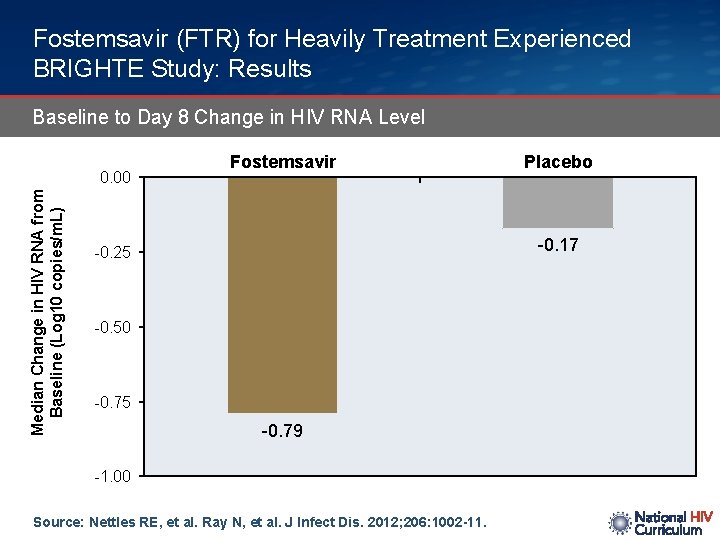
Fostemsavir (FTR) for Heavily Treatment Experienced BRIGHTE Study: Results Baseline to Day 8 Change in HIV RNA Level Median Change in HIV RNA from Baseline (Log 10 copies/m. L) 0. 00 Fostemsavir Placebo -0. 17 -0. 25 -0. 50 -0. 75 -0. 79 -1. 00 Source: Nettles RE, et al. Ray N, et al. J Infect Dis. 2012; 206: 1002 -11.
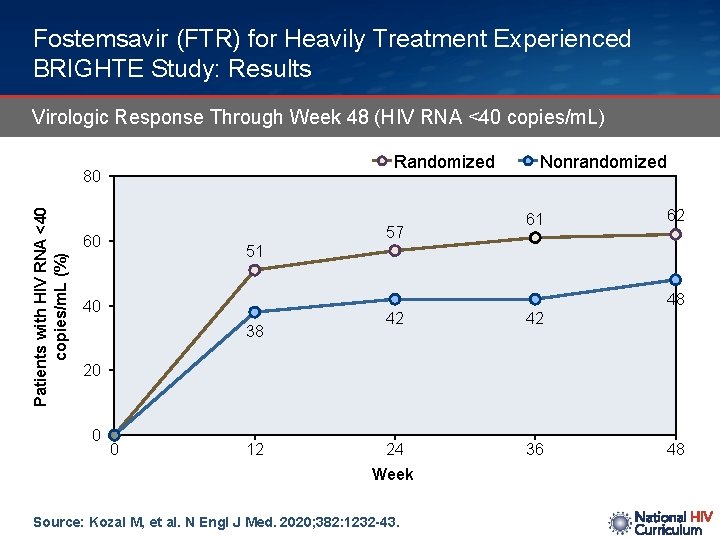
Fostemsavir (FTR) for Heavily Treatment Experienced BRIGHTE Study: Results Virologic Response Through Week 48 (HIV RNA <40 copies/m. L) Randomized Patients with HIV RNA <40 copies/m. L (%) 80 57 60 Nonrandomized 61 62 51 48 40 38 42 42 24 36 20 0 0 12 Week Source: Kozal M, et al. N Engl J Med. 2020; 382: 1232 -43. 48
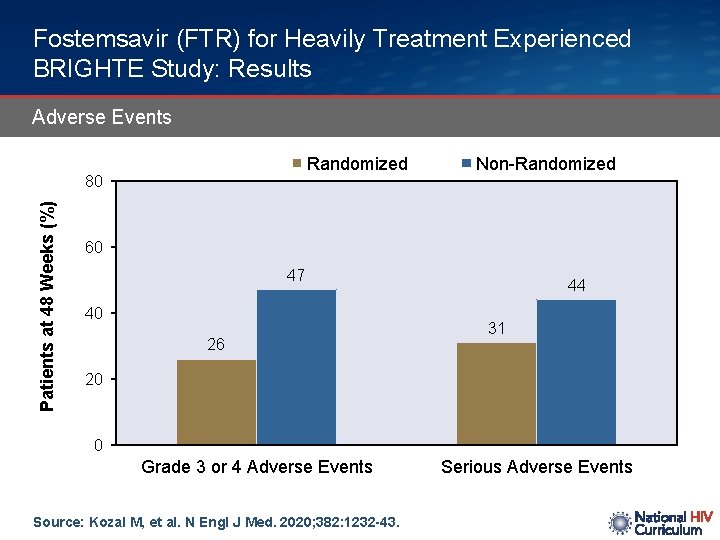
Fostemsavir (FTR) for Heavily Treatment Experienced BRIGHTE Study: Results Adverse Events Randomized Patients at 48 Weeks (%) 80 Non-Randomized 60 47 40 26 44 31 20 0 Grade 3 or 4 Adverse Events Source: Kozal M, et al. N Engl J Med. 2020; 382: 1232 -43. Serious Adverse Events
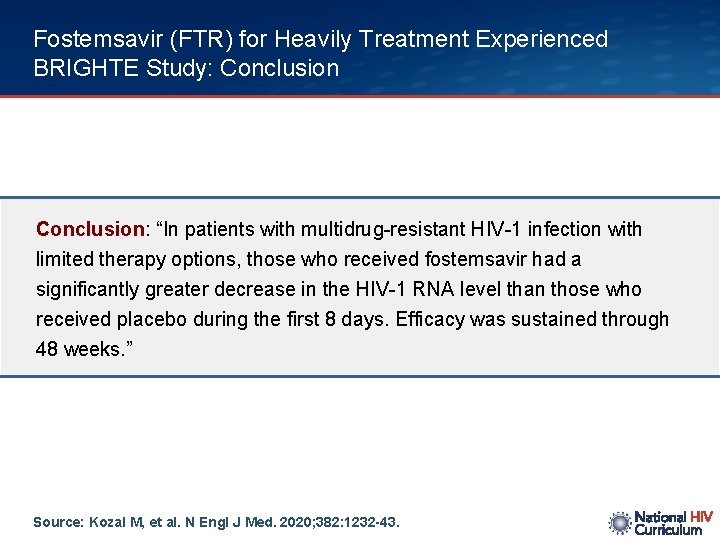
Fostemsavir (FTR) for Heavily Treatment Experienced BRIGHTE Study: Conclusion: “In patients with multidrug-resistant HIV-1 infection with limited therapy options, those who received fostemsavir had a significantly greater decrease in the HIV-1 RNA level than those who received placebo during the first 8 days. Efficacy was sustained through 48 weeks. ” Source: Kozal M, et al. N Engl J Med. 2020; 382: 1232 -43.
Fostemsavir (BMS-663068) Dose-Ranging Study AI 438 -006 Study
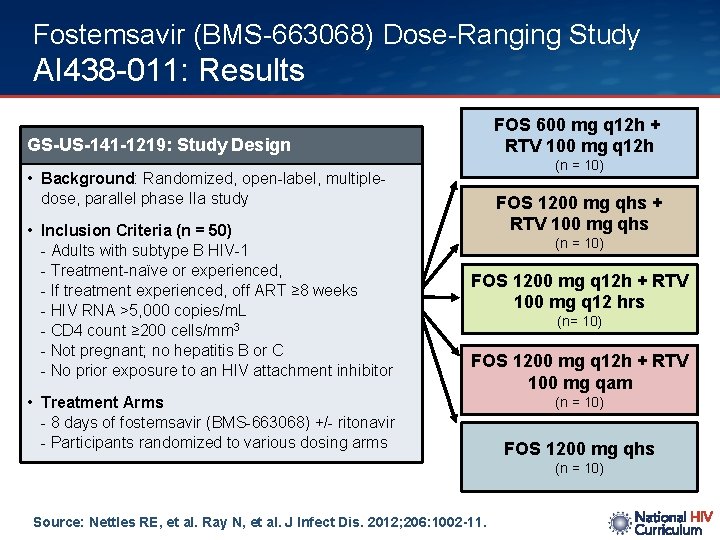
Fostemsavir (BMS-663068) Dose-Ranging Study AI 438 -011: Results FOS 600 mg q 12 h + RTV 100 mg q 12 h GS-US-141 -1219: Study Design (n = 10) • Background: Randomized, open-label, multipledose, parallel phase IIa study • Inclusion Criteria (n = 50) - Adults with subtype B HIV-1 - Treatment-naïve or experienced, - If treatment experienced, off ART ≥ 8 weeks - HIV RNA >5, 000 copies/m. L - CD 4 count ≥ 200 cells/mm 3 - Not pregnant; no hepatitis B or C - No prior exposure to an HIV attachment inhibitor FOS 1200 mg qhs + RTV 100 mg qhs (n = 10) FOS 1200 mg q 12 h + RTV 100 mg q 12 hrs (n= 10) FOS 1200 mg q 12 h + RTV 100 mg qam • Treatment Arms - 8 days of fostemsavir (BMS-663068) +/- ritonavir - Participants randomized to various dosing arms (n = 10) FOS 1200 mg qhs (n = 10) Source: Nettles RE, et al. Ray N, et al. J Infect Dis. 2012; 206: 1002 -11.
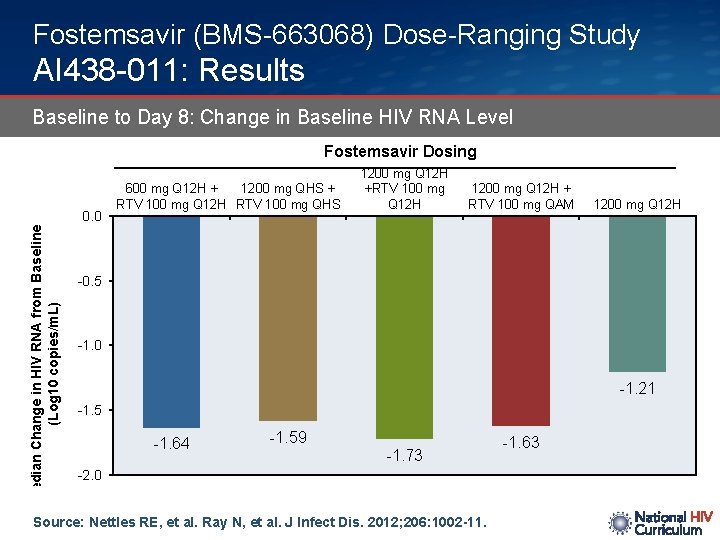
Fostemsavir (BMS-663068) Dose-Ranging Study AI 438 -011: Results Baseline to Day 8: Change in Baseline HIV RNA Level Fostemsavir Dosing Median Change in HIV RNA from Baseline (Log 10 copies/m. L) 0. 0 600 mg Q 12 H + 1200 mg QHS + RTV 100 mg Q 12 H RTV 100 mg QHS 1200 mg Q 12 H +RTV 100 mg Q 12 H 1200 mg Q 12 H + RTV 100 mg QAM 1200 mg Q 12 H -0. 5 -1. 0 -1. 21 -1. 5 -1. 64 -1. 59 -1. 73 -2. 0 Source: Nettles RE, et al. Ray N, et al. J Infect Dis. 2012; 206: 1002 -11. -1. 63
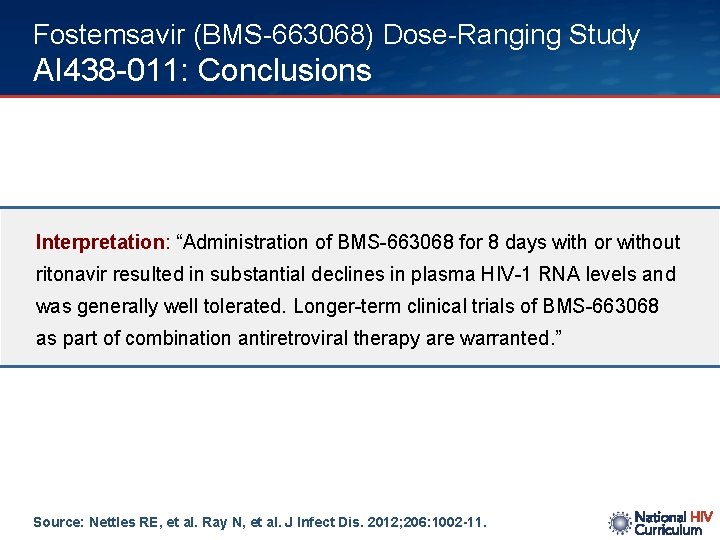
Fostemsavir (BMS-663068) Dose-Ranging Study AI 438 -011: Conclusions Interpretation: “Administration of BMS-663068 for 8 days with or without ritonavir resulted in substantial declines in plasma HIV-1 RNA levels and was generally well tolerated. Longer-term clinical trials of BMS-663068 as part of combination antiretroviral therapy are warranted. ” Source: Nettles RE, et al. Ray N, et al. J Infect Dis. 2012; 206: 1002 -11.
Fostemsavir in Treatment-Experienced Patients AI 438 -011 Study
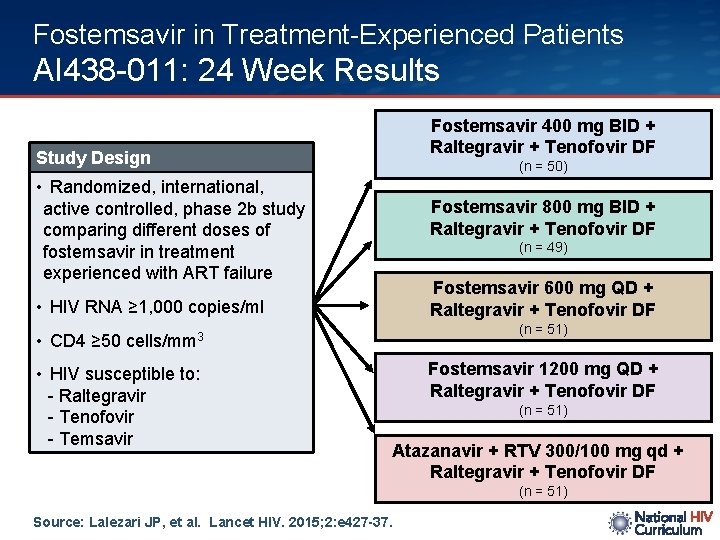
Fostemsavir in Treatment-Experienced Patients AI 438 -011: 24 Week Results Fostemsavir 400 mg BID + Raltegravir + Tenofovir DF Study Design (n = 50) • Randomized, international, active controlled, phase 2 b study comparing different doses of fostemsavir in treatment experienced with ART failure Fostemsavir 800 mg BID + Raltegravir + Tenofovir DF (n = 49) Fostemsavir 600 mg QD + Raltegravir + Tenofovir DF • HIV RNA ≥ 1, 000 copies/ml (n = 51) • CD 4 ≥ 50 cells/mm 3 • HIV susceptible to: - Raltegravir - Tenofovir - Temsavir Fostemsavir 1200 mg QD + Raltegravir + Tenofovir DF (n = 51) Atazanavir + RTV 300/100 mg qd + Raltegravir + Tenofovir DF (n = 51) Source: Lalezari JP, et al. Lancet HIV. 2015; 2: e 427 -37.
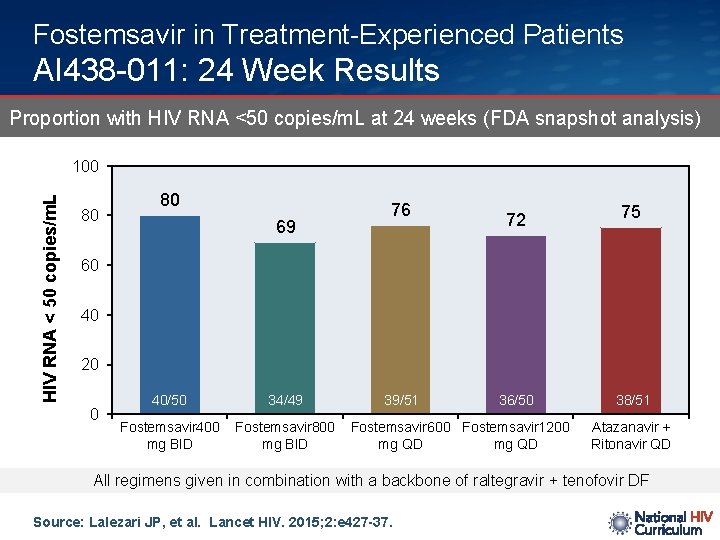
Fostemsavir in Treatment-Experienced Patients AI 438 -011: 24 Week Results Proportion with HIV RNA <50 copies/m. L at 24 weeks (FDA snapshot analysis) Source: Lalezari JP, et al. Lancet HIV. 2015; 2: e 427 -37. HIV RNA < 50 copies/m. L 100 80 80 69 76 72 75 60 40 20 0 40/50 34/49 39/51 36/50 Fostemsavir 400 Fostemsavir 800 Fostemsavir 600 Fostemsavir 1200 mg BID mg QD 38/51 Atazanavir + Ritonavir QD All regimens given in combination with a backbone of raltegravir + tenofovir DF Source: Lalezari JP, et al. Lancet HIV. 2015; 2: e 427 -37.
Fostemsavir in Treatment-Experienced Patients AI 438 -011: 24 Week Results, Conclusions Interpretation: “In a comparison with ritonavir-boosted atazanavir, efficacy and safety of BMS-663068 up to the week 24 analysis support continued development of BMS-663068, which is being assessed in a phase 3 trial in heavily treatment-experienced individuals. ” Source: Lalezari JP, et al. Lancet HIV. 2015; 2: e 427 -37.
Acknowledgment The National HIV Curriculum is an AIDS Education and Training Center (AETC) Program supported by the Health Resources and Services Administration (HRSA) of the U. S. Department of Health and Human Services (HHS) as part of an award totaling $800, 000 with 0% financed with non-governmental sources. This project is led by the University of Washington’s Infectious Diseases Education and Assessment (IDEA) Program. The content in this presentation are those of the author(s) and do not necessarily represent the official views of, nor an endorsement, by HRSA, HHS, or the U. S. Government.
- Slides: 22