
FOSSILS History of Life through fossils 1650 it
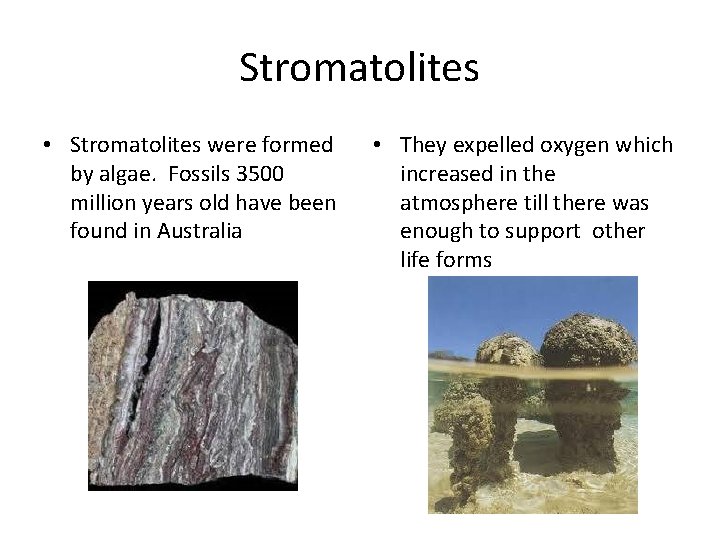
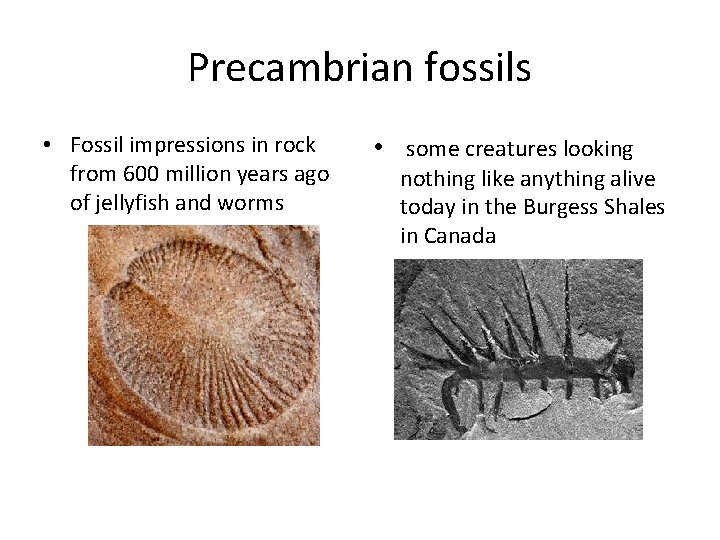
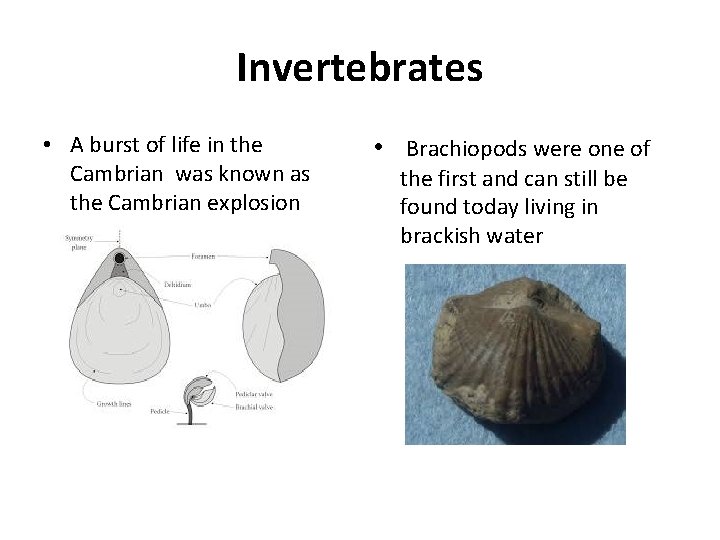
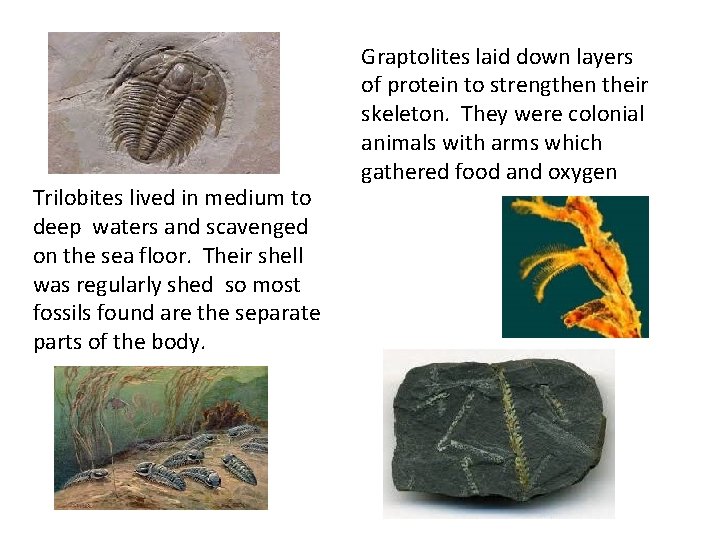
- Slides: 21
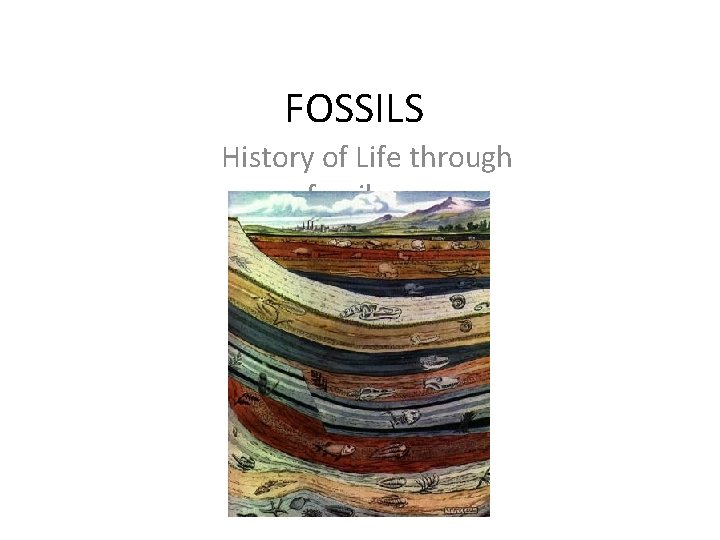
FOSSILS History of Life through fossils
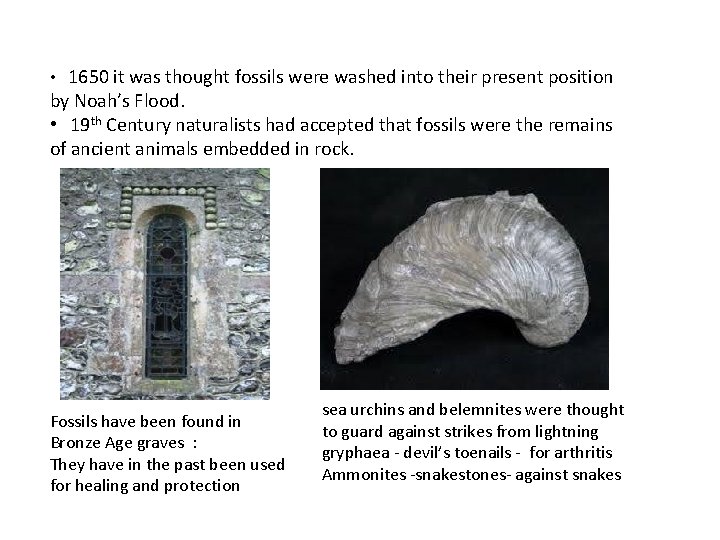
• 1650 it was thought fossils were washed into their present position by Noah’s Flood. • 19 th Century naturalists had accepted that fossils were the remains of ancient animals embedded in rock. Fossils have been found in Bronze Age graves : They have in the past been used for healing and protection sea urchins and belemnites were thought to guard against strikes from lightning gryphaea - devil’s toenails - for arthritis Ammonites -snakestones- against snakes
Stromatolites • Stromatolites were formed by algae. Fossils 3500 million years old have been found in Australia • They expelled oxygen which increased in the atmosphere till there was enough to support other life forms
Precambrian fossils • Fossil impressions in rock from 600 million years ago of jellyfish and worms • some creatures looking nothing like anything alive today in the Burgess Shales in Canada
Invertebrates • A burst of life in the Cambrian was known as the Cambrian explosion • Brachiopods were one of the first and can still be found today living in brackish water
Trilobites lived in medium to deep waters and scavenged on the sea floor. Their shell was regularly shed so most fossils found are the separate parts of the body. Graptolites laid down layers of protein to strengthen their skeleton. They were colonial animals with arms which gathered food and oxygen
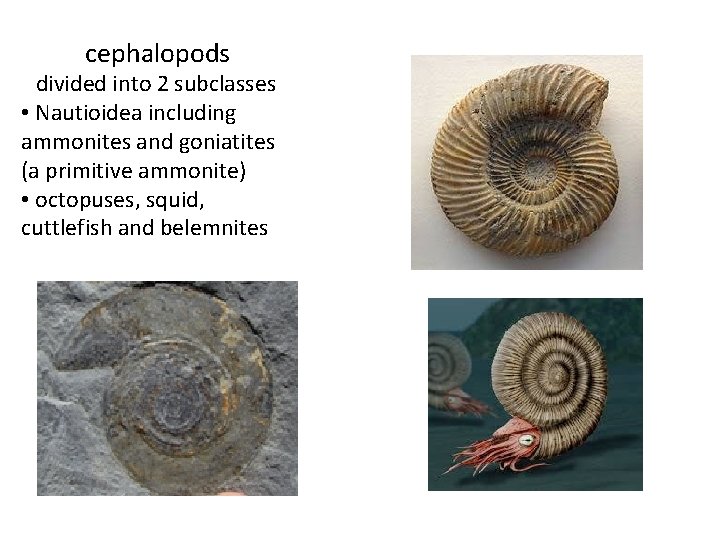
cephalopods divided into 2 subclasses • Nautioidea including ammonites and goniatites (a primitive ammonite) • octopuses, squid, cuttlefish and belemnites
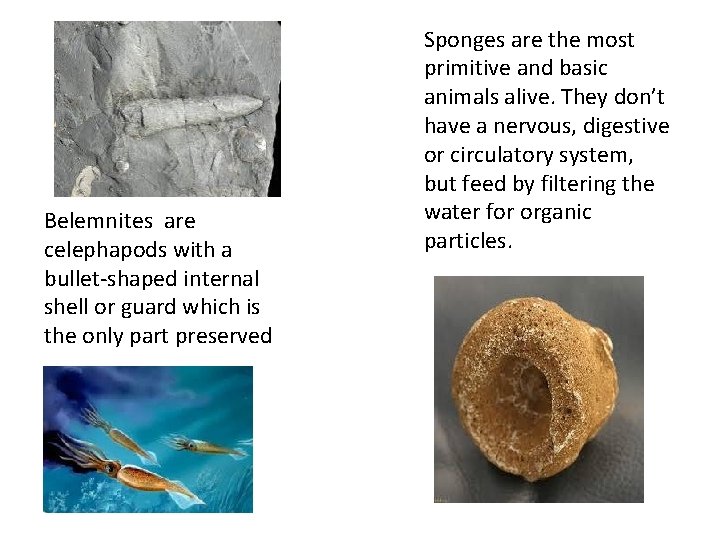
Belemnites are celephapods with a bullet-shaped internal shell or guard which is the only part preserved Sponges are the most primitive and basic animals alive. They don’t have a nervous, digestive or circulatory system, but feed by filtering the water for organic particles.
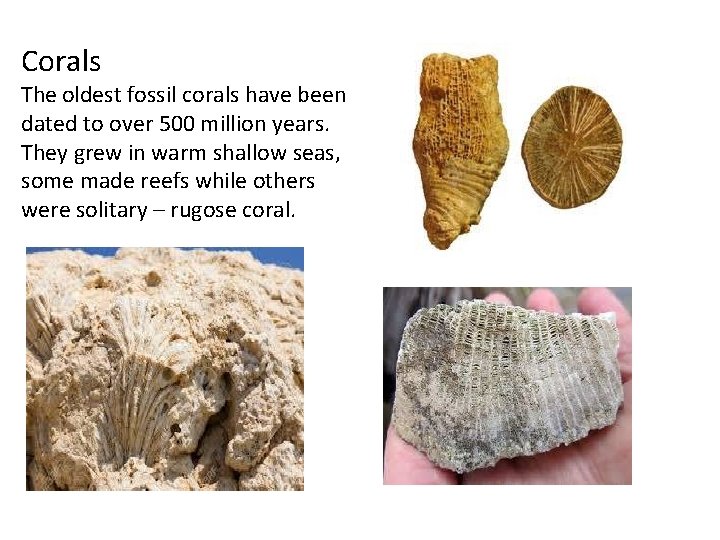
Corals The oldest fossil corals have been dated to over 500 million years. They grew in warm shallow seas, some made reefs while others were solitary – rugose coral.
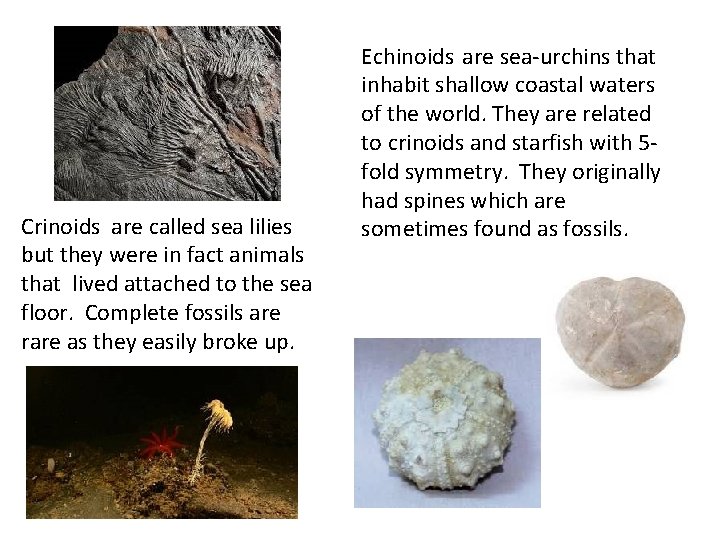
Crinoids are called sea lilies but they were in fact animals that lived attached to the sea floor. Complete fossils are rare as they easily broke up. Echinoids are sea-urchins that inhabit shallow coastal waters of the world. They are related to crinoids and starfish with 5 fold symmetry. They originally had spines which are sometimes found as fossils.
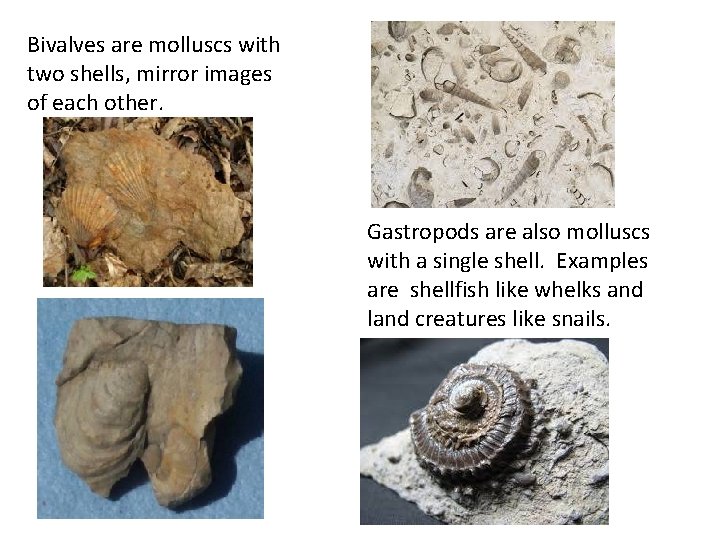
Bivalves are molluscs with two shells, mirror images of each other. Gastropods are also molluscs with a single shell. Examples are shellfish like whelks and land creatures like snails.
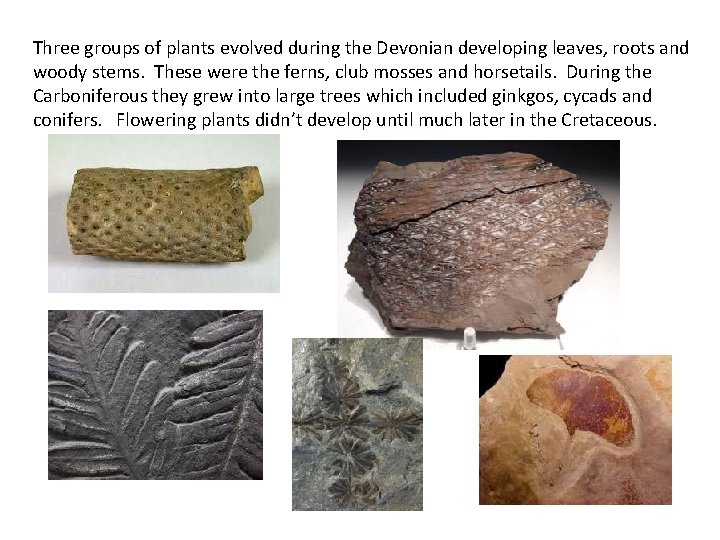
Three groups of plants evolved during the Devonian developing leaves, roots and woody stems. These were the ferns, club mosses and horsetails. During the Carboniferous they grew into large trees which included ginkgos, cycads and conifers. Flowering plants didn’t develop until much later in the Cretaceous.
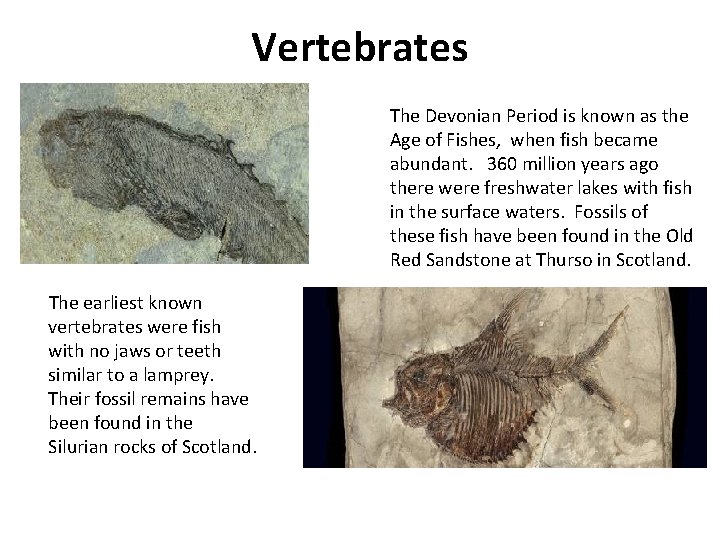
Vertebrates The Devonian Period is known as the Age of Fishes, when fish became abundant. 360 million years ago there were freshwater lakes with fish in the surface waters. Fossils of these fish have been found in the Old Red Sandstone at Thurso in Scotland. The earliest known vertebrates were fish with no jaws or teeth similar to a lamprey. Their fossil remains have been found in the Silurian rocks of Scotland.
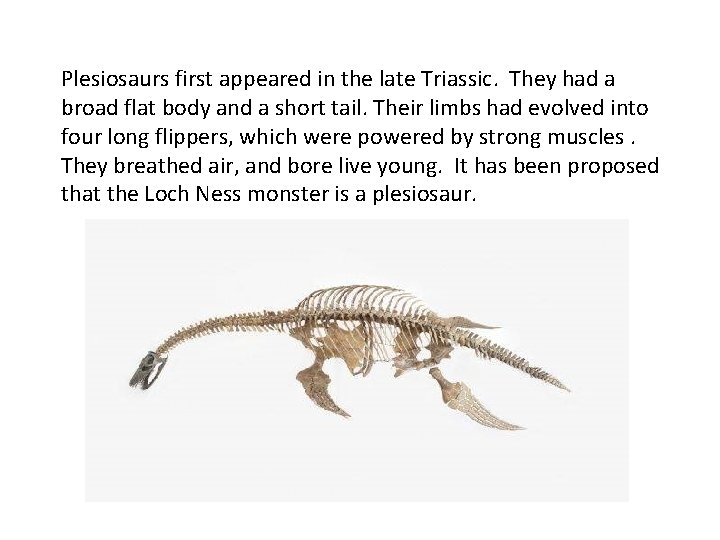
Plesiosaurs first appeared in the late Triassic. They had a broad flat body and a short tail. Their limbs had evolved into four long flippers, which were powered by strong muscles. They breathed air, and bore live young. It has been proposed that the Loch Ness monster is a plesiosaur.
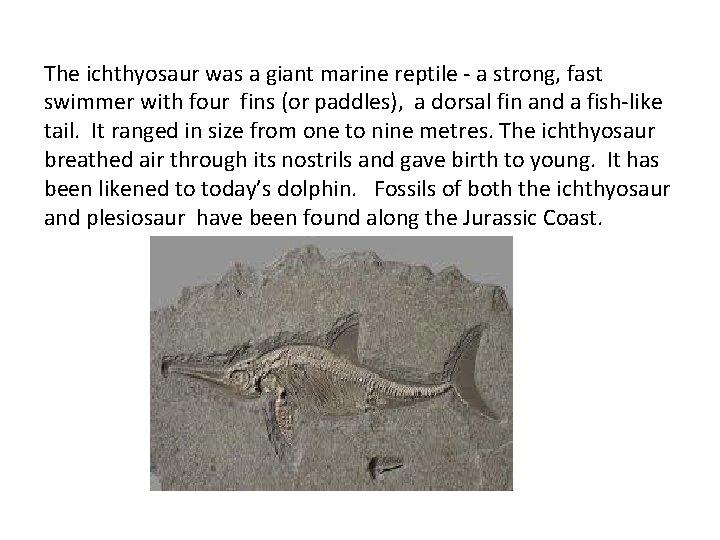
The ichthyosaur was a giant marine reptile - a strong, fast swimmer with four fins (or paddles), a dorsal fin and a fish-like tail. It ranged in size from one to nine metres. The ichthyosaur breathed air through its nostrils and gave birth to young. It has been likened to today’s dolphin. Fossils of both the ichthyosaur and plesiosaur have been found along the Jurassic Coast.
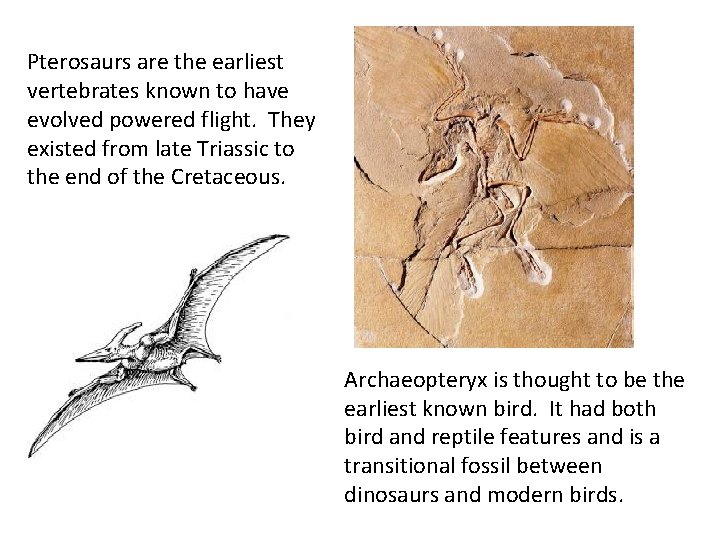
Pterosaurs are the earliest vertebrates known to have evolved powered flight. They existed from late Triassic to the end of the Cretaceous. Archaeopteryx is thought to be the earliest known bird. It had both bird and reptile features and is a transitional fossil between dinosaurs and modern birds.
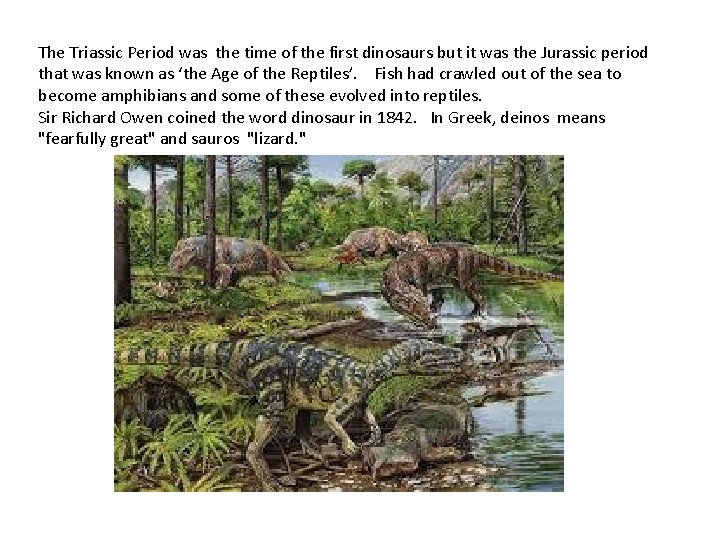
The Triassic Period was the time of the first dinosaurs but it was the Jurassic period that was known as ‘the Age of the Reptiles’. Fish had crawled out of the sea to become amphibians and some of these evolved into reptiles. Sir Richard Owen coined the word dinosaur in 1842. In Greek, deinos means "fearfully great" and sauros "lizard. "
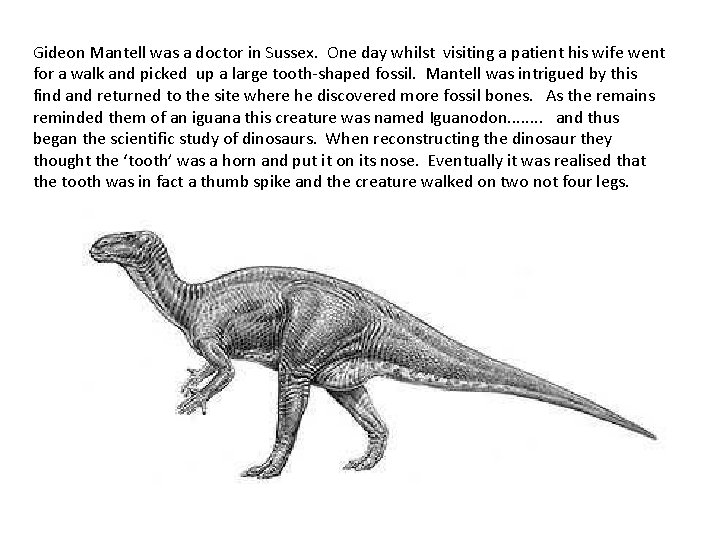
Gideon Mantell was a doctor in Sussex. One day whilst visiting a patient his wife went for a walk and picked up a large tooth-shaped fossil. Mantell was intrigued by this find and returned to the site where he discovered more fossil bones. As the remains reminded them of an iguana this creature was named Iguanodon. . . . and thus began the scientific study of dinosaurs. When reconstructing the dinosaur they thought the ‘tooth’ was a horn and put it on its nose. Eventually it was realised that the tooth was in fact a thumb spike and the creature walked on two not four legs.
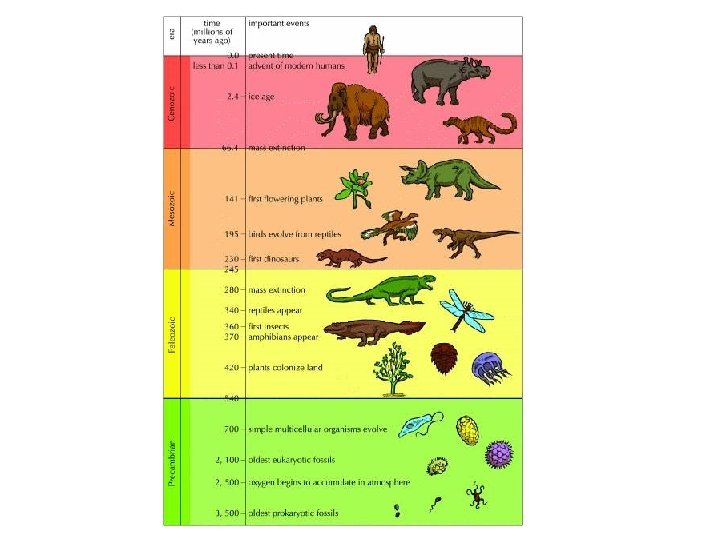
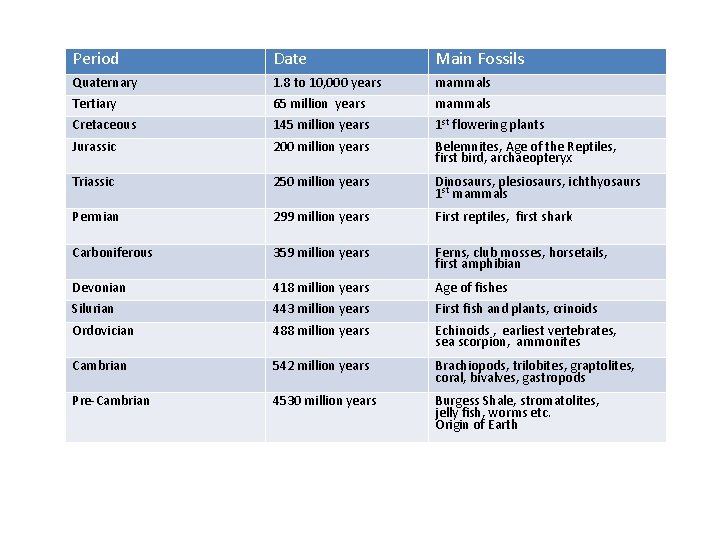
Period Date Main Fossils Quaternary 1. 8 to 10, 000 years mammals Tertiary 65 million years mammals Cretaceous 145 million years 1 st flowering plants Jurassic 200 million years Belemnites, Age of the Reptiles, first bird, archaeopteryx Triassic 250 million years Dinosaurs, plesiosaurs, ichthyosaurs 1 st mammals Permian 299 million years First reptiles, first shark Carboniferous 359 million years Ferns, club mosses, horsetails, first amphibian Devonian 418 million years Age of fishes Silurian 443 million years First fish and plants, crinoids Ordovician 488 million years Echinoids , earliest vertebrates, sea scorpion, ammonites Cambrian 542 million years Brachiopods, trilobites, graptolites, coral, bivalves, gastropods Pre-Cambrian 4530 million years Burgess Shale, stromatolites, jelly fish, worms etc. Origin of Earth