
Fossils Fossils Preserved remains or traces of living




- Slides: 9
Fossils • Fossils – Preserved remains or traces of living things. • How do they form? – When living things die and are buried in sediment. – The sediment hardens into rock and preserves the shape of the organism. Brain Pop Video https: //www. brainpop. com/science/diversityoflife/fossils/
Types of Fossils • There are 6 types of Fossils: – Molds – Casts – Petrified Fossils – Carbon Films – Trace Fossils – Preserved Remains
Molds and Casts • Mold – A hollow area in sediment in the shape of the organism. • Cast – A solid (3 D) copy of the shape of an organism.
Petrified Fossils • Petrified Fossils – When minerals replace all or part of an organism, and it becomes stone.
Carbon Films • Carbon Film – An extremely thin coating of carbon on rock. – All living things are made up of carbon! – When the other materials decompose or evaporate, carbon is left in the rock, creating a carbon film.
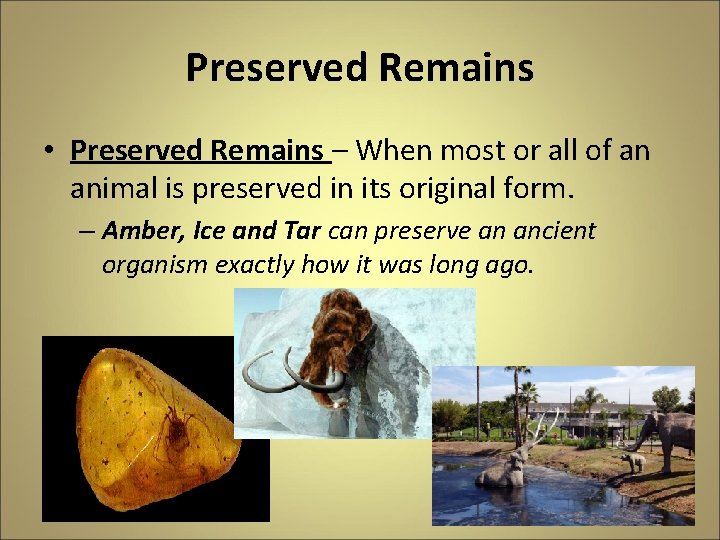
Preserved Remains • Preserved Remains – When most or all of an animal is preserved in its original form. – Amber, Ice and Tar can preserve an ancient organism exactly how it was long ago.
Trace Fossils • Trace Fossils – Fossils that provide evidence of the activities of ancient organisms. – Dinosaur Footprints are a perfect example!
Trace Fossils Activity • Look at the footprints in the diagram. • What inferences can you make about what happened here? • Work with a partner to come up with an explanation of what happened. Describe why you think this and support your version of events with evidence. • Write it out on one paper (3 -5 sentences) and be ready to present your idea to the class.