
FOSSILIZATION Group Nirmal Lauren Antonio Charlene OVERVIEW Chapter






- Slides: 44
FOSSILIZATION Group: Nirmal, Lauren, Antonio & Charlene
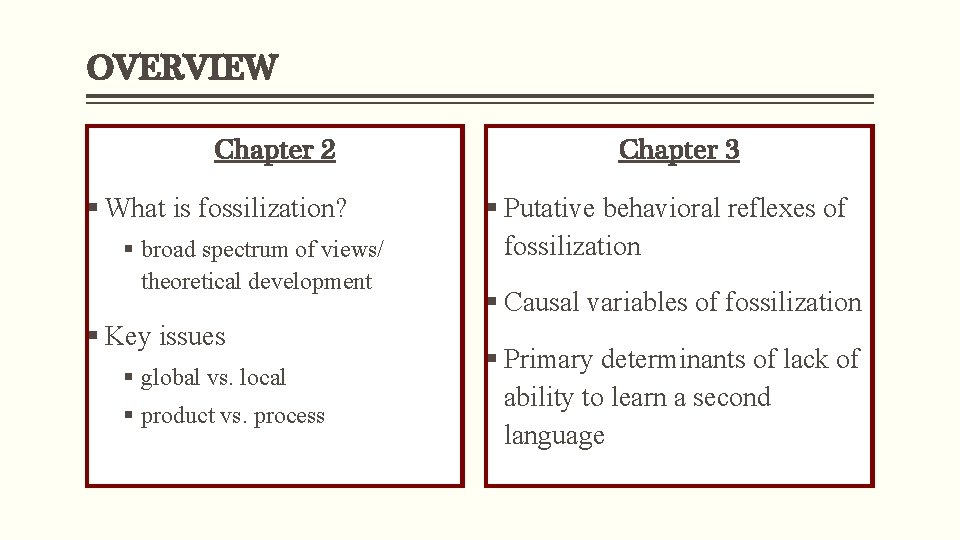
OVERVIEW Chapter 2 § What is fossilization? § broad spectrum of views/ theoretical development § Key issues § global vs. local § product vs. process Chapter 3 § Putative behavioral reflexes of fossilization § Causal variables of fossilization § Primary determinants of lack of ability to learn a second language
CHAPTER 2 WHAT IS FOSSILIZATION?
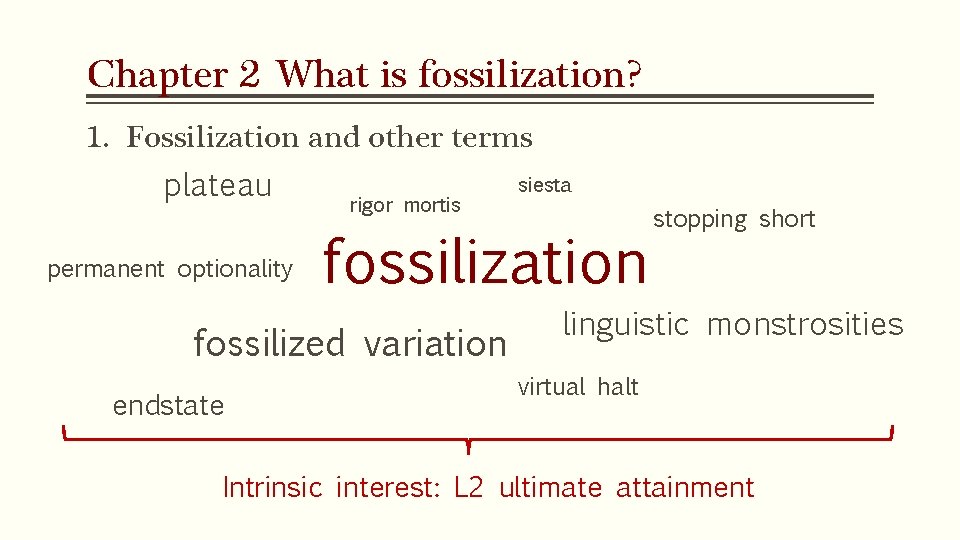
Chapter 2 What is fossilization? 1. Fossilization and other terms plateau permanent optionality rigor mortis fossilization fossilized variation endstate siesta stopping short linguistic monstrosities virtual halt Intrinsic interest: L 2 ultimate attainment
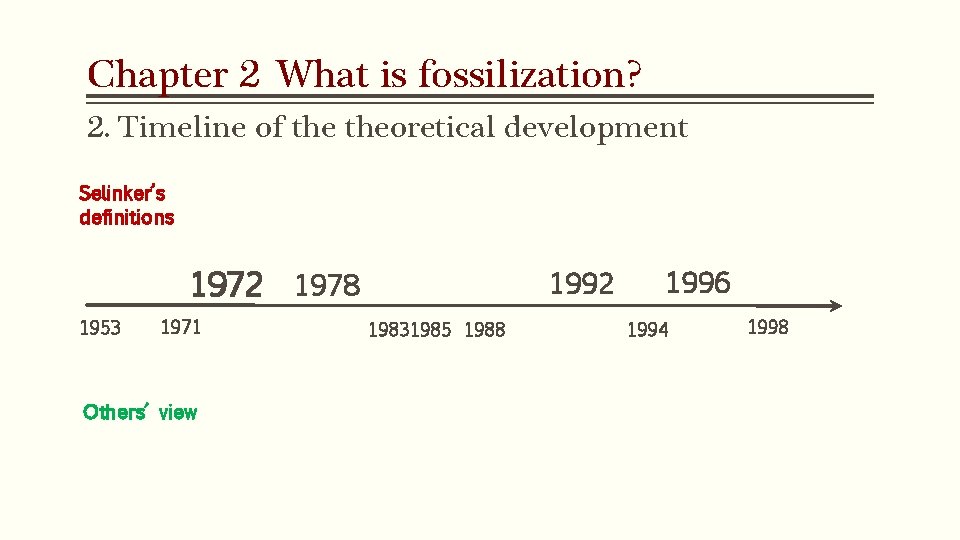
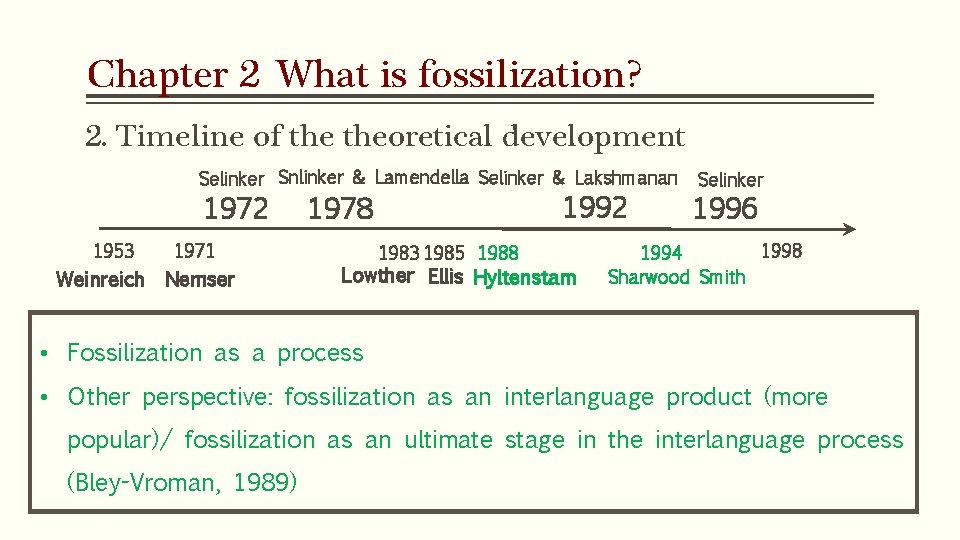
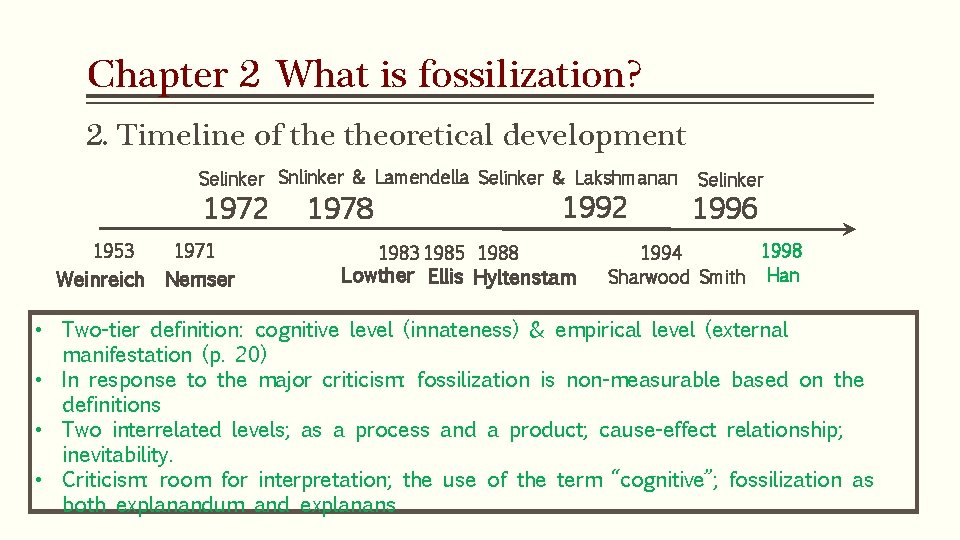
Chapter 2 What is fossilization? 2. Timeline of theoretical development Selinker’s definitions 1972 1978 1953 1971 Others’ view 1992 19831985 1988 1996 1994 1998
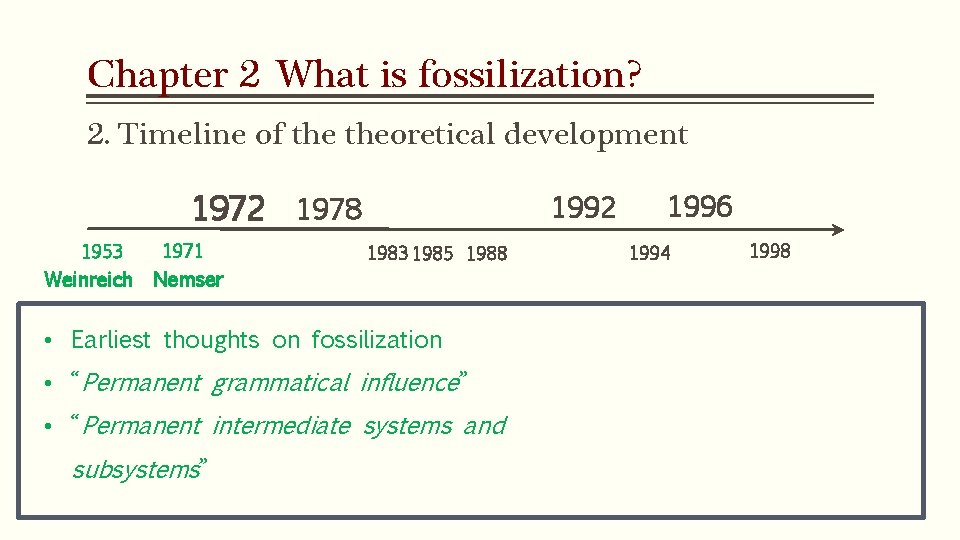
Chapter 2 What is fossilization? 2. Timeline of theoretical development 1972 1978 1953 1971 1992 1983 1985 1988 Weinreich Nemser • Earliest thoughts on fossilization • “Permanent grammatical influence” • “Permanent intermediate systems and subsystems” 1996 1994 1998
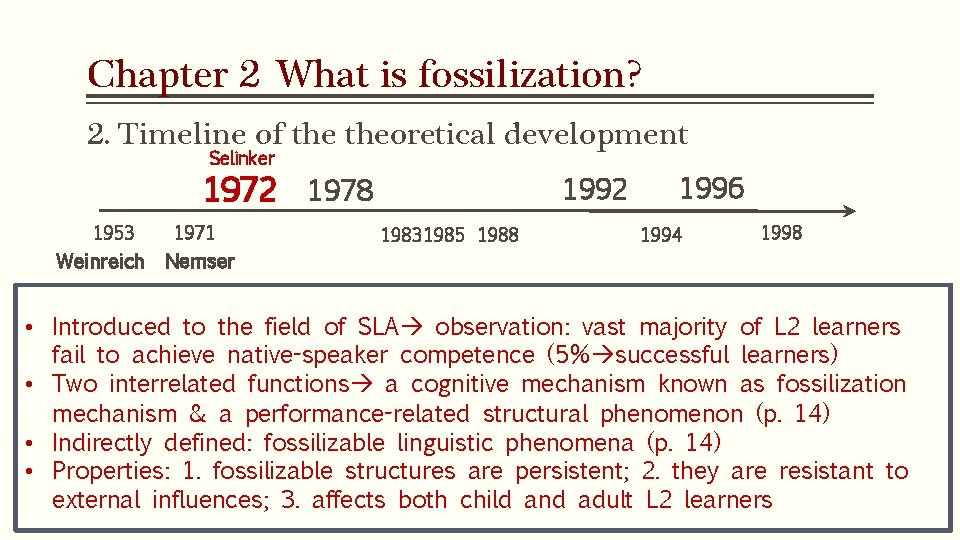
Chapter 2 What is fossilization? 2. Timeline of theoretical development Selinker 1972 1978 1953 1971 1992 1983 1985 1988 1996 1994 1998 Weinreich Nemser • Introduced to the field of SLA observation: vast majority of L 2 learners fail to achieve native-speaker competence (5% successful learners) • Two interrelated functions a cognitive mechanism known as fossilization mechanism & a performance-related structural phenomenon (p. 14) • Indirectly defined: fossilizable linguistic phenomena (p. 14) • Properties: 1. fossilizable structures are persistent; 2. they are resistant to external influences; 3. affects both child and adult L 2 learners
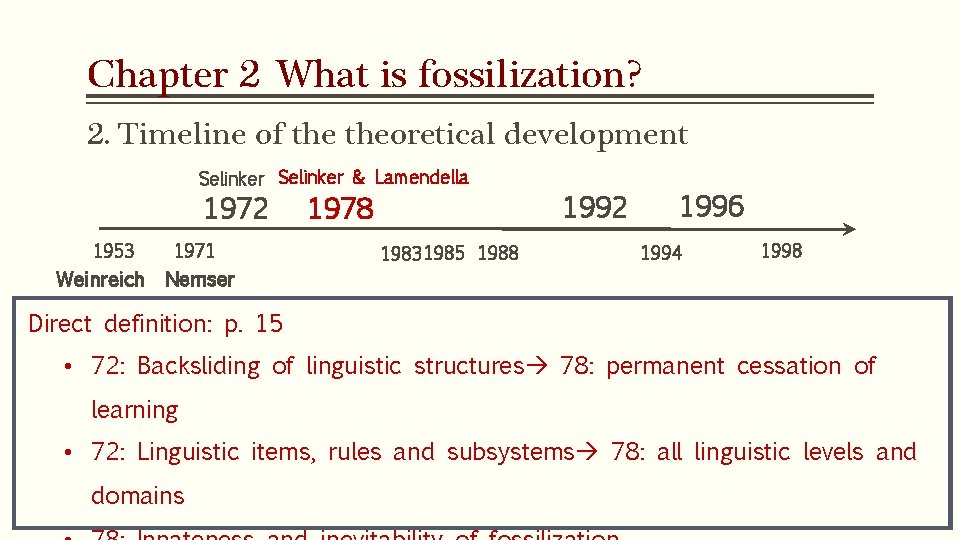
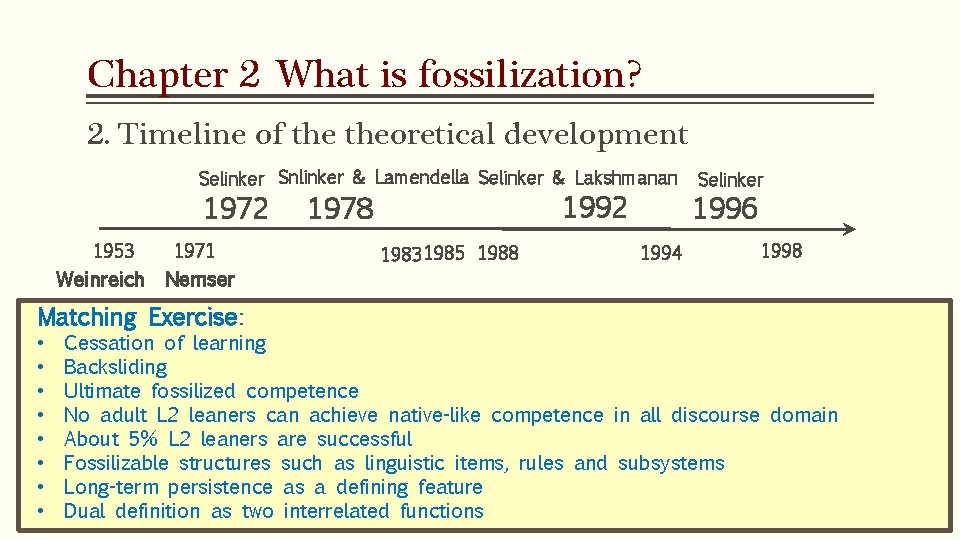
Chapter 2 What is fossilization? 2. Timeline of theoretical development Selinker & Lamendella 1972 1953 1971 1978 1983 1985 1988 1992 1996 1994 1998 Weinreich Nemser Direct definition: p. 15 • 72: Backsliding of linguistic structures 78: permanent cessation of learning • 72: Linguistic items, rules and subsystems 78: all linguistic levels and domains
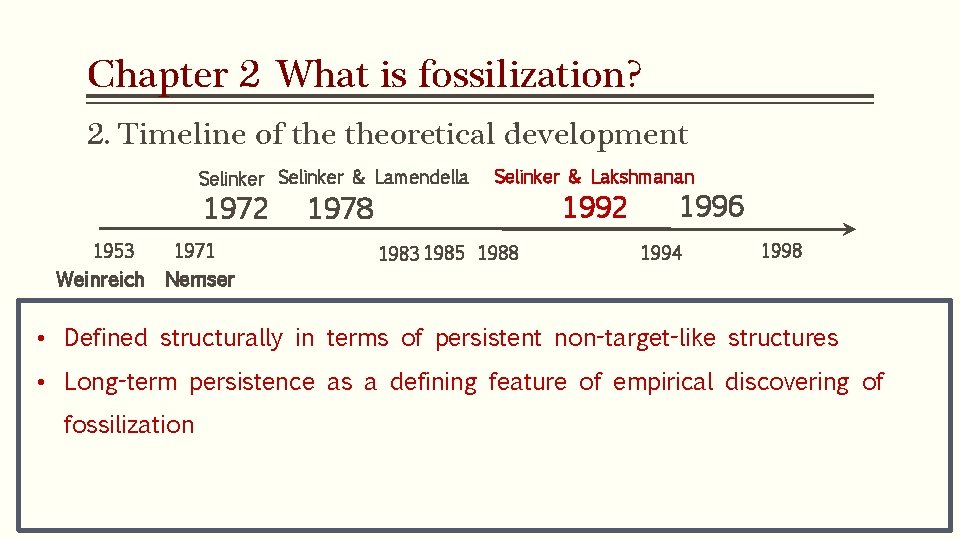
Chapter 2 What is fossilization? 2. Timeline of theoretical development Selinker & Lamendella 1972 1953 1971 Weinreich Nemser Selinker & Lakshmanan 1978 1983 1985 1988 1992 1996 1994 1998 • Defined structurally in terms of persistent non-target-like structures • Long-term persistence as a defining feature of empirical discovering of fossilization
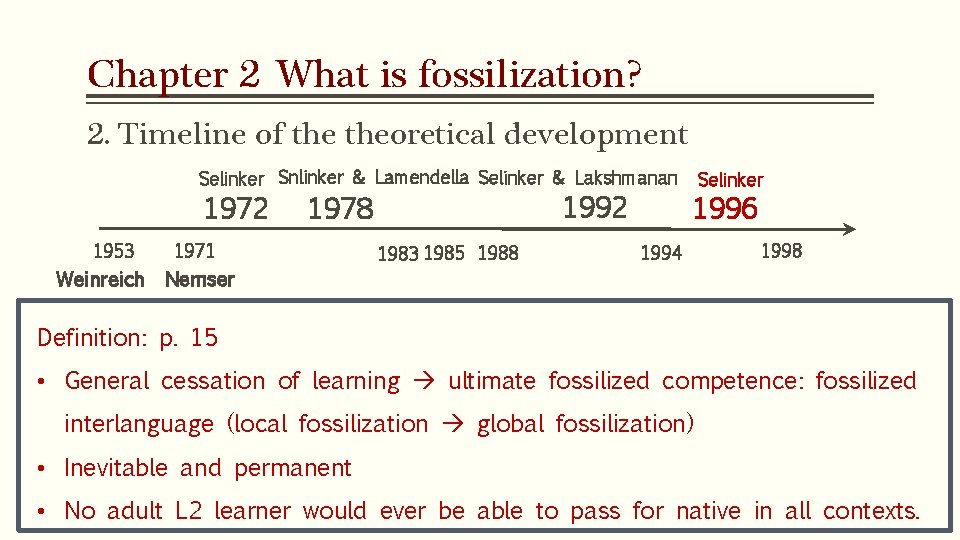
Chapter 2 What is fossilization? 2. Timeline of theoretical development Selinker Snlinker & Lamendella Selinker & Lakshmanan 1972 1953 1992 1978 1971 Weinreich Nemser 1983 1985 1988 Selinker 1996 1994 1998 Definition: p. 15 • General cessation of learning ultimate fossilized competence: fossilized interlanguage (local fossilization global fossilization) • Inevitable and permanent • No adult L 2 learner would ever be able to pass for native in all contexts.
Chapter 2 What is fossilization? 2. Timeline of theoretical development Selinker Snlinker & Lamendella Selinker & Lakshmanan 1972 1953 1971 Weinreich Nemser Matching Exercise: • • 1992 1978 1983 1985 1988 1994 Selinker 1996 1998 Cessation of learning Backsliding Ultimate fossilized competence No adult L 2 leaners can achieve native-like competence in all discourse domain About 5% L 2 leaners are successful Fossilizable structures such as linguistic items, rules and subsystems Long-term persistence as a defining feature Dual definition as two interrelated functions
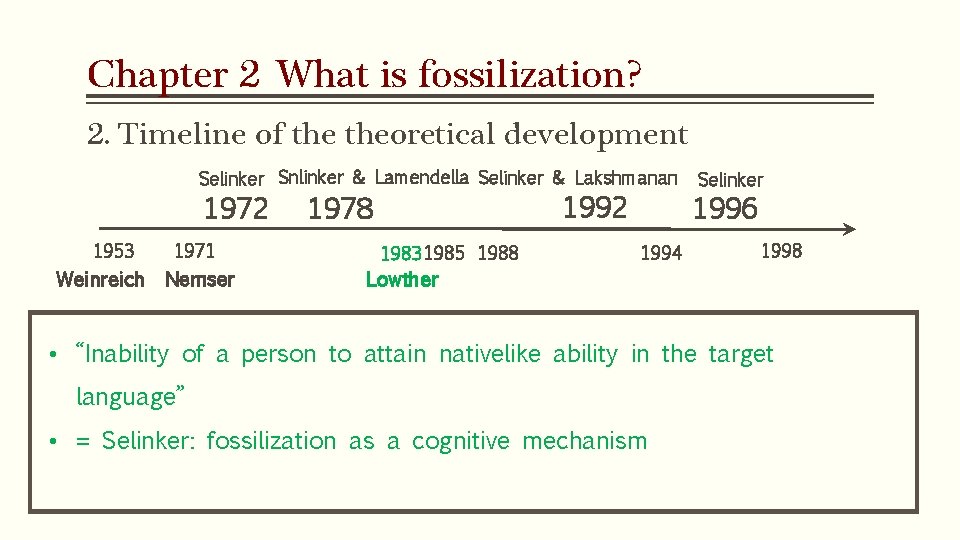
Chapter 2 What is fossilization? 2. Timeline of theoretical development Selinker Snlinker & Lamendella Selinker & Lakshmanan 1972 1953 1971 Weinreich Nemser 1992 1978 1983 1985 1988 1994 Selinker 1996 1998 Lowther • “Inability of a person to attain nativelike ability in the target language” • = Selinker: fossilization as a cognitive mechanism
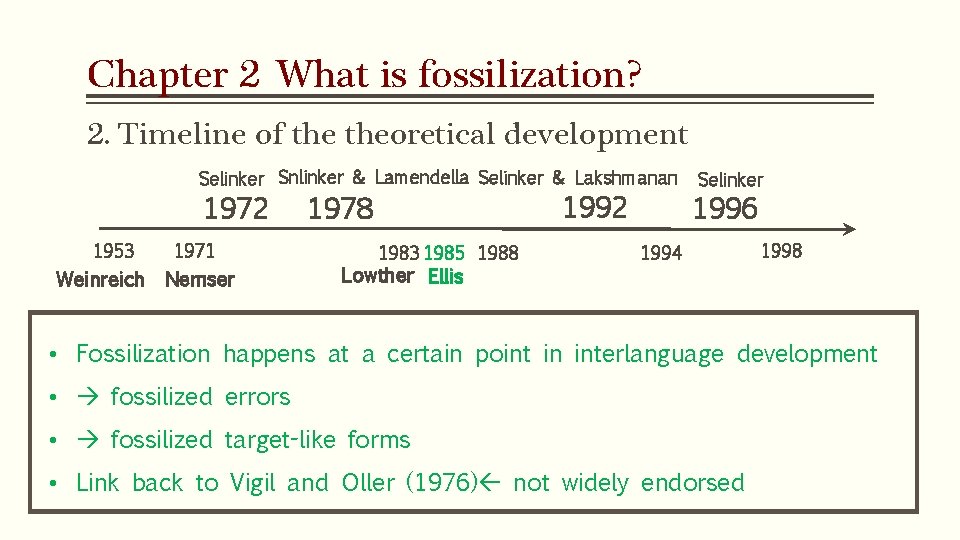
Chapter 2 What is fossilization? 2. Timeline of theoretical development Selinker Snlinker & Lamendella Selinker & Lakshmanan 1972 1953 1971 Weinreich Nemser 1992 1978 1983 1985 1988 Lowther Ellis Selinker 1996 1994 1998 • Fossilization happens at a certain point in interlanguage development • fossilized errors • fossilized target-like forms • Link back to Vigil and Oller (1976) not widely endorsed
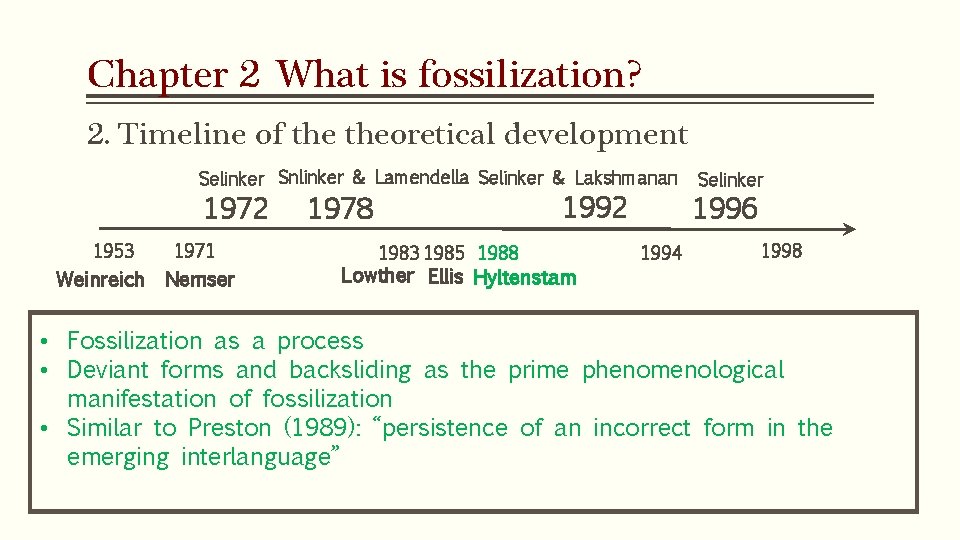
Chapter 2 What is fossilization? 2. Timeline of theoretical development Selinker Snlinker & Lamendella Selinker & Lakshmanan 1972 1953 1971 Weinreich Nemser 1992 1978 1983 1985 1988 Lowther Ellis Hyltenstam 1994 Selinker 1996 1998 • Fossilization as a process • Deviant forms and backsliding as the prime phenomenological manifestation of fossilization • Similar to Preston (1989): “persistence of an incorrect form in the emerging interlanguage”
Chapter 2 What is fossilization? 2. Timeline of theoretical development Selinker Snlinker & Lamendella Selinker & Lakshmanan 1972 1953 1971 Weinreich Nemser 1992 1978 1983 1985 1988 Lowther Ellis Hyltenstam Selinker 1996 1998 1994 Sharwood Smith • Fossilization as a process • Other perspective: fossilization as an interlanguage product (more popular)/ fossilization as an ultimate stage in the interlanguage process (Bley-Vroman, 1989)
Chapter 2 What is fossilization? 2. Timeline of theoretical development Selinker Snlinker & Lamendella Selinker & Lakshmanan 1972 1953 1971 Weinreich Nemser 1992 1978 1983 1985 1988 Lowther Ellis Hyltenstam Selinker 1996 1998 1994 Sharwood Smith Han • Two-tier definition: cognitive level (innateness) & empirical level (external manifestation (p. 20) • In response to the major criticism: fossilization is non-measurable based on the definitions • Two interrelated levels; as a process and a product; cause-effect relationship; inevitability. • Criticism: room for interpretation; the use of the term “cognitive”; fossilization as both explanandum and explanans
Chapter 2 What is fossilization? 3. Key issues: § Is fossilization global or local? § Is fossilization a product or a process?
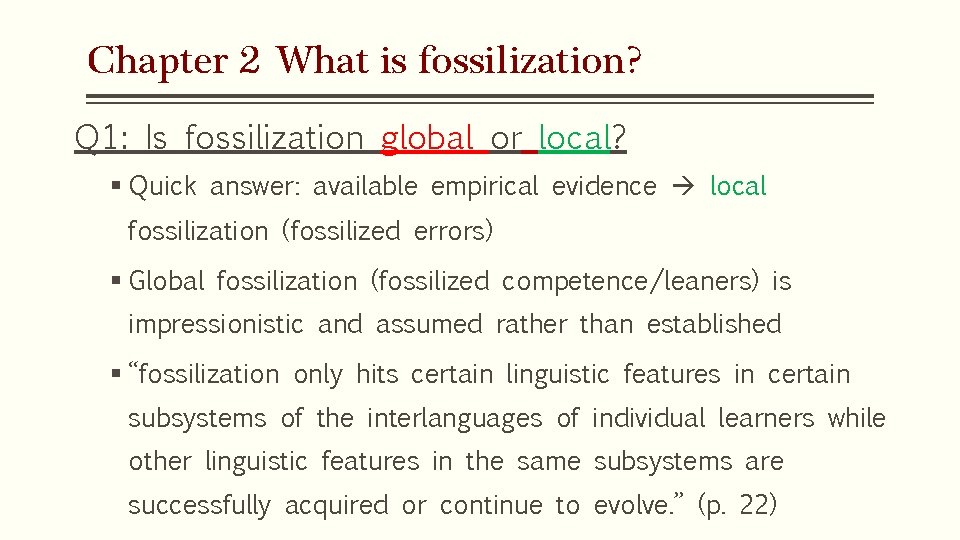
Chapter 2 What is fossilization? Q 1: Is fossilization global or local? § Quick answer: available empirical evidence local fossilization (fossilized errors) § Global fossilization (fossilized competence/leaners) is impressionistic and assumed rather than established § “fossilization only hits certain linguistic features in certain subsystems of the interlanguages of individual learners while other linguistic features in the same subsystems are successfully acquired or continue to evolve. ” (p. 22)
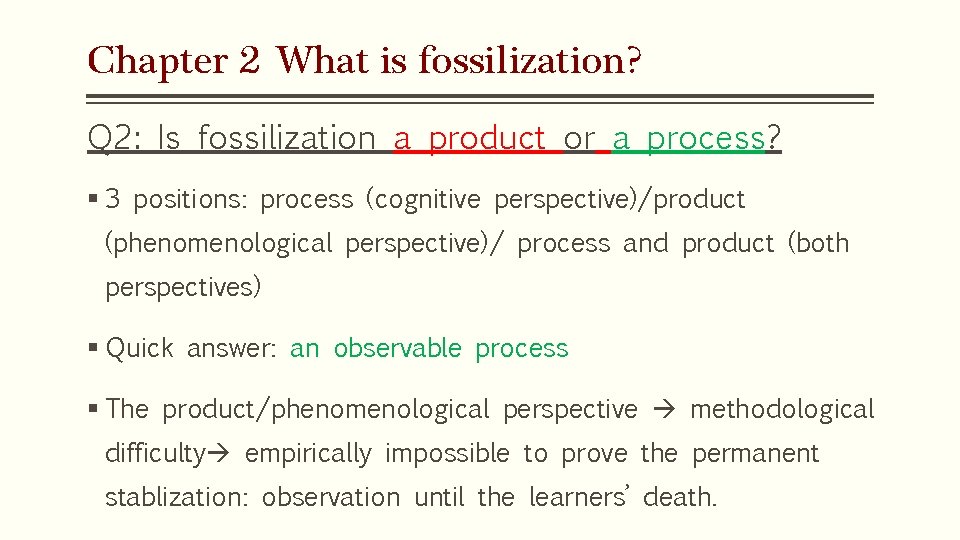
Chapter 2 What is fossilization? Q 2: Is fossilization a product or a process? § 3 positions: process (cognitive perspective)/product (phenomenological perspective)/ process and product (both perspectives) § Quick answer: an observable process § The product/phenomenological perspective methodological difficulty empirically impossible to prove the permanent stablization: observation until the learners’ death.
Discussion questions
CHAPTER 3 Behavioral Reflexes and Causal Variables
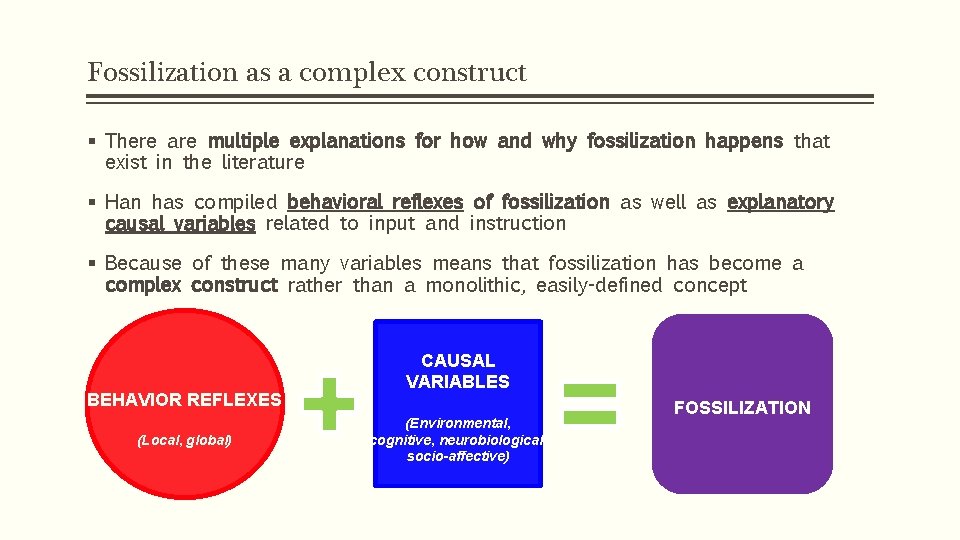
Fossilization as a complex construct § There are multiple explanations for how and why fossilization happens that exist in the literature § Han has compiled behavioral reflexes of fossilization as well as explanatory causal variables related to input and instruction § Because of these many variables means that fossilization has become a complex construct rather than a monolithic, easily-defined concept BEHAVIOR REFLEXES (Local, global) CAUSAL VARIABLES (Environmental, cognitive, neurobiological, socio-affective) FOSSILIZATION
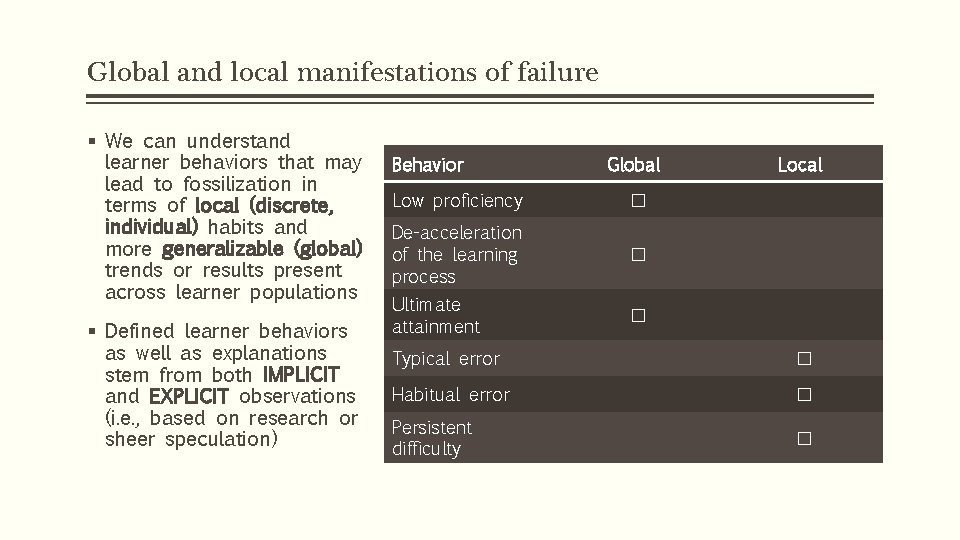
Global and local manifestations of failure § We can understand learner behaviors that may lead to fossilization in terms of local (discrete, individual) habits and more generalizable (global) trends or results present across learner populations § Defined learner behaviors as well as explanations stem from both IMPLICIT and EXPLICIT observations (i. e. , based on research or sheer speculation) Behavior Global Low proficiency � De-acceleration of the learning process � Ultimate attainment � Local Typical error � Habitual error � Persistent difficulty �
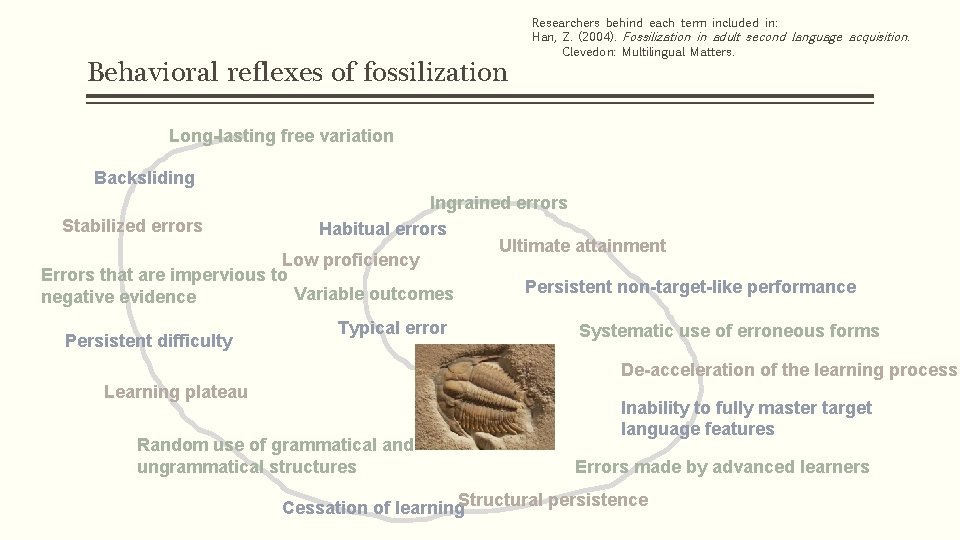
Behavioral reflexes of fossilization Researchers behind each term included in: Han, Z. (2004). Fossilization in adult second language acquisition. Clevedon: Multilingual Matters. Long-lasting free variation Backsliding Ingrained errors Stabilized errors Habitual errors Ultimate attainment Low proficiency Errors that are impervious to Persistent non-target-like performance Variable outcomes negative evidence Persistent difficulty Typical error Systematic use of erroneous forms De-acceleration of the learning process Learning plateau Random use of grammatical and ungrammatical structures Inability to fully master target language features Errors made by advanced learners Cessation of learning. Structural persistence
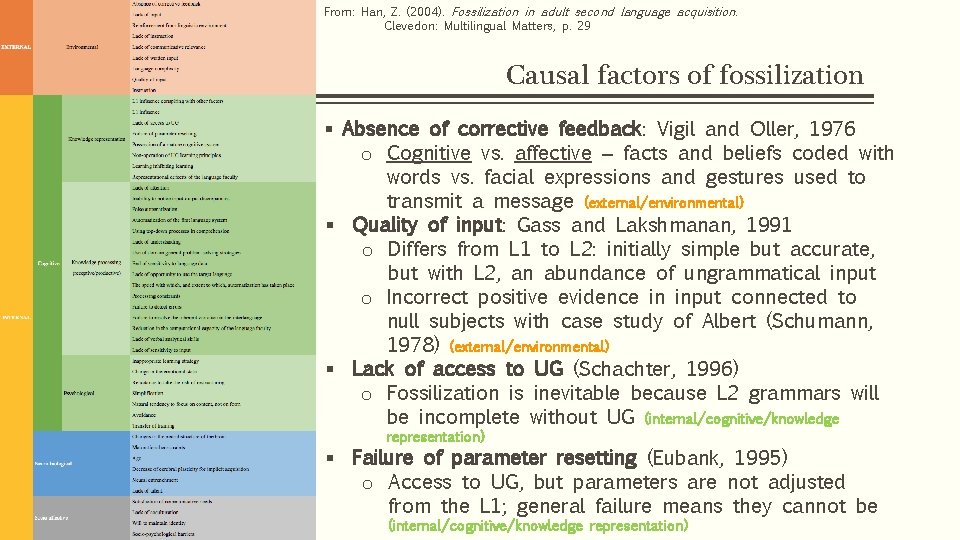
From: Han, Z. (2004). Fossilization in adult second language acquisition. Clevedon: Multilingual Matters, p. 29 Causal factors of fossilization § Absence of corrective feedback: Vigil and Oller, 1976 o Cognitive vs. affective – facts and beliefs coded with words vs. facial expressions and gestures used to transmit a message (external/environmental) § Quality of input: Gass and Lakshmanan, 1991 o Differs from L 1 to L 2: initially simple but accurate, but with L 2, an abundance of ungrammatical input o Incorrect positive evidence in input connected to null subjects with case study of Albert (Schumann, 1978) (external/environmental) § Lack of access to UG (Schachter, 1996) o Fossilization is inevitable because L 2 grammars will be incomplete without UG (internal/cognitive/knowledge representation) § Failure of parameter resetting (Eubank, 1995) o Access to UG, but parameters are not adjusted from the L 1; general failure means they cannot be (internal/cognitive/knowledge representation)
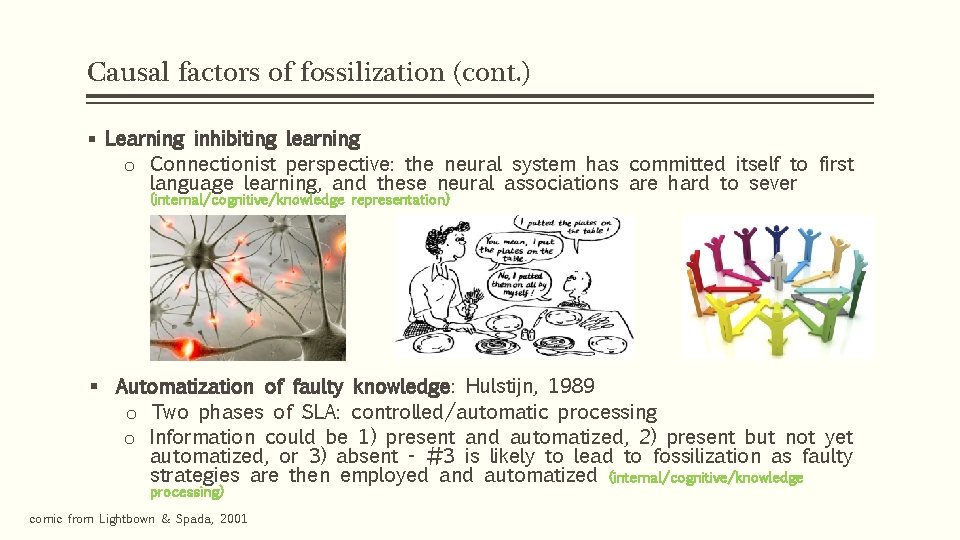
Causal factors of fossilization (cont. ) § Learning inhibiting learning o Connectionist perspective: the neural system has committed itself to first language learning, and these neural associations are hard to sever (internal/cognitive/knowledge representation) § Automatization of faulty knowledge: Hulstijn, 1989 o Two phases of SLA: controlled/automatic processing o Information could be 1) present and automatized, 2) present but not yet automatized, or 3) absent - #3 is likely to lead to fossilization as faulty strategies are then employed and automatized (internal/cognitive/knowledge processing) comic from Lightbown & Spada, 2001
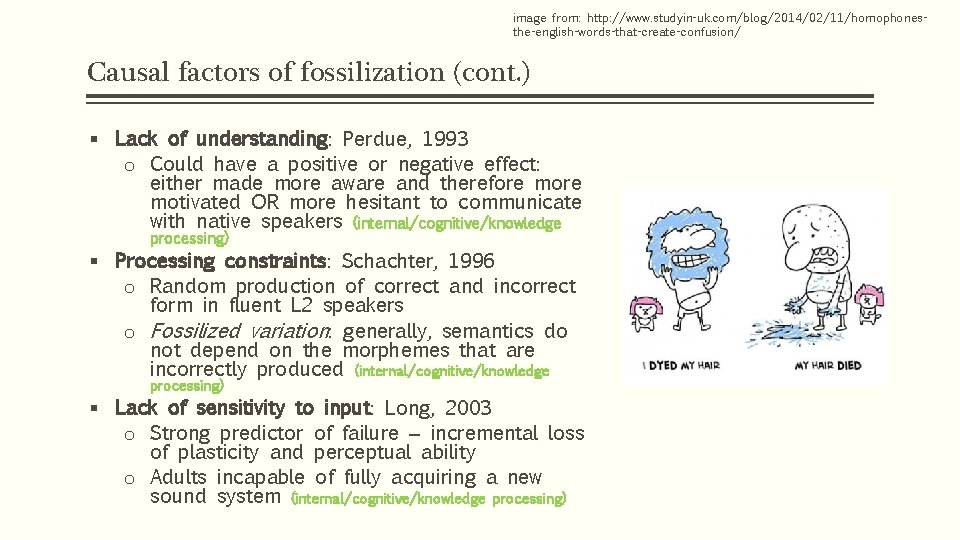
image from: http: //www. studyin-uk. com/blog/2014/02/11/homophonesthe-english-words-that-create-confusion/ Causal factors of fossilization (cont. ) § Lack of understanding: Perdue, 1993 o Could have a positive or negative effect: either made more aware and therefore motivated OR more hesitant to communicate with native speakers (internal/cognitive/knowledge processing) § Processing constraints: Schachter, 1996 o Random production of correct and incorrect form in fluent L 2 speakers o Fossilized variation: generally, semantics do not depend on the morphemes that are incorrectly produced (internal/cognitive/knowledge processing) § Lack of sensitivity to input: Long, 2003 o Strong predictor of failure – incremental loss of plasticity and perceptual ability o Adults incapable of fully acquiring a new sound system (internal/cognitive/knowledge processing)
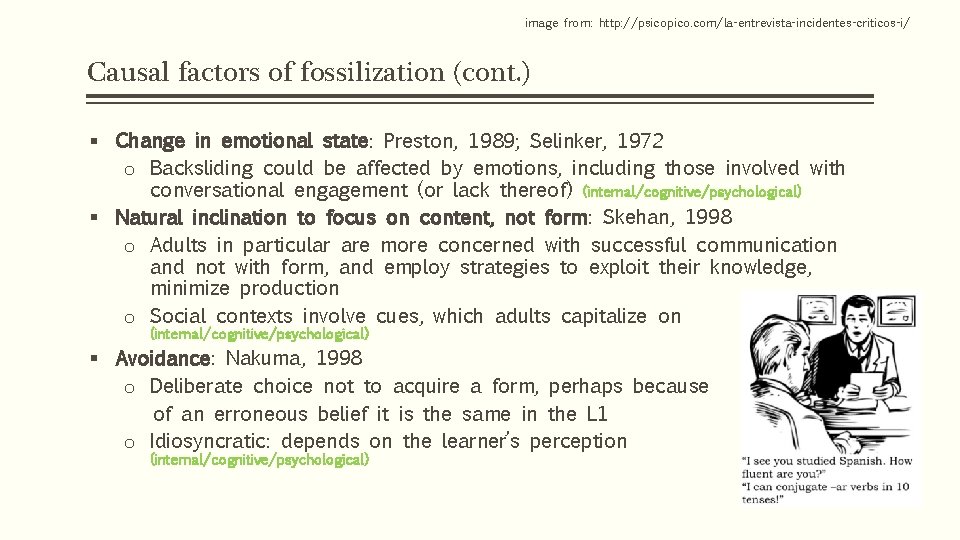
image from: http: //psicopico. com/la-entrevista-incidentes-criticos-i/ Causal factors of fossilization (cont. ) § Change in emotional state: Preston, 1989; Selinker, 1972 o Backsliding could be affected by emotions, including those involved with conversational engagement (or lack thereof) (internal/cognitive/psychological) § Natural inclination to focus on content, not form: Skehan, 1998 o Adults in particular are more concerned with successful communication and not with form, and employ strategies to exploit their knowledge, minimize production o Social contexts involve cues, which adults capitalize on (internal/cognitive/psychological) § Avoidance: Nakuma, 1998 o Deliberate choice not to acquire a form, perhaps because of an erroneous belief it is the same in the L 1 o Idiosyncratic: depends on the learner’s perception (internal/cognitive/psychological)
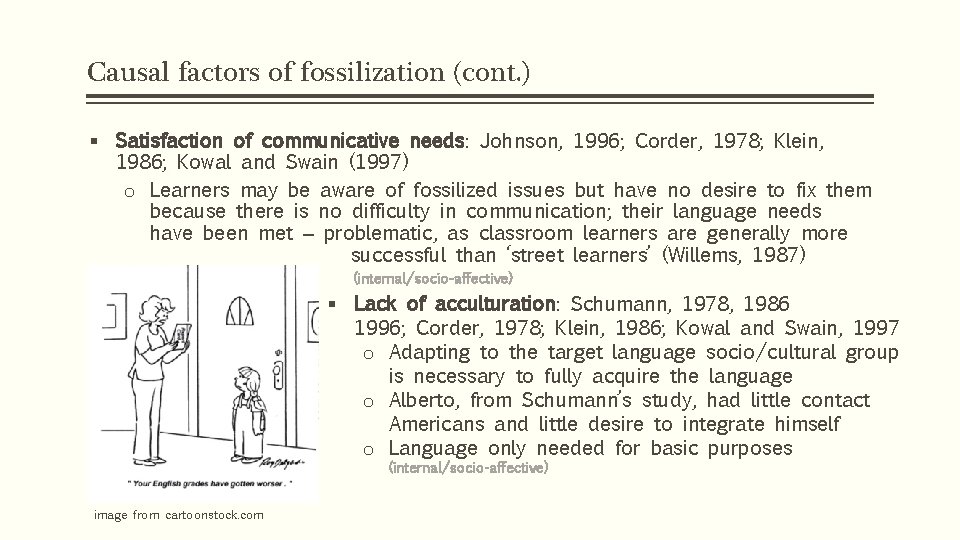
Causal factors of fossilization (cont. ) § Satisfaction of communicative needs: Johnson, 1996; Corder, 1978; Klein, 1986; Kowal and Swain (1997) o Learners may be aware of fossilized issues but have no desire to fix them because there is no difficulty in communication; their language needs have been met – problematic, as classroom learners are generally more successful than ‘street learners’ (Willems, 1987) (internal/socio-affective) § Lack of acculturation: Schumann, 1978, 1986 1996; Corder, 1978; Klein, 1986; Kowal and Swain, 1997 o Adapting to the target language socio/cultural group is necessary to fully acquire the language o Alberto, from Schumann’s study, had little contact Americans and little desire to integrate himself o Language only needed for basic purposes (internal/socio-affective) image from cartoonstock. com
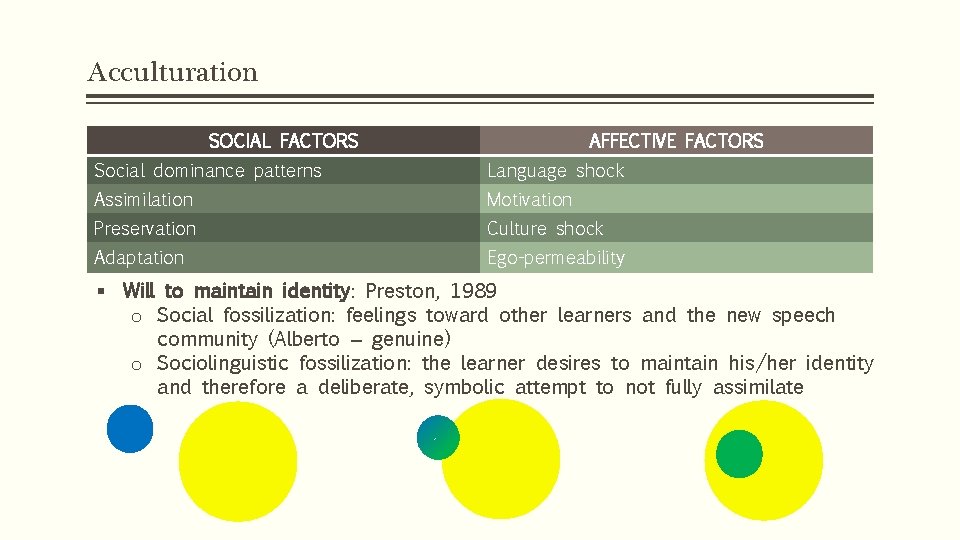
Acculturation SOCIAL FACTORS AFFECTIVE FACTORS Social dominance patterns Language shock Assimilation Motivation Preservation Culture shock Adaptation Ego-permeability § Will to maintain identity: Preston, 1989 o Social fossilization: feelings toward other learners and the new speech community (Alberto – genuine) o Sociolinguistic fossilization: the learner desires to maintain his/her identity and therefore a deliberate, symbolic attempt to not fully assimilate
image from: http: //lifeisanamusementparkrtisticworld. blogspot. com/2012/09/momentum-energy-and-growth. html What determines lack of language ability? § Two key factors: maturational constraints and native language interference § The Competition Model (Bates & Mac. Whinney, 1981; Mac. Whinney, 2001) 1) Neuronal commitment: plasticity declines with age, and certain neural areas of the brain are already “committed” to a specific function 2) The parasitic nature of learning: learning a new language imposes on these committed neural areas, essentially making it a parasite. TRANSFER from the L 1 occurs as a compensatory strategy.
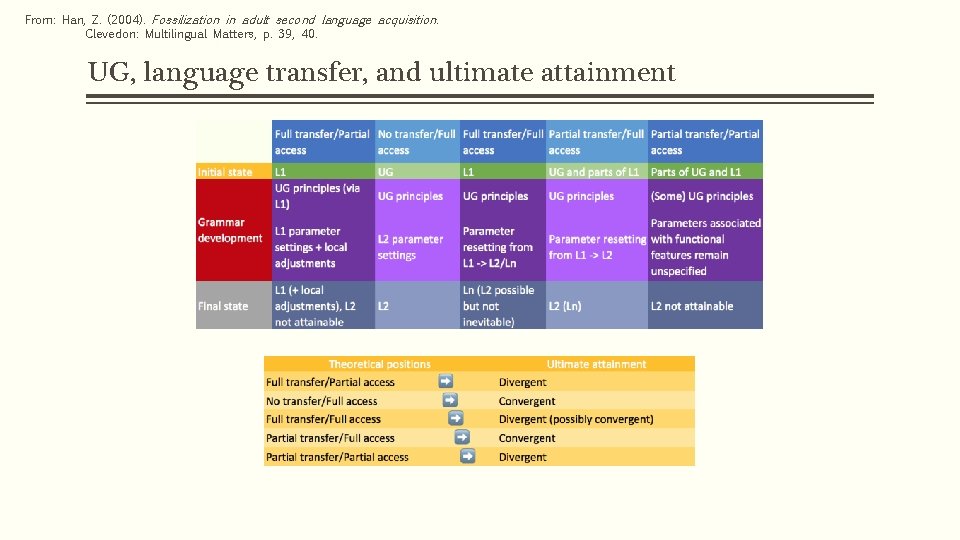
What determines lack of language ability? (cont. ) § The UG Approach: focuses on describing grammatical competence rather than input processing – how does L 2 performance/competence differ from L 1 speakers or other L 2 learners? (White, 1998) § Many theoretical positions divided over the extent to which adult learners can access UG and the influence of the L 1 (next slide) § What they have in common: if any amount of L 1 transfer is involved, ultimate attainment will diverge from proper L 2 grammar § Neuro-biological maturation (described by Eubank & Gregg, 1999) o The brain is compartmentalized into different faculties, one of which is linguistic competence (memory, face perception, visual perception…); each of these is divided into subfaculties – linguistically, this means that subcompetencies such as phonology, syntax, and morphology exist discretely and may each have a different biological timetable for maturation, and there could be varying success across these areas o Neural architecture changes in a much more limited way in adults o UG and CP may not be mutually exclusive – some properties are susceptible to CP while others are not
From: Han, Z. (2004). Fossilization in adult second language acquisition. Clevedon: Multilingual Matters, p. 39, 40. UG, language transfer, and ultimate attainment
Discussion questions
References § Han, Z. (2004). Fossilization in adult second language acquisition. Clevedon: Multilingual Matters. § Images: § Bangkokpost. com § Lightbown & Spada, 2001 § http: //www. studyin-uk. com/blog/2014/02/11/homophones-the-english-words-that-createconfusion/ § http: //psicopico. com/la-entrevista-incidentes-criticos-i § cartoonstock. com § http: //lifeisanamusementparkrtisticworld. blogspot. com/2012/09/momentum-energy-andgrowth. html
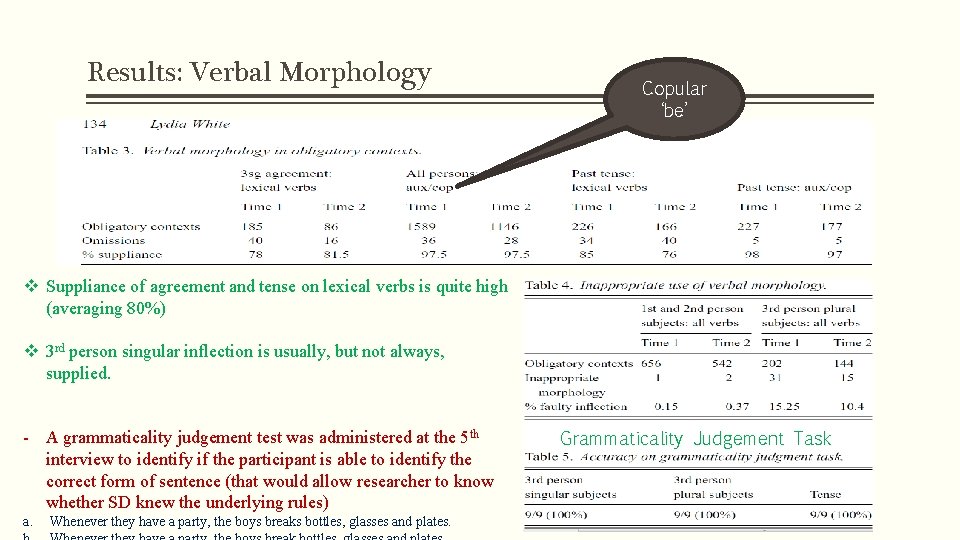
Fossilization in steady state L 2 grammars: Presistent problems with inflectional morphology by Lydia White (Mc. Gill University) Rationale: v Fossilization is sometimes used to describe an acquisition process, but it more suitably refers to the outcome to L 2 acquisition, namely the endstate grammar (Long, 2003). This process typically reveals itself in spontaneous production. v Bound inflectional morphology (tense marker, plural markers), lexical morphology (auxiliary and determiners) are long been noted and pervasive during the course of acquisition. (Haznedar and Schwartz, 1997; Eubank and Grace, 1998; Lardiere, 1998 a, b, 2000; Hawkins, 2000; Prevost and White, 2000; Robertson, 2000; Leung, 2000; Ionin and Wexler, 2002) v This study tries to test the MISSING SURFACE INFLECTION HYPOTHESIS or Mapping problem: while underlying syntax is intact (and not restricted to properties found in the L 1), L 2 speakers at various stages of acquisition have considerable problems in use of inflection, in many cases failing to produce overt morphology.
Methodology § Number of Participant (N=1) § Adult female (age 50 at the time of study) § Bilingual speaker (L 1: Turkish, L 2: English) § Place of Study: Canada § The participant moved to Canada at the age of 40. § Had minimal foreign language instruction in English in High School in Turkey § At 20, in Turkey, she took a six-month intensive course in spoken English § She attended college (mode of instruction: English) § Worked in English-speaking environment
Methodology cont. § Time 1: 2168 utterances (ranged from two words to several clauses) were collected during first 4 interviews § No change was found in this course thus, data were collapsed (felt a need to conduct interview after certain time interval) § Time 2: 18 months after the four interviews- 1256 utterances were collected. § During data mining, single-word utterances and repetitions were eliminated from the analysis.
Results: Verbal Morphology Copular ‘be’ v Suppliance of agreement and tense on lexical verbs is quite high (averaging 80%) v 3 rd person singular inflection is usually, but not always, supplied. - A grammaticality judgement test was administered at the 5 th interview to identify if the participant is able to identify the correct form of sentence (that would allow researcher to know whether SD knew the underlying rules) a. Whenever they have a party, the boys breaks bottles, glasses and plates. Grammaticality Judgement Task
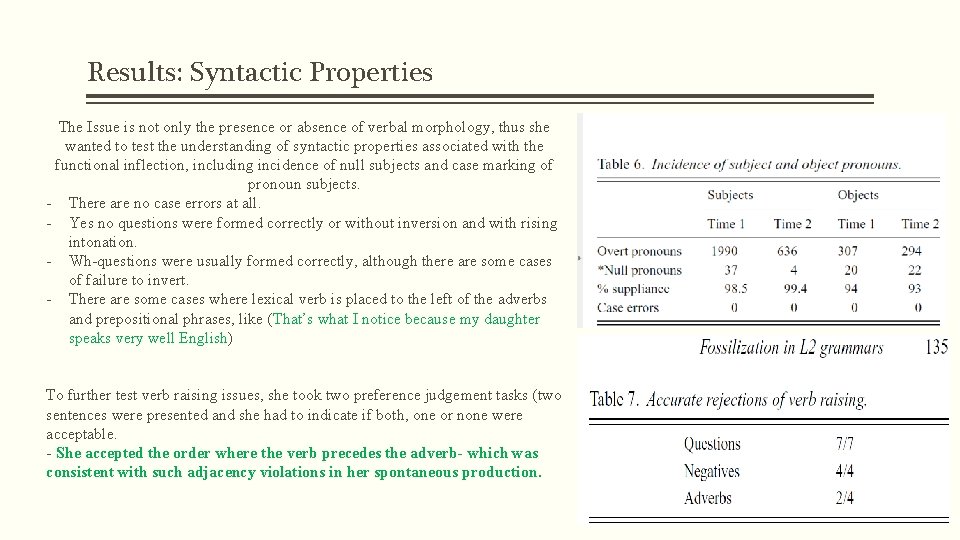
Results: Syntactic Properties The Issue is not only the presence or absence of verbal morphology, thus she wanted to test the understanding of syntactic properties associated with the functional inflection, including incidence of null subjects and case marking of pronoun subjects. - There are no case errors at all. - Yes no questions were formed correctly or without inversion and with rising intonation. - Wh-questions were usually formed correctly, although there are some cases of failure to invert. - There are some cases where lexical verb is placed to the left of the adverbs and prepositional phrases, like (That’s what I notice because my daughter speaks very well English) To further test verb raising issues, she took two preference judgement tasks (two sentences were presented and she had to indicate if both, one or none were acceptable. - She accepted the order where the verb precedes the adverb- which was consistent with such adjacency violations in her spontaneous production.
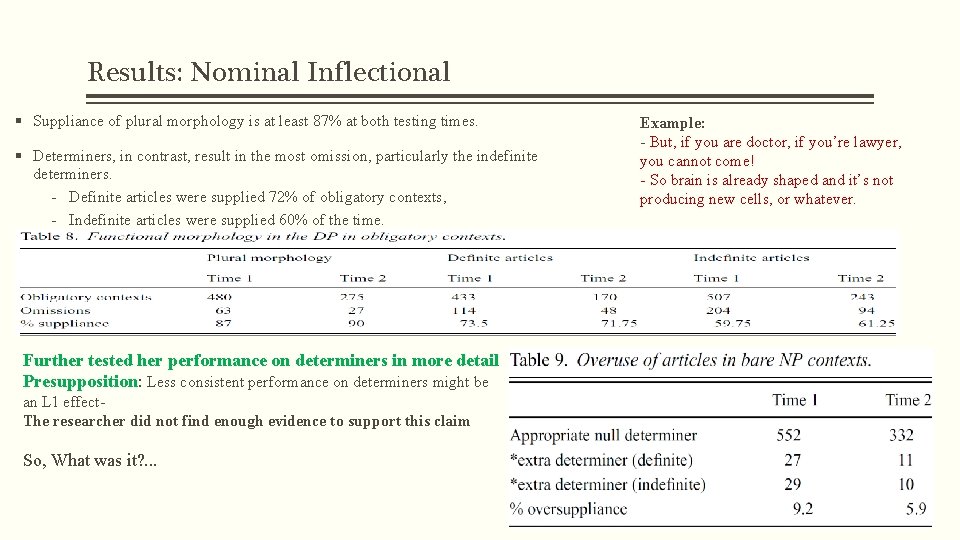
Results: Nominal Inflectional § Suppliance of plural morphology is at least 87% at both testing times. § Determiners, in contrast, result in the most omission, particularly the indefinite determiners. - Definite articles were supplied 72% of obligatory contexts, - Indefinite articles were supplied 60% of the time. Further tested her performance on determiners in more detail Presupposition: Less consistent performance on determiners might be an L 1 effect. The researcher did not find enough evidence to support this claim So, What was it? . . . Example: - But, if you are doctor, if you’re lawyer, you cannot come! - So brain is already shaped and it’s not producing new cells, or whatever.
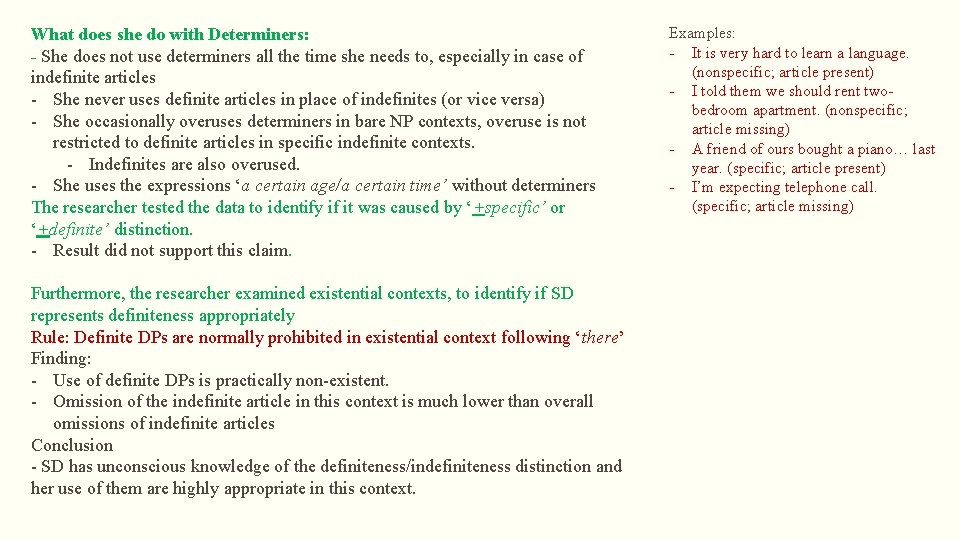
What does she do with Determiners: - She does not use determiners all the time she needs to, especially in case of indefinite articles - She never uses definite articles in place of indefinites (or vice versa) - She occasionally overuses determiners in bare NP contexts, overuse is not restricted to definite articles in specific indefinite contexts. - Indefinites are also overused. - She uses the expressions ‘a certain age/a certain time’ without determiners The researcher tested the data to identify if it was caused by ‘+specific’ or ‘+definite’ distinction. - Result did not support this claim. Furthermore, the researcher examined existential contexts, to identify if SD represents definiteness appropriately Rule: Definite DPs are normally prohibited in existential context following ‘there’ Finding: - Use of definite DPs is practically non-existent. - Omission of the indefinite article in this context is much lower than overall omissions of indefinite articles Conclusion - SD has unconscious knowledge of the definiteness/indefiniteness distinction and her use of them are highly appropriate in this context. Examples: - It is very hard to learn a language. (nonspecific; article present) - I told them we should rent twobedroom apartment. (nonspecific; article missing) - A friend of ours bought a piano… last year. (specific; article present) - I’m expecting telephone call. (specific; article missing)
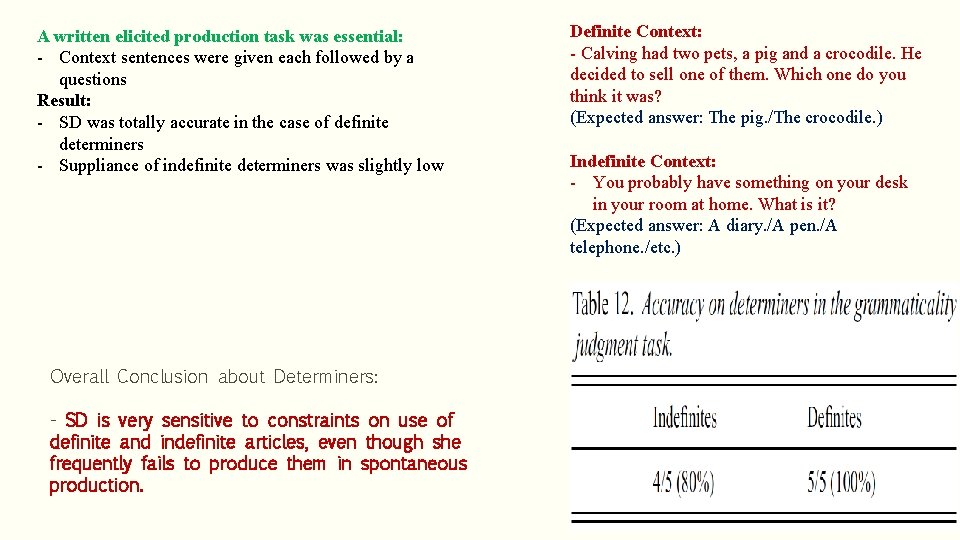
A written elicited production task was essential: - Context sentences were given each followed by a questions Result: - SD was totally accurate in the case of definite determiners - Suppliance of indefinite determiners was slightly low Overall Conclusion about Determiners: - SD is very sensitive to constraints on use of definite and indefinite articles, even though she frequently fails to produce them in spontaneous production. Definite Context: - Calving had two pets, a pig and a crocodile. He decided to sell one of them. Which one do you think it was? (Expected answer: The pig. /The crocodile. ) Indefinite Context: - You probably have something on your desk in your room at home. What is it? (Expected answer: A diary. /A pen. /A telephone. /etc. )
Conclusion: - Given the similarity in performance between Time 1 and Time 2, with one-and-a-half-year interval between them, it seems reasonable to suppose that SD’s grammar is indeed at the ‘endstate’ - Endstate grammars are indeed involved. Further Research: - SD’s endstate grammar may have been constrained by L 1 prosodic structure. - Thus, L 1 prosodic structure is implicated in accounting for missing inflection, it may help to explain other puzzle References: White, L. (2003). Fossilization in steady state L 2 grammars: Persistent problems with inflectional morphology. Bilingualism, 6(2), 129.