
Fossil Records and Carbon Dating Fossils are the
{ Fossil Records and Carbon Dating }
Fossils are the remains of once living animals. Fossils that we find in rocks represent the ancestors of the animals that are alive today. What are Fossils?
Fossil record provides snapshots of the past that, when assembled, illustrate a view of evolutionary change over the past four billion years In the 17 th century, Nicholas Steno discovered the similarity between shark teeth and the rocks commonly known as "tongue stones. " This was the first understanding that fossils were a record of past life. Fossils in Evolution
Fossils that show the intermediate states between an ancestral form and that of its descendants are referred to as transitional fossils. A Pakicetus is an early ancestor to the modern whale. Pakicetus were a land mammal and we know that whales are not. Then how do we know that the Pakicetus and the whale are related to each other? We know this because of the similarities in their ear. The Pakicetus had the same ear structure as the modern whale does now. Transitional Fossils
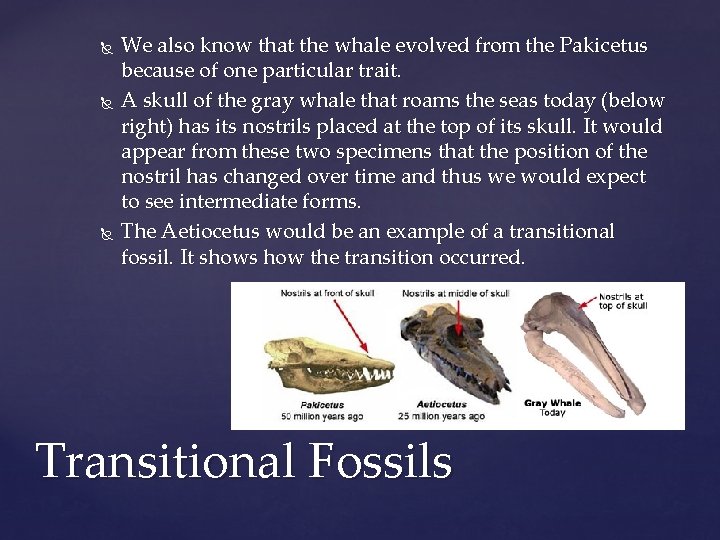
We also know that the whale evolved from the Pakicetus because of one particular trait. A skull of the gray whale that roams the seas today (below right) has its nostrils placed at the top of its skull. It would appear from these two specimens that the position of the nostril has changed over time and thus we would expect to see intermediate forms. The Aetiocetus would be an example of a transitional fossil. It shows how the transition occurred. Transitional Fossils
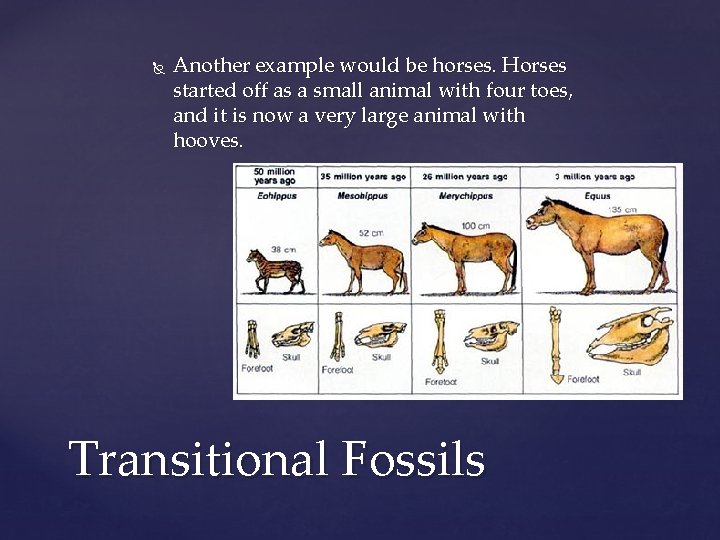
Another example would be horses. Horses started off as a small animal with four toes, and it is now a very large animal with hooves. Transitional Fossils

This transitional fossils are evidence of gradual change. They show that the changes that occurred did not just happen all at once. At 500 million years ago, ancient fish without jawbones surface; and at 400 million years ago, fish with jaws are found. Gradually, new animals appear: amphibians at 350 million years ago, reptiles at 300 million years ago, mammals at 230 million years ago, and birds at 150 million years ago. As the rocks become more and more recent, the fossils look increasingly like the animals we observe today. Transitional Fossils
How can scientists tell how old a fossil is? CARBON DATING! We often hear about things like “At an ar chaeological dig, a piece of wooden tool is unearthed and the archaeologist finds it to be 5, 000 years old. ” The archaeologist has figured it is 5000 years old by using Carbon dating. Carbon Dating
Carbon 14 dating is a way of determining the age of certain archeological artifacts of a biological origin up to about 50, 000 years old. Certain chemical elements have more than one type of atom. Different atoms of the same element are called isotopes. Carbon has three main isotopes. They are carbon 12, carbon 13 and carbon 14. Carbon 12 makes up 99% of an atom, carbon 13 makes up 1% and carbon 14 makes up 1 part per million. Carbon 14 is radioactive and it is this radioactivity which is used to measure age. Carbon Dating
Radioactive atoms decay into stable atoms by a simple mathematical process. Half of the available atoms will change in a given period of time, known as the half life. For instance, if 1000 atoms in the year 2000 had a half life of ten years, then in 2010 there would be 500 left. In 2020, there would be 250 left, and in 2030 there would be 125 left. Carbon Dating
Using that formula, we can depict how old a fossil is. By counting how many carbon 14 atoms in any object with carbon in it, we can work out how old the object is or how long ago it died. So we only have to know two things, the half life of carbon 14 and how many carbon 14 atoms the object had before it died. The half life of carbon 14 is 5, 730 years. However knowing how many carbon 14 atoms something had before it died can only be guessed at. Carbon Dating
The assumption is that the proportion of carbon 14 in any living organism is constant. When a particular fossil was alive, it had the same amount of carbon 14 as the same living organism today. As soon as a living organism dies, it stops taking in new carbon. The ratio of carbon 12 to carbon 14 at the moment of death is the same as every other living thing, but the carbon 14 decays and is not replaced. By looking at the ratio of carbon 12 to carbon 14 in the sample and comparing it to the ratio in a living organism, it is possible to determine the age of a formerly living thing fairly precisely. https: //www. youtube. com/watch? v=ph. Ze. E 7 Att_s Carbon Dating
- Slides: 12