
Fossil Fuels Types and Use Outline n Origins
- Slides: 13
Fossil Fuels: Types and Use
Outline n Origins and Types n Exploration and Development n Production n Use n The Environment
Photosynthesis n Radiant energy n Chlorophyll, turning sunlight into carbohydrates. n Combines radiant energy, CO 2 and H 2 O, and produces O 2 and carbohydrates. n Carbon and Oxygen cycles.
Fossil Fuel Origins The organic (carbon-based) remnants of ancient life. n Anaerobic bacteria: Bacteria that thrive where there is NO Oxygen broke down the remains into molecules of hydrocarbons of various sizes. n Overburden: Pressure and heat from the sediment and rock above the deposits helped the process of refining the material into fuel. n
Coal n There are various types of coal that reflect the long process by which it is made. – Peat – compressed dead leaves in bogs. – Lignite – dirty, brown coal, can still see bits of leaves. – Bituminous and Sub-bituminous. – Anthracite – the oldest, hardest, cleanest coal.
Carbon-based fuels n n n Hydrocarbons: molecules of carbon and hydrogen, mostly carbon. Anthracite is nearly 90% carbon atoms – Lignite, less than 50%. Natural Gas, made of methane (CH 4), has a relatively low carbon content. A “clean” burn of such fuels produces CO 2 and H 2 O (Carbon dioxide and water). Contributes to the “Greenhouse” effect.
Trace Elements in Fossil fuels Carbon and hydrogen aren’t alone. n Coal and oil contain up to 2% Sulfur. n – Produces Sulfur dioxide, SO 2, upon burning, leading to acid rain. Other non-combustible materials producing ash or soot – particulates. n Coal even has uranium in it, the stuff of atom bombs. n – Presently, more radioactive materials are introduced into the environment by the burning of coal than by nuclear power production.
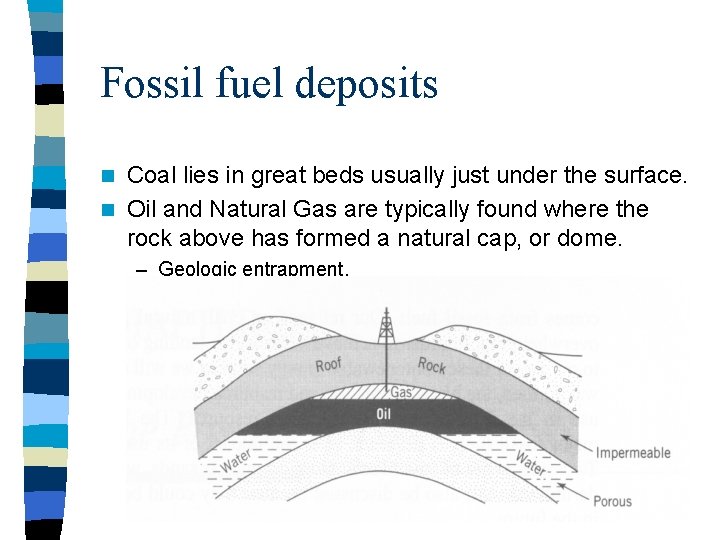
Fossil fuel deposits Coal lies in great beds usually just under the surface. n Oil and Natural Gas are typically found where the rock above has formed a natural cap, or dome. n – Geologic entrapment.
Fossil Fuel Exploration and Recovery Use Seismic data to map the underground – looking for domes of rock that might hold oil and gas. n Drilling n – Exploratory wells -- 1 in 9 is successful in US. – Primary recovery – natural pressure – 15% of deposit. – Secondary recovery – pump water or gas to force oil out – 15% more. – Tertiary recovery – techniques to reduce viscosity and surface tension – 10%
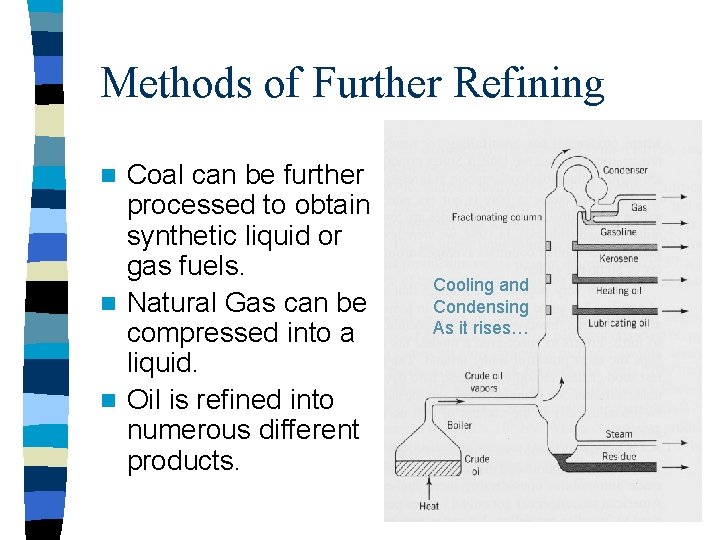
Methods of Further Refining Coal can be further processed to obtain synthetic liquid or gas fuels. n Natural Gas can be compressed into a liquid. n Oil is refined into numerous different products. n Cooling and Condensing As it rises…
Gasoline Additives n Lead – enhances “octane” rating. n MTBE – an oxygenate to reduce Carbon monoxide emissions – now suspected of being a carcinogen. n Ethanol – corn or sugar cane turned into alcohol to improve octane, make the fuel cleaner, make the farmers happy.
Natural Gas – the next big thing. Natural gas burns cleaner. n Less carbon per weight. n New turbine designs use the natural gas to run a turbine, and then heat up water to run a traditional steam generator – Efficiencies of 45% or more. n Natural gas is cheaper 3. 5 to 1 compared to coal, 1. 75 to 1 compared to gasoline. n
Outlook n Still the easiest and cheapest fuel around. n Technologies are being developed to increase yields, enhance efficiency and reduce pollution. n The biggest obstacles remain that they are non-renewable, carbon-based resources.