
Forwarding State Reduction for OnetoMany Group Communications Sahar


- Slides: 26
Forwarding State Reduction for One-to-Many Group Communications Sahar A. Al-Talib (Ph. D. Candidate) Prof. Dr. Borhanuddin Mohd Ali Assoc. Prof. Sabira Khatun Presenter: Chong Jin Hui
Motivations n n The initial design was motivated by the need to support one-to-many (Source Specific Multicast) and many-to-many group applications in a scalable fashion. Such applications cannot be serviced efficiently with unicast delivery. The intend of the research is trying to remove some of the obstacles encountered in the way of multicast deployment in the Internet.
Group Communication Applications: n n n Internet TV, Radio and Games Video conferencing Distance learning File distribution Streaming media etc, . .
Issues that have delayed IP multicast deployment: • Scalability in multicast routing means that overhead in packets and the amount of states stored in routers must be kept minimal. • Address allocation • Billing • Security • Etc.
Introduction n Source Specific Multicast (SSM) is a solution for current multicast applications It brings many benefits in address allocation, billing, and security. SSM still faces the state scalability problem that delayed its deployment.
n n SSM is dedicated to single source applications (one-to-many Group Communications) 90% of multicast applications of immediate interest are single-source [Cui J. et al. , 2002]
Proposed solution n Providing means for incremental deployment of multicast Methodology n n Clustering ( tree construction ) sub-trees to serve large-size group Improve the State Scalability of Source Specific Multicast
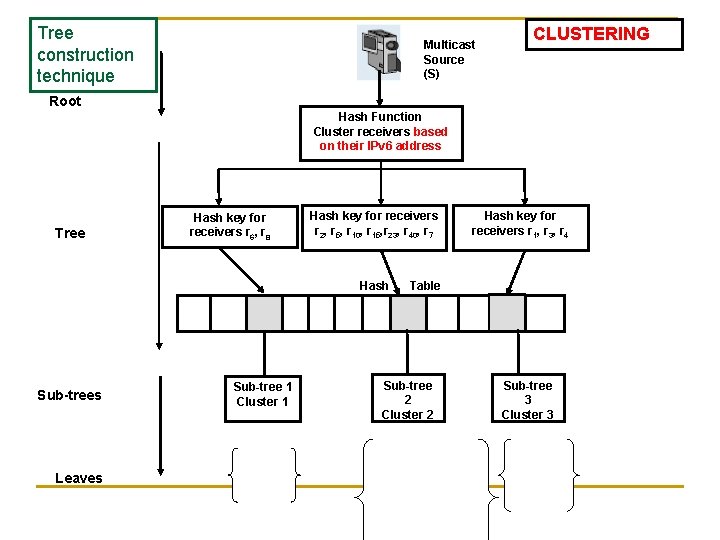
Tree construction technique n n The tree can be build using different techniques according to the way it spans between source & receivers (dynamic tree with routing state maintenance) (Hash Technique with one source and thousands of receivers source specific tree one–to-many applications
Tree construction technique Multicast Source (S) CLUSTERING Root Hash Function Cluster receivers based on their IPv 6 address Tree Hash key for receivers r 2, r 5, r 10, r 15, r 23, r 40, r 7 Hash key for receivers r 6, r 8 Hash Sub-trees Sub-tree 1 Cluster 1 Leaves r 6 r 8 Hash key for receivers r 1, r 3, r 4 Table Sub-tree 2 Cluster 2 r 5 Sub-tree 3 Cluster 3 r 10 r 15 r 23 r 40 r 3 r 4
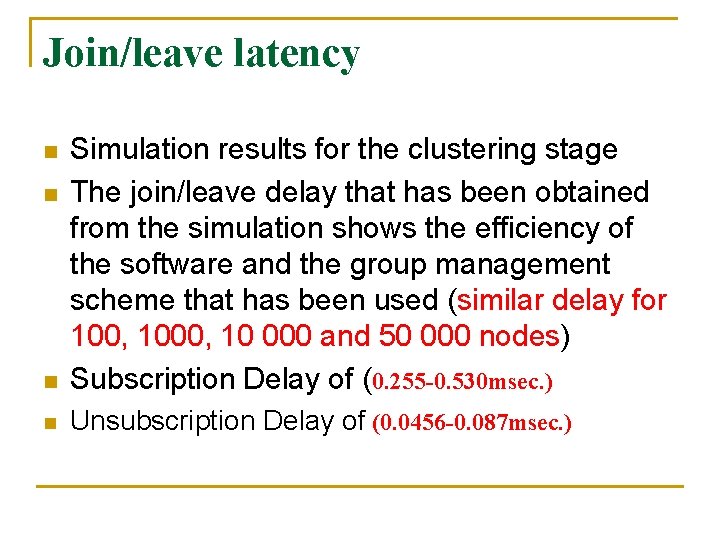
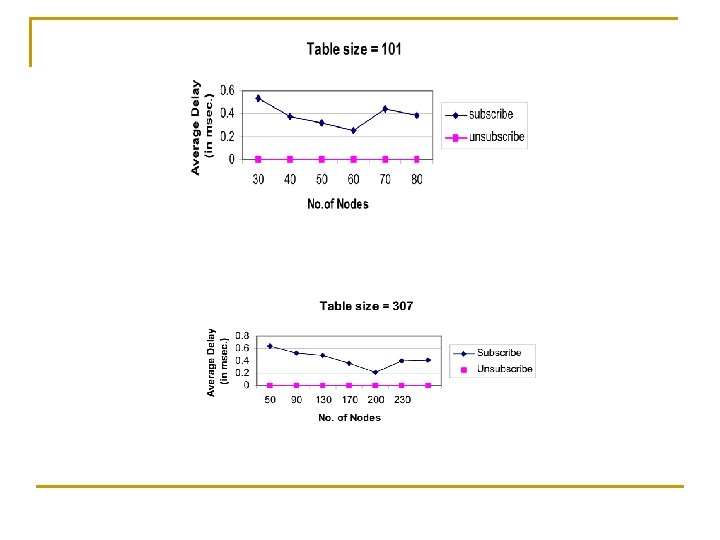
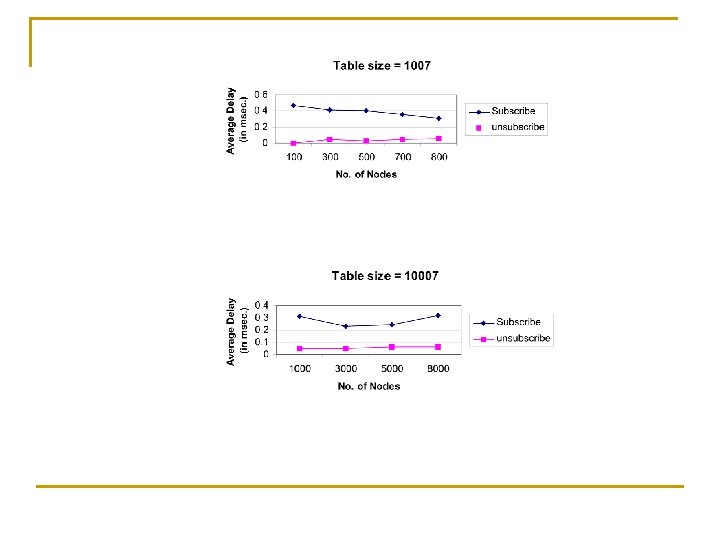
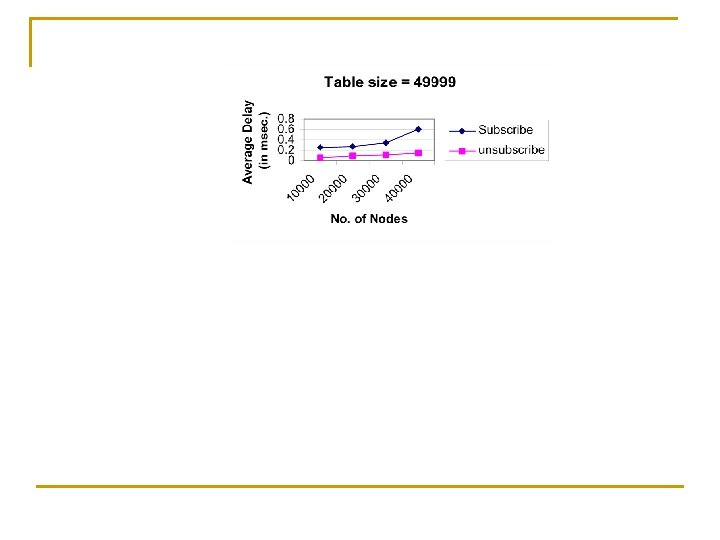
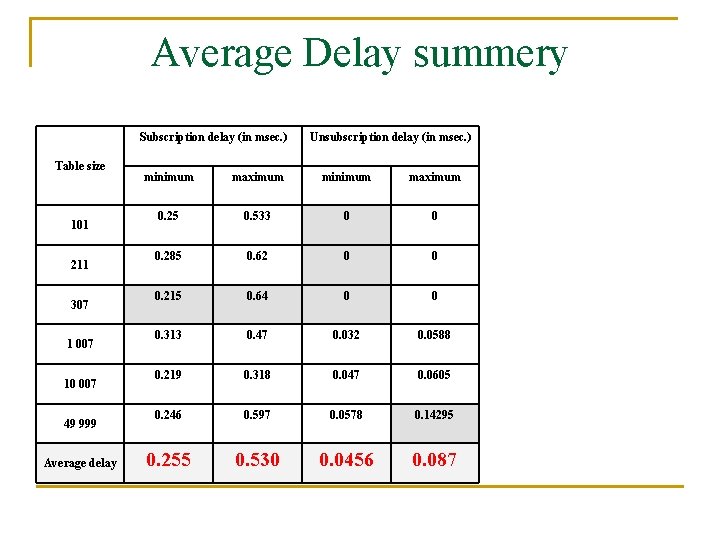
Join/leave latency n Simulation results for the clustering stage The join/leave delay that has been obtained from the simulation shows the efficiency of the software and the group management scheme that has been used (similar delay for 100, 10 000 and 50 000 nodes) Subscription Delay of (0. 255 -0. 530 msec. ) n Unsubscription Delay of (0. 0456 -0. 087 msec. ) n n
Average Delay summery Subscription delay (in msec. ) Table size 101 211 307 1 007 10 007 49 999 Average delay Unsubscription delay (in msec. ) minimum maximum 0. 25 0. 533 0 0 0. 285 0. 62 0 0 0. 215 0. 64 0 0 0. 313 0. 47 0. 032 0. 0588 0. 219 0. 318 0. 047 0. 0605 0. 246 0. 597 0. 0578 0. 14295 0. 255 0. 530 0. 0456 0. 087
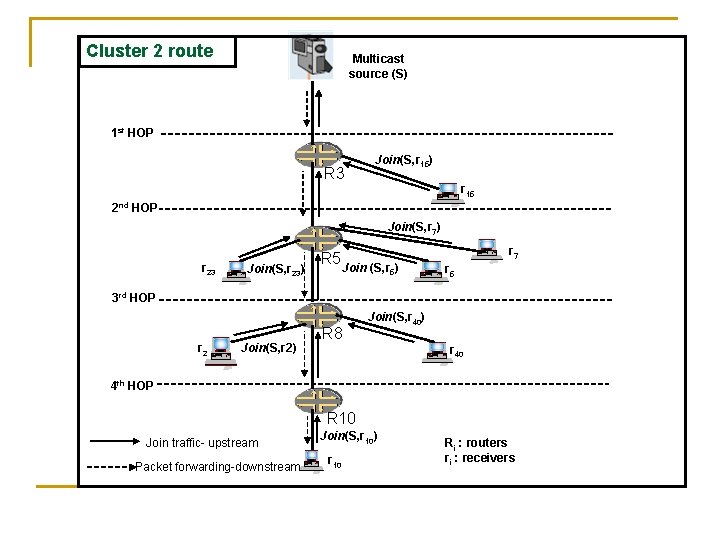
Cluster 2 route Multicast source (S) 1 st HOP R 3 Join(S, r 15) r 15 2 nd HOP Join(S, r 7) r 23 Join(S, r 23) R 5 Join (S, r ) 5 r 7 r 5 3 rd HOP r 2 Join(S, r 2) R 8 Join(S, r 40) r 40 4 th HOP R 10 Join traffic- upstream Packet forwarding-downstream Join(S, r 10) r 10 Ri : routers ri : receivers
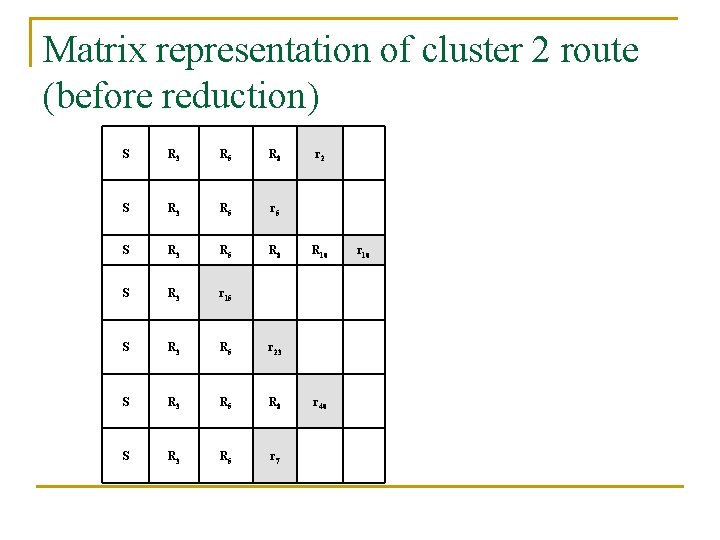
Matrix representation of cluster 2 route (before reduction) S R 3 R 5 R 8 S R 3 R 5 r 5 S R 3 R 5 R 8 S R 3 r 15 S R 3 R 5 r 23 S R 3 R 5 R 8 S R 3 R 5 r 7 r 2 R 10 r 40 r 10
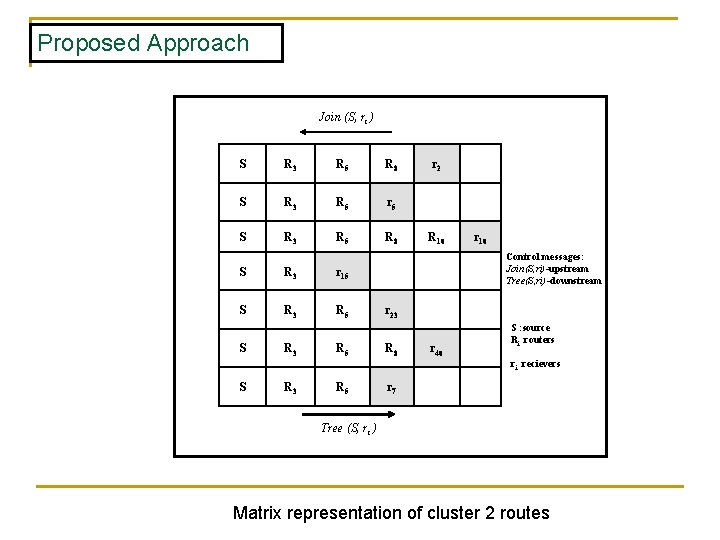
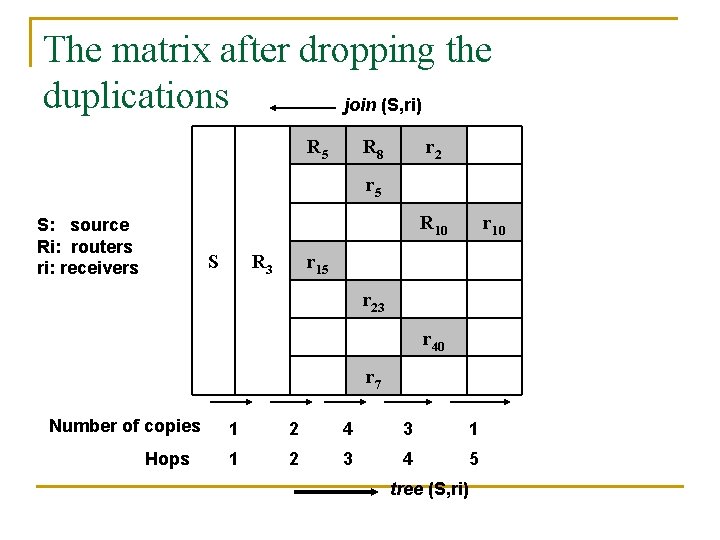
Proposed Approach Join (S, ri ) S R 3 R 5 R 8 S R 3 R 5 r 5 S R 3 R 5 R 8 S R 3 r 15 S R 3 R 5 r 2 R 10 r 10 Control messages: Join(S, ri)-upstream Tree(S, ri)-downstream r 23 R 8 r 40 S : source Ri: routers ri recievers S R 3 R 5 r 7 Tree (S, ri ) Matrix representation of cluster 2 routes
The matrix after dropping the duplications join (S, ri) R 5 R 8 r 2 r 5 R 10 S: source Ri: routers ri: receivers S R 3 r 10 r 15 r 23 r 40 r 7 Number of copies Hops 1 2 4 3 1 1 2 3 4 5 tree (S, ri)
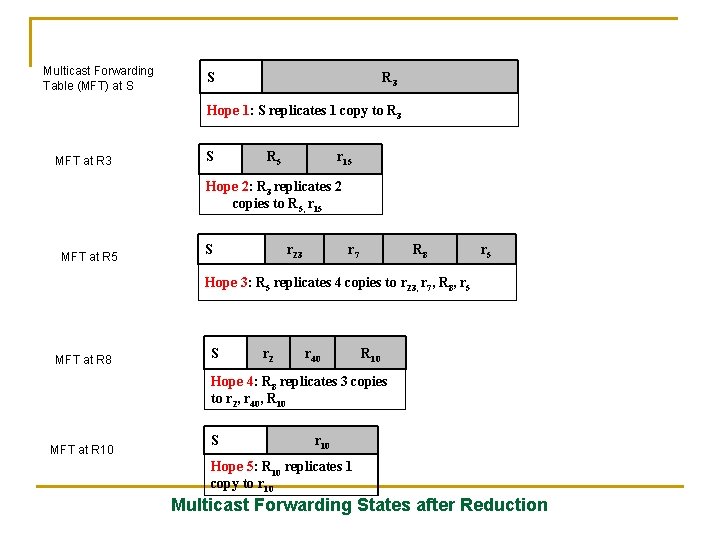
Multicast Forwarding Table (MFT) at S S R 3 Hope 1: S replicates 1 copy to R 3 MFT at R 3 S R 5 r 15 Hope 2: R 3 replicates 2 copies to R 5, r 15 MFT at R 5 S r 23 r 7 R 8 r 5 Hope 3: R 5 replicates 4 copies to r 23, r 7, R 8, r 5 MFT at R 8 S r 2 r 40 R 10 Hope 4: R 8 replicates 3 copies to r 2, r 40, R 10 MFT at R 10 S r 10 Hope 5: R 10 replicates 1 copy to r 10 Multicast Forwarding States after Reduction
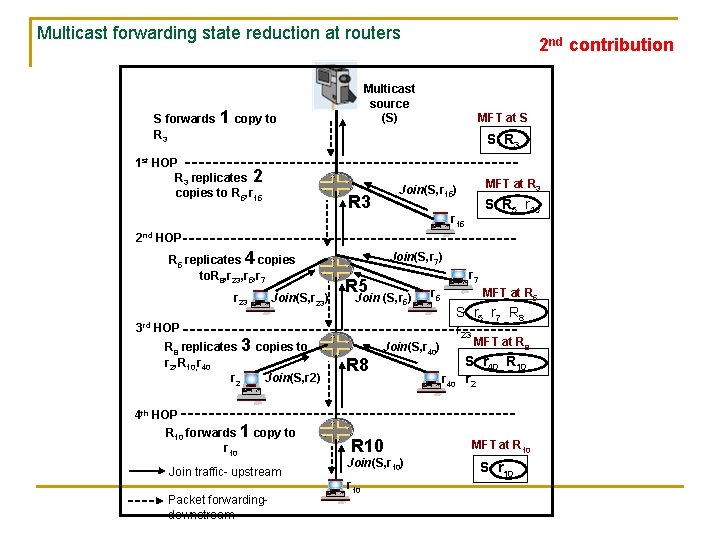
Multicast forwarding state reduction at routers Multicast source (S) S forwards 1 copy to R 3 1 st HOP R 3 replicates 2 copies to R 5, r 15 2 nd contribution MFT at S S R 3 MFT at R 3 Join(S, r 15) R 3 S R 5 r 15 2 nd HOP R 5 replicates 4 copies to. R 8, r 23, r 5, r 7 r 23 Join(S, r 23) Join(S, r 7) r 7 R 5 Join (S, r 5) r 5 MFT at R 5 S r 5 r 7 R 8 r 23 3 rd HOP R 8 replicates 3 copies to r 2, R 10, r 40 r 2 Join(S, r 2) 4 th HOP R 10 forwards 1 copy to r 10 Join traffic- upstream Packet forwardingdownstream R 8 R 10 Join(S, r 10) r 10 MFT at R 8 Join(S, r 40) r 40 S r 40 R 10 r 2 MFT at R 10 S r 10
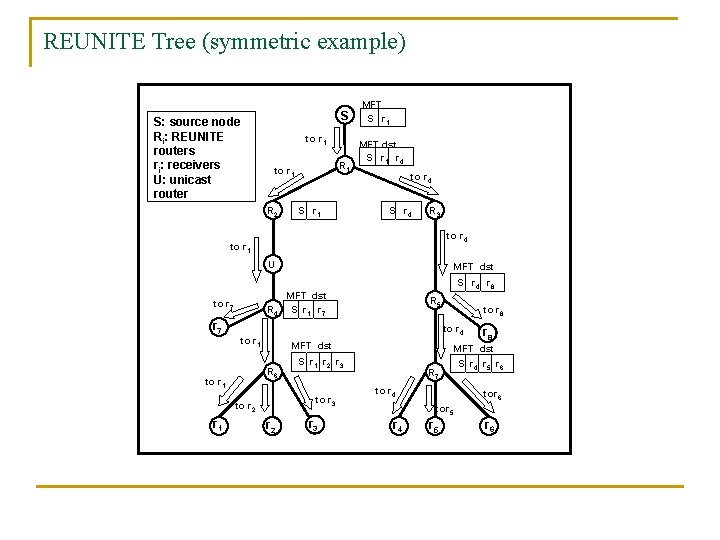
REUNITE Tree (symmetric example) S S: source node Ri: REUNITE routers ri: receivers U: unicast router to r 1 R 1 to r 1 R 2 S r 1 MFT dst S r 1 r 4 to r 4 S r 4 R 3 to r 4 to r 1 U to r 7 R 4 R 5 to r 8 MFT dst R 6 r 2 r 3 r 8 MFT dst S r 1 r 2 r 3 to r 2 r 1 S r 4 r 8 MFT dst S r 1 r 7 to r 4 to r 1 MFT dst R 7 to r 4 S r 4 r 5 r 6 tor 5 r 4 r 5 r 6
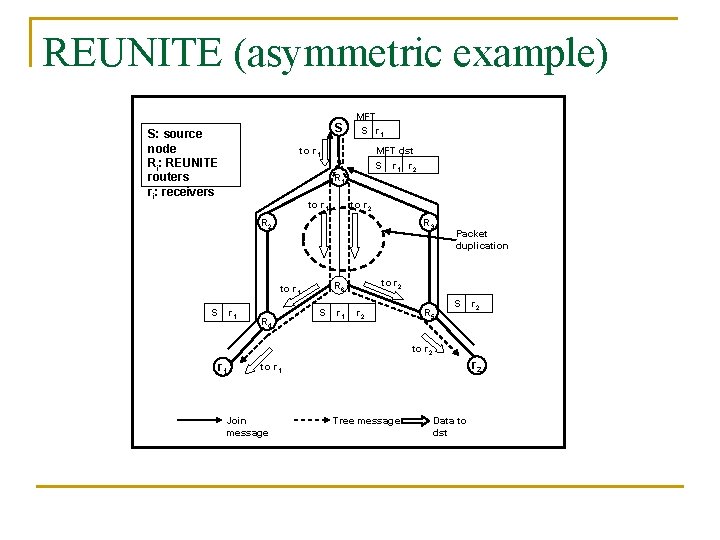
REUNITE (asymmetric example) S S: source node Ri: REUNITE routers ri: receivers MFT S r 1 to r 1 MFT dst S r 1 r 2 R 1 to r 2 R 3 R 2 S r 1 R 4 to r 2 R 6 to r 1 S r 1 Packet duplication r 2 R 5 S r 2 to r 2 r 1 r 2 to r 1 Join message Tree message Data to dst
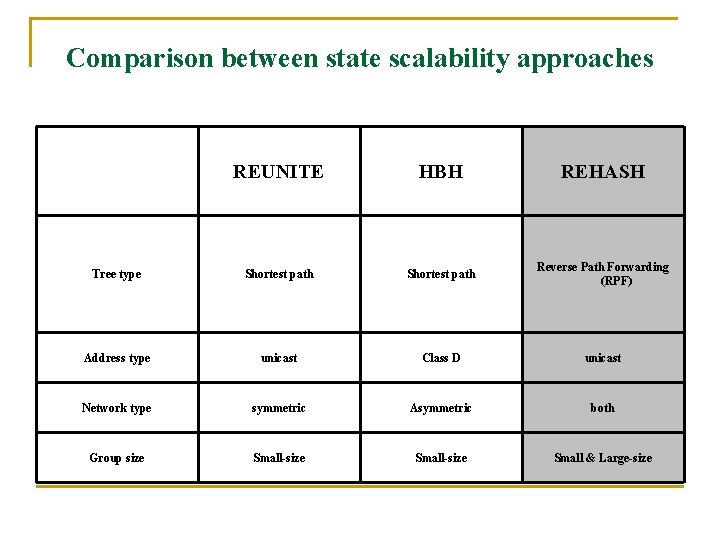
Comparison between state scalability approaches REUNITE HBH REHASH Tree type Shortest path Reverse Path Forwarding (RPF) Address type unicast Class D unicast Network type symmetric Asymmetric both Group size Small-size Small & Large-size
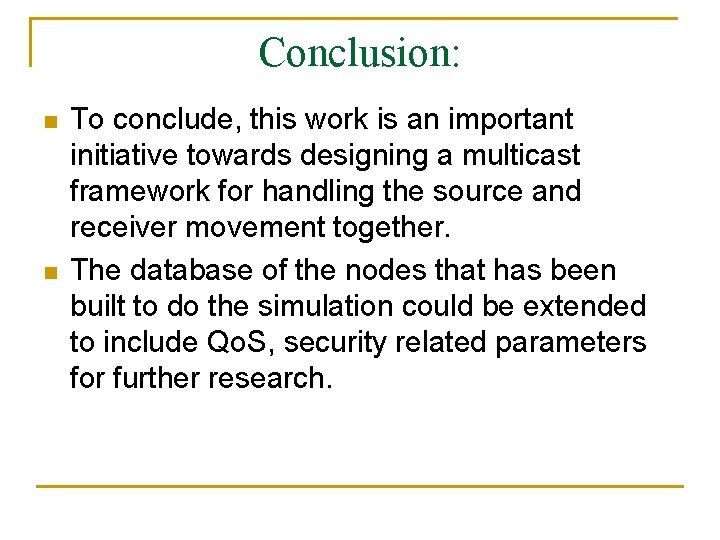
Conclusion: n n To conclude, this work is an important initiative towards designing a multicast framework for handling the source and receiver movement together. The database of the nodes that has been built to do the simulation could be extended to include Qo. S, security related parameters for further research.
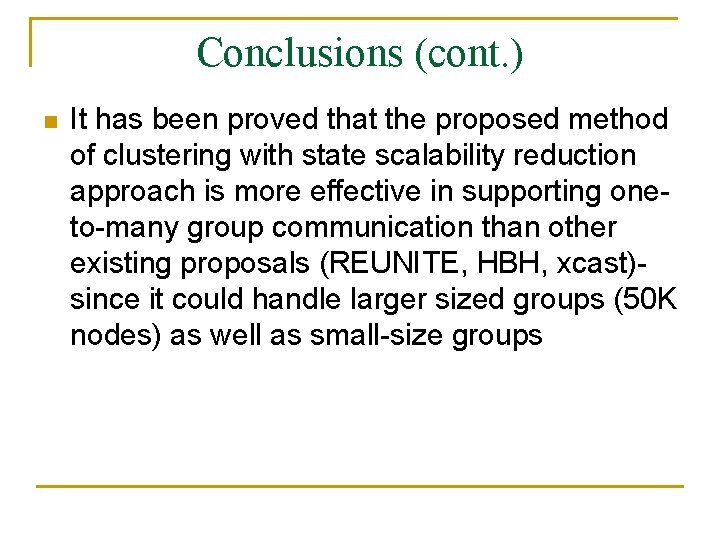
Conclusions (cont. ) n It has been proved that the proposed method of clustering with state scalability reduction approach is more effective in supporting oneto-many group communication than other existing proposals (REUNITE, HBH, xcast)since it could handle larger sized groups (50 K nodes) as well as small-size groups
THANK YOU Forwarding State Reduction for One-to-Many Group Communications Sahar A. Al-Talib (Ph. D. Candidate) e-mail: sahartalib@hotmail. com