
Forward Physics with BRAHMS at RHIC Dieter Roehrich
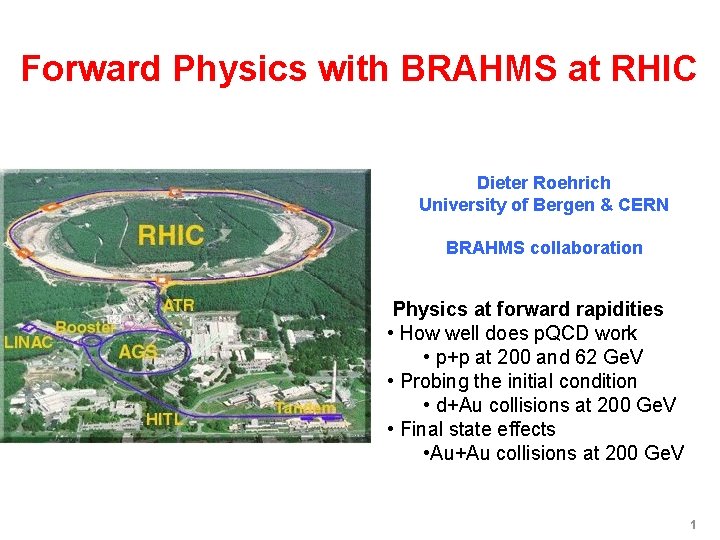
Forward Physics with BRAHMS at RHIC Dieter Roehrich University of Bergen & CERN BRAHMS collaboration Physics at forward rapidities • How well does p. QCD work • p+p at 200 and 62 Ge. V • Probing the initial condition • d+Au collisions at 200 Ge. V • Final state effects • Au+Au collisions at 200 Ge. V 1
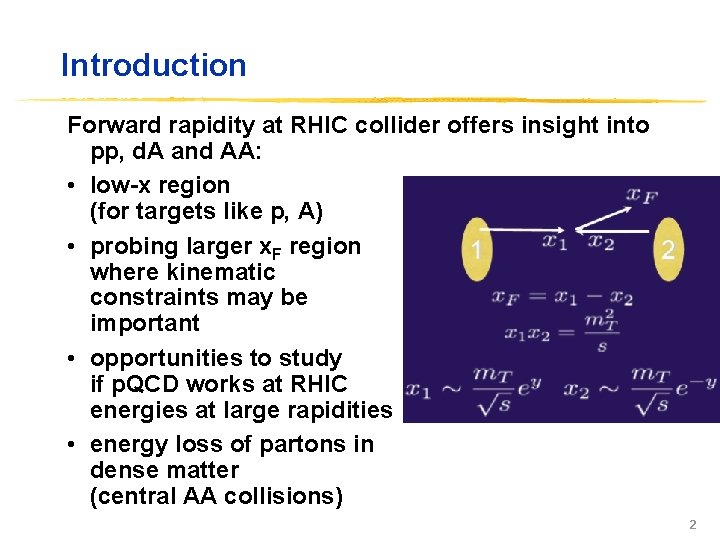
Introduction Forward rapidity at RHIC collider offers insight into pp, d. A and AA: • low-x region (for targets like p, A) • probing larger x. F region where kinematic constraints may be important • opportunities to study if p. QCD works at RHIC energies at large rapidities • energy loss of partons in dense matter (central AA collisions) 2
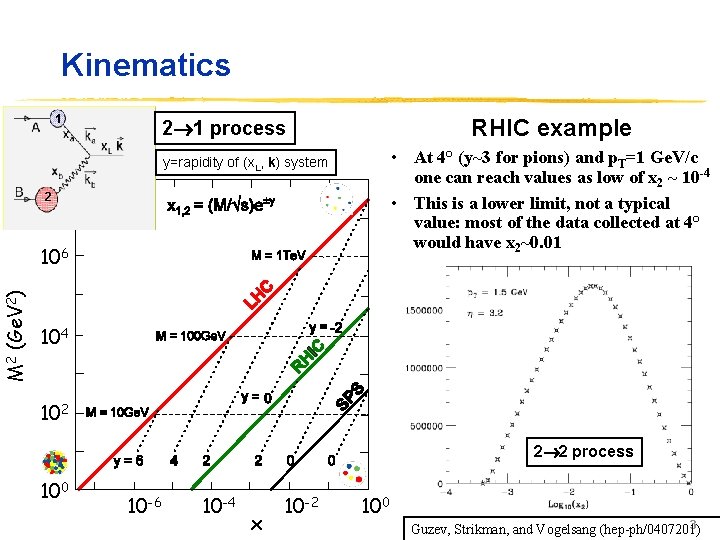
Kinematics 1 RHIC example 2 1 process • At 4° (y~3 for pions) and p. T=1 Ge. V/c one can reach values as low of x 2 ~ 10 -4 • This is a lower limit, not a typical value: most of the data collected at 4° would have x 2~0. 01 y=rapidity of (x. L, k) system 108 2 M 2 (Ge. V 2) 106 104 102 2 2 process 100 10 -6 10 -4 x 10 -2 100 3 Guzev, Strikman, and Vogelsang (hep-ph/0407201)
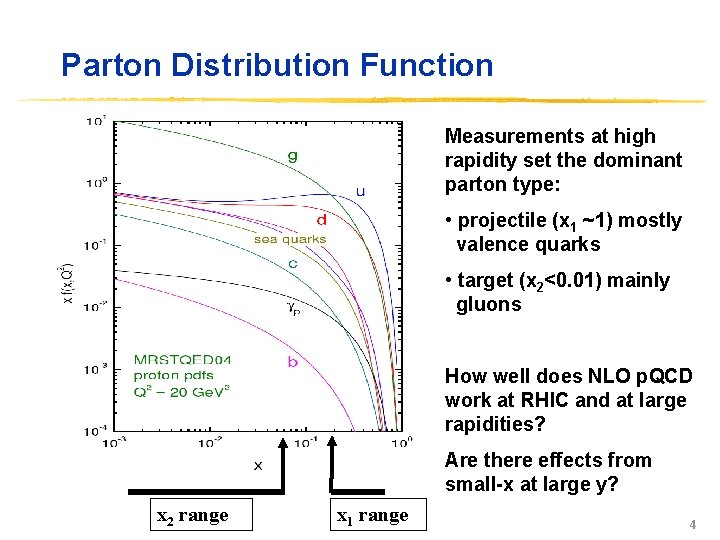
Parton Distribution Function Measurements at high rapidity set the dominant parton type: • projectile (x 1 ~1) mostly valence quarks • target (x 2<0. 01) mainly gluons How well does NLO p. QCD work at RHIC and at large rapidities? Are there effects from small-x at large y? x 2 range x 1 range 4
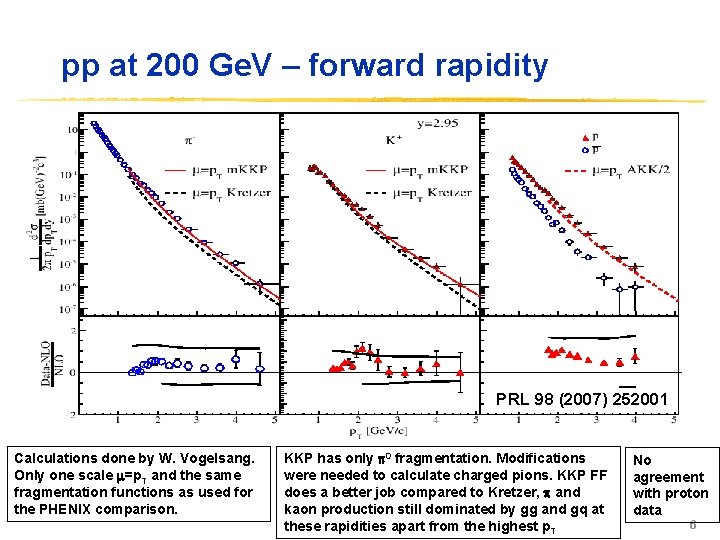
pp at 200 Ge. V – forward rapidity PRL 98 (2007) 252001 Calculations done by W. Vogelsang. Only one scale =p. T and the same fragmentation functions as used for the PHENIX comparison. KKP has only 0 fragmentation. Modifications were needed to calculate charged pions. KKP FF does a better job compared to Kretzer, and kaon production still dominated by gg and gq at these rapidities apart from the highest p. T No agreement with proton data 6
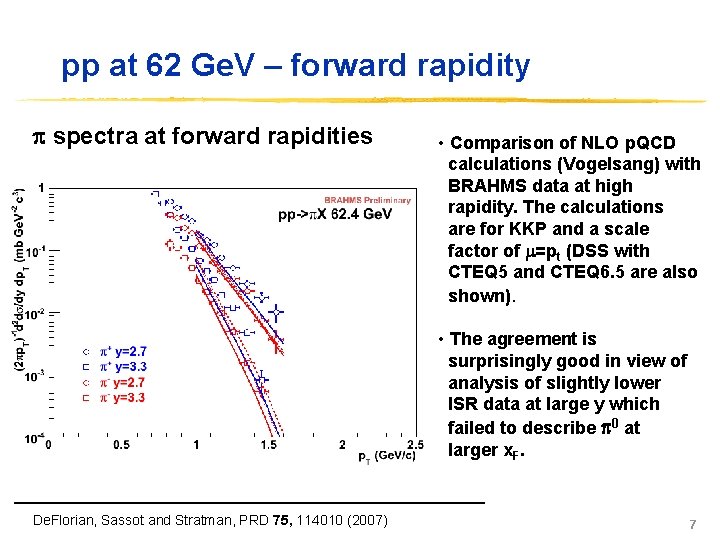
pp at 62 Ge. V – forward rapidity spectra at forward rapidities • Comparison of NLO p. QCD calculations (Vogelsang) with BRAHMS data at high rapidity. The calculations are for KKP and a scale factor of =pt (DSS with CTEQ 5 and CTEQ 6. 5 are also shown). • The agreement is surprisingly good in view of analysis of slightly lower ISR data at large y which failed to describe 0 at larger x. F. De. Florian, Sassot and Stratman, PRD 75, 114010 (2007) 7
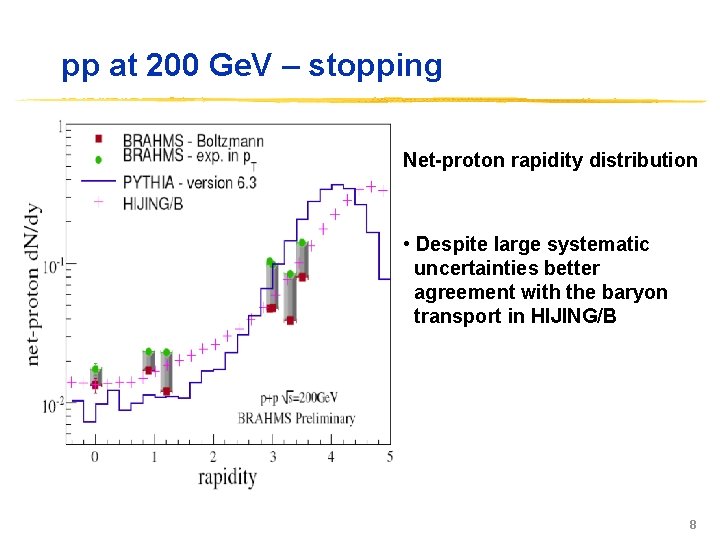
pp at 200 Ge. V – stopping Net-proton rapidity distribution • Despite large systematic uncertainties better agreement with the baryon transport in HIJING/B 8
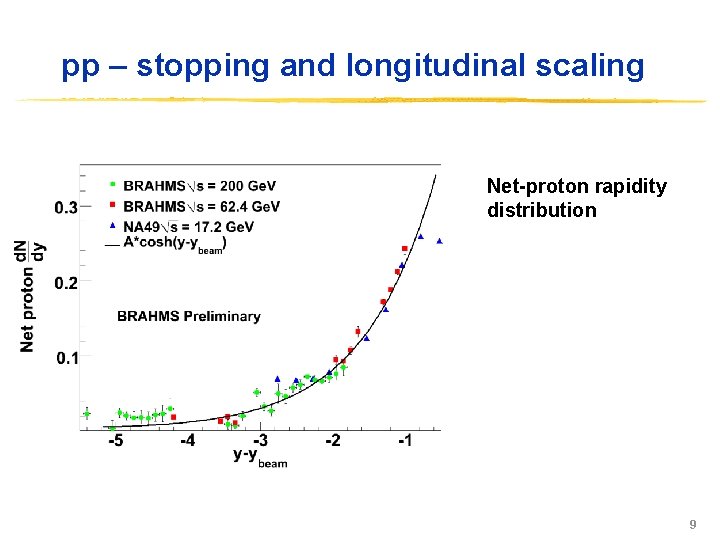
pp – stopping and longitudinal scaling Net-proton rapidity distribution 9
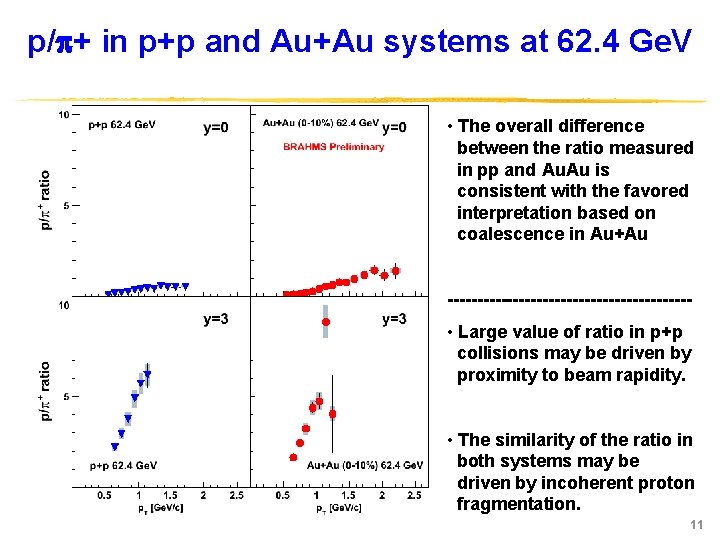
p/ + in p+p and Au+Au systems at 62. 4 Ge. V • The overall difference between the ratio measured in pp and Au. Au is consistent with the favored interpretation based on coalescence in Au+Au --------------------- • Large value of ratio in p+p collisions may be driven by proximity to beam rapidity. • The similarity of the ratio in both systems may be driven by incoherent proton fragmentation. 11
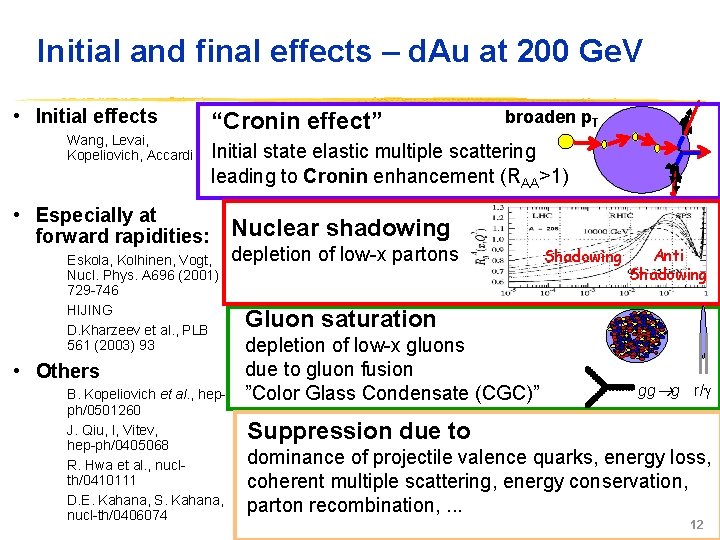
Initial and final effects – d. Au at 200 Ge. V • Initial effects Wang, Levai, Kopeliovich, Accardi “Cronin effect” broaden p. T Initial state elastic multiple scattering leading to Cronin enhancement (RAA>1) • Especially at forward rapidities: Eskola, Kolhinen, Vogt, Nucl. Phys. A 696 (2001) 729 -746 HIJING D. Kharzeev et al. , PLB 561 (2003) 93 • Others B. Kopeliovich et al. , hepph/0501260 J. Qiu, I, Vitev, hep-ph/0405068 R. Hwa et al. , nuclth/0410111 D. E. Kahana, S. Kahana, nucl-th/0406074 Nuclear shadowing depletion of low-x partons Shadowing Anti Shadowing Gluon saturation depletion of low-x gluons due to gluon fusion ”Color Glass Condensate (CGC)” gg g r/ Suppression due to dominance of projectile valence quarks, energy loss, coherent multiple scattering, energy conservation, parton recombination, . . . 12
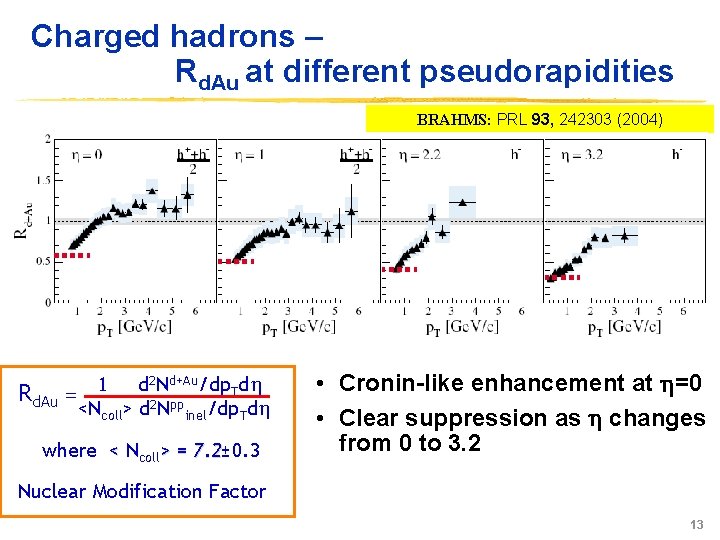
Charged hadrons – Rd. Au at different pseudorapidities BRAHMS: PRL 93, 242303 (2004) Rd. Au 2 Nd+Au/dp d 1 d T = 2 pp <Ncoll> d N inel/dp. Td where < Ncoll> = 7. 2± 0. 3 7. 2 • Cronin-like enhancement at =0 • Clear suppression as changes from 0 to 3. 2 Nuclear Modification Factor 13
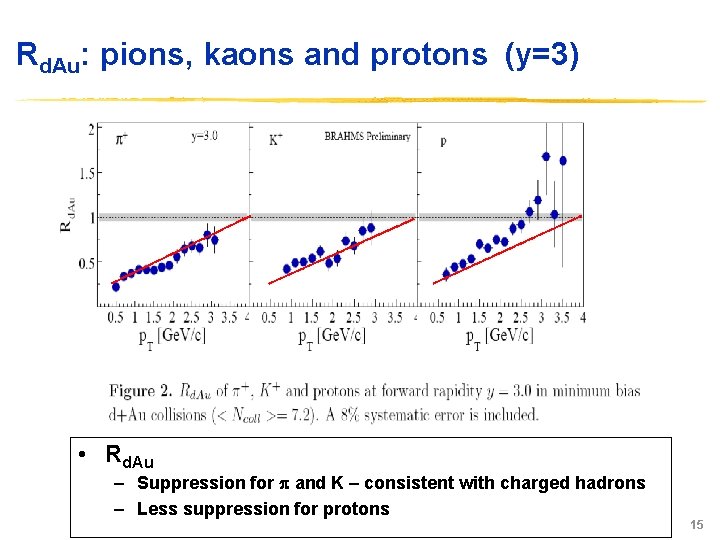
Rd. Au: pions, kaons and protons (y=3) • Rd. Au – Suppression for and K – consistent with charged hadrons – Less suppression for protons 15
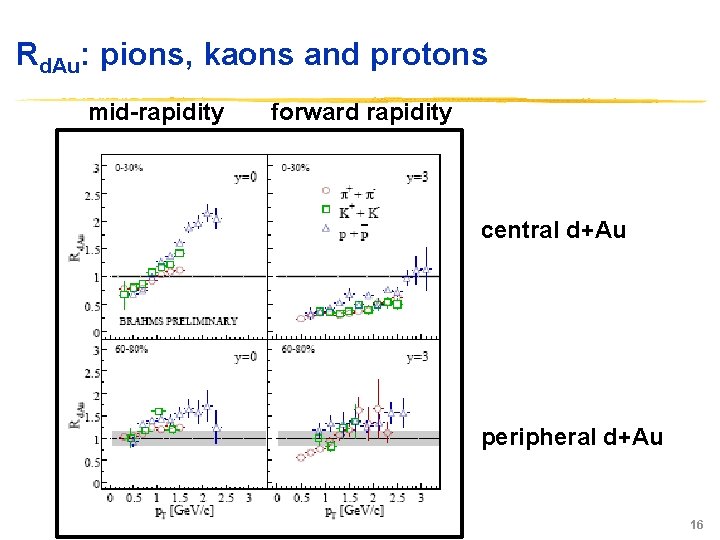
Rd. Au: pions, kaons and protons mid-rapidity forward rapidity central d+Au peripheral d+Au 16
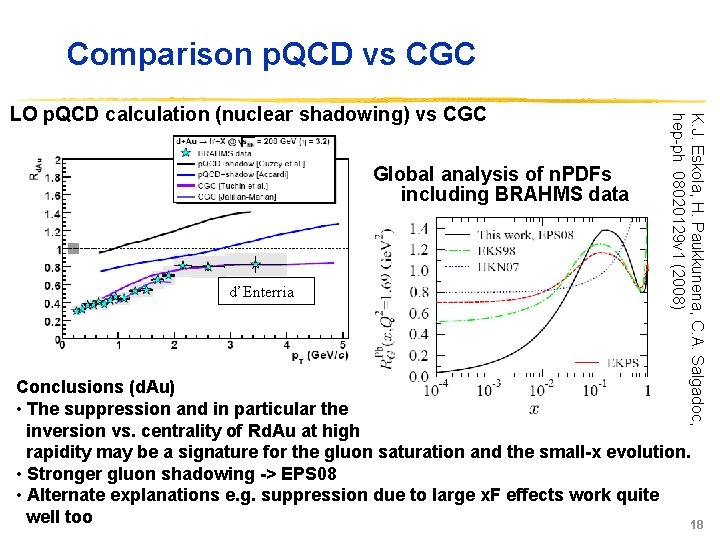
Comparison p. QCD vs CGC Global analysis of n. PDFs including BRAHMS data d’Enterria K. J. Eskola, H. Paukkunena, C. A. Salgadoc, hep-ph 08020129 v 1 (2008) LO p. QCD calculation (nuclear shadowing) vs CGC Conclusions (d. Au) • The suppression and in particular the inversion vs. centrality of Rd. Au at high rapidity may be a signature for the gluon saturation and the small-x evolution. • Stronger gluon shadowing -> EPS 08 • Alternate explanations e. g. suppression due to large x. F effects work quite well too 18
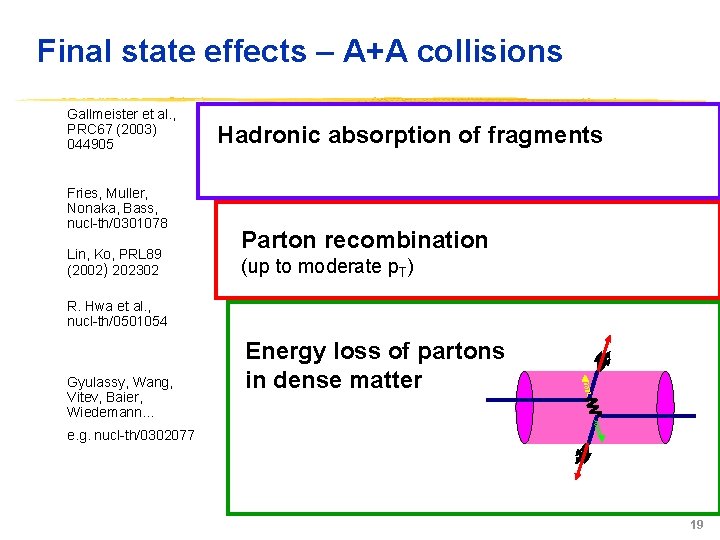
Final state effects – A+A collisions Gallmeister et al. , PRC 67 (2003) 044905 Fries, Muller, Nonaka, Bass, nucl-th/0301078 Lin, Ko, PRL 89 (2002) 202302 Hadronic absorption of fragments Parton recombination (up to moderate p. T) R. Hwa et al. , nucl-th/0501054 Gyulassy, Wang, Vitev, Baier, Wiedemann… Energy loss of partons in dense matter e. g. nucl-th/0302077 19
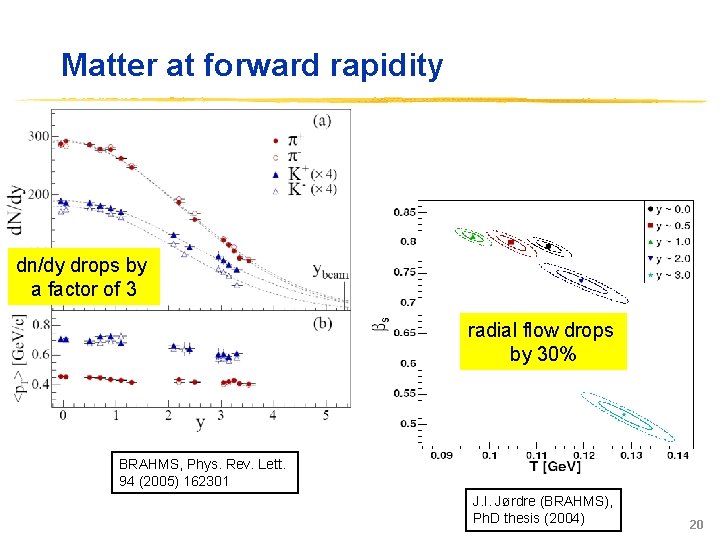
Matter at forward rapidity dn/dy drops by a factor of 3 radial flow drops by 30% BRAHMS, Phys. Rev. Lett. 94 (2005) 162301 J. I. Jørdre (BRAHMS), Ph. D thesis (2004) 20
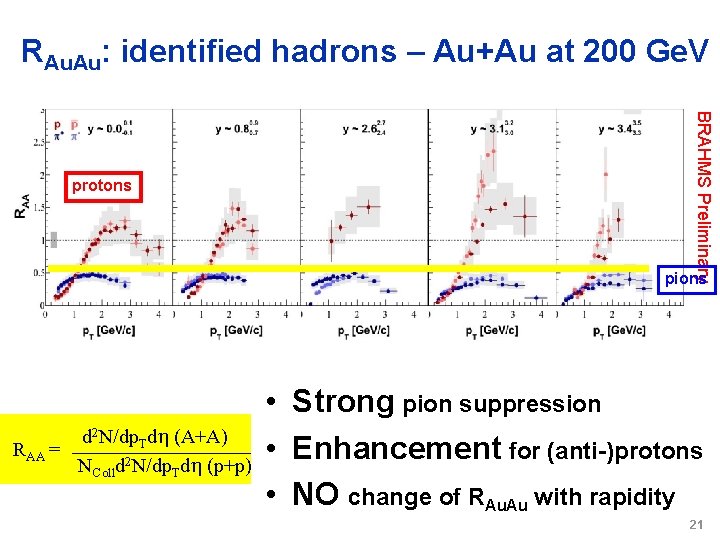
RAu. Au: identified hadrons – Au+Au at 200 Ge. V BRAHMS Preliminary protons pions d 2 N/dp. Td (A+A) RAA = NColld 2 N/dp. Td (p+p) • Strong pion suppression • Enhancement for (anti-)protons • NO change of RAu. Au with rapidity 21
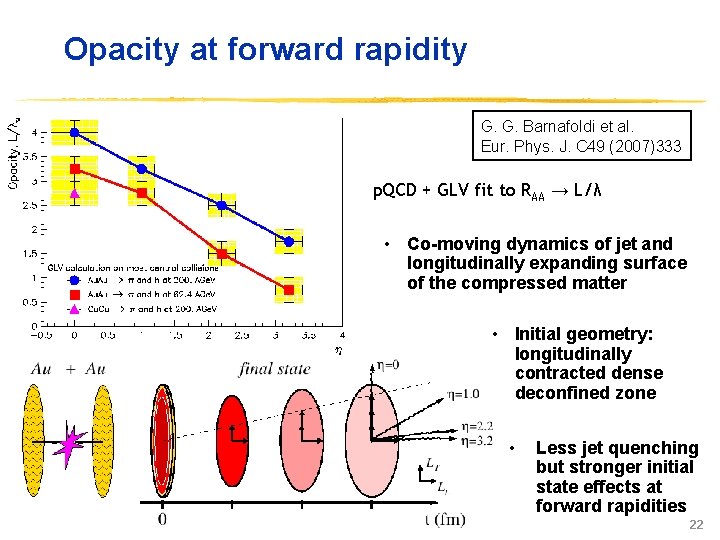
Opacity at forward rapidity G. G. Barnafoldi et al. Eur. Phys. J. C 49 (2007)333 p. QCD + GLV fit to RAA → L/λ • Co-moving dynamics of jet and longitudinally expanding surface of the compressed matter • Initial geometry: longitudinally contracted dense deconfined zone • Less jet quenching but stronger initial state effects at forward rapidities 22
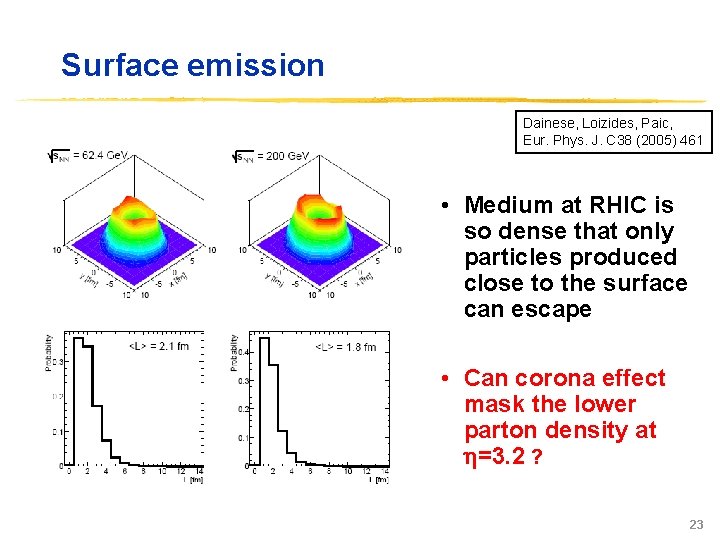
Surface emission Dainese, Loizides, Paic, Eur. Phys. J. C 38 (2005) 461 • Medium at RHIC is so dense that only particles produced close to the surface can escape • Can corona effect mask the lower parton density at =3. 2 ? 23
Conclusions (Au. Au) • Nuclear modification – Strong pion suppression at all rapidities – Protons are enhanced at all rapidities (RAu. Au) and moderate p. T – No dependence of RAu. Au on rapidity 24
The BRAHMS Collaboration I. Arsene 7, I. G. Bearden 6, D. Beavis 1, S. Bekele 6 , C. Besliu 9, B. Budick 5, H. Bøggild 6 , C. Chasman 1, C. H. Christensen 6, P. Christiansen 6, R. Clarke 9, R. Debbe 1, J. J. Gaardhøje 6, K. Hagel 7, H. Ito 10, A. Jipa 9, J. I. Jordre 9, F. Jundt 2, E. B. Johnson 10, C. E. Jørgensen 6, R. Karabowicz 3, E. J. Kim 4, T. M. Larsen 11, J. H. Lee 1, Y. K. Lee 4, S. Lindal 11, G. Løvhøjden 2, Z. Majka 3, M. Murray 10, J. Natowitz 7, B. S. Nielsen 6, D. Ouerdane 6, R. Planeta 3, F. Rami 2, C. Ristea 6, O. Ristea 9, D. Röhrich 8, B. H. Samset 11, D. Sandberg 6, S. J. Sanders 10, R. A. Sheetz 1, P. Staszel 3, T. S. Tveter 11, F. Videbæk 1, R. Wada 7, H. Yang 6, Z. Yin 8, and I. S. Zgura 9 1 Brookhaven National Laboratory, USA, 2 IRe. S and Université Louis Pasteur, Strasbourg, France 3 Jagiellonian University, Cracow, Poland, 4 Johns Hopkins University, Baltimore, USA, 5 New York University, USA 6 Niels Bohr Institute, University of Copenhagen, Denmark 7 Texas A&M University, College Station. USA, 8 University of Bergen, Norway 9 University of Bucharest, Romania, 10 University of Kansas, Lawrence, USA 11 University of Oslo Norway 26
- Slides: 21