
Forward onium physics from PHENIX Mickey Chiu Why
- Slides: 34
Forward (onium) physics from PHENIX Mickey Chiu
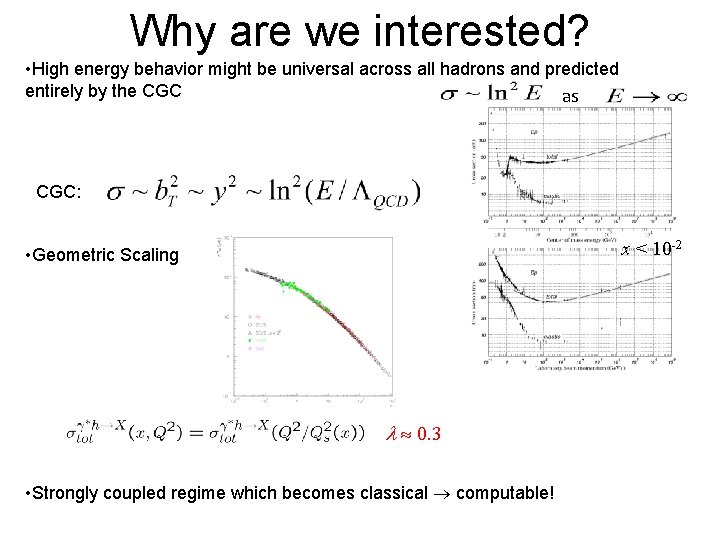
Why are we interested? • High energy behavior might be universal across all hadrons and predicted entirely by the CGC as CGC: x < 10 -2 • Geometric Scaling 0. 3 • Strongly coupled regime which becomes classical computable!
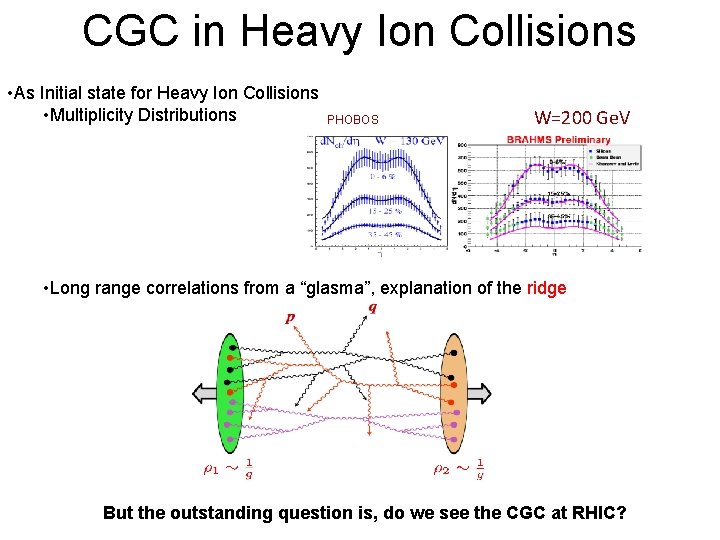
CGC in Heavy Ion Collisions • As Initial state for Heavy Ion Collisions • Multiplicity Distributions PHOBOS W=200 Ge. V • Long range correlations from a “glasma”, explanation of the ridge But the outstanding question is, do we see the CGC at RHIC?
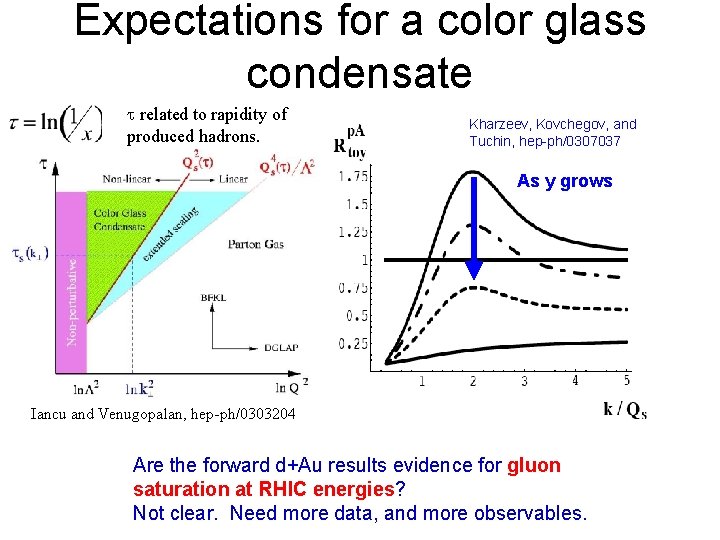
Expectations for a color glass condensate t related to rapidity of produced hadrons. Kharzeev, Kovchegov, and Tuchin, hep-ph/0307037 As y grows Iancu and Venugopalan, hep-ph/0303204 Are the forward d+Au results evidence for gluon saturation at RHIC energies? Not clear. Need more data, and more observables.
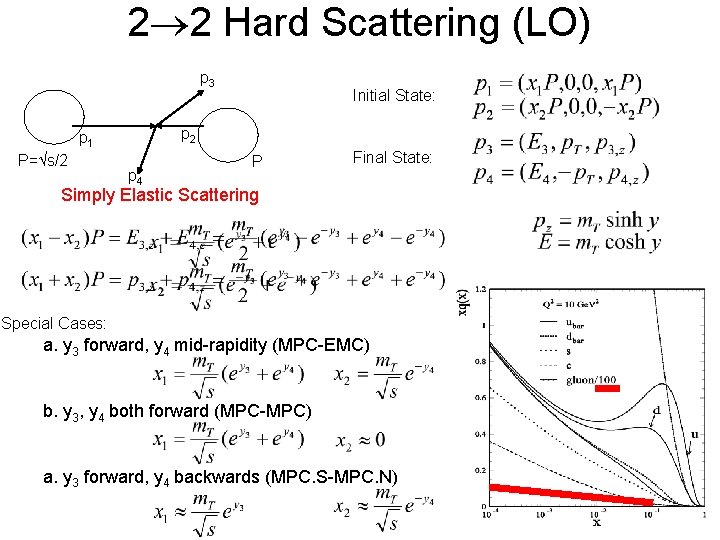
2 2 Hard Scattering (LO) p 3 p 2 p 1 P= s/2 Initial State: p 4 P Final State: Simply Elastic Scattering Special Cases: a. y 3 forward, y 4 mid-rapidity (MPC-EMC) b. y 3, y 4 both forward (MPC-MPC) a. y 3 forward, y 4 backwards (MPC. S-MPC. N)
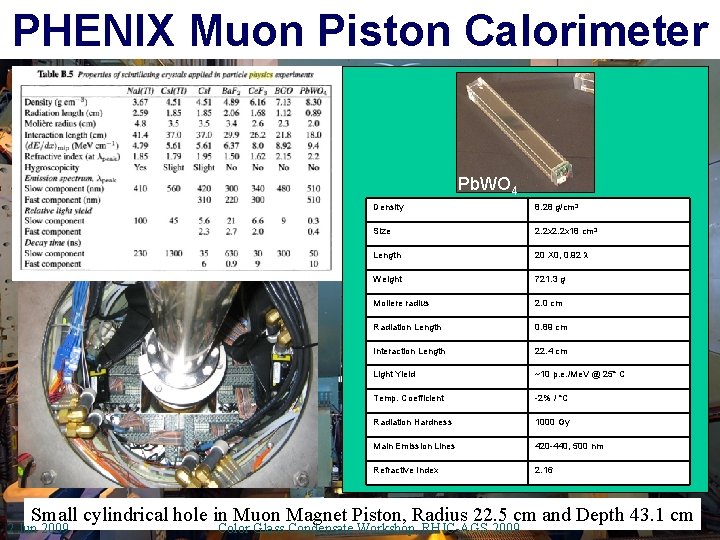
PHENIX Muon Piston Calorimeter Pb. WO 4 SOUTH Density 8. 28 g/cm 3 Size 2. 2 x 18 cm 3 Length 20 X 0, 0. 92 Weight 721. 3 g Moliere radius NORTH 2. 0 cm Radiation Length 0. 89 cm Interaction Length 22. 4 cm Light Yield ~10 p. e. /Me. V @ 25 C Temp. Coefficient -2% / C Radiation Hardness 1000 Gy Main Emission Lines 420 -440, 500 nm Refractive Index 2. 16 Small cylindrical hole in Muon Magnet Piston, Radius 22. 5 cm and Depth 43. 1 cm 2 Jun 2009 Color Glass Condensate Workshop, RHIC-AGS 2009 6
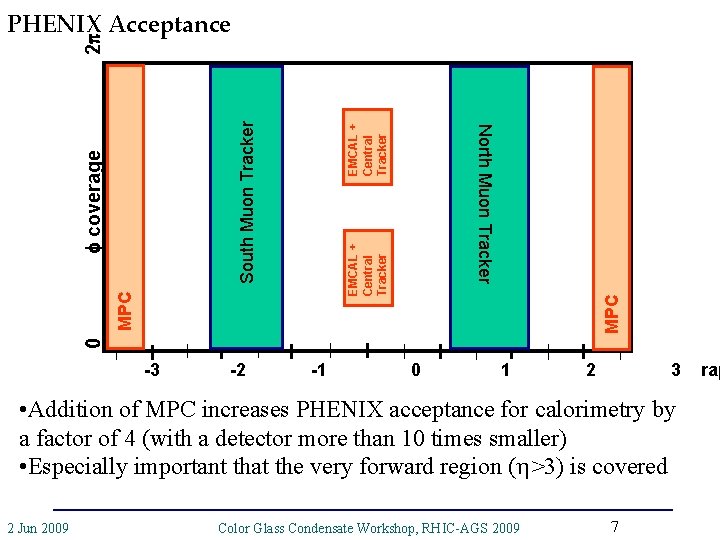
EMCAL + Central Tracker MPC 0 MPC EMCAL + Central Tracker North Muon Tracker f coverage South Muon Tracker 2 p PHENIX Acceptance -3 -2 -1 0 1 2 3 • Addition of MPC increases PHENIX acceptance for calorimetry by a factor of 4 (with a detector more than 10 times smaller) • Especially important that the very forward region ( >3) is covered 2 Jun 2009 Color Glass Condensate Workshop, RHIC-AGS 2009 7 rap
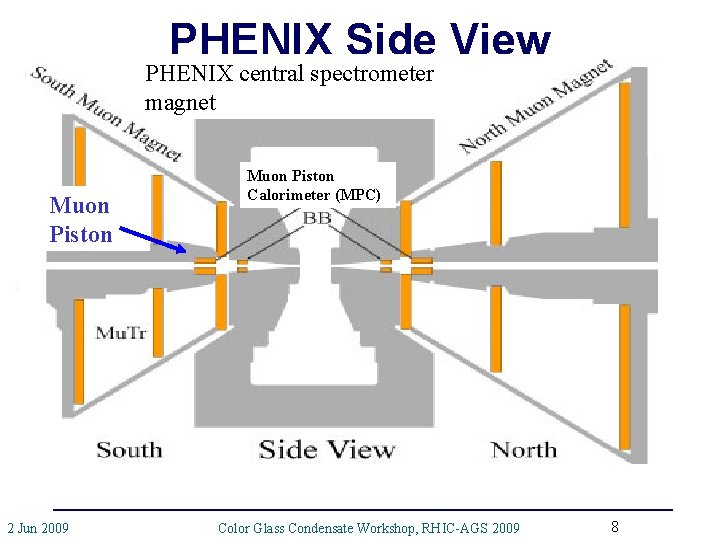
PHENIX Side View PHENIX central spectrometer magnet Muon Piston 2 Jun 2009 Muon Piston Calorimeter (MPC) Color Glass Condensate Workshop, RHIC-AGS 2009 8
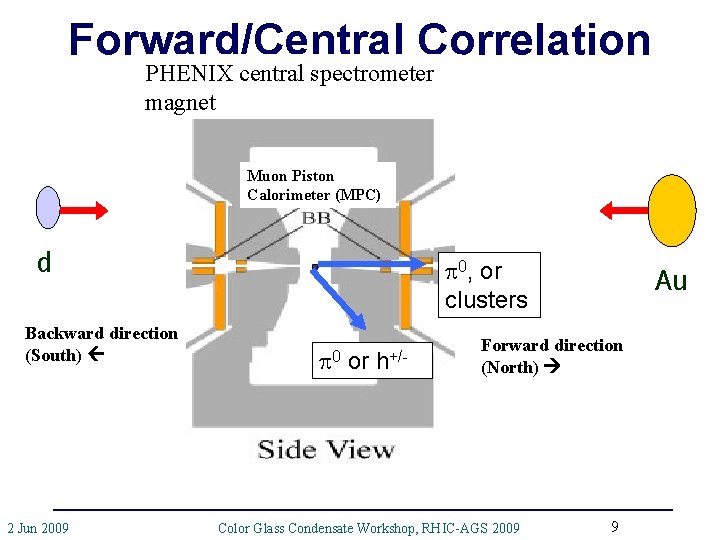
Forward/Central Correlation PHENIX central spectrometer magnet Muon Piston Calorimeter (MPC) d Backward direction (South) 2 Jun 2009 p 0, or clusters p 0 or h+/- Au Forward direction (North) Color Glass Condensate Workshop, RHIC-AGS 2009 9
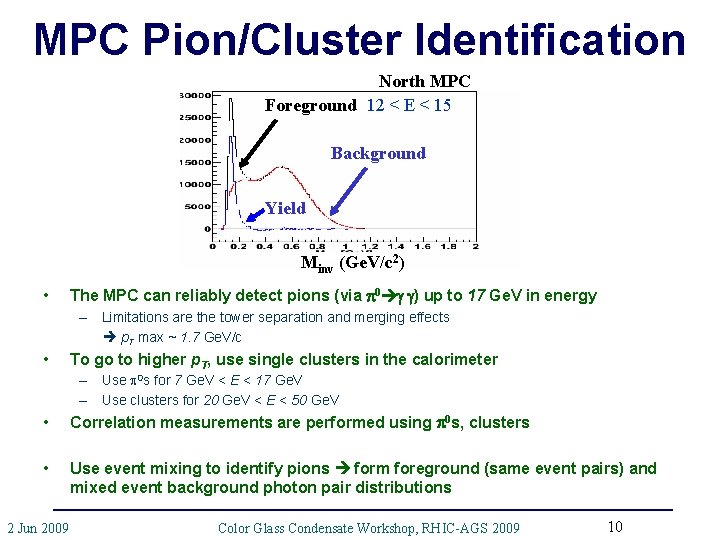
MPC Pion/Cluster Identification North MPC Foreground 12 < E < 15 Background Yield Minv (Ge. V/c 2) • The MPC can reliably detect pions (via p 0 g g) up to 17 Ge. V in energy – Limitations are the tower separation and merging effects p. T max ~ 1. 7 Ge. V/c • To go to higher p. T, use single clusters in the calorimeter – Use p 0 s for 7 Ge. V < E < 17 Ge. V – Use clusters for 20 Ge. V < E < 50 Ge. V • Correlation measurements are performed using p 0 s, clusters • Use event mixing to identify pions form foreground (same event pairs) and mixed event background photon pair distributions 2 Jun 2009 Color Glass Condensate Workshop, RHIC-AGS 2009 10
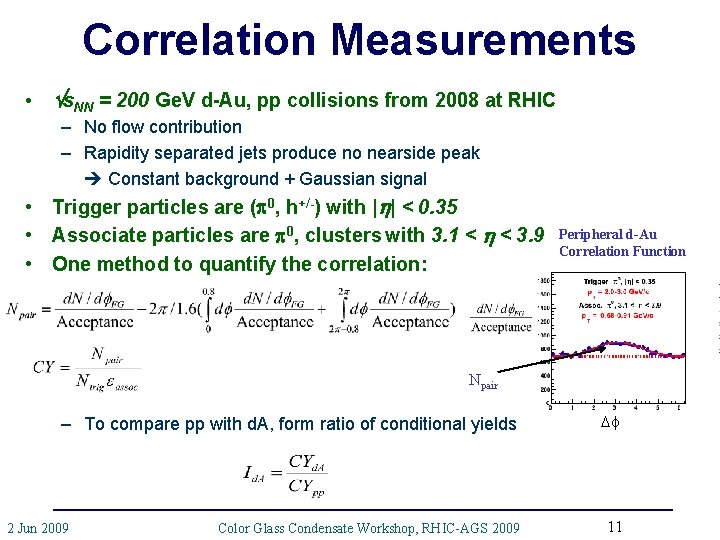
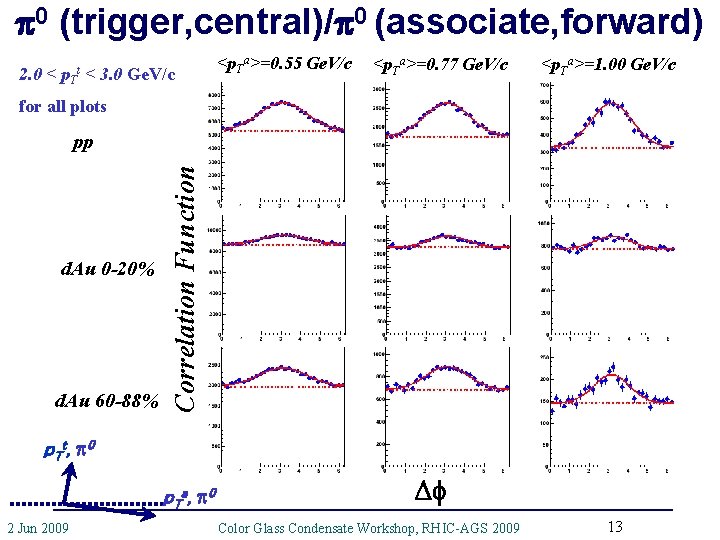
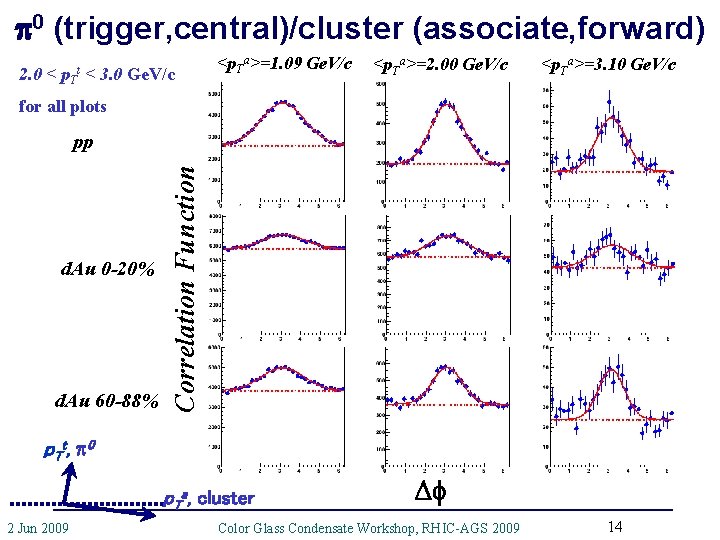
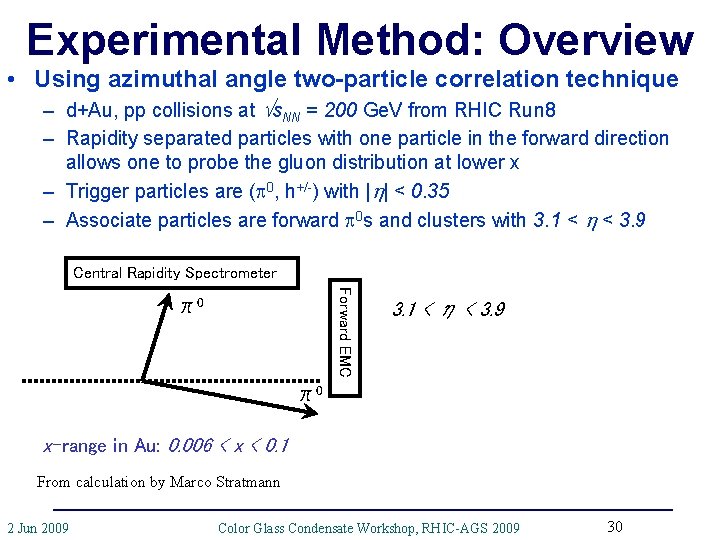
Correlation Measurements • s. NN = 200 Ge. V d-Au, pp collisions from 2008 at RHIC – No flow contribution – Rapidity separated jets produce no nearside peak Constant background + Gaussian signal • Trigger particles are (p 0, h+/-) with |h| < 0. 35 • Associate particles are p 0, clusters with 3. 1 < h < 3. 9 • One method to quantify the correlation: Peripheral d-Au Correlation Function Npair – To compare pp with d. A, form ratio of conditional yields 2 Jun 2009 Color Glass Condensate Workshop, RHIC-AGS 2009 Df 11
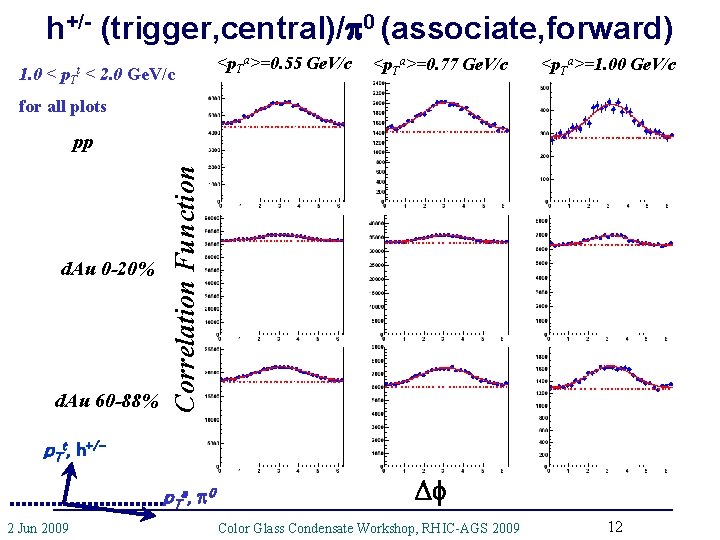
h+/- (trigger, central)/p 0 (associate, forward) 1. 0 < p. T < 2. 0 Ge. V/c t <p. Ta>=0. 55 Ge. V/c <p. Ta>=0. 77 Ge. V/c <p. Ta>=1. 00 Ge. V/c for all plots d. Au 0 -20% d. Au 60 -88% Correlation Function pp p. Tt, h+/p. Ta, p 0 2 Jun 2009 Df Color Glass Condensate Workshop, RHIC-AGS 2009 12
p 0 (trigger, central)/p 0 (associate, forward) 2. 0 < p. T < 3. 0 Ge. V/c t <p. Ta>=0. 55 Ge. V/c <p. Ta>=0. 77 Ge. V/c <p. Ta>=1. 00 Ge. V/c for all plots d. Au 0 -20% d. Au 60 -88% Correlation Function pp p. Tt, p 0 p. Ta, p 0 2 Jun 2009 Df Color Glass Condensate Workshop, RHIC-AGS 2009 13
p 0 (trigger, central)/cluster (associate, forward) 2. 0 < p. T < 3. 0 Ge. V/c t <p. Ta>=1. 09 Ge. V/c <p. Ta>=2. 00 Ge. V/c <p. Ta>=3. 10 Ge. V/c for all plots d. Au 0 -20% d. Au 60 -88% Correlation Function pp p. Tt, p 0 p. Ta, cluster 2 Jun 2009 Df Color Glass Condensate Workshop, RHIC-AGS 2009 14
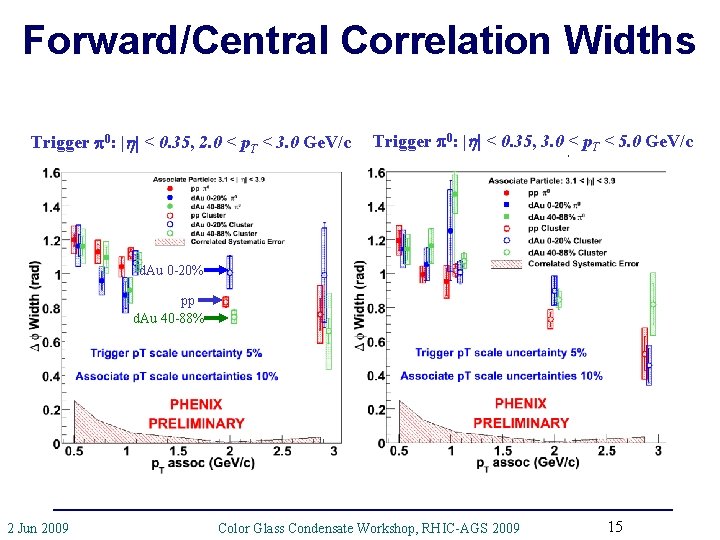
Forward/Central Correlation Widths Trigger p 0: |h| < 0. 35, 2. 0 < p. T < 3. 0 Ge. V/c Trigger p 0: |h| < 0. 35, 3. 0 < p. T < 5. 0 Ge. V/c • No significant changes in correlation width between pp and d. Au within experimental uncertainties d. Au 0 -20% pp d. Au 40 -88% 2 Jun 2009 Color Glass Condensate Workshop, RHIC-AGS 2009 15
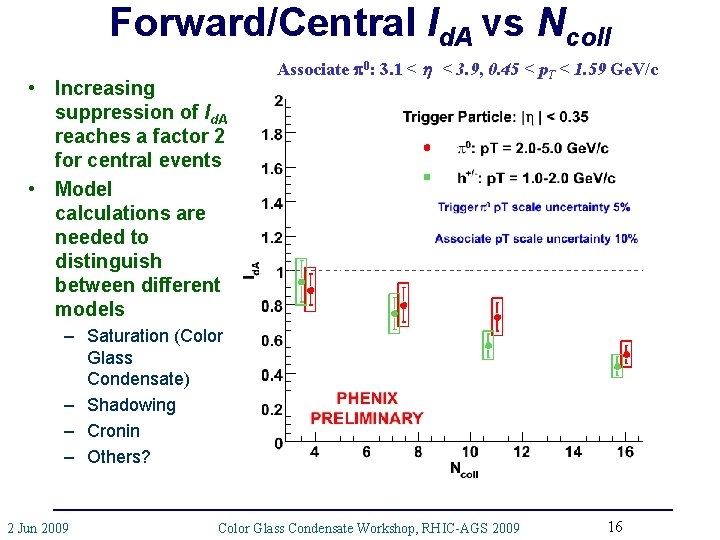
Forward/Central Id. A vs Ncoll • Increasing suppression of Id. A reaches a factor 2 for central events • Model calculations are needed to distinguish between different models Associate p 0: 3. 1 < h < 3. 9, 0. 45 < p. T < 1. 59 Ge. V/c – Saturation (Color Glass Condensate) – Shadowing – Cronin – Others? 2 Jun 2009 Color Glass Condensate Workshop, RHIC-AGS 2009 16
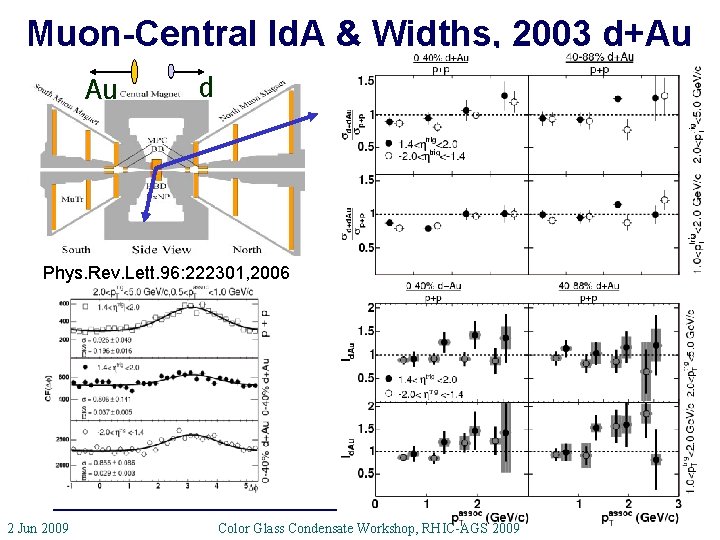
Muon-Central Id. A & Widths, 2003 d+Au Au d Phys. Rev. Lett. 96: 222301, 2006 2 Jun 2009 Color Glass Condensate Workshop, RHIC-AGS 2009
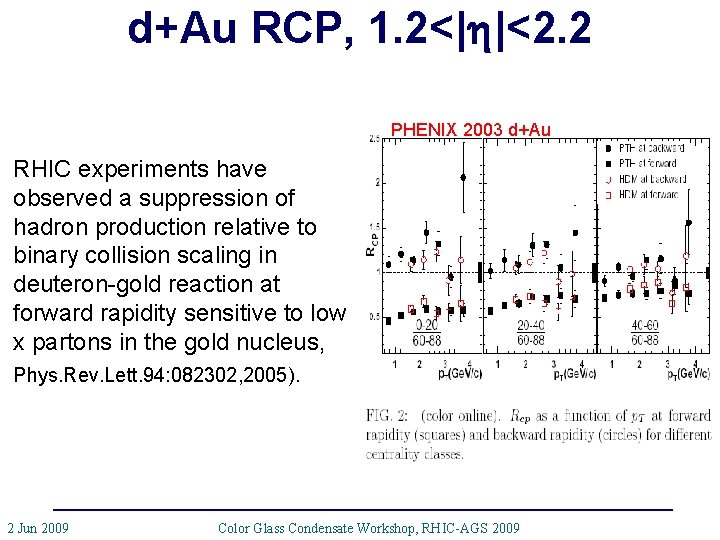
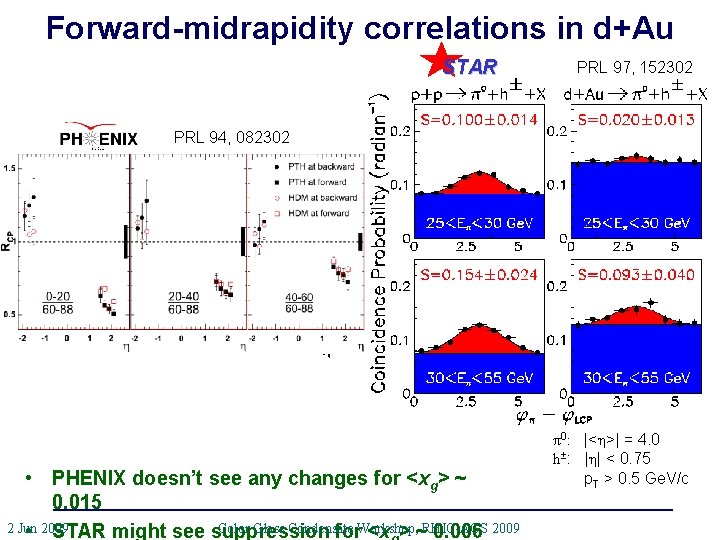
d+Au RCP, 1. 2<| |<2. 2 PHENIX 2003 d+Au RHIC experiments have observed a suppression of hadron production relative to binary collision scaling in deuteron-gold reaction at forward rapidity sensitive to low x partons in the gold nucleus, Phys. Rev. Lett. 94: 082302, 2005). 2 Jun 2009 Color Glass Condensate Workshop, RHIC-AGS 2009
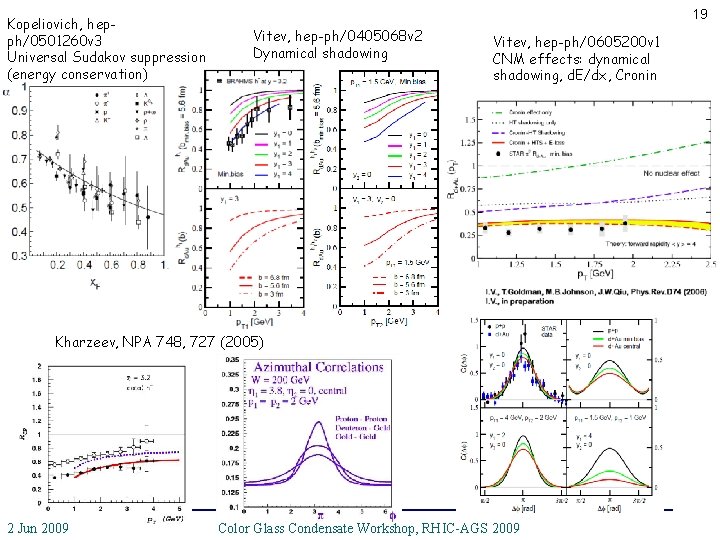
Kopeliovich, hepph/0501260 v 3 Universal Sudakov suppression (energy conservation) 19 Vitev, hep-ph/0405068 v 2 Dynamical shadowing Vitev, hep-ph/0605200 v 1 CNM effects: dynamical shadowing, d. E/dx, Cronin Kharzeev, NPA 748, 727 (2005) 2 Jun 2009 Color Glass Condensate Workshop, RHIC-AGS 2009
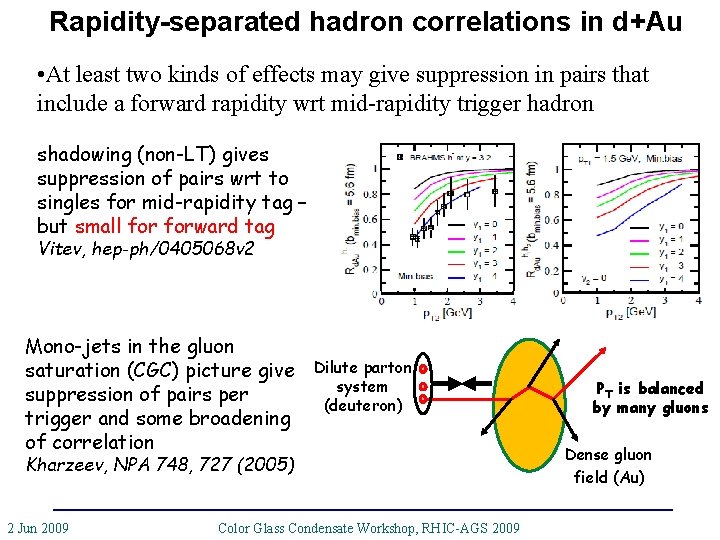
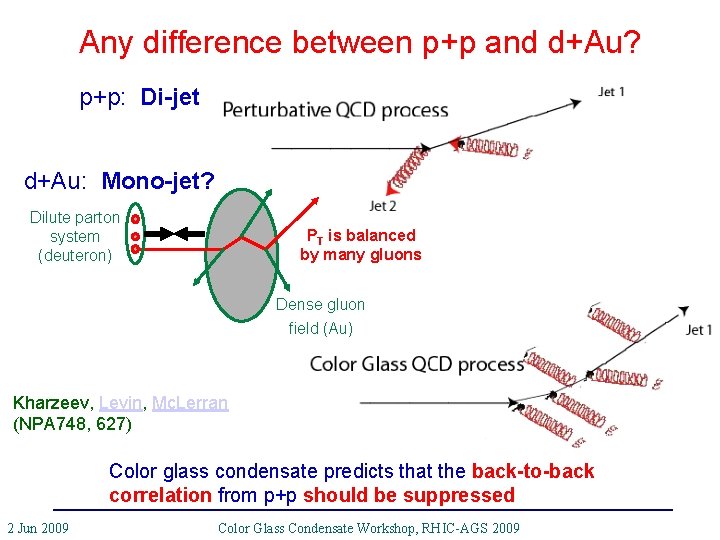
Rapidity-separated hadron correlations in d+Au • At least two kinds of effects may give suppression in pairs that include a forward rapidity wrt mid-rapidity trigger hadron shadowing (non-LT) gives suppression of pairs wrt to singles for mid-rapidity tag – but small forward tag Vitev, hep-ph/0405068 v 2 Mono-jets in the gluon saturation (CGC) picture give suppression of pairs per trigger and some broadening of correlation Dilute parton system (deuteron) Kharzeev, NPA 748, 727 (2005) 2 Jun 2009 Color Glass Condensate Workshop, RHIC-AGS 2009 PT is balanced by many gluons Dense gluon field (Au)
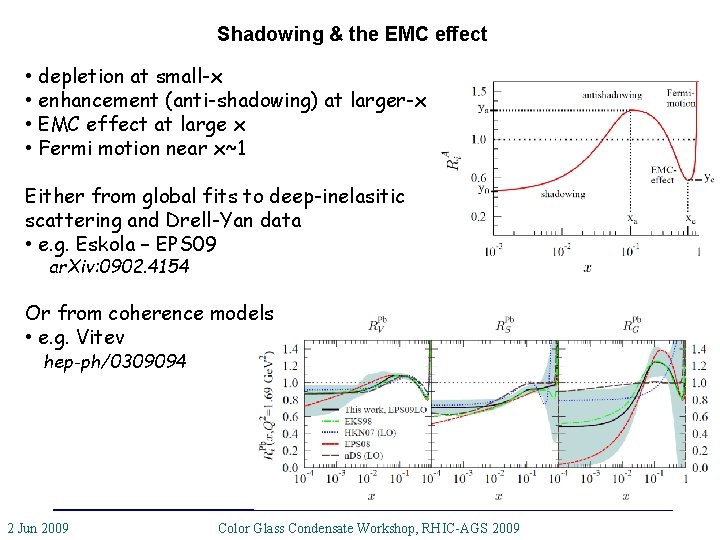
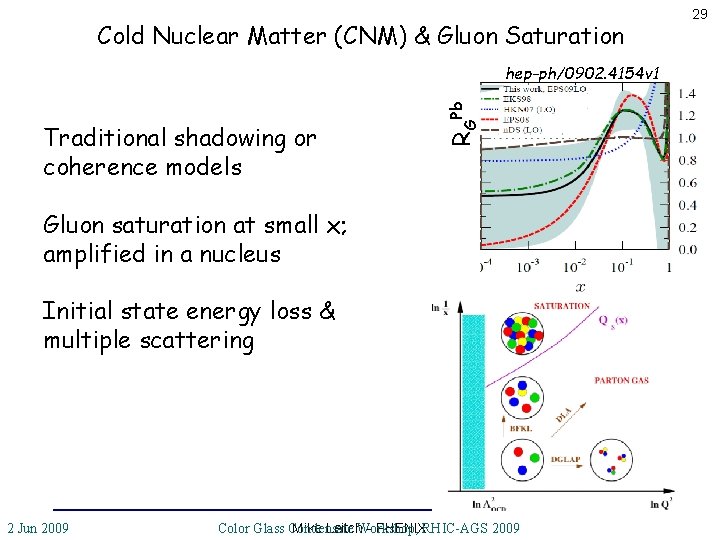
Shadowing & the EMC effect • depletion at small-x • enhancement (anti-shadowing) at larger-x • EMC effect at large x • Fermi motion near x~1 Either from global fits to deep-inelasitic scattering and Drell-Yan data • e. g. Eskola – EPS 09 ar. Xiv: 0902. 4154 Or from coherence models • e. g. Vitev hep-ph/0309094 2 Jun 2009 Color Glass Condensate Workshop, RHIC-AGS 2009
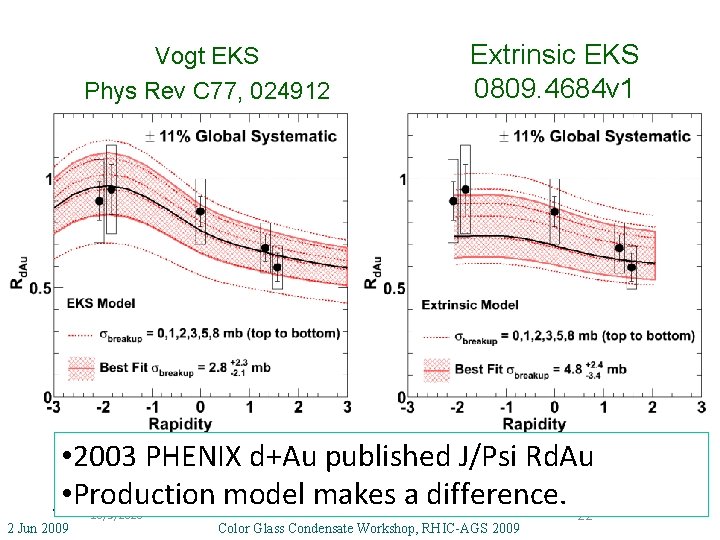
Vogt EKS Phys Rev C 77, 024912 Extrinsic EKS 0809. 4684 v 1 • 2003 PHENIX d+Au published J/Psi Rd. Au • Production model makes a difference. 2 Jun 2009 10/3/2020 QM 09 Knoxville TN Color Glass Condensate Workshop, RHIC-AGS 2009 22
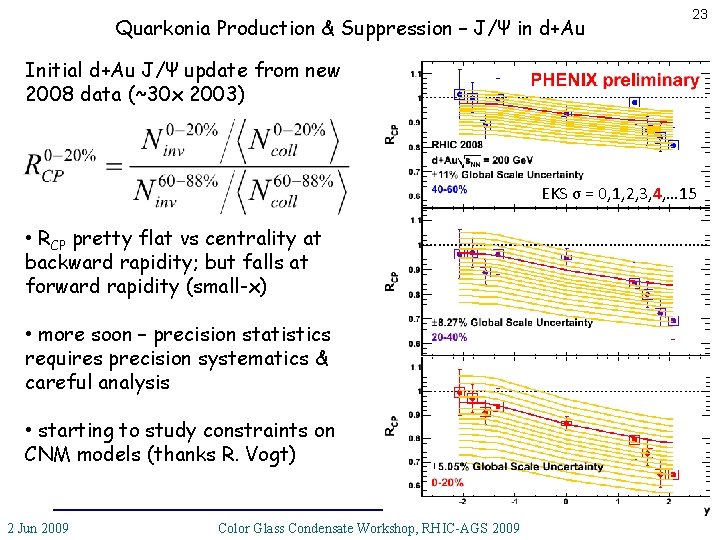
Quarkonia Production & Suppression – J/Ψ in d+Au 23 Initial d+Au J/Ψ update from new 2008 data (~30 x 2003) EKS σ = 0, 1, 2, 3, 4, … 15 • RCP pretty flat vs centrality at backward rapidity; but falls at forward rapidity (small-x) • more soon – precision statistics requires precision systematics & careful analysis • starting to study constraints on CNM models (thanks R. Vogt) 2 Jun 2009 Color Glass Condensate Workshop, RHIC-AGS 2009
Conclusions • Forward Pion I_d. A for Central Arm Triggered hadrons – forward MPC pi 0’s • Widths ~ consistent between p+p and d+Au • Associated Yields suppressed in d+Au, and stronger with more central collisions • Working on triggered MPC data and Au going MPC side • Can then map out x dependence • Less forward muon arm triggered (2 -5 Ge. V p. T) hadrons – central arm hadron correlations show small I_d. Au difference • R_d. Au of those muon arm hadrons shows suppression pattern • New data from run 08 on the way • Some of the more “ordinary” cold nuclear effects can be mapped out with complementary measurements, like J/Psi. • d+Au is a very complicated system 2 Jun 2009 Color Glass Condensate Workshop, RHIC-AGS 2009
Backup Slides 2 Jun 2009 Color Glass Condensate Workshop, RHIC-AGS 2009
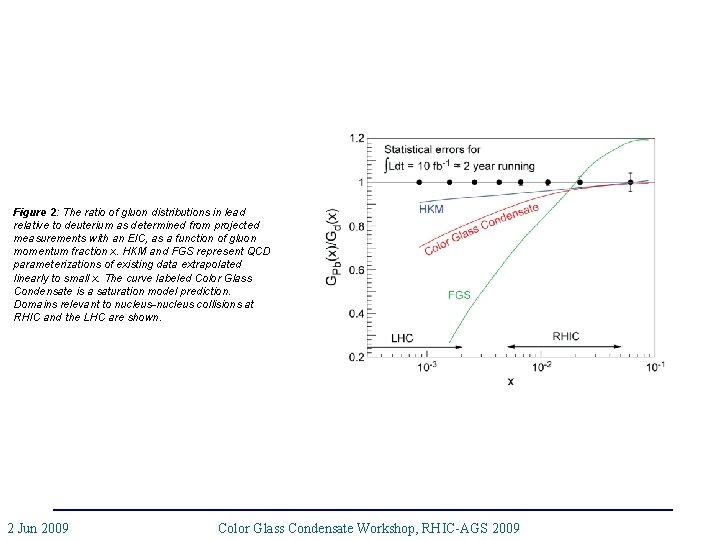
Figure 2: The ratio of gluon distributions in lead relative to deuterium as determined from projected measurements with an EIC, as a function of gluon momentum fraction x. HKM and FGS represent QCD parameterizations of existing data extrapolated linearly to small x. The curve labeled Color Glass Condensate is a saturation model prediction. Domains relevant to nucleus-nucleus collisions at RHIC and the LHC are shown. 2 Jun 2009 Color Glass Condensate Workshop, RHIC-AGS 2009
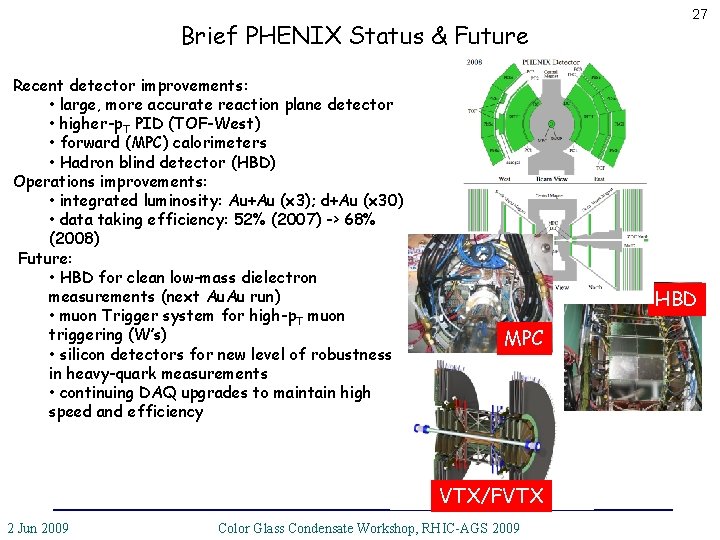
Brief PHENIX Status & Future Recent detector improvements: • large, more accurate reaction plane detector • higher-p. T PID (TOF-West) • forward (MPC) calorimeters • Hadron blind detector (HBD) Operations improvements: • integrated luminosity: Au+Au (x 3); d+Au (x 30) • data taking efficiency: 52% (2007) -> 68% (2008) Future: • HBD for clean low-mass dielectron measurements (next Au. Au run) • muon Trigger system for high-p. T muon triggering (W’s) • silicon detectors for new level of robustness in heavy-quark measurements • continuing DAQ upgrades to maintain high speed and efficiency HBD MPC VTX/FVTX 2 Jun 2009 27 Color Glass Condensate Workshop, RHIC-AGS 2009
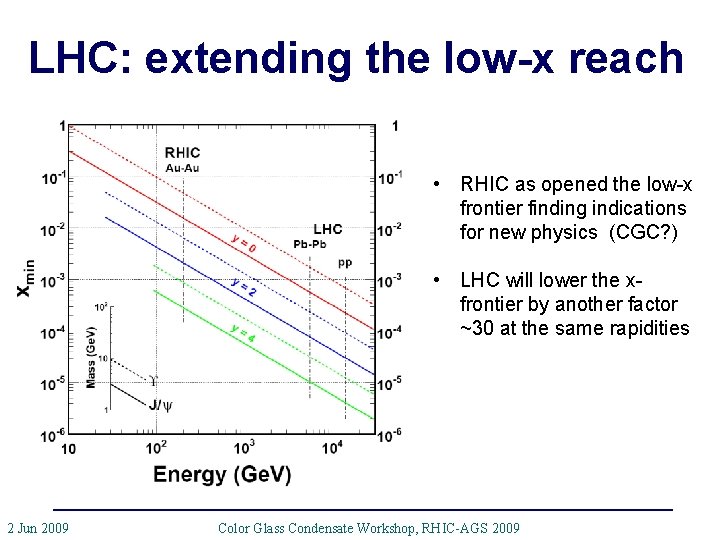
LHC: extending the low-x reach • RHIC as opened the low-x frontier finding indications for new physics (CGC? ) • LHC will lower the xfrontier by another factor ~30 at the same rapidities 2 Jun 2009 Color Glass Condensate Workshop, RHIC-AGS 2009
Cold Nuclear Matter (CNM) & Gluon Saturation Traditional shadowing or coherence models RGPb hep-ph/0902. 4154 v 1 Gluon saturation at small x; amplified in a nucleus Initial state energy loss & multiple scattering 2 Jun 2009 Color Glass Condensate Mike Leitch. Workshop, - PHENIXRHIC-AGS 2009 29
Experimental Method: Overview • Using azimuthal angle two-particle correlation technique – d+Au, pp collisions at s. NN = 200 Ge. V from RHIC Run 8 – Rapidity separated particles with one particle in the forward direction allows one to probe the gluon distribution at lower x – Trigger particles are (p 0, h+/-) with |h| < 0. 35 – Associate particles are forward p 0 s and clusters with 3. 1 < h < 3. 9 Central Rapidity Spectrometer Forward EMC π0 3. 1 < η < 3. 9 π0 x-range in Au: 0. 006 < x < 0. 1 From calculation by Marco Stratmann 2 Jun 2009 Color Glass Condensate Workshop, RHIC-AGS 2009 30
Any difference between p+p and d+Au? p+p: Di-jet d+Au: Mono-jet? Dilute parton system (deuteron) PT is balanced by many gluons Dense gluon field (Au) Kharzeev, Levin, Mc. Lerran (NPA 748, 627) Color glass condensate predicts that the back-to-back correlation from p+p should be suppressed 2 Jun 2009 Color Glass Condensate Workshop, RHIC-AGS 2009
Forward-midrapidity correlations in d+Au STAR PRL 97, 152302 PRL 94, 96, 082302 222301 • PHENIX doesn’t see any changes for <xg> ~ 0. 015 2 Jun Color Glass Condensate • 2009 STAR might see suppression for. Workshop, <x > ~RHIC-AGS 0. 006 2009 π0: |<η>| = 4. 0 h±: |η| < 0. 75 p. T > 0. 5 Ge. V/c
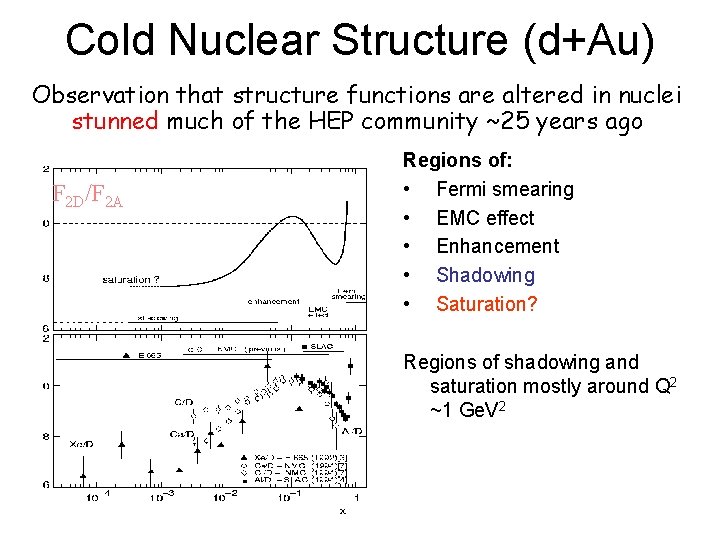
Cold Nuclear Structure (d+Au) Observation that structure functions are altered in nuclei stunned much of the HEP community ~25 years ago F 2 D/F 2 A Regions of: • Fermi smearing • EMC effect • Enhancement • Shadowing • Saturation? Regions of shadowing and saturation mostly around Q 2 ~1 Ge. V 2
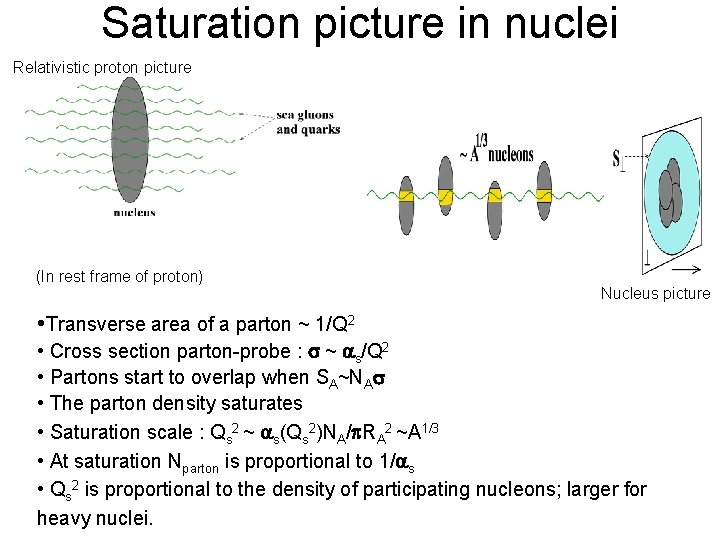
Saturation picture in nuclei Relativistic proton picture (In rest frame of proton) Nucleus picture • Transverse area of a parton ~ 1/Q 2 • Cross section parton-probe : s ~ as/Q 2 • Partons start to overlap when SA~NAs • The parton density saturates • Saturation scale : Qs 2 ~ as(Qs 2)NA/p. RA 2 ~A 1/3 • At saturation Nparton is proportional to 1/as • Qs 2 is proportional to the density of participating nucleons; larger for heavy nuclei.