
Forward Error Correction vs Active Retransmit Requests in
- Slides: 14
Forward Error Correction vs. Active Retransmit Requests in Wireless Networks Robbert Haarman
Contents 1. Introduction 2. Research Question 3. Protocols 4. Results 5. Conclusions
Introduction - TCP ● ● ● On the Internet, TCP is commonly used to provide reliable message delivery TCP retransmits lost packets to enable the receiver to reassemble the message Requesting and sending retransmissions can be time-consuming, especially on high-latency networks
Introduction - FEC ● ● ● As an alternative to retransmits, we may use forward error correction (FEC) Here, the sender adds redundancy to the message, so that it can be reconstructed even if some packets are lost The sender transmits until the receiver has received enough packets to reconstruct the message
Research Question ● ● On a wireless network, does active retransmission (ARQ) or forward error correction (FEC) perform better? We will be looking at throughput (how long does it take to transfer a message? ) and wastage (how many bits does it take to transfer a message? )
Protocols ● ● To answer the question, two protocols will be compared: a simple ARQ protocol, and a simple FEC protocol The protocols are kept as similar as possible Both protocols split the message in 1 kilobyte blocks, which are transmitted with 16 bytes overhead Both protocols use 8 -byte acknowledgments to signal transmission completion
Protocols - ARQ ● ● ● The ARQ protocol detects lost packets using timeouts When such a timeout expires, a 12 -byte ARQ message is sent to the sender, which then retransmits the lost packet When the transmission is complete, the receiver sends an ACK to the sender, which responds with an ACK to the receiver (both repeated as necessary)
Protocols - FEC ● ● The FEC protocol uses an (unspecified) erasure code that allows it to generate an unlimited number of code packets from n data packets The message can be reconstructed from any n code packets The sender keeps sending code packets until it receives an ACK The receiver sends an ACK when it has enough packets (repeated as it receives more packets)
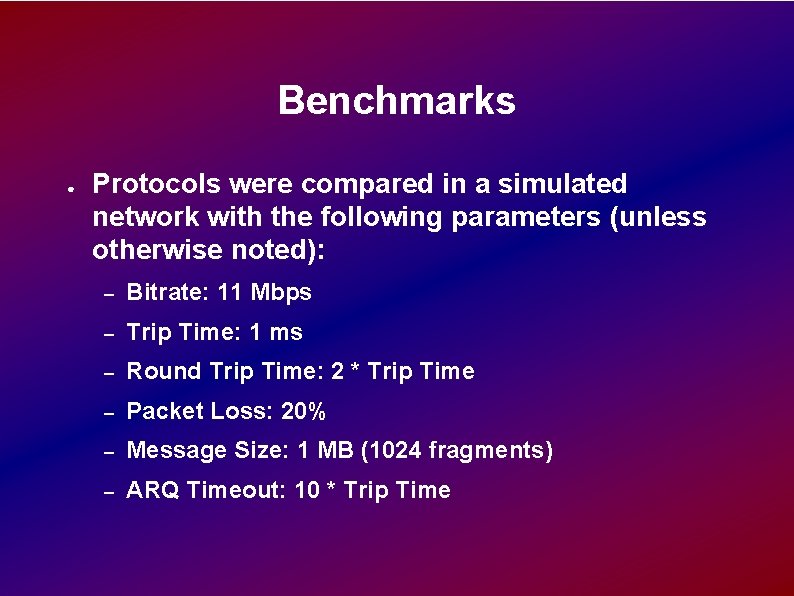
Benchmarks ● Protocols were compared in a simulated network with the following parameters (unless otherwise noted): – Bitrate: 11 Mbps – Trip Time: 1 ms – Round Trip Time: 2 * Trip Time – Packet Loss: 20% – Message Size: 1 MB (1024 fragments) – ARQ Timeout: 10 * Trip Time
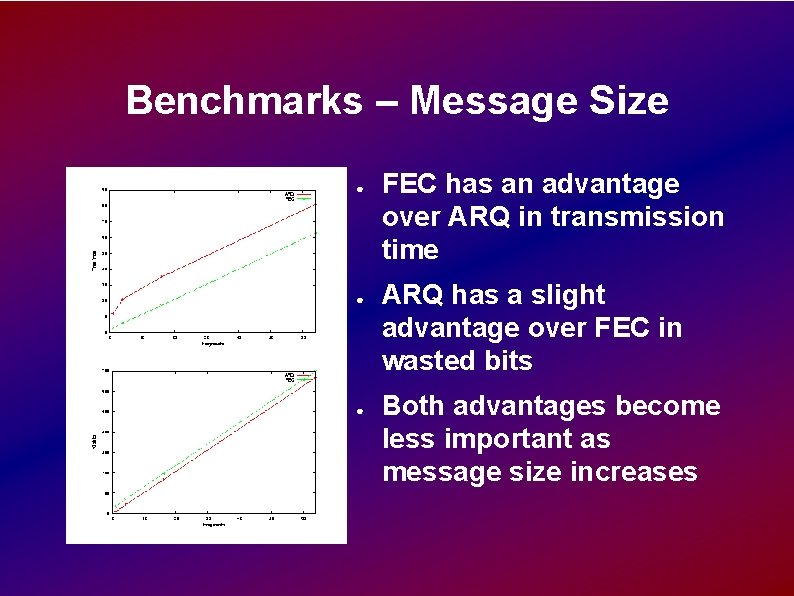
Benchmarks – Message Size ● ● ● FEC has an advantage over ARQ in transmission time ARQ has a slight advantage over FEC in wasted bits Both advantages become less important as message size increases
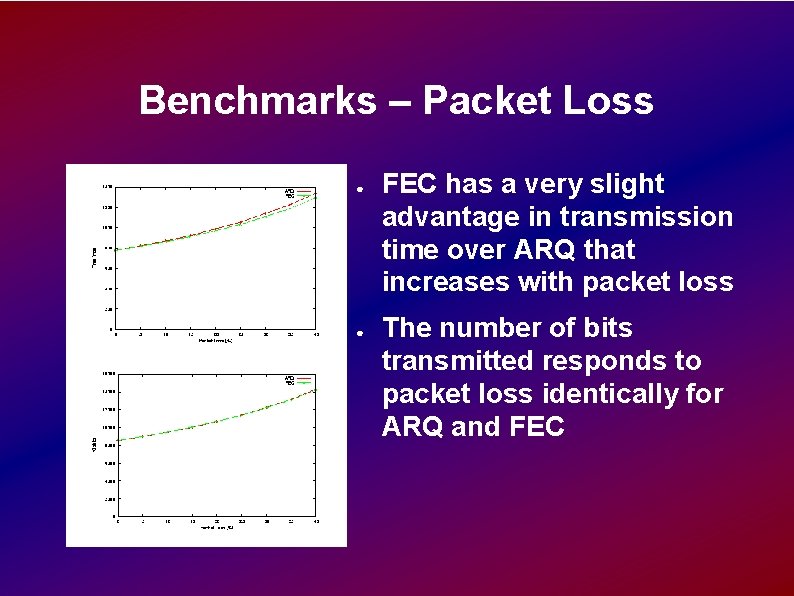
Benchmarks – Packet Loss ● ● FEC has a very slight advantage in transmission time over ARQ that increases with packet loss The number of bits transmitted responds to packet loss identically for ARQ and FEC
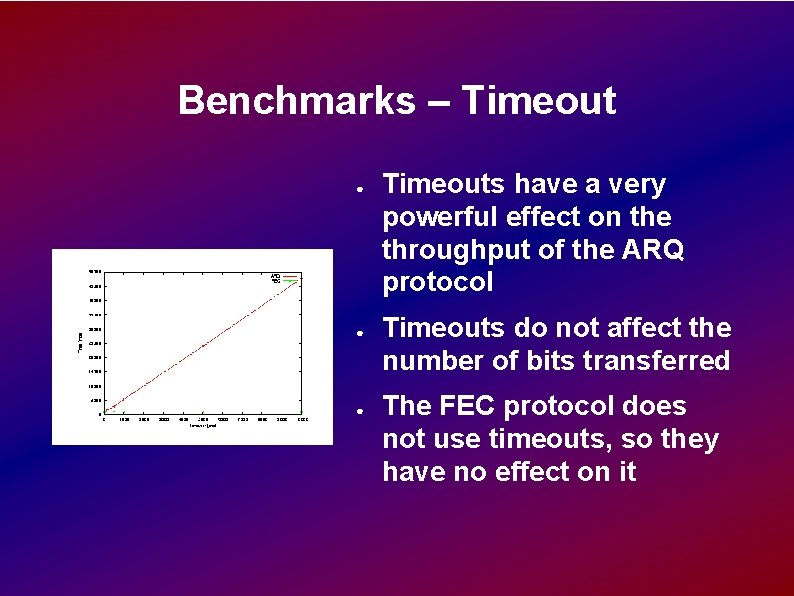
Benchmarks – Timeout ● ● ● Timeouts have a very powerful effect on the throughput of the ARQ protocol Timeouts do not affect the number of bits transferred The FEC protocol does not use timeouts, so they have no effect on it
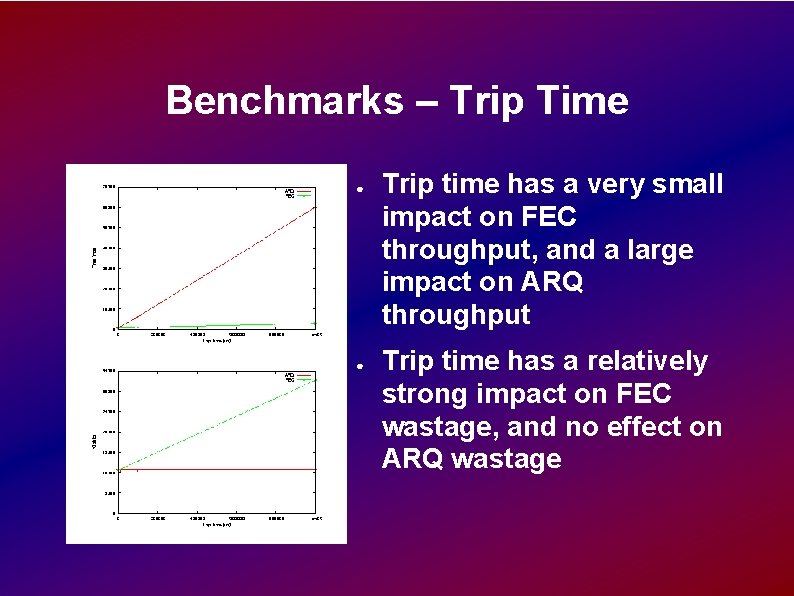
Benchmarks – Trip Time ● ● Trip time has a very small impact on FEC throughput, and a large impact on ARQ throughput Trip time has a relatively strong impact on FEC wastage, and no effect on ARQ wastage
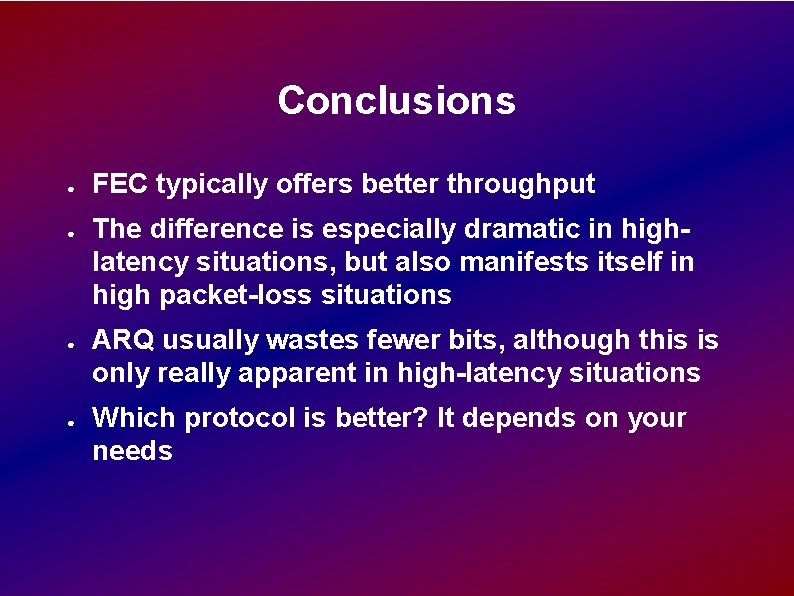
Conclusions ● ● FEC typically offers better throughput The difference is especially dramatic in highlatency situations, but also manifests itself in high packet-loss situations ARQ usually wastes fewer bits, although this is only really apparent in high-latency situations Which protocol is better? It depends on your needs