
Forthcoming schedule HSE International Ch 16 The Organization
- Slides: 73
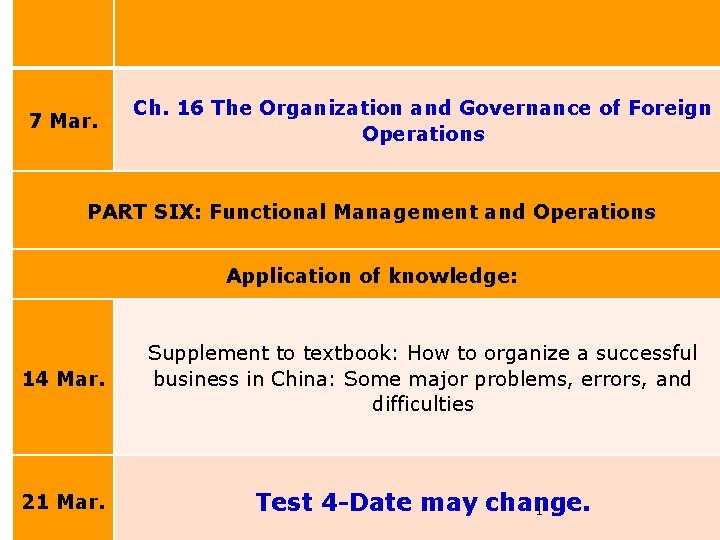
Forthcoming schedule HSE: International Ch. 16 The Organization and Governance of Foreign 7 Mar. Operations Business Environments & Operations PART SIX: Functional Management and Operations Application of knowledge: 15 e, Global Edition 14 Mar. 21 Mar. Supplement to textbook: How to organize a successful Daniels ● Radebaugh ● Sullivan business in China: Some major problems, errors, and difficulties Test 4 -Date may change. 1 16 -1
Chapter 16 The Organization and Governance of Foreign Operations 16 -2
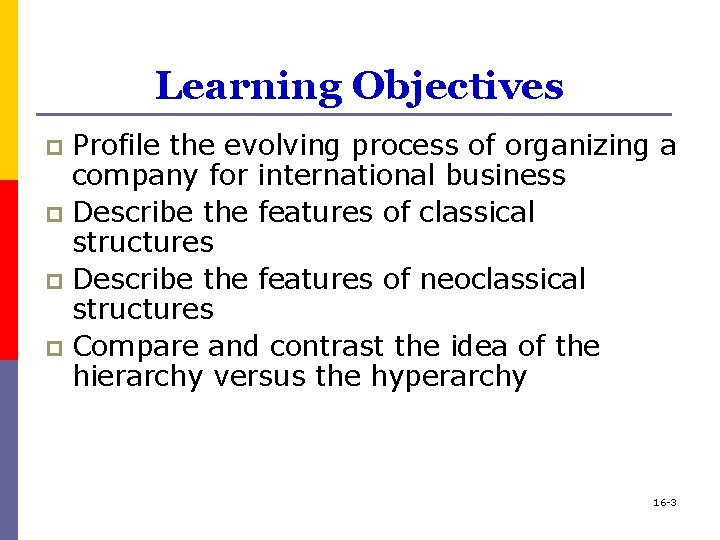
Learning Objectives Profile the evolving process of organizing a company for international business p Describe the features of classical structures p Describe the features of neoclassical structures p Compare and contrast the idea of the hierarchy versus the hyperarchy p 16 -3
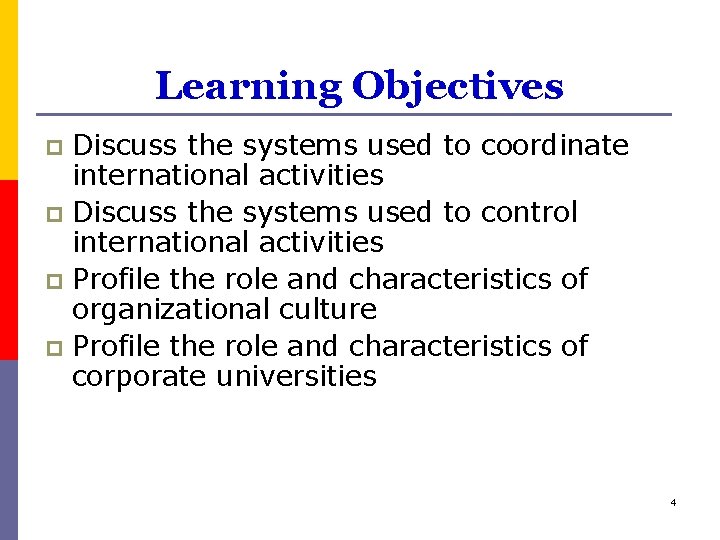
Learning Objectives Discuss the systems used to coordinate international activities p Discuss the systems used to control international activities p Profile the role and characteristics of organizational culture p Profile the role and characteristics of corporate universities p 4
Introduction Learning Objective: Profile the evolving process of organizing a company for international business 16 -5
Introduction The goal of MNEs is to standardize activities to maximize global efficiency and at the same time adapt activities to maximize local effectiveness p To achieve this goal the MNE must establish the right structure to implement it p 16 -6
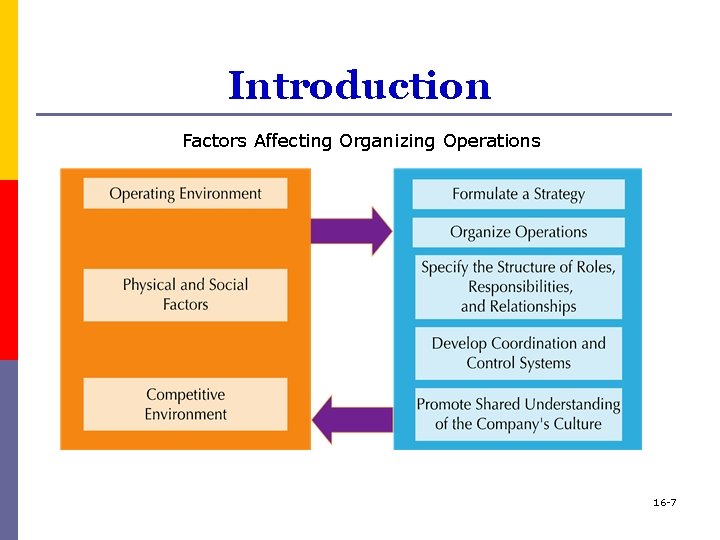
Introduction Factors Affecting Organizing Operations 16 -7
Changing Situations, Changing Organizations p Environmental trends, industry conditions, and market opportunities are forcing change n n n Expansion of international business The Internet as a design standard Managerial standards Social contracts Building a ‘magical’ organization 16 -8
Organization Structure Learning Objective: Describe the features of classical structures 16 -9
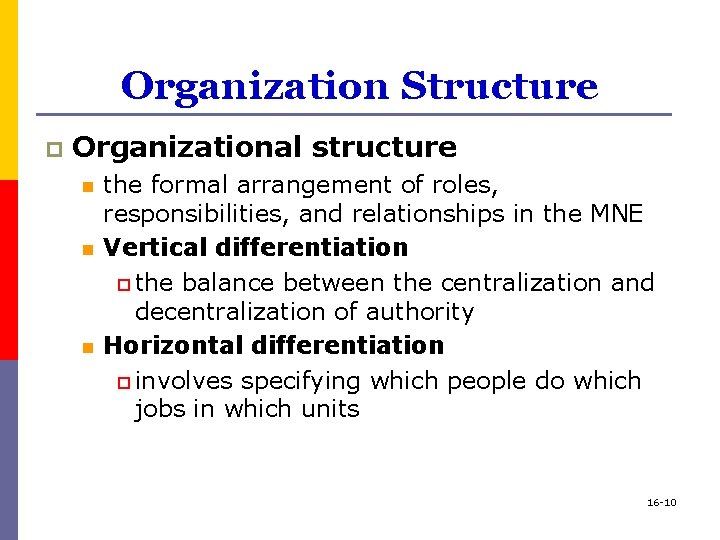
Organization Structure p Organizational structure n n n the formal arrangement of roles, responsibilities, and relationships in the MNE Vertical differentiation p the balance between the centralization and decentralization of authority Horizontal differentiation p involves specifying which people do which jobs in which units 16 -10
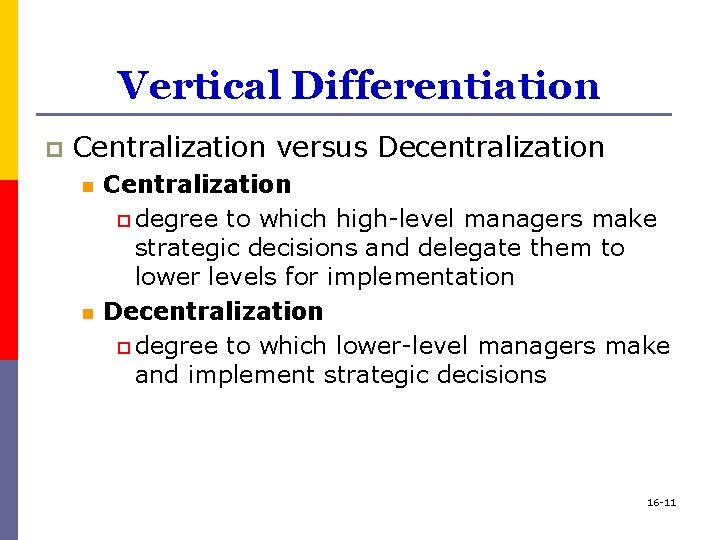
Vertical Differentiation p Centralization versus Decentralization n n Centralization p degree to which high-level managers make strategic decisions and delegate them to lower levels for implementation Decentralization p degree to which lower-level managers make and implement strategic decisions 16 -11
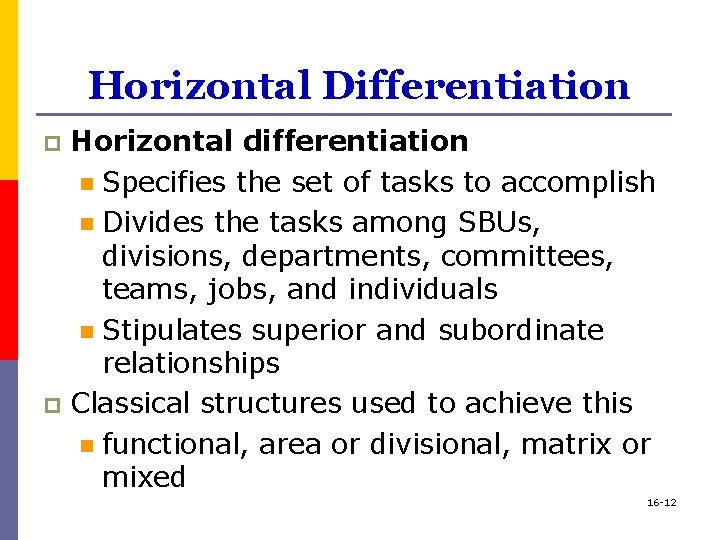
Horizontal Differentiation Horizontal differentiation n Specifies the set of tasks to accomplish n Divides the tasks among SBUs, divisions, departments, committees, teams, jobs, and individuals n Stipulates superior and subordinate relationships p Classical structures used to achieve this n functional, area or divisional, matrix or mixed p 16 -12
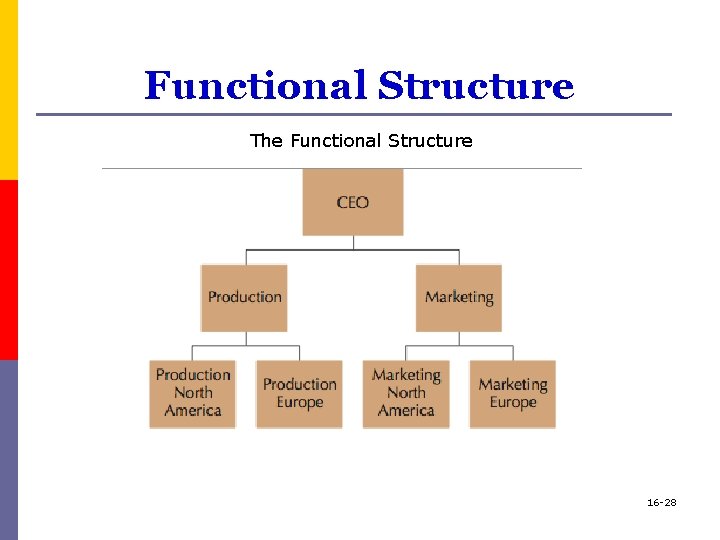
Functional Structure p The functional structure groups people based on common expertise and resources n is popular among companies with narrow product lines n 16 -13
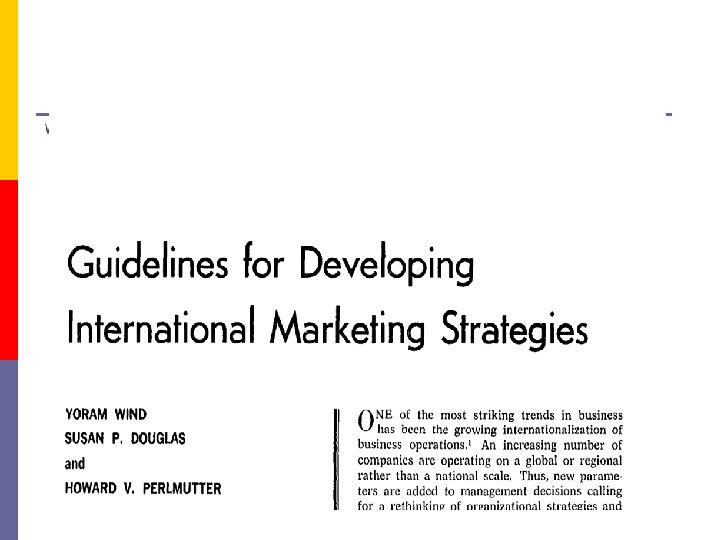
International Organisational Structure Perlmutter: Ethnocentric, Polycentric, Regiocentric, Geocentric 14
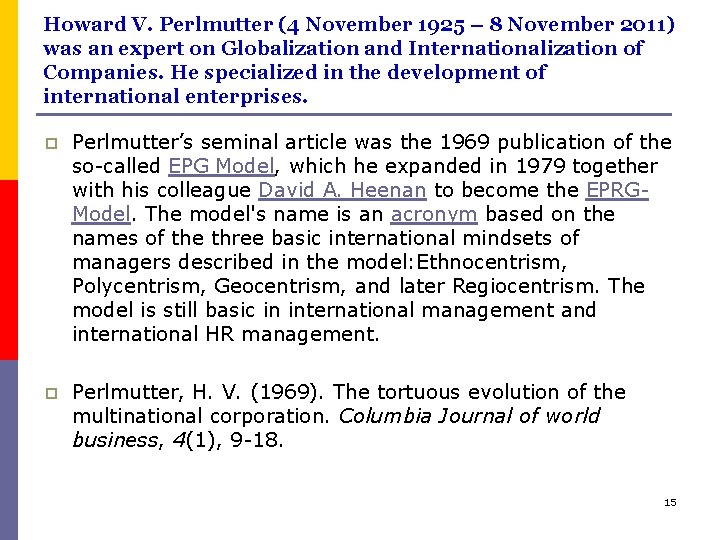
Howard V. Perlmutter (4 November 1925 – 8 November 2011) was an expert on Globalization and Internationalization of Companies. He specialized in the development of international enterprises. p Perlmutter’s seminal article was the 1969 publication of the so-called EPG Model, which he expanded in 1979 together with his colleague David A. Heenan to become the EPRGModel. The model's name is an acronym based on the names of the three basic international mindsets of managers described in the model: Ethnocentrism, Polycentrism, Geocentrism, and later Regiocentrism. The model is still basic in international management and international HR management. p Perlmutter, H. V. (1969). The tortuous evolution of the multinational corporation. Columbia Journal of world business, 4(1), 9 -18. 15
Journal of World Business, 1969 16
How multinational should your top managers be? It may be easier to talk to your man in Rio if he speaks your language, but insisting on that may cause MNCs to lose some top people, not to mention profits Howard V. Perlmutter and David A. Heenan Harvard Business Review, Nov. -Dec. , 1974 17
Categories of International Firms p http: //www. cbsnews. com/news/get-yourinternational-business-terms-right/ 18
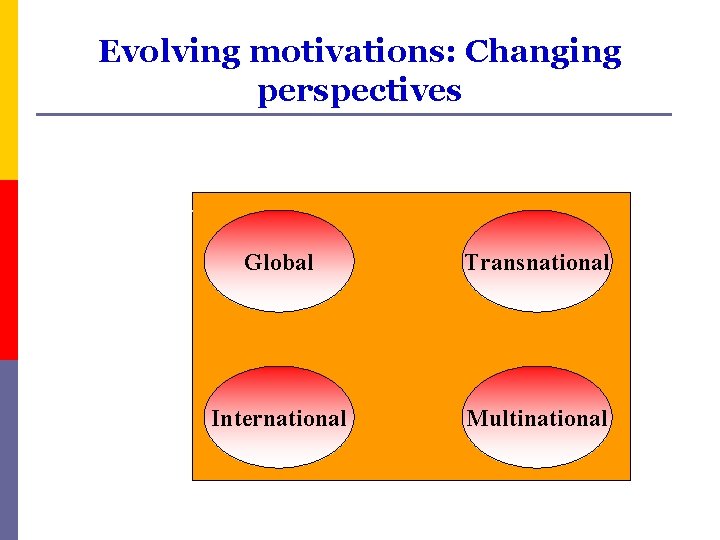
Evolving motivations: Changing perspectives High Global Transnational International Multinational Global Coordination Integration Low Local Responsiveness High 19
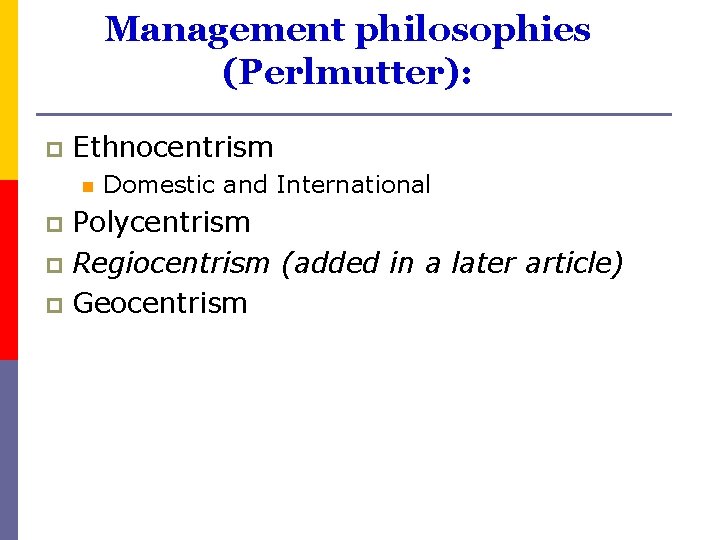
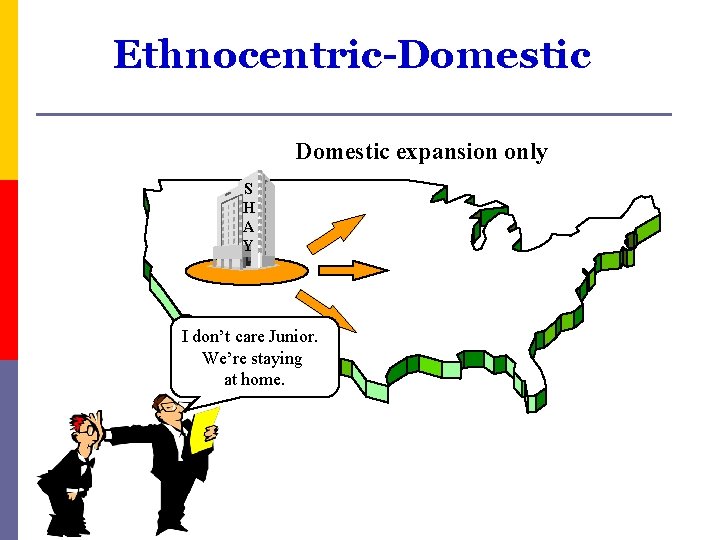
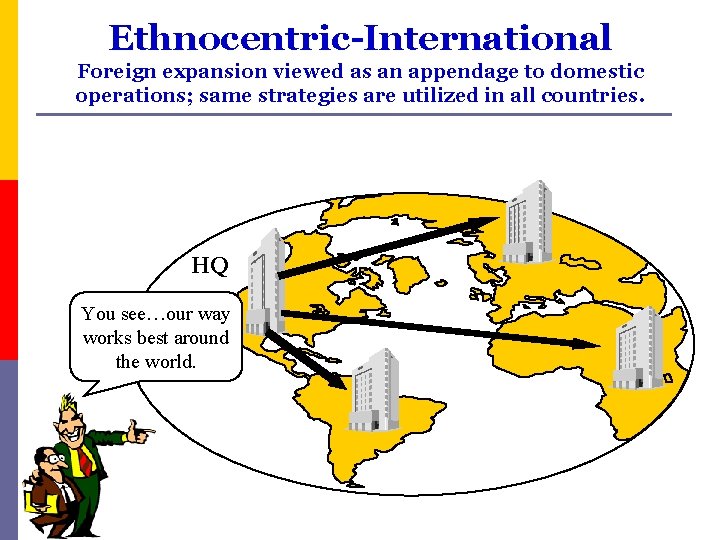
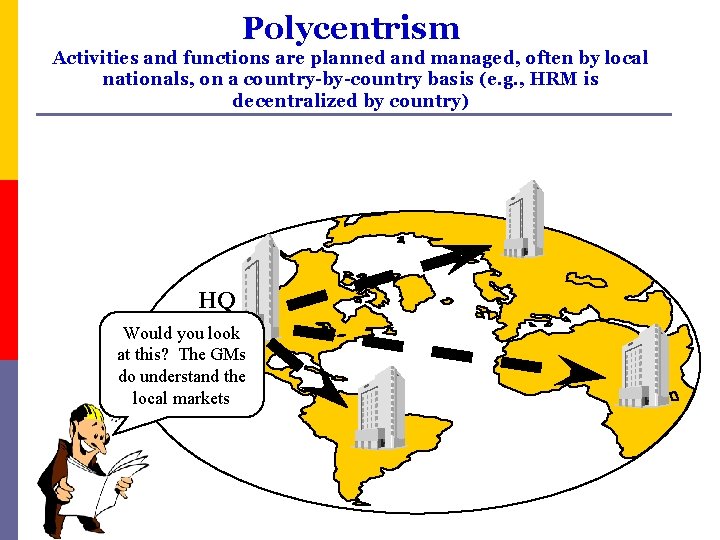
Management philosophies (Perlmutter): p Ethnocentrism n Domestic and International Polycentrism p Regiocentrism (added in a later article) p Geocentrism p 20
Between the two extremes of highly centralized, centocentric/global (standardization, global integration, efficiency, economies of scale…) and decentralized, multinational (host country focus, effectiveness…) strategies, there lies a possibility of combining the features of the two to better respond to the situation. 21
Ethnocentric-Domestic expansion only S H A Y I don’t care Junior. We’re staying at home. 22
Ethnocentric-International Foreign expansion viewed as an appendage to domestic operations; same strategies are utilized in all countries. HQ You see…our way works best around the world. 23
Polycentrism Activities and functions are planned and managed, often by local nationals, on a country-by-country basis (e. g. , HRM is decentralized by country) HQ Would you look at this? The GMs do understand the local markets 24
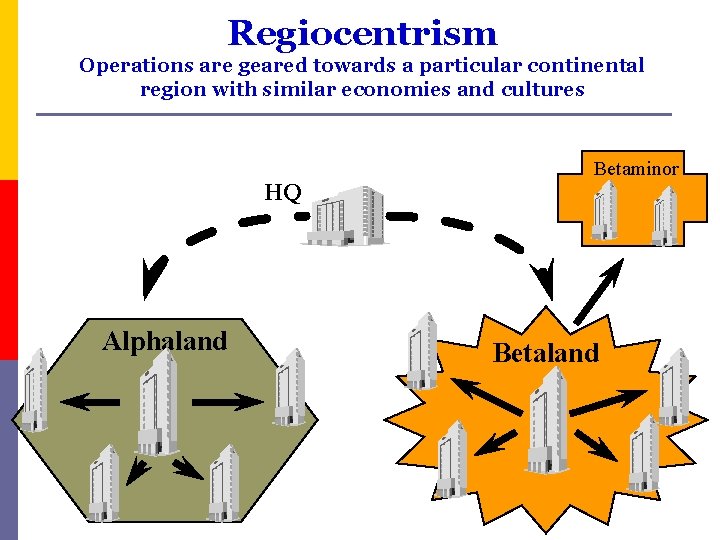
Regiocentrism Operations are geared towards a particular continental region with similar economies and cultures HQ Alphaland Betaminor Betaland 25
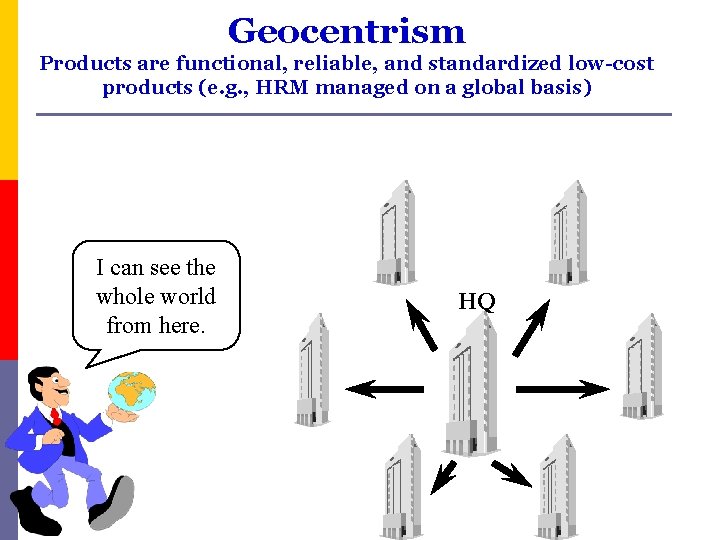
Geocentrism Products are functional, reliable, and standardized low-cost products (e. g. , HRM managed on a global basis) I can see the whole world from here. HQ 26
Video: Staffing https: //www. youtube. com/watch? v=Bj. SX 3 FVAkgw p 7 minutes p 27
Functional Structure The Functional Structure 16 -28
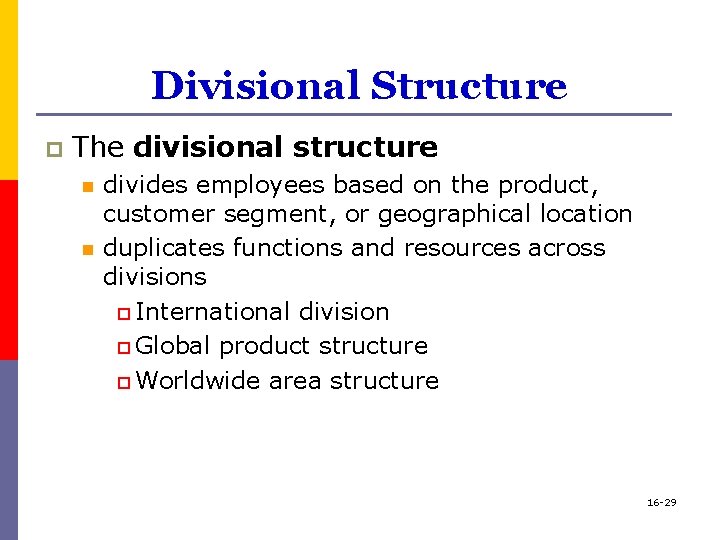
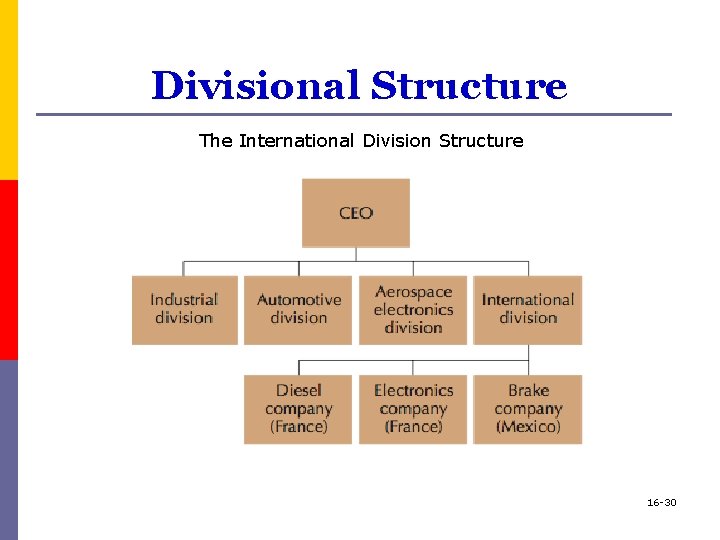
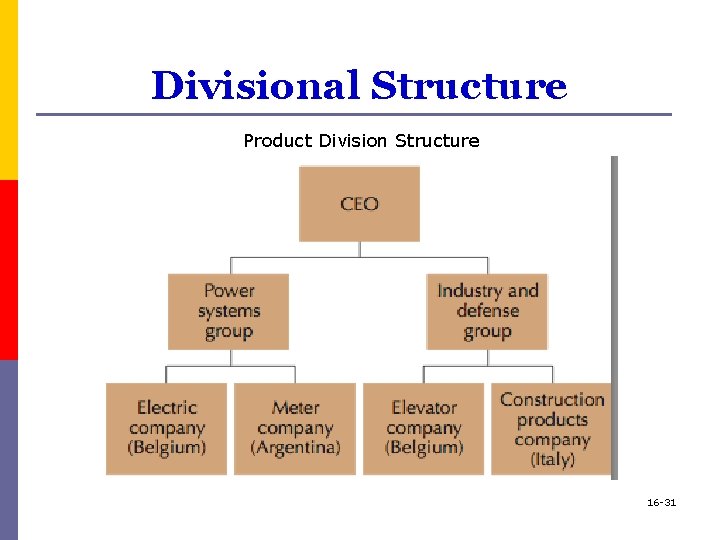
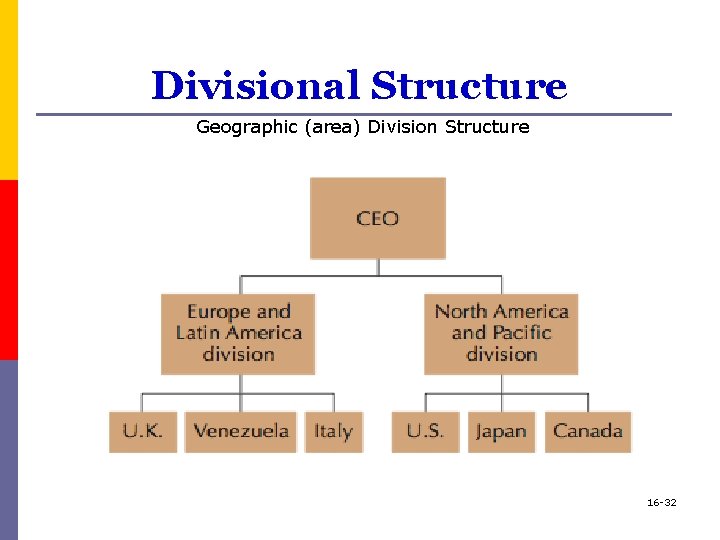
Divisional Structure p The divisional structure n n divides employees based on the product, customer segment, or geographical location duplicates functions and resources across divisions p International division p Global product structure p Worldwide area structure 16 -29
Divisional Structure The International Division Structure 16 -30
Divisional Structure Product Division Structure 16 -31
Divisional Structure Geographic (area) Division Structure 16 -32
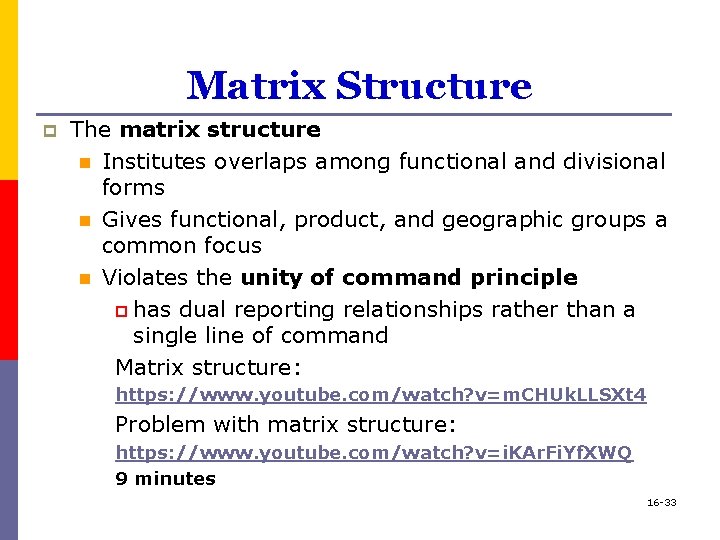
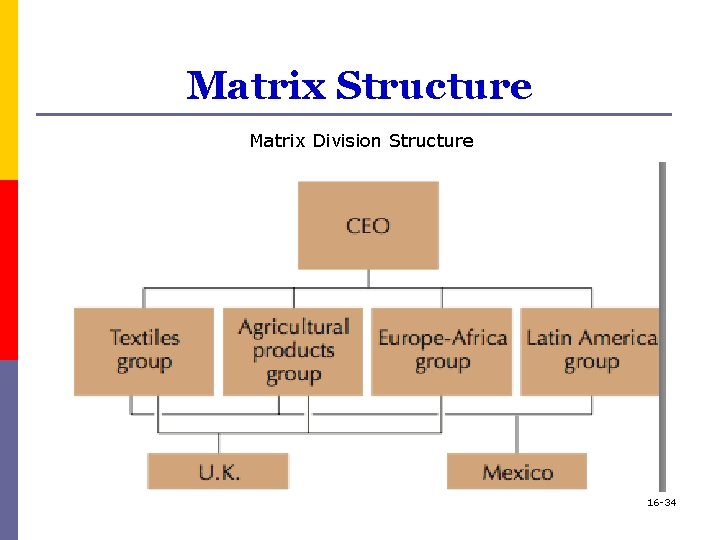
Matrix Structure p The matrix structure n Institutes overlaps among functional and divisional forms n Gives functional, product, and geographic groups a common focus n Violates the unity of command principle p has dual reporting relationships rather than a single line of command Matrix structure: https: //www. youtube. com/watch? v=m. CHUk. LLSXt 4 Problem with matrix structure: https: //www. youtube. com/watch? v=i. KAr. Fi. Yf. XWQ 9 minutes 16 -33
Matrix Structure Matrix Division Structure 16 -34
Mixed Structure p The mixed structure n n Combines elements of the functional, area, and product structures Allows the firm to better adapt to market conditions worldwide 16 -35
Neoclassical Structures Learning Objective: Describe the features of neoclassical structures 16 -36
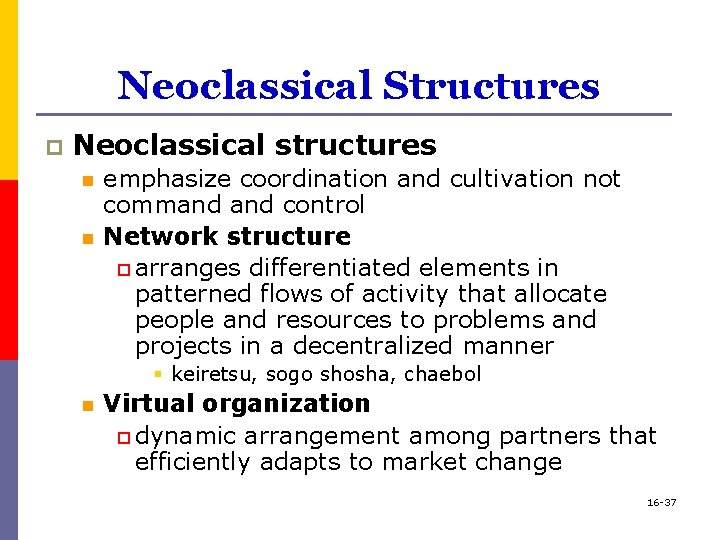
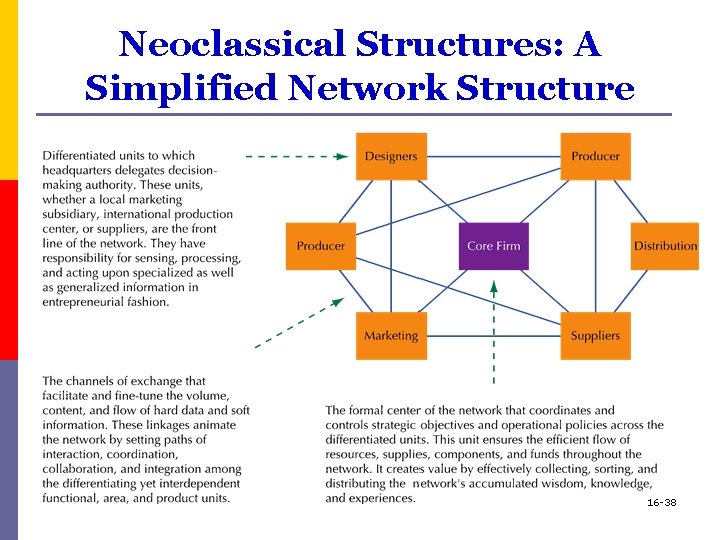
Neoclassical Structures p Neoclassical structures n n emphasize coordination and cultivation not command control Network structure p arranges differentiated elements in patterned flows of activity that allocate people and resources to problems and projects in a decentralized manner § keiretsu, sogo shosha, chaebol n Virtual organization p dynamic arrangement among partners that efficiently adapts to market change 16 -37
Neoclassical Structures: A Simplified Network Structure 16 -38
Neoclassical Structures p Virtual p Organization A virtual organization is a temporary arrangement among independent companies, suppliers, customers and rivals that “works across space time and organizational boundaries with links strengthened by webs of communication technology” 16 -39
Coordinated Systems Learning Objective: Discuss the systems used to coordinate international activities 16 -40
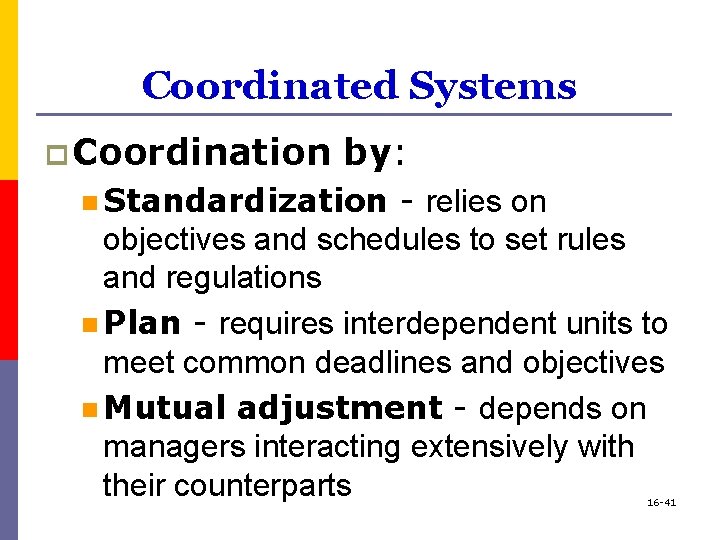
Coordinated Systems p Coordination by: n Standardization - relies on objectives and schedules to set rules and regulations n Plan - requires interdependent units to meet common deadlines and objectives n Mutual adjustment - depends on managers interacting extensively with their counterparts 16 -41
Control Systems Learning Objective: Discuss the systems used to control international activities p 42
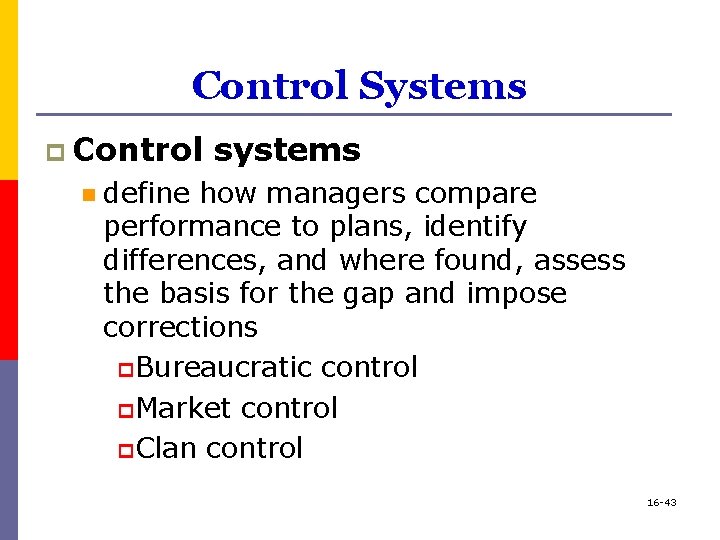
Control Systems p Control n systems define how managers compare performance to plans, identify differences, and where found, assess the basis for the gap and impose corrections p Bureaucratic control p Market control p Clan control 16 -43
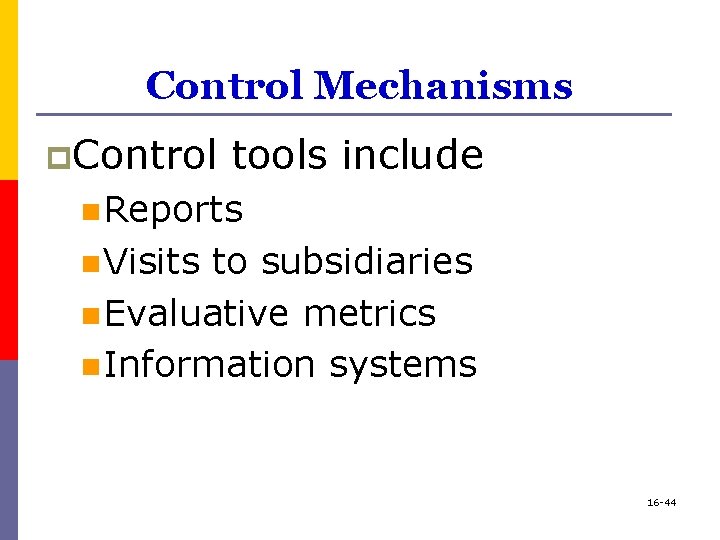
Control Mechanisms p. Control tools include n Reports n Visits to subsidiaries n Evaluative metrics n Information systems 16 -44
Organization Culture Learning Objective: Profile the role and characteristics of organizational culture 16 -45
Organization Culture p Organization n culture the coherent set of assumptions about an MNE and its goals and practices shared by its members p management values and principles p work climate and atmosphere p ‘how we do things around here’ patterns p traditions p ethical standards 16 -46
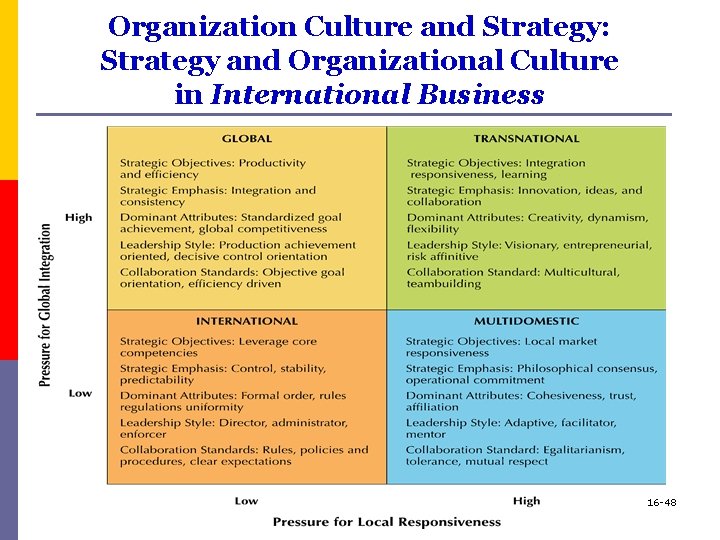
Organization Culture and Strategy p An organization’s culture n shapes its strategic moves n varies with the strategy the MNE pursues 16 -47
Organization Culture and Strategy: Strategy and Organizational Culture in International Business 16 -48
4 9 Organizational Culture
5 0 Learning Objectives Define organizational culture and know why it is important p Distinguish among organizational, national, and global culture and understand the relationships among them p Evaluate the culture-free approach to understanding organizational culture p
5 1 Learning Objectives (cont. ) p Identify levels of organizational culture Know what organizational culture does p Discuss the cultural dimensions and typology approaches to understanding organizational culture p Understand how organizational culture can be managed p
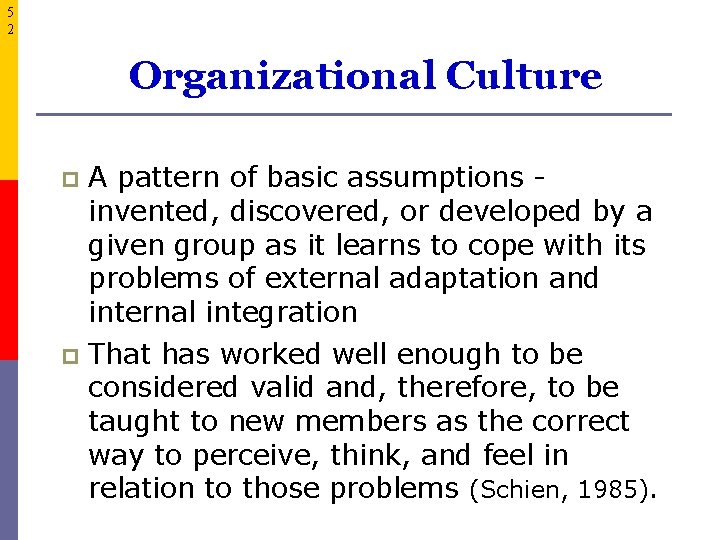
5 2 Organizational Culture A pattern of basic assumptions - invented, discovered, or developed by a given group as it learns to cope with its problems of external adaptation and internal integration p That has worked well enough to be considered valid and, therefore, to be taught to new members as the correct way to perceive, think, and feel in relation to those problems (Schien, 1985). p
5 3 National and Global Culture p Relationship between national and corporate culture is complex: “Logic of industrialization" may affect all organizations the same way n National culture and other elements in an organization's environment may determine internal organizational culture n Globalization also affects organizational culture n
5 4 Henry Ford, founder of the Ford Motor Company said: Getting together is beginning p Keeping together is progress p Working together is success p
5 5 National and Global Culture p One can not understand what’s going on inside an organizational culture without understanding what exists outside the boundary. n n n National culture provides basic assumptions that legitimize and guide organizational behavior. Industrialization promotes changes in national culture. Globalization increases awareness of successful practices elsewhere. Modern communication enhances connections among manufacturers, merchants, financiers, consumers, etc. globally. MNCs seek consistency and shape organizational culture on a global basis.
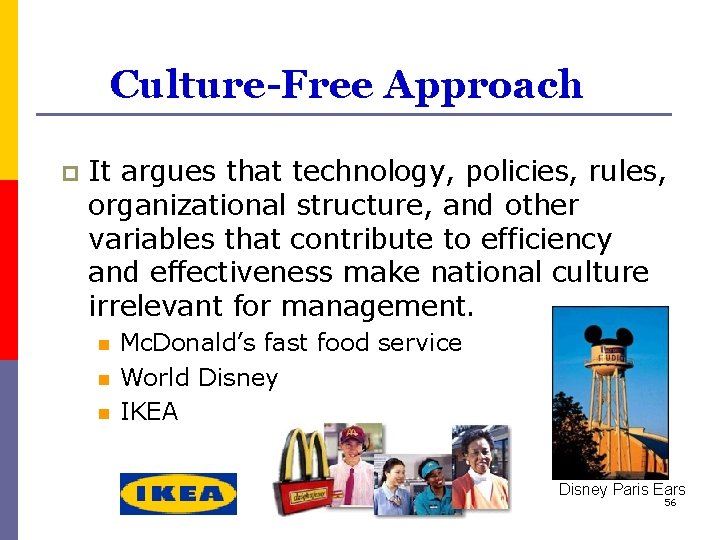
Culture-Free Approach p It argues that technology, policies, rules, organizational structure, and other variables that contribute to efficiency and effectiveness make national culture irrelevant for management. n n n Mc. Donald’s fast food service World Disney IKEA Disney Paris Ears 56
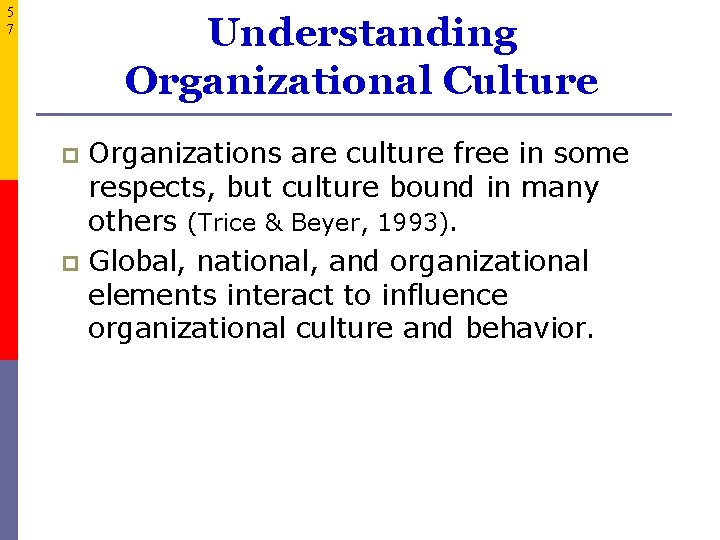
5 7 Understanding Organizational Culture Organizations are culture free in some respects, but culture bound in many others (Trice & Beyer, 1993). p Global, national, and organizational elements interact to influence organizational culture and behavior. p
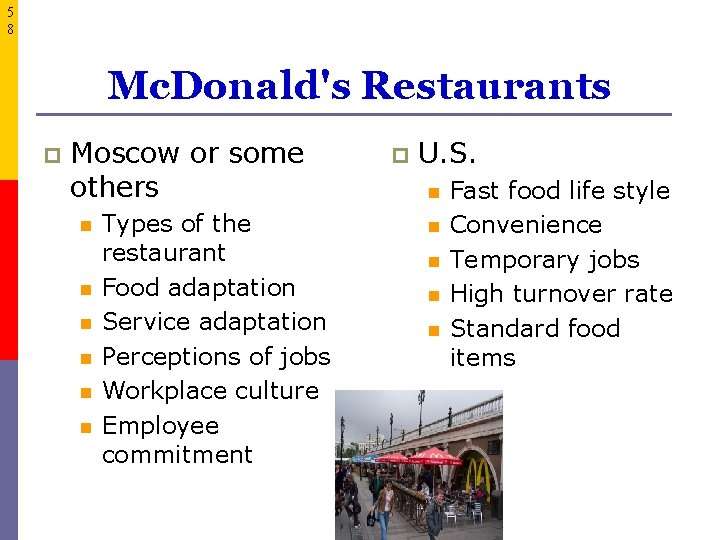
5 8 Mc. Donald's Restaurants p Moscow or some others n n n Types of the restaurant Food adaptation Service adaptation Perceptions of jobs Workplace culture Employee commitment p U. S. n n n Fast food life style Convenience Temporary jobs High turnover rate Standard food items
5 9 Levels of Organizational Culture Artifacts p Espoused Values (should be) p Actual Values (as is) p Basic Underlying Assumptions p n Subcultures
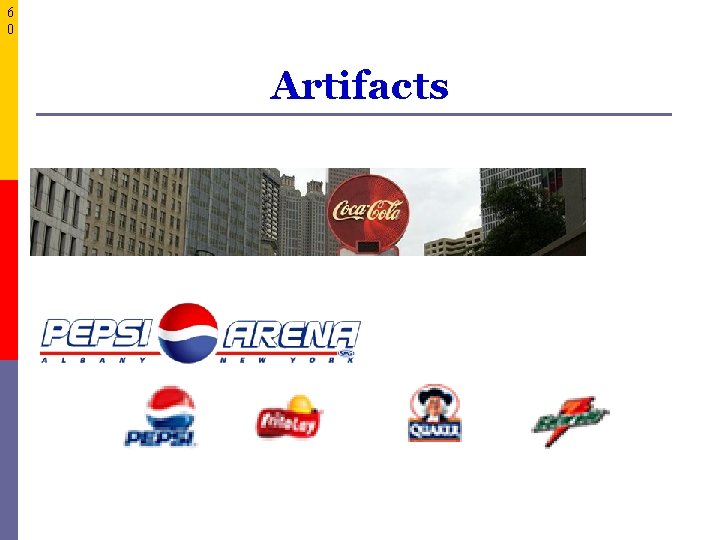
6 0 Artifacts
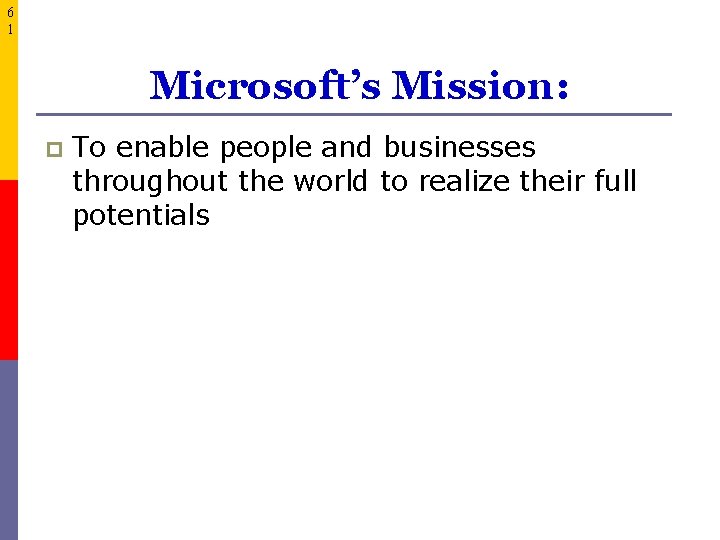
6 1 Microsoft’s Mission: p To enable people and businesses throughout the world to realize their full potentials
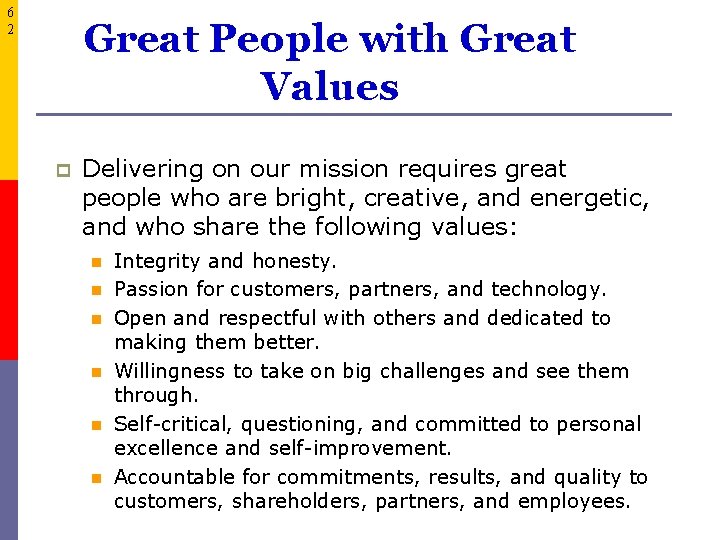
6 2 Great People with Great Values p Delivering on our mission requires great people who are bright, creative, and energetic, and who share the following values: n n n Integrity and honesty. Passion for customers, partners, and technology. Open and respectful with others and dedicated to making them better. Willingness to take on big challenges and see them through. Self-critical, questioning, and committed to personal excellence and self-improvement. Accountable for commitments, results, and quality to customers, shareholders, partners, and employees.
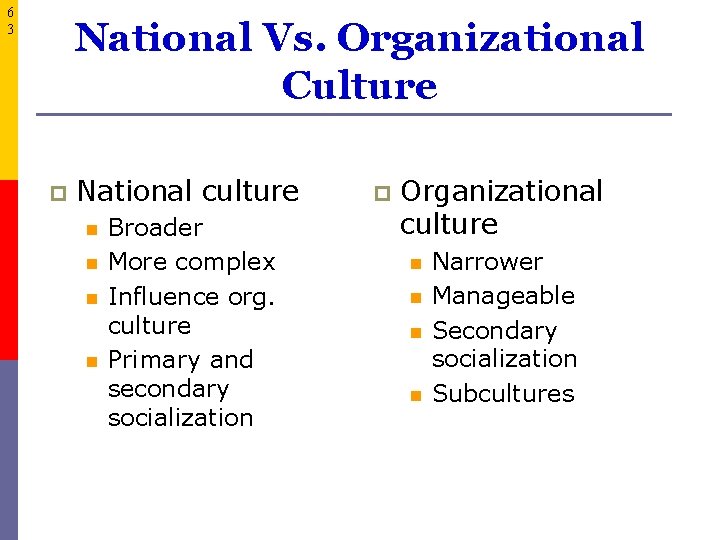
6 3 National Vs. Organizational Culture p National culture n n Broader More complex Influence org. culture Primary and secondary socialization p Organizational culture n n Narrower Manageable Secondary socialization Subcultures
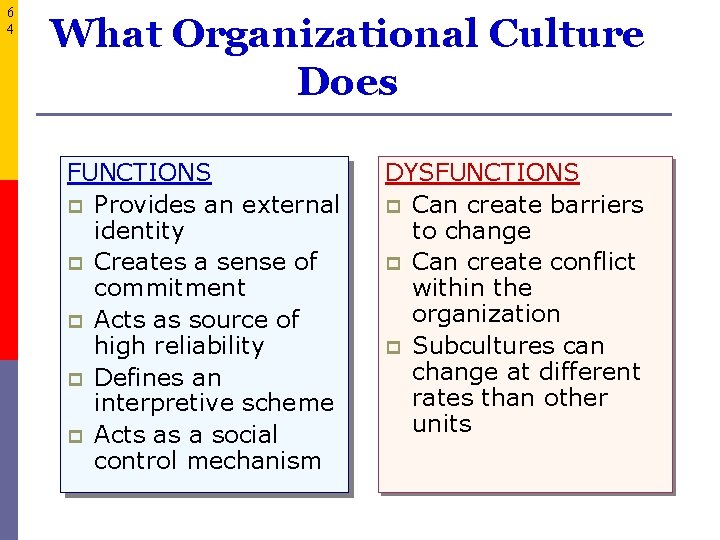
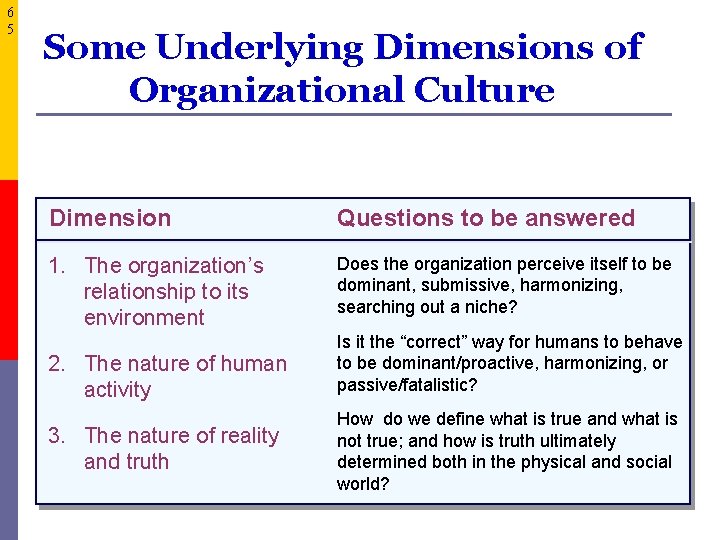
6 4 What Organizational Culture Does FUNCTIONS p Provides an external identity p Creates a sense of commitment p Acts as source of high reliability p Defines an interpretive scheme p Acts as a social control mechanism DYSFUNCTIONS p Can create barriers to change p Can create conflict within the organization p Subcultures can change at different rates than other units
6 5 Some Underlying Dimensions of Organizational Culture Dimension Questions to be answered 1. The organization’s relationship to its environment Does the organization perceive itself to be dominant, submissive, harmonizing, searching out a niche? 2. The nature of human activity 3. The nature of reality and truth Is it the “correct” way for humans to behave to be dominant/proactive, harmonizing, or passive/fatalistic? How do we define what is true and what is not true; and how is truth ultimately determined both in the physical and social world?
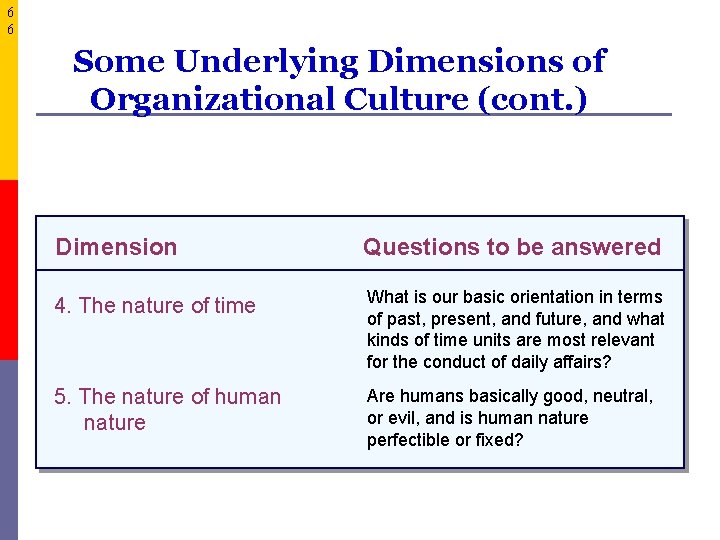
6 6 Some Underlying Dimensions of Organizational Culture (cont. ) Dimension Questions to be answered 4. The nature of time What is our basic orientation in terms of past, present, and future, and what kinds of time units are most relevant for the conduct of daily affairs? 5. The nature of human nature Are humans basically good, neutral, or evil, and is human nature perfectible or fixed?
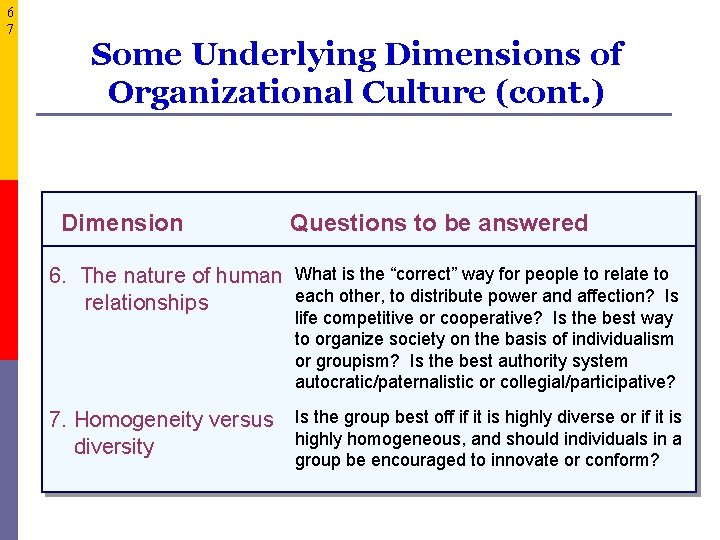
6 7 Some Underlying Dimensions of Organizational Culture (cont. ) Dimension Questions to be answered 6. The nature of human What is the “correct” way for people to relate to each other, to distribute power and affection? Is relationships life competitive or cooperative? Is the best way to organize society on the basis of individualism or groupism? Is the best authority system autocratic/paternalistic or collegial/participative? 7. Homogeneity versus Is the group best off if it is highly diverse or if it is highly homogeneous, and should individuals in a diversity group be encouraged to innovate or conform?
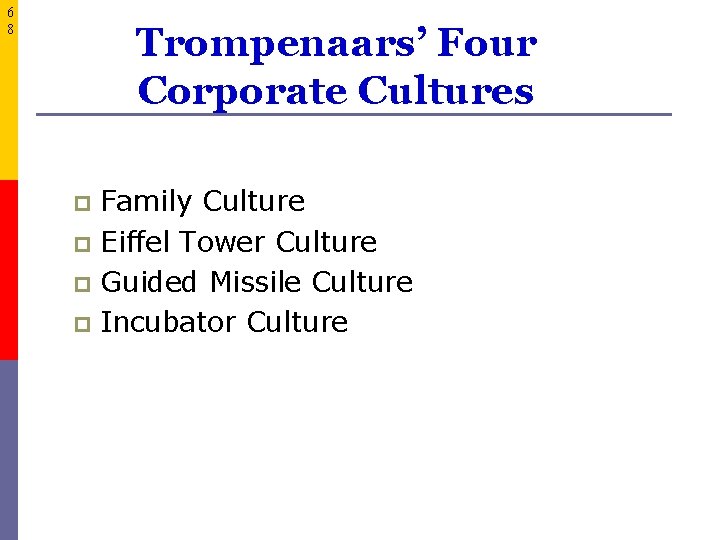
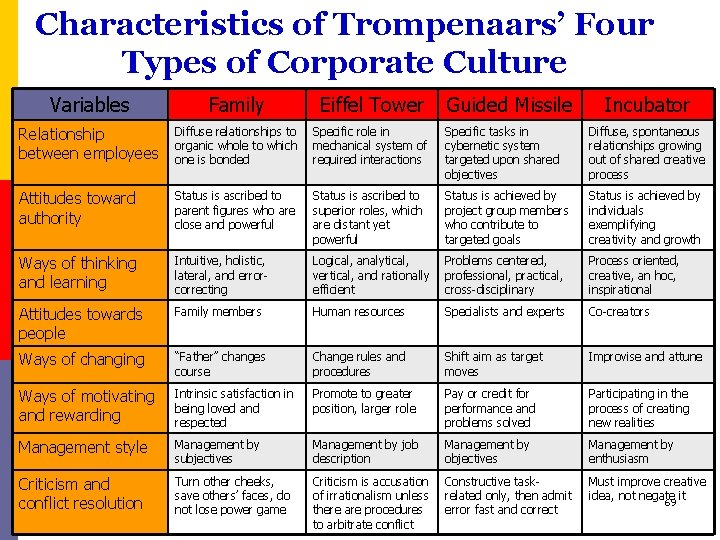
6 8 Trompenaars’ Four Corporate Cultures Family Culture p Eiffel Tower Culture p Guided Missile Culture p Incubator Culture p
Characteristics of Trompenaars’ Four Types of Corporate Culture Variables Family Eiffel Tower Guided Missile Incubator Relationship between employees Diffuse relationships to organic whole to which one is bonded Specific role in mechanical system of required interactions Specific tasks in cybernetic system targeted upon shared objectives Diffuse, spontaneous relationships growing out of shared creative process Attitudes toward authority Status is ascribed to parent figures who are close and powerful Status is ascribed to superior roles, which are distant yet powerful Status is achieved by project group members who contribute to targeted goals Status is achieved by individuals exemplifying creativity and growth Ways of thinking and learning Intuitive, holistic, lateral, and errorcorrecting Logical, analytical, vertical, and rationally efficient Problems centered, professional, practical, cross-disciplinary Process oriented, creative, an hoc, inspirational Attitudes towards people Family members Human resources Specialists and experts Co-creators Ways of changing “Father” changes course Change rules and procedures Shift aim as target moves Improvise and attune Ways of motivating and rewarding Intrinsic satisfaction in being loved and respected Promote to greater position, larger role Pay or credit for performance and problems solved Participating in the process of creating new realities Management style Management by subjectives Management by job description Management by objectives Management by enthusiasm Criticism and conflict resolution Turn other cheeks, save others’ faces, do not lose power game Criticism is accusation of irrationalism unless there are procedures to arbitrate conflict Constructive taskrelated only, then admit error fast and correct Must improve creative idea, not negate it 69
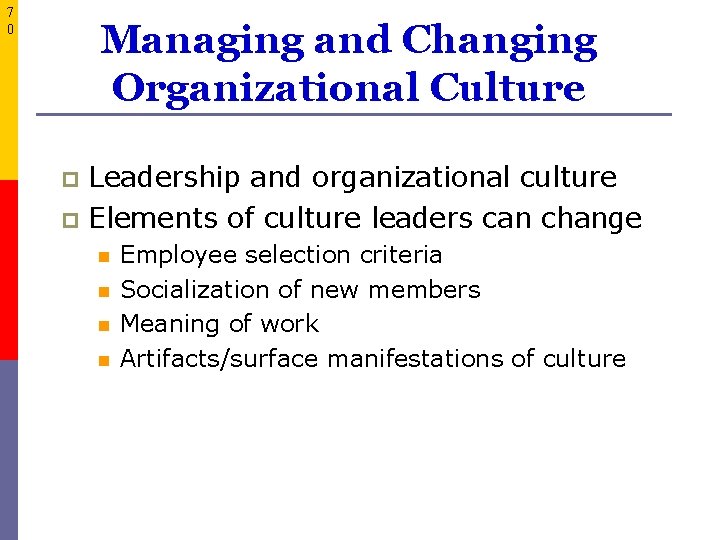
7 0 Managing and Changing Organizational Culture Leadership and organizational culture p Elements of culture leaders can change p n n Employee selection criteria Socialization of new members Meaning of work Artifacts/surface manifestations of culture
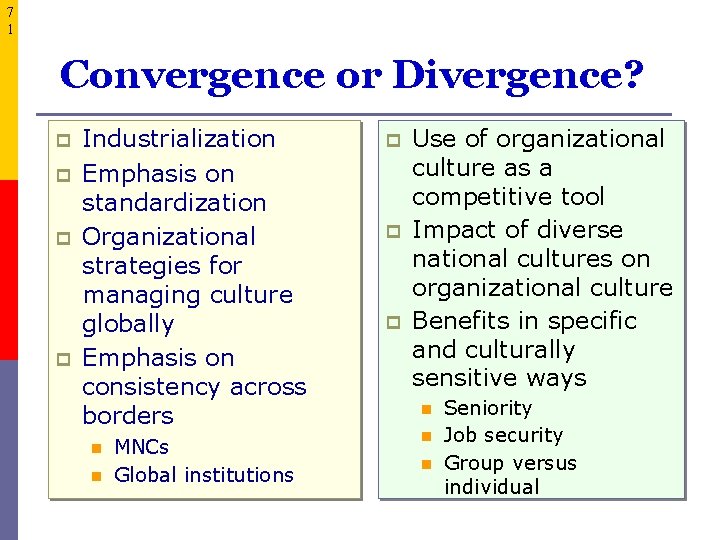
7 1 Convergence or Divergence? p p Industrialization Emphasis on standardization Organizational strategies for managing culture globally Emphasis on consistency across borders n n MNCs Global institutions p p p Use of organizational culture as a competitive tool Impact of diverse national cultures on organizational culture Benefits in specific and culturally sensitive ways n n n Seniority Job security Group versus individual
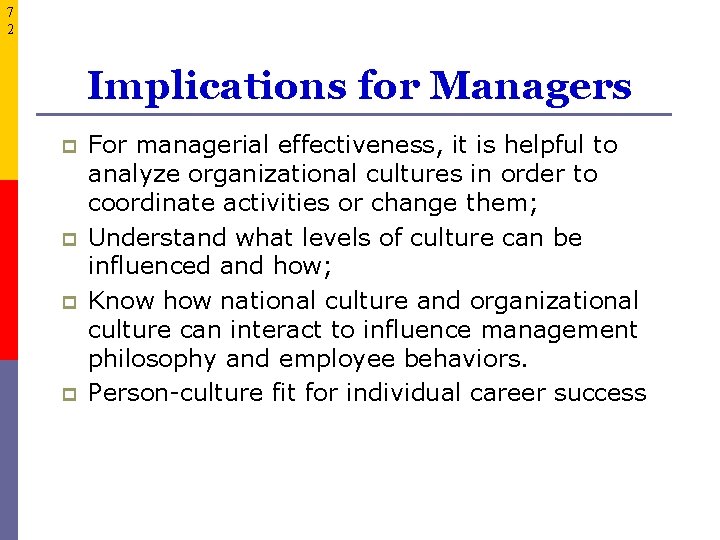
7 2 Implications for Managers p p For managerial effectiveness, it is helpful to analyze organizational cultures in order to coordinate activities or change them; Understand what levels of culture can be influenced and how; Know how national culture and organizational culture can interact to influence management philosophy and employee behaviors. Person-culture fit for individual career success
All rights reserved. No part of this publication may be reproduced, stored in a retrieval system, or transmitted, in any form or by any means, electronic, mechanical, photocopying, recording, or otherwise, without the prior written permission of the publisher. Printed in the United States of America. 16 -73