
Formulation of Learning Outcomes and Mapping Prof Tatjana






- Slides: 28
Formulation of Learning Outcomes and Mapping Prof. Tatjana Koķe, Vice rector RSU, Latvia The EU Twinning Project Support to strengthening HE System in Azerbaijan 2018 -2020; Activity 1. 5 2019. 02. Baku
Learning outcomes of this session Learning outcomes of the session: • Identify weaknessess of the current Study Programs/Courses • List major LO of your study course • Identify resources which may help to formulate LO • Discover value of mapping as a means for improvement of St. P/St. C
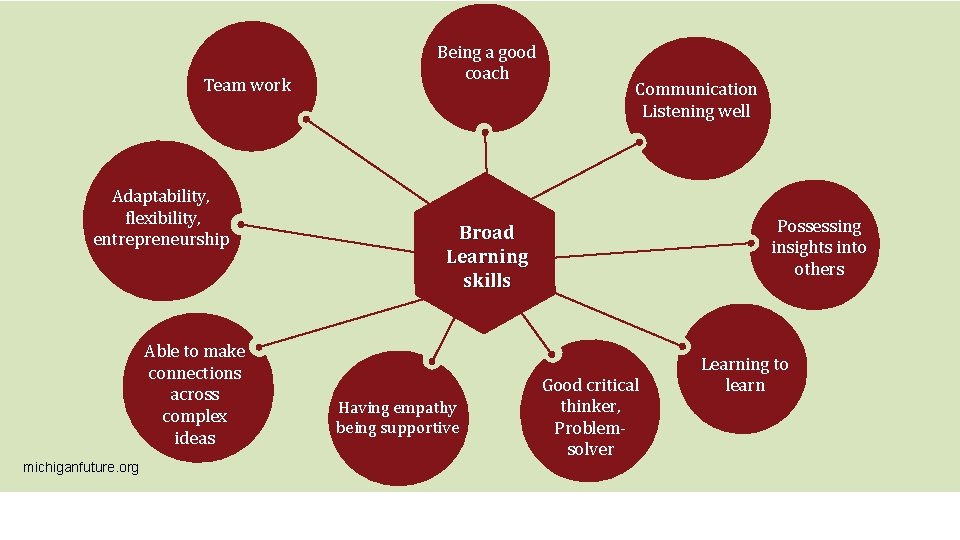
Team work Adaptability, flexibility, entrepreneurship Able to make connections across complex ideas michiganfuture. org Being a good coach Communication Listening well Possessing insights into others Broad Learning skills Having empathy being supportive Good critical thinker, Problemsolver Learning to learn
Some reasons for the weaknessess: - Vague connections to employers - Lack or out dated occupational standarts - Faculty orientation towards subject instead of students and their learning outcomes - Curriculum focus on knowledge instead of its application - Less developed assessment methods for skills evidence
What are LO? LO are statements of what a student is expected to know, understand and/or be able to demonstrate after completion of a process of learning in order to meet complex demands. Formulation of LO is a prerequisite to implement change from subject and teacher –centered education to student centered learning. It means that: • At the centre of study process is student who is able to learn independently; • LO are clearly formulated and known to students who study in order to attain them; • Students are aware, involved and they understand formulated LO at each study course and program; • Learning activities are implemented in a way that helps to achieve LO; • Student performance assessment allows to make sure that students have achieved their LO and at what level; • Faculty role is to stimulate students learning in order to achieve LO.
How to write LO LO should be observable and measurable. Clear understanding of what LO and how will be assessed should be stated (how student will be able to demonstrate achieved LO and What will serve as a proof that LO is achieved). LO should be attainable within the time frame of course or program Unclear and general statements should be avoided , e. g. –know, improve, get acquainted, be familiar with, be exposed to, be acquainted with, be aware of, etc. These terms are associated with teaching objectives rather than learning outcomes.
What do LO promote? • Unanimous understanding both for students and faculty what is expected to be achieved by the end of course or program; • Students efficiency as they have clear understanding what they need to obtain in terms of knowledge, skills, attitudes and values in order to cover the program successfully; • Organisation of study process more efficiently by choosing appropriate themes, materials, learning activities that suit achievement of LO; • Faculty members to develop common understanding on most efficient methods for achieving proposed LO; • Provision of clear information for employers on what graduates have attained within the program in accordance with the requirements of professional qualification.
Structure of LO LO – unity of knowledge, skills and competences acquired during study process and is able to demonstrate this unity. • Knowledge: the outcome of the assimilation of information through learning, work and life experience; • Skills: ability to perform activities at adequate level and quality; • Competence: flexible and dynamic unity of knowledge, skills, attitudes, values and emotions to perform required activities.
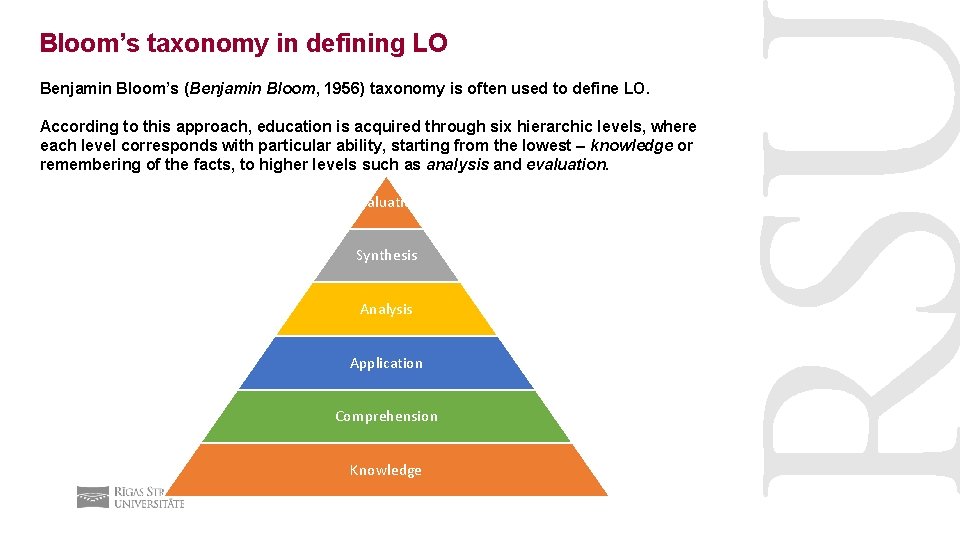
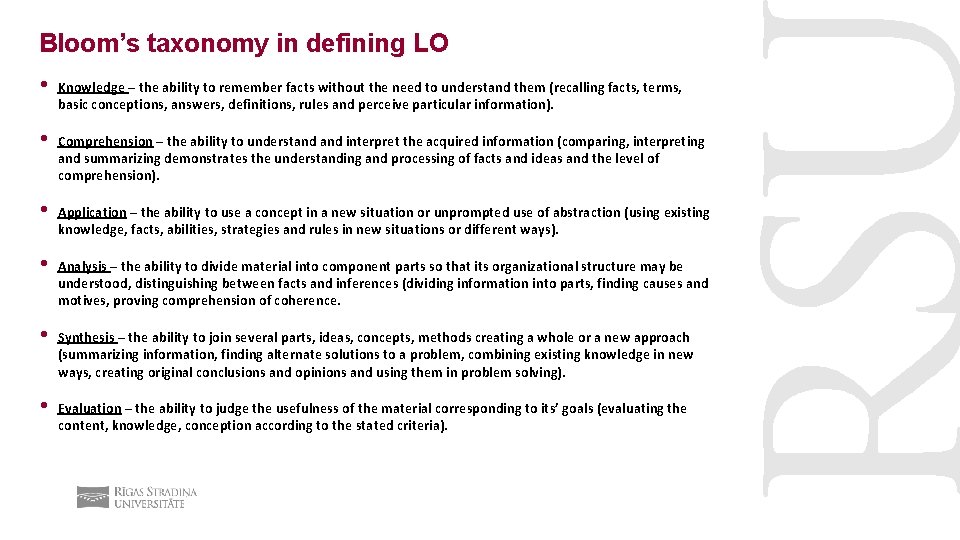
Bloom’s taxonomy in defining LO Benjamin Bloom’s (Benjamin Bloom, 1956) taxonomy is often used to define LO. According to this approach, education is acquired through six hierarchic levels, where each level corresponds with particular ability, starting from the lowest – knowledge or remembering of the facts, to higher levels such as analysis and evaluation. Evaluation Synthesis Analysis Application Comprehension Knowledge
Bloom’s taxonomy in defining LO • • • Knowledge – the ability to remember facts without the need to understand them (recalling facts, terms, basic conceptions, answers, definitions, rules and perceive particular information). Comprehension – the ability to understand interpret the acquired information (comparing, interpreting and summarizing demonstrates the understanding and processing of facts and ideas and the level of comprehension). Application – the ability to use a concept in a new situation or unprompted use of abstraction (using existing knowledge, facts, abilities, strategies and rules in new situations or different ways). Analysis – the ability to divide material into component parts so that its organizational structure may be understood, distinguishing between facts and inferences (dividing information into parts, finding causes and motives, proving comprehension of coherence. Synthesis – the ability to join several parts, ideas, concepts, methods creating a whole or a new approach (summarizing information, finding alternate solutions to a problem, combining existing knowledge in new ways, creating original conclusions and opinions and using them in problem solving). Evaluation – the ability to judge the usefulness of the material corresponding to its’ goals (evaluating the content, knowledge, conception according to the stated criteria).
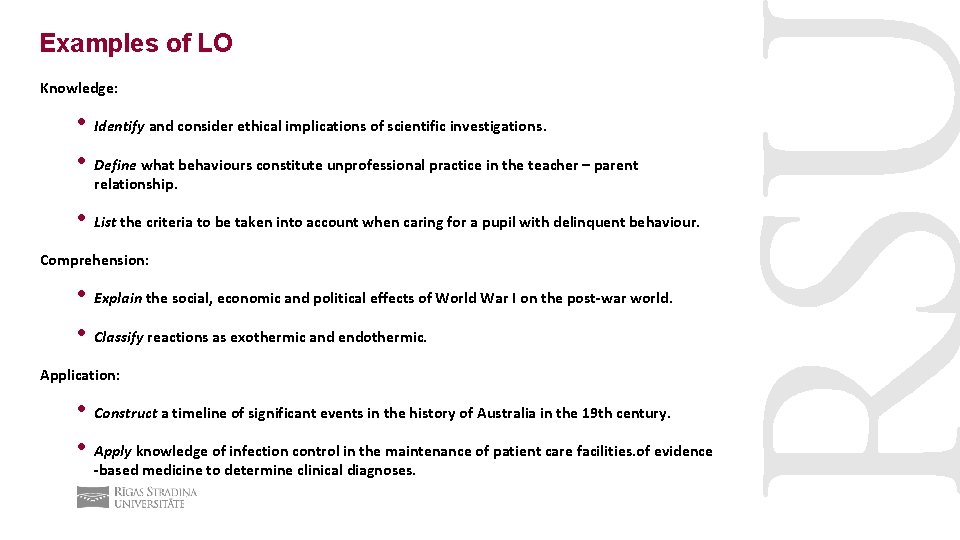
Examples of LO Knowledge: • • • Identify and consider ethical implications of scientific investigations. Define what behaviours constitute unprofessional practice in the teacher – parent relationship. List the criteria to be taken into account when caring for a pupil with delinquent behaviour. Comprehension: • • Explain the social, economic and political effects of World War I on the post-war world. Classify reactions as exothermic and endothermic. Application: • • Construct a timeline of significant events in the history of Australia in the 19 th century. Apply knowledge of infection control in the maintenance of patient care facilities. of evidence -based medicine to determine clinical diagnoses.
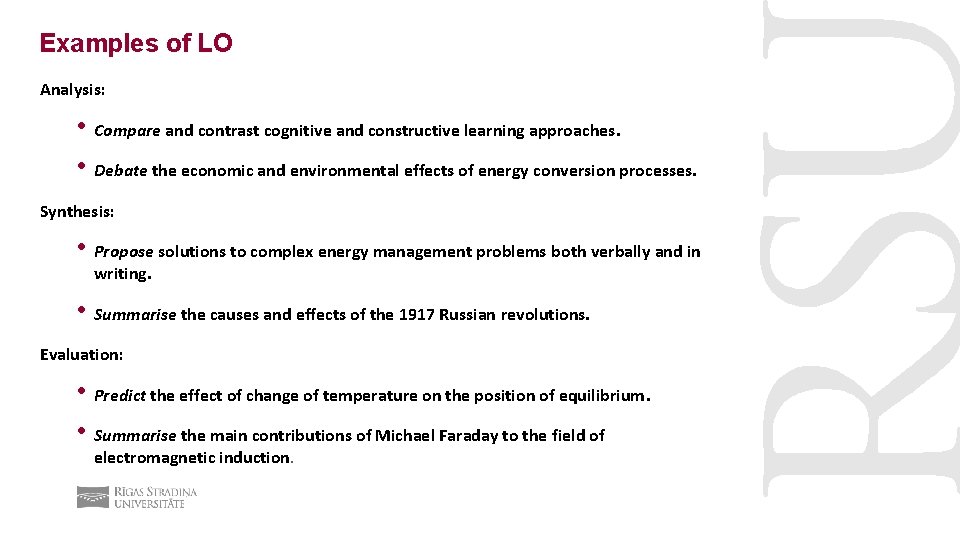
Examples of LO Analysis: • Compare and contrast cognitive and constructive learning approaches. • Debate the economic and environmental effects of energy conversion processes. Synthesis: • Propose solutions to complex energy management problems both verbally and in writing. • Summarise the causes and effects of the 1917 Russian revolutions. Evaluation: • Predict the effect of change of temperature on the position of equilibrium. • Summarise the main contributions of Michael Faraday to the field of electromagnetic induction.
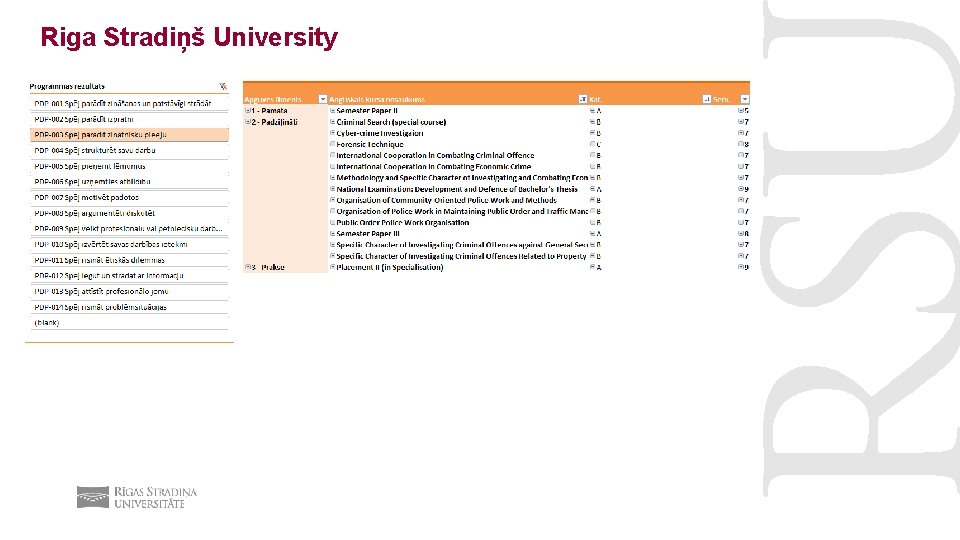
Mapping of LO: case of RSU
Unity of Quality Assurance Policy and Strategic Management Studentcentred learning Programme development, implementation, modernisation Quality assurance policy Partnership Manage ment, incl. infor mation Resources, incl. human, IT, etc. Continuous professional development
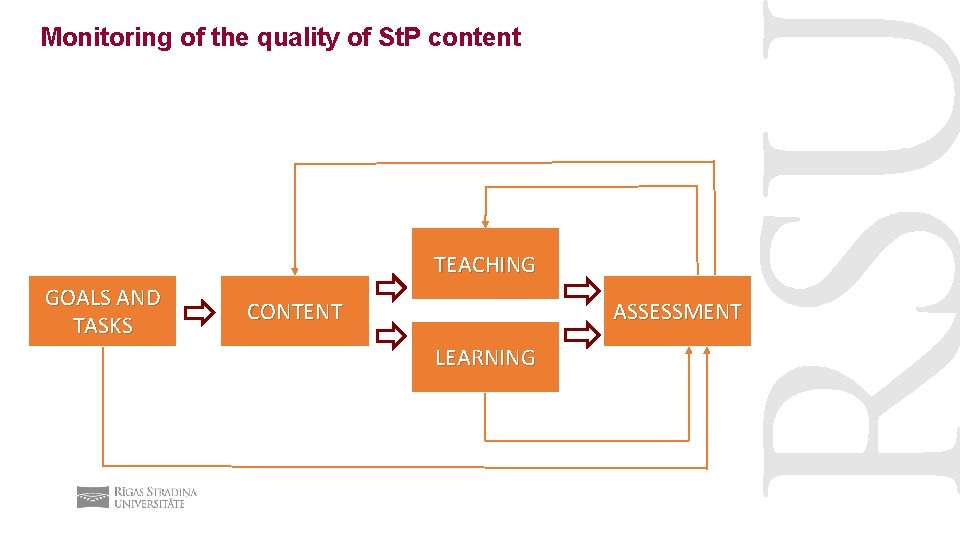
Monitoring of the quality of St. P content TEACHING GOALS AND TASKS CONTENT ASSESSMENT LEARNING
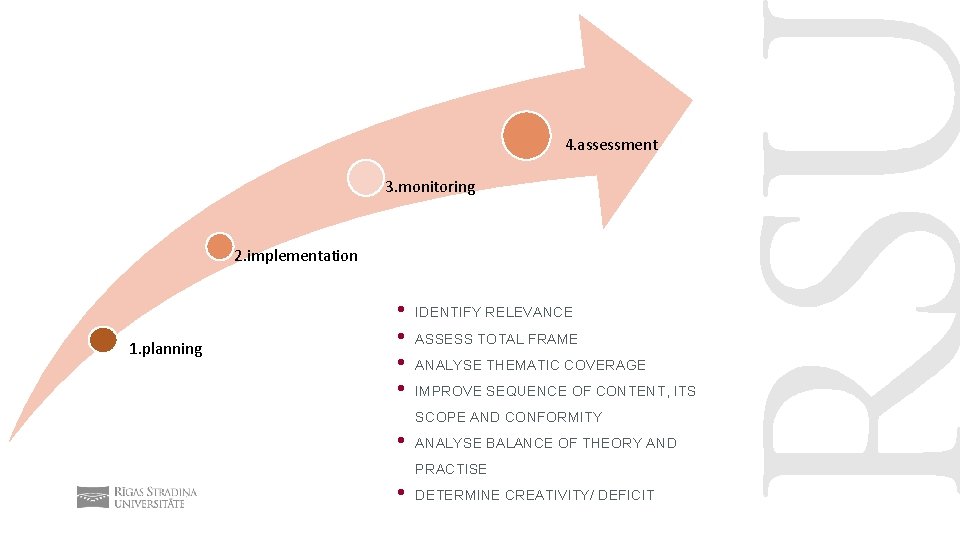
4. assessment 3. monitoring 2. implementation 1. planning • • IDENTIFY RELEVANCE ASSESS TOTAL FRAME ANALYSE THEMATIC COVERAGE IMPROVE SEQUENCE OF CONTENT, ITS SCOPE AND CONFORMITY • ANALYSE BALANCE OF THEORY AND PRACTISE • DETERMINE CREATIVITY/ DEFICIT
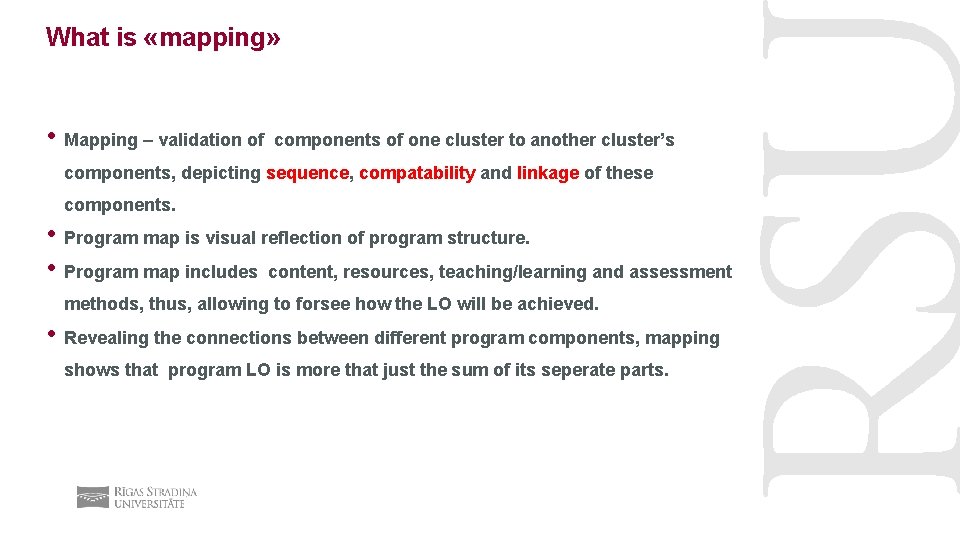
What is «mapping» • Mapping – validation of components of one cluster to another cluster’s components, depicting sequence, compatability and linkage of these components. • Program map is visual reflection of program structure. • Program map includes content, resources, teaching/learning and assessment methods, thus, allowing to forsee how the LO will be achieved. • Revealing the connections between different program components, mapping shows that program LO is more that just the sum of its seperate parts.
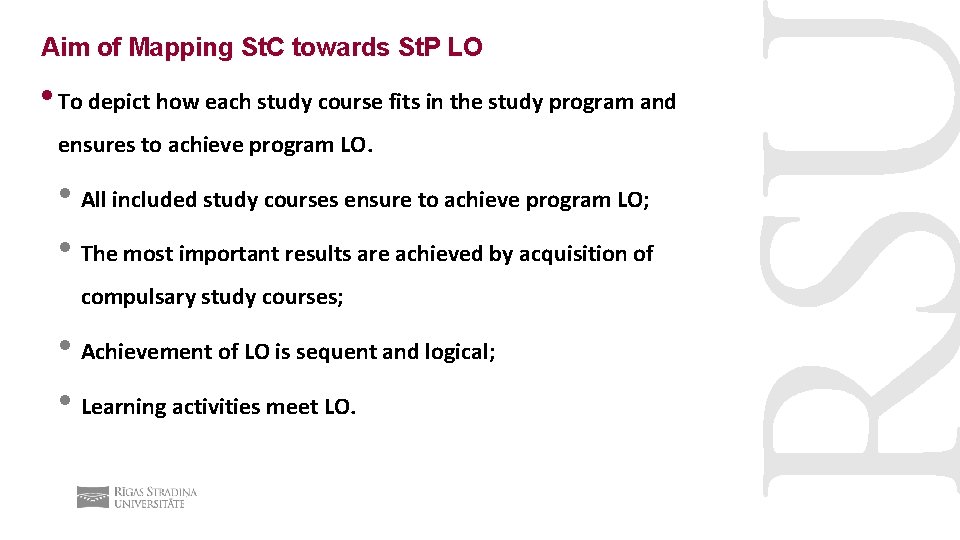
Aim of Mapping St. C towards St. P LO • To depict how each study course fits in the study program and ensures to achieve program LO. • All included study courses ensure to achieve program LO; • The most important results are achieved by acquisition of compulsary study courses; • Achievement of LO is sequent and logical; • Learning activities meet LO.
Riga Stradiņš University
Riga Stradiņš University
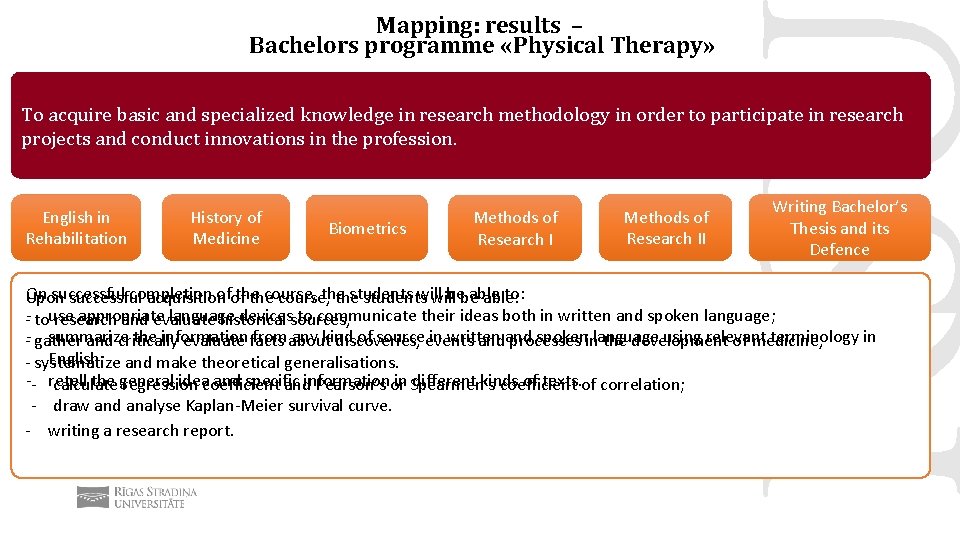
Mapping: results – Bachelors programme «Physical Therapy» To acquire basic and specialized knowledge in research methodology in order to participate in research projects and conduct innovations in the profession. English in Rehabilitation History of Medicine Biometrics Methods of Research II Writing Bachelor’s Thesis and its Defence On successful completion ofof the course, students bebe able to: As the resultin of study course student willthe be able to: will Upon successful acquisition the course, the students will able: Upon successful acquisition of the course, the students will be able Participates research and the development of physical therapy as to: a science, using the principles of evidence-based As the result of study course student will acquire basic skills in: use appropriate language devices to communicate --toformulation formulate and justify a historical research ---practice. research and sources, create and interpret scatter plotsproblem; and histograms; their ideas both in written and spoken language; ofevaluate research questions; summarize the information from any kind of main source in written spoken language using relevant terminology in --gather prepare and defend the proposal for thesis; ---Uses and critically evaluate facts about discoveries, events andand processes the development of medicine, draw a normal distribution andto calculate its parameters; different activities according thebachelor needs of society, explaining the linkinbetween occupations, health and well-being. independent scientific literature searching, English; --systematize increase skills in ascientific systematic search of the scientific literature and critical analysis ofto scientific publications in field; --Understands and of make theoretical generalisations. compute and interpret simple linear regression two variables; applies strategies for provision of between services at regional level, according health and social needs. critical review publications; retell thescientific general idea and specific in Spearmen’s different of texts. look for evidence tojustifying answer clinical questions. calculate regression coefficient andinformation Pearson’s or coefficient of correlation; taking into account the ethical ---- understanding, choosing and appropriate researchkinds design and methodology, - aspects; draw and analyse Kaplan-Meier survival curve. - writing a research report.
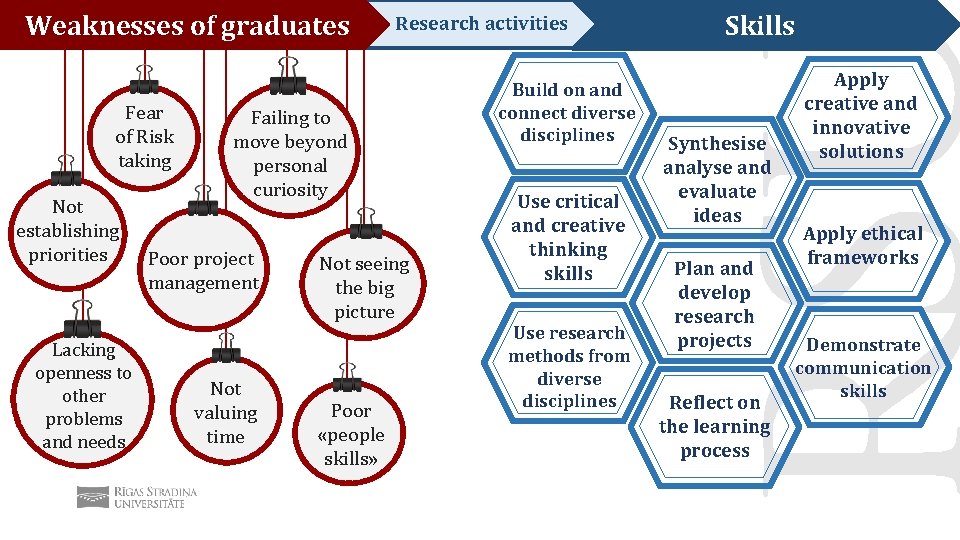
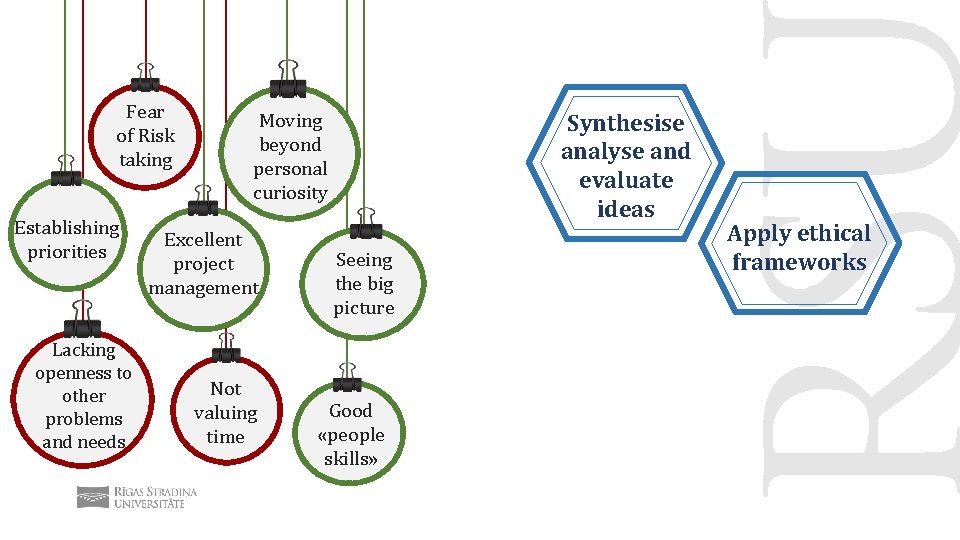
Weaknesses of graduates Fear of Risk taking Not establishing priorities Lacking openness to other problems and needs Research activities Failing to move beyond personal curiosity Poor project management Not valuing time Not seeing the big picture Poor «people skills» Build on and connect diverse disciplines Use critical and creative thinking skills Use research methods from diverse disciplines Skills Synthesise analyse and evaluate ideas Plan and develop research projects Reflect on the learning process Apply creative and innovative solutions Apply ethical frameworks Demonstrate communication skills
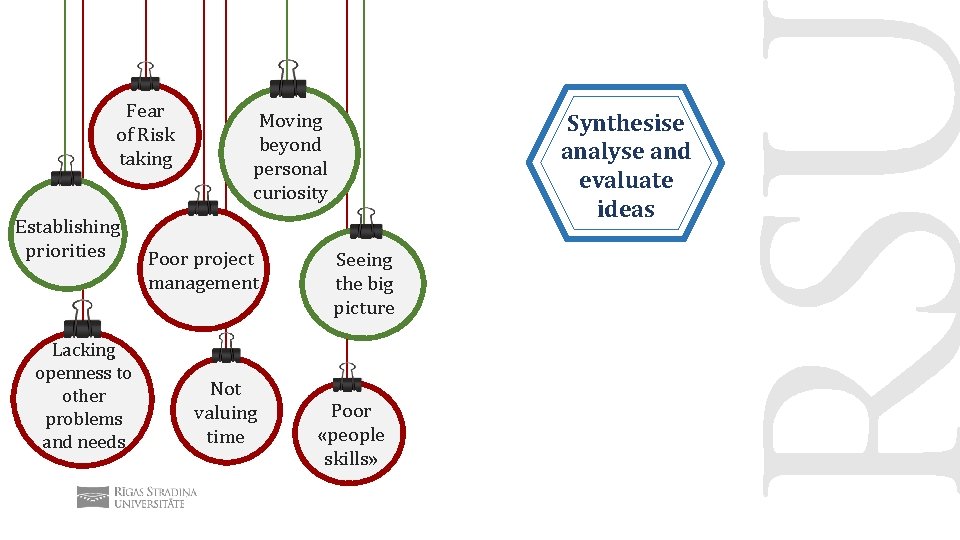
Fear of Risk taking Establishing priorities Lacking openness to other problems and needs Moving beyond personal curiosity Poor project management Not valuing time Synthesise analyse and evaluate ideas Seeing the big picture Poor «people skills»
Fear of Risk taking Establishing priorities Lacking openness to other problems and needs Moving beyond personal curiosity Excellent project management Not valuing time Synthesise analyse and evaluate ideas Seeing the big picture Good «people skills» Apply ethical frameworks
Strengths of Ph. D holders Risk taking Establishing priorities Openness to other problems and needs Moving beyond personal curiosity Excellent project management Valuing time Research activities Synthesise analyse and evaluate ideas Seeing the big picture Good «people skills» Reflect on the learning process Skills Apply ethical frameworks
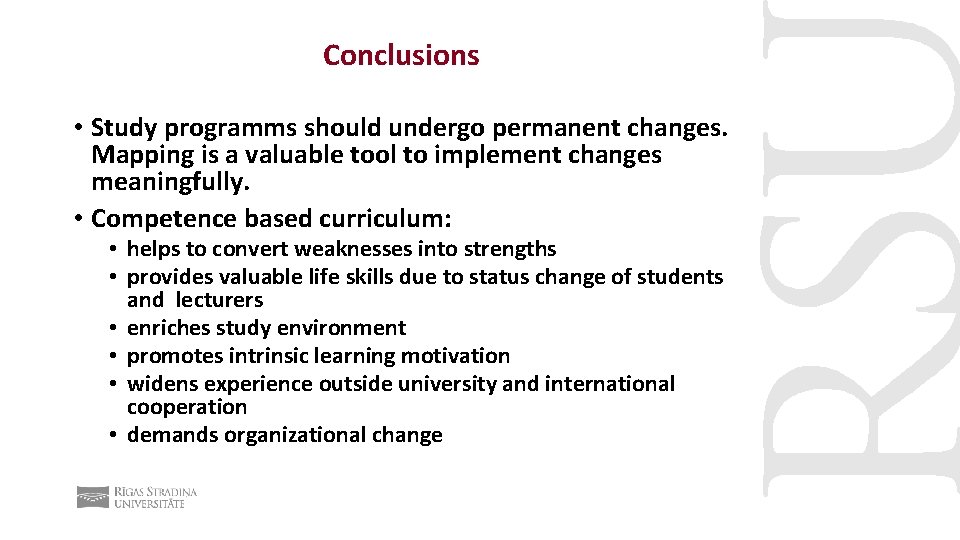
Conclusions • Study programms should undergo permanent changes. Mapping is a valuable tool to implement changes meaningfully. • Competence based curriculum: • helps to convert weaknesses into strengths • provides valuable life skills due to status change of students and lecturers • enriches study environment • promotes intrinsic learning motivation • widens experience outside university and international cooperation • demands organizational change
Thank you for your attention! www. rsu. lv