
Formulation implementation and testing of an intermediate complexity
- Slides: 1
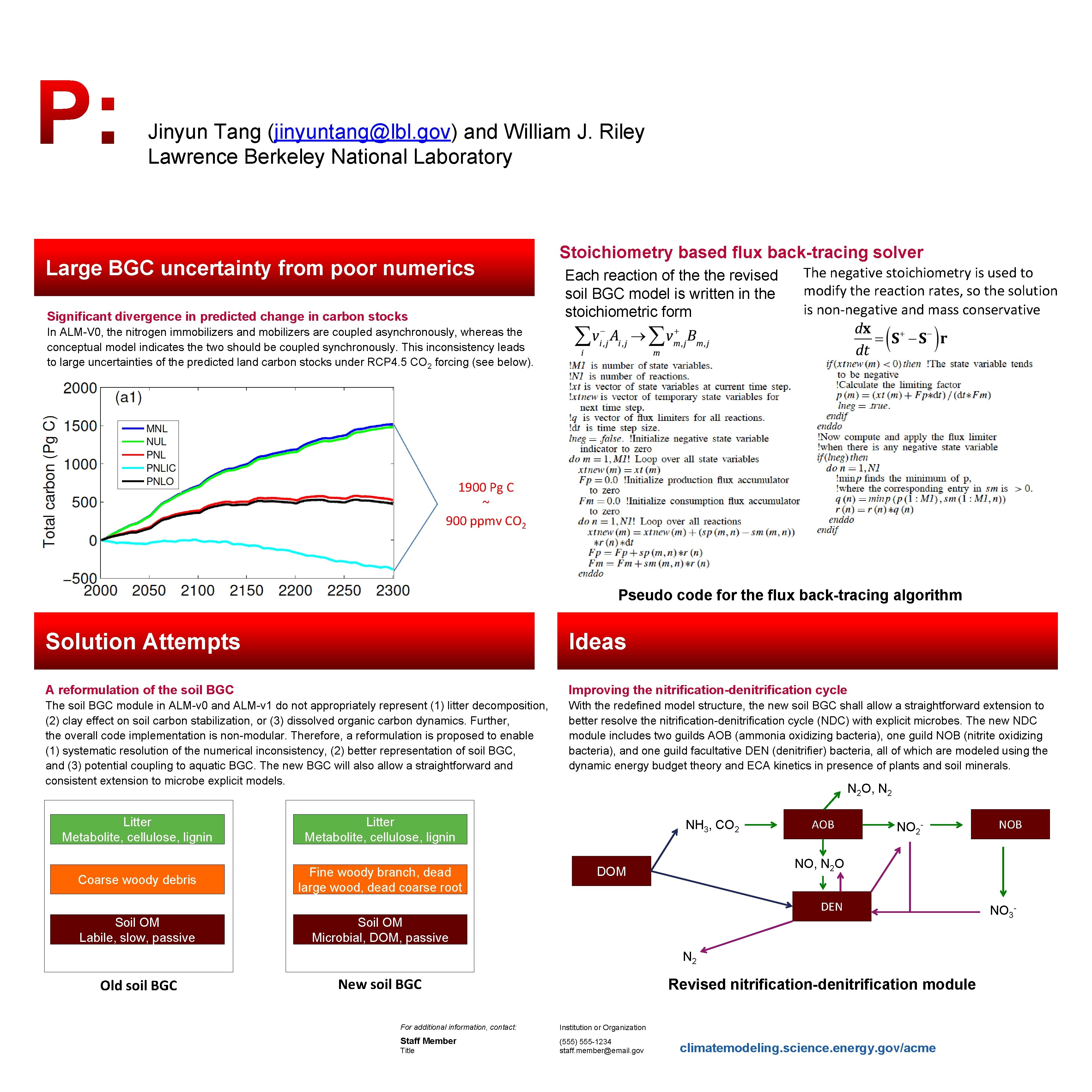
Formulation, implementation, and testing of an intermediate complexity model for robust soil biogeochemistry modeling Jinyun Tang (jinyuntang@lbl. gov) and William J. Riley Lawrence Berkeley National Laboratory Large BGC uncertainty from poor numerics Significant divergence in predicted change in carbon stocks Stoichiometry based flux back-tracing solver Each reaction of the revised soil BGC model is written in the stoichiometric form The negative stoichiometry is used to modify the reaction rates, so the solution is non-negative and mass conservative In ALM-V 0, the nitrogen immobilizers and mobilizers are coupled asynchronously, whereas the conceptual model indicates the two should be coupled synchronously. This inconsistency leads to large uncertainties of the predicted land carbon stocks under RCP 4. 5 CO 2 forcing (see below). . 1900 Pg C ~ 900 ppmv CO 2 Pseudo code for the flux back-tracing algorithm Solution Attempts Ideas A reformulation of the soil BGC Improving the nitrification-denitrification cycle The soil BGC module in ALM-v 0 and ALM-v 1 do not appropriately represent (1) litter decomposition, (2) clay effect on soil carbon stabilization, or (3) dissolved organic carbon dynamics. Further, the overall code implementation is non-modular. Therefore, a reformulation is proposed to enable (1) systematic resolution of the numerical inconsistency, (2) better representation of soil BGC, and (3) potential coupling to aquatic BGC. The new BGC will also allow a straightforward and consistent extension to microbe explicit models. With the redefined model structure, the new soil BGC shall allow a straightforward extension to better resolve the nitrification-denitrification cycle (NDC) with explicit microbes. The new NDC module includes two guilds AOB (ammonia oxidizing bacteria), one guild NOB (nitrite oxidizing bacteria), and one guild facultative DEN (denitrifier) bacteria, all of which are modeled using the dynamic energy budget theory and ECA kinetics in presence of plants and soil minerals. Litter Metabolite, cellulose, lignin Coarse woody debris N 2 O, N 2 Litter Metabolite, cellulose, lignin Fine woody branch, dead large wood, dead coarse root NH 3, CO 2 AOB NO 2 - NO, N 2 O DOM DEN Soil OM Labile, slow, passive Soil OM Microbial, DOM, passive N 2 Old soil BGC New soil BGC Revised nitrification-denitrification module For additional information, contact: Institution or Organization Staff Member (555) 555 -1234 staff. member@email. gov Title NOB climatemodeling. science. energy. gov/acme NO 3 -