
Formulation and Enhancement of the Development Administration System

- Slides: 24
Formulation and Enhancement of the Development Administration System in East Asia: -- Thailand, Malaysia and the Philippines -- Policy Formulation in Developing Countries GRIPS Development Forum
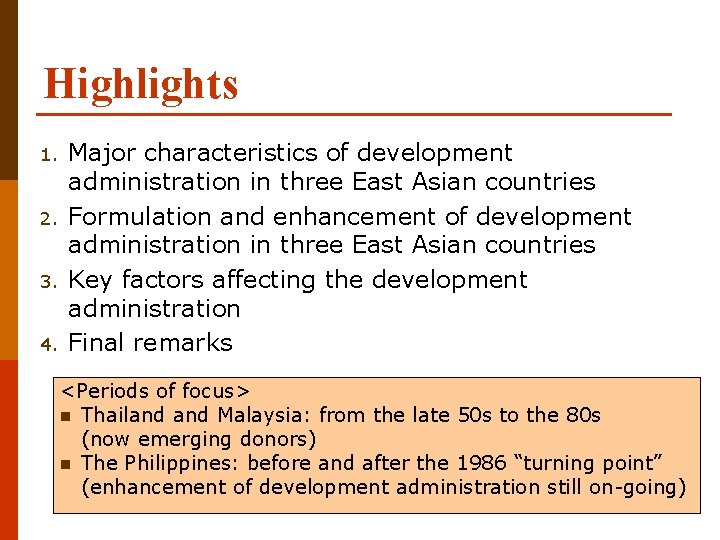
Highlights 1. 2. 3. 4. Major characteristics of development administration in three East Asian countries Formulation and enhancement of development administration in three East Asian countries Key factors affecting the development administration Final remarks <Periods of focus> n Thailand Malaysia: from the late 50 s to the 80 s (now emerging donors) n The Philippines: before and after the 1986 “turning point” (enhancement of development administration still on-going)
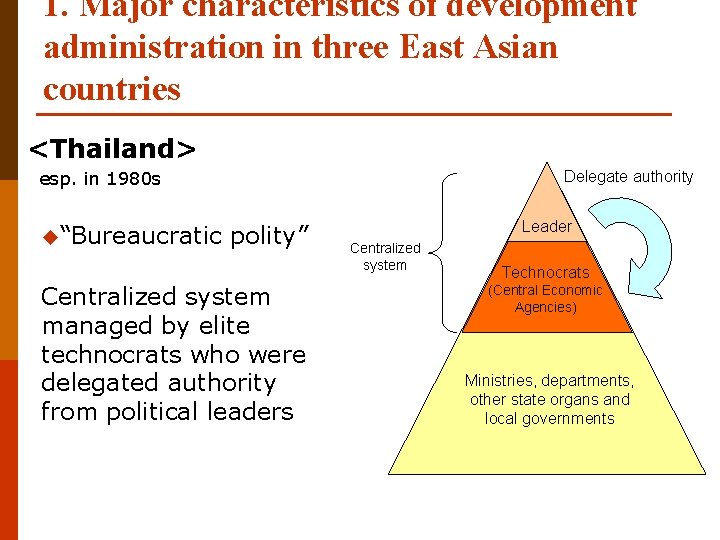
1. Major characteristics of development administration in three East Asian countries <Thailand> esp. in 1980 s u“Bureaucratic polity” Centralized system managed by elite technocrats who were delegated authority from political leaders Delegate authority Leader Centralized system Technocrats (Central Economic Agencies) Ministries, departments, other state organs and local governments
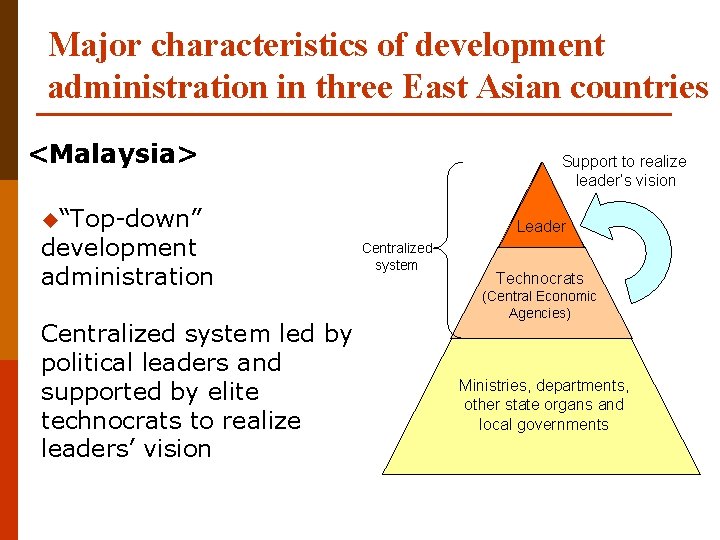
Major characteristics of development administration in three East Asian countries <Malaysia> Support to realize leader’s vision u“Top-down” development administration Centralized system led by political leaders and supported by elite technocrats to realize leaders’ vision Leader Centralized system Technocrats (Central Economic Agencies) Ministries, departments, other state organs and local governments
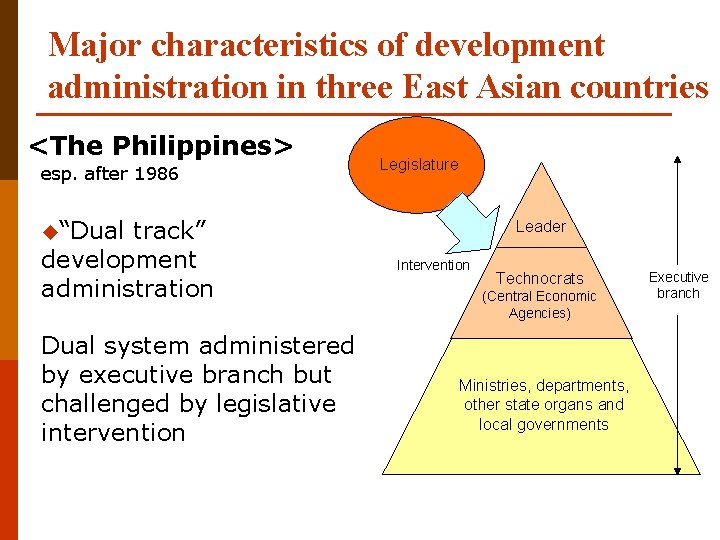
Major characteristics of development administration in three East Asian countries <The Philippines> esp. after 1986 Legislature u“Dual track” development administration Dual system administered by executive branch but challenged by legislative intervention Leader Intervention Technocrats (Central Economic Agencies) Ministries, departments, other state organs and local governments Executive branch
Chronological Outline of the Development Plans and Political Leaders of Thailand, Malaysia, and the Philippines Source: Author
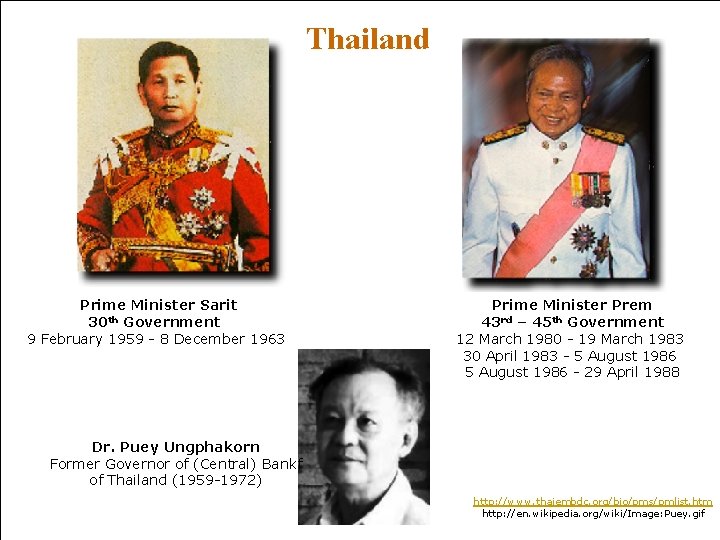
Thailand Prime Minister Sarit 30 th Government 9 February 1959 - 8 December 1963 Prime Minister Prem 43 rd – 45 th Government 12 March 1980 - 19 March 1983 30 April 1983 - 5 August 1986 - 29 April 1988 Dr. Puey Ungphakorn Former Governor of (Central) Bankf of Thailand (1959 -1972) http: //www. thaiembdc. org/bio/pms/pmlist. htm http: //en. wikipedia. org/wiki/Image: Puey. gif
Malaysia Prime Minister Rahman 1 st Prime Minister 31 August 1957 – 22 September Prime Minister Razak 2 nd Prime Minister 22 September 1970 – 14 January 1976 Prime Minister Mahathir 4 th Prime Minister 16 July 1981 – 31 October 2003 http: //ms. wikipedia. org/wiki/Tunku_Abdul_Rahman http: //en. wikipedia. org/wiki/Abdul_Razak http: //ms. wikipedia. org/wiki/Mahathir_bin_Mohamad
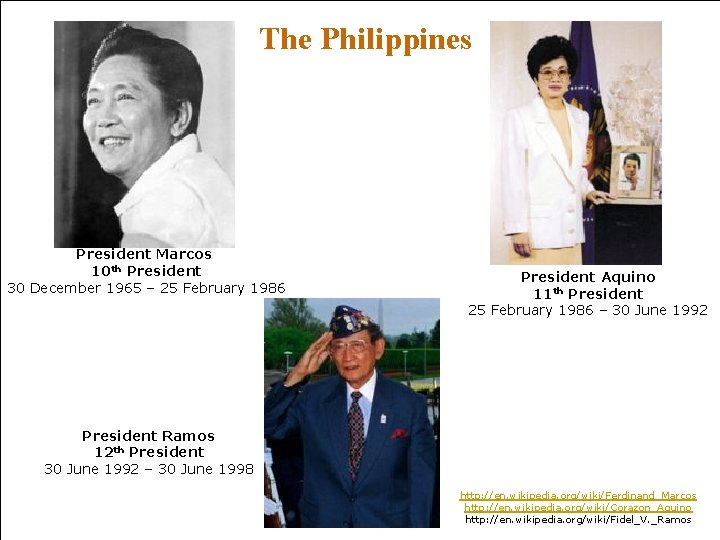
The Philippines President Marcos 10 th President 30 December 1965 – 25 February 1986 President Aquino 11 th President 25 February 1986 – 30 June 1992 President Ramos 12 th President 30 June 1992 – 30 June 1998 http: //en. wikipedia. org/wiki/Ferdinand_Marcos http: //en. wikipedia. org/wiki/Corazon_Aquino http: //en. wikipedia. org/wiki/Fidel_V. _Ramos
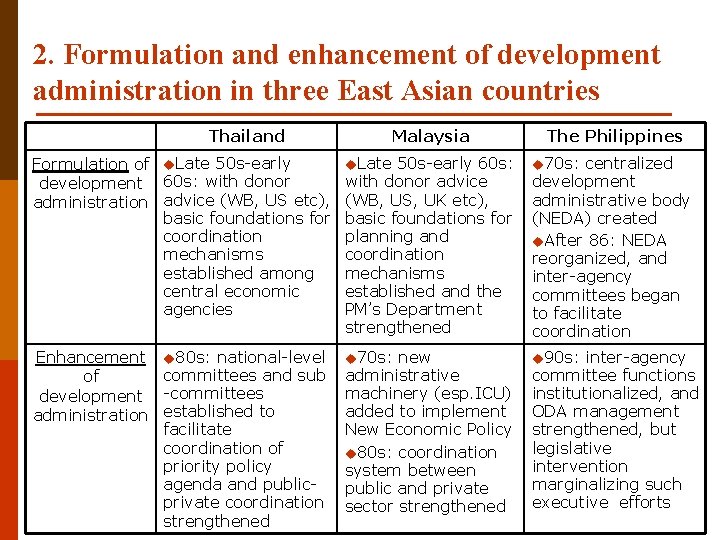
2. Formulation and enhancement of development administration in three East Asian countries Thailand Malaysia The Philippines Formulation of u. Late 50 s-early development 60 s: with donor administration advice (WB, US etc), basic foundations for coordination mechanisms established among central economic agencies u. Late 50 s-early 60 s: u 70 s: centralized with donor advice (WB, US, UK etc), basic foundations for planning and coordination mechanisms established and the PM’s Department strengthened development administrative body (NEDA) created u. After 86: NEDA reorganized, and inter-agency committees began to facilitate coordination Enhancement u 80 s: national-level committees and sub of development -committees administration established to facilitate coordination of priority policy agenda and publicprivate coordination strengthened u 70 s: new u 90 s: inter-agency administrative machinery (esp. ICU) added to implement New Economic Policy u 80 s: coordination system between public and private sector strengthened committee functions institutionalized, and ODA management strengthened, but legislative intervention marginalizing such executive efforts
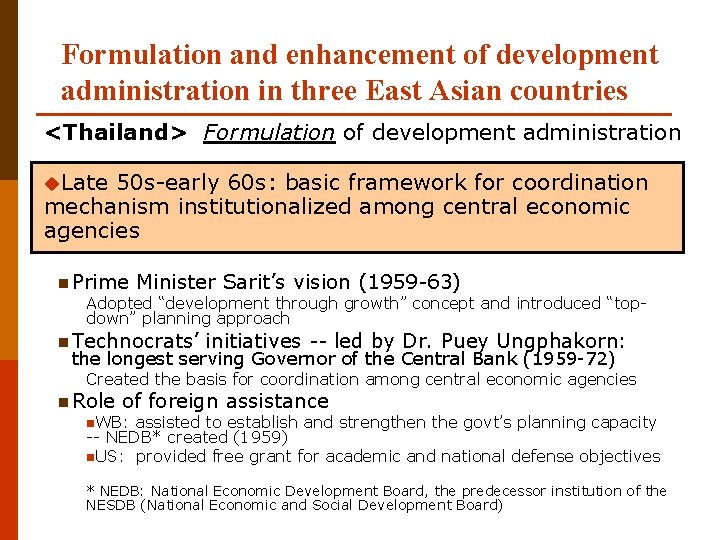
Formulation and enhancement of development administration in three East Asian countries <Thailand> Formulation of development administration u. Late 50 s-early 60 s: basic framework for coordination mechanism institutionalized among central economic agencies n Prime Minister Sarit’s vision (1959 -63) Adopted “development through growth” concept and introduced “topdown” planning approach n Technocrats’ initiatives -- led by Dr. Puey Ungphakorn: the longest serving Governor of the Central Bank (1959 -72) Created the basis for coordination among central economic agencies n Role of foreign assistance n. WB: assisted to establish and strengthen the govt’s planning capacity -- NEDB* created (1959) n. US: provided free grant for academic and national defense objectives * NEDB: National Economic Development Board, the predecessor institution of the NESDB (National Economic and Social Development Board)
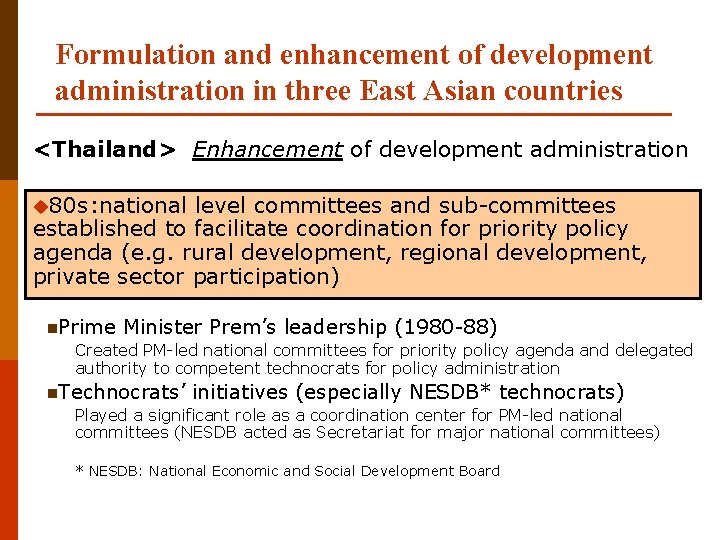
Formulation and enhancement of development administration in three East Asian countries <Thailand> Enhancement of development administration u 80 s: national level committees and sub-committees established to facilitate coordination for priority policy agenda (e. g. rural development, regional development, private sector participation) n. Prime Minister Prem’s leadership (1980 -88) Created PM-led national committees for priority policy agenda and delegated authority to competent technocrats for policy administration n. Technocrats’ initiatives (especially NESDB* technocrats) Played a significant role as a coordination center for PM-led national committees (NESDB acted as Secretariat for major national committees) * NESDB: National Economic and Social Development Board
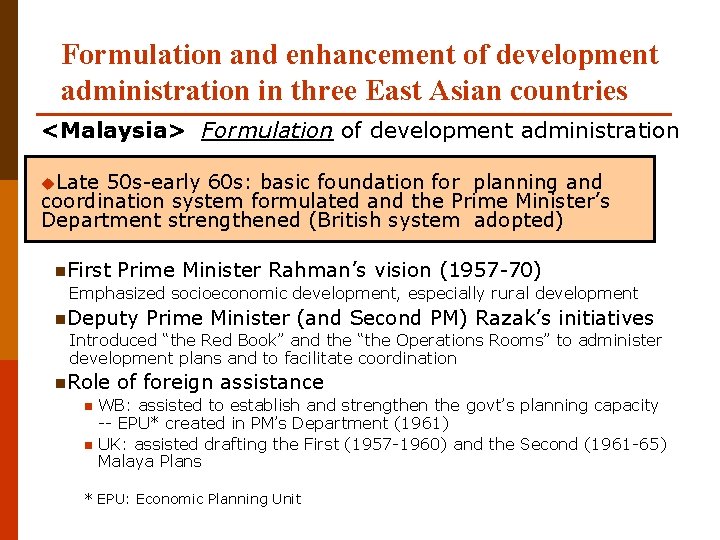
Formulation and enhancement of development administration in three East Asian countries <Malaysia> Formulation of development administration u. Late 50 s-early 60 s: basic foundation for planning and coordination system formulated and the Prime Minister’s Department strengthened (British system adopted) n. First Prime Minister Rahman’s vision (1957 -70) Emphasized socioeconomic development, especially rural development n. Deputy Prime Minister (and Second PM) Razak’s initiatives Introduced “the Red Book” and the “the Operations Rooms” to administer development plans and to facilitate coordination n. Role of foreign assistance n WB: assisted to establish and strengthen the govt’s planning capacity -- EPU* created in PM’s Department (1961) n UK: assisted drafting the First (1957 -1960) and the Second (1961 -65) Malaya Plans * EPU: Economic Planning Unit
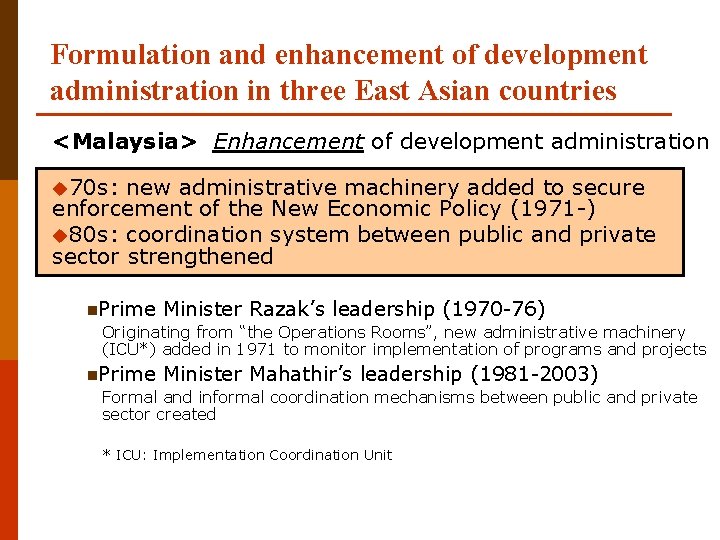
Formulation and enhancement of development administration in three East Asian countries <Malaysia> Enhancement of development administration u 70 s: new administrative machinery added to secure enforcement of the New Economic Policy (1971 -) u 80 s: coordination system between public and private sector strengthened n. Prime Minister Razak’s leadership (1970 -76) Originating from “the Operations Rooms”, new administrative machinery (ICU*) added in 1971 to monitor implementation of programs and projects n. Prime Minister Mahathir’s leadership (1981 -2003) Formal and informal coordination mechanisms between public and private sector created * ICU: Implementation Coordination Unit
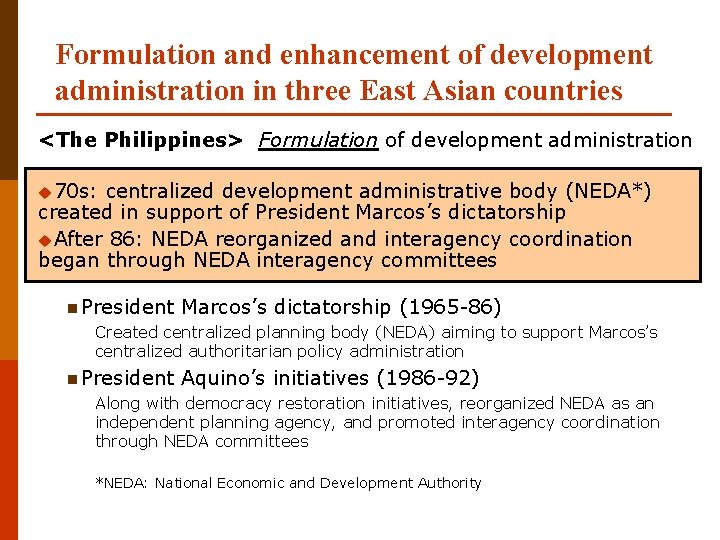
Formulation and enhancement of development administration in three East Asian countries <The Philippines> Formulation of development administration u 70 s: centralized development administrative body (NEDA*) created in support of President Marcos’s dictatorship u. After 86: NEDA reorganized and interagency coordination began through NEDA interagency committees n President Marcos’s dictatorship (1965 -86) Created centralized planning body (NEDA) aiming to support Marcos’s centralized authoritarian policy administration n President Aquino’s initiatives (1986 -92) Along with democracy restoration initiatives, reorganized NEDA as an independent planning agency, and promoted interagency coordination through NEDA committees *NEDA: National Economic and Development Authority
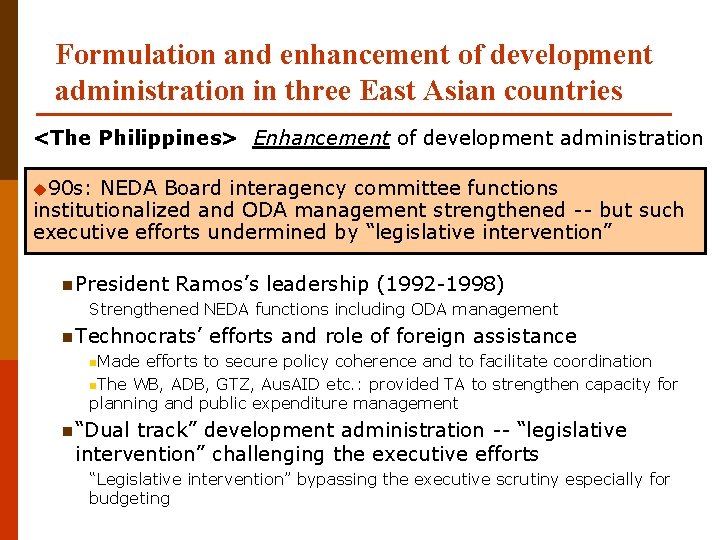
Formulation and enhancement of development administration in three East Asian countries <The Philippines> Enhancement of development administration u 90 s: NEDA Board interagency committee functions institutionalized and ODA management strengthened -- but such executive efforts undermined by “legislative intervention” n President Ramos’s leadership (1992 -1998) Strengthened NEDA functions including ODA management n Technocrats’ efforts and role of foreign assistance n. Made efforts to secure policy coherence and to facilitate coordination n. The WB, ADB, GTZ, Aus. AID etc. : provided TA to strengthen capacity for planning and public expenditure management n “Dual track” development administration -- “legislative intervention” challenging the executive efforts “Legislative intervention” bypassing the executive scrutiny especially for budgeting
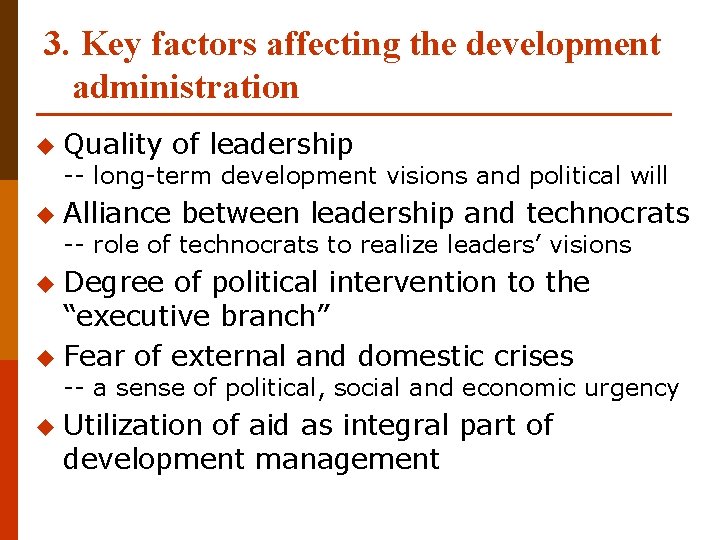
3. Key factors affecting the development administration u Quality of leadership -- long-term development visions and political will u Alliance between leadership and technocrats -- role of technocrats to realize leaders’ visions Degree of political intervention to the “executive branch” u Fear of external and domestic crises u -- a sense of political, social and economic urgency u Utilization of aid as integral part of development management
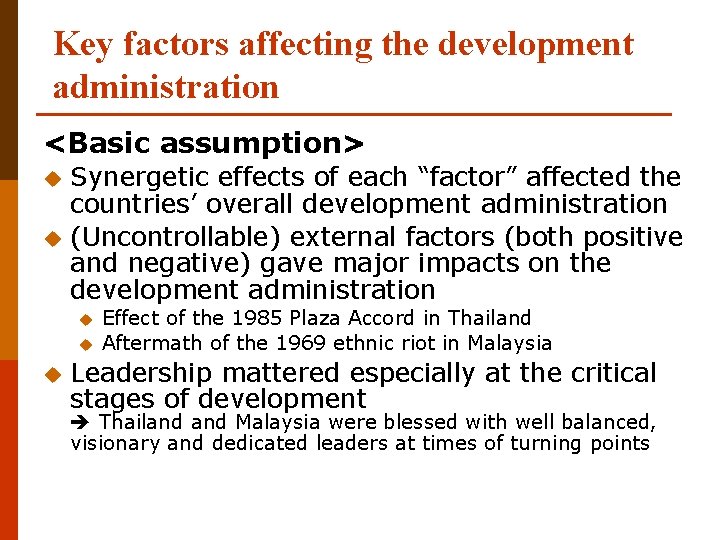
Key factors affecting the development administration <Basic assumption> u u Synergetic effects of each “factor” affected the countries’ overall development administration (Uncontrollable) external factors (both positive and negative) gave major impacts on the development administration u u u Effect of the 1985 Plaza Accord in Thailand Aftermath of the 1969 ethnic riot in Malaysia Leadership mattered especially at the critical stages of development Thailand Malaysia were blessed with well balanced, visionary and dedicated leaders at times of turning points
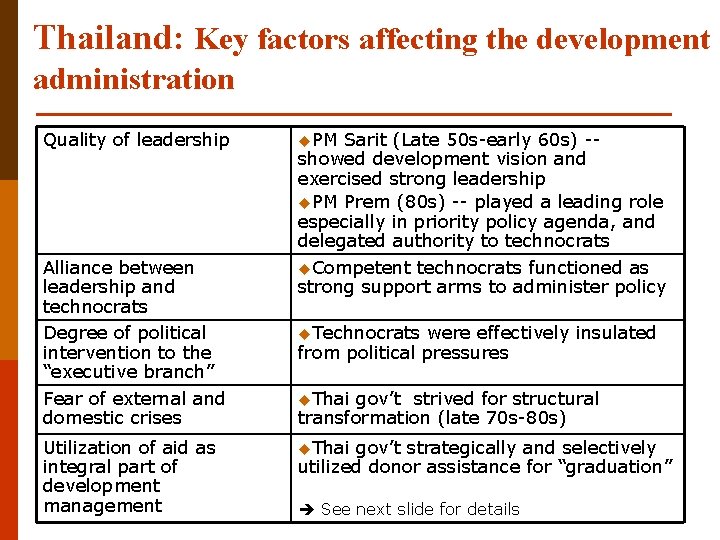
Thailand: Key factors affecting the development administration Quality of leadership Alliance between leadership and technocrats Degree of political intervention to the “executive branch” Fear of external and domestic crises Utilization of aid as integral part of development management u. PM Sarit (Late 50 s-early 60 s) -- showed development vision and exercised strong leadership u. PM Prem (80 s) -- played a leading role especially in priority policy agenda, and delegated authority to technocrats u. Competent technocrats functioned as strong support arms to administer policy u. Technocrats were effectively insulated from political pressures u. Thai gov’t strived for structural transformation (late 70 s-80 s) u. Thai gov’t strategically and selectively utilized donor assistance for “graduation” See next slide for details
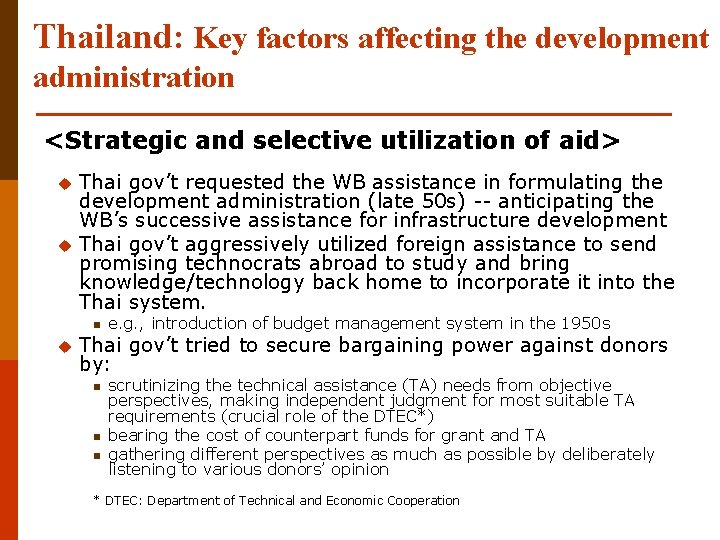
Thailand: Key factors affecting the development administration <Strategic and selective utilization of aid> Thai gov’t requested the WB assistance in formulating the development administration (late 50 s) -- anticipating the WB’s successive assistance for infrastructure development u Thai gov’t aggressively utilized foreign assistance to send promising technocrats abroad to study and bring knowledge/technology back home to incorporate it into the Thai system. u n u e. g. , introduction of budget management system in the 1950 s Thai gov’t tried to secure bargaining power against donors by: n n n scrutinizing the technical assistance (TA) needs from objective perspectives, making independent judgment for most suitable TA requirements (crucial role of the DTEC*) bearing the cost of counterpart funds for grant and TA gathering different perspectives as much as possible by deliberately listening to various donors’ opinion * DTEC: Department of Technical and Economic Cooperation
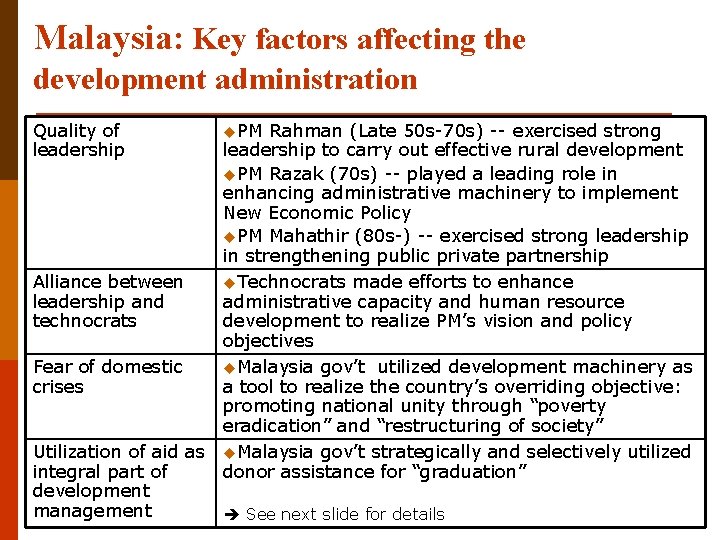
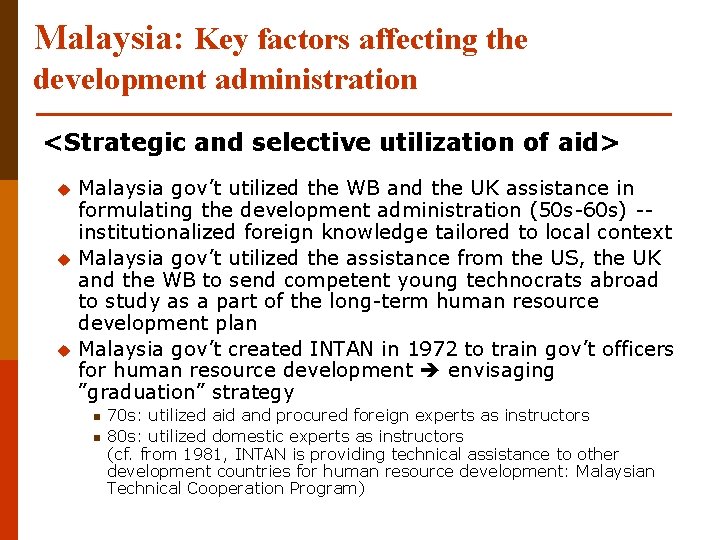
Malaysia: Key factors affecting the development administration Quality of leadership u. PM Rahman (Late 50 s-70 s) -- exercised strong leadership to carry out effective rural development u. PM Razak (70 s) -- played a leading role in enhancing administrative machinery to implement New Economic Policy u. PM Mahathir (80 s-) -- exercised strong leadership in strengthening public private partnership Alliance between u. Technocrats made efforts to enhance leadership and administrative capacity and human resource technocrats development to realize PM’s vision and policy objectives Fear of domestic u. Malaysia gov’t utilized development machinery as crises a tool to realize the country’s overriding objective: promoting national unity through “poverty eradication” and “restructuring of society” Utilization of aid as u. Malaysia gov’t strategically and selectively utilized integral part of donor assistance for “graduation” development management See next slide for details
Malaysia: Key factors affecting the development administration <Strategic and selective utilization of aid> Malaysia gov’t utilized the WB and the UK assistance in formulating the development administration (50 s-60 s) -- institutionalized foreign knowledge tailored to local context u Malaysia gov’t utilized the assistance from the US, the UK and the WB to send competent young technocrats abroad to study as a part of the long-term human resource development plan u Malaysia gov’t created INTAN in 1972 to train gov’t officers for human resource development envisaging ”graduation” strategy u n n 70 s: utilized aid and procured foreign experts as instructors 80 s: utilized domestic experts as instructors (cf. from 1981, INTAN is providing technical assistance to other development countries for human resource development: Malaysian Technical Cooperation Program)
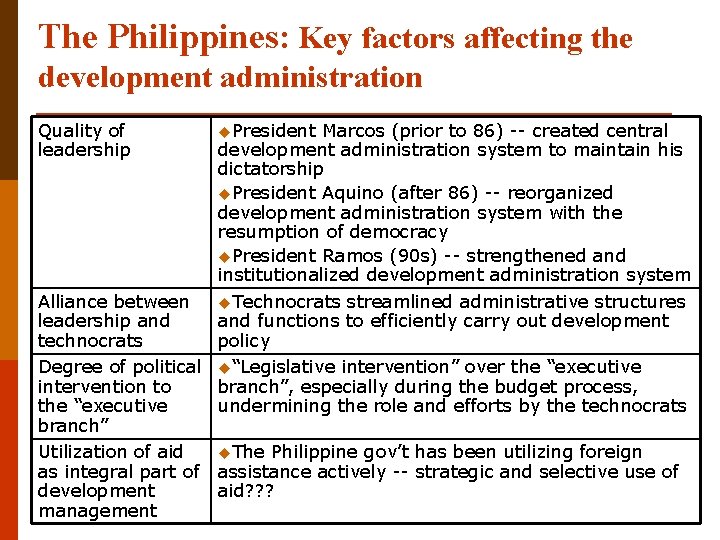
The Philippines: Key factors affecting the development administration Quality of leadership u. President Marcos (prior to 86) -- created central development administration system to maintain his dictatorship u. President Aquino (after 86) -- reorganized development administration system with the resumption of democracy u. President Ramos (90 s) -- strengthened and institutionalized development administration system Alliance between u. Technocrats streamlined administrative structures leadership and functions to efficiently carry out development technocrats policy Degree of political u“Legislative intervention” over the “executive intervention to branch”, especially during the budget process, the “executive undermining the role and efforts by the technocrats branch” Utilization of aid u. The Philippine gov’t has been utilizing foreign as integral part of assistance actively -- strategic and selective use of development aid? ? ? management
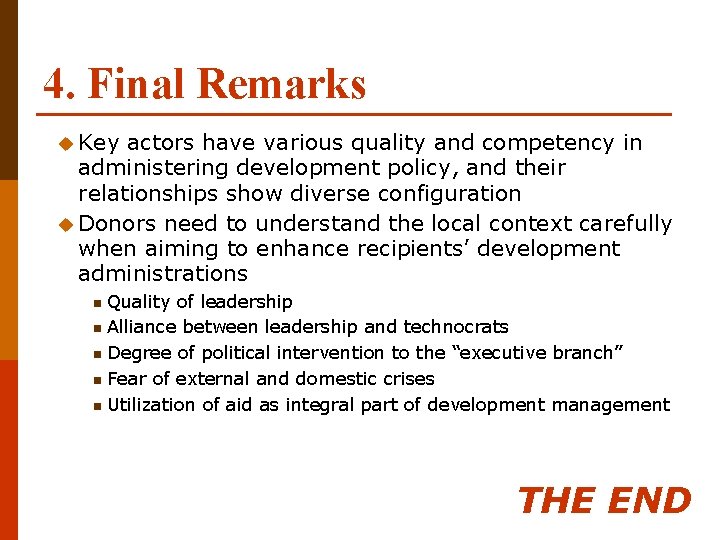
4. Final Remarks u Key actors have various quality and competency in administering development policy, and their relationships show diverse configuration u Donors need to understand the local context carefully when aiming to enhance recipients’ development administrations Quality of leadership n Alliance between leadership and technocrats n Degree of political intervention to the “executive branch” n Fear of external and domestic crises n Utilization of aid as integral part of development management n THE END