
Formulating the Systems Engineering Concept Model SECM Part
- Slides: 12
Formulating the Systems Engineering Concept Model (SECM) Part 1: Approach Presenting: Charles Galey Christopher Delp Robert Karban Maged Elasar 10/20/2021
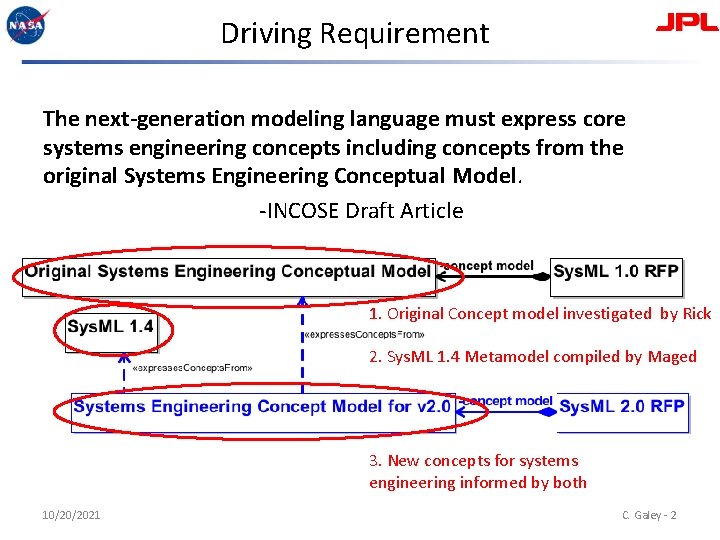
Driving Requirement The next-generation modeling language must express core systems engineering concepts including concepts from the original Systems Engineering Conceptual Model. -INCOSE Draft Article 1. Original Concept model investigated by Rick 2. Sys. ML 1. 4 Metamodel compiled by Maged 3. New concepts for systems engineering informed by both 10/20/2021 C. Galey - 2
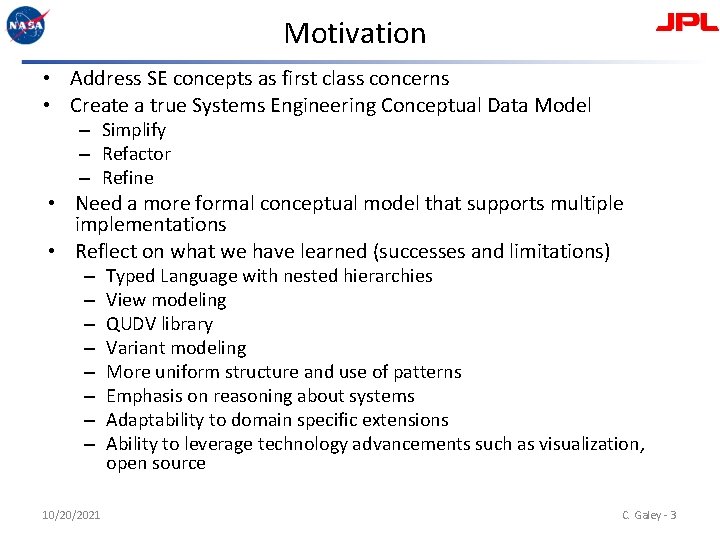
Motivation • Address SE concepts as first class concerns • Create a true Systems Engineering Conceptual Data Model – Simplify – Refactor – Refine • Need a more formal conceptual model that supports multiple implementations • Reflect on what we have learned (successes and limitations) – – – – 10/20/2021 Typed Language with nested hierarchies View modeling QUDV library Variant modeling More uniform structure and use of patterns Emphasis on reasoning about systems Adaptability to domain specific extensions Ability to leverage technology advancements such as visualization, open source C. Galey - 3
APPROACH 10/20/2021 C. Galey - 4
Goals • Develop a formal conceptual model that supports multiple implementations – Requirements not implementation – Implementations will come via responses to the Sys. ML v 2 RFP • Measure our success against the original Systems Engineering Concept Model and Sys. ML 1. 4 10/20/2021 5
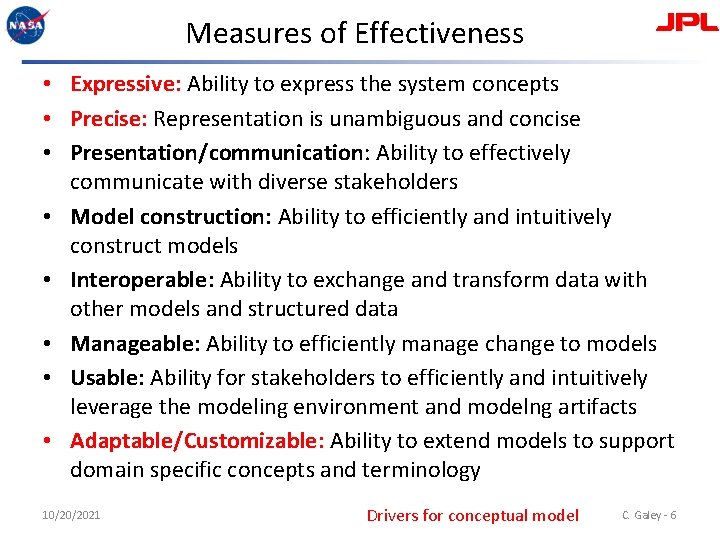
Measures of Effectiveness • Expressive: Ability to express the system concepts • Precise: Representation is unambiguous and concise • Presentation/communication: Ability to effectively communicate with diverse stakeholders • Model construction: Ability to efficiently and intuitively construct models • Interoperable: Ability to exchange and transform data with other models and structured data • Manageable: Ability to efficiently manage change to models • Usable: Ability for stakeholders to efficiently and intuitively leverage the modeling environment and modelng artifacts • Adaptable/Customizable: Ability to extend models to support domain specific concepts and terminology 10/20/2021 Drivers for conceptual model C. Galey - 6
ARCHITECTURE 10/20/2021 7
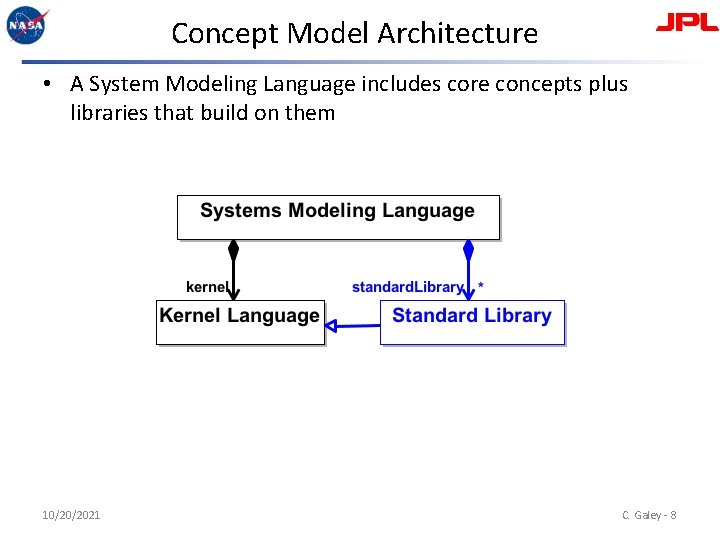
Concept Model Architecture • A System Modeling Language includes core concepts plus libraries that build on them Diagram this 10/20/2021 C. Galey - 8
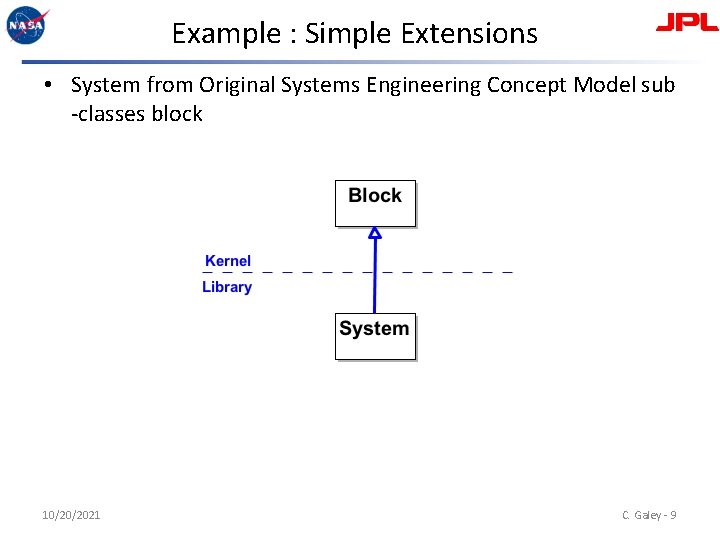
Example : Simple Extensions • System from Original Systems Engineering Concept Model sub -classes block Diagram these 10/20/2021 C. Galey - 9
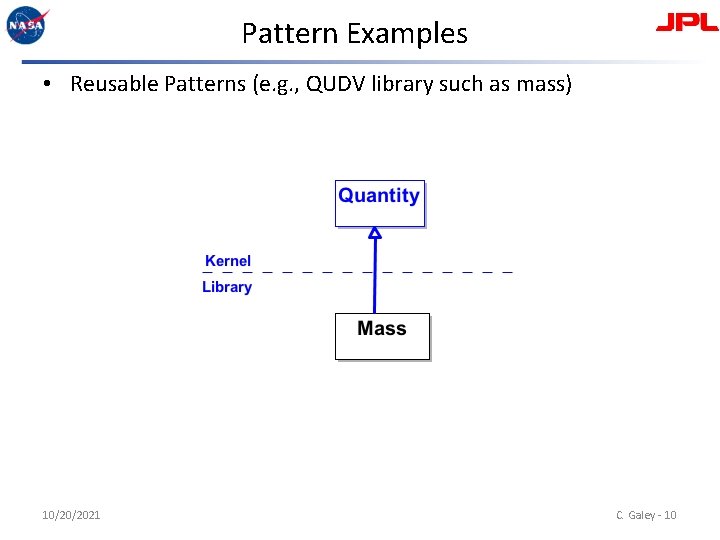
Pattern Examples • Reusable Patterns (e. g. , QUDV library such as mass) 10/20/2021 C. Galey - 10
Plan Going Forward • Incremental Development and Review – – Modeling in Magic Draw with XMI files HTML version Documenting discussion, issues and decisions/resolutions Open issues maintained in TBD (JIRA/Excel? ) • All material is baselined and posted to the Roadmap Wiki Page for SECM 10/20/2021 C. Galey - 11
Next Steps… • Respond to feedback • Setup Wiki for SE Concept Model v 2 • Upcoming Presentations – Intro to Core Concepts (TBD) – Core Concepts Continued (TBD) – Libraries (TBD) 10/20/2021 C. Galey - 12