
Formulating the Research Design In this topic we




- Slides: 17
Formulating the Research Design • In this topic we have discussed about various research strategies, for example; Action Research which focuses on close collaboration between researcher and practitioner. Grounded Theory which focuses on Collection of data starts without the formation of an initial theoretical framework. Ethnographic research helps in interpreting the social world the research subjects lives in and their own way of interpreting it.
Formulating the Research Design • Also we have discussed briefly about naturalism which means that researcher will be researching the phenomenon within the context in which it occurs. • Time Horizon is another important aspect which we have discussed for example; cross section or longitudinal. • Credibility of research findings is another important aspect which must consider the following; Reliability; Validity; Generalisability; Logic hurdles and false assumptions
Research Design Ethics The research design should not subject the Research population to embarrassment Harm them and/or Lead to other material disadvantages
Theoretical Framework & Hypothesis Development Lecture 10 th
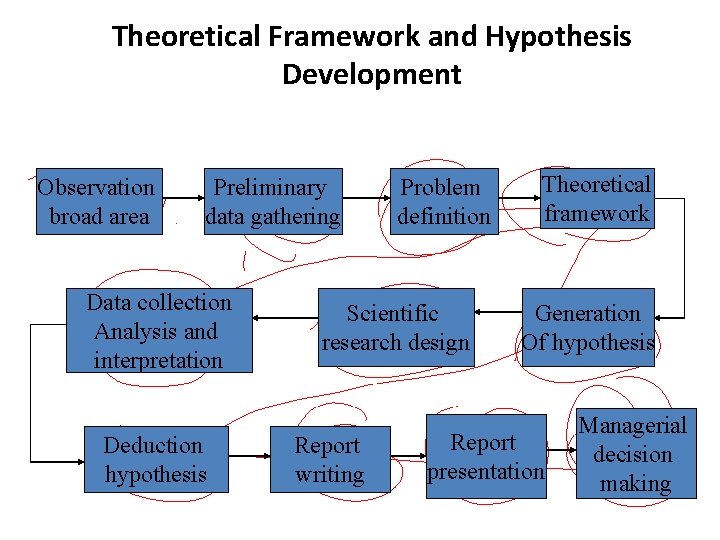
Theoretical Framework and Hypothesis Development Observation broad area Preliminary data gathering Data collection Analysis and interpretation Deduction hypothesis Problem definition Scientific research design Report writing Theoretical framework Generation Of hypothesis Report presentation Managerial decision making
Theoretical Framework: What and Why? • Basis of entire research. • Helps in building and identifying logical sense of the relationship among the several factors that are important to the problem. • Integrating logical beliefs with published research.
Theoretical Framework: What and Why? • It helps in developing a scientific basis for investigating the research problem. • Helps in testing certain relationships to improve our understanding of the situation. • Testable hypothesis can be developed
Theoretical Framework: What and Why? • First identify the problem and then, identify the variables that contribute to it. • Literature survey provides a solid foundation for developing a theoretical/conceptual framework. • The theoretical framework elaborates the relationships among the variables, explain theory underlying these relations and describes the nature and direction of the relationships.
Theoretical Framework: What and Why? • Clarity, identification and labeling (relevance) the variables of study • The important relationships among the variables must be defined. • Give clear explanation of the existing relationships of different variables.
Theoretical Framework: What and Why? • Get the direction of the relationships on the basis of previous research findings. (Literature Review ) • The arguments could be drawn from the previous research findings. (Literature Review )
Variables • There are changeable values of any thing. (e. g. exam score) Types of variables: • Dependent • Independent • Moderate • Intervening
Dependent variables • It is the variable of primary interest. • It is the main variable. • Researcher gives importance to understand describe the dependant variable. • Finding those variables which influence it. • Quantifying and measuring the dependent variable and the influence of other variables (e. g checking loyalty of employees).
Independent variable • It is that variable which influences the dependent variable. Moderating Variable • It is that variables which modifies the original relationship between the independent and the dependent variables.
Moderating Variables Quality Of products Independent variable Customer satisfaction Dependent variable Training oderating variable
Intervening variable • It is the impact on the dependent variable caused by the independent variables influence the same. Quality of products Independent Variable variable Awareness Intervening Variable Customer satisfaction Dependent
Definition: Hypothesis • It is an statement logically formed an opinion on the basis of relationships between two or more variables. • An opinion is made on the basis of theoretical network. For example; • Customer oriented companies can make more business than production oriented companies.
Hypothesis Development • Once identify the important variables then establish the relationships among them through logical reasoning in theoretical framework. • Test the relationships validity. • Get some reliable information about the existing relationship. • Get some test results and ideas to solve the problem.