
FORMULATING EFFECTIVE ARGUMENTS OUTCOME 3 TO CRAFT PERSUASIVE


- Slides: 29
FORMULATING EFFECTIVE ARGUMENTS
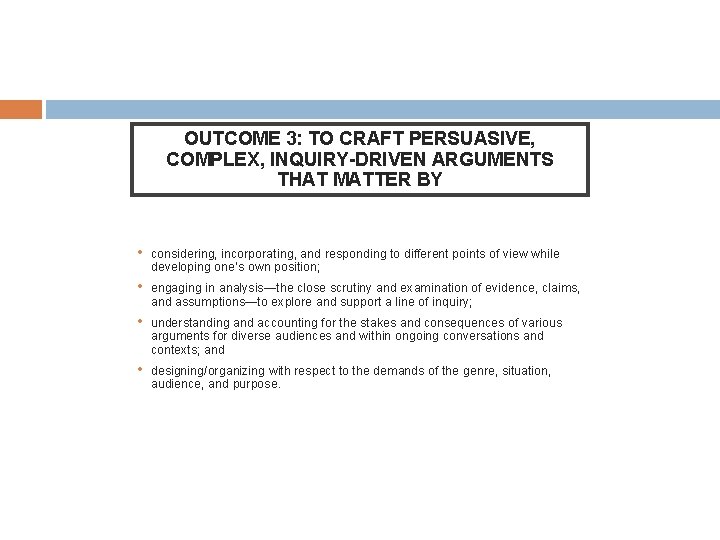
OUTCOME 3: TO CRAFT PERSUASIVE, COMPLEX, INQUIRY-DRIVEN ARGUMENTS THAT MATTER BY • considering, incorporating, and responding to different points of view while developing one’s own position; • engaging in analysis—the close scrutiny and examination of evidence, claims, and assumptions—to explore and support a line of inquiry; • understanding and accounting for the stakes and consequences of various arguments for diverse audiences and within ongoing conversations and contexts; and • designing/organizing with respect to the demands of the genre, situation, audience, and purpose.
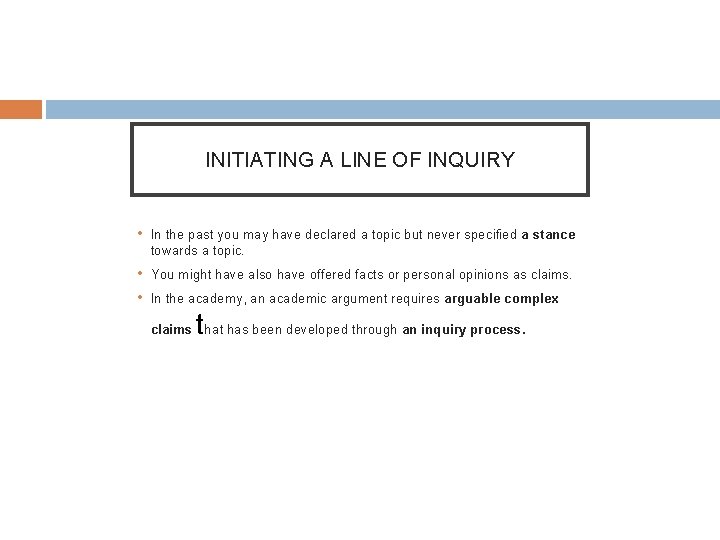
INITIATING A LINE OF INQUIRY • In the past you may have declared a topic but never specified a stance towards a topic. • • You might have also have offered facts or personal opinions as claims. In the academy, an academic argument requires arguable complex t claims hat has been developed through an inquiry process.
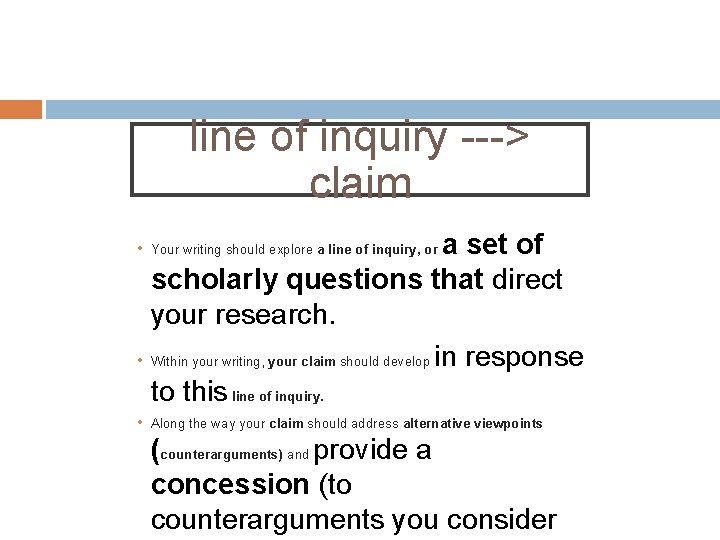
line of inquiry ---> claim a set of scholarly questions that direct your research. • Within your writing, your claim should develop in response to this line of inquiry. • Your writing should explore a line of inquiry, or • Along the way your claim should address alternative viewpoints (counterarguments) and provide a concession (to counterarguments you consider
HOW TO FORMULATE A LINE OF INQUIRY • ute. This could be a gap in the field you’re writing in (Cultural Studies/Film Studies) that your paper seeks to intervene in. Identify an issue: an idea or statement that is open to disp Ex A: binge-watching, “sitting too close, ” “Netflix and Chill” Ex B: gossip, fandom, gender, Grey’s Anatomy
EXAMPLE • Ex A: binge-watching, “sitting too close, ” “Netflix and Chill” Ex. A--CRITICAL LINE OF INQUIRY: How can we use Jenkins’ argument about “sitting too close” versus “critical distance” to shed light on the phenomenon of bingewatching in the U. S. today? Is
EXAMPLE • Ex B: gossip, fandom, gender, Grey’s Anatomy CRITICAL LINE OF INQUIRY: What is “Shondaland, ” and how do Grey’s Anatomy fans engage each other and/or the creators of the show? Does the show pose any interesting “arguments” about gossip (perhaps its underrated
GUIDELINES TO FORMULATING ISSUE BASED QUESTIONS • Refine your topic: Consider the scope of your essay. Part of this is thinking critically about what kinds of claims you can support with what types of evidence. Narrow your framework to a specific historical moment, geographical location, and perhaps even to a specific TV series or fandom (though this is not required) . • Acknowledge your audience: Reflect on what readers may know about the issue, why they may be interested, and what you would like to teach them.
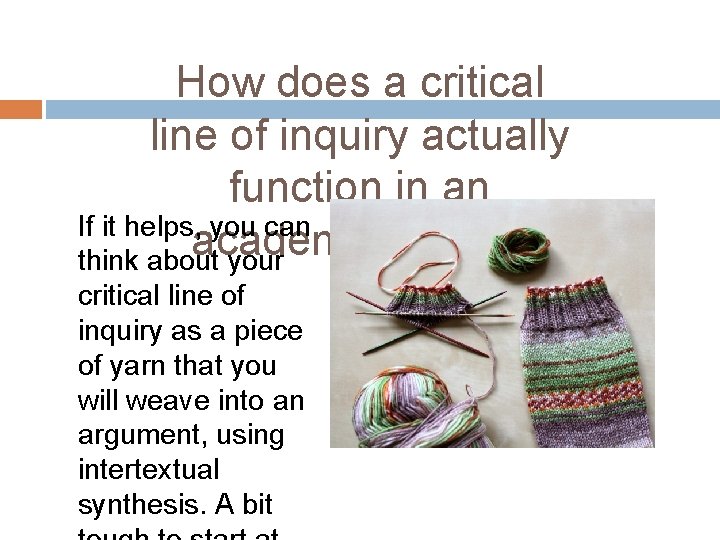
How does a critical line of inquiry actually function in an If it helps, you can academic paper? think about your critical line of inquiry as a piece of yarn that you will weave into an argument, using intertextual synthesis. A bit
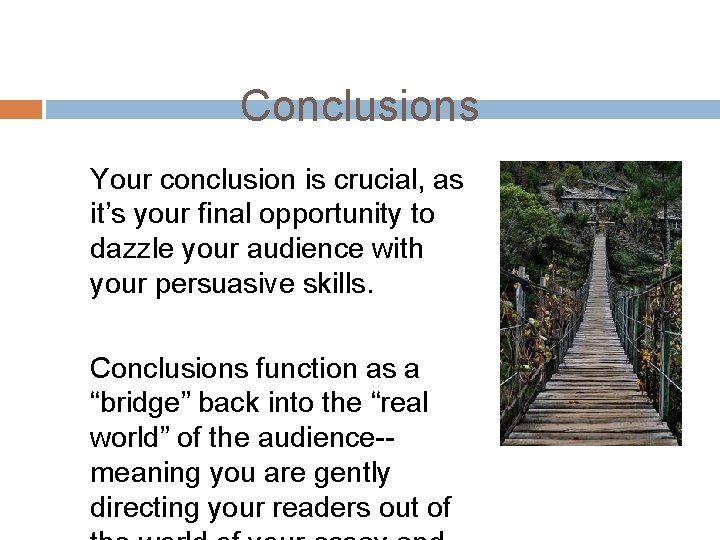
Conclusions Your conclusion is crucial, as it’s your final opportunity to dazzle your audience with your persuasive skills. Conclusions function as a “bridge” back into the “real world” of the audience-meaning you are gently directing your readers out of
COMPLEX CLAIMS
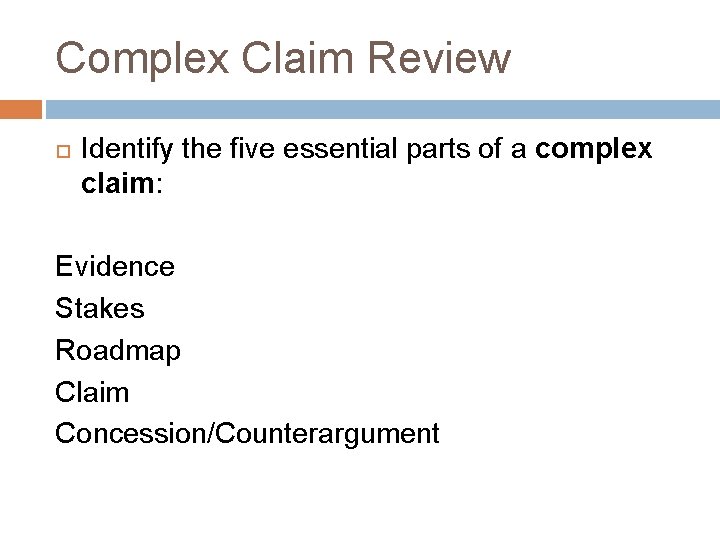
Complex Claim Review Identify the five essential parts of a complex claim: Evidence Stakes Roadmap Claim Concession/Counterargument
Complex Claims Review What is the difference between a thesis statement and a complex claim?
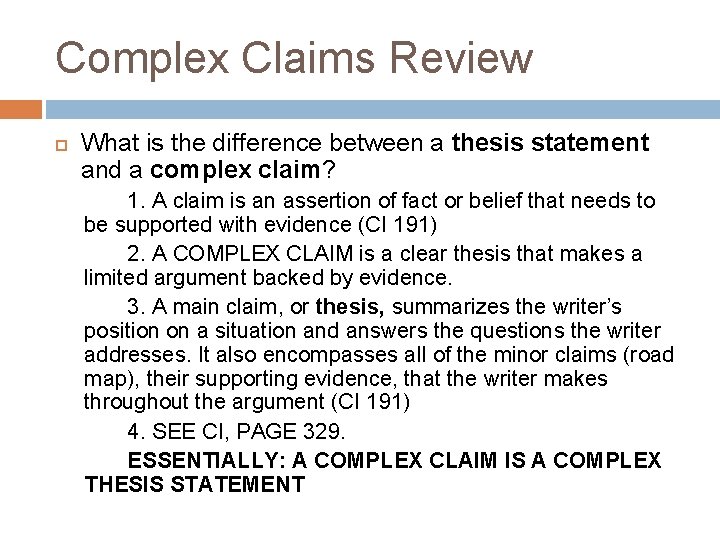
Complex Claims Review What is the difference between a thesis statement and a complex claim? 1. A claim is an assertion of fact or belief that needs to be supported with evidence (CI 191) 2. A COMPLEX CLAIM is a clear thesis that makes a limited argument backed by evidence. 3. A main claim, or thesis, summarizes the writer’s position on a situation and answers the questions the writer addresses. It also encompasses all of the minor claims (road map), their supporting evidence, that the writer makes throughout the argument (CI 191) 4. SEE CI, PAGE 329. ESSENTIALLY: A COMPLEX CLAIM IS A COMPLEX THESIS STATEMENT
Complex Claims Review What is the difference between a concession, a counterargument and a rebuttal?
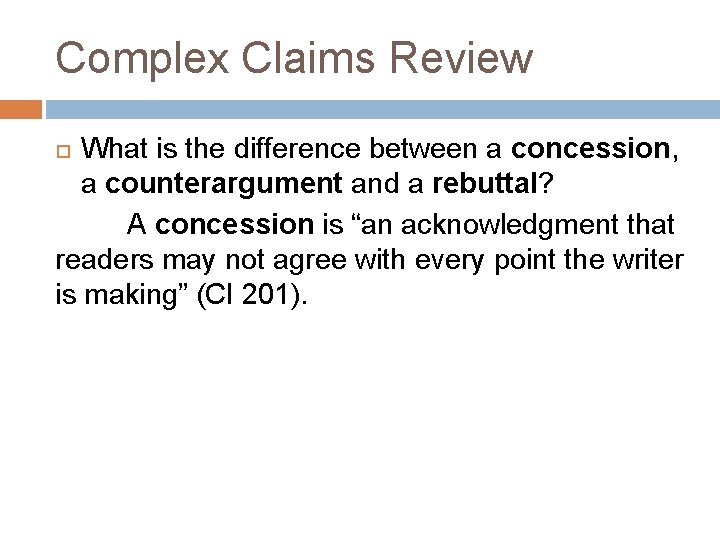
Complex Claims Review What is the difference between a concession, a counterargument and a rebuttal? A concession is “an acknowledgment that readers may not agree with every point the writer is making” (CI 201).
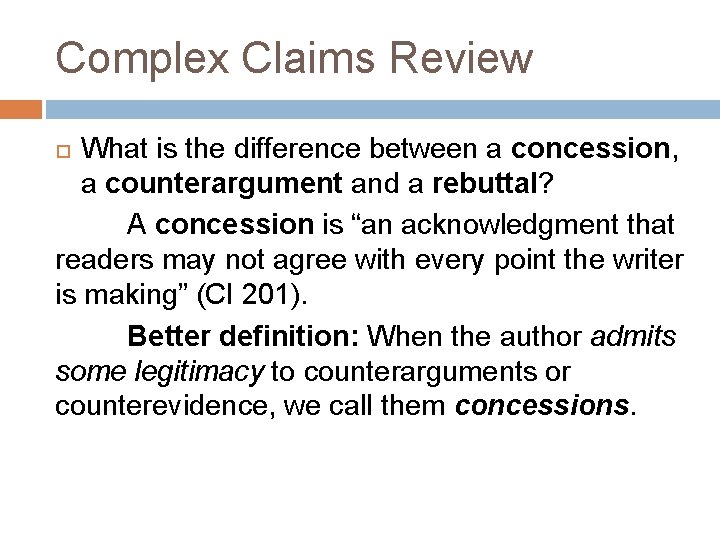
Complex Claims Review What is the difference between a concession, a counterargument and a rebuttal? A concession is “an acknowledgment that readers may not agree with every point the writer is making” (CI 201). Better definition: When the author admits some legitimacy to counterarguments or counterevidence, we call them concessions.
Complex Claims Review What is the difference between a concession, a counterargument and a rebuttal? A concession is “an acknowledgment that readers may not agree with every point the writer is making” (CI 201). Better definition: When the author admits some legitimacy to counterarguments or counterevidence, we call them concessions. A counterargument is “an argument raised in response to another argument” (CI 202).
Complex Claims Review What is the difference between a concession, a counterargument and a rebuttal? A concession is “an acknowledgment that readers may not agree with every point the writer is making” (CI 201). Better definition: When the author admits some legitimacy to counterarguments or counterevidence, we call them concessions. A counterargument is “an argument raised in response to another argument” (CI 202). A rebuttal is a response to an argument or counterargument.
Complex Claims Review What is a roadmap?
Complex Claims Review What is a roadmap? �A roadmap tells your reader how you will prove that your claim is the right one. � It offers a brief outline or roadmap of your argument’s main points.
Complex Claims Review What is a roadmap? �A roadmap tells your reader how you will prove that your claim is the right one. � It offers a brief outline or roadmap of your argument’s main points. � Ex: “In this essay, I will define the major goals of feminism, examine how sexualized images of women’s bodies work against these goals, and then evaluate images of Beyonce that make her a problematic icon for modern feminism. ”
Complex Claims Review What is a roadmap? �A roadmap tells your reader how you will prove that your claim is the right one. � It offers a brief outline or roadmap of your arguments main points. Might also include evidence for your claim. � Ex: “In this essay, I will define the major goals of feminism, examine how sexualized images of women’s bodies work against these goals, and then evaluate images of Beyonce that make her a problematic icon for modern feminism. ” � Another example: “Through an examination of how black female bodies have been objectified throughout history and how these images have both negatively impacted women and undermined the goals of the feminist movement…”
Complex Claims Review A complex claim should always be an “either/or” argument? True or False?
Complex Claims Review A complex claim should always be an “either/or” argument? True or False? � FALSE �A complex claim can be an argument for one side or another (pro-choice v I’m pro-life), but it must also use a rationale (evidence) for that position. � Complex claims, especially in academics, are usually arguing more subtle claims. Ex: “While I agree with Marxist theorists that the conditions of labor influence social formation, I believe that Marxist theory neglects issues of race, gender, and sexuality that must also be considered. ”
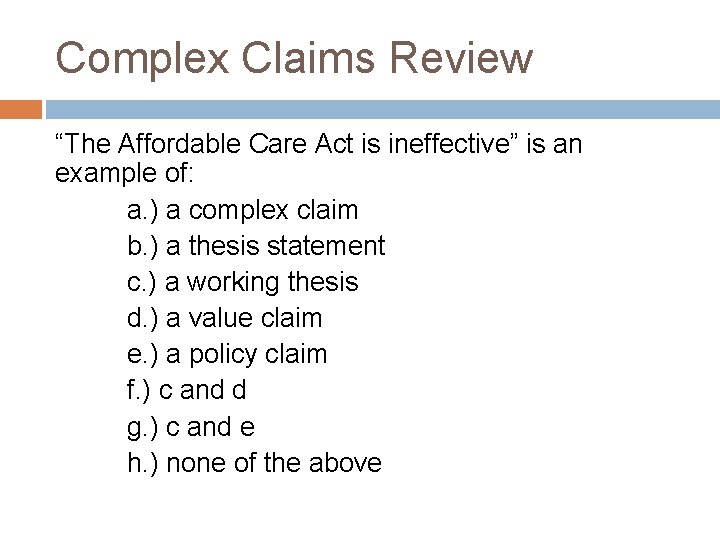
Complex Claims Review “The Affordable Care Act is ineffective” is an example of: a. ) a complex claim b. ) a thesis statement c. ) a working thesis d. ) a value claim e. ) a policy claim f. ) c and d g. ) c and e h. ) none of the above
Complex Claims Review “The Affordable Care Act is ineffective” is an example of: a. ) a complex claim b. ) a thesis statement c. ) a working thesis d. ) a value claim e. ) a policy claim X f. ) c and d g. ) c and e h. ) none of the above
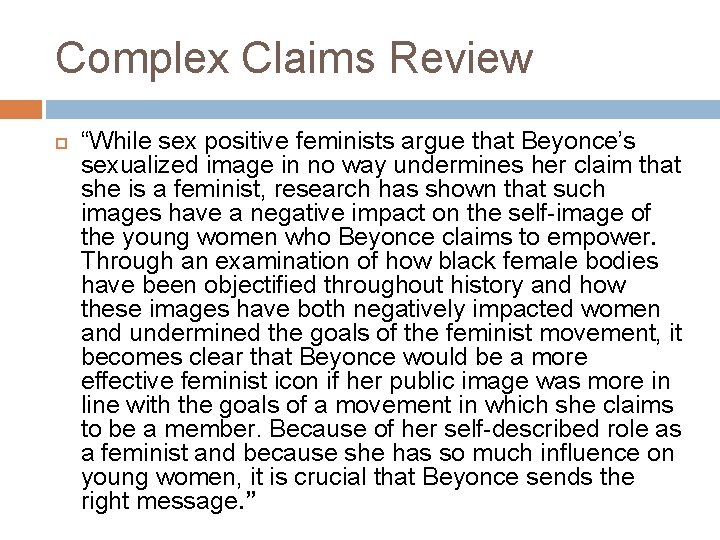
Complex Claims Review “While sex positive feminists argue that Beyonce’s sexualized image in no way undermines her claim that she is a feminist, research has shown that such images have a negative impact on the self-image of the young women who Beyonce claims to empower. Through an examination of how black female bodies have been objectified throughout history and how these images have both negatively impacted women and undermined the goals of the feminist movement, it becomes clear that Beyonce would be a more effective feminist icon if her public image was more in line with the goals of a movement in which she claims to be a member. Because of her self-described role as a feminist and because she has so much influence on young women, it is crucial that Beyonce sends the right message. ”
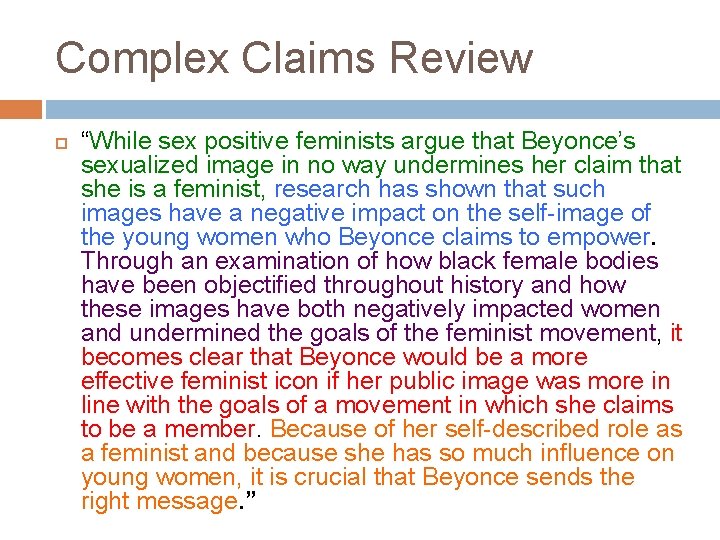
Complex Claims Review “While sex positive feminists argue that Beyonce’s sexualized image in no way undermines her claim that she is a feminist, research has shown that such images have a negative impact on the self-image of the young women who Beyonce claims to empower. Through an examination of how black female bodies have been objectified throughout history and how these images have both negatively impacted women and undermined the goals of the feminist movement, it becomes clear that Beyonce would be a more effective feminist icon if her public image was more in line with the goals of a movement in which she claims to be a member. Because of her self-described role as a feminist and because she has so much influence on young women, it is crucial that Beyonce sends the right message. ”