
Formulating and implementing national adaptation plans NAPs JCCCP

- Slides: 24
Formulating and implementing national adaptation plans (NAPs) JCCCP Inception Workshop 26 -27 January 2016, Radisson Aquatica Resort, Barbados Julie Amoroso-Garbin Adaptation Programme, UNFCCC secretariat
Outline 1. Evolution of mandates defining NAPs 2. Guidance in formulating and implementing NAPs 3. The NAP technical guidelines 4. Designing the process to formulate and implement a NAP 5. Aligning the NAPs with the intergovernmental process
Evolution of mandates defining NAPs
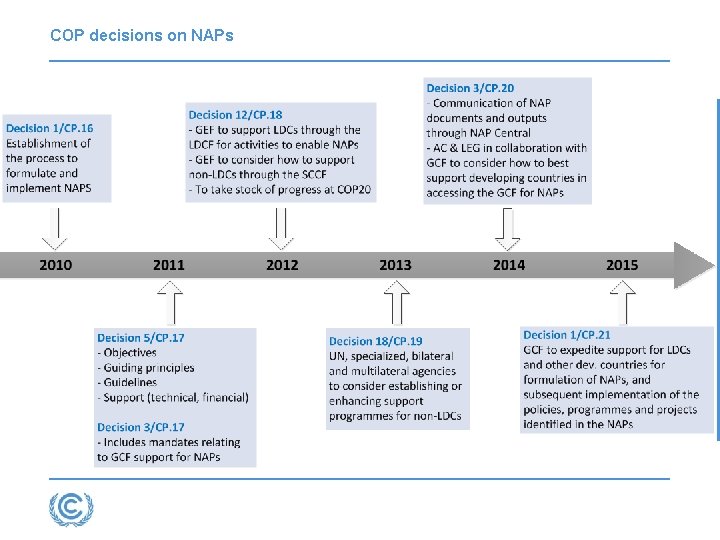
COP decisions on NAPs
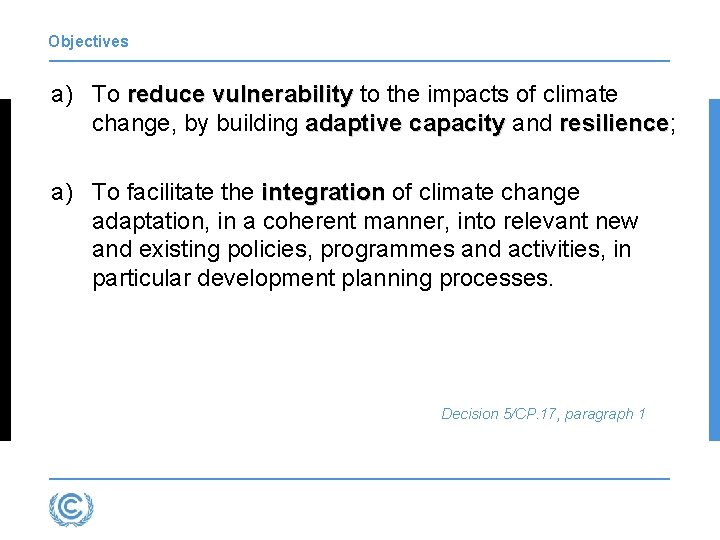
Objectives a) To reduce vulnerability to the impacts of climate change, by building adaptive capacity and resilience; resilience a) To facilitate the integration of climate change integration adaptation, in a coherent manner, into relevant new and existing policies, programmes and activities, in particular development planning processes. Decision 5/CP. 17, paragraph 1
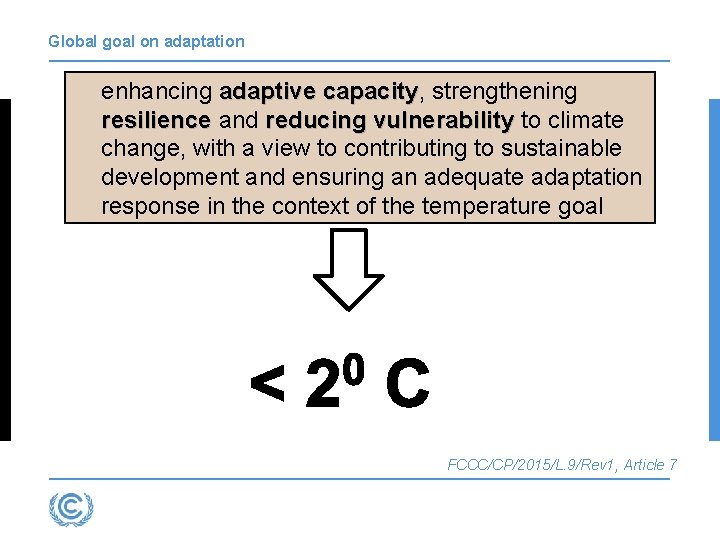
Global goal on adaptation enhancing adaptive capacity, strengthening capacity resilience and reducing vulnerability to climate change, with a view to contributing to sustainable development and ensuring an adequate adaptation response in the context of the temperature goal FCCC/CP/2015/L. 9/Rev 1, Article 7
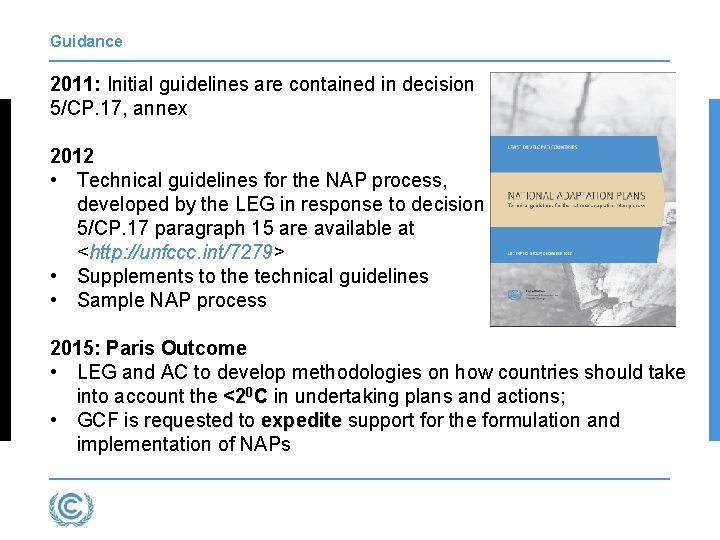
Guidance 2011: Initial guidelines are contained in decision 5/CP. 17, annex 2012 • Technical guidelines for the NAP process, developed by the LEG in response to decision 5/CP. 17 paragraph 15 are available at <http: //unfccc. int/7279> • Supplements to the technical guidelines • Sample NAP process 2015: Paris Outcome • LEG and AC to develop methodologies on how countries should take into account the <20 C in undertaking plans and actions; • GCF is requested to requested expedite support for the formulation and expedite implementation of NAPs
The NAP technical guidelines
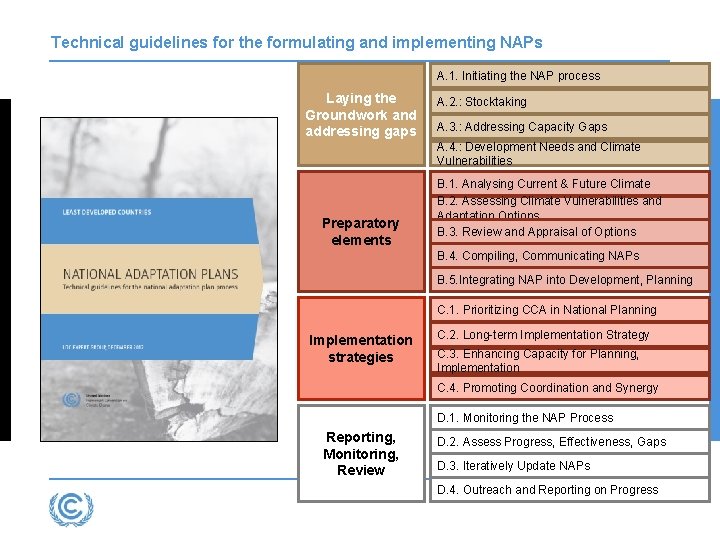
Technical guidelines for the formulating and implementing NAPs A. 1. Initiating the NAP process Laying the Groundwork and addressing gaps A. 2. : Stocktaking A. 3. : Addressing Capacity Gaps A. 4. : Development Needs and Climate Vulnerabilities Preparatory elements B. 1. Analysing Current & Future Climate B. 2. Assessing Climate Vulnerabilities and Adaptation Options B. 3. Review and Appraisal of Options B. 4. Compiling, Communicating NAPs B. 5. Integrating NAP into Development, Planning C. 1. Prioritizing CCA in National Planning Implementation strategies C. 2. Long-term Implementation Strategy C. 3. Enhancing Capacity for Planning, Implementation C. 4. Promoting Coordination and Synergy D. 1. Monitoring the NAP Process Reporting, Monitoring, Review D. 2. Assess Progress, Effectiveness, Gaps D. 3. Iteratively Update NAPs D. 4. Outreach and Reporting on Progress
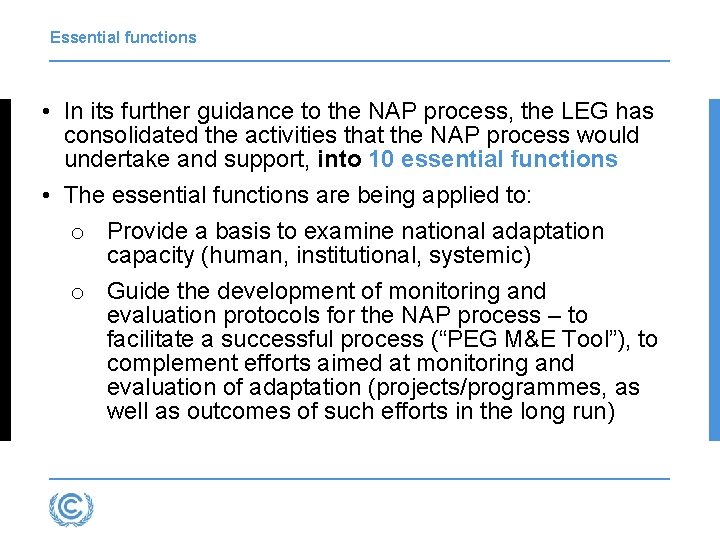
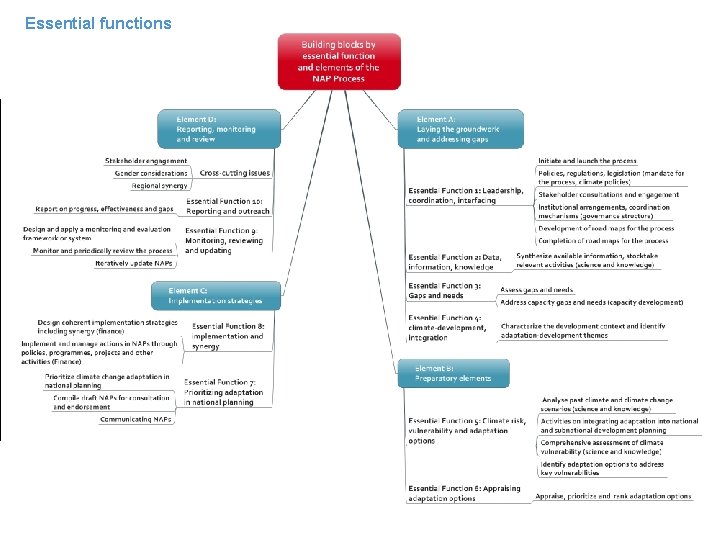
Essential functions • In its further guidance to the NAP process, the LEG has consolidated the activities that the NAP process would undertake and support, into 10 essential functions • The essential functions are being applied to: o Provide a basis to examine national adaptation capacity (human, institutional, systemic) o Guide the development of monitoring and evaluation protocols for the NAP process – to facilitate a successful process (“PEG M&E Tool”), to complement efforts aimed at monitoring and evaluation of adaptation (projects/programmes, as well as outcomes of such efforts in the long run)
Essential functions
Designing the process to formulate and implement a NAP
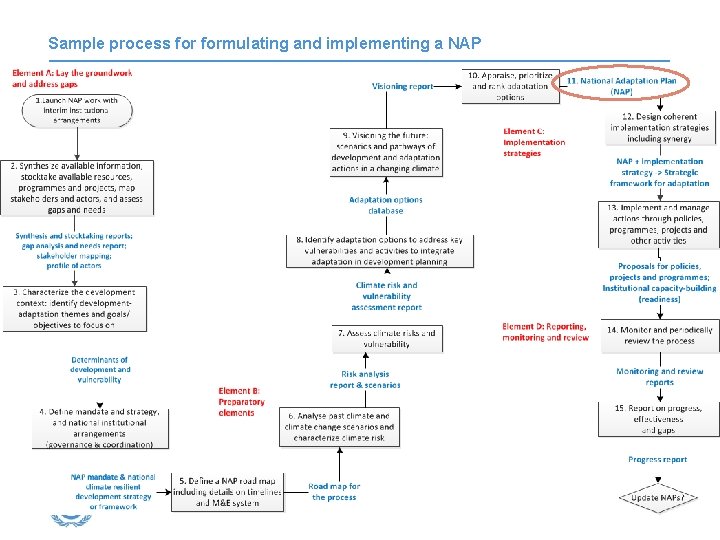
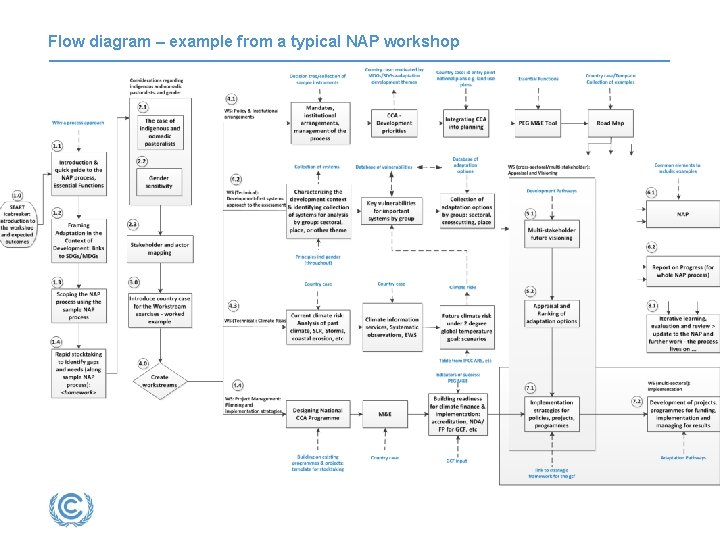
How to apply the technical guidelines • The LEG, with input from other experts, have prepared a sample NAP process that shows the flow of information and outputs from one step to another • Shows the main steps and outputs of a typical NAP process • While the activities are shown sequentially, in reality they would be carried out in parallel and mainly on a continuous basis. • An initial activity would then be to go through this sample NAP process to get a better understanding of what would be required, add any missing steps or outputs, then use this flow to conduct a stocktaking of what exists, in effect what identifying gaps and needs in terms of what is needed to carry out the NAP process • The initial scoping establishes a baseline, and helps in assigning activities to different workstreams – teams of actors working on activities of the NAP process based on their mandate and functions
Sample process formulating and implementing a NAP
How to apply the technical guidelines • The LEG, with input from other experts, have prepared a sample NAP process that shows the flow of information and outputs from one step to another • Shows the main steps and outputs of a typical NAP process • While the activities are shown sequentially, in reality they would be carried out in parallel and mainly on a continuous basis. • An initial activity would then be to go through this sample NAP process to get a better understanding of what would be required, add any missing steps or outputs, then use this flow to conduct a stocktaking of what exists, in effect what identifying gaps and needs in terms of what is needed to carry out the NAP process • The initial scoping establishes a baseline, and helps in assigning activities to different workstreams – teams of actors working on activities of the NAP process based on their mandate and functions
Creating workstreams • The activities and steps of the process to formulate and implement NAPs can be clustered into workstreams that would be managed by different stakeholders; • Together, the workstreams could form a programme that would be “the NAP process”; • The coordinating mechanism of the NAP process would manage the relationships and flow of information between the workstreams, and sufficient authority would be delegated to leaders of each workstream to ensure the effective and efficient delivery of intended outputs and outcomes of the NAP process; • See pages 119 to 124 of the technical guidelines for the NAP process for sample workstreams.
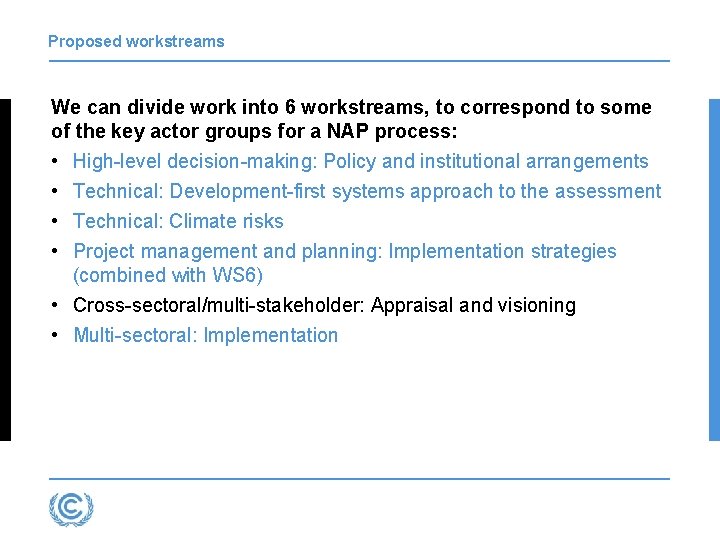
Proposed workstreams We can divide work into 6 workstreams, to correspond to some of the key actor groups for a NAP process: • • High-level decision-making: Policy and institutional arrangements Technical: Development-first systems approach to the assessment Technical: Climate risks Project management and planning: Implementation strategies (combined with WS 6) • Cross-sectoral/multi-stakeholder: Appraisal and visioning • Multi-sectoral: Implementation
Aligning the NAPs with the intergovernmental process
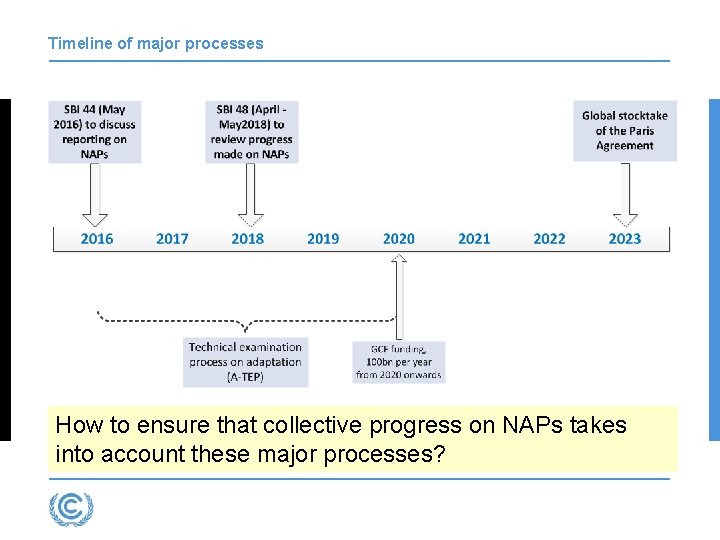
Timeline of major processes How to ensure that collective progress on NAPs takes into account these major processes?
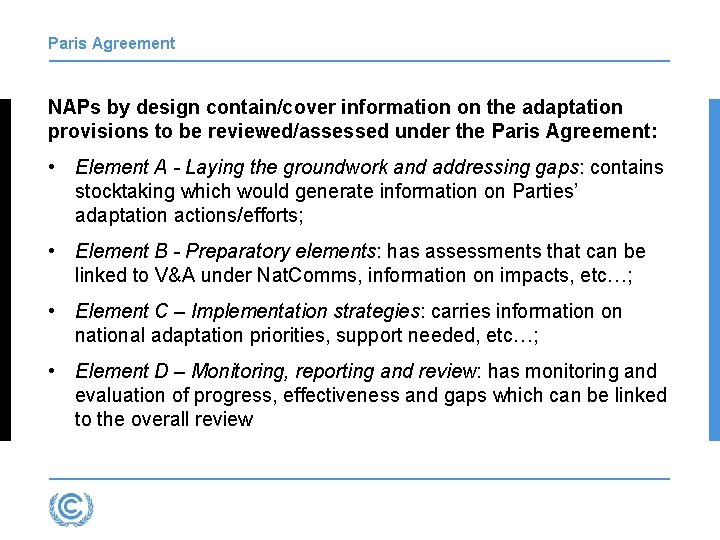
Paris Agreement NAPs by design contain/cover information on the adaptation provisions to be reviewed/assessed under the Paris Agreement: • Element A - Laying the groundwork and addressing gaps: contains stocktaking which would generate information on Parties’ adaptation actions/efforts; • Element B - Preparatory elements: has assessments that can be linked to V&A under Nat. Comms, information on impacts, etc…; • Element C – Implementation strategies: carries information on national adaptation priorities, support needed, etc…; • Element D – Monitoring, reporting and review: has monitoring and evaluation of progress, effectiveness and gaps which can be linked to the overall review
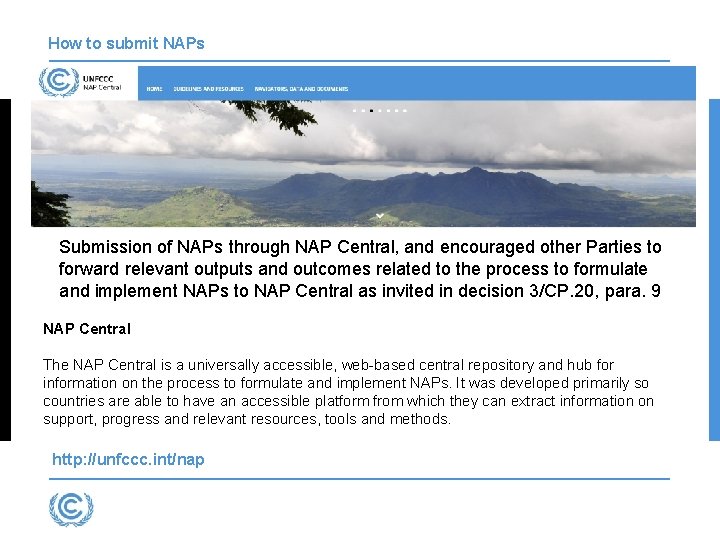
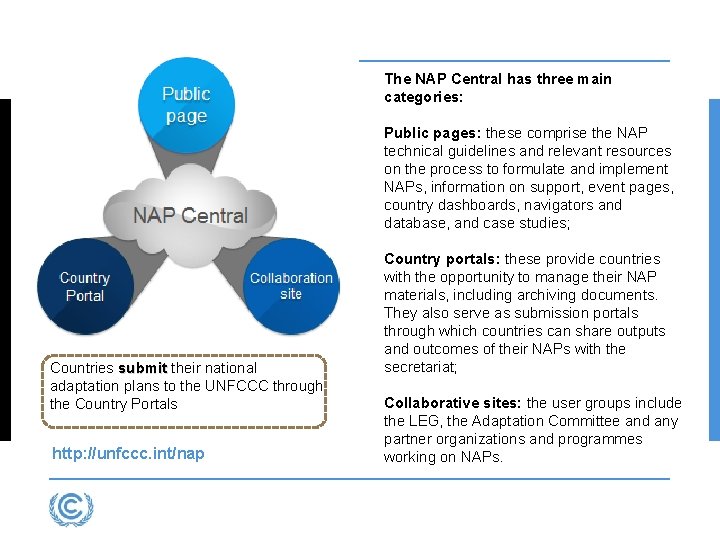
How to submit NAPs Submission of NAPs through NAP Central, and encouraged other Parties to forward relevant outputs and outcomes related to the process to formulate and implement NAPs to NAP Central as invited in decision 3/CP. 20, para. 9 NAP Central The NAP Central is a universally accessible, web-based central repository and hub for information on the process to formulate and implement NAPs. It was developed primarily so countries are able to have an accessible platform from which they can extract information on support, progress and relevant resources, tools and methods. http: //unfccc. int/nap
The NAP Central has three main categories: Public pages: these comprise the NAP technical guidelines and relevant resources on the process to formulate and implement NAPs, information on support, event pages, country dashboards, navigators and database, and case studies; Countries submit their national submit adaptation plans to the UNFCCC through the Country Portals http: //unfccc. int/nap Country portals: these provide countries with the opportunity to manage their NAP materials, including archiving documents. They also serve as submission portals through which countries can share outputs and outcomes of their NAPs with the secretariat; Collaborative sites: the user groups include the LEG, the Adaptation Committee and any partner organizations and programmes working on NAPs.
Flow diagram – example from a typical NAP workshop
For more information http: //unfccc. int/6057 Join The Adaptation Exchange on Facebook http: //www. facebook. com/The. Adaptation. Exchange