
Formulas for Career Success Career Testing Investigation 1
- Slides: 64
Formulas for Career Success: Career Testing & Investigation 1
Objectives 1. To identify factors which may affect career choices. 2. To explore types and benefits of career testing and assessment. 3. To analyze methods of investigating career fields. 2
Main Menu Considering Careers Career Testing Career Investigation 3
Formulas for Career Success: Career Testing & Investigation Considering Careers 4
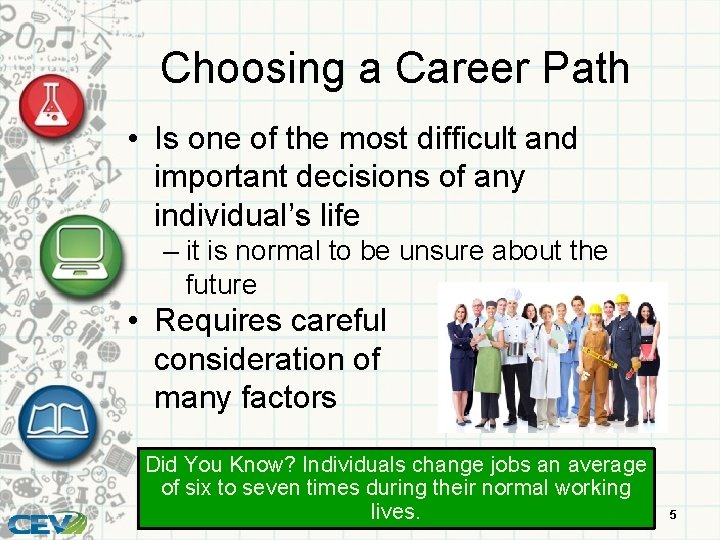
Choosing a Career Path • Is one of the most difficult and important decisions of any individual’s life – it is normal to be unsure about the future • Requires careful consideration of many factors Did You Know? Individuals change jobs an average of six to seven times during their normal working lives. 5
Factors to Consider • When choosing a career path include: – interests and skills – work-life balance – job outlook – work environment – amount of interaction – pay – benefits 6
Interests & Skills • Must be considered when choosing a career path • Affect job satisfaction and success – interests can indicate what will be enjoyable – skills provide the ability to be effective • for example, a student who likes to help people and is good at science might consider a career in the medical field 7
Work-Life Balance • Is a term used to refer to the way individuals manage their time and energy between career activities and home activities – some career choices may involve long hours or stressful situations which could affect life outside of work – be aware of the implications career choices will have on family and personal time 8
Job Outlook • Refers to the demand availability of an occupation – industries differ greatly in terms of size and rate of growth 9
Job Outlook • Is important to consider when making career decisions – if a career field is shrinking or opportunities to enter the field are rare, working harder and smarter to gain employment will be necessary – some people thrive when faced with tough competition, but others prefer stability and job security 10
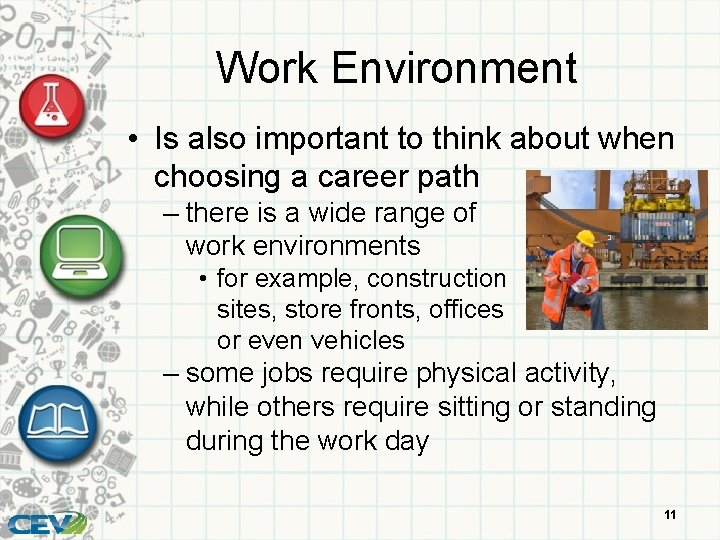
Work Environment • Is also important to think about when choosing a career path – there is a wide range of work environments • for example, construction sites, store fronts, offices or even vehicles – some jobs require physical activity, while others require sitting or standing during the work day 11
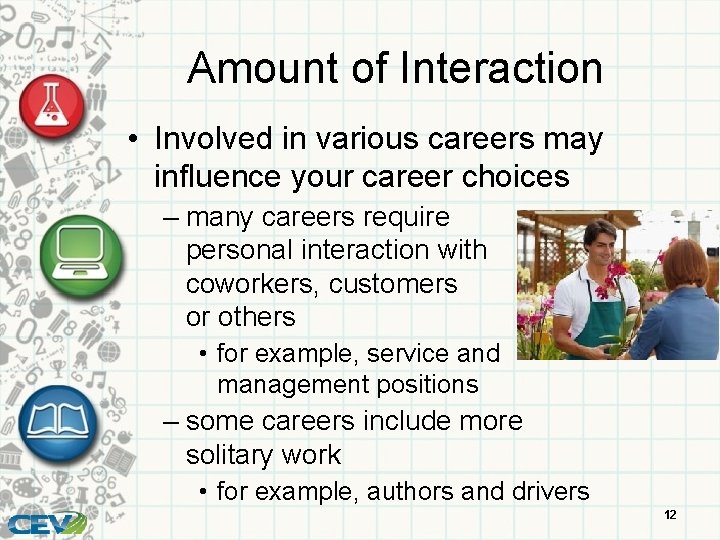
Amount of Interaction • Involved in various careers may influence your career choices – many careers require personal interaction with coworkers, customers or others • for example, service and management positions – some careers include more solitary work • for example, authors and drivers 12
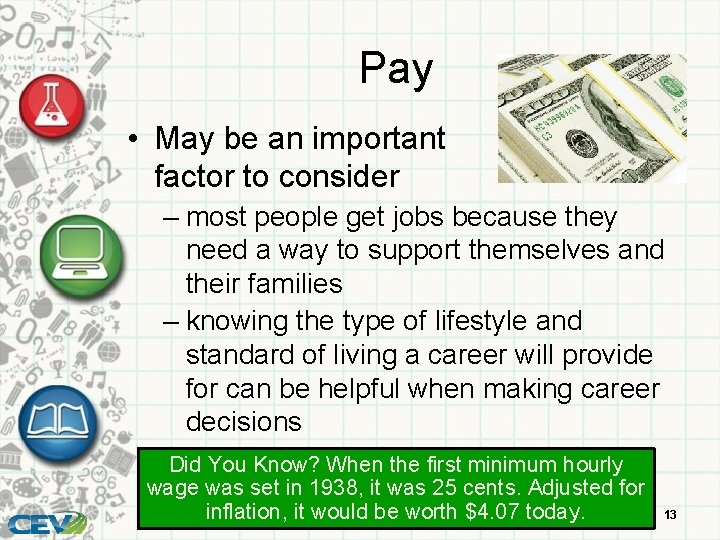
Pay • May be an important factor to consider – most people get jobs because they need a way to support themselves and their families – knowing the type of lifestyle and standard of living a career will provide for can be helpful when making career decisions Did You Know? When the first minimum hourly wage was set in 1938, it was 25 cents. Adjusted for inflation, it would be worth $4. 07 today. 13
Benefits • Are services or rights provided by employers in addition to wages or salary • Include: – health, dental and life insurance – paid vacation time and sick leave – retirement plan options • Are commonly included in compensation in some industries, but may be rare in others 14
Choosing a Career Path • Should include consideration of all factors – think about which factors are most important and which factors are less important – research how each factor applies to various career fields and specific occupations 15
Formulas for Career Success: Career Testing & Investigation Career Testing 16
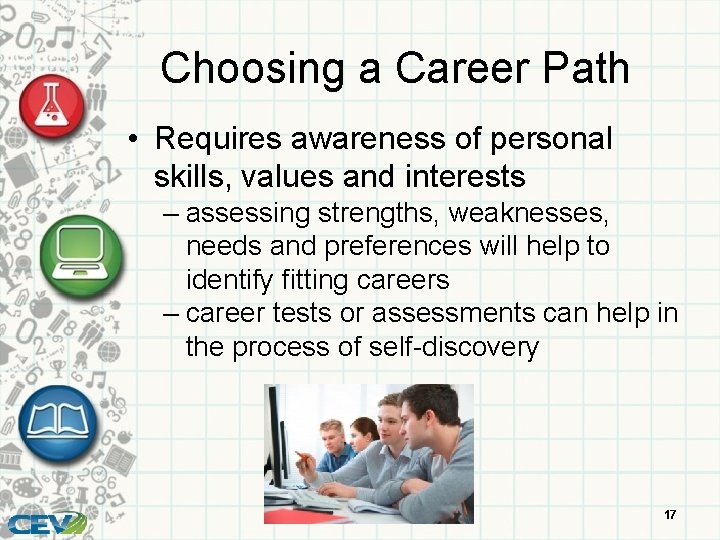
Choosing a Career Path • Requires awareness of personal skills, values and interests – assessing strengths, weaknesses, needs and preferences will help to identify fitting careers – career tests or assessments can help in the process of self-discovery 17
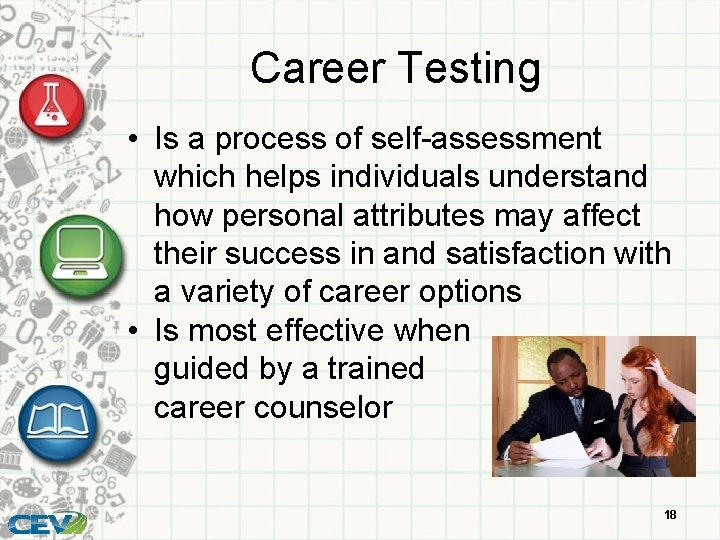
Career Testing • Is a process of self-assessment which helps individuals understand how personal attributes may affect their success in and satisfaction with a variety of career options • Is most effective when guided by a trained career counselor 18
Career Testing • Should be participated in throughout high school, college and career development – start early – re-evaluate before making important career decisions Did You Know? The first methodology of career guidance was created in 1908 when Frank Parsons began the Vocational Bureau of Boston. 19
Career Testing • Tools include: – Strong Interest Inventory® – Self-Directed Search® – Myers-Briggs Type Indicator® – Career Ability Placement Survey – SIGI 3 Assessment 20
Strong Interest Inventory® • Is a well known and highly respected assessment frequently used to identify and analyze interests • Is based on the work of psychologist E. K. Strong Jr. , who originally published his inventory in 1927 Did You Know? Strong developed a male version and female version, initially believing men and women were interested in different careers. 21
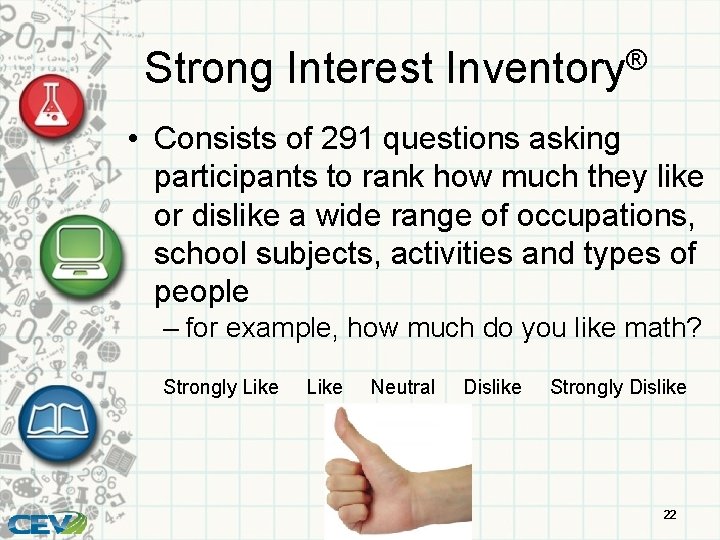
Strong Interest Inventory® • Consists of 291 questions asking participants to rank how much they like or dislike a wide range of occupations, school subjects, activities and types of people – for example, how much do you like math? Strongly Like Neutral Dislike Strongly Dislike 22
Strong Interest Inventory® • Results suggest some general interest areas and specific occupations • Describes an individual’s preferred style of: – working – learning – leading – risk-taking – team participation 23
Self-Directed Search® • Is a career interest test used by more than 22 million people worldwide • Was created by psychologist John Holland first published in 1970 – it is based on John Holland’s RIASEC theory, first published in 1959 Did You Know? Holland’s theory states people can be categorized into six personality types: Realistic, Investigative, Artistic, Social, Enterprising or Conventional (RIASEC). 24
Self-Directed Search® • Asks questions about aspirations, activities, skills and interests in different jobs • Assigns a Holland Code to each participant, which is used to identify potential careers – codes consist of three of the six RIASEC personality types • for example, SAE for Social, Artistic and Enterprising 25
Myers-Briggs Type Indicator® • Is an assessment designed to measure personality by identifying how an individual perceives situations and makes decisions • Is administered by certified professionals only – there are many similar assessments available for free online, but these are imitations 26
Myers-Briggs Type Indicator® • Was originally developed by Katharine Briggs and her daughter, Isabel Briggs Myers and was first published in 1943 – their work was based on Carl Jung’s theory of psychological type • Has been subtly revised and enhanced over time Did You Know? Jung wrote “what appears to be random behavior is actually the result of differences in the way people prefer to use their mental capacities. ” 27
Myers-Briggs Type Indicator® • Measures personality through four sections, each of which reveals a specific aspect of personality – extraversion or introversion – sensing or intuition – thinking or feeling – judging or perceiving • Assigns one of 16 personality types, revealing tendencies and values to be considered when making career choices 28
Career Ability Placement Survey • Is a test designed to measure careerrelated abilities • Includes eight sections of questions – mechanical reasoning – special relations – verbal reasoning – language usage – word knowledge – perceptual speed and accuracy – manual speed and dexterity – mathematical ability 29
Career Ability Placement Survey • Is available in self-scoring and computer-scored formats • Is designed to identify occupational areas most suited to present abilities – related areas requiring more training are also discussed 30
Career Ability Placement Survey • Is one of the few assessments which has right and wrong answers – it measures ability by asking participants to demonstrate skills – it is timed, so it tests participants’ ability to think on their feet and solve problems – scores are interpreted in terms of participants’ abilities relative to others at the same education level 31
SIGI 3 • Is the System of Integrated Guidance and Information, third generation • Was originally developed in the early 1980 s by Dr. Martin Katz of Educational Testing Service – based on his theory of value-based career decision making 32
SIGI 3 • Integrates self-assessment with in -depth and up-to-date career information • Includes four self-paced surveys to help users examine key motivators and match values, interests, personality and skills to career pathways 33
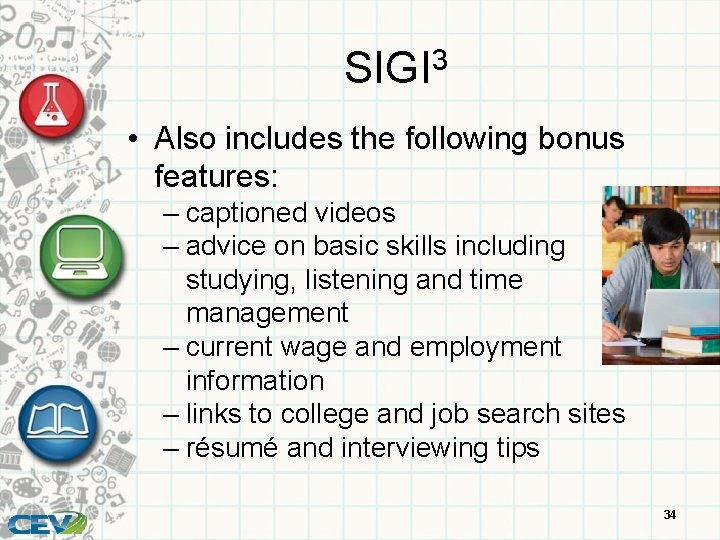
SIGI 3 • Also includes the following bonus features: – captioned videos – advice on basic skills including studying, listening and time management – current wage and employment information – links to college and job search sites – résumé and interviewing tips 34
Career Assessments • Of many other types are also available – be aware of the reliability and validity of each assessment – research how and by whom assessments were developed to learn more about the credibility of each Reliability: extent to which an assessment yields the same result on repeated trials Validity: extent to which an assessment measures what it claims to measure 35
Career Assessments • Are available from counselors, career centers, libraries and the Internet – some assessments must be administered by a certified professional – even assessments which can be selfadministered may be more helpful if discussed with a trained counselor • counselors can provide clarification, insight and instruction beyond what the actual assessments provide 36
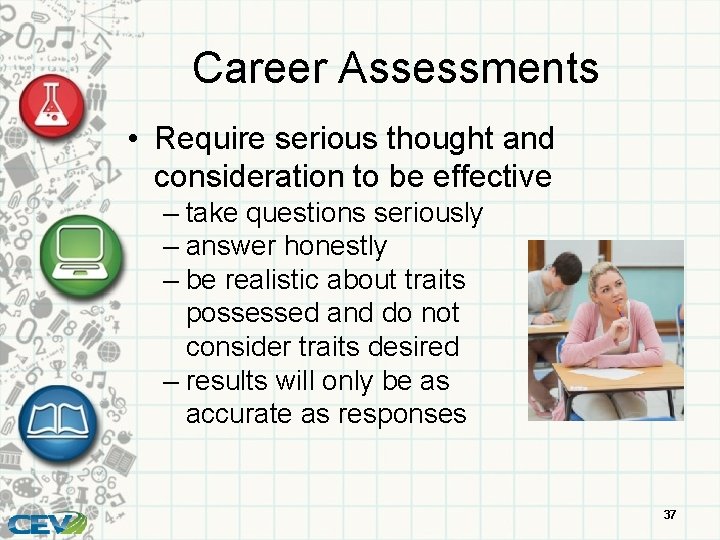
Career Assessments • Require serious thought and consideration to be effective – take questions seriously – answer honestly – be realistic about traits possessed and do not consider traits desired – results will only be as accurate as responses 37
Career Assessments • Require an open mind and thorough exploration – thinking deeply and possibly “outside of the box” may provide more possibilities • for example, if an assessment suggests clergy as a career choice, but the student is not religious, it would be helpful to think about the key skills and traits of clergymen and where else those traits may be valuable, such as counseling 38
Career Assessments • Are not meant to be a road map to a perfect job, but simply a suggestion to provide ideas about careers which should be explored – talk to parents, teachers, counselors and friends about what each assessment reveals and how it should affect career choices 39
Formulas for Career Success: Career Testing & Investigation Career Investigation 40
Investigating Careers • Will likely be necessary before making career decisions • Includes learning the following about possible career paths: – day-to-day tasks and activities – challenging experiences – rewarding experiences – misconceptions 41
Investigating Careers • Includes: – entry-level employment – military services – steps required to participate in different careers – education needed • • apprenticeships community college technical college universities 42
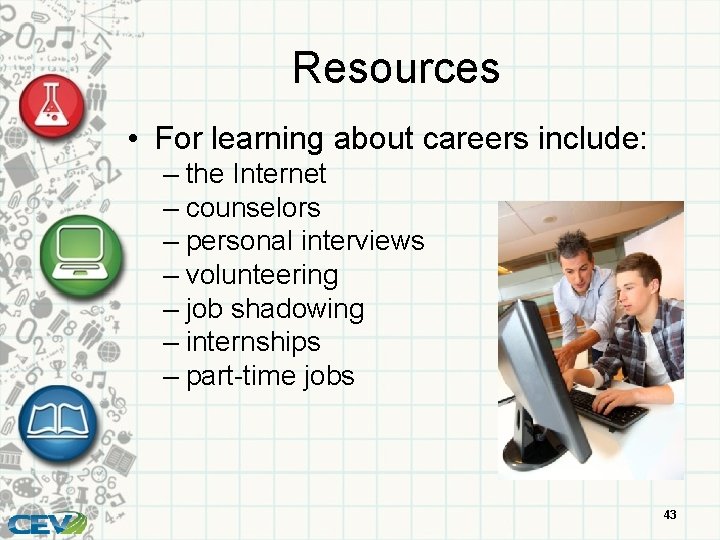
Resources • For learning about careers include: – the Internet – counselors – personal interviews – volunteering – job shadowing – internships – part-time jobs 43
The Internet • Can be a great starting point for investigating careers – there is an abundance of career information available, including: • • • job descriptions job outlooks qualifications and requirements earnings advancement opportunities 44
Internet Resources • Are NOT all equal – be sure websites used are sponsored by credible, established organizations • sources most likely to be credible are those ending in “. gov”, “. org” and “. edu” – use a variety of sources to allow for comparison and consensus Did You Know? The organization which approves and regulates domain names is the Internet Corporation for Assigned Names and Numbers (ICANN), a privately held, nonprofit organization in California. 45
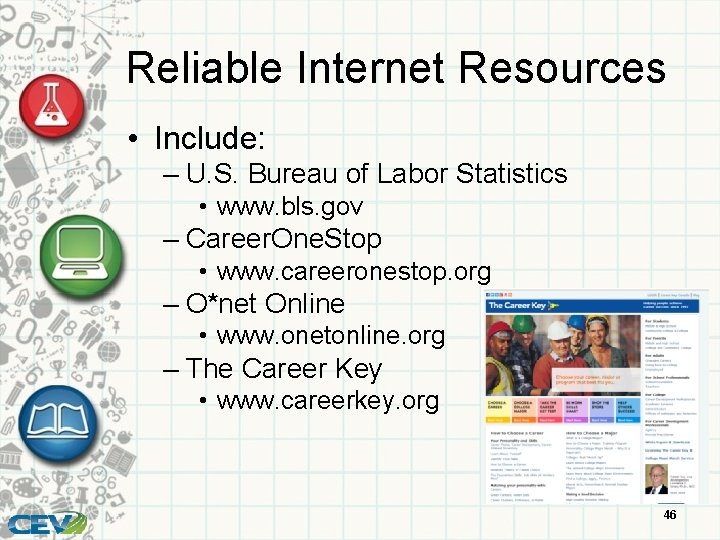
Reliable Internet Resources • Include: – U. S. Bureau of Labor Statistics • www. bls. gov – Career. One. Stop • www. careeronestop. org – O*net Online • www. onetonline. org – The Career Key • www. careerkey. org 46
Counselors • Are experts on career exploration and decision-making • Can help individuals sort through the vast amount of information and apply it to their specific career goals • Ask questions to provide guidance concerning career goals and plans 47
Counselors • Can be found in high schools, colleges and commercial career centers • May request participation in selfassessments • Will ask questions and discuss various career options • Will not provide specific instructions, but suggestions, information and guidance concerning career goals and plans 48
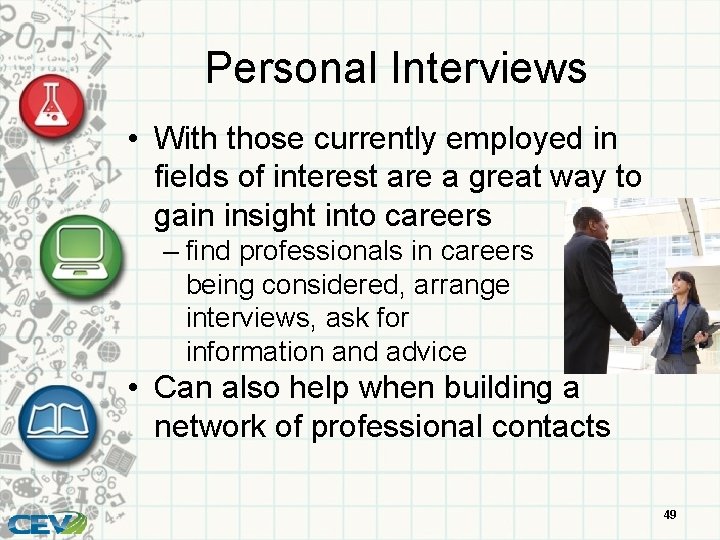
Personal Interviews • With those currently employed in fields of interest are a great way to gain insight into careers – find professionals in careers being considered, arrange interviews, ask for information and advice • Can also help when building a network of professional contacts 49
Personal Interviews • Should be held in a professional manner – develop questions and discussion points beforehand – dress appropriately – be polite, gracious and considerate – listen and express interest – express thanks – consider asking for suggestions of others who would be helpful to talk to 50
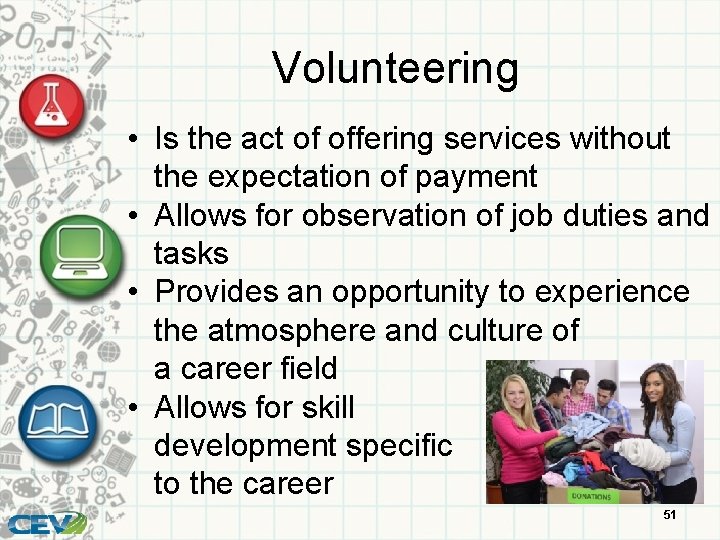
Volunteering • Is the act of offering services without the expectation of payment • Allows for observation of job duties and tasks • Provides an opportunity to experience the atmosphere and culture of a career field • Allows for skill development specific to the career 51
Volunteering • Can help when building a network of professional contacts • Opportunities can be found through many different organizations in many different career fields – to search opportunities use: • volunteermatch. org • idealist. org • handsonnetwork. org Did You Know? On any given day, there are more than 10, 000 volunteer opportunities in the United States. 52
Job Shadowing • Is a program in which students learn about an occupation by following a professional throughout the work day • Offers a chance to observe the dayto-day activities of a job • Provides the opportunity to have questions answered 53
Job Shadowing • May be available through programs at high schools and colleges • Programs are also offered by some companies, organizations and government agencies • May also be set up on an individual basis through students’ utilization of professional contacts 54
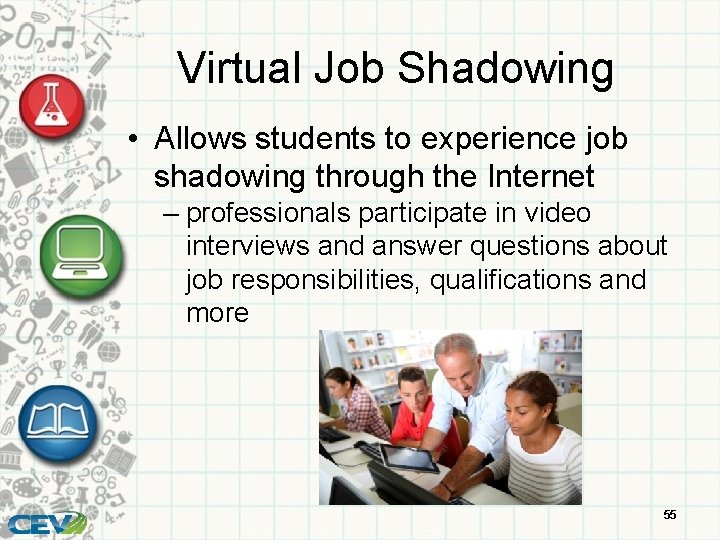
Virtual Job Shadowing • Allows students to experience job shadowing through the Internet – professionals participate in video interviews and answer questions about job responsibilities, qualifications and more 55
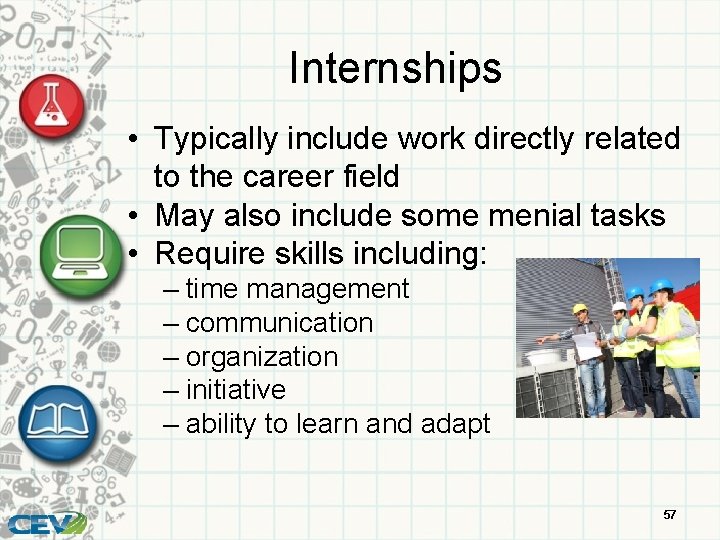
Internships • Are a temporary form of employment with an emphasis on supervised onthe-job training • May be paid or unpaid • May be part-time or full-time • Allow students to get exposure and gain experience in a career field without long-term commitment 56
Internships • Typically include work directly related to the career field • May also include some menial tasks • Require skills including: – time management – communication – organization – initiative – ability to learn and adapt 57
Internships • Are a great way to enhance a résumé because they count as work experience • Are a great way to build a professional network of contacts • Can be found through: – high school and college counselors – online internship databases – utilization of professional contacts 58
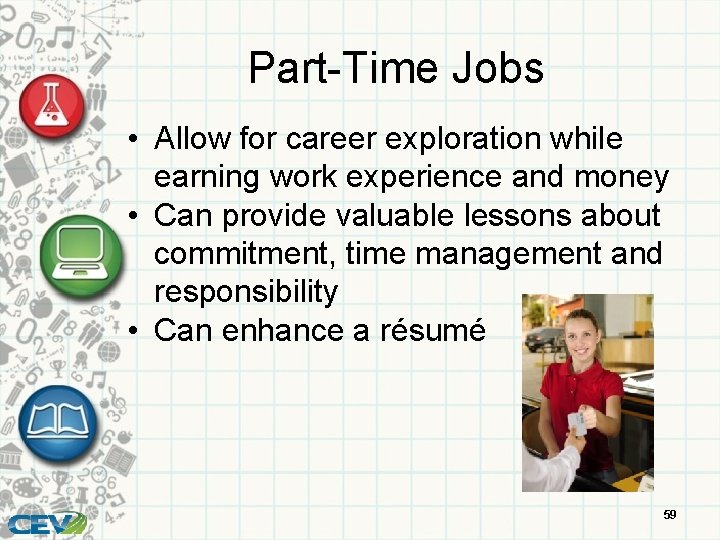
Part-Time Jobs • Allow for career exploration while earning work experience and money • Can provide valuable lessons about commitment, time management and responsibility • Can enhance a résumé 59
Investigating Careers • Is a process requiring patience, flexibility, thought and reflection – be open-minded and willing to take on tasks which might not be considered desirable – be enthusiastic and do not become discouraged if things do not go as expected – be purposeful and think about how each experience affects career goals 60
Career Planning • Is vital for individuals who want to be successful and effectively plan their career path • Requires knowledge and understanding of the career, including: – determining academic and training requirements 61
Career Planning • Positively effects an individuals career path and improves the following: – job satisfaction – productivity – motivation – loyalty – security – work life balance 62
Resources Big Future by The College Board https: //bigfuture. collegeboard. org/ CPP, Inc. https: //www. cpp. com/products/strong/index. aspx John Holland’s Self-Directed Search http: //www. self-directed-search. com/home Sigi 3 http: //www. sigi 3. org/ The Myers & Briggs Foundation http: //www. myersbriggs. org/ 63
Acknowledgements Production Coordinator Amy Hogan Brand Manager Megan O’Quinn Graphic Designer Pamela Hester Technical Writer Jessica Odom V. P. of Brand Management Clayton Franklin CEV Multimedia, Ltd. ©MMXIV Executive Producer Gordon W. Davis, Ph. D. 64