
Formulae square Work out the answers to the
- Slides: 30
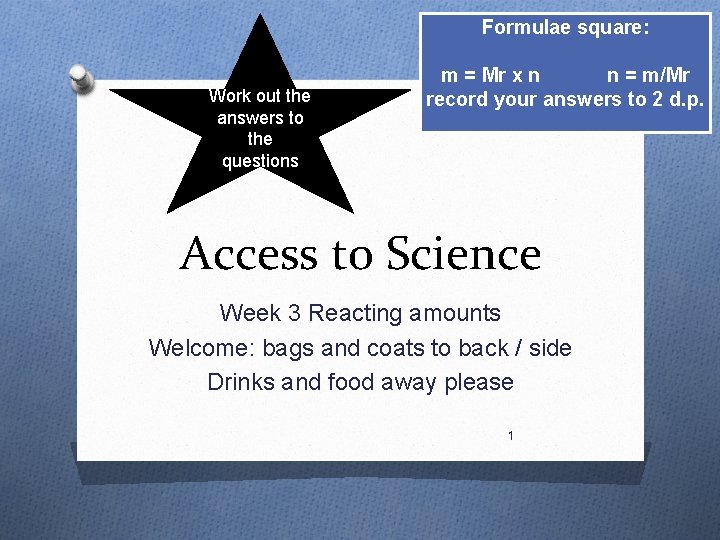
Formulae square: Work out the answers to the questions m = Mr x n n = m/Mr record your answers to 2 d. p. Access to Science Week 3 Reacting amounts Welcome: bags and coats to back / side Drinks and food away please 1
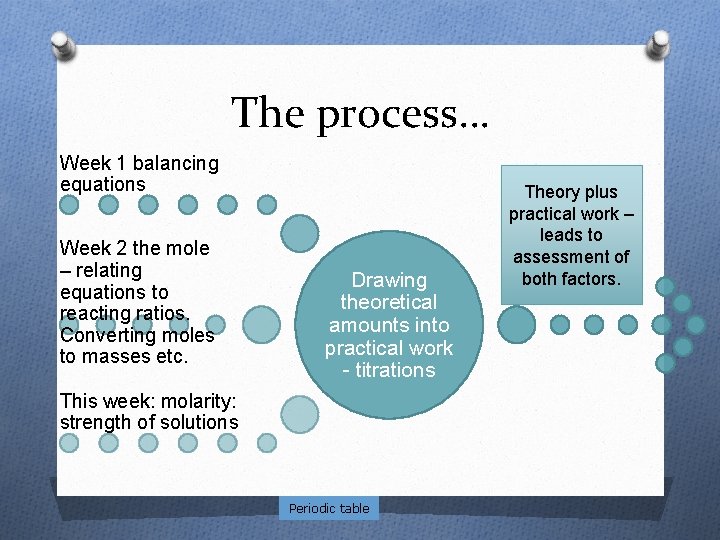
The process… Week 1 balancing equations Week 2 the mole – relating equations to reacting ratios. Converting moles to masses etc. Drawing theoretical amounts into practical work - titrations This week: molarity: strength of solutions Periodic table Theory plus practical work – leads to assessment of both factors.
Week 3 learning aims: O Recall calculating Mr and converting moles to masses and visa versa (lots in the exam) O Calculate reacting masses from equations. O Make up a standard solution News ! 3 Periodic table
Molarity or concentration in moles per dm 3 O Molarity is a measure of concentration in solutions and is defined as the number of moles of a solute dissolved in 1 dm 3 (1000 cm 3 or 1 litre) of solution. O Think of it like dissolving sugar in tea! O Units are mol dm-3 or M 4 Periodic table
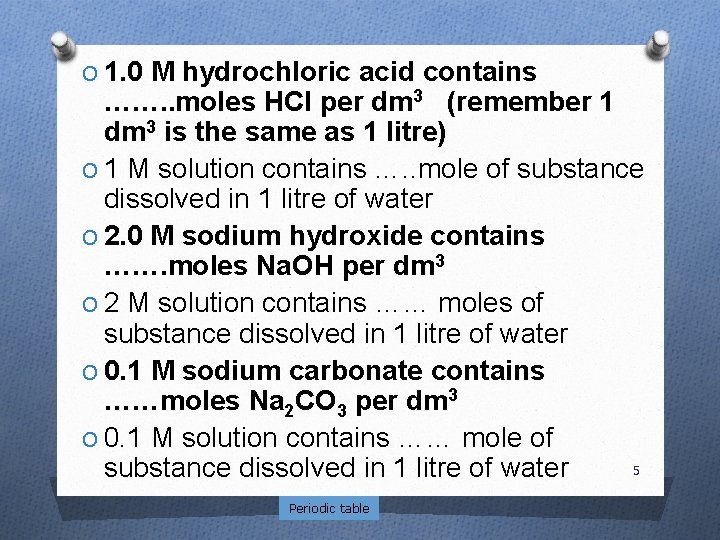
O 1. 0 M hydrochloric acid contains ……. . moles HCl per dm 3 (remember 1 dm 3 is the same as 1 litre) O 1 M solution contains …. . mole of substance dissolved in 1 litre of water O 2. 0 M sodium hydroxide contains ……. moles Na. OH per dm 3 O 2 M solution contains …… moles of substance dissolved in 1 litre of water O 0. 1 M sodium carbonate contains ……moles Na 2 CO 3 per dm 3 O 0. 1 M solution contains …… mole of 5 substance dissolved in 1 litre of water Periodic table
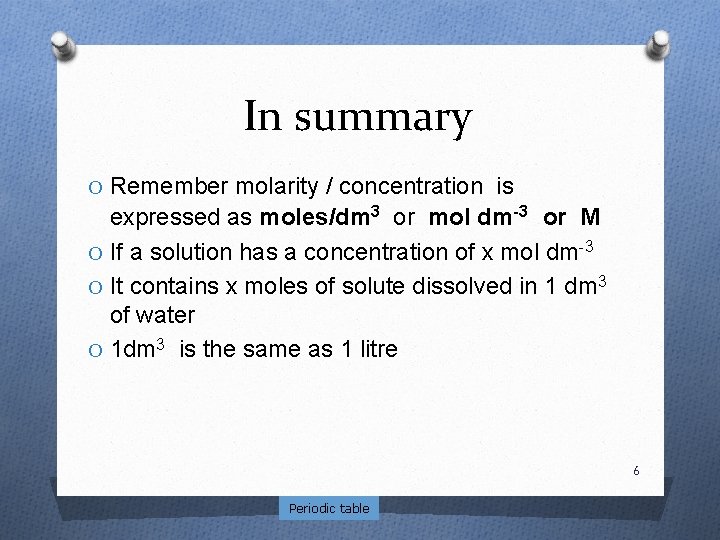
In summary O Remember molarity / concentration is expressed as moles/dm 3 or mol dm-3 or M O If a solution has a concentration of x mol dm-3 O It contains x moles of solute dissolved in 1 dm 3 of water O 1 dm 3 is the same as 1 litre 6 Periodic table
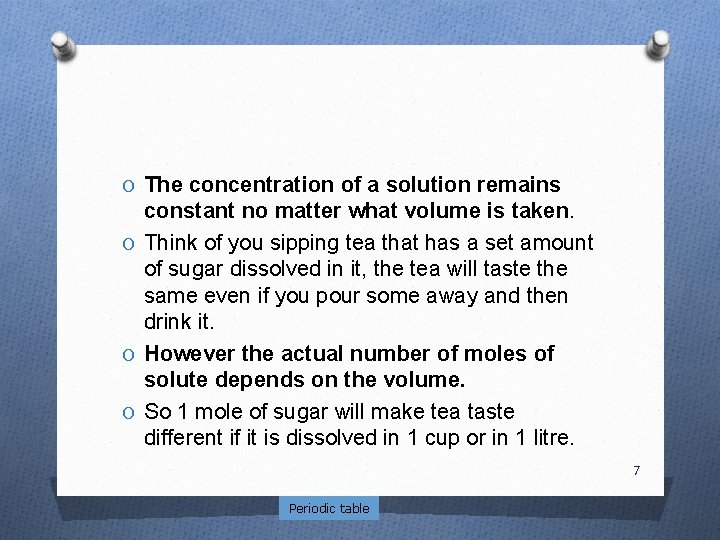
O The concentration of a solution remains constant no matter what volume is taken. O Think of you sipping tea that has a set amount of sugar dissolved in it, the tea will taste the same even if you pour some away and then drink it. O However the actual number of moles of solute depends on the volume. O So 1 mole of sugar will make tea taste different if it is dissolved in 1 cup or in 1 litre. 7 Periodic table
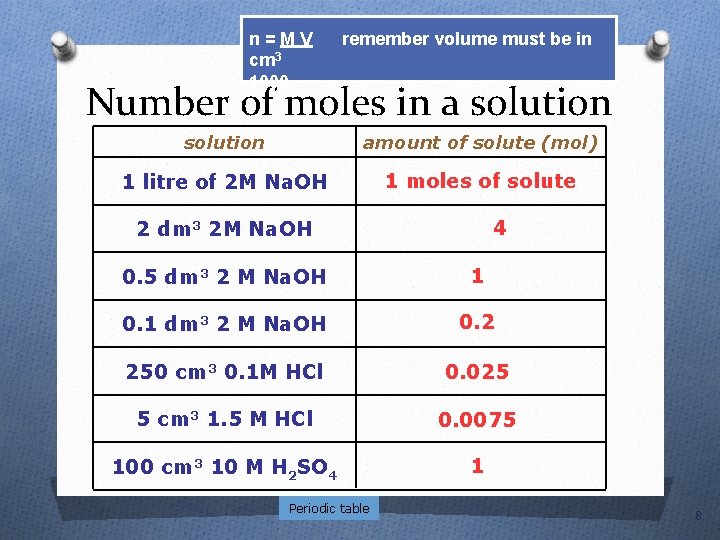
n=MV cm 3 1000 remember volume must be in Number of moles in a solution amount of solute (mol) 1 litre of 2 M Na. OH 1 moles of solute 4 2 dm 3 2 M Na. OH 0. 5 dm 3 2 M Na. OH 1 0. 1 dm 3 2 M Na. OH 0. 2 250 cm 3 0. 1 M HCl 0. 025 5 cm 3 1. 5 M HCl 0. 0075 100 cm 3 10 M H 2 SO 4 1 Periodic table 8
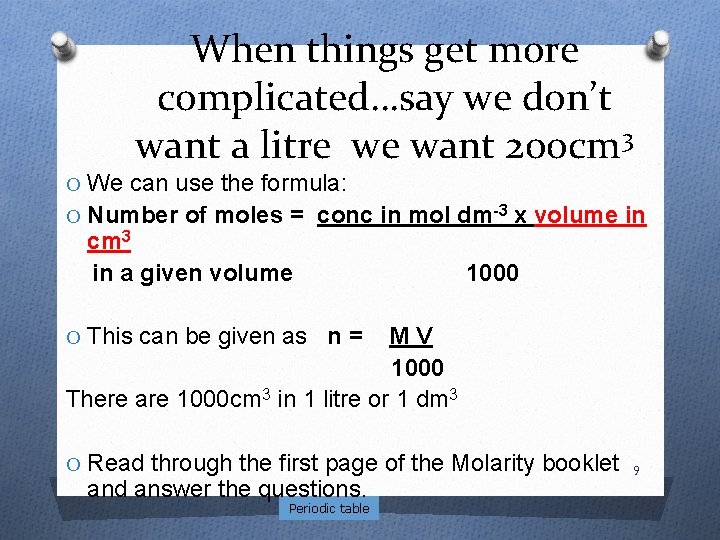
When things get more complicated…say we don’t want a litre we want 200 cm 3 O We can use the formula: O Number of moles = conc in mol dm-3 x volume in cm 3 in a given volume 1000 O This can be given as n = MV 1000 There are 1000 cm 3 in 1 litre or 1 dm 3 O Read through the first page of the Molarity booklet and answer the questions. Periodic table 9
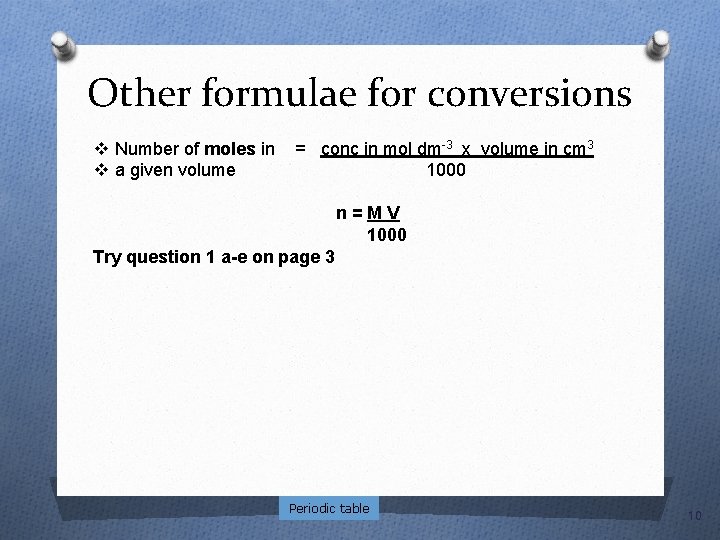
Other formulae for conversions v Number of moles in = conc in mol dm-3 x volume in cm 3 v a given volume 1000 n=MV 1000 Try question 1 a-e on page 3 Periodic table 10
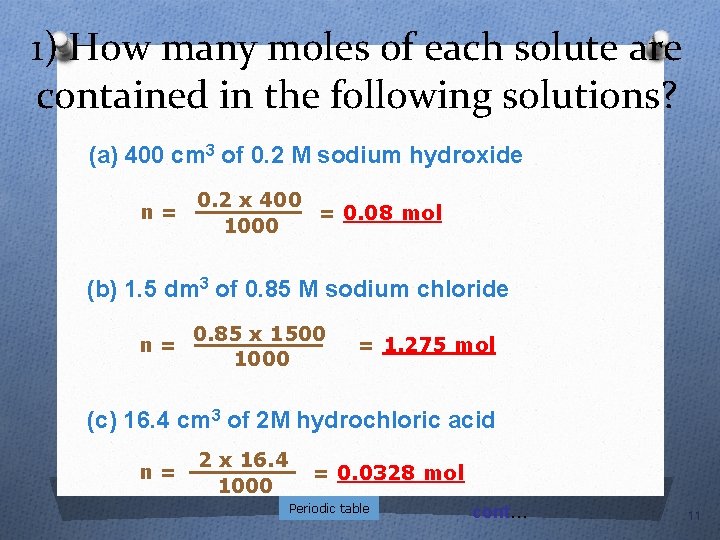
1) How many moles of each solute are contained in the following solutions? (a) 400 cm 3 of 0. 2 M sodium hydroxide n= 0. 2 x 400 = 0. 08 mol 1000 (b) 1. 5 dm 3 of 0. 85 M sodium chloride n= 0. 85 x 1500 1000 = 1. 275 mol (c) 16. 4 cm 3 of 2 M hydrochloric acid n= 2 x 16. 4 1000 = 0. 0328 mol Periodic table cont… 11
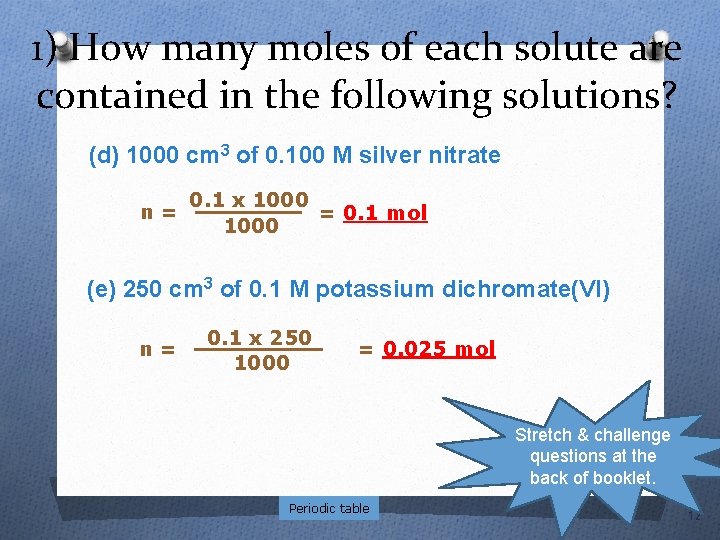
1) How many moles of each solute are contained in the following solutions? (d) 1000 cm 3 of 0. 100 M silver nitrate n= 0. 1 x 1000 = 0. 1 mol 1000 (e) 250 cm 3 of 0. 1 M potassium dichromate(VI) n= 0. 1 x 250 1000 = 0. 025 mol Stretch & challenge questions at the back of booklet. Periodic table 12
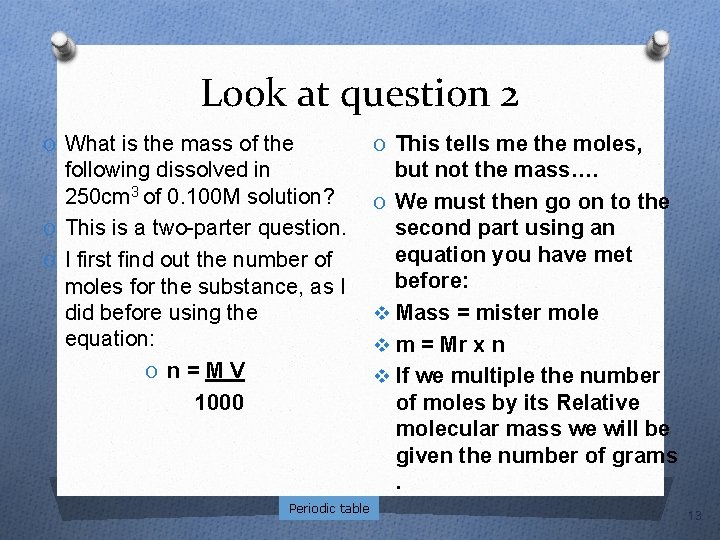
Look at question 2 O What is the mass of the O This tells me the moles, following dissolved in 250 cm 3 of 0. 100 M solution? O This is a two-parter question. O I first find out the number of moles for the substance, as I did before using the equation: O n=MV 1000 but not the mass…. O We must then go on to the second part using an equation you have met before: v Mass = mister mole v m = Mr x n v If we multiple the number of moles by its Relative molecular mass we will be given the number of grams. Periodic table 13
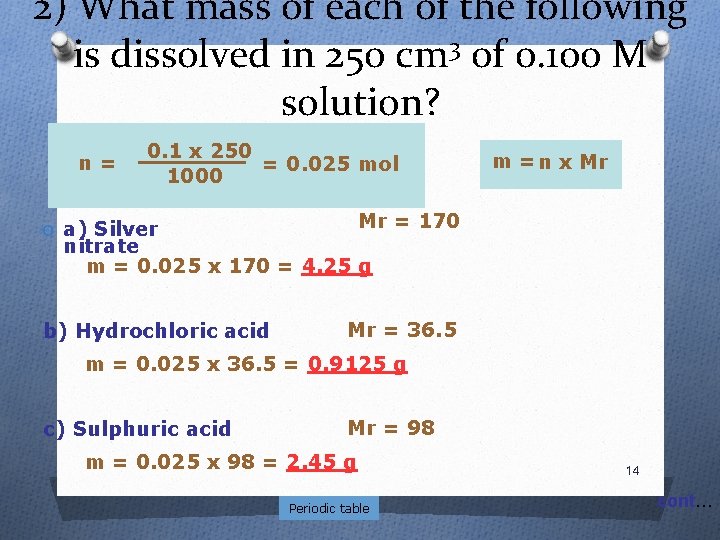
2) What mass of each of the following is dissolved in 250 cm 3 of 0. 100 M solution? n= 0. 1 x 250 = 0. 025 mol 1000 m = n x Mr Mr = 170 O a) Silver nitrate m = 0. 025 x 170 = 4. 25 g b) Hydrochloric acid Mr = 36. 5 m = 0. 025 x 36. 5 = 0. 9125 g c) Sulphuric acid Mr = 98 m = 0. 025 x 98 = 2. 45 g Periodic table 14 cont…
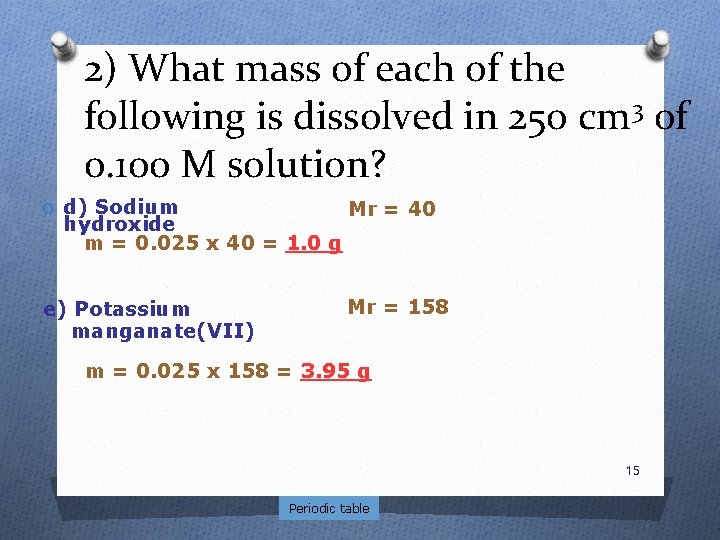
2) What mass of each of the following is dissolved in 250 cm 3 of 0. 100 M solution? O d) Sodium Mr = 40 e) Potassium manganate(VII) Mr = 158 hydroxide m = 0. 025 x 40 = 1. 0 g m = 0. 025 x 158 = 3. 95 g 15 Periodic table
Break! 16 Periodic table
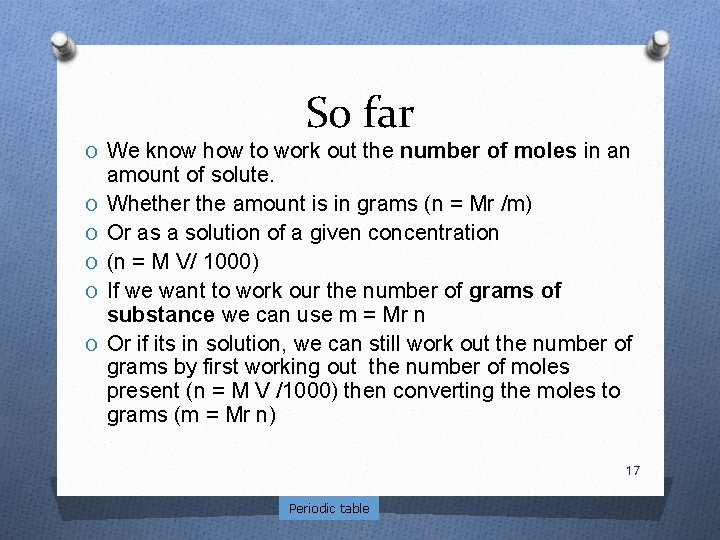
So far O We know how to work out the number of moles in an O O O amount of solute. Whether the amount is in grams (n = Mr /m) Or as a solution of a given concentration (n = M V/ 1000) If we want to work our the number of grams of substance we can use m = Mr n Or if its in solution, we can still work out the number of grams by first working out the number of moles present (n = M V /1000) then converting the moles to grams (m = Mr n) 17 Periodic table
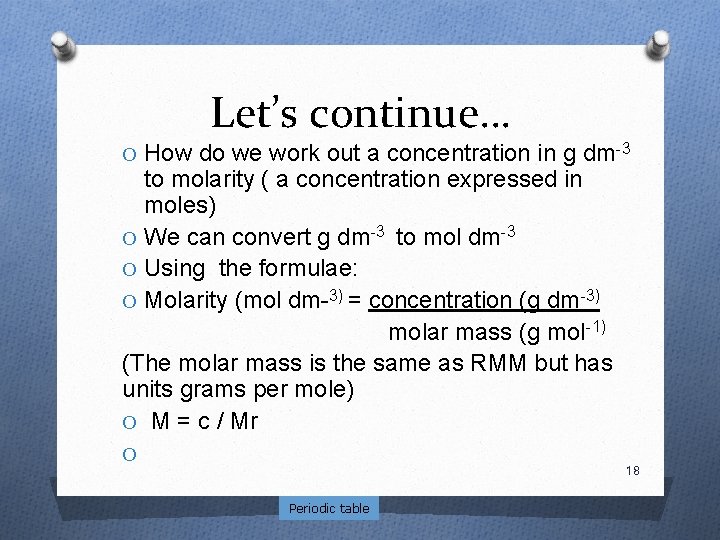
Let’s continue… O How do we work out a concentration in g dm-3 to molarity ( a concentration expressed in moles) O We can convert g dm-3 to mol dm-3 O Using the formulae: O Molarity (mol dm-3) = concentration (g dm-3) molar mass (g mol -1) (The molar mass is the same as RMM but has units grams per mole) O M = c / Mr O Periodic table 18
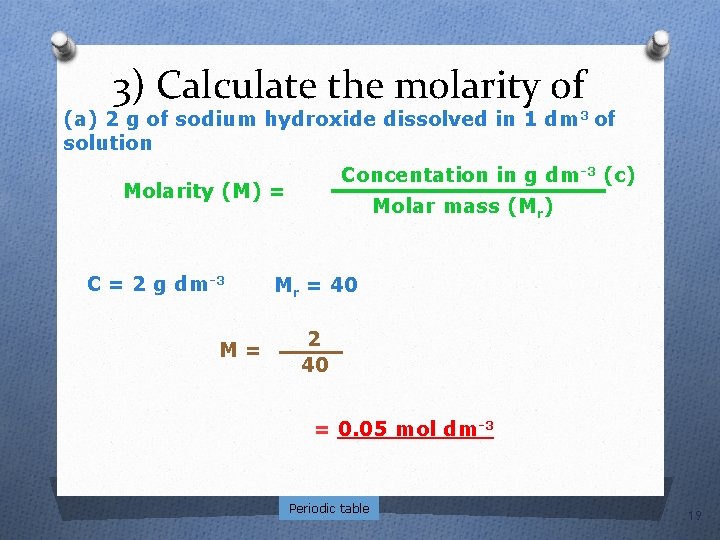
3) Calculate the molarity of (a) 2 g of sodium hydroxide dissolved in 1 dm 3 of solution Concentation in g dm-3 (c) Molarity (M) = C = 2 g dm-3 M= Molar mass (Mr) Mr = 40 2 40 = 0. 05 mol dm-3 Periodic table 19
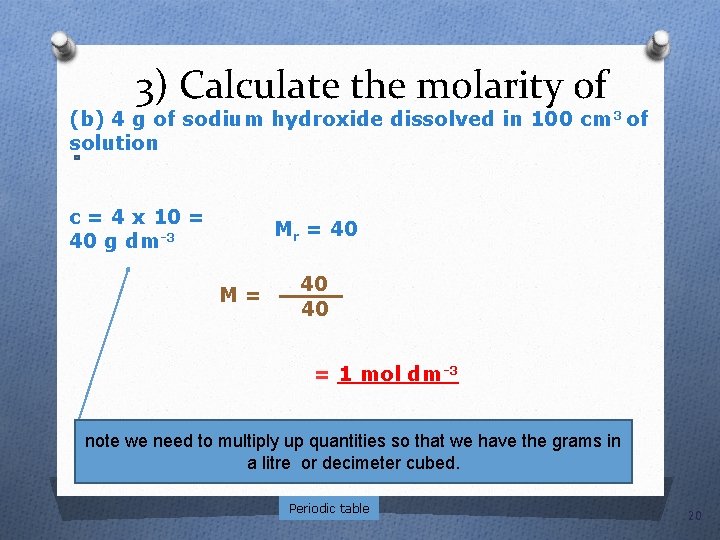
3) Calculate the molarity of (b) 4 g of sodium hydroxide dissolved in 100 cm 3 of solution c = 4 x 10 = 40 g dm-3 Mr = 40 M= 40 40 = 1 mol dm-3 note we need to multiply up quantities so that we have the grams in a litre or decimeter cubed. Periodic table 20
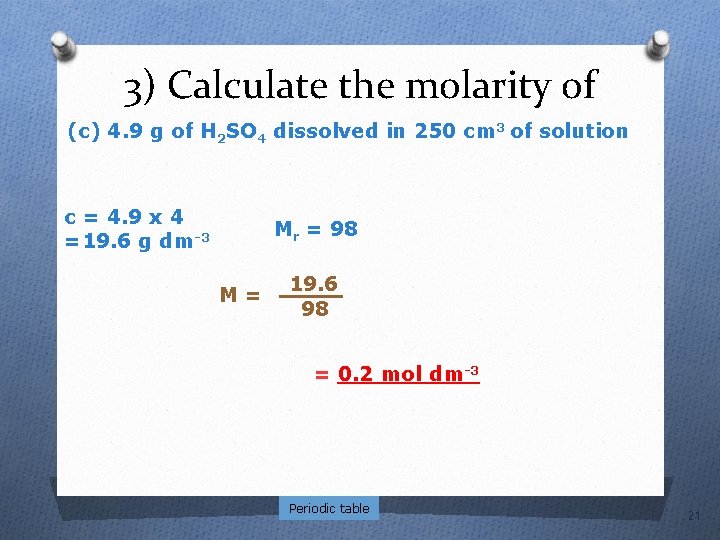
3) Calculate the molarity of (c) 4. 9 g of H 2 SO 4 dissolved in 250 cm 3 of solution c = 4. 9 x 4 =19. 6 g dm-3 Mr = 98 M= 19. 6 98 = 0. 2 mol dm-3 Periodic table 21
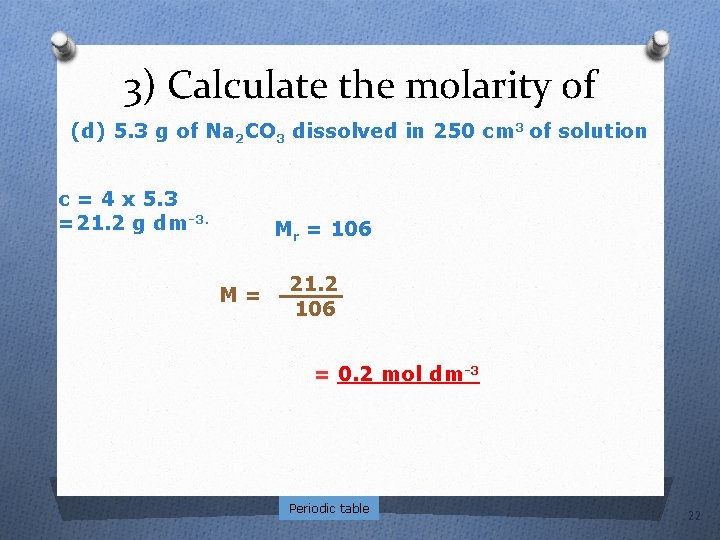
3) Calculate the molarity of (d) 5. 3 g of Na 2 CO 3 dissolved in 250 cm 3 of solution c = 4 x 5. 3 =21. 2 g dm-3. Mr = 106 M= 21. 2 106 = 0. 2 mol dm-3 Periodic table 22
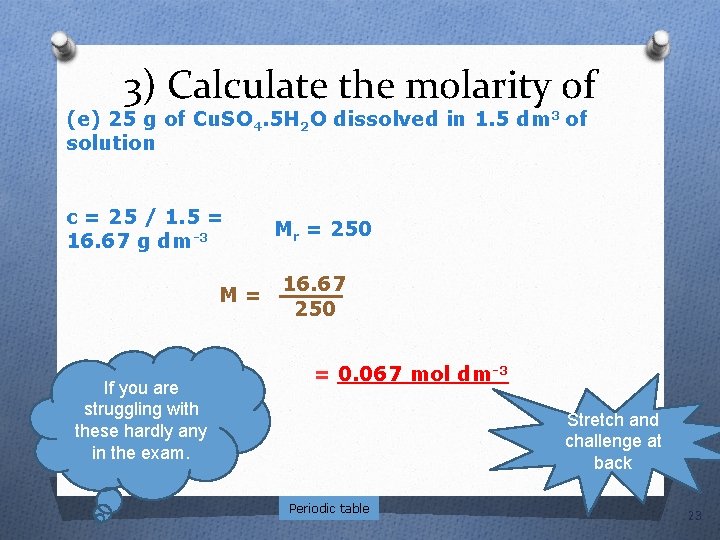
3) Calculate the molarity of (e) 25 g of Cu. SO 4. 5 H 2 O dissolved in 1. 5 dm 3 of solution c = 25 / 1. 5 = 16. 67 g dm-3 M= If you are struggling with these hardly any in the exam. Mr = 250 16. 67 250 = 0. 067 mol dm-3 Stretch and challenge at back Periodic table 23
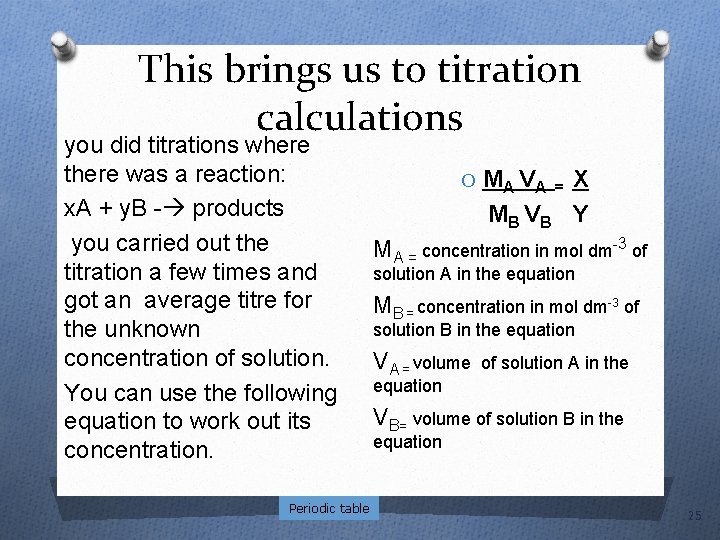
Titrations O When we have carried out practical work the past 2 weeks, we have carried out titrations. O This is where we use a solution of known concentration and volume (a standard solution) to work out the concentration of an unknown solution. O So far you have carried out your titration and found how much you have to add of the unknown solution to the set volume and concentration of your standard solution. O This value was your average titre. But we haven’t worked out it’s concentration, the objective of a titration. 24 Periodic table
This brings us to titration calculations you did titrations where there was a reaction: x. A + y. B - products you carried out the titration a few times and got an average titre for the unknown concentration of solution. You can use the following equation to work out its concentration. Periodic table O MA V A M B VB = X Y MA = concentration in mol dm-3 of solution A in the equation MB = concentration in mol dm-3 of solution B in the equation VA = volume of solution A in the equation VB= volume of solution B in the equation 25
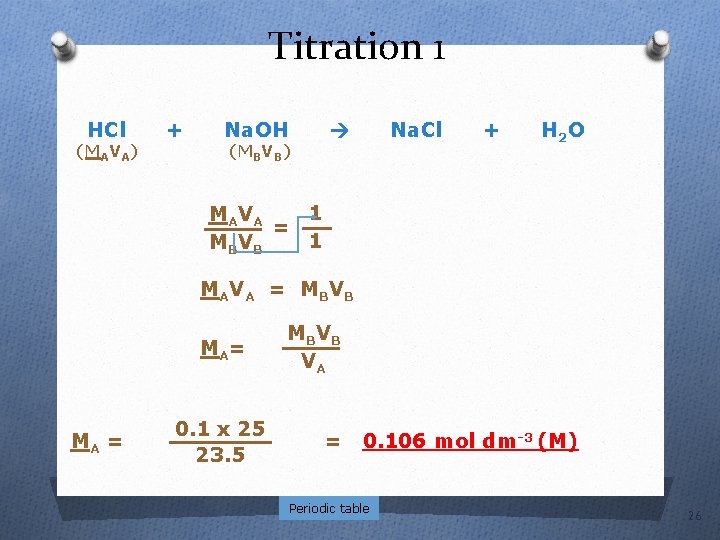
Titration 1 HCl (MAVA) + Na. OH (MBVB) Na. Cl + H 2 O 1 M AV A = 1 MBVB MAVA = MBVB M A= MA = 0. 1 x 25 23. 5 MBVB VA = 0. 106 mol dm-3 (M) Periodic table 26
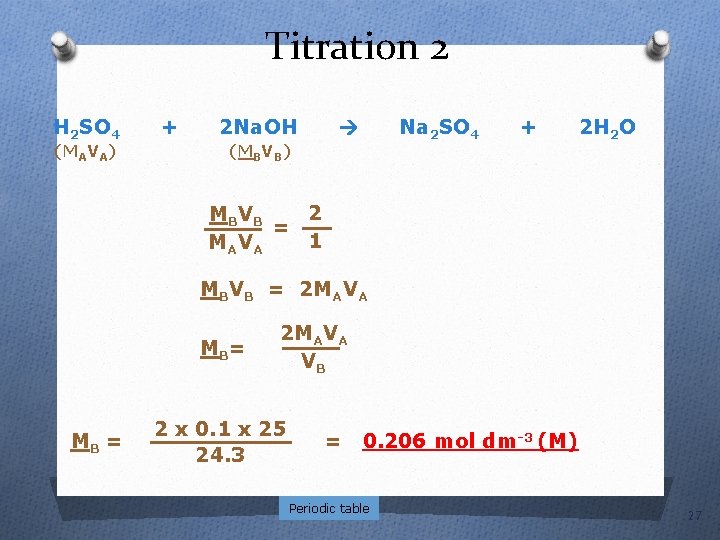
Titration 2 H 2 SO 4 (MAVA) + 2 Na. OH Na 2 SO 4 (MBVB) + 2 H 2 O 2 MBVB = 1 M AV A MBVB = 2 MAVA MB= MB = 2 MAVA VB 2 x 0. 1 x 25 24. 3 = 0. 206 mol dm-3 (M) Periodic table 27
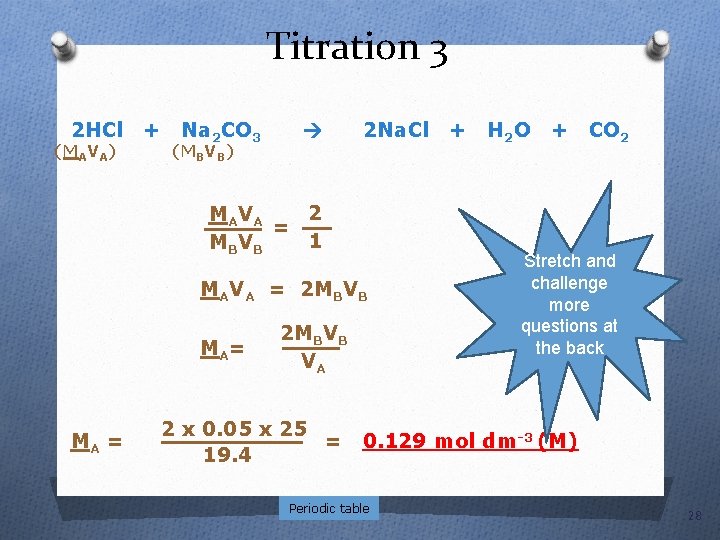
Titration 3 2 HCl (MAVA) + Na 2 CO 3 (MBVB) 2 Na. Cl 2 M AV A = 1 MBVB MAVA = 2 MBVB M A= MA = 2 MBVB VA 2 x 0. 05 x 25 = 19. 4 + H 2 O + CO 2 Stretch and challenge more questions at the back 0. 129 mol dm-3 (M) Periodic table 28
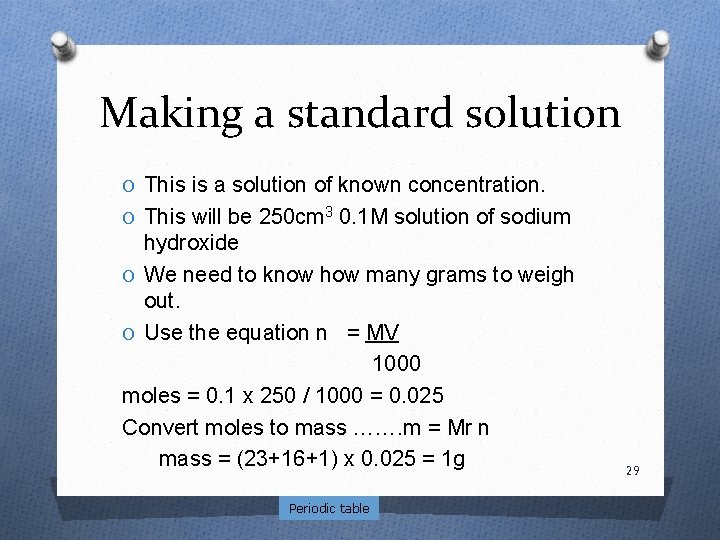
Making a standard solution O This is a solution of known concentration. O This will be 250 cm 3 0. 1 M solution of sodium hydroxide O We need to know how many grams to weigh out. O Use the equation n = MV 1000 moles = 0. 1 x 250 / 1000 = 0. 025 Convert moles to mass ……. m = Mr n mass = (23+16+1) x 0. 025 = 1 g Periodic table 29
Periodic Table 30 click to return