
Formulae equations and amounts of substance DEFINITION The
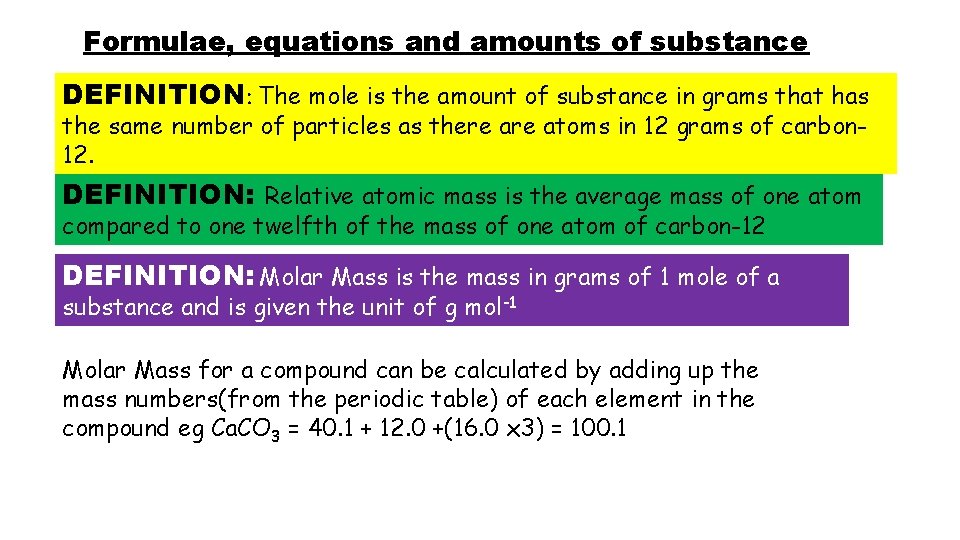
Formulae, equations and amounts of substance DEFINITION: The mole is the amount of substance in grams that has the same number of particles as there atoms in 12 grams of carbon 12. DEFINITION: Relative atomic mass is the average mass of one atom compared to one twelfth of the mass of one atom of carbon-12 DEFINITION: Molar Mass is the mass in grams of 1 mole of a substance and is given the unit of g mol-1 Molar Mass for a compound can be calculated by adding up the mass numbers(from the periodic table) of each element in the compound eg Ca. CO 3 = 40. 1 + 12. 0 +(16. 0 x 3) = 100. 1
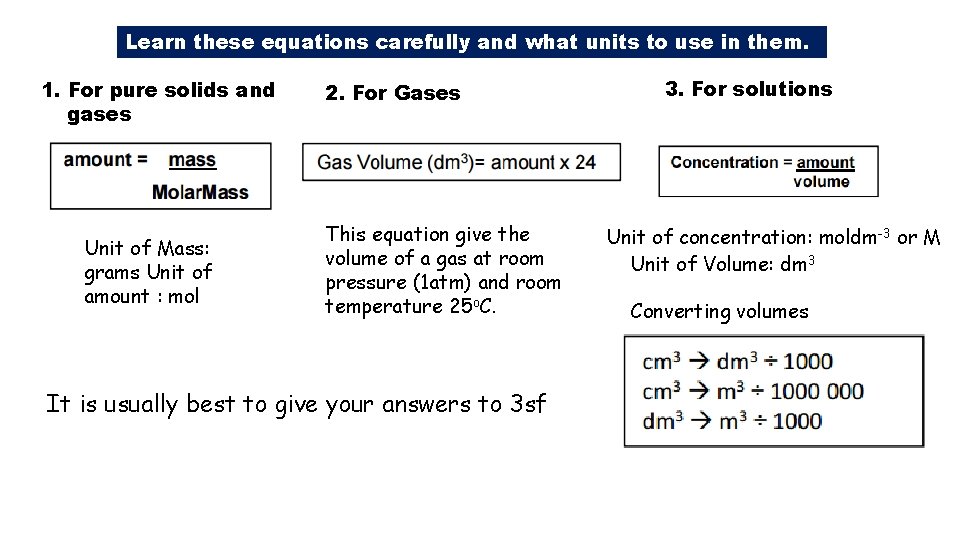
Learn these equations carefully and what units to use in them. 1. For pure solids and gases Unit of Mass: grams Unit of amount : mol 2. For Gases This equation give the volume of a gas at room pressure (1 atm) and room temperature 25 o. C. It is usually best to give your answers to 3 sf 3. For solutions Unit of concentration: moldm-3 or M Unit of Volume: dm 3 Converting volumes
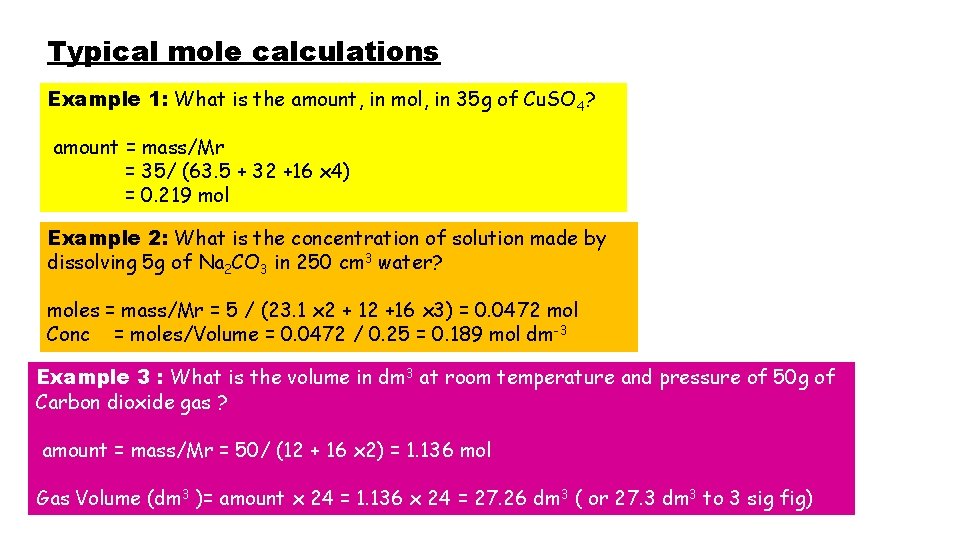
Typical mole calculations Example 1: What is the amount, in mol, in 35 g of Cu. SO 4? amount = mass/Mr = 35/ (63. 5 + 32 +16 x 4) = 0. 219 mol Example 2: What is the concentration of solution made by dissolving 5 g of Na 2 CO 3 in 250 cm 3 water? moles = mass/Mr = 5 / (23. 1 x 2 + 12 +16 x 3) = 0. 0472 mol Conc = moles/Volume = 0. 0472 / 0. 25 = 0. 189 mol dm -3 Example 3 : What is the volume in dm 3 at room temperature and pressure of 50 g of Carbon dioxide gas ? amount = mass/Mr = 50/ (12 + 16 x 2) = 1. 136 mol Gas Volume (dm 3 )= amount x 24 = 1. 136 x 24 = 27. 26 dm 3 ( or 27. 3 dm 3 to 3 sig fig)
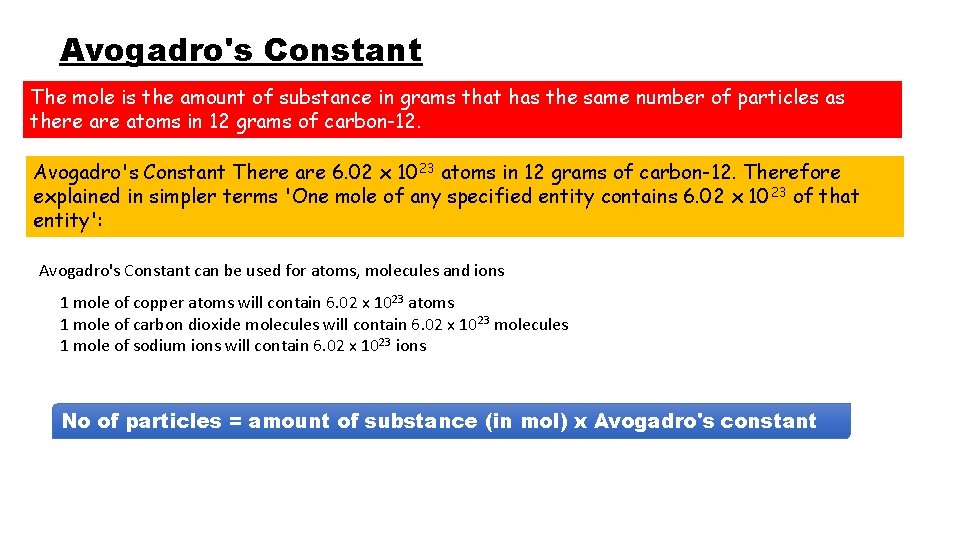
Avogadro's Constant The mole is the amount of substance in grams that has the same number of particles as there atoms in 12 grams of carbon-12. Avogadro's Constant There are 6. 02 x 1023 atoms in 12 grams of carbon-12. Therefore explained in simpler terms 'One mole of any specified entity contains 6. 02 x 10 23 of that entity': Avogadro's Constant can be used for atoms, molecules and ions 1 mole of copper atoms will contain 6. 02 x 1023 atoms 1 mole of carbon dioxide molecules will contain 6. 02 x 1023 molecules 1 mole of sodium ions will contain 6. 02 x 1023 ions No of particles = amount of substance (in mol) x Avogadro's constant
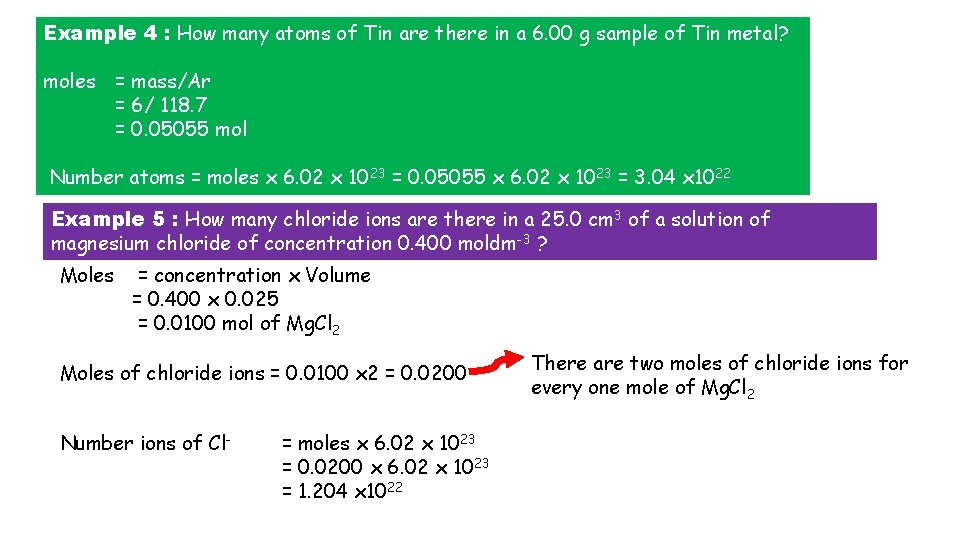
Example 4 : How many atoms of Tin are there in a 6. 00 g sample of Tin metal? moles = mass/Ar = 6/ 118. 7 = 0. 05055 mol Number atoms = moles x 6. 02 x 1023 = 0. 05055 x 6. 02 x 1023 = 3. 04 x 1022 Example 5 : How many chloride ions are there in a 25. 0 cm 3 of a solution of magnesium chloride of concentration 0. 400 moldm-3 ? Moles = concentration x Volume = 0. 400 x 0. 025 = 0. 0100 mol of Mg. Cl 2 Moles of chloride ions = 0. 0100 x 2 = 0. 0200 Number ions of Cl- = moles x 6. 02 x 1023 = 0. 0200 x 6. 02 x 1023 = 1. 204 x 1022 There are two moles of chloride ions for every one mole of Mg. Cl 2
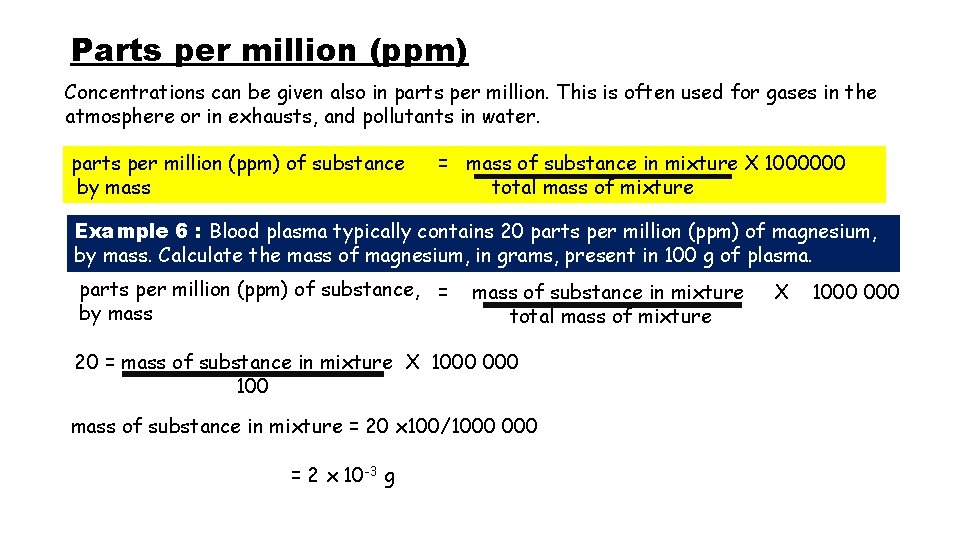
Parts per million (ppm) Concentrations can be given also in parts per million. This is often used for gases in the atmosphere or in exhausts, and pollutants in water. parts per million (ppm) of substance by mass = mass of substance in mixture X 1000000 total mass of mixture Example 6 : Blood plasma typically contains 20 parts per million (ppm) of magnesium, by mass. Calculate the mass of magnesium, in grams, present in 100 g of plasma. parts per million (ppm) of substance, = by mass of substance in mixture total mass of mixture 20 = mass of substance in mixture X 1000 100 mass of substance in mixture = 20 x 100/1000 = 2 x 10 -3 g X 1000
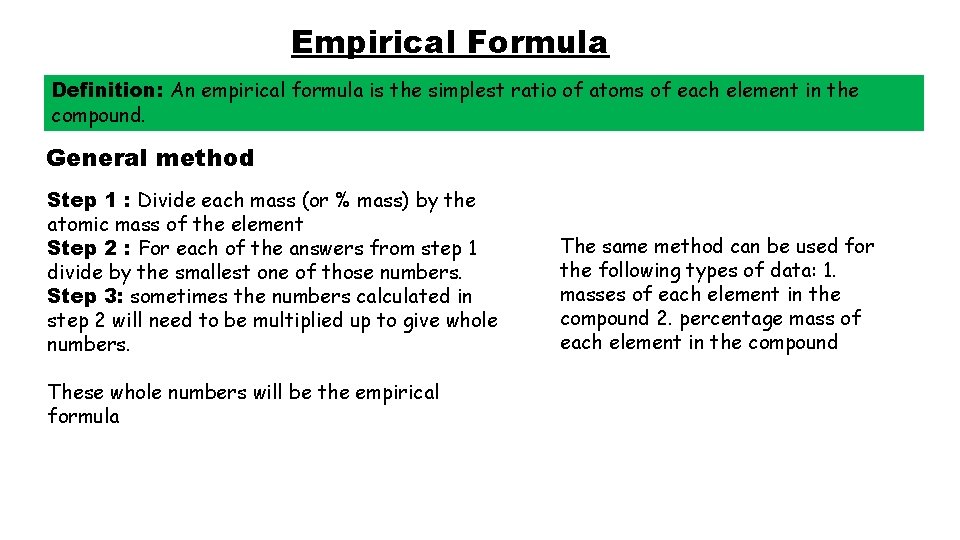
Empirical Formula Definition: An empirical formula is the simplest ratio of atoms of each element in the compound. General method Step 1 : Divide each mass (or % mass) by the atomic mass of the element Step 2 : For each of the answers from step 1 divide by the smallest one of those numbers. Step 3: sometimes the numbers calculated in step 2 will need to be multiplied up to give whole numbers. These whole numbers will be the empirical formula The same method can be used for the following types of data: 1. masses of each element in the compound 2. percentage mass of each element in the compound

Example 7 : Calculate the empirical formula for a compound that contains 1. 82 g of K, 5. 93 g of I and 2. 24 g of O Step 1: Divide each mass by the atomic mass of the element K = 1. 82 / 39. 1 I = 5. 93/126. 9 O = 2. 24/16 = 0. 0465 mol = 0. 0467 mol = 0. 14 mol Step 2 For each of the answers from step 1 divide by the smallest one of those numbers. K = 0. 0465/0. 0465 I = 0. 0467/0. 0465 O = 0. 14 / 0. 0465 =1 =1 =3 Empirical formula =KIO 3 Molecular formula from empirical formula Definition: A molecular formula is the actual number of atoms of each element in the compound. From the relative molecular mass (Mr) work out how many times the mass of the empirical formula fits into the Mr.
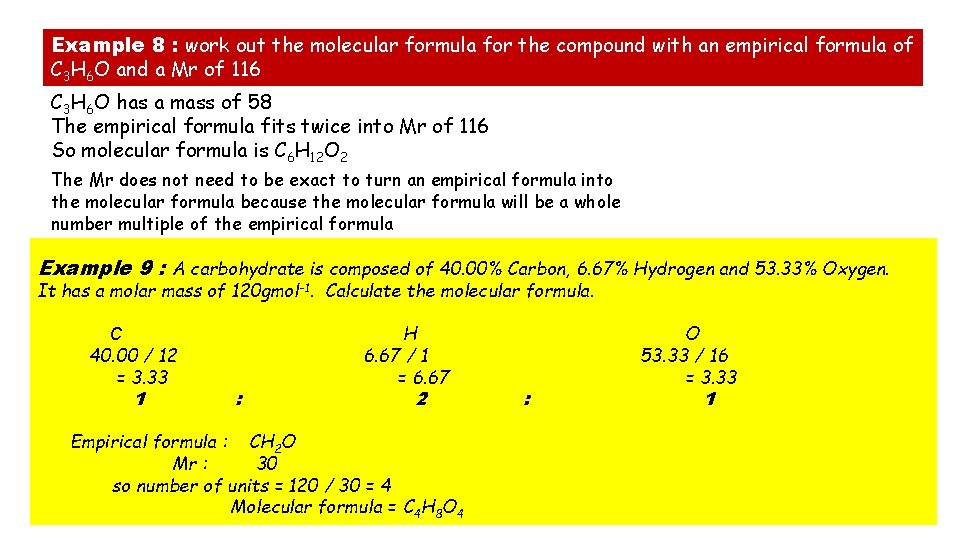
Example 8 : work out the molecular formula for the compound with an empirical formula of C 3 H 6 O and a Mr of 116 C 3 H 6 O has a mass of 58 The empirical formula fits twice into Mr of 116 So molecular formula is C 6 H 12 O 2 The Mr does not need to be exact to turn an empirical formula into the molecular formula because the molecular formula will be a whole number multiple of the empirical formula Example 9 : A carbohydrate is composed of 40. 00% Carbon, 6. 67% Hydrogen and 53. 33% Oxygen. It has a molar mass of 120 gmol-1. Calculate the molecular formula. C 40. 00 / 12 = 3. 33 1 : H 6. 67 / 1 = 6. 67 2 Empirical formula : CH 2 O Mr : 30 so number of units = 120 / 30 = 4 Molecular formula = C 4 H 8 O 4 : O 53. 33 / 16 = 3. 33 1
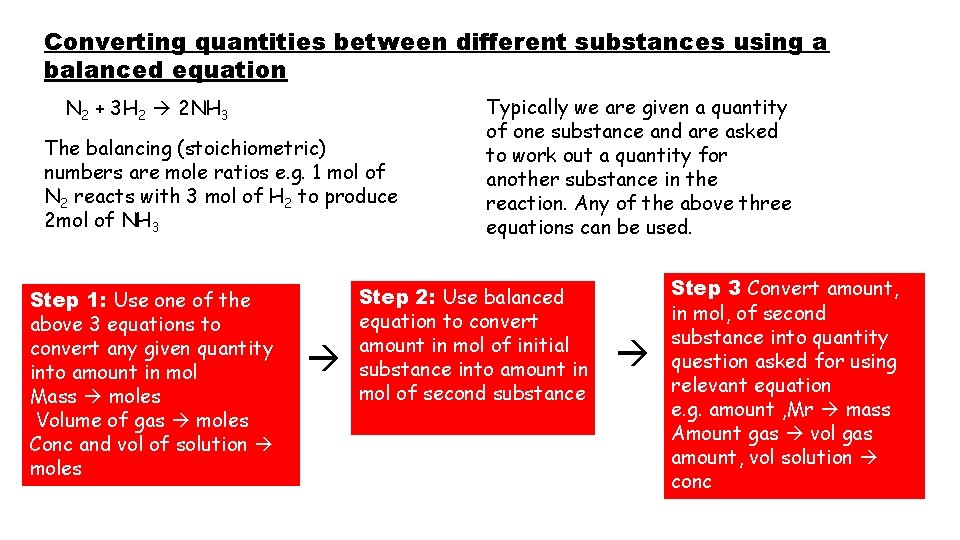
Converting quantities between different substances using a balanced equation N 2 + 3 H 2 2 NH 3 The balancing (stoichiometric) numbers are mole ratios e. g. 1 mol of N 2 reacts with 3 mol of H 2 to produce 2 mol of NH 3 Step 1: Use one of the above 3 equations to convert any given quantity into amount in mol Mass moles Volume of gas moles Conc and vol of solution moles Typically we are given a quantity of one substance and are asked to work out a quantity for another substance in the reaction. Any of the above three equations can be used. Step 2: Use balanced equation to convert amount in mol of initial substance into amount in mol of second substance Step 3 Convert amount, in mol, of second substance into quantity question asked for using relevant equation e. g. amount , Mr mass Amount gas vol gas amount, vol solution conc
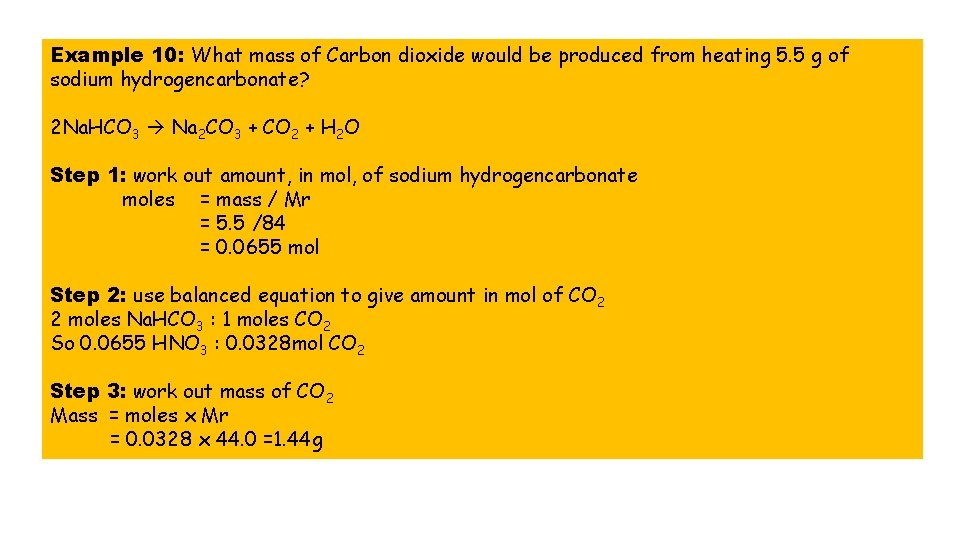
Example 10: What mass of Carbon dioxide would be produced from heating 5. 5 g of sodium hydrogencarbonate? 2 Na. HCO 3 Na 2 CO 3 + CO 2 + H 2 O Step 1: work out amount, in mol, of sodium hydrogencarbonate moles = mass / Mr = 5. 5 /84 = 0. 0655 mol Step 2: use balanced equation to give amount in mol of CO 2 2 moles Na. HCO 3 : 1 moles CO 2 So 0. 0655 HNO 3 : 0. 0328 mol CO 2 Step 3: work out mass of CO 2 Mass = moles x Mr = 0. 0328 x 44. 0 =1. 44 g
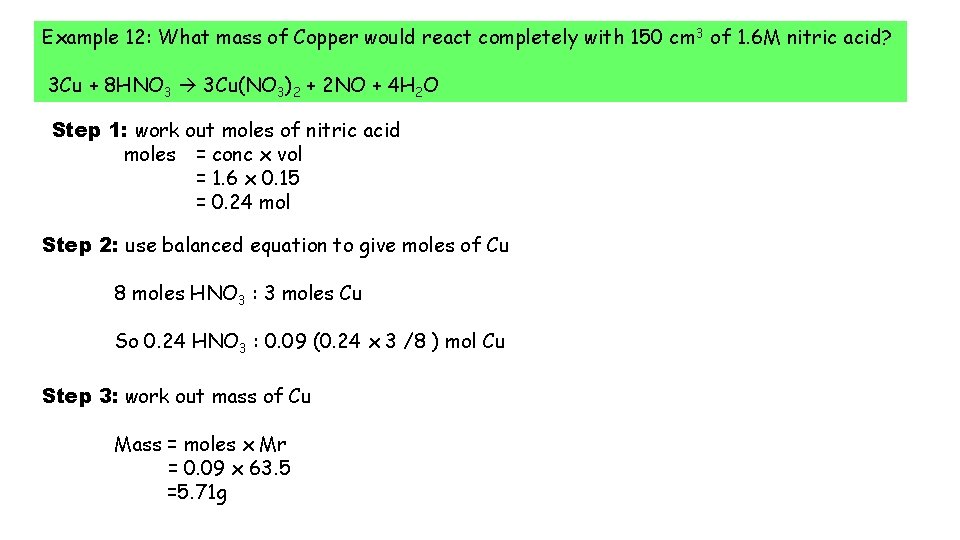
Example 12: What mass of Copper would react completely with 150 cm 3 of 1. 6 M nitric acid? 3 Cu + 8 HNO 3 3 Cu(NO 3)2 + 2 NO + 4 H 2 O Step 1: work out moles of nitric acid moles = conc x vol = 1. 6 x 0. 15 = 0. 24 mol Step 2: use balanced equation to give moles of Cu 8 moles HNO 3 : 3 moles Cu So 0. 24 HNO 3 : 0. 09 (0. 24 x 3 /8 ) mol Cu Step 3: work out mass of Cu Mass = moles x Mr = 0. 09 x 63. 5 =5. 71 g
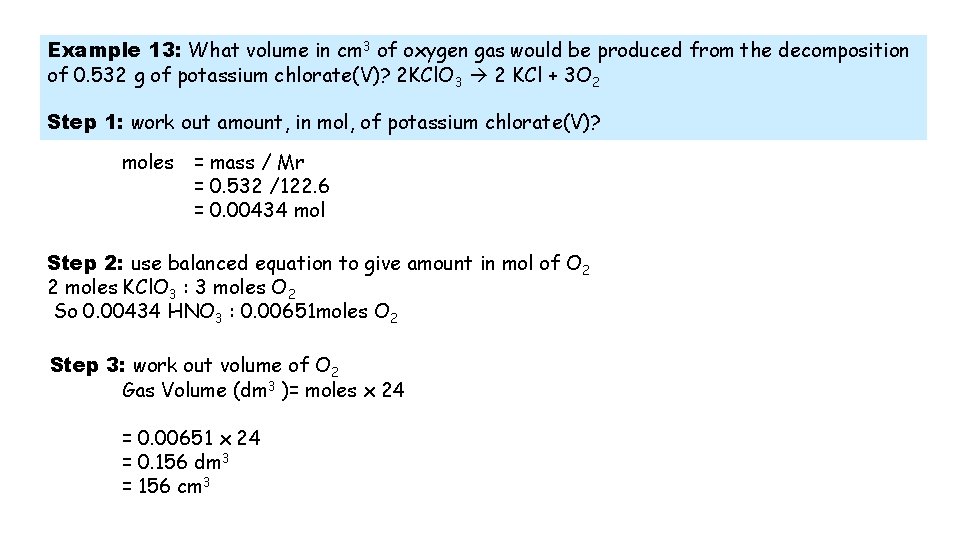
Example 13: What volume in cm 3 of oxygen gas would be produced from the decomposition of 0. 532 g of potassium chlorate(V)? 2 KCl. O 3 2 KCl + 3 O 2 Step 1: work out amount, in mol, of potassium chlorate(V)? moles = mass / Mr = 0. 532 /122. 6 = 0. 00434 mol Step 2: use balanced equation to give amount in mol of O 2 2 moles KCl. O 3 : 3 moles O 2 So 0. 00434 HNO 3 : 0. 00651 moles O 2 Step 3: work out volume of O 2 Gas Volume (dm 3 )= moles x 24 = 0. 00651 x 24 = 0. 156 dm 3 = 156 cm 3
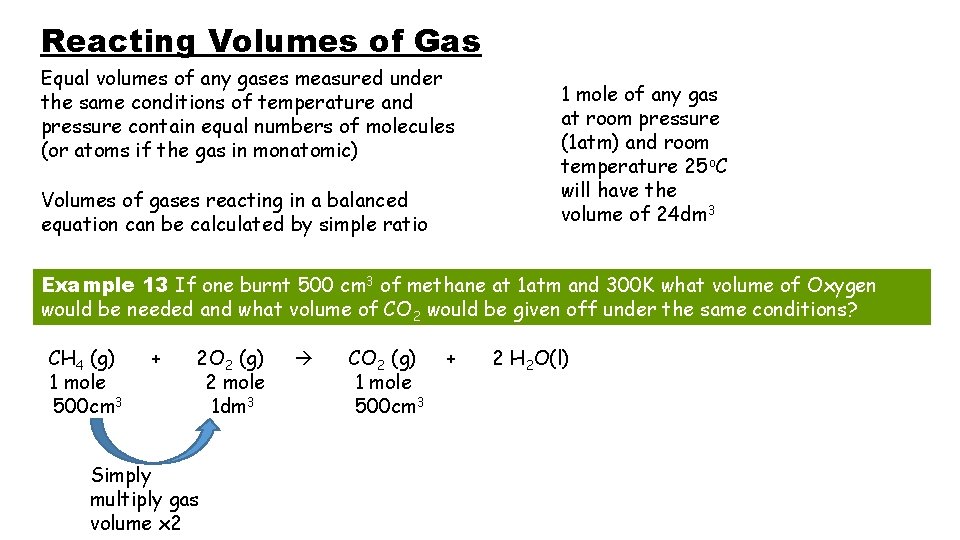
Reacting Volumes of Gas Equal volumes of any gases measured under the same conditions of temperature and pressure contain equal numbers of molecules (or atoms if the gas in monatomic) Volumes of gases reacting in a balanced equation can be calculated by simple ratio 1 mole of any gas at room pressure (1 atm) and room temperature 25 o. C will have the volume of 24 dm 3 Example 13 If one burnt 500 cm 3 of methane at 1 atm and 300 K what volume of Oxygen would be needed and what volume of CO 2 would be given off under the same conditions? CH 4 (g) 1 mole 500 cm 3 + 2 O 2 (g) 2 mole 1 dm 3 Simply multiply gas volume x 2 CO 2 (g) 1 mole 500 cm 3 + 2 H 2 O(l)
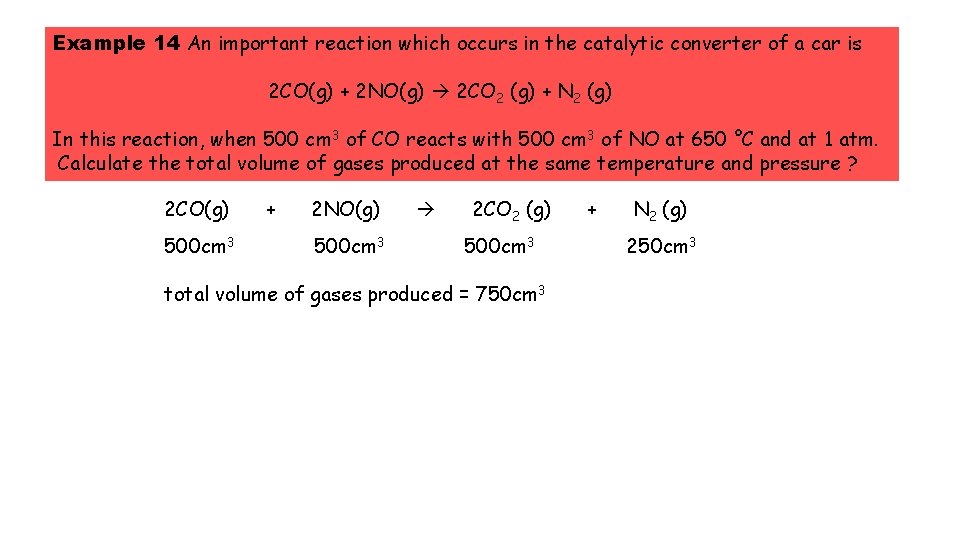
Example 14 An important reaction which occurs in the catalytic converter of a car is 2 CO(g) + 2 NO(g) 2 CO 2 (g) + N 2 (g) In this reaction, when 500 cm 3 of CO reacts with 500 cm 3 of NO at 650 °C and at 1 atm. Calculate the total volume of gases produced at the same temperature and pressure ? 2 CO(g) 500 cm 3 + 2 NO(g) 500 cm 3 2 CO 2 (g) 500 cm 3 total volume of gases produced = 750 cm 3 + N 2 (g) 250 cm 3
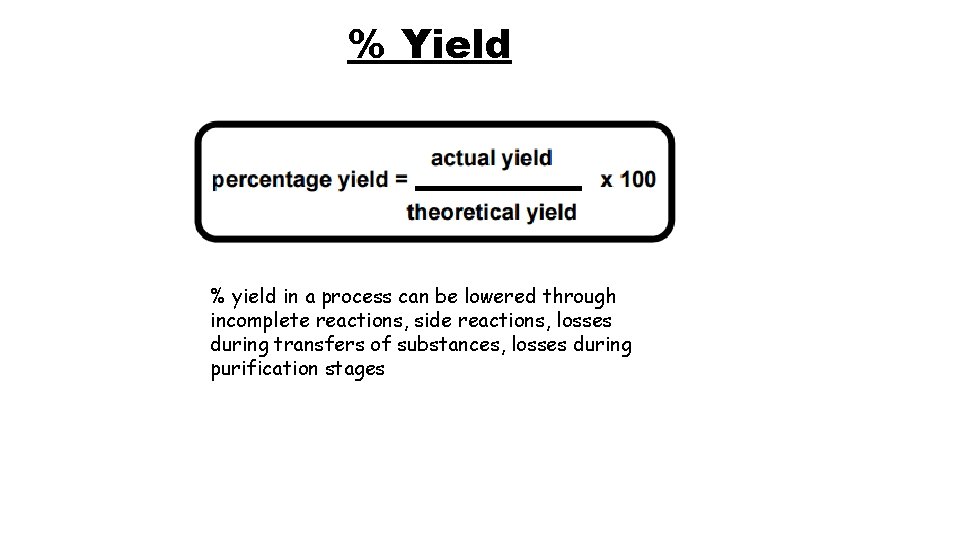
% Yield % yield in a process can be lowered through incomplete reactions, side reactions, losses during transfers of substances, losses during purification stages
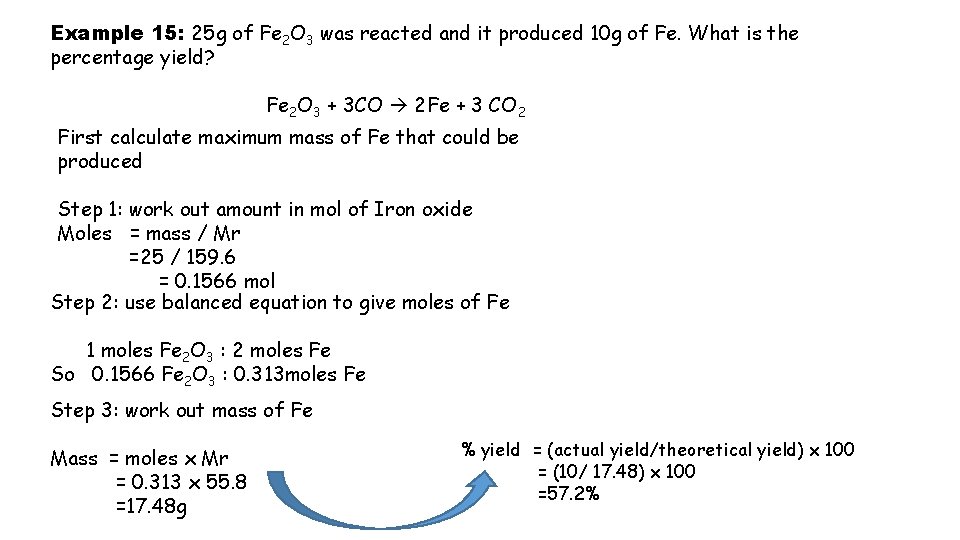
Example 15: 25 g of Fe 2 O 3 was reacted and it produced 10 g of Fe. What is the percentage yield? Fe 2 O 3 + 3 CO 2 Fe + 3 CO 2 First calculate maximum mass of Fe that could be produced Step 1: work out amount in mol of Iron oxide Moles = mass / Mr =25 / 159. 6 = 0. 1566 mol Step 2: use balanced equation to give moles of Fe 1 moles Fe 2 O 3 : 2 moles Fe So 0. 1566 Fe 2 O 3 : 0. 313 moles Fe Step 3: work out mass of Fe Mass = moles x Mr = 0. 313 x 55. 8 =17. 48 g % yield = (actual yield/theoretical yield) x 100 = (10/ 17. 48) x 100 =57. 2%
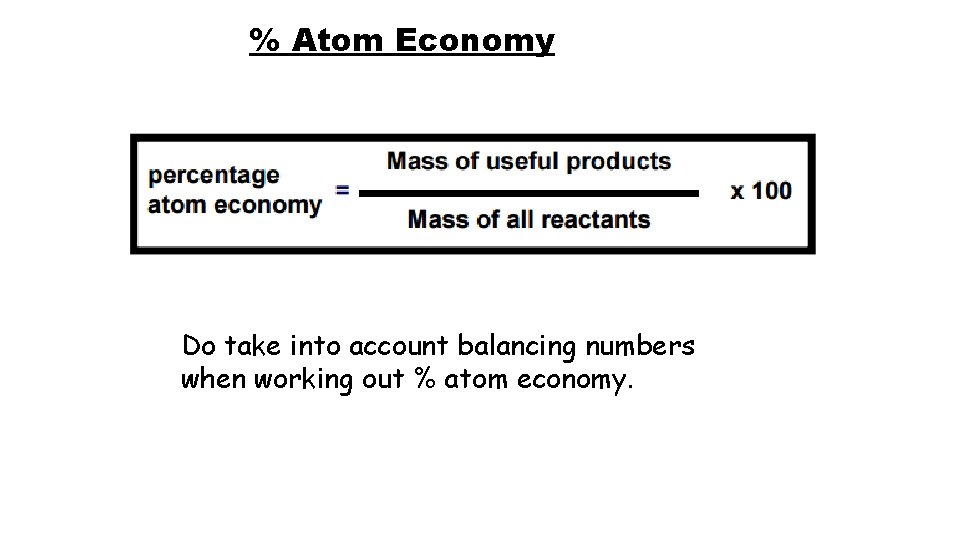
% Atom Economy Do take into account balancing numbers when working out % atom economy.
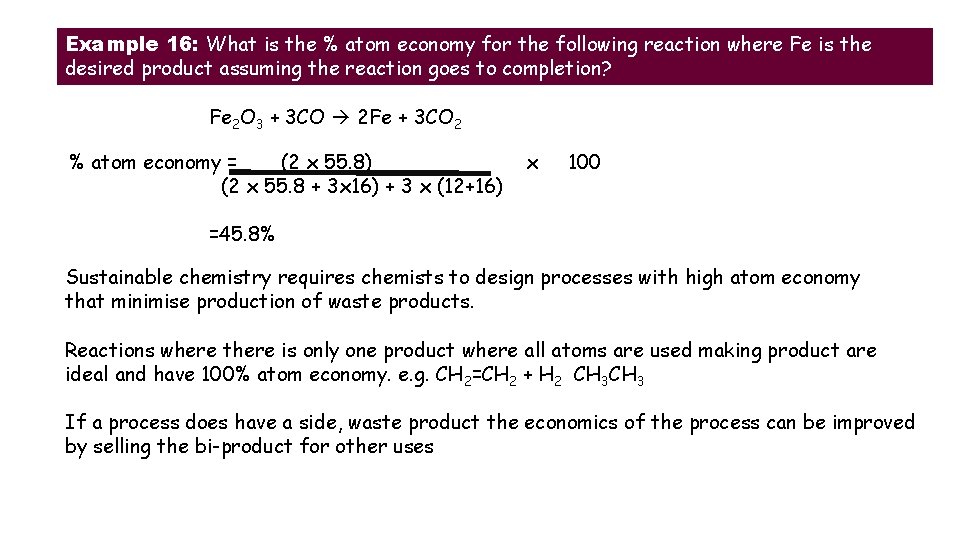
Example 16: What is the % atom economy for the following reaction where Fe is the desired product assuming the reaction goes to completion? Fe 2 O 3 + 3 CO 2 Fe + 3 CO 2 % atom economy = (2 x 55. 8) (2 x 55. 8 + 3 x 16) + 3 x (12+16) x 100 =45. 8% Sustainable chemistry requires chemists to design processes with high atom economy that minimise production of waste products. Reactions where there is only one product where all atoms are used making product are ideal and have 100% atom economy. e. g. CH 2=CH 2 + H 2 CH 3 If a process does have a side, waste product the economics of the process can be improved by selling the bi-product for other uses
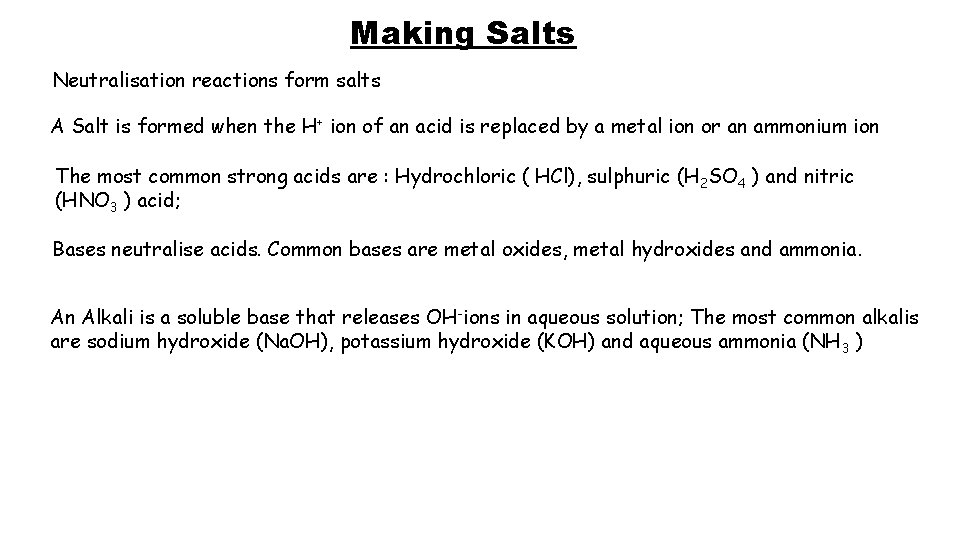
Making Salts Neutralisation reactions form salts A Salt is formed when the H+ ion of an acid is replaced by a metal ion or an ammonium ion The most common strong acids are : Hydrochloric ( HCl), sulphuric (H 2 SO 4 ) and nitric (HNO 3 ) acid; Bases neutralise acids. Common bases are metal oxides, metal hydroxides and ammonia. An Alkali is a soluble base that releases OH-ions in aqueous solution; The most common alkalis are sodium hydroxide (Na. OH), potassium hydroxide (KOH) and aqueous ammonia (NH 3 )
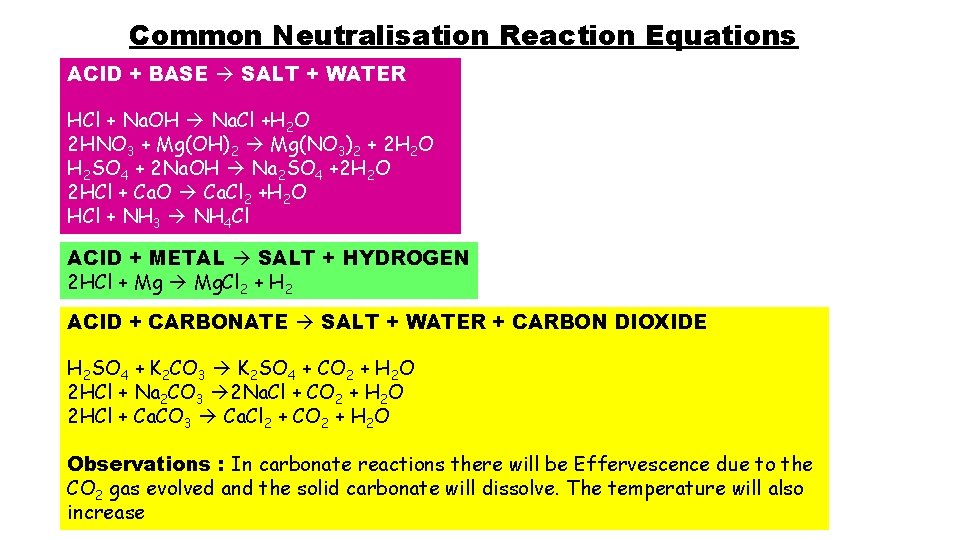
Common Neutralisation Reaction Equations ACID + BASE SALT + WATER HCl + Na. OH Na. Cl +H 2 O 2 HNO 3 + Mg(OH)2 Mg(NO 3)2 + 2 H 2 O H 2 SO 4 + 2 Na. OH Na 2 SO 4 +2 H 2 O 2 HCl + Ca. O Ca. Cl 2 +H 2 O HCl + NH 3 NH 4 Cl ACID + METAL SALT + HYDROGEN 2 HCl + Mg Mg. Cl 2 + H 2 ACID + CARBONATE SALT + WATER + CARBON DIOXIDE H 2 SO 4 + K 2 CO 3 K 2 SO 4 + CO 2 + H 2 O 2 HCl + Na 2 CO 3 2 Na. Cl + CO 2 + H 2 O 2 HCl + Ca. CO 3 Ca. Cl 2 + CO 2 + H 2 O Observations : In carbonate reactions there will be Effervescence due to the CO 2 gas evolved and the solid carbonate will dissolve. The temperature will also increase
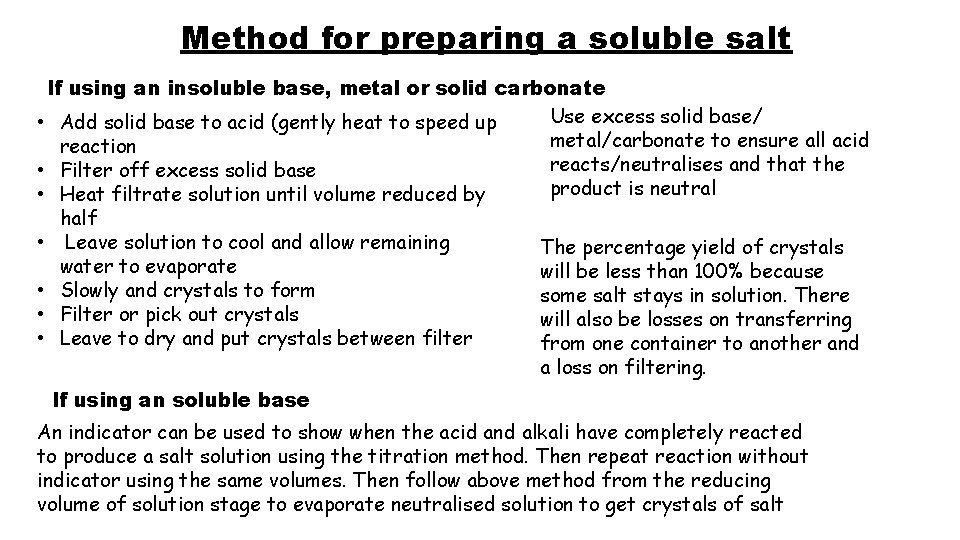
Method for preparing a soluble salt If using an insoluble base, metal or solid carbonate Use excess solid base/ • Add solid base to acid (gently heat to speed up metal/carbonate to ensure all acid reaction reacts/neutralises and that the • Filter off excess solid base product is neutral • Heat filtrate solution until volume reduced by half • Leave solution to cool and allow remaining The percentage yield of crystals water to evaporate will be less than 100% because • Slowly and crystals to form some salt stays in solution. There • Filter or pick out crystals will also be losses on transferring • Leave to dry and put crystals between filter from one container to another and a loss on filtering. If using an soluble base An indicator can be used to show when the acid and alkali have completely reacted to produce a salt solution using the titration method. Then repeat reaction without indicator using the same volumes. Then follow above method from the reducing volume of solution stage to evaporate neutralised solution to get crystals of salt
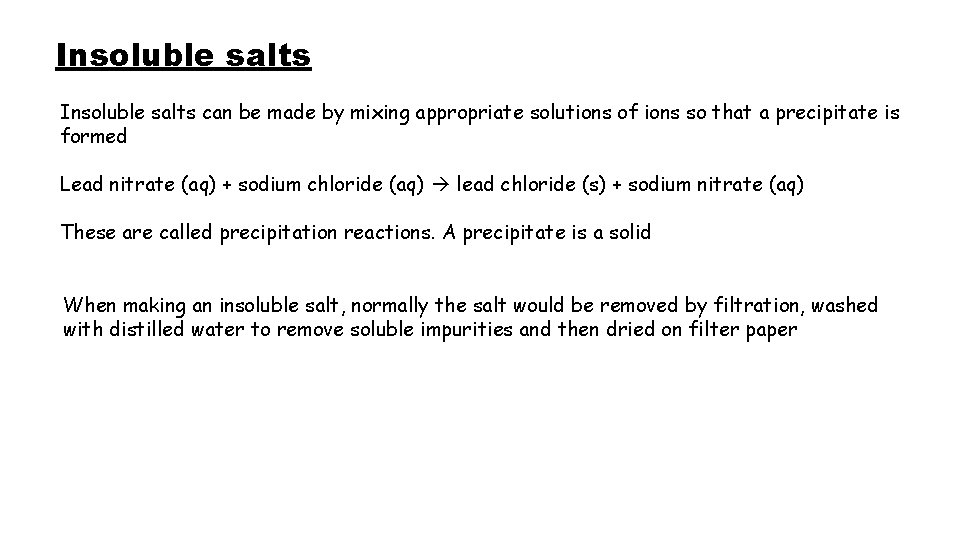
Insoluble salts can be made by mixing appropriate solutions of ions so that a precipitate is formed Lead nitrate (aq) + sodium chloride (aq) lead chloride (s) + sodium nitrate (aq) These are called precipitation reactions. A precipitate is a solid When making an insoluble salt, normally the salt would be removed by filtration, washed with distilled water to remove soluble impurities and then dried on filter paper
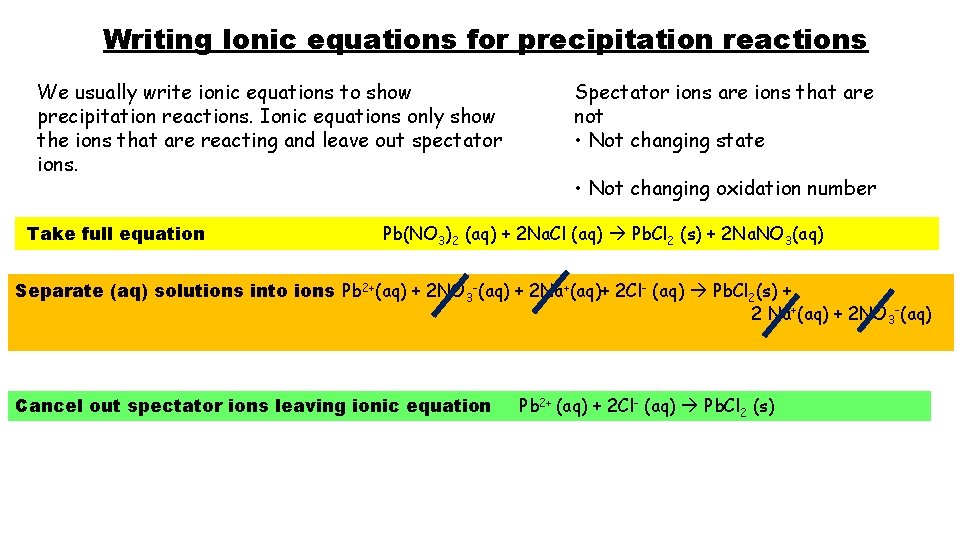
Writing Ionic equations for precipitation reactions We usually write ionic equations to show precipitation reactions. Ionic equations only show the ions that are reacting and leave out spectator ions. Take full equation Spectator ions are ions that are not • Not changing state • Not changing oxidation number Pb(NO 3)2 (aq) + 2 Na. Cl (aq) Pb. Cl 2 (s) + 2 Na. NO 3(aq) Separate (aq) solutions into ions Pb 2+(aq) + 2 NO 3 -(aq) + 2 Na+(aq)+ 2 Cl- (aq) Pb. Cl 2(s) + 2 Na+(aq) + 2 NO 3 -(aq) Cancel out spectator ions leaving ionic equation Pb 2+ (aq) + 2 Cl- (aq) Pb. Cl 2 (s)
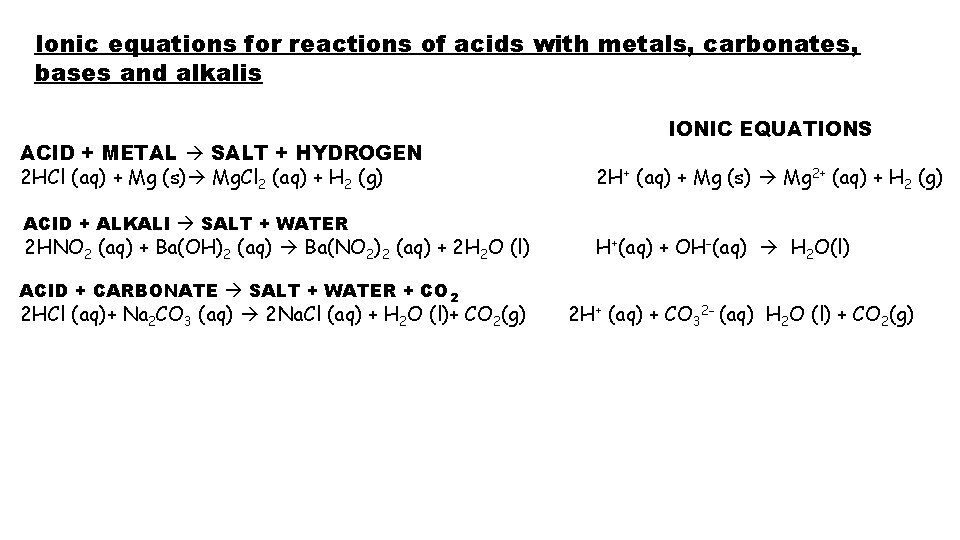
Ionic equations for reactions of acids with metals, carbonates, bases and alkalis ACID + METAL SALT + HYDROGEN 2 HCl (aq) + Mg (s) Mg. Cl 2 (aq) + H 2 (g) ACID + ALKALI SALT + WATER 2 HNO 2 (aq) + Ba(OH)2 (aq) Ba(NO 2)2 (aq) + 2 H 2 O (l) ACID + CARBONATE SALT + WATER + CO 2 2 HCl (aq)+ Na 2 CO 3 (aq) 2 Na. Cl (aq) + H 2 O (l)+ CO 2(g) IONIC EQUATIONS 2 H+ (aq) + Mg (s) Mg 2+ (aq) + H 2 (g) H+(aq) + OH–(aq) H 2 O(l) 2 H+ (aq) + CO 32– (aq) H 2 O (l) + CO 2(g)
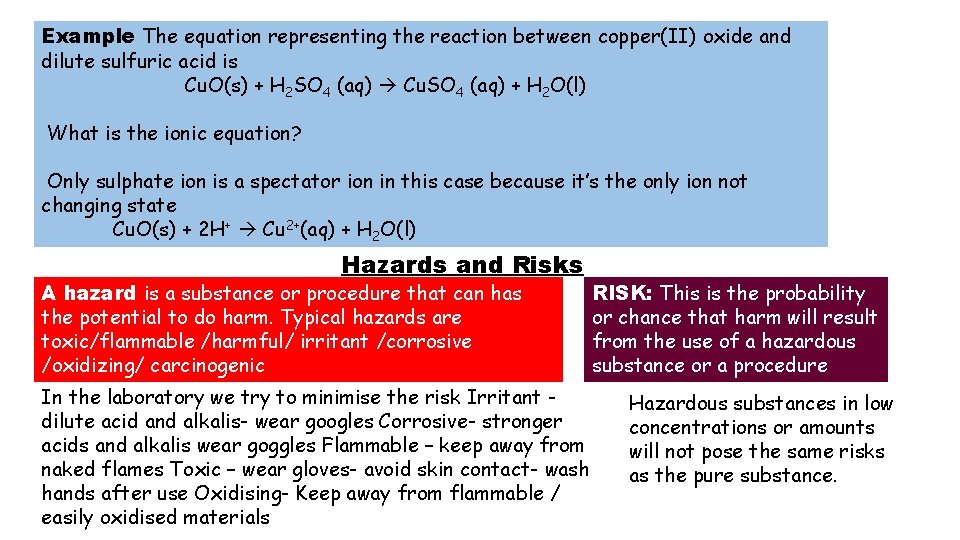
Example The equation representing the reaction between copper(II) oxide and dilute sulfuric acid is Cu. O(s) + H 2 SO 4 (aq) Cu. SO 4 (aq) + H 2 O(l) What is the ionic equation? Only sulphate ion is a spectator ion in this case because it’s the only ion not changing state Cu. O(s) + 2 H+ Cu 2+(aq) + H 2 O(l) Hazards and Risks A hazard is a substance or procedure that can has the potential to do harm. Typical hazards are toxic/flammable /harmful/ irritant /corrosive /oxidizing/ carcinogenic In the laboratory we try to minimise the risk Irritant dilute acid and alkalis- wear googles Corrosive- stronger acids and alkalis wear goggles Flammable – keep away from naked flames Toxic – wear gloves- avoid skin contact- wash hands after use Oxidising- Keep away from flammable / easily oxidised materials RISK: This is the probability or chance that harm will result from the use of a hazardous substance or a procedure Hazardous substances in low concentrations or amounts will not pose the same risks as the pure substance.
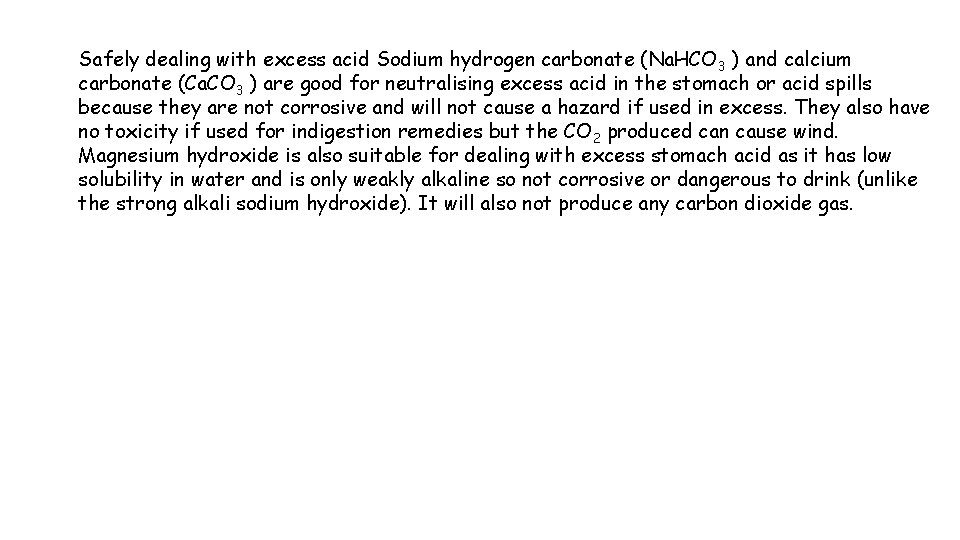
Safely dealing with excess acid Sodium hydrogen carbonate (Na. HCO 3 ) and calcium carbonate (Ca. CO 3 ) are good for neutralising excess acid in the stomach or acid spills because they are not corrosive and will not cause a hazard if used in excess. They also have no toxicity if used for indigestion remedies but the CO 2 produced can cause wind. Magnesium hydroxide is also suitable for dealing with excess stomach acid as it has low solubility in water and is only weakly alkaline so not corrosive or dangerous to drink (unlike the strong alkali sodium hydroxide). It will also not produce any carbon dioxide gas.
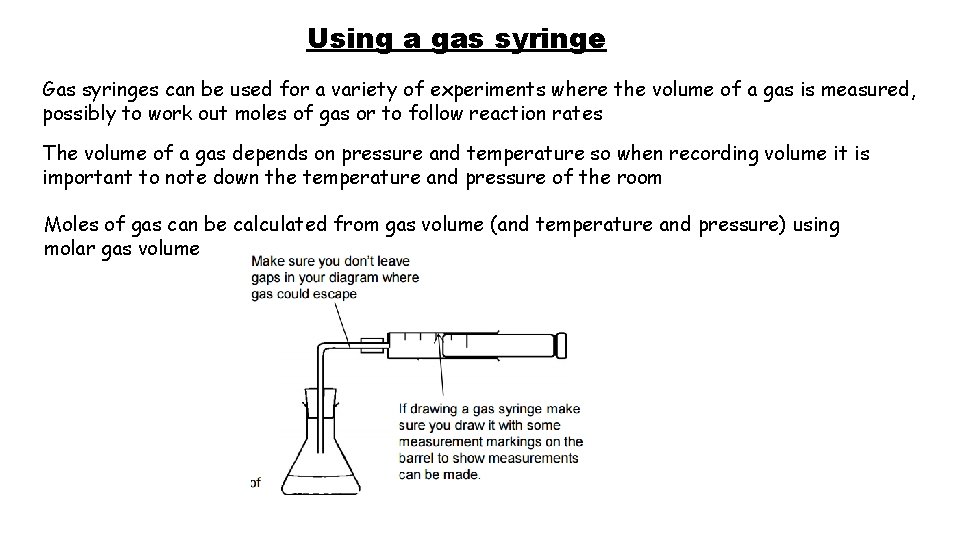
Using a gas syringe Gas syringes can be used for a variety of experiments where the volume of a gas is measured, possibly to work out moles of gas or to follow reaction rates The volume of a gas depends on pressure and temperature so when recording volume it is important to note down the temperature and pressure of the room Moles of gas can be calculated from gas volume (and temperature and pressure) using molar gas volume
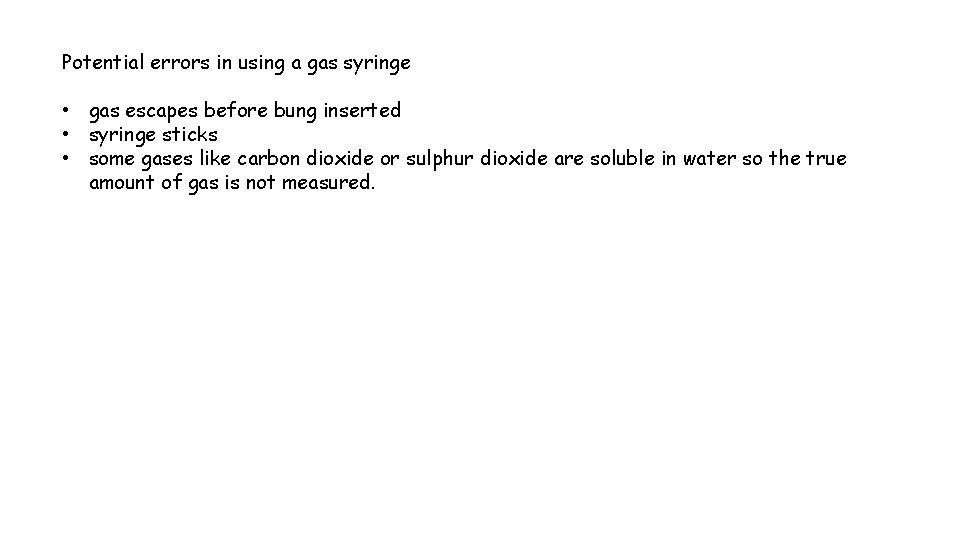
Potential errors in using a gas syringe • gas escapes before bung inserted • syringe sticks • some gases like carbon dioxide or sulphur dioxide are soluble in water so the true amount of gas is not measured.
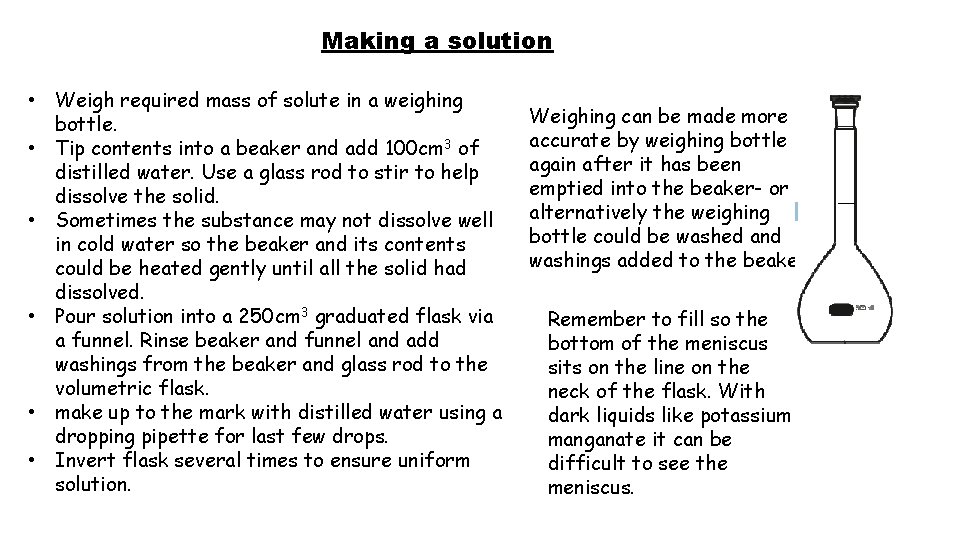
Making a solution • Weigh required mass of solute in a weighing bottle. • Tip contents into a beaker and add 100 cm 3 of distilled water. Use a glass rod to stir to help dissolve the solid. • Sometimes the substance may not dissolve well in cold water so the beaker and its contents could be heated gently until all the solid had dissolved. • Pour solution into a 250 cm 3 graduated flask via a funnel. Rinse beaker and funnel and add washings from the beaker and glass rod to the volumetric flask. • make up to the mark with distilled water using a dropping pipette for last few drops. • Invert flask several times to ensure uniform solution. Weighing can be made more accurate by weighing bottle again after it has been emptied into the beaker- or alternatively the weighing bottle could be washed and washings added to the beaker. Remember to fill so the bottom of the meniscus sits on the line on the neck of the flask. With dark liquids like potassium manganate it can be difficult to see the meniscus.
Titrations A titration is a method of finding out how much of one material will react with how much of another. Carrying out the titration 1. 2. 3. 4. 5. 6. 7. 8. 9. 10. 11. 12. 13. 14. 15. A pipette-filler is added to the volumetric pipette. Some of the solution is drawn into the pipette. The pipette is tilted and rotated so that all the surfaces are rinsed in the solution. The rinsing solution is then discarded. The solution is drawn into the pipette until the bottom of the meniscus is on the mark. The solution is then released into a clean conical flask. When no more solution emerges from the burette, touch the tip of the pipette against the side of the conical flask. Some of the liquid will remain in the tip and this should be left as the pipette is calibrated to allow for this. A suitable indicator should be added to the conical flask The flask is placed on a white tile under a burette. The flask should be held in the right hand (or writing hand) and swirled. The burette tap should be controlled by the left hand, first and second fingers behind the tap and the thumb in front of it. Add the solution from the burette until the indicator changes colour. Note the reading on the burette. This is the rough reading. Discard the contents of the flask and rinse it with tap water and then distilled water. Repeat the process, adding the solution from the burette fairly slowly with continual stirring. As the level in the burette approaches that of the rough reading, the solution is added drop by drop. When one drop changes the colour of the indicator, allow the solution to drain down the sides of the burette before taking the reading. Accurate burette readings should be recorded to two decimal places, the second decimal place being 0 or 5. Readings should continue to be taken in this way until one rough and two accurate readings that are within 0. 1 cm 3 of each other – concordant readings - are obtained. Calculations should be based on the mean average of the two concordant readings.
Titration calculations Use the same three step method as before. Example If 23. 45 cm 3 of 0. 2 mol dm-3 sodium hydroxide react with 25. 0 cm 3 of sulphuric acid. Find the concentration of the acid. 2 Na. OH + H 2 SO 4 Na 2 SO 4 + 2 H 2 O Step 1 - Moles of Na. OH = 23. 45 / 1000 x 0. 2 = 0. 00469 mol Step 2 - Moles of H 2 SO 4 = 0. 00469 / 2 = 0. 002345 mol Step 3 - Concentration of H 2 SO 4 = 0. 002345 / 0. 025 = 0. 0938 mol dm-3 (3 sig. fig. )
Errors Calculating apparatus errors Each type of apparatus has a sensitivity error • balance ± 0. 001 g • volumetric flask ± 0. 1 cm 3 • 25 cm 3 pipette ± 0. 1 cm 3 • burette (start & end readings and end point ) ± 0. 15 cm 3 To decrease the apparatus errors you can either decrease the sensitivity error by using apparatus with a greater resolution (finer scale divisions ) or you can increase the size of the measurement made. Calculate the percentage error for each piece of equipment used by % error = ± sensitivity error x 100 Measurement made on apparatus e. g. for burette % error = 0. 15/average titre result x 100 To calculate the maximum percentage apparatus error in the final result add all the individual equipment errors together. If looking at a series of measurements in an investigation the experiments with the smallest readings will have the highest experimental errors.
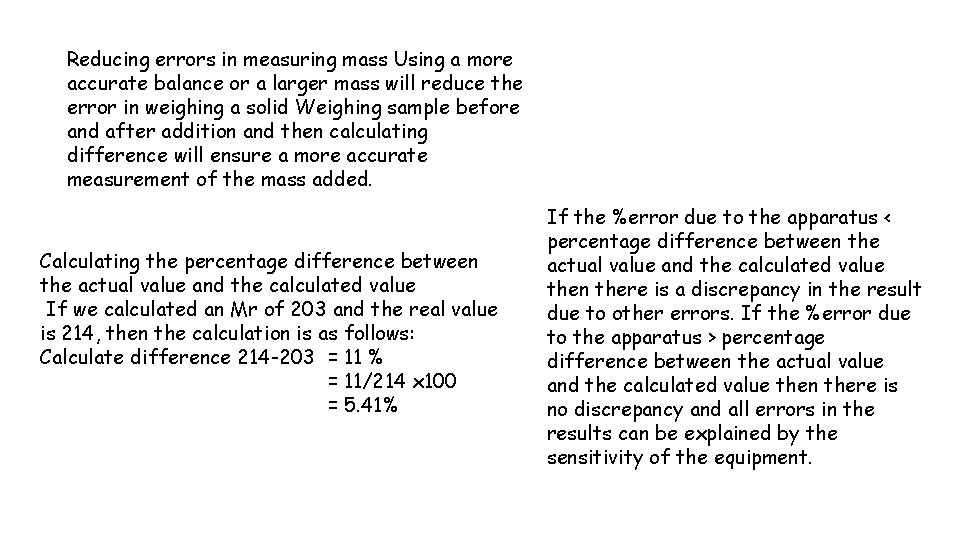
Reducing errors in measuring mass Using a more accurate balance or a larger mass will reduce the error in weighing a solid Weighing sample before and after addition and then calculating difference will ensure a more accurate measurement of the mass added. Calculating the percentage difference between the actual value and the calculated value If we calculated an Mr of 203 and the real value is 214, then the calculation is as follows: Calculate difference 214 -203 = 11 % = 11/214 x 100 = 5. 41% If the %error due to the apparatus < percentage difference between the actual value and the calculated value then there is a discrepancy in the result due to other errors. If the %error due to the apparatus > percentage difference between the actual value and the calculated value then there is no discrepancy and all errors in the results can be explained by the sensitivity of the equipment.
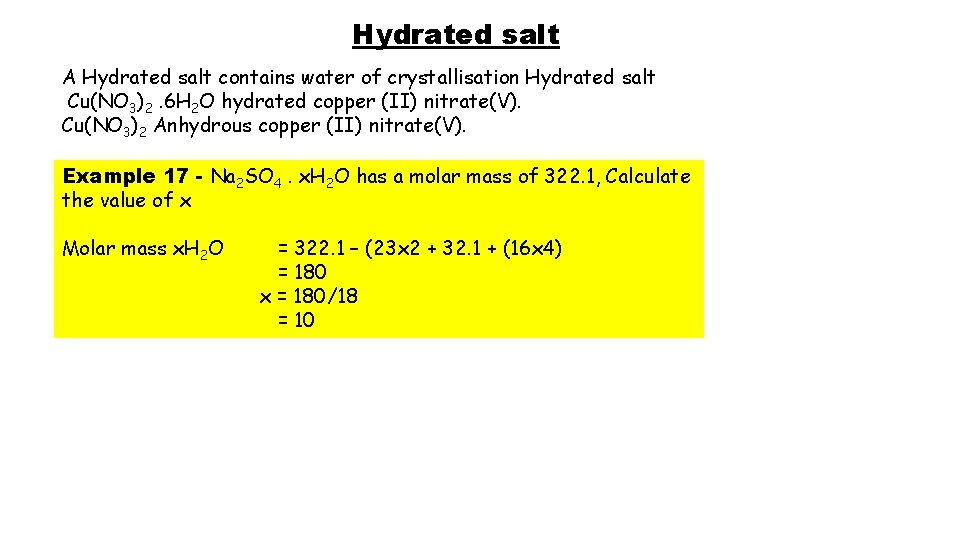
Hydrated salt A Hydrated salt contains water of crystallisation Hydrated salt Cu(NO 3)2. 6 H 2 O hydrated copper (II) nitrate(V). Cu(NO 3)2 Anhydrous copper (II) nitrate(V). Example 17 - Na 2 SO 4. x. H 2 O has a molar mass of 322. 1, Calculate the value of x Molar mass x. H 2 O = 322. 1 – (23 x 2 + 32. 1 + (16 x 4) = 180 x = 180/18 = 10
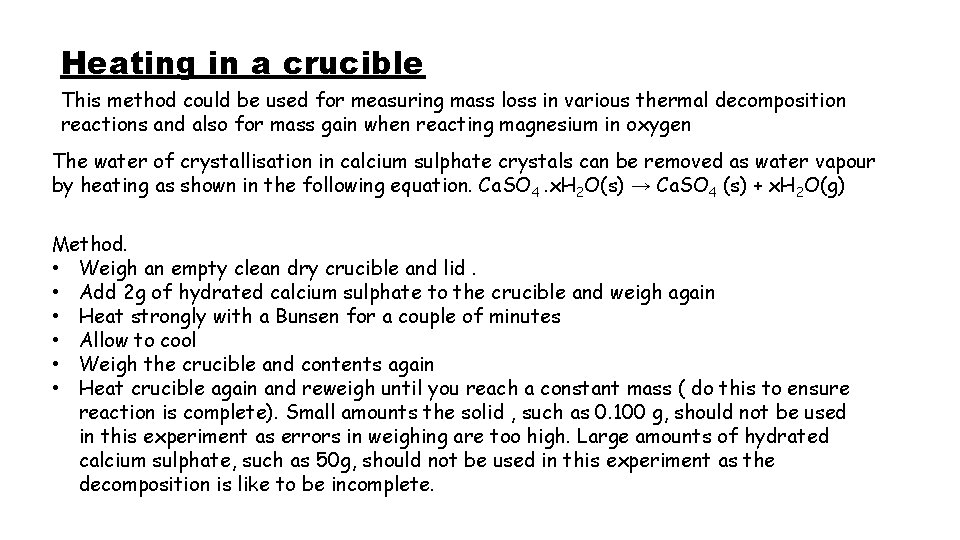
Heating in a crucible This method could be used for measuring mass loss in various thermal decomposition reactions and also for mass gain when reacting magnesium in oxygen The water of crystallisation in calcium sulphate crystals can be removed as water vapour by heating as shown in the following equation. Ca. SO 4. x. H 2 O(s) → Ca. SO 4 (s) + x. H 2 O(g) Method. • Weigh an empty clean dry crucible and lid. • Add 2 g of hydrated calcium sulphate to the crucible and weigh again • Heat strongly with a Bunsen for a couple of minutes • Allow to cool • Weigh the crucible and contents again • Heat crucible again and reweigh until you reach a constant mass ( do this to ensure reaction is complete). Small amounts the solid , such as 0. 100 g, should not be used in this experiment as errors in weighing are too high. Large amounts of hydrated calcium sulphate, such as 50 g, should not be used in this experiment as the decomposition is like to be incomplete.
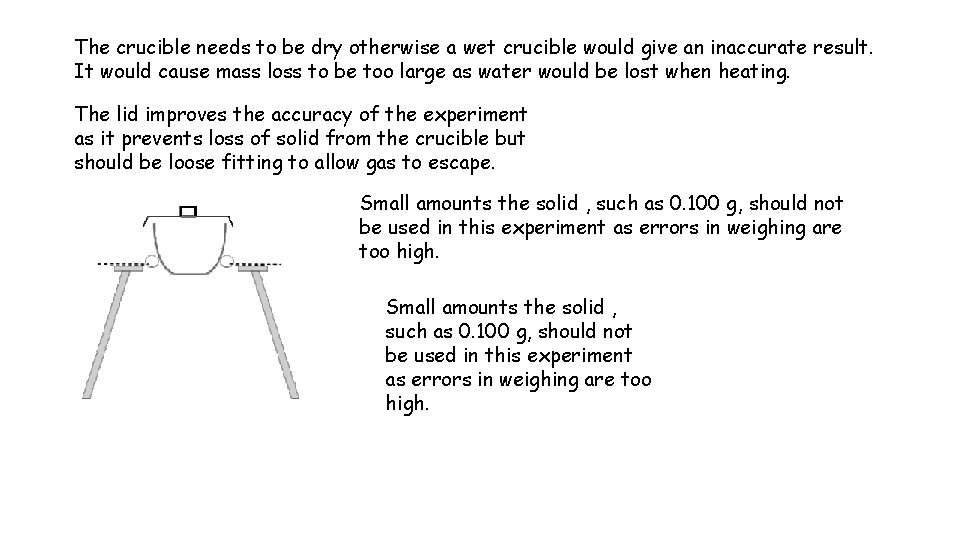
The crucible needs to be dry otherwise a wet crucible would give an inaccurate result. It would cause mass loss to be too large as water would be lost when heating. The lid improves the accuracy of the experiment as it prevents loss of solid from the crucible but should be loose fitting to allow gas to escape. Small amounts the solid , such as 0. 100 g, should not be used in this experiment as errors in weighing are too high.
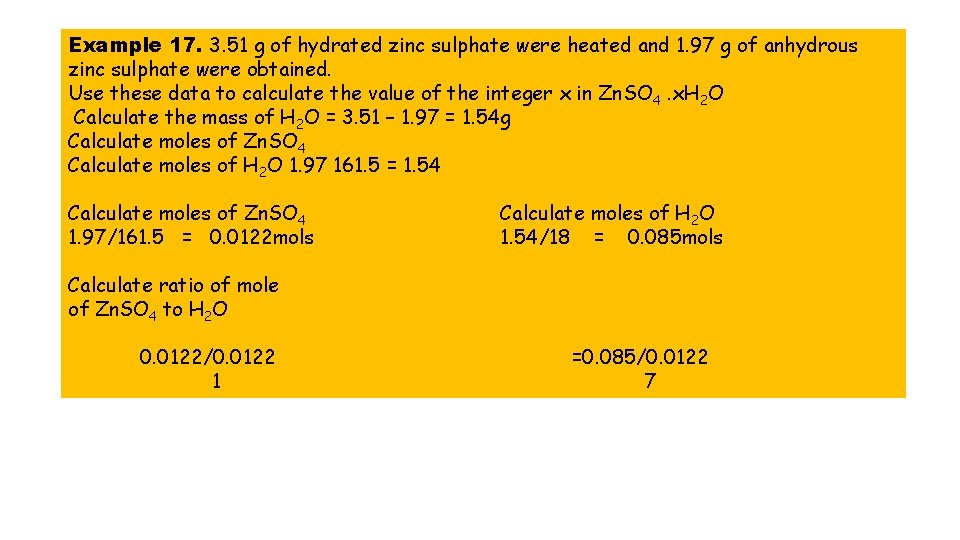
Example 17. 3. 51 g of hydrated zinc sulphate were heated and 1. 97 g of anhydrous zinc sulphate were obtained. Use these data to calculate the value of the integer x in Zn. SO 4. x. H 2 O Calculate the mass of H 2 O = 3. 51 – 1. 97 = 1. 54 g Calculate moles of Zn. SO 4 Calculate moles of H 2 O 1. 97 161. 5 = 1. 54 Calculate moles of Zn. SO 4 1. 97/161. 5 = 0. 0122 mols Calculate moles of H 2 O 1. 54/18 = 0. 085 mols Calculate ratio of mole of Zn. SO 4 to H 2 O 0. 0122/0. 0122 1 =0. 085/0. 0122 7

- Slides: 39