
Formula Writing and Nomenclature Chemical Names and Formulas
- Slides: 14
Formula Writing and Nomenclature: (Chemical Names and Formulas) 1
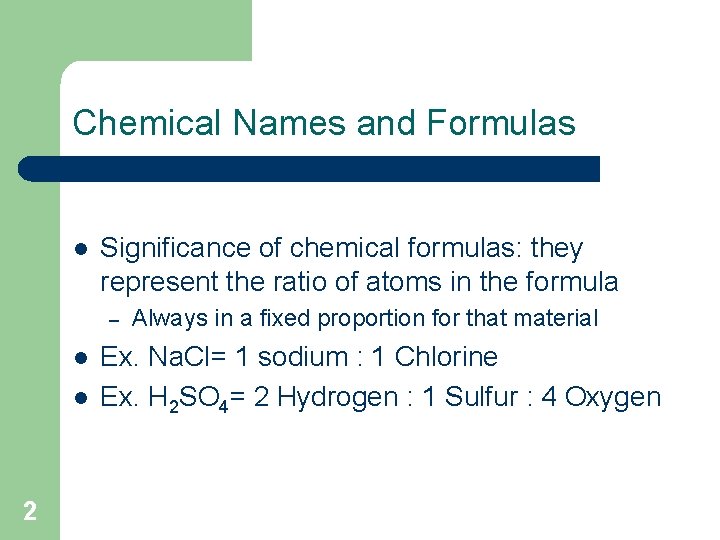
Chemical Names and Formulas l Significance of chemical formulas: they represent the ratio of atoms in the formula – l l 2 Always in a fixed proportion for that material Ex. Na. Cl= 1 sodium : 1 Chlorine Ex. H 2 SO 4= 2 Hydrogen : 1 Sulfur : 4 Oxygen
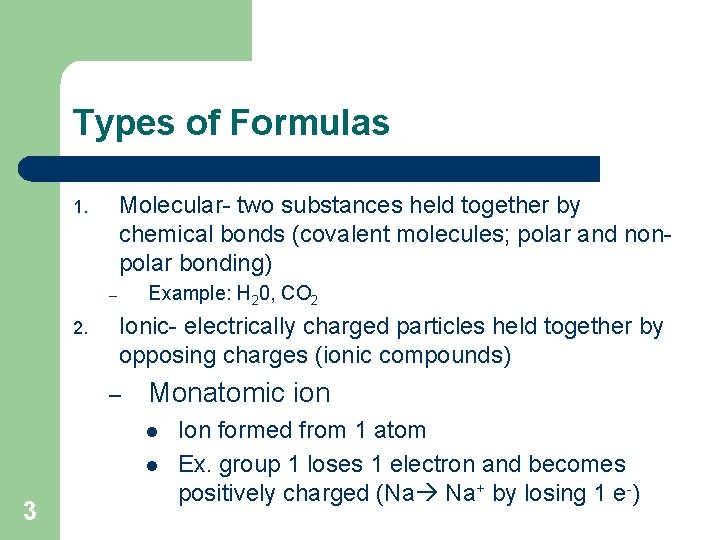
Types of Formulas Molecular- two substances held together by chemical bonds (covalent molecules; polar and nonpolar bonding) 1. Example: H 20, CO 2 – 2. Ionic- electrically charged particles held together by opposing charges (ionic compounds) – Monatomic ion l l 3 Ion formed from 1 atom Ex. group 1 loses 1 electron and becomes positively charged (Na Na+ by losing 1 e-)
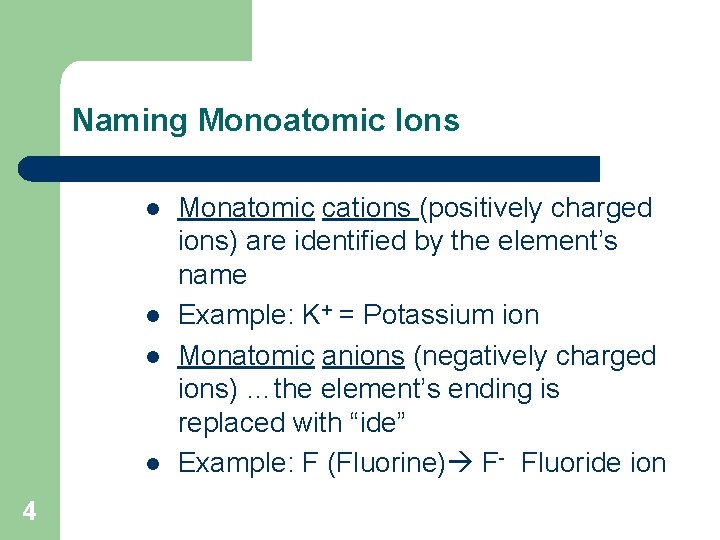
Naming Monoatomic Ions l l 4 Monatomic cations (positively charged ions) are identified by the element’s name Example: K+ = Potassium ion Monatomic anions (negatively charged ions) …the element’s ending is replaced with “ide” Example: F (Fluorine) F- Fluoride ion
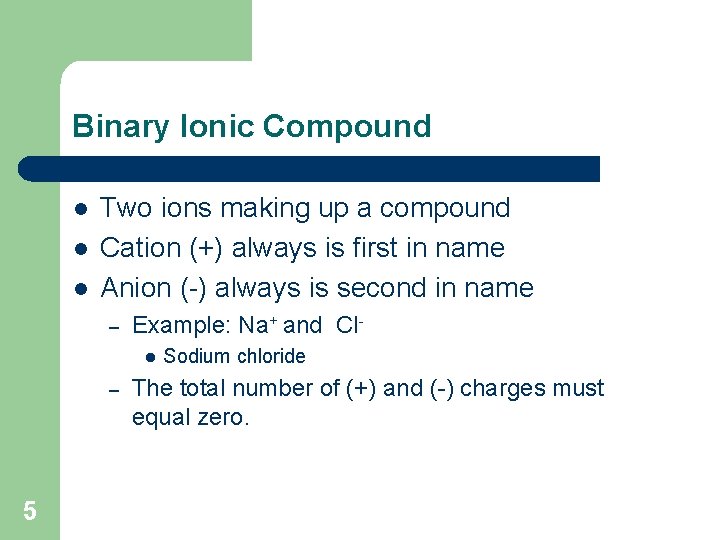
Binary Ionic Compound l l l Two ions making up a compound Cation (+) always is first in name Anion (-) always is second in name – Example: Na+ and Cll – 5 Sodium chloride The total number of (+) and (-) charges must equal zero.
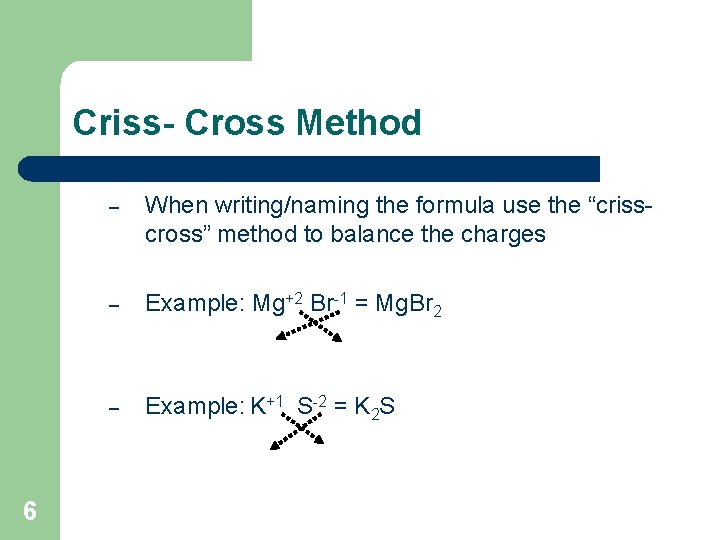
Criss- Cross Method 6 – When writing/naming the formula use the “crisscross” method to balance the charges – Example: Mg+2 Br-1 = Mg. Br 2 – Example: K+1 S-2 = K 2 S
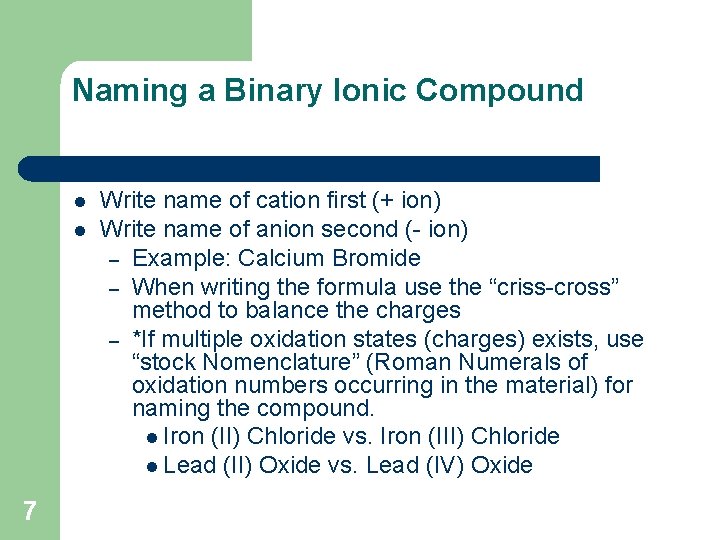
Naming a Binary Ionic Compound l l 7 Write name of cation first (+ ion) Write name of anion second (- ion) – Example: Calcium Bromide – When writing the formula use the “criss-cross” method to balance the charges – *If multiple oxidation states (charges) exists, use “stock Nomenclature” (Roman Numerals of oxidation numbers occurring in the material) for naming the compound. l Iron (II) Chloride vs. Iron (III) Chloride l Lead (II) Oxide vs. Lead (IV) Oxide
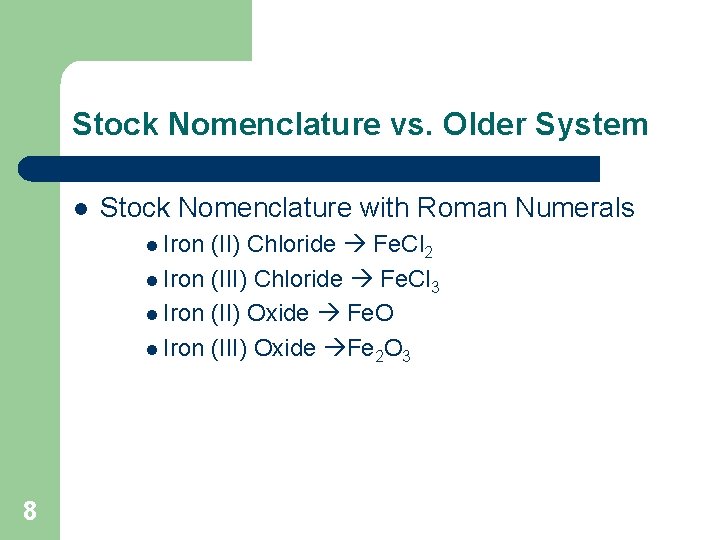
Stock Nomenclature vs. Older System l Stock Nomenclature with Roman Numerals l Iron (II) Chloride Fe. Cl 2 l Iron (III) Chloride Fe. Cl 3 l Iron (II) Oxide Fe. O l Iron (III) Oxide Fe 2 O 3 8
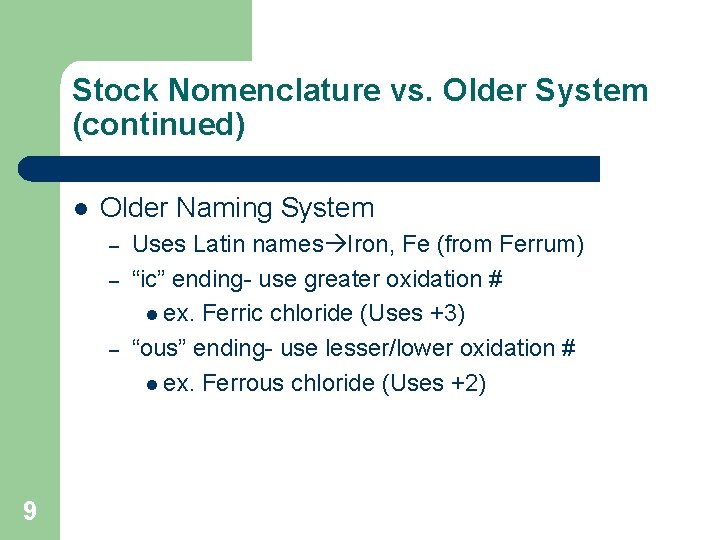
Stock Nomenclature vs. Older System (continued) l Older Naming System – – – 9 Uses Latin names Iron, Fe (from Ferrum) “ic” ending- use greater oxidation # l ex. Ferric chloride (Uses +3) “ous” ending- use lesser/lower oxidation # l ex. Ferrous chloride (Uses +2)
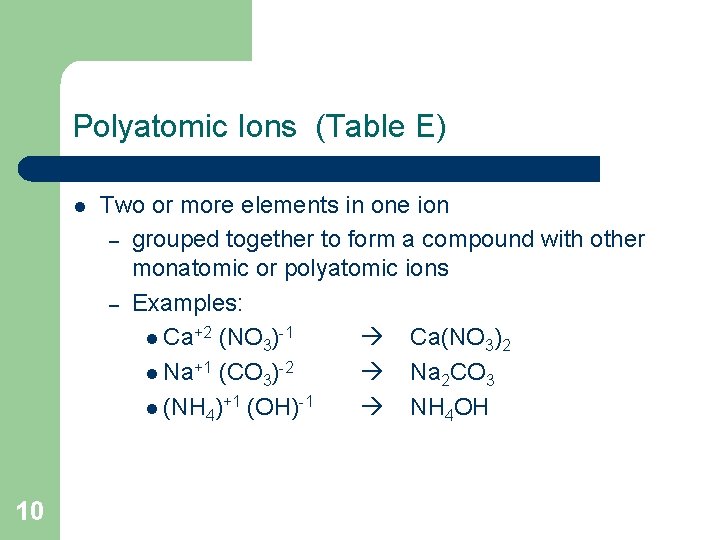
Polyatomic Ions (Table E) l 10 Two or more elements in one ion – grouped together to form a compound with other monatomic or polyatomic ions – Examples: l Ca+2 (NO 3)-1 Ca(NO 3)2 l Na+1 (CO 3)-2 Na 2 CO 3 l (NH 4)+1 (OH)-1 NH 4 OH
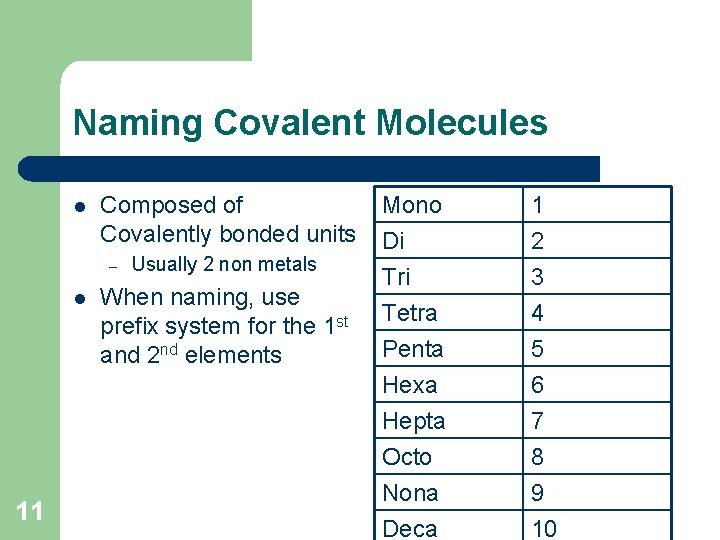
Naming Covalent Molecules l Composed of Covalently bonded units – l 11 Usually 2 non metals When naming, use prefix system for the 1 st and 2 nd elements Mono Di Tri Tetra 1 2 3 4 Penta Hexa Hepta Octo Nona Deca 5 6 7 8 9 10
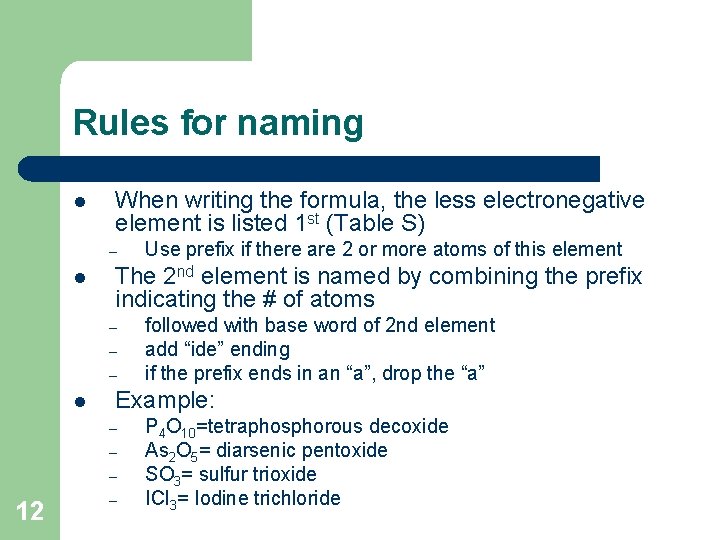
Rules for naming l When writing the formula, the less electronegative element is listed 1 st (Table S) – l The 2 nd element is named by combining the prefix indicating the # of atoms – – – l followed with base word of 2 nd element add “ide” ending if the prefix ends in an “a”, drop the “a” Example: – – – 12 Use prefix if there are 2 or more atoms of this element – P 4 O 10=tetraphosphorous decoxide As 2 O 5= diarsenic pentoxide SO 3= sulfur trioxide ICl 3= Iodine trichloride
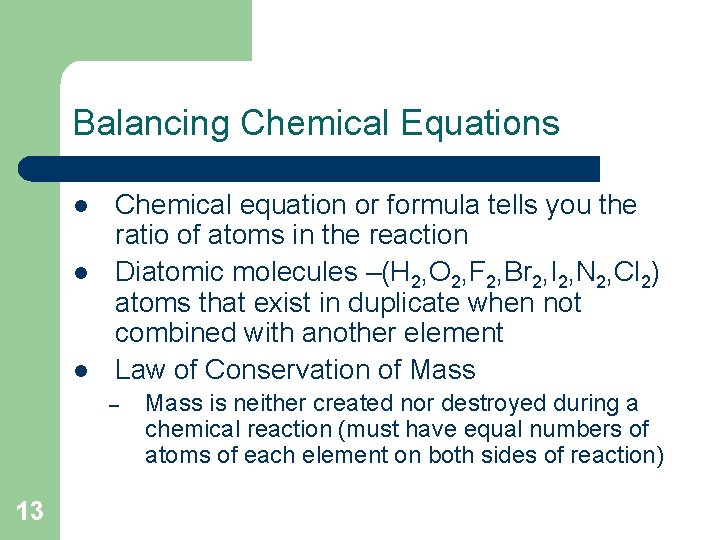
Balancing Chemical Equations l l l Chemical equation or formula tells you the ratio of atoms in the reaction Diatomic molecules –(H 2, O 2, F 2, Br 2, I 2, N 2, Cl 2) atoms that exist in duplicate when not combined with another element Law of Conservation of Mass – 13 Mass is neither created nor destroyed during a chemical reaction (must have equal numbers of atoms of each element on both sides of reaction)
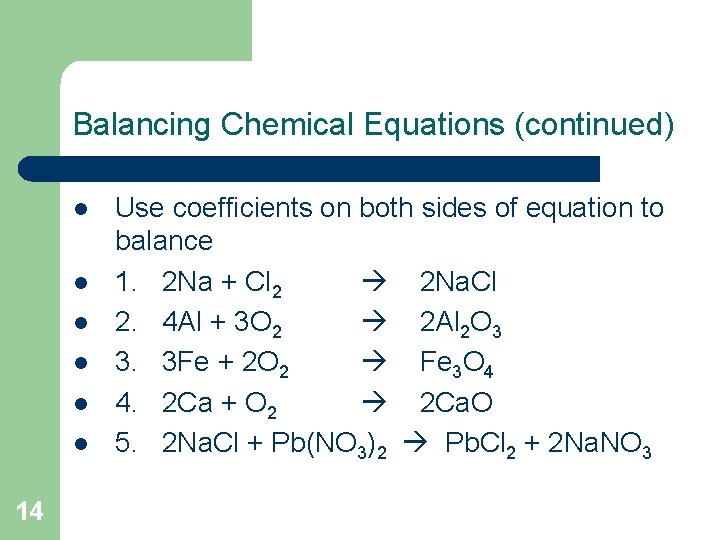
Balancing Chemical Equations (continued) l l l 14 Use coefficients on both sides of equation to balance 1. 2 Na + Cl 2 2 Na. Cl 2. 4 Al + 3 O 2 2 Al 2 O 3 3. 3 Fe + 2 O 2 Fe 3 O 4 4. 2 Ca + O 2 2 Ca. O 5. 2 Na. Cl + Pb(NO 3)2 Pb. Cl 2 + 2 Na. NO 3