
Forms of drugs and how they act Introduction

- Slides: 48
Forms of drugs and how they act
Introduction Drugs are compounded in three basic types of preparations: liquids, solids, and semisolids.
Introduction ●The ease with which a drug’s ingredients can be dissolved largely determines the variety of forms manufactured. Some drug agents are soluble in water, others in alcohol, and others in a mixture of several solvents. solvent: a substance that dissolves another to form a solution Water is a solvent for sugar. ●The method for administering a drug depends upon its form, its properties, and the effects desired
Introduction ØWhen given orally, a drug may be in the form of a liquid, powder, tablet, capsule, or, caplet. ØIf it is to be injected, it must be in the form of a liquid. ØFor topical use, the drug may be in the form of a liquid, a powder, or a semisolid. ØOral and injectable medications are examples of preparations designed for internal use.
Liquid Preparations Liquid preparations are those containing a drug that has been dissolved or suspended. Depending upon the solvent used, the drug may be further classified as an aqueous (water) or alcohol preparation. When prescribed for internal use, liquid preparations other than emulsions are rapidly absorbed through the stomach or intestinal walls.
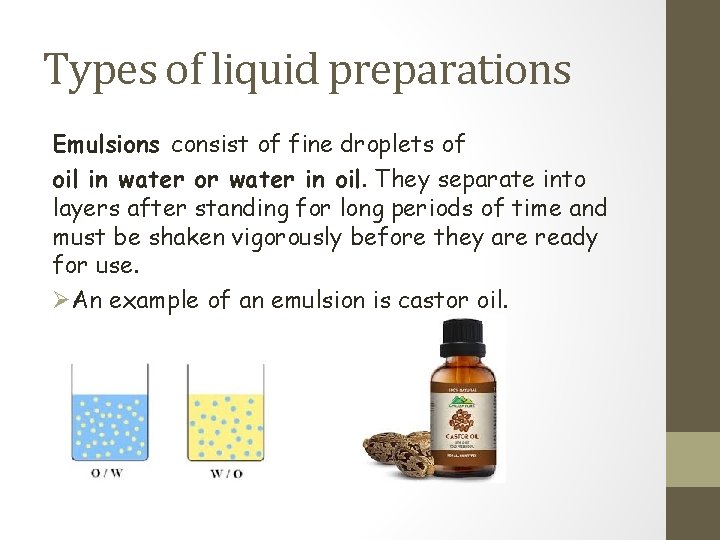
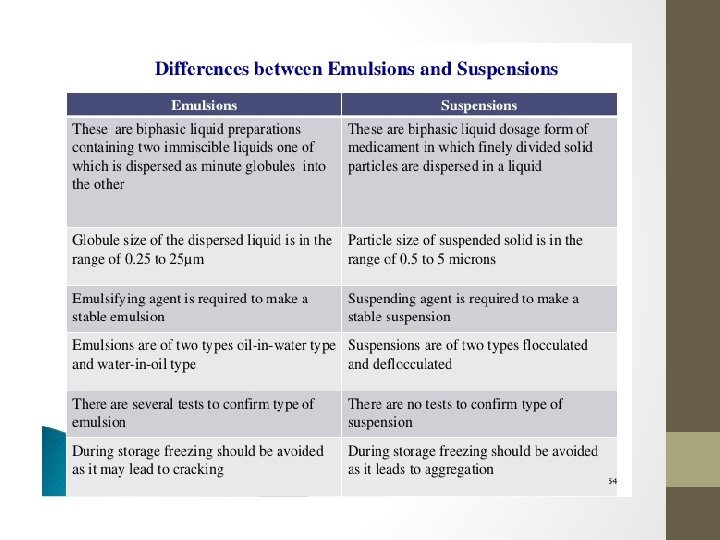
Types of liquid preparations Emulsions consist of fine droplets of oil in water or water in oil. They separate into layers after standing for long periods of time and must be shaken vigorously before they are ready for use. ØAn example of an emulsion is castor oil.
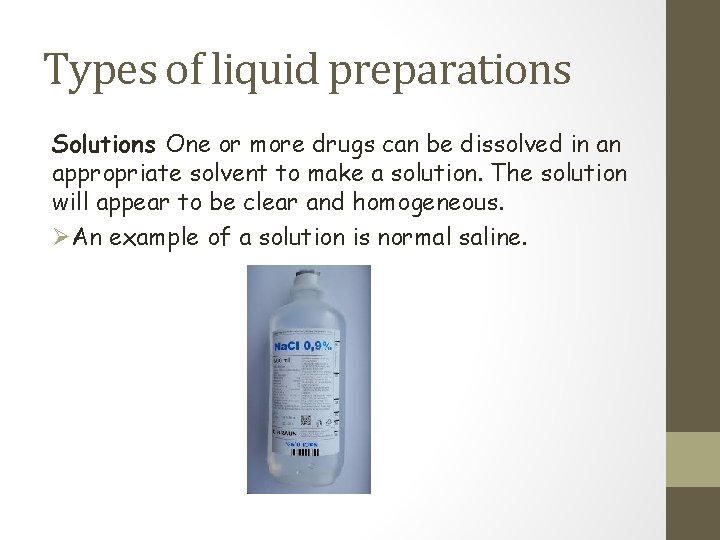
Types of liquid preparations Solutions One or more drugs can be dissolved in an appropriate solvent to make a solution. The solution will appear to be clear and homogeneous. ØAn example of a solution is normal saline.
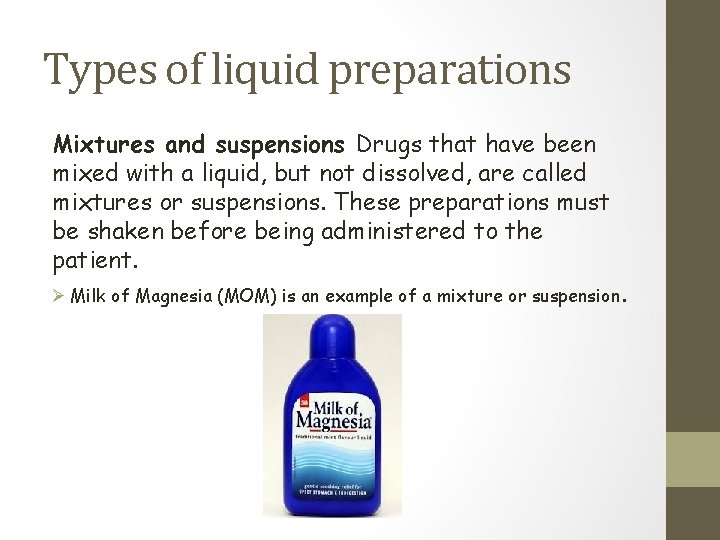
Types of liquid preparations Mixtures and suspensions Drugs that have been mixed with a liquid, but not dissolved, are called mixtures or suspensions. These preparations must be shaken before being administered to the patient. Ø Milk of Magnesia (MOM) is an example of a mixture or suspension.
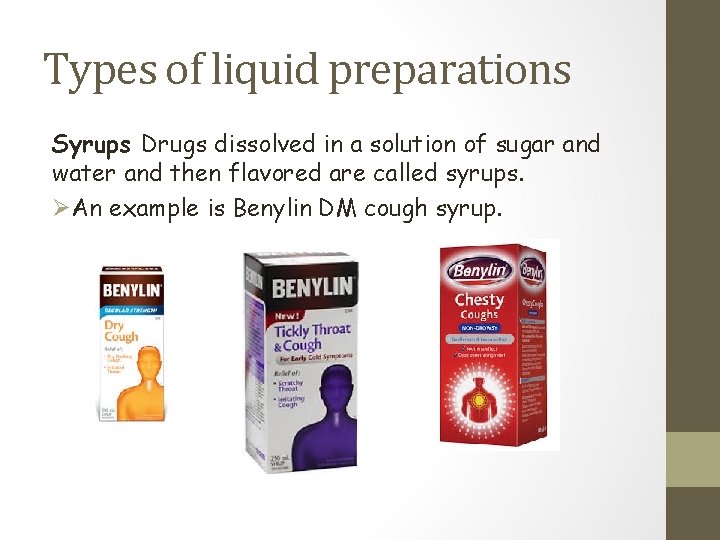
Types of liquid preparations Syrups Drugs dissolved in a solution of sugar and water and then flavored are called syrups. ØAn example is Benylin DM cough syrup.
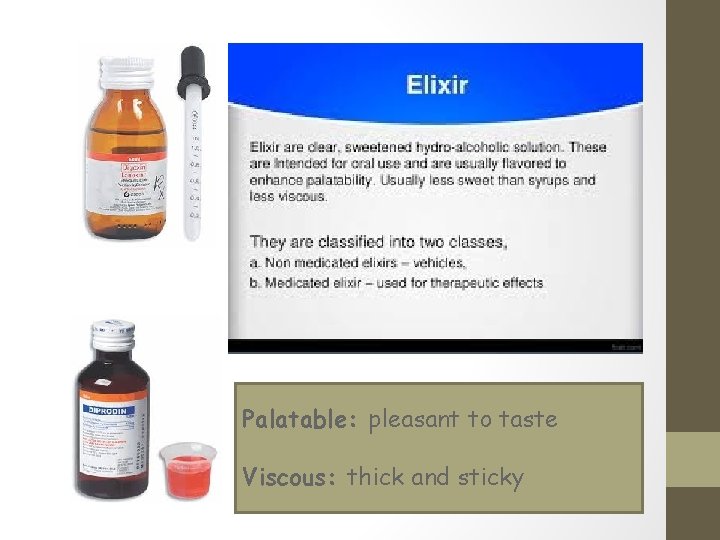
Types of liquid preparations Elixirs Drugs dissolved in a solution of alcohol and water that has been sweetened and flavored are elixirs. When prepared in this manner, the bitter or salty taste of the drug is disguised. For this reason, elixirs are frequently used for children’s medications.
Palatable: pleasant to taste Viscous: thick and sticky
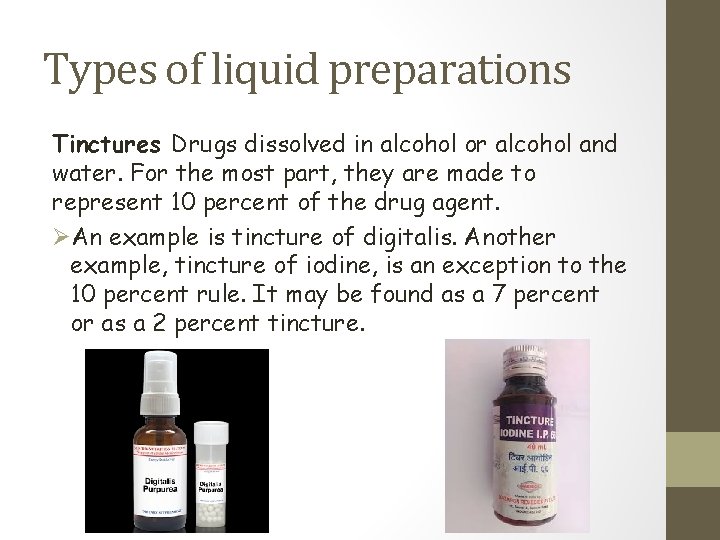
Types of liquid preparations Tinctures Drugs dissolved in alcohol or alcohol and water. For the most part, they are made to represent 10 percent of the drug agent. ØAn example is tincture of digitalis. Another example, tincture of iodine, is an exception to the 10 percent rule. It may be found as a 7 percent or as a 2 percent tincture.
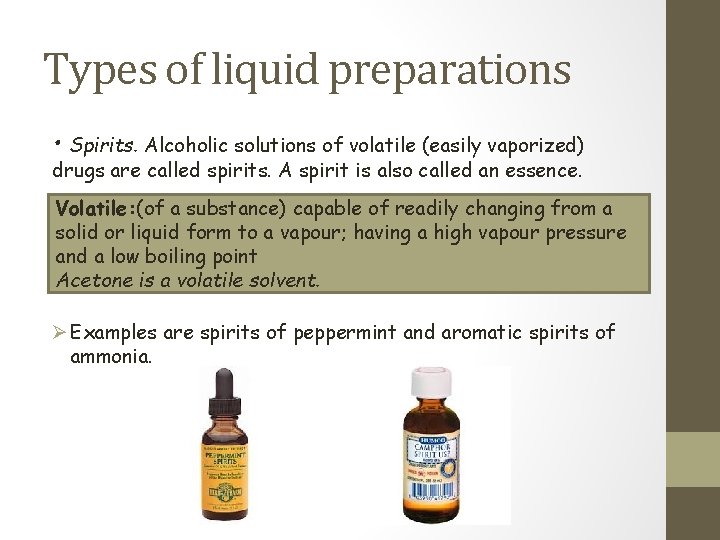
Types of liquid preparations • Spirits. Alcoholic solutions of volatile (easily vaporized) drugs are called spirits. A spirit is also called an essence. Volatile: (of a substance) capable of readily changing from a solid or liquid form to a vapour; having a high vapour pressure and a low boiling point Acetone is a volatile solvent. Ø Examples are spirits of peppermint and aromatic spirits of ammonia.
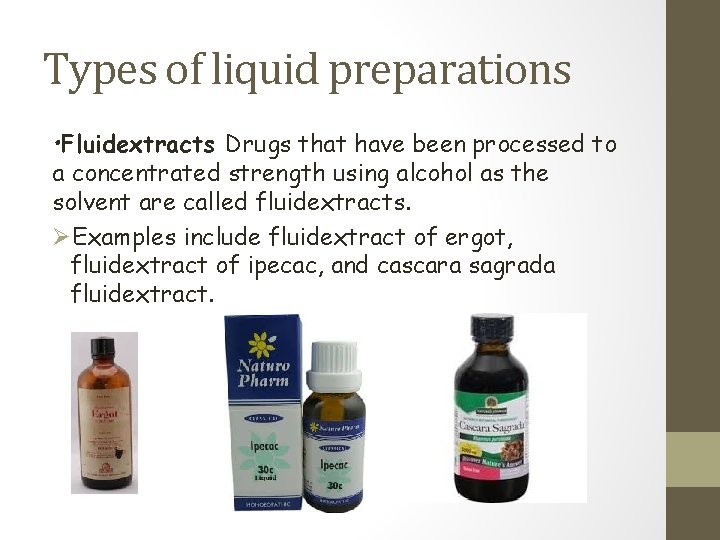
Types of liquid preparations • Fluidextracts Drugs that have been processed to a concentrated strength using alcohol as the solvent are called fluidextracts. ØExamples include fluidextract of ergot, fluidextract of ipecac, and cascara sagrada fluidextract.
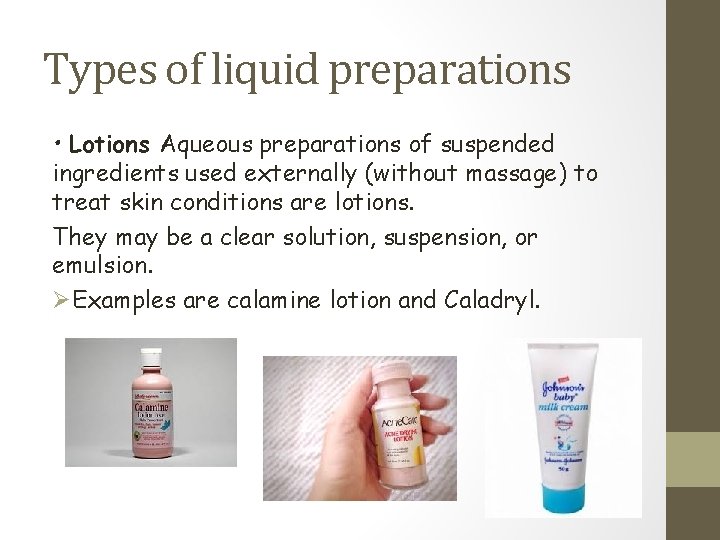
Types of liquid preparations • Lotions Aqueous preparations of suspended ingredients used externally (without massage) to treat skin conditions are lotions. They may be a clear solution, suspension, or emulsion. ØExamples are calamine lotion and Caladryl.
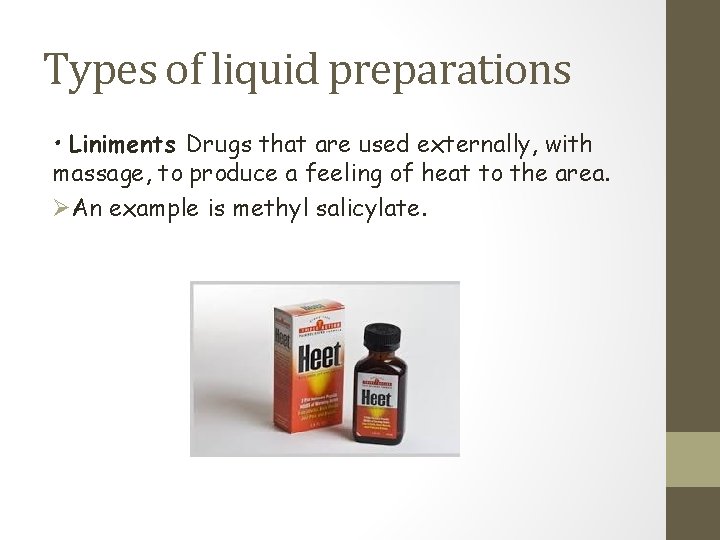
Types of liquid preparations • Liniments Drugs that are used externally, with massage, to produce a feeling of heat to the area. ØAn example is methyl salicylate.
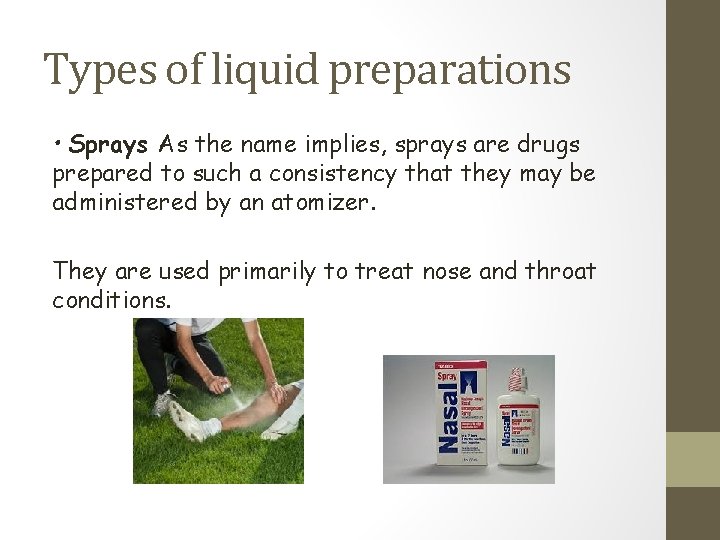
Types of liquid preparations • Sprays As the name implies, sprays are drugs prepared to such a consistency that they may be administered by an atomizer. They are used primarily to treat nose and throat conditions.
Types of liquid preparations Some drugs administered by this method function as astringents and produce a shrinking or contracting effect. astringent: noun Medicine/Medical. a substance that contracts the tissues or Medicine/Medical. a substance that contracts theas tissues canals of the body, thereby diminishing discharges, of or canals of the body, thereby diminishing discharges, as mucus or blood. of mucus or blood. a cosmetic that cleans the skin and constricts the pores.
Types of liquid preparations Others function as antiseptics and inhibit the growth of bacteria. Antiseptic: Of, relating to, or producing antisepsis. Capable of preventing infection by inhibiting the growth of infectious agents.
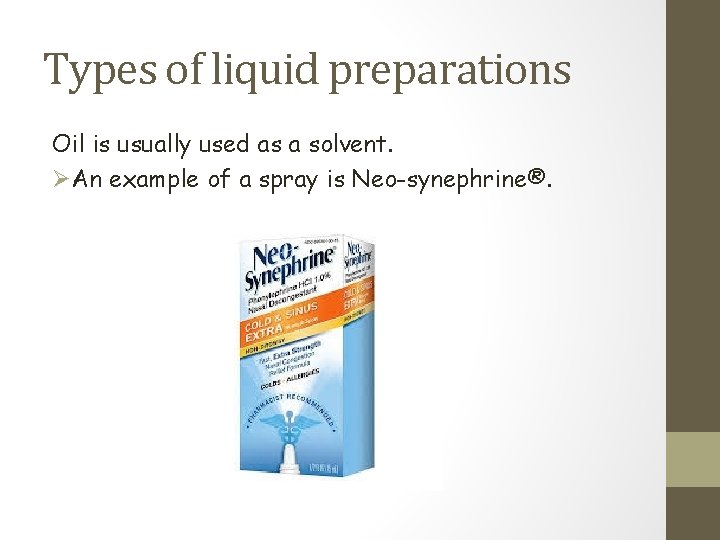
Types of liquid preparations Oil is usually used as a solvent. ØAn example of a spray is Neo-synephrine®.
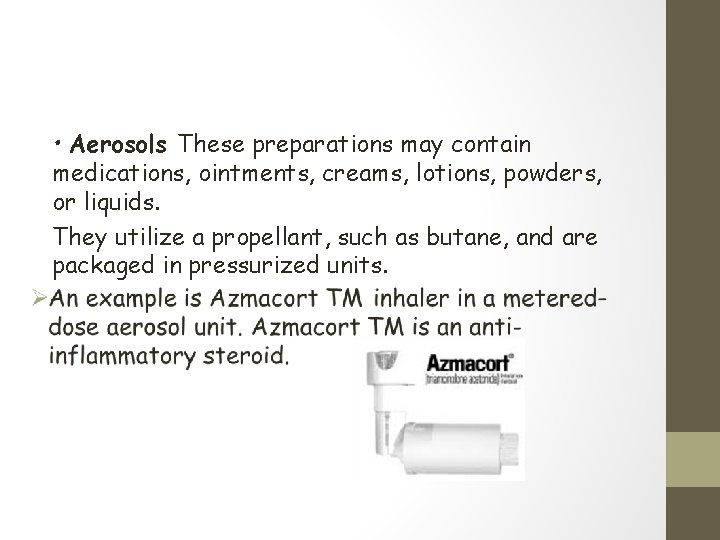
• Aerosols These preparations may contain medications, ointments, creams, lotions, powders, or liquids. They utilize a propellant, such as butane, and are packaged in pressurized units.
Solid and Semisolid Preparations Tablets, capsules, caplets, troches or lozenges, suppositories, and ointments are examples of solid and semisolid preparations. These products offer great flexibility as a means of dispensing different dosages of drugs. dispense: Pharmacology. to make up and distribute (medicine), especially on prescription.
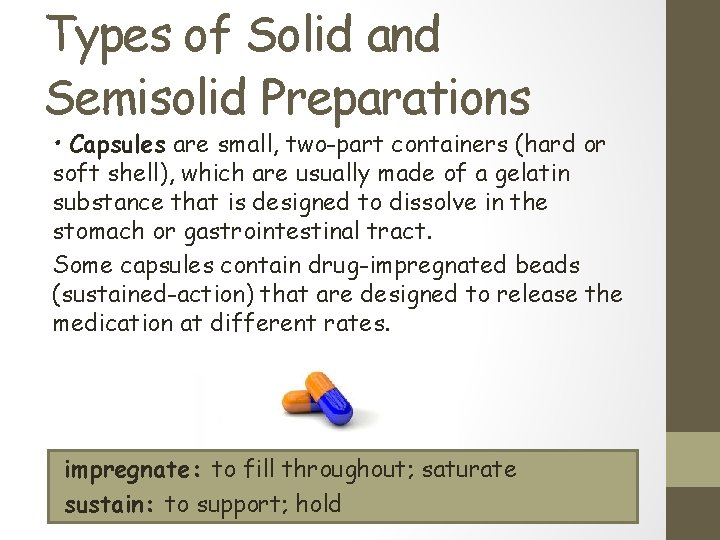
Types of Solid and Semisolid Preparations • Capsules are small, two-part containers (hard or soft shell), which are usually made of a gelatin substance that is designed to dissolve in the stomach or gastrointestinal tract. Some capsules contain drug-impregnated beads (sustained-action) that are designed to release the medication at different rates. impregnate: to fill throughout; saturate sustain: to support; hold
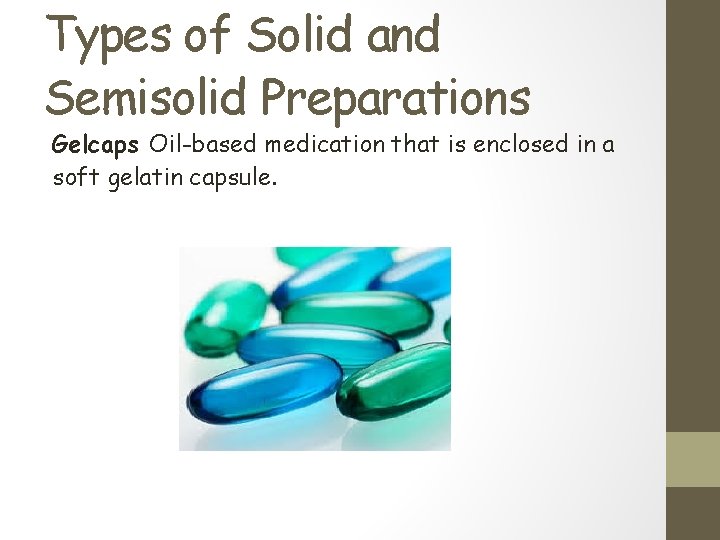
Types of Solid and Semisolid Preparations Gelcaps Oil-based medication that is enclosed in a soft gelatin capsule.
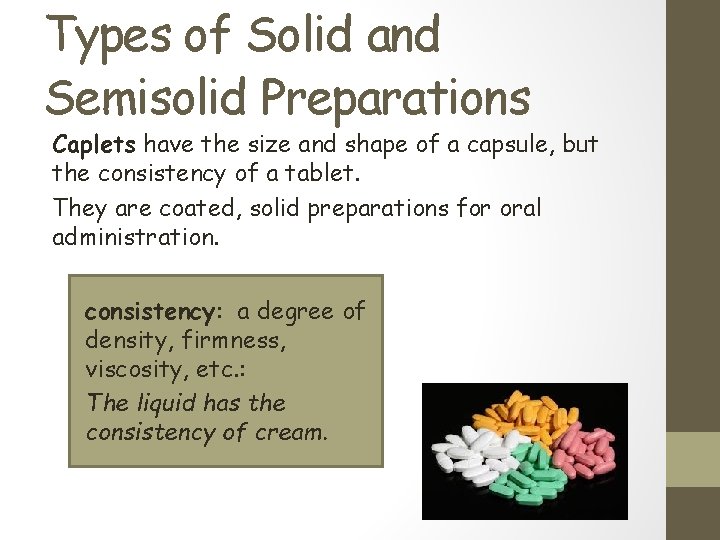
Types of Solid and Semisolid Preparations Caplets have the size and shape of a capsule, but the consistency of a tablet. They are coated, solid preparations for oral administration. consistency: a degree of density, firmness, viscosity, etc. : The liquid has the consistency of cream.
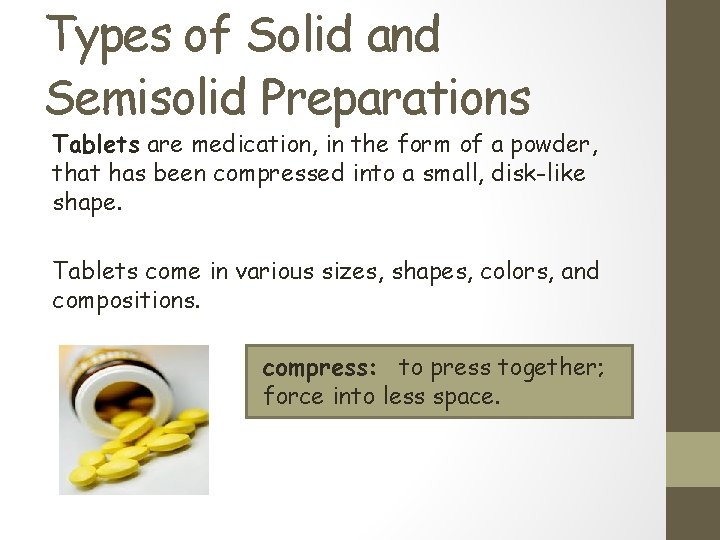
Types of Solid and Semisolid Preparations Tablets are medication, in the form of a powder, that has been compressed into a small, disk-like shape. Tablets come in various sizes, shapes, colors, and compositions. compress: to press together; force into less space.
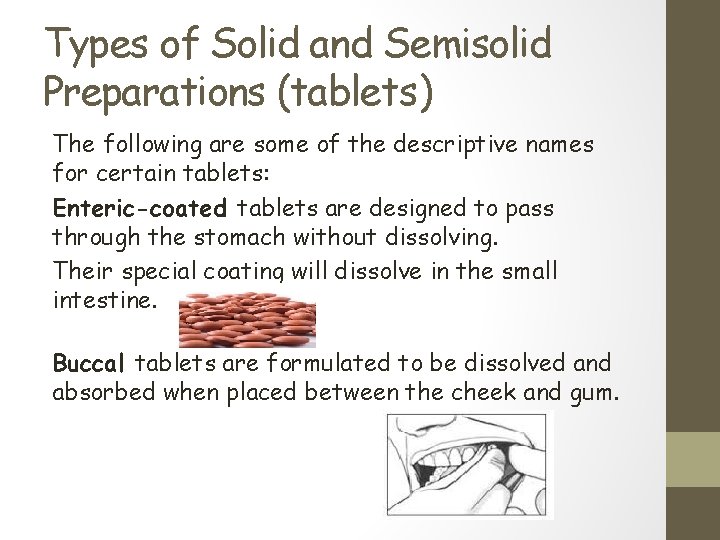
Types of Solid and Semisolid Preparations (tablets) The following are some of the descriptive names for certain tablets: Enteric-coated tablets are designed to pass through the stomach without dissolving. Their special coating will dissolve in the small intestine. Buccal tablets are formulated to be dissolved and absorbed when placed between the cheek and gum.
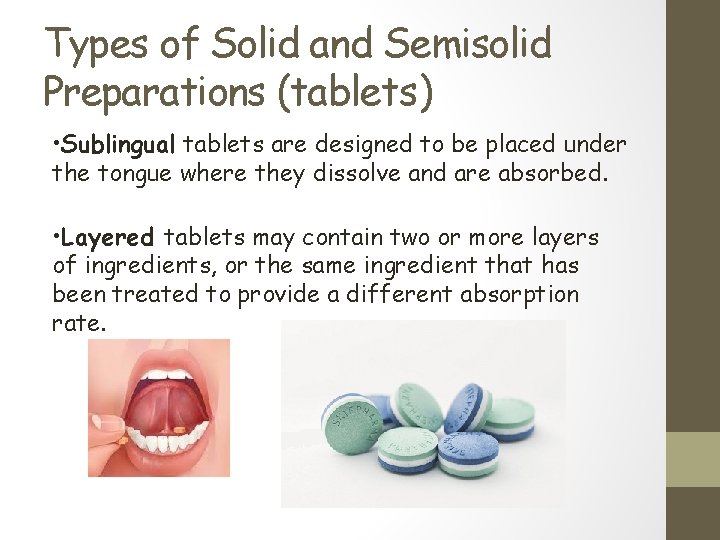
Types of Solid and Semisolid Preparations (tablets) • Sublingual tablets are designed to be placed under the tongue where they dissolve and are absorbed. • Layered tablets may contain two or more layers of ingredients, or the same ingredient that has been treated to provide a different absorption rate.
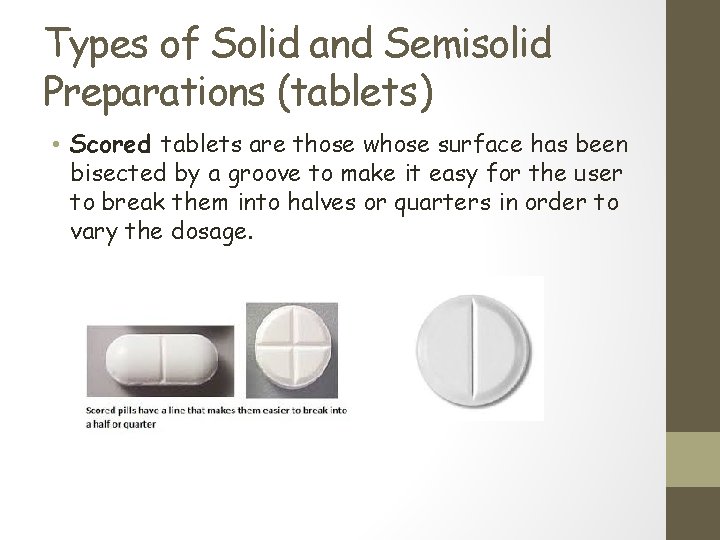
Types of Solid and Semisolid Preparations (tablets) • Scored tablets are those whose surface has been bisected by a groove to make it easy for the user to break them into halves or quarters in order to vary the dosage.
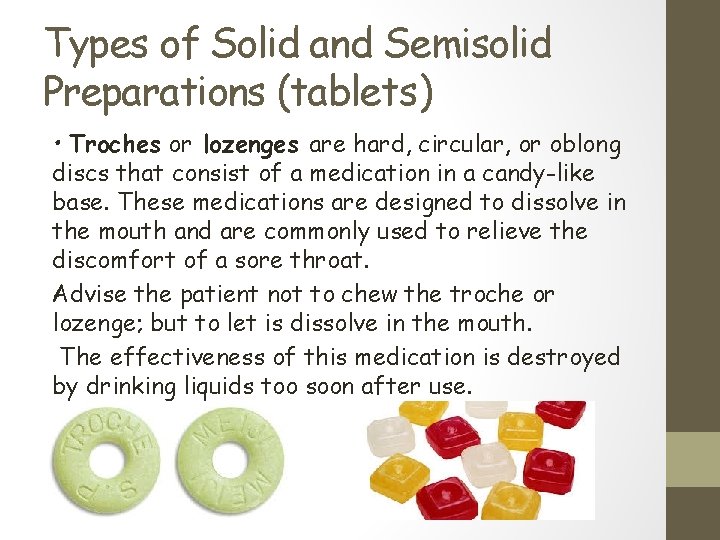
Types of Solid and Semisolid Preparations (tablets) • Troches or lozenges are hard, circular, or oblong discs that consist of a medication in a candy-like base. These medications are designed to dissolve in the mouth and are commonly used to relieve the discomfort of a sore throat. Advise the patient not to chew the troche or lozenge; but to let is dissolve in the mouth. The effectiveness of this medication is destroyed by drinking liquids too soon after use.
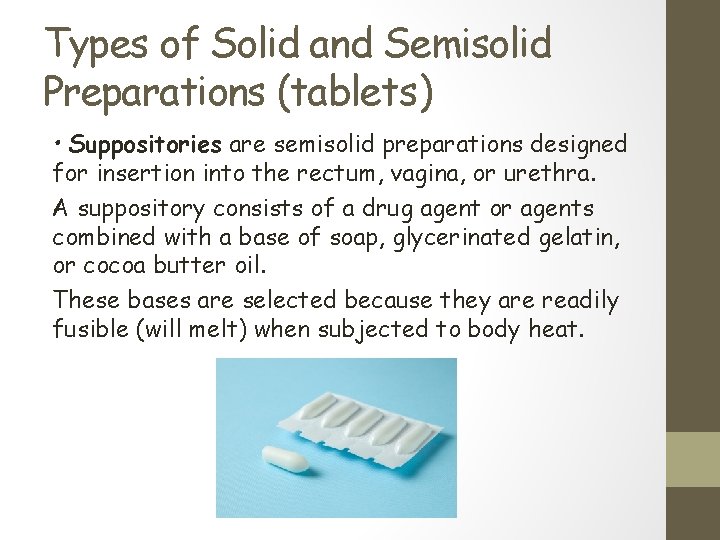
Types of Solid and Semisolid Preparations (tablets) • Suppositories are semisolid preparations designed for insertion into the rectum, vagina, or urethra. A suppository consists of a drug agent or agents combined with a base of soap, glycerinated gelatin, or cocoa butter oil. These bases are selected because they are readily fusible (will melt) when subjected to body heat.
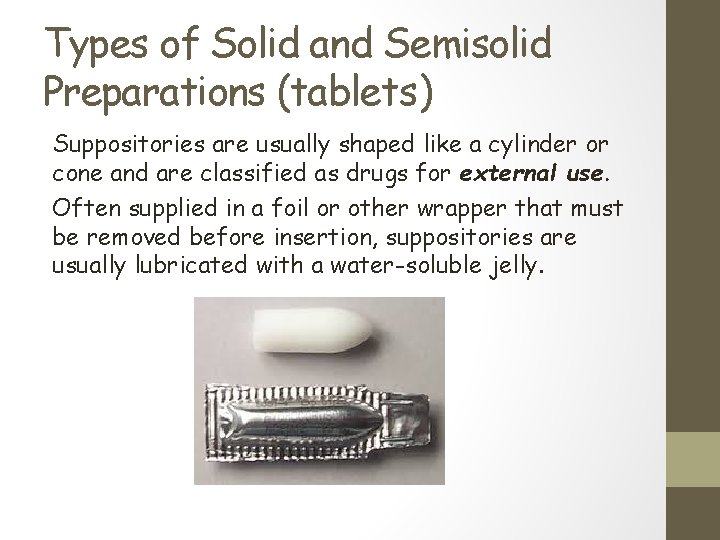
Types of Solid and Semisolid Preparations (tablets) Suppositories are usually shaped like a cylinder or cone and are classified as drugs for external use. Often supplied in a foil or other wrapper that must be removed before insertion, suppositories are usually lubricated with a water-soluble jelly.
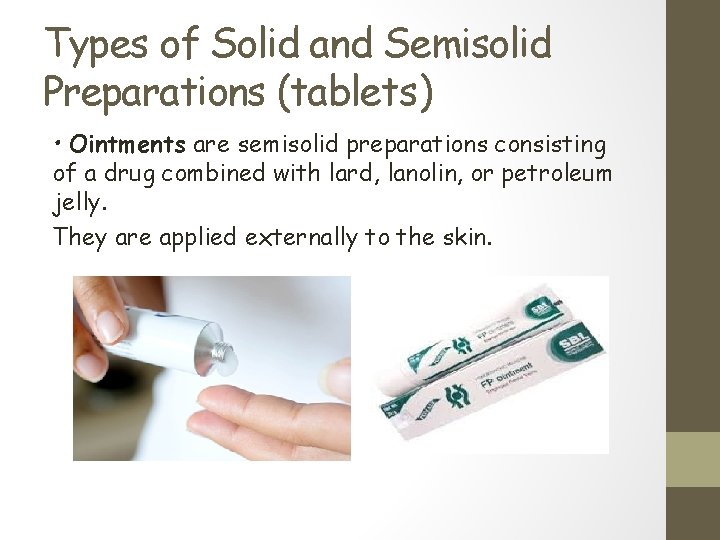
Types of Solid and Semisolid Preparations (tablets) • Ointments are semisolid preparations consisting of a drug combined with lard, lanolin, or petroleum jelly. They are applied externally to the skin.
Types of Solid and Semisolid Preparations (tablets) • Creams are semisolid preparations that are usually white, non-greasy, and have a water base. Creams may contain a drug or other substances depending upon their purpose. They may be applied externally to the skin, or administered via an applicator intra-vaginally.
Other Drug Delivery Systems Technological advances have introduced new ways by which drugs can be prepared and delivered to a patient. Some of these preparations are known as “special delivery systems” that provide the drug to a targeted area. Others are modified preparations of the conventional form of the drug.
Other Drug Delivery Systems: Transdermal System A small adhesive patch or disc that may be attached to the body near the treatment site. A transdermal system consists of four layers: 1. An impermeable backing that keeps the drug from leaking out of the system. 2. A reservoir containing the drug. 3. A membrane with tiny holes in it that controls the rate of drug release. 4. An adhesive layer or gel that keeps the device in place.
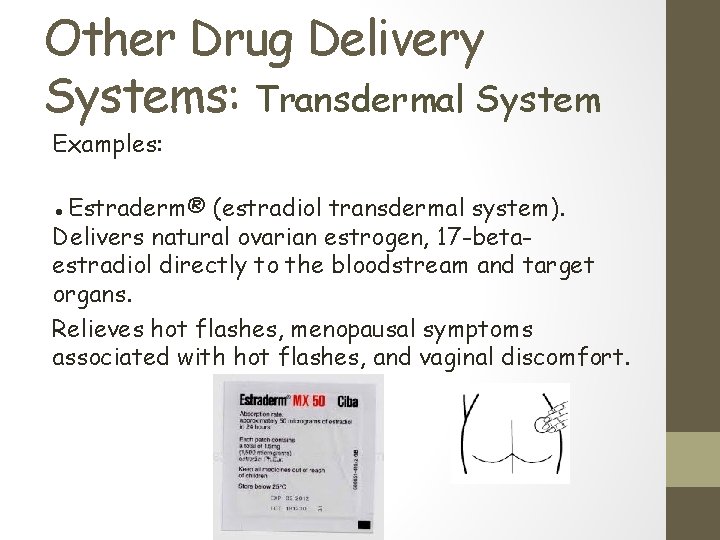
Other Drug Delivery Systems: Transdermal System Examples: ●Estraderm® (estradiol transdermal system). Delivers natural ovarian estrogen, 17 -betaestradiol directly to the bloodstream and target organs. Relieves hot flashes, menopausal symptoms associated with hot flashes, and vaginal discomfort.
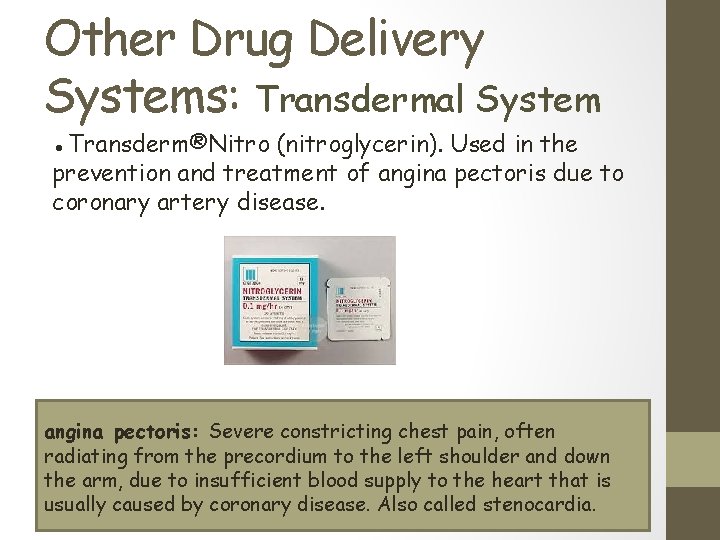
Other Drug Delivery Systems: Transdermal System ●Transderm®Nitro (nitroglycerin). Used in the prevention and treatment of angina pectoris due to coronary artery disease. angina pectoris: Severe constricting chest pain, often radiating from the precordium to the left shoulder and down the arm, due to insufficient blood supply to the heart that is usually caused by coronary disease. Also called stenocardia.
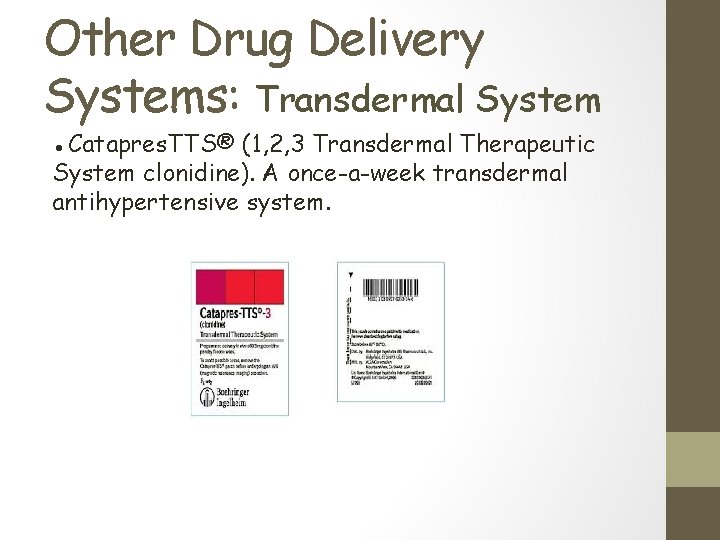
Other Drug Delivery Systems: Transdermal System ●Catapres. TTS® (1, 2, 3 Transdermal Therapeutic System clonidine). A once-a-week transdermal antihypertensive system.
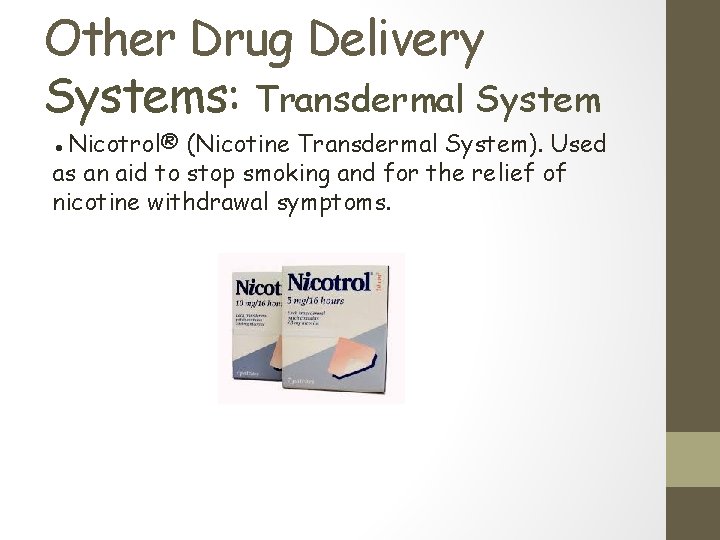
Other Drug Delivery Systems: Transdermal System ●Nicotrol® (Nicotine Transdermal System). Used as an aid to stop smoking and for the relief of nicotine withdrawal symptoms.
Other Drug Delivery Systems: eye curing lens Another innovative drug delivery system in which a drug, contained between two ultrathin plastic membranes, is placed inside the lower eyelid. It appears to cause little or no discomfort and provides a controlled release of the medication for an extended period of time. Pilocarpine, a miotic that causes contraction of the pupil, is being used in this method for the treatment of glaucoma.
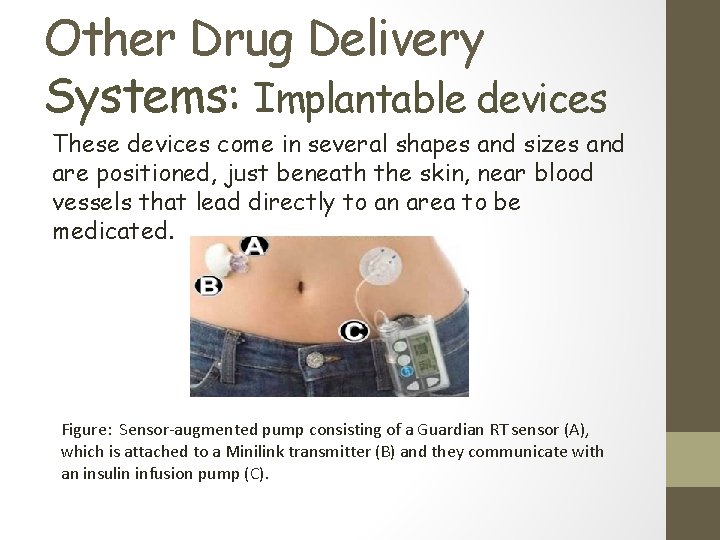
Other Drug Delivery Systems: Implantable devices These devices come in several shapes and sizes and are positioned, just beneath the skin, near blood vessels that lead directly to an area to be medicated. Figure: Sensor-augmented pump consisting of a Guardian RT sensor (A), which is attached to a Minilink transmitter (B) and they communicate with an insulin infusion pump (C).
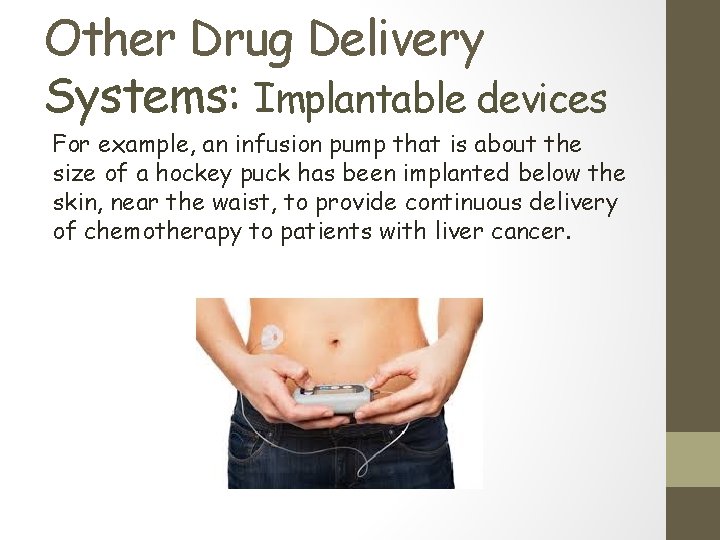
Other Drug Delivery Systems: Implantable devices For example, an infusion pump that is about the size of a hockey puck has been implanted below the skin, near the waist, to provide continuous delivery of chemotherapy to patients with liver cancer.
Other Drug Delivery Systems: Implantable devices This device, which has a refillable drug reservoir, is connected by an outlet catheter to the patient’s blood vessel. In addition to providing a continuous supply of medication, these devices have the advantage of delivering higher doses with fewer side effects than can be realized through the systemic route.
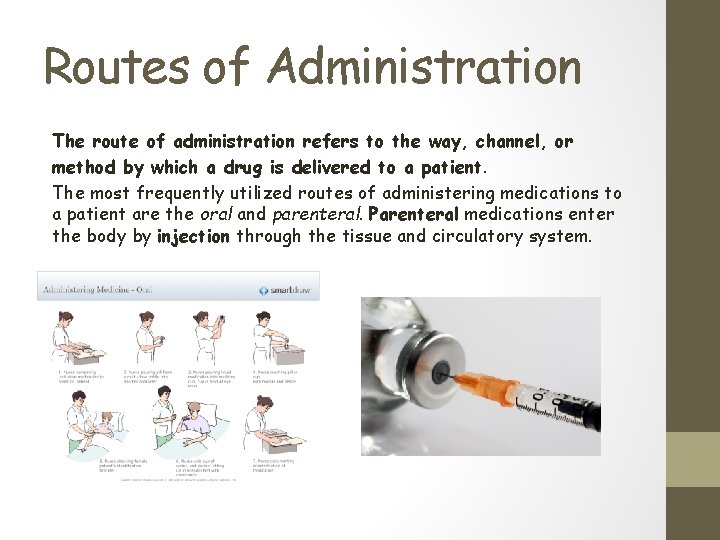
Routes of Administration The route of administration refers to the way, channel, or method by which a drug is delivered to a patient. The most frequently utilized routes of administering medications to a patient are the oral and parenteral. Parenteral medications enter the body by injection through the tissue and circulatory system.
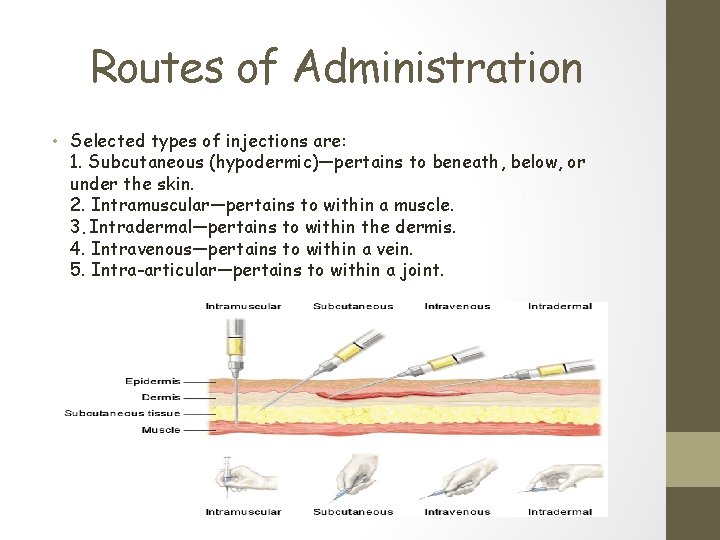
Routes of Administration • Selected types of injections are: 1. Subcutaneous (hypodermic)—pertains to beneath, below, or under the skin. 2. Intramuscular—pertains to within a muscle. 3. Intradermal—pertains to within the dermis. 4. Intravenous—pertains to within a vein. 5. Intra-articular—pertains to within a joint.
Routes of Administration • Other routes of administration are: ●direct application to the skin (lotions, creams, liniments, ointments, and transdermal systems) ●sublingual (tablets, liquid: drops) ●buccal (tablets) ●rectal (suppositories, ointments) ●vaginal (suppositories, creams, tablets) • inhalation (sprays, aerosols) ●instillation (liquid: drops)