
Forming Maintaining and Working in Multicultural Teams Agenda


- Slides: 24
Forming, Maintaining and Working in Multicultural Teams
Agenda: • Types of labor • Approaches to international staffing • Selection criteria • Expatriate failure • Types of international assignments
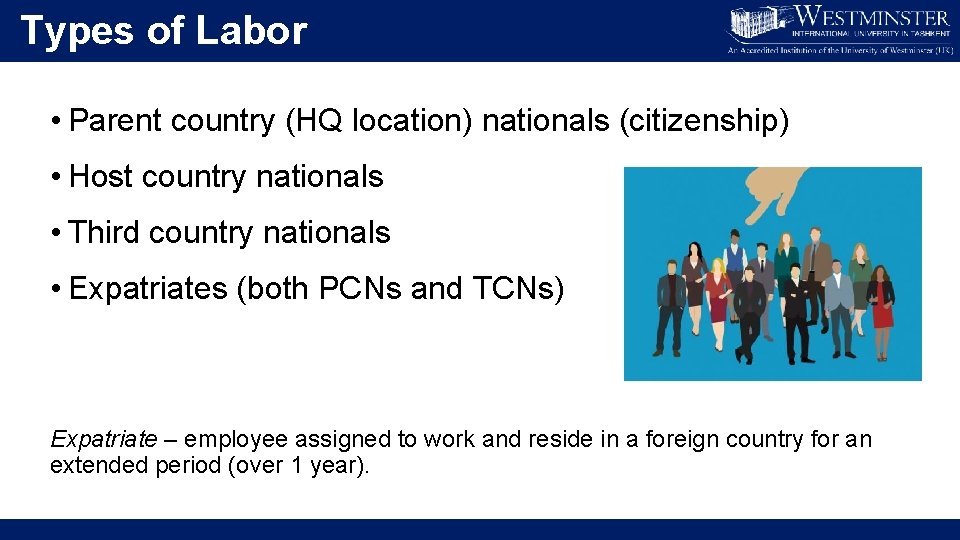
Types of Labor • Parent country (HQ location) nationals (citizenship) • Host country nationals • Third country nationals • Expatriates (both PCNs and TCNs) Expatriate – employee assigned to work and reside in a foreign country for an extended period (over 1 year).
APPROACHES TO INTERNATIONAL STAFFING • Ethnocentric approach • Polycentric approach • Geocentric approach • Regiocentric approach
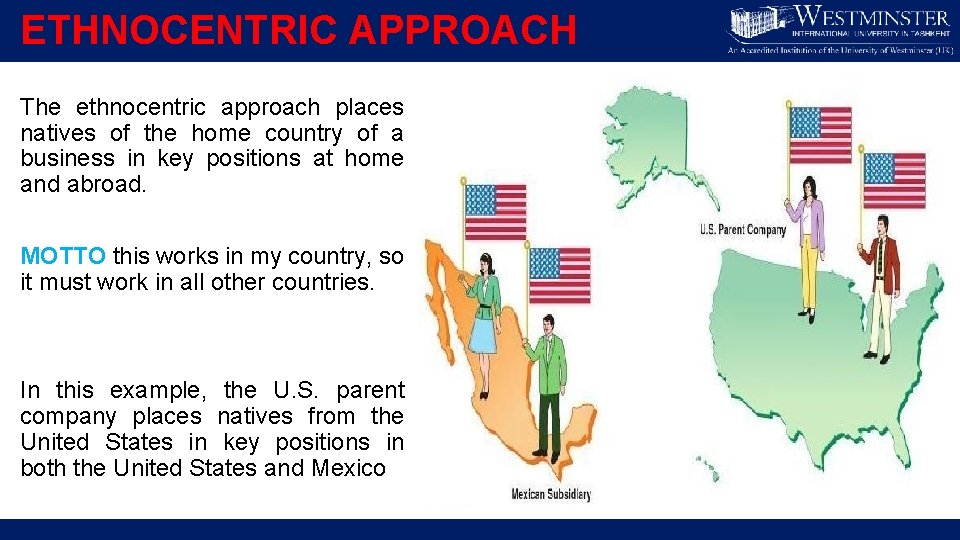
ETHNOCENTRIC APPROACH The ethnocentric approach places natives of the home country of a business in key positions at home and abroad. MOTTO this works in my country, so it must work in all other countries. In this example, the U. S. parent company places natives from the United States in key positions in both the United States and Mexico
REASONS for ETHNOCENTRIC APPROACH: • Lack of qualified HCNs particularly senior management talent. • A desire to maintain good communication, coordination, tighter control and a unified corporate culture linked with corporate HQ. • A desire to transfer parent firm’s core competencies to a foreign subsidiary more expeditiously.
ADVANTAGES OF ETHNOCENTRIC APPROACH: • Organizational control and coordination is maintained and facilitated. • Promising managers are given international experience. • Assure that subsidiary will comply with company objectives.
DISADVANTAGES OF ETHNOCENTRIC APPROACH • Limits the promotion opportunities of HCNs which may lead to reduced productivity and increased turnover among that group. • The adaptation of expatriate managers to new environment takes time during which these expatriates make poor decisions. • Income packages of expatriates are 4 times higher than locals.
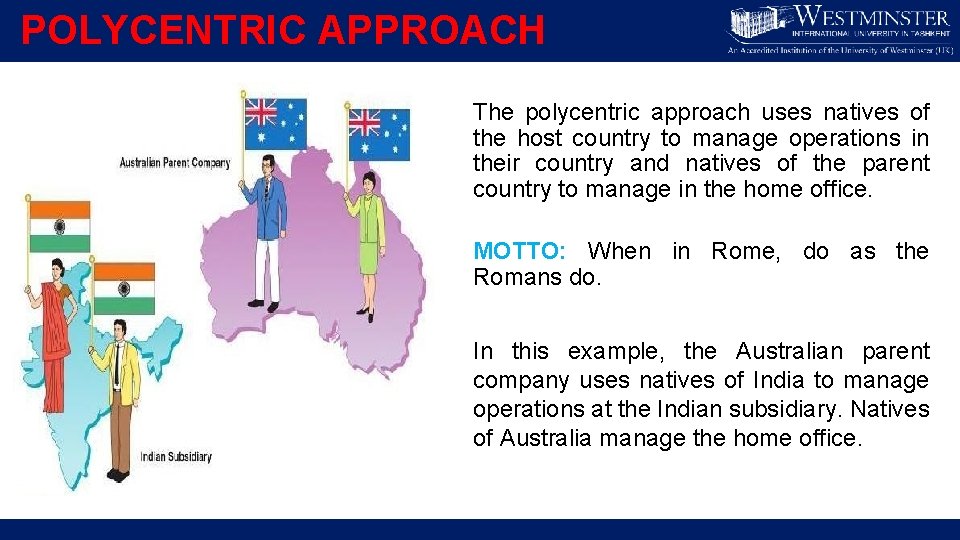
POLYCENTRIC APPROACH The polycentric approach uses natives of the host country to manage operations in their country and natives of the parent country to manage in the home office. MOTTO: When in Rome, do as the Romans do. In this example, the Australian parent company uses natives of India to manage operations at the Indian subsidiary. Natives of Australia manage the home office.
ADVANTAGES OF POLYCENTRIC APPROACH • Eliminates language barriers. • Avoids adjustment problems of expatriates and their families and removes the need for cultural awareness training. • Less expensive. • Gives continuity to the management of foreign subsidiaries, thus reduces turnover.
DISADVANTAGES OF POLYCENTRIC APPROACH • The gap between HQ and subsidiaries increased which becomes difficult to be managed. • Limited career opportunities for HCN and PCN managers.
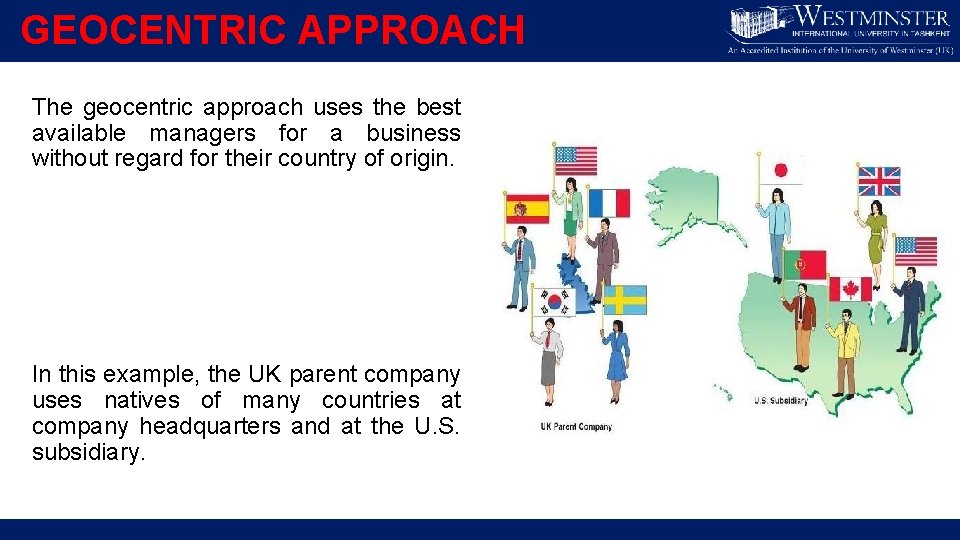
GEOCENTRIC APPROACH The geocentric approach uses the best available managers for a business without regard for their country of origin. In this example, the UK parent company uses natives of many countries at company headquarters and at the U. S. subsidiary.
REASONS FOR GEOCENTRIC APPROACH: • Highly competent employees are available not only at HQs but also in subsidiaries. • International experience is a condition for success in top positions. • Managers with high potential are constantly ready to be transferred from one country to another.
ADVANTAGES OF GEOCENTRIC APPROACH: • Enables an MNC to develop an international executive team. • Overcome the federation drawback of polycentric approach
DISADVANTAGES OF GEOCENTRIC APPROACH • Host govt. pressurizes MNC to employ high number of HCNs. • Expensive to implement because of training and relocation expense. • Time consuming. • Requires more centralized control of staffing.
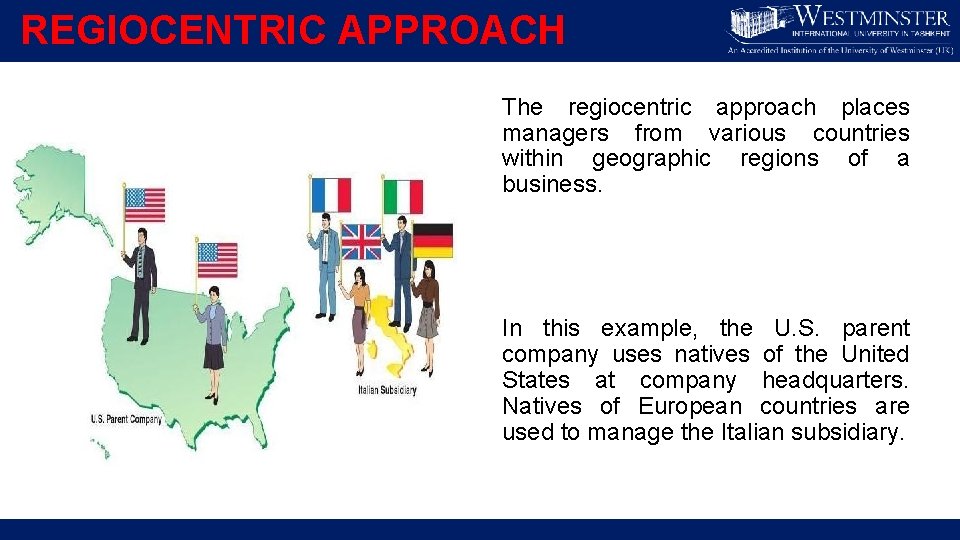
REGIOCENTRIC APPROACH The regiocentric approach places managers from various countries within geographic regions of a business. In this example, the U. S. parent company uses natives of the United States at company headquarters. Natives of European countries are used to manage the Italian subsidiary.
ADVANTAGES OF REGIOCENTRIC APPROACH: • Allows interaction between executives transferred to regional HQs. • A step for MNC to move from purely poly or ethnocentric or geocentric approach.
DISADVANTAGES OF REGIOCENTRIC APPROACH • It provides federalism at regional basis rather than country basis. This serves as a barrier in taking a global stance. • Limits career progression opportunities to the regional level.
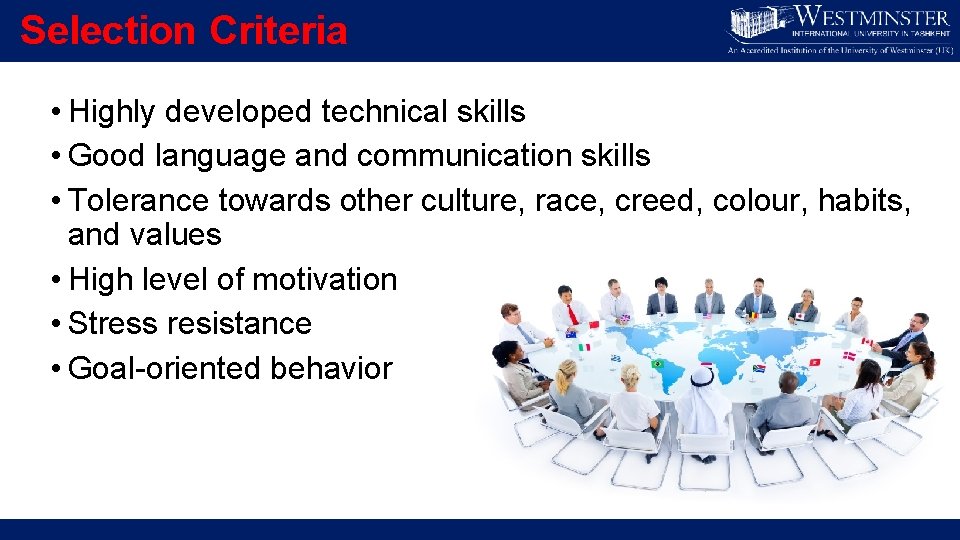
Selection Criteria • Highly developed technical skills • Good language and communication skills • Tolerance towards other culture, race, creed, colour, habits, and values • High level of motivation • Stress resistance • Goal-oriented behavior
EXPATRIATE FAILURE The premature return of an expatriate before completion of assignment is referred to as Expatriate Failure. It incurs direct as well as indirect cost on the organization. DIRECT COST: • Airfares • Associated relocation expenses • Salary • Training
REASONS OF EXPATRIATE FAILURE: • Spouse/partner dissatisfaction • Family concerns • Ability to adapt • Wrong Candidate selection • Job fails to meet expectations • Job performance • Quality of life
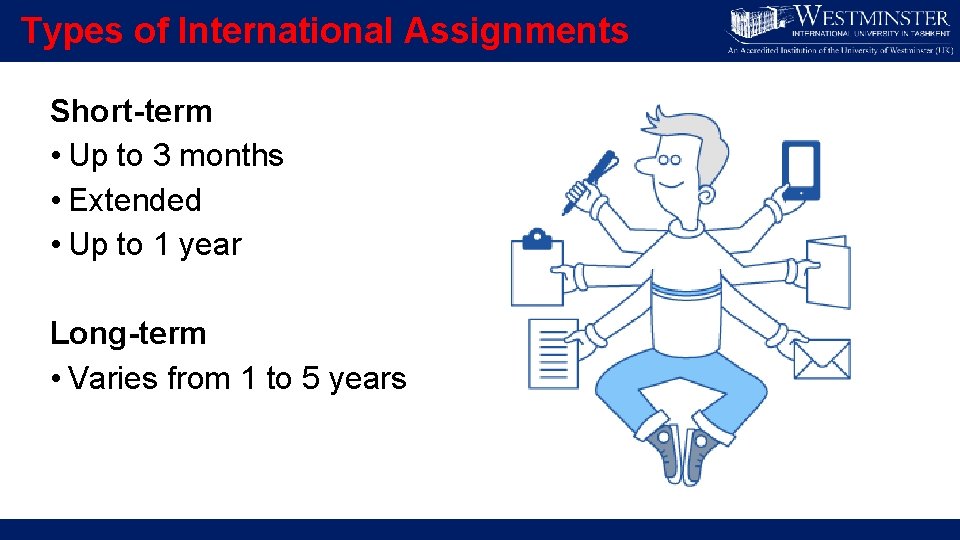
Types of International Assignments Short-term • Up to 3 months • Extended • Up to 1 year Long-term • Varies from 1 to 5 years
Indicative reading • Mead, R (2009). International Management. Chapter 19 • Deresky, H (2014). International Management: Managing Across Borders and Cultures. Chapter 9 • Dowling, P (2013) International Human Resource Management, 6 edn. Chapter 5 • Luthans, F & Doh, J. P. (2012) International Management: Culture, Strategy and Behavior. 8 th edn. Chapter 14 • Reiche & Harzing (2009) International Assignments, <http: //www. harzing. com/download/ihrmchapter. pdf>