
FORMING AND CREATING THESIS STATEMENTS WHAT IS A
- Slides: 11
FORMING AND CREATING THESIS STATEMENTS
WHAT IS A THESIS STATEMENT? MYTH 1: A thesis statement is the answer to the problem MYTH 2: Your paper should focus on gathering evidence to solve the claim in your thesis statement INSTEAD, think of a thesis • as a THEORY about the meaning of evidence • as something that is not immediately evident or obvious to your reader
PRODUCTIVE THESIS STATEMENTS • Promotes thinking • Reduces the scope of your ideas • Provides direction • A thesis needs to be open enough to allow you to explore all ideas about a certain topic. • You also do not have to have a thesis to begin writing. Arriving at claims too early blinds writers and they miss complicating evidence.
HOW TO COME UP WITH A THESIS: • Focus on an area of your subject that is open to OPPOSING VIEWPOINTS or MULTIPLE INTERPRETATIONS • Treat thesis as a hypothesis to be tested, rather than an obvious truth
WHAT IT MEANS TO HAVE AN IDEA • An idea usually starts with an observation that is puzzling, with something that you want to figure out rather than something that you already understand • An idea often accounts for some dissonance, something that seems not to fit together • An idea may be the discovery of a question where there seemed not to be one • An idea may make explicit and explore the meaning of something implicit • An idea may connect elements of a subject and explain the significance of that connection Ideas often arise when there is something to negotiate
SETTING UP THESIS • In setting up thesis, the introduction accomplishes two tasks: • It lays out something at stake—an issue, question, or problem to which the writer’s thesis is a tentative answer or solution, and • It provides an interpretive context that locates thesis in relation to existing thinking • The introduction tells readers why the idea that the paper is about to explore matters—why, in other words, the paper needs to be written. The most important thing is that your introduction explains WHY thesis is worth considering.
HOW TO WORD A THESIS STATEMENT • A productive thesis usually contains tension, the balance of this against that • Effective thesis statements often begin with a grammatically subordinate idea that will get outweighed by a more pressing claim: “Although X appears to account for Z, Y account for it better. ” • A less effective thesis shape is the list • Active verbs and specific nouns produce strong thesis statements
TENSION • Pit one idea against another; find a new way of thinking about your topic that might have a better interpretation than another • You are not setting out to argue that one is better than another; instead, show both ideas have some validity Examples: • It may not seem like it, but “Nice Pants” is as radical a campaign as the original Dockers series. • If opponents of cosmetic surgery are too quick to dismiss those who claim great psychological benefits, proponents are far too willing to dismiss those who raise concerns. Cosmetic surgery might make individual people happier, but in the aggregate it makes life worse for everyone.
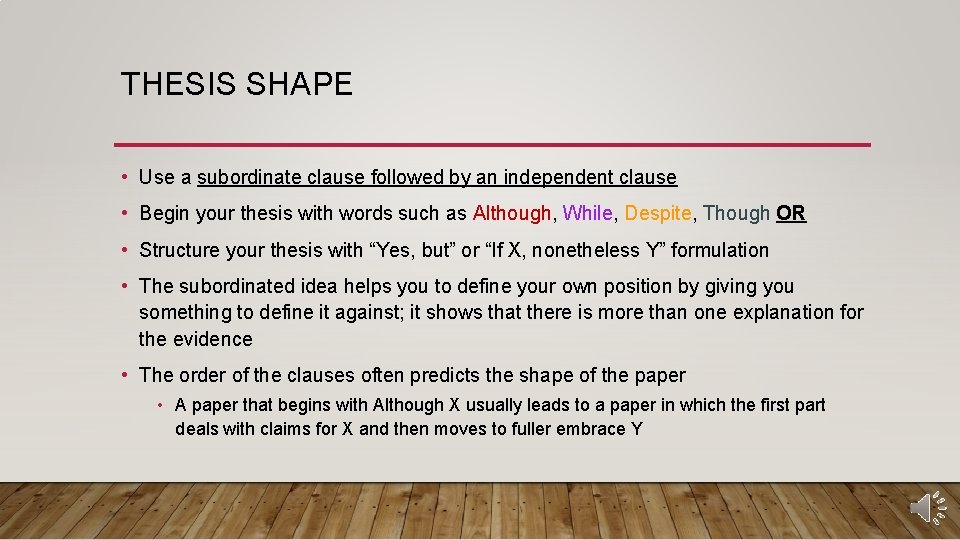
THESIS SHAPE • Use a subordinate clause followed by an independent clause • Begin your thesis with words such as Although, While, Despite, Though OR • Structure your thesis with “Yes, but” or “If X, nonetheless Y” formulation • The subordinated idea helps you to define your own position by giving you something to define it against; it shows that there is more than one explanation for the evidence • The order of the clauses often predicts the shape of the paper • A paper that begins with Although X usually leads to a paper in which the first part deals with claims for X and then moves to fuller embrace Y
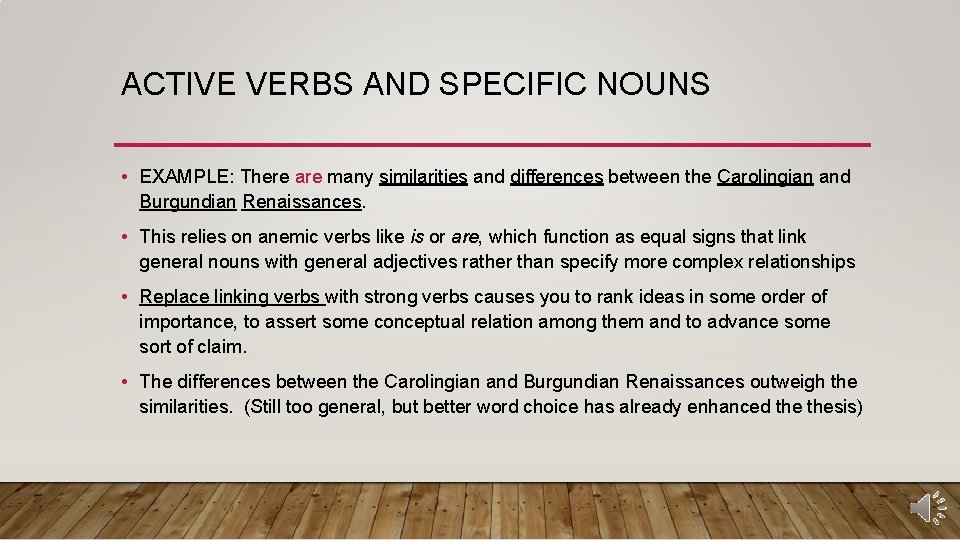
ACTIVE VERBS AND SPECIFIC NOUNS • EXAMPLE: There are many similarities and differences between the Carolingian and Burgundian Renaissances. • This relies on anemic verbs like is or are, which function as equal signs that link general nouns with general adjectives rather than specify more complex relationships • Replace linking verbs with strong verbs causes you to rank ideas in some order of importance, to assert some conceptual relation among them and to advance some sort of claim. • The differences between the Carolingian and Burgundian Renaissances outweigh the similarities. (Still too general, but better word choice has already enhanced thesis)
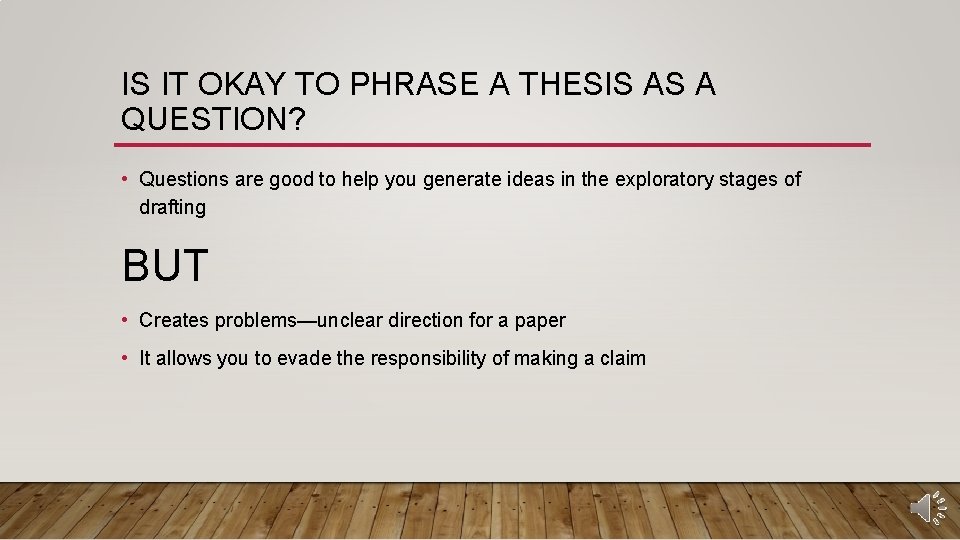
IS IT OKAY TO PHRASE A THESIS AS A QUESTION? • Questions are good to help you generate ideas in the exploratory stages of drafting BUT • Creates problems—unclear direction for a paper • It allows you to evade the responsibility of making a claim