
FormFinding of Long Span Bridges with Continuum Topology
Form-Finding of Long Span Bridges with Continuum Topology Optimization and a Buckling Criterion Salam Rahmatalla (Graduate Student) Prof. Colby C. Swan (Adviser) Department of Civil and Environmental Engineering Center for Computer-Aided Design The University of Iowa
Objective Statement To develop a continuum topology formulation capable of finding structural forms of maximum buckling stability.
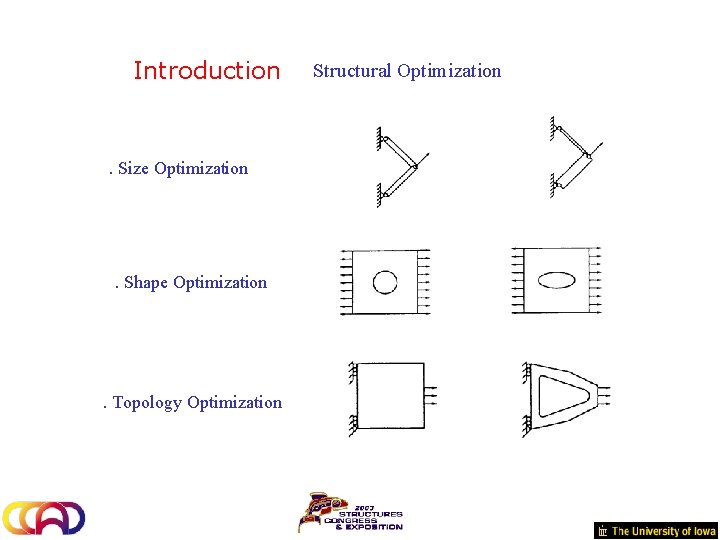
Introduction . Size Optimization . Shape Optimization . Topology Optimization Structural Optimization
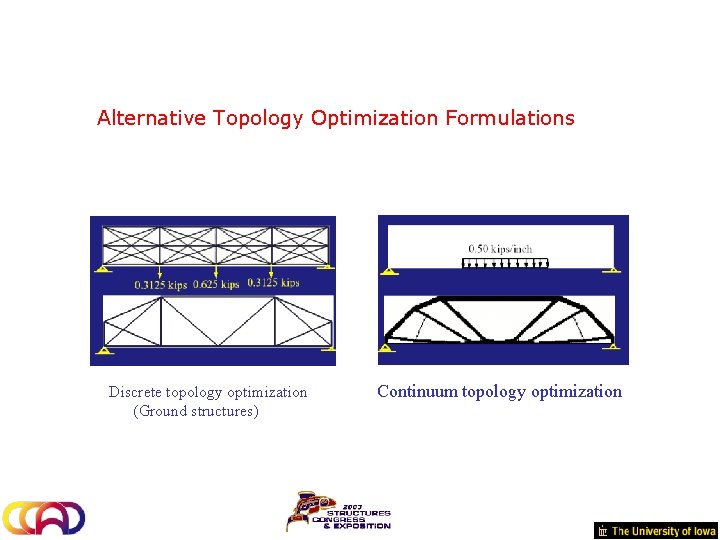
Alternative Topology Optimization Formulations Discrete topology optimization (Ground structures) Continuum topology optimization
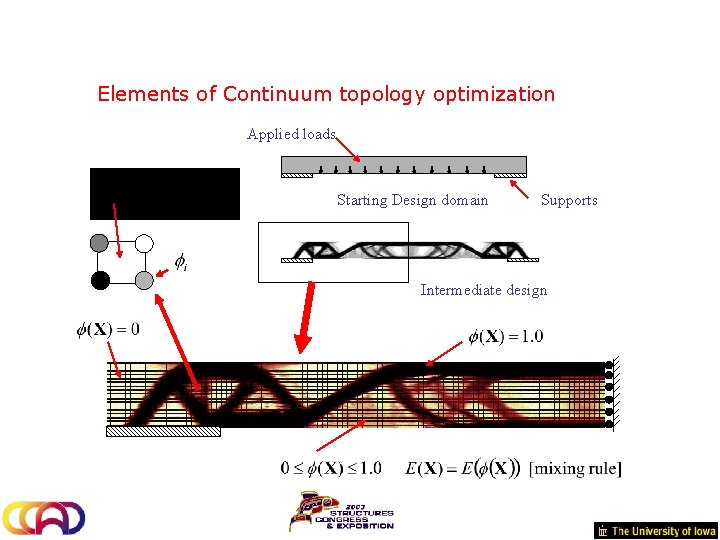
Elements of Continuum topology optimization Applied loads Starting Design domain Supports Intermediate design

Sparsity of Long-Span Bridges Sunshine Skyway bridge cable-stayed bridge in Tampa, Florida Akashi Bridge suspension bridge In Japan Most long-span bridges occupy < 1% of their envelope volume.
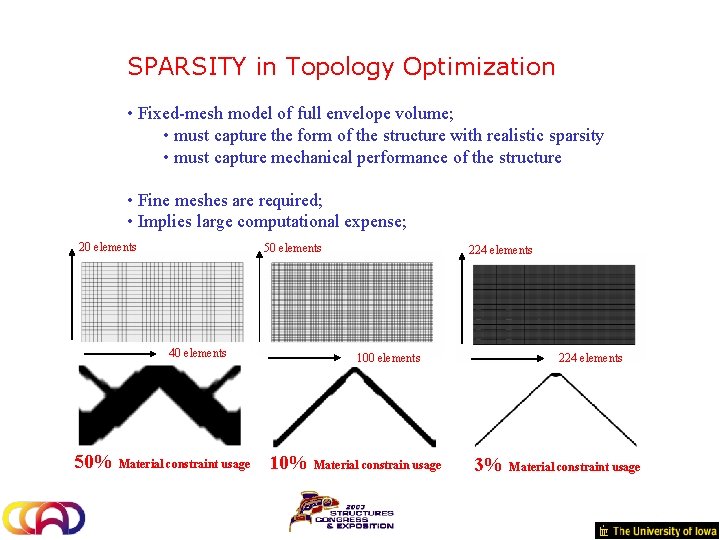
SPARSITY in Topology Optimization • Fixed-mesh model of full envelope volume; • must capture the form of the structure with realistic sparsity • must capture mechanical performance of the structure • Fine meshes are required; • Implies large computational expense; 20 elements 50 elements 40 elements 224 elements 100 elements 50% Material constraint usage 10% Material constrain usage 224 elements 3% Material constraint usage
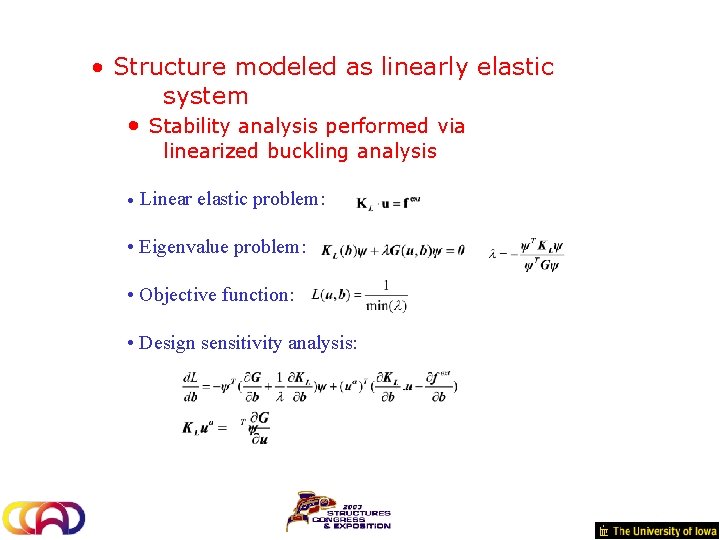
• Structure modeled as linearly elastic system • Stability analysis performed via linearized buckling analysis • Linear elastic problem: • Eigenvalue problem: • Objective function: • Design sensitivity analysis:
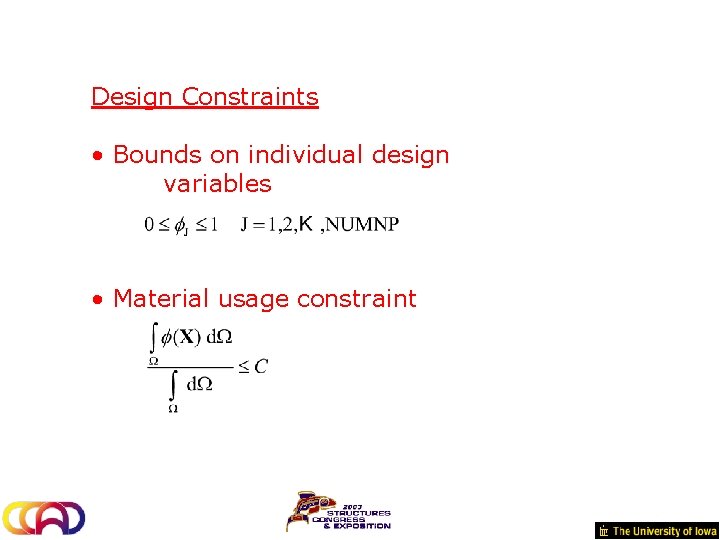
Design Constraints • Bounds on individual design variables • Material usage constraint
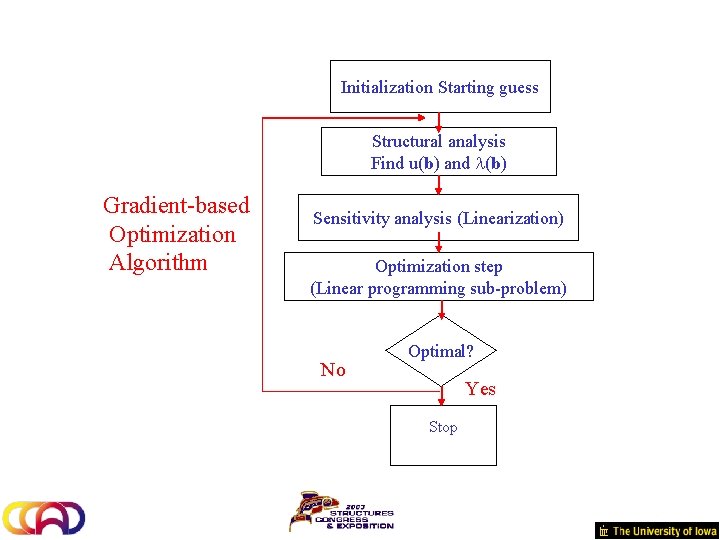
Initialization Starting guess Structural analysis Find u(b) and l(b) Gradient-based Optimization Algorithm Sensitivity analysis (Linearization) Optimization step (Linear programming sub-problem) No Optimal? Yes Stop
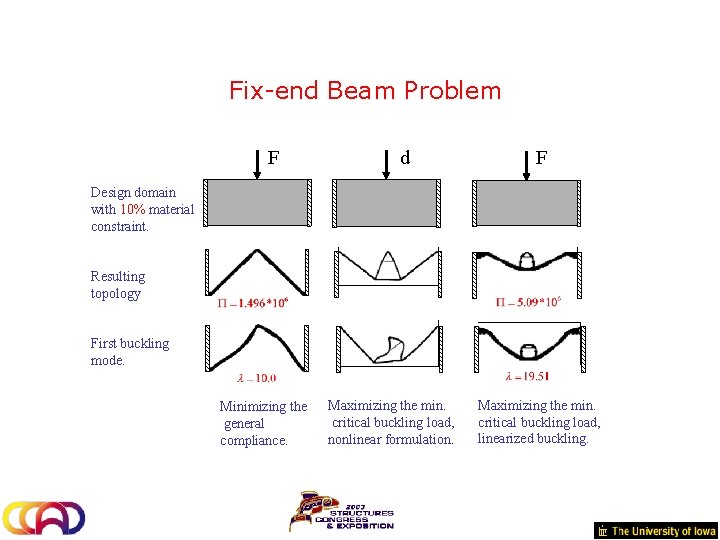
Fix-end Beam Problem F d F Design domain with 10% material constraint. Resulting topology First buckling mode. Minimizing the general compliance. Maximizing the min. critical buckling load, nonlinear formulation. Maximizing the min. critical buckling load, linearized buckling.
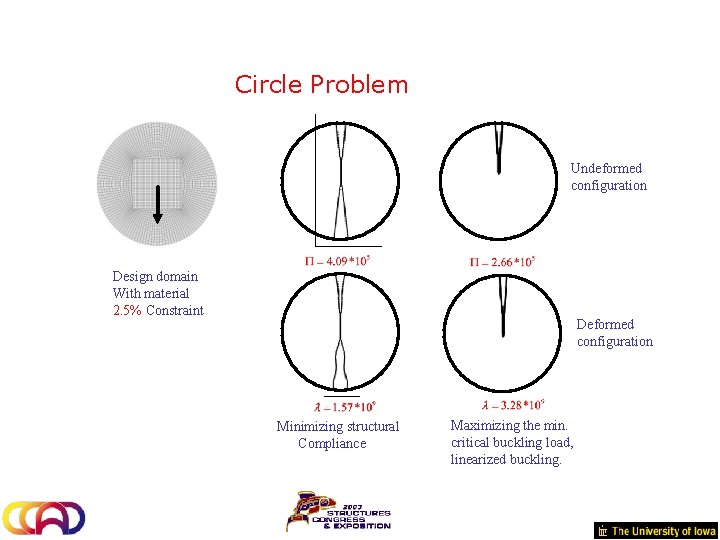
Circle Problem Undeformed configuration Design domain With material 2. 5% Constraint Deformed configuration Minimizing structural Compliance Maximizing the min. critical buckling load, linearized buckling.
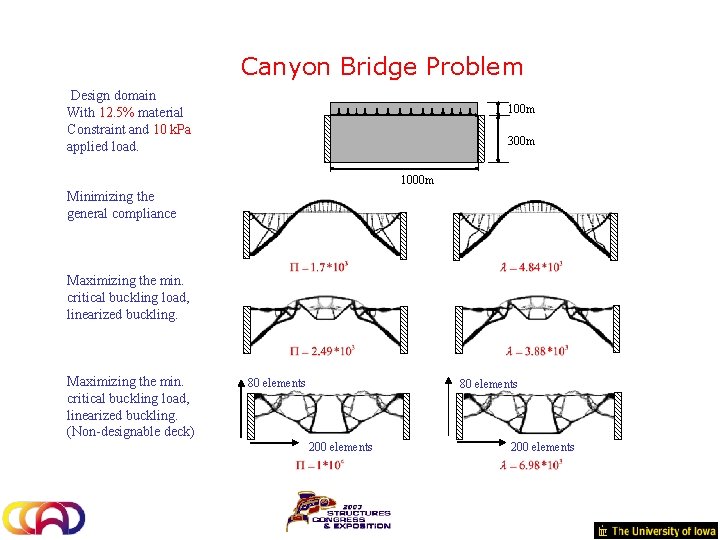
Canyon Bridge Problem Design domain With 12. 5% material Constraint and 10 k. Pa applied load. 100 m 300 m 1000 m Minimizing the general compliance Maximizing the min. critical buckling load, linearized buckling. (Non-designable deck) 80 elements 200 elements
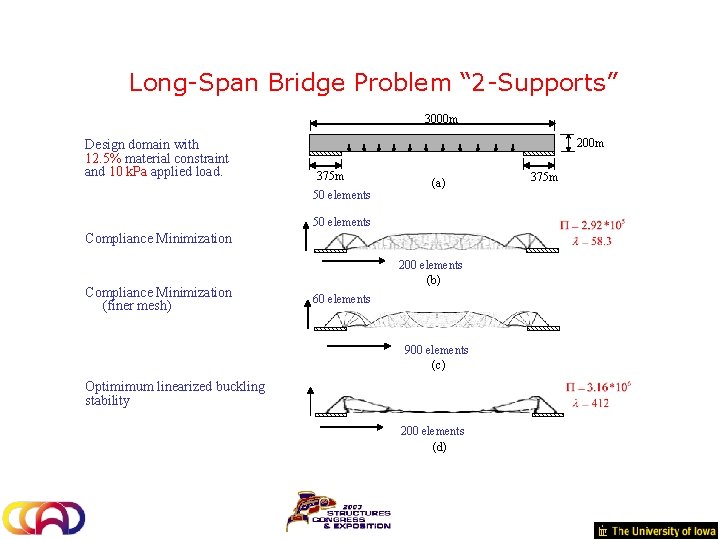
Long-Span Bridge Problem “ 2 -Supports” 3000 m Design domain with 12. 5% material constraint and 10 k. Pa applied load. 200 m 375 m 50 elements (a) 50 elements Compliance Minimization (finer mesh) 200 elements (b) 60 elements 900 elements (c) Optimimum linearized buckling stability 200 elements (d) 375 m
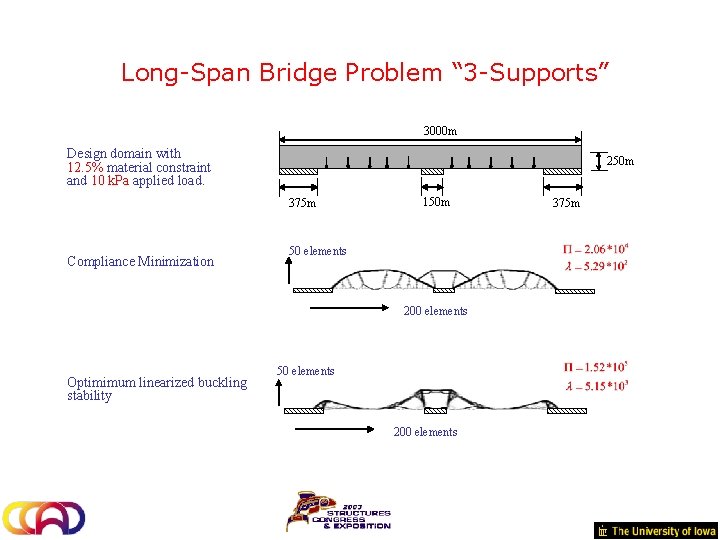
Long-Span Bridge Problem “ 3 -Supports” 3000 m Design domain with 12. 5% material constraint and 10 k. Pa applied load. 250 m 375 m Compliance Minimization 150 m 50 elements 200 elements Optimimum linearized buckling stability 50 elements 200 elements 375 m
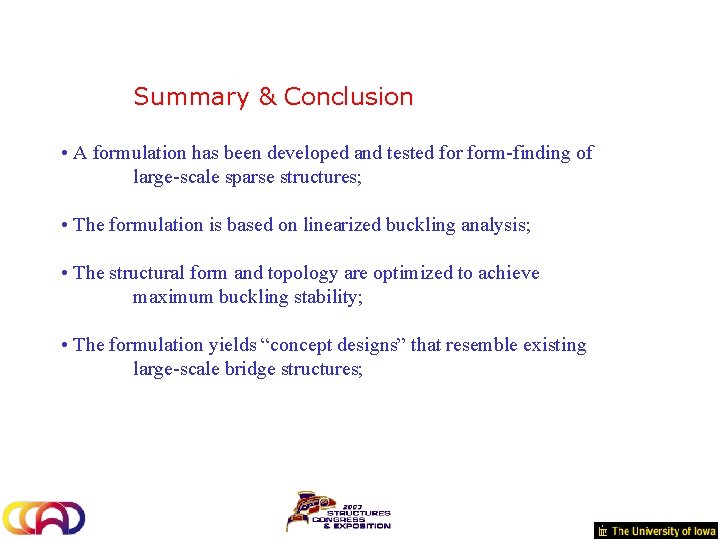
Summary & Conclusion • A formulation has been developed and tested form-finding of large-scale sparse structures; • The formulation is based on linearized buckling analysis; • The structural form and topology are optimized to achieve maximum buckling stability; • The formulation yields “concept designs” that resemble existing large-scale bridge structures;
- Slides: 16