
Formative assessment what it is and what its


- Slides: 7
Formative assessment: what it is and what it’s not Dylan Wiliam www. dylanwiliam. net
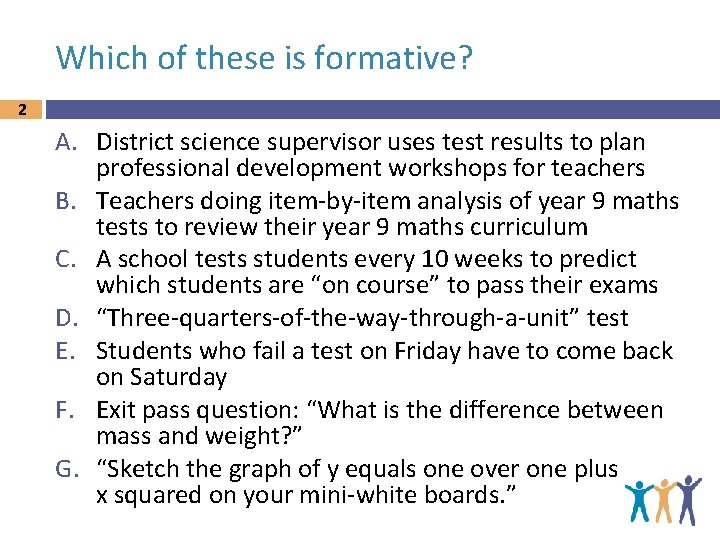
Which of these is formative? 2 A. District science supervisor uses test results to plan professional development workshops for teachers B. Teachers doing item-by-item analysis of year 9 maths tests to review their year 9 maths curriculum C. A school tests students every 10 weeks to predict which students are “on course” to pass their exams D. “Three-quarters-of-the-way-through-a-unit” test E. Students who fail a test on Friday have to come back on Saturday F. Exit pass question: “What is the difference between mass and weight? ” G. “Sketch the graph of y equals one over one plus x squared on your mini-white boards. ”
The formative assessment hijack 3 Long-cycle: Medium-cycle: Span: across units, terms Length: four weeks to one year Impact: Student monitoring; curriculum alignment Span: within and between teaching units Length: one to four weeks Impact: Improved, student-involved assessment; teacher cognition about learning Short-cycle: Span: within and between lessons Length: day-by-day: 24 to 48 hours minute-by-minute: five seconds to two hours Impact: classroom practice; student engagement
Unpacking formative assessment 4 Where the learner is going Teacher Peer Learner Clarifying, sharing and understanding learning intentions Where the learner is How to get there Providing Engineering effective discussions, tasks, and feedback that moves learners activities that elicit forward evidence of learning Activating students as learning resources for one another Activating students as owners of their own learning
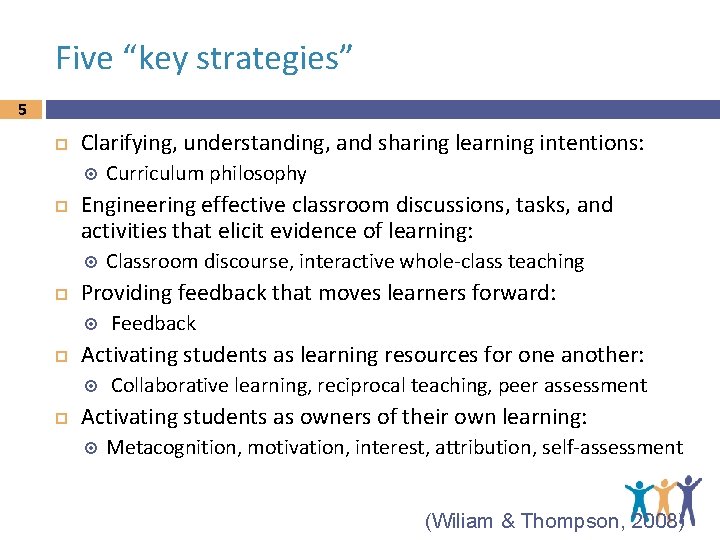
Five “key strategies” 5 Clarifying, understanding, and sharing learning intentions: Engineering effective classroom discussions, tasks, and activities that elicit evidence of learning: Feedback Activating students as learning resources for one another: Classroom discourse, interactive whole-class teaching Providing feedback that moves learners forward: Curriculum philosophy Collaborative learning, reciprocal teaching, peer assessment Activating students as owners of their own learning: Metacognition, motivation, interest, attribution, self-assessment (Wiliam & Thompson, 2008)
And one big idea 6 Use evidence about learning to adapt instruction to meet student needs.
An educational positioning system 7 A good teacher: Establishes where the students are in their learning Identifies the learning destination Carefully plans a route Begins the learning journey Makes regular checks on progress on the way Makes adjustments to the course as conditions dictate