
FORMATIVE ASSESSMENT How to use the assessment process
- Slides: 17
FORMATIVE ASSESSMENT How to use the assessment process to improve the afterschool program.
The Goal � The purpose of this training is to provide participating teachers with the knowledge, skills, and resources needed to assess students in a way that guides learning and increases achievement.
Overview � In today’s training session you will: � Understand the difference between formative and summative assessments. � Discover how to use the formative assessment process to improve the afterschool experience for students. � Design a plan to consistently and effectively formative assessments in the afterschool program.
Activity 1: Unlimited Testing � � � Part 1: Write down all the ways you can think of that students are tested/measured in school. Part 2: Rank the top five most important ways. Share your top five with a group of four. Are there similarities? What does the top five of others tell you about them?
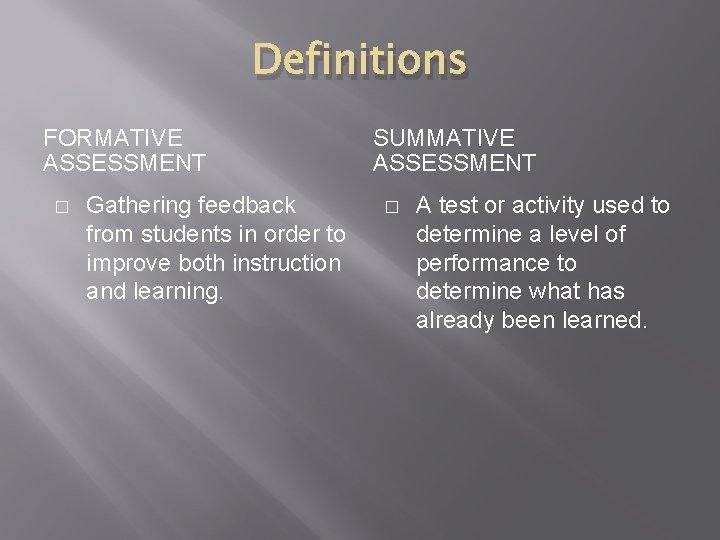
Definitions FORMATIVE ASSESSMENT � Gathering feedback from students in order to improve both instruction and learning. SUMMATIVE ASSESSMENT � A test or activity used to determine a level of performance to determine what has already been learned.
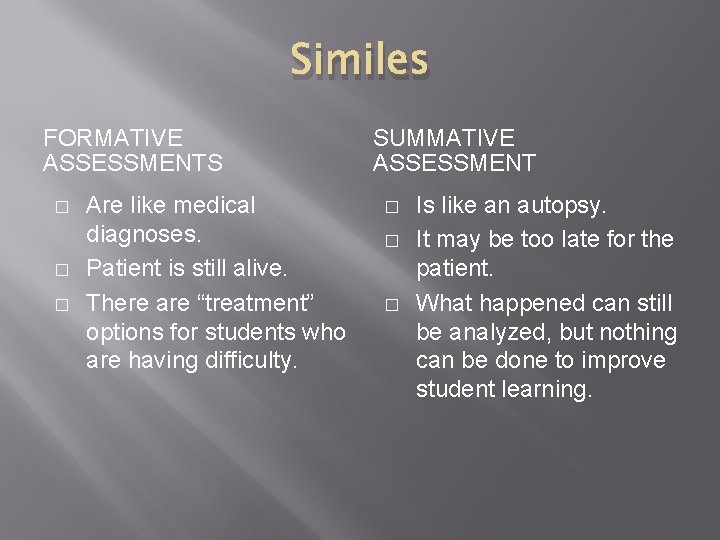
Similes FORMATIVE ASSESSMENTS � � � Are like medical diagnoses. Patient is still alive. There are “treatment” options for students who are having difficulty. SUMMATIVE ASSESSMENT � � � Is like an autopsy. It may be too late for the patient. What happened can still be analyzed, but nothing can be done to improve student learning.
Reflection Question � What type of testing did you mostly have in your top 5? � A lot of attention is paid to “Big” tests that are summative in nature. These are important, but they don’t have nearly the impact on learning that formative testing methods have. �
Afterschool Assessments � � Are often lacking. Are often VERY informal and almost exclusively based on teacher observation. Many teachers measure their effectiveness in the afterschool program based on how hard they tried or how thoroughly they covered the material. Student achievement must be measured; it makes sense to measure it in a way that directly improves both instruction and learning.
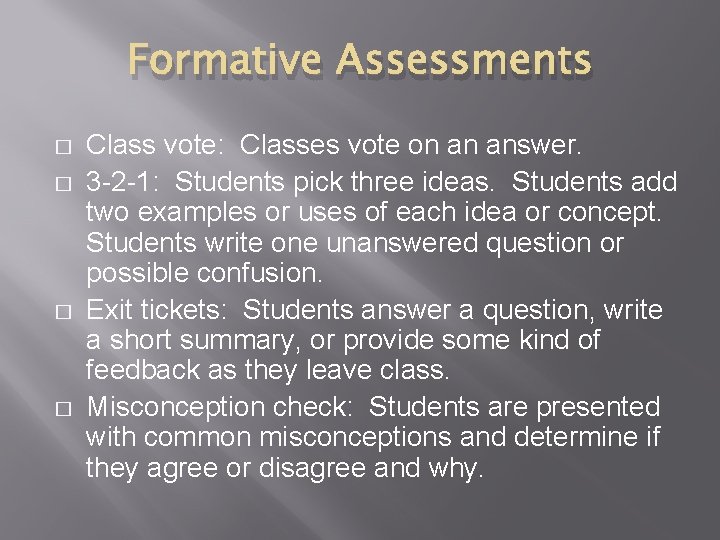
Formative Assessments � � Class vote: Classes vote on an answer. 3 -2 -1: Students pick three ideas. Students add two examples or uses of each idea or concept. Students write one unanswered question or possible confusion. Exit tickets: Students answer a question, write a short summary, or provide some kind of feedback as they leave class. Misconception check: Students are presented with common misconceptions and determine if they agree or disagree and why.
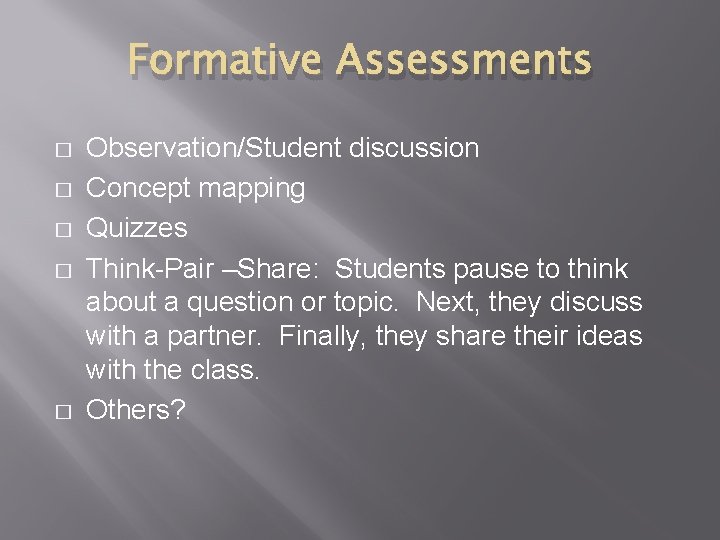
Formative Assessments � � � Observation/Student discussion Concept mapping Quizzes Think-Pair –Share: Students pause to think about a question or topic. Next, they discuss with a partner. Finally, they share their ideas with the class. Others?
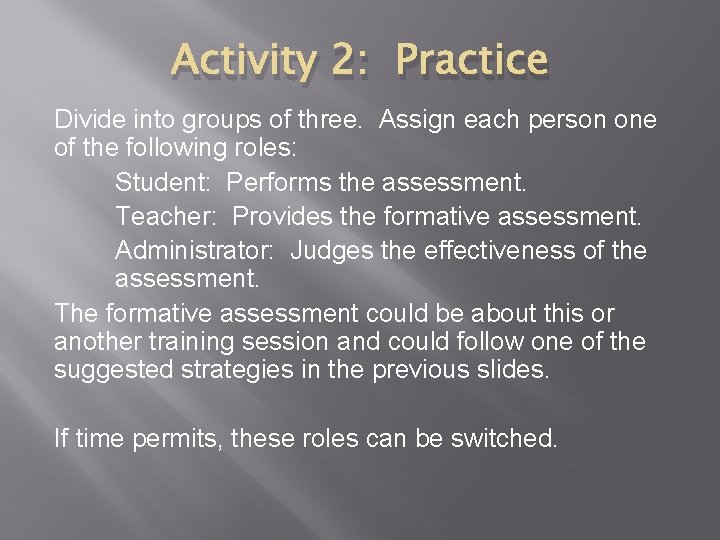
Activity 2: Practice Divide into groups of three. Assign each person one of the following roles: Student: Performs the assessment. Teacher: Provides the formative assessment. Administrator: Judges the effectiveness of the assessment. The formative assessment could be about this or another training session and could follow one of the suggested strategies in the previous slides. If time permits, these roles can be switched.
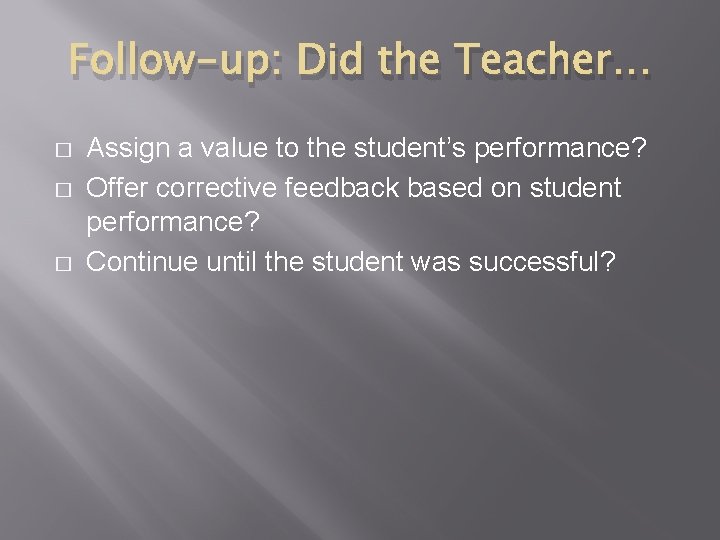
Follow-up: Did the Teacher… � � � Assign a value to the student’s performance? Offer corrective feedback based on student performance? Continue until the student was successful?
Afterschool Applications � � � Determine what the most important aspect of the lesson is, and formatively assess that. Make sure students understand that feedback from their assessment will be used to improve their performance. Use the information from formative assessments to focus instruction and adapt methods.
Suggestions � � Consider working with the regular school day teachers to find out what formative assessments they have been using and using that data to help your own instruction. Use formative assessments to both gauge and improve the instruction in the afterschool program.
Questions? � � Any questions? Comments? Concerns? Or anything else for the good of the group?
Summary � � � Formative assessments are different from summative assessments in that formative assessments are used to improve performance and instruction. Formative assessments can be done in a variety of styles and methods. Formative assessments can be used to greatly improve the success of the afterschool program.
Sources � � � Add references: ASCD Brookhart Hattie Marzano