
FORMATION OF THE UNIVERSE THE BIG BANG THEORY
FORMATION OF THE UNIVERSE
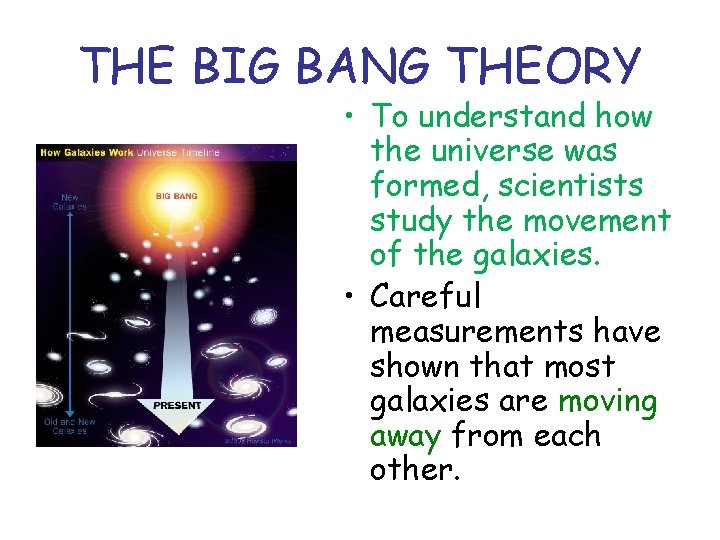
THE BIG BANG THEORY • To understand how the universe was formed, scientists study the movement of the galaxies. • Careful measurements have shown that most galaxies are moving away from each other.
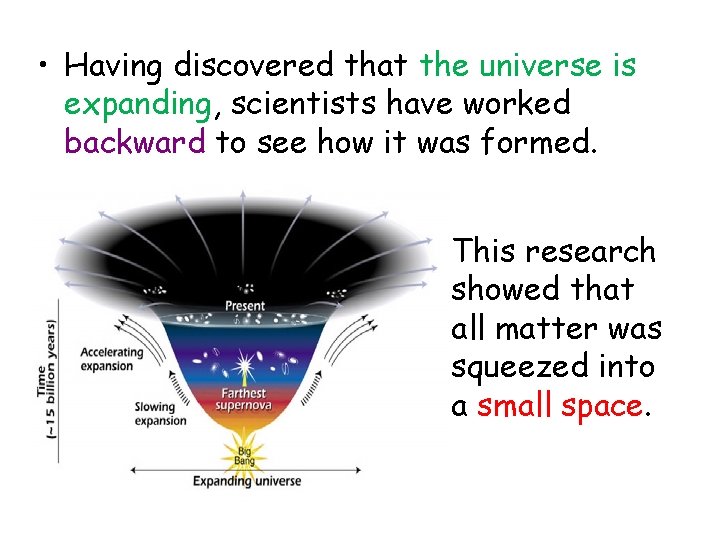
• Having discovered that the universe is expanding, scientists have worked backward to see how it was formed. This research showed that all matter was squeezed into a small space.
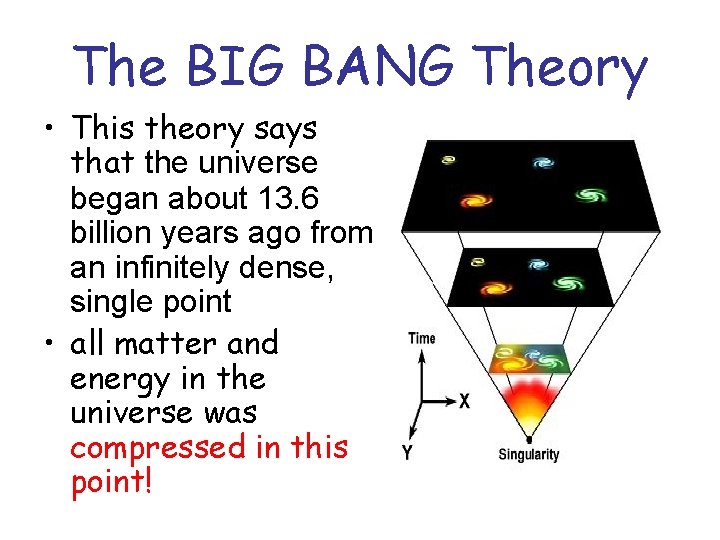
The BIG BANG Theory • This theory says that the universe began about 13. 6 billion years ago from an infinitely dense, single point • all matter and energy in the universe was compressed in this point!
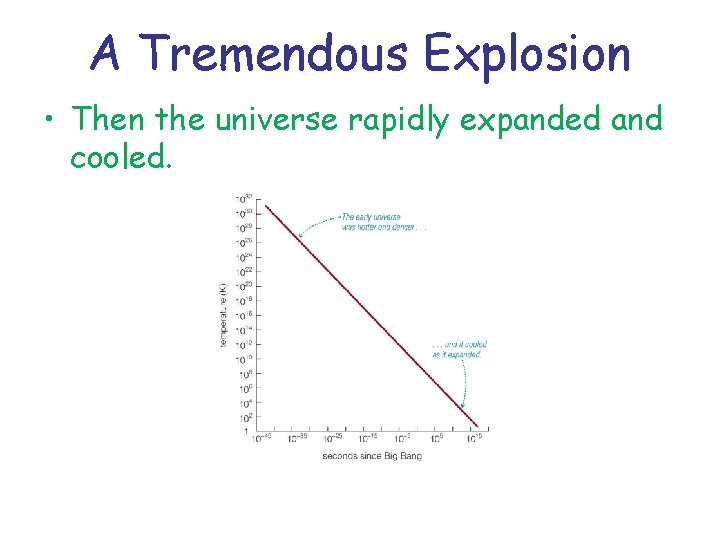
A Tremendous Explosion • Then the universe rapidly expanded and cooled.
Expansion of Spacetime
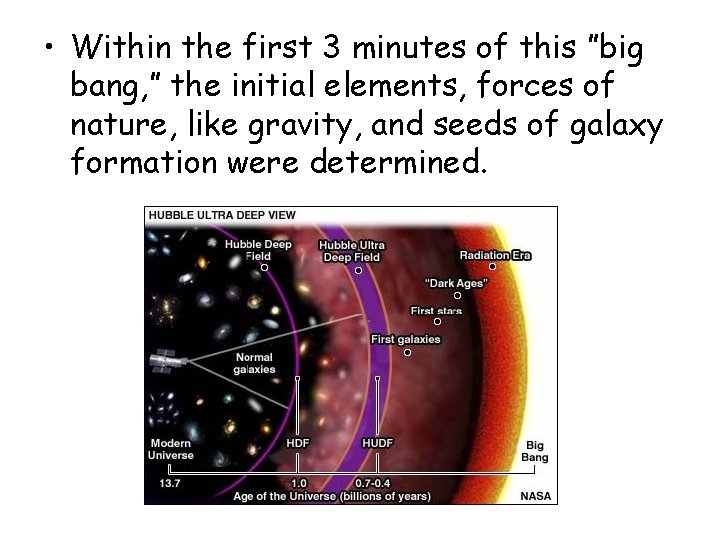
• Within the first 3 minutes of this ”big bang, ” the initial elements, forces of nature, like gravity, and seeds of galaxy formation were determined.
Primary Evidence for BB 1) We have detected the leftover radiation from the Big Bang. 2) The Big Bang theory correctly predicts the abundance of helium and other light elements. 3) The night sky is dark.
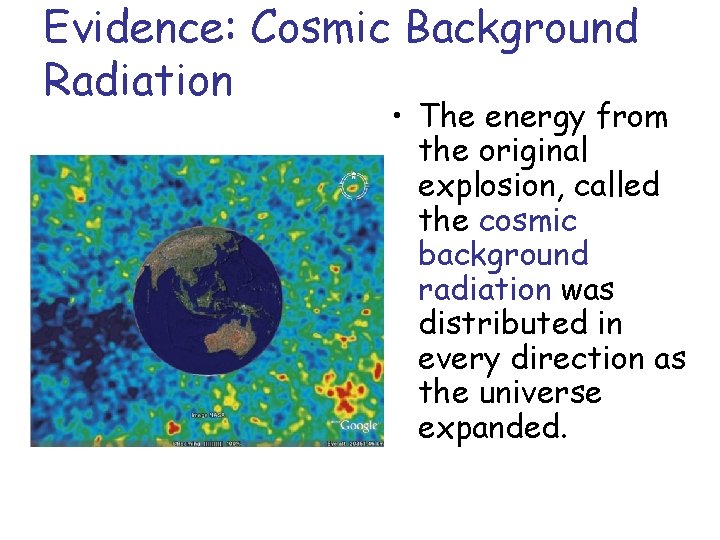
Evidence: Cosmic Background Radiation • The energy from the original explosion, called the cosmic background radiation was distributed in every direction as the universe expanded.
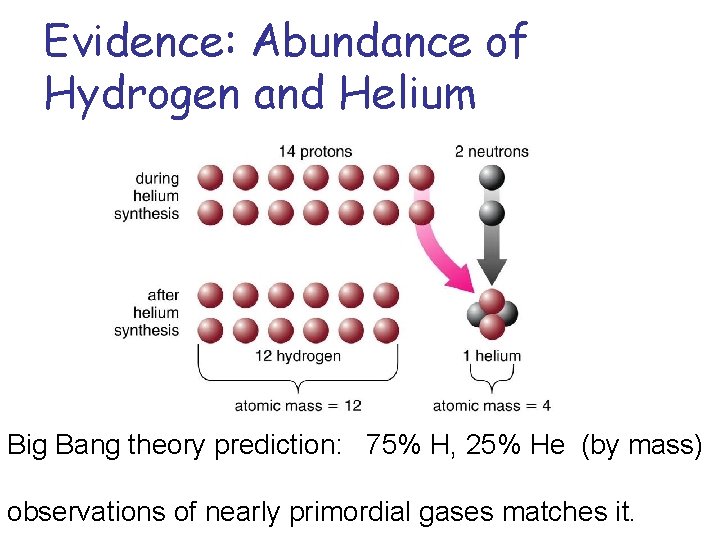
Evidence: Abundance of Hydrogen and Helium Big Bang theory prediction: 75% H, 25% He (by mass) observations of nearly primordial gases matches it.
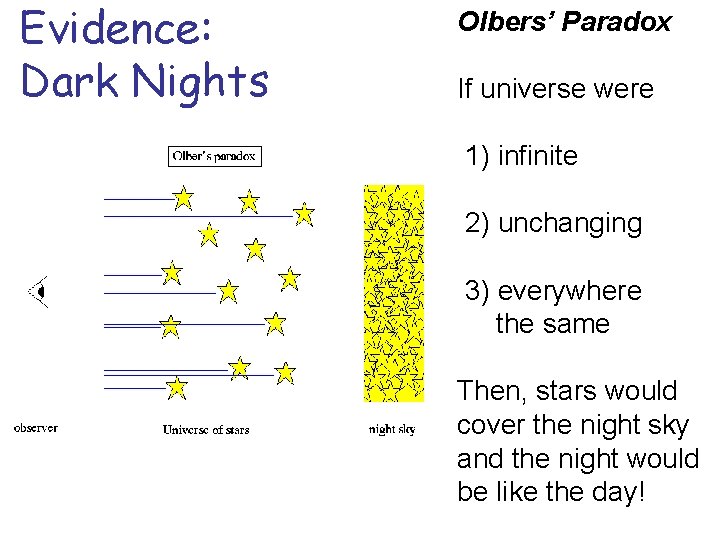
Evidence: Dark Nights Olbers’ Paradox If universe were 1) infinite 2) unchanging 3) everywhere the same Then, stars would cover the night sky and the night would be like the day!
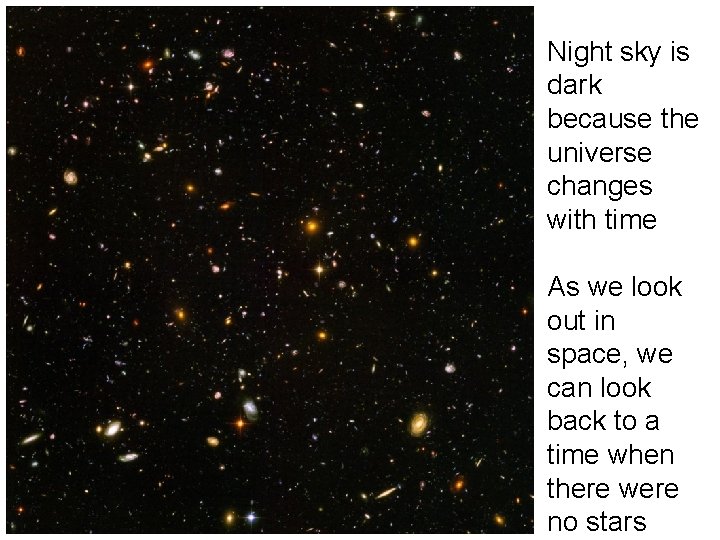
Night sky is dark because the universe changes with time As we look out in space, we can look back to a time when there were no stars
Evidence for Big Bang
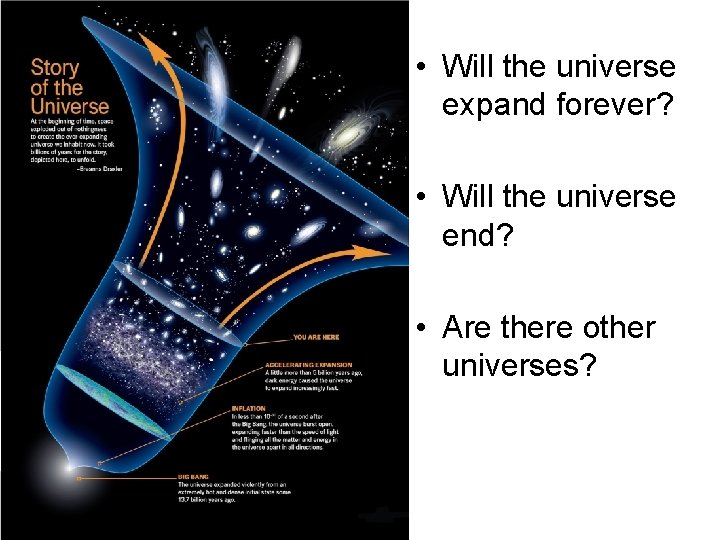
• Will the universe expand forever? • Will the universe end? • Are there other universes?
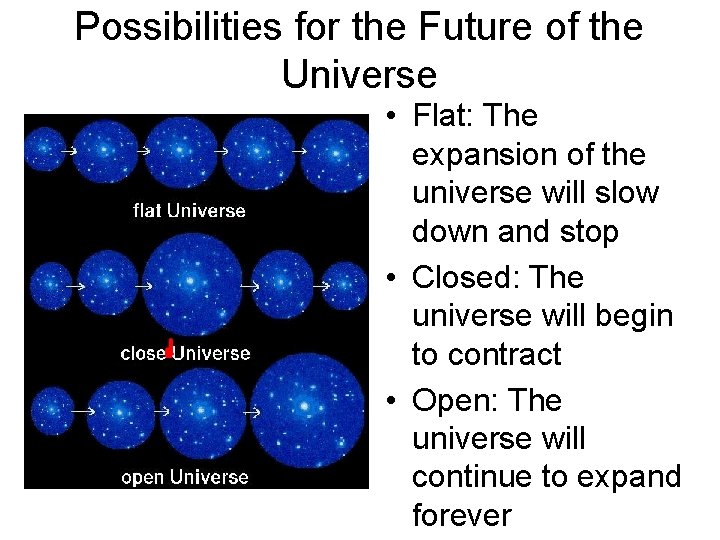
Possibilities for the Future of the Universe • Flat: The expansion of the universe will slow down and stop • Closed: The universe will begin to contract • Open: The universe will continue to expand forever
Dark matter and dark energy • Dark Matter: An undetected form of mass that emits little or no light but we can see its gravitational influence on objects • Dark Energy: An unknown form of energy that seems to be the source of a repulsive force causing the expansion of the universe to accelerate
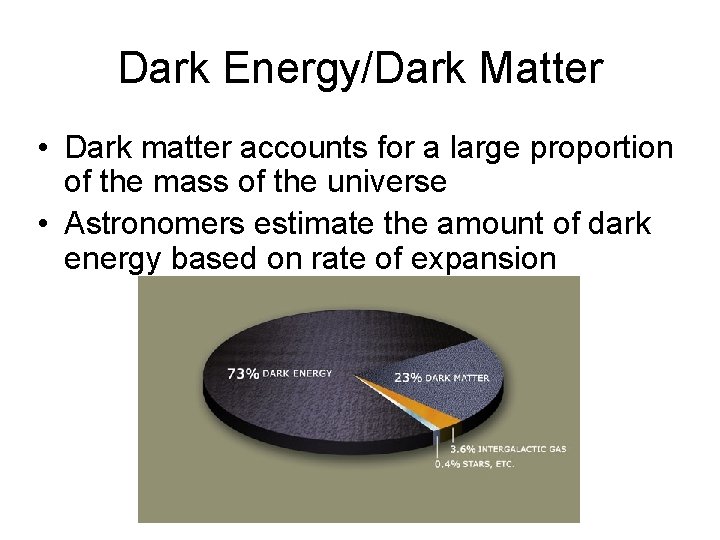
Dark Energy/Dark Matter • Dark matter accounts for a large proportion of the mass of the universe • Astronomers estimate the amount of dark energy based on rate of expansion

What is dark matter?
Dark Matter • Fred Zwicky – 1930’s, studied galaxy clusters • Obtained spectra and found they were spinning too fast • Vera Rubin – 1960’s, studied spiral galaxies and got the same results
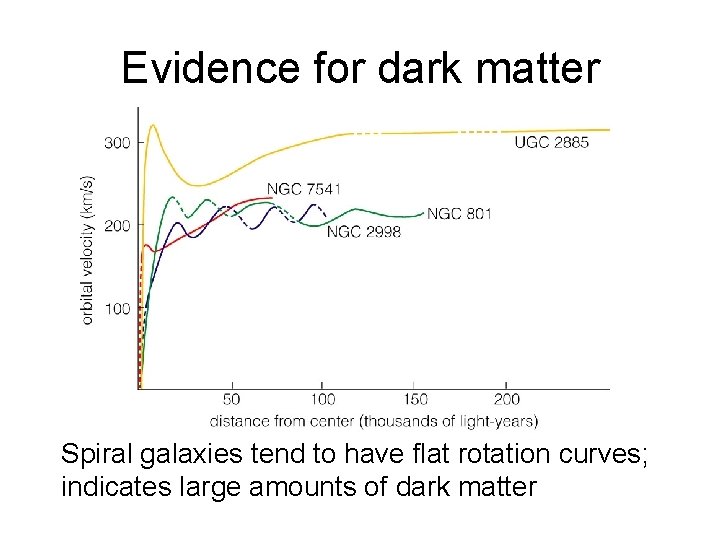
Evidence for dark matter Spiral galaxies tend to have flat rotation curves; indicates large amounts of dark matter
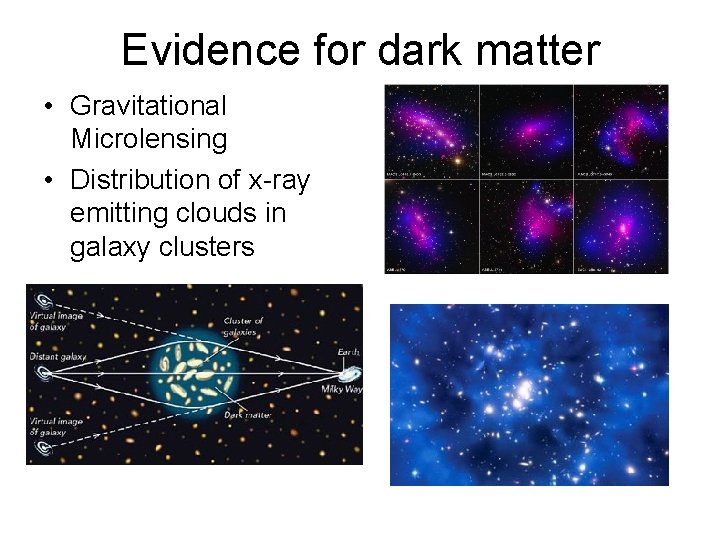
Evidence for dark matter • Gravitational Microlensing • Distribution of x-ray emitting clouds in galaxy clusters
What could dark matter be made of? • Ordinary Dark Matter (MACHOS) – Massive Compact Halo Objects: dead or failed stars in halos of galaxies • Extraordinary Dark Matter (WIMPS) – Weakly Interacting Massive Particles: mysterious neutrino-like particles
What do we know about dark energy? • Estimated amount based on HST images of distant supernovae • Universal expansion speed has changed • It may be a property of space • It may be a new kind of energy • Maybe Einstein’s theory of gravity is wrong
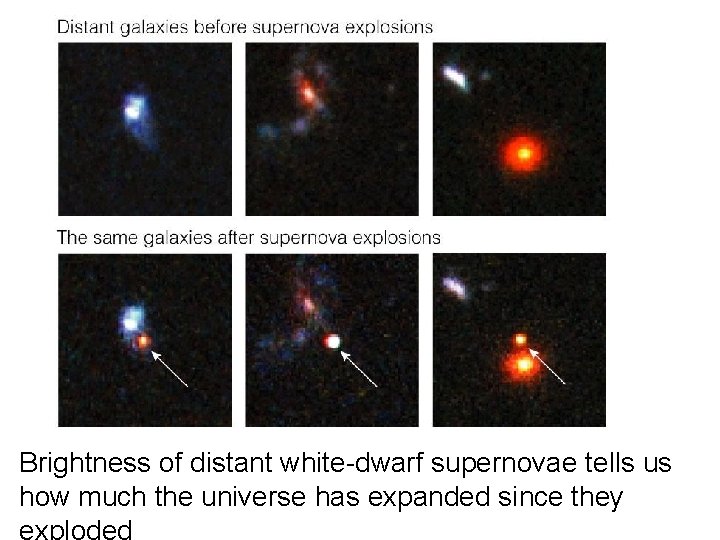
Brightness of distant white-dwarf supernovae tells us how much the universe has expanded since they exploded
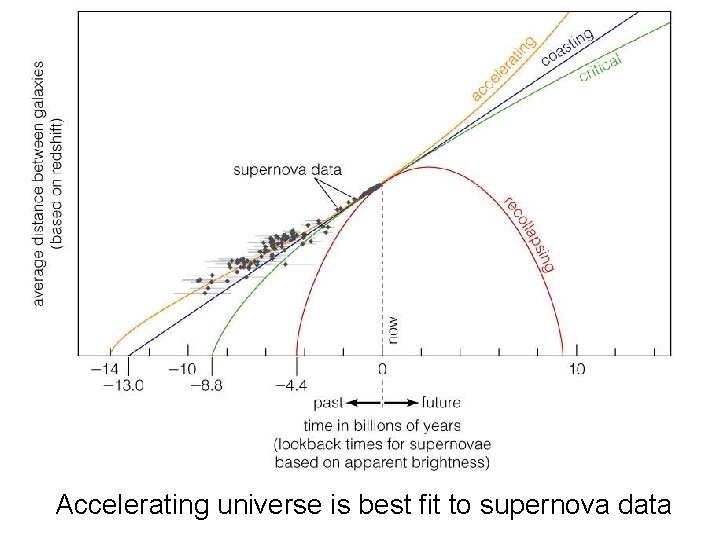
Accelerating universe is best fit to supernova data
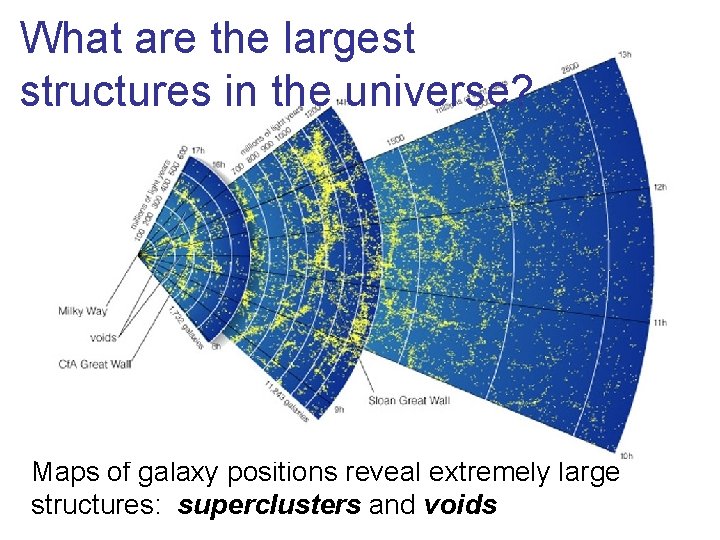
What are the largest structures in the universe? Maps of galaxy positions reveal extremely large structures: superclusters and voids
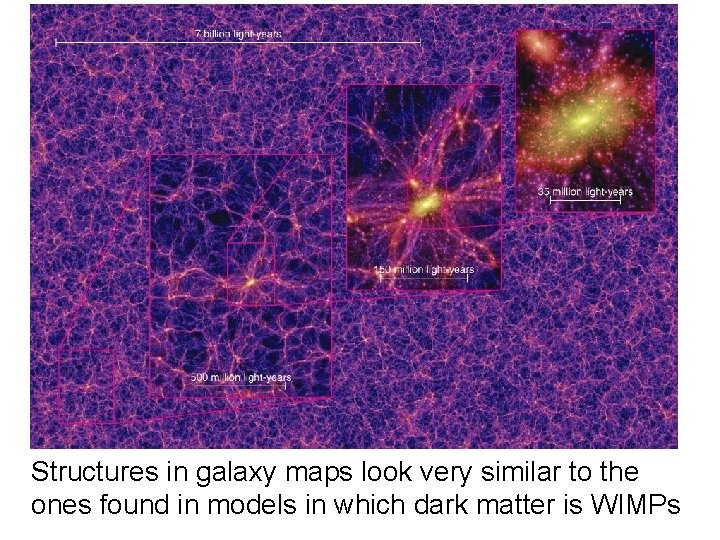
Structures in galaxy maps look very similar to the ones found in models in which dark matter is WIMPs
- Slides: 27