
Formation of the Universe 1 Cosmology is the
- Slides: 58
Formation of the Universe 1
Cosmology is the study of the Nature, Structure, Origin, And fate of the universe. 2
Universe in a Nutshell 3
Big Bang Theory The Big Bang Theory was first proposed in the late 1920’s. It states that there was an infinitely small, infinitely dense point that contained everything that is the universe. This singularity was incredibly dense and hot. 4
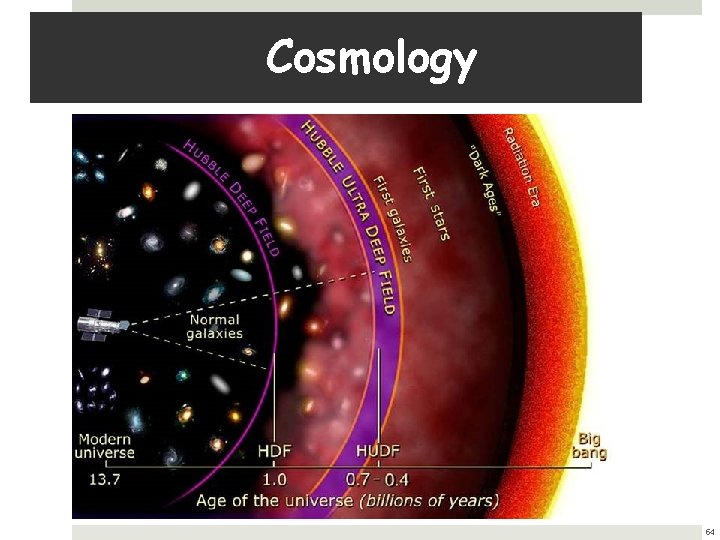
Big Bang Theory l The Big Bang is believed to have occurred between 10 and 15 billion years ago. (Most scientists agree that the universe is 13. 7 billion years old. ) l Two elements, hydrogen and helium were created in the primordial fireball, along with small amounts of lithium and beryllium. 5
Georges Henri Lemaitre Late 1920’s Belgian Astronomer “Father of the Big Bang” First suggested that the universe formed from a singularity but had no evidence. 6
Edwin Hubble 1929 Studied light given off by galaxies. Proposed Hubble’s Law after studying these galaxies. 7
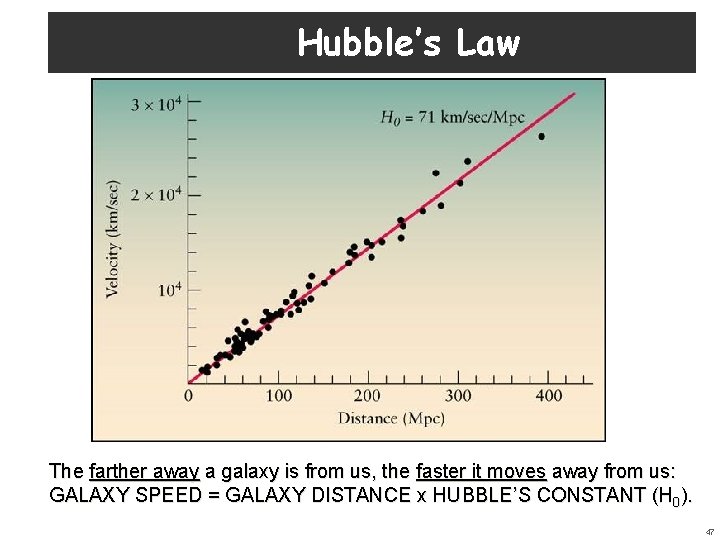
Hubble’s Law l The rate at which a galaxy is moving is directly proportional to its distance from us. l In other words, the farther away a galaxy is from us, the faster it travels away from us. l Thus the universe is expanding. 8
Steady State Theory l Opposes the Big Bang Theory l Steady State Theory states that the universe has always been essentially the same as it is today and that it will continue that way forever. 9
Steady State Theory l As matter moves apart, new matter is created to fill the gaps. l Cosmic Background Radiation in the universe ruled out the Steady State Theory. 10
Evidence of the Big Bang 1. The expansion of the universe Hubble 1929 -galaxies were generally receding 11
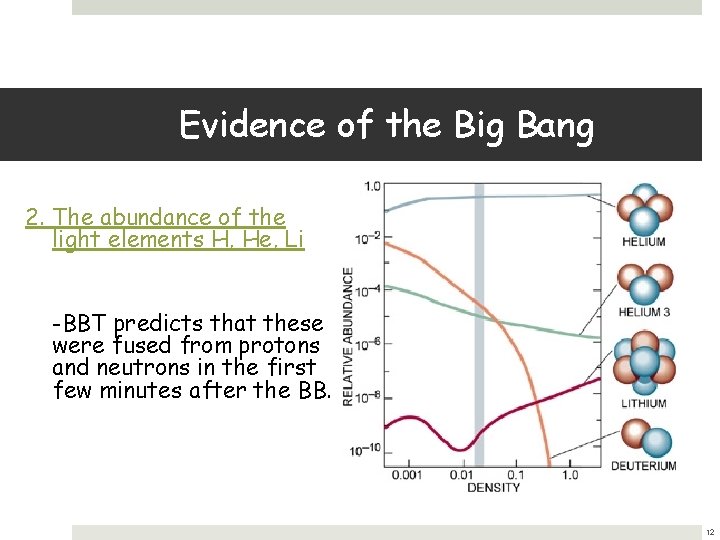
Evidence of the Big Bang 2. The abundance of the light elements H, He, Li -BBT predicts that these were fused from protons and neutrons in the first few minutes after the BB. 12
Evidence of the Big Bang 3. The cosmic microwave background (CMB) radiation -Early universe was very hot. - CMB radiation is the remnant heat from the Big Bang. 13
Limitations of the Big Bang 1. Structure in the universe Doesn’t explain how structures like stars and galaxies came to exist in the universe. 14
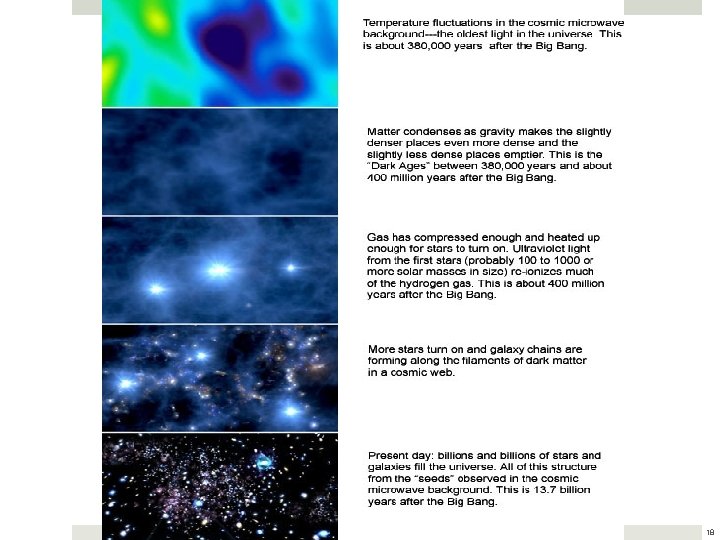
Limitations of the Big Bang 2. Fluctuations in the cosmic microwave background (CMB) radiation -The temperature of the CMB is observed to vary slightly across the sky. -What produced these fluctuations? -How do they relate to stars and galaxies? 15
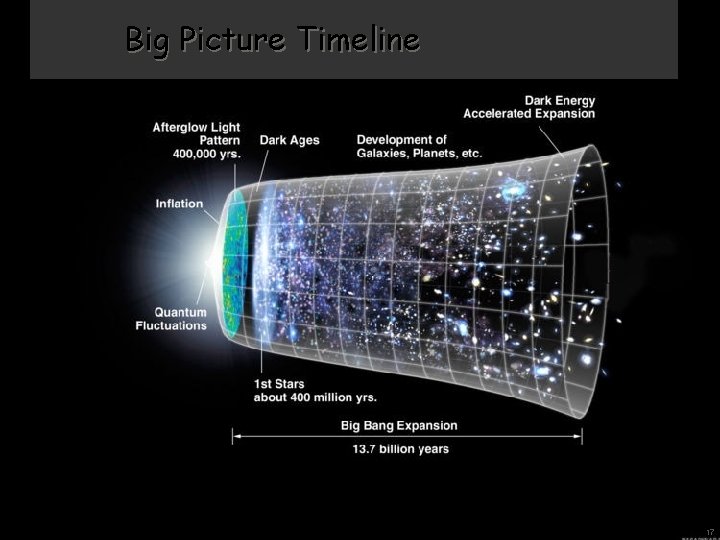
Limitations of the Big Bang 3. The inflationary universe -A very short, rapid burst of growth in the very early universe (“inflation”) - Why? 16
Big Picture Timeline 17
18
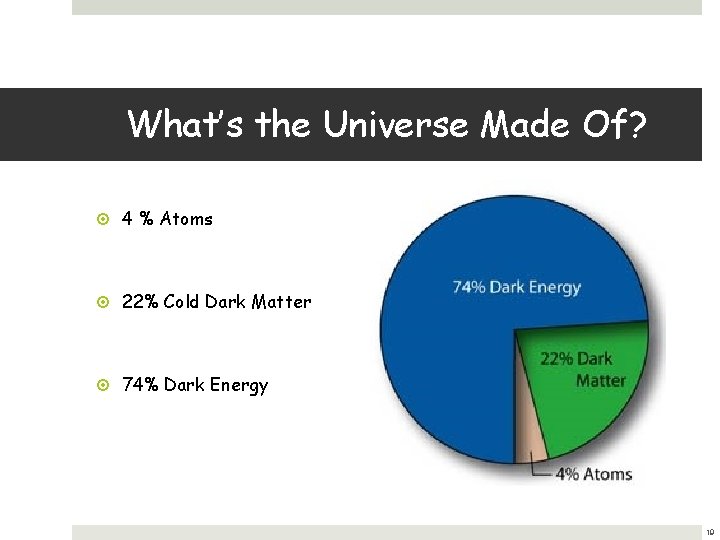
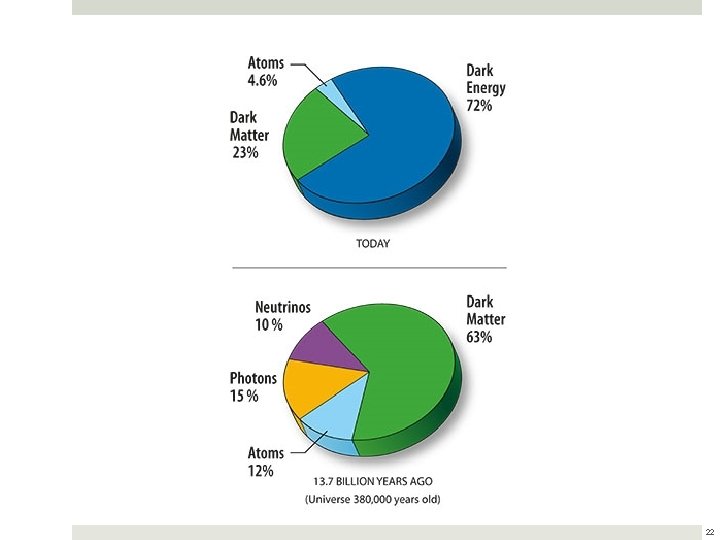
What’s the Universe Made Of? 4 % Atoms 22% Cold Dark Matter 74% Dark Energy 19
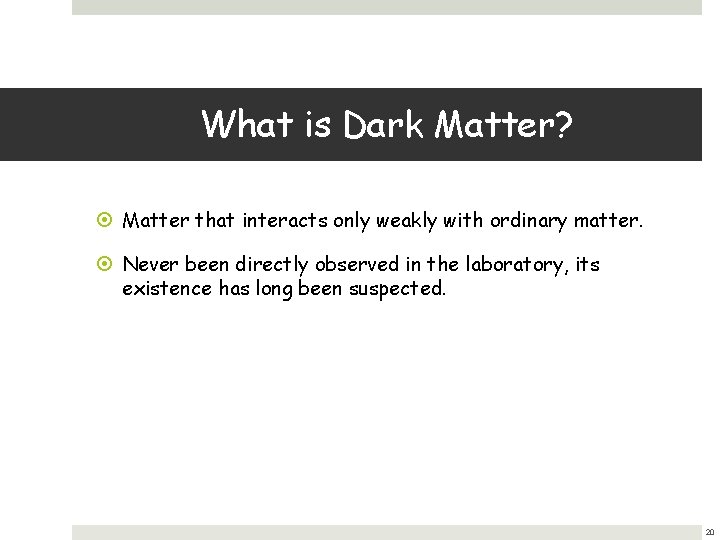
What is Dark Matter? Matter that interacts only weakly with ordinary matter. Never been directly observed in the laboratory, its existence has long been suspected. 20
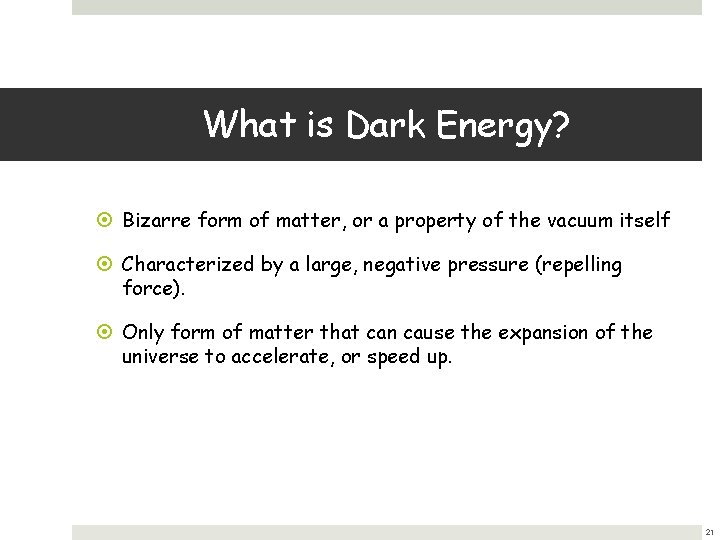
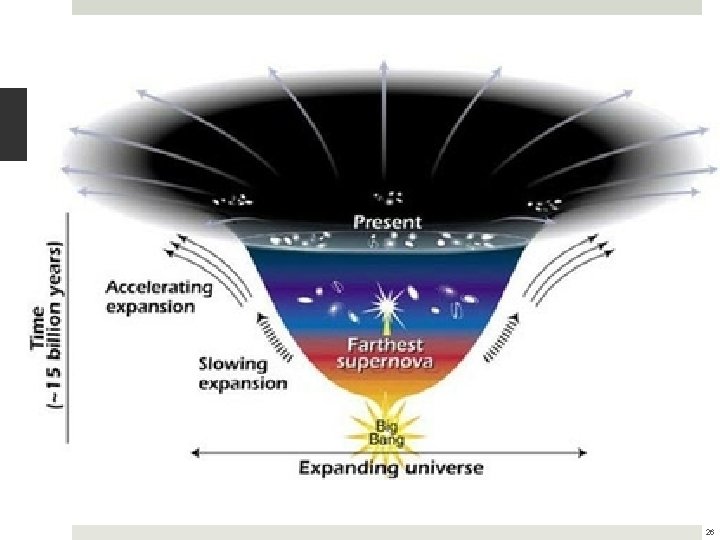
What is Dark Energy? Bizarre form of matter, or a property of the vacuum itself Characterized by a large, negative pressure (repelling force). Only form of matter that can cause the expansion of the universe to accelerate, or speed up. 21
22
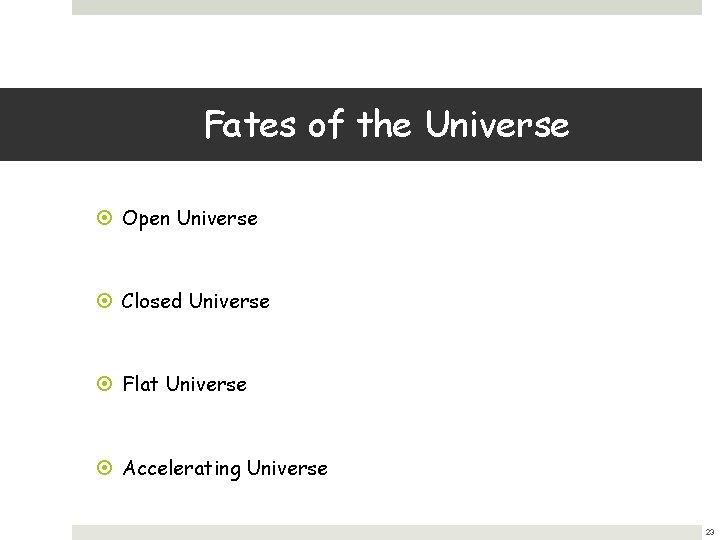
Fates of the Universe Open Universe Closed Universe Flat Universe Accelerating Universe 23
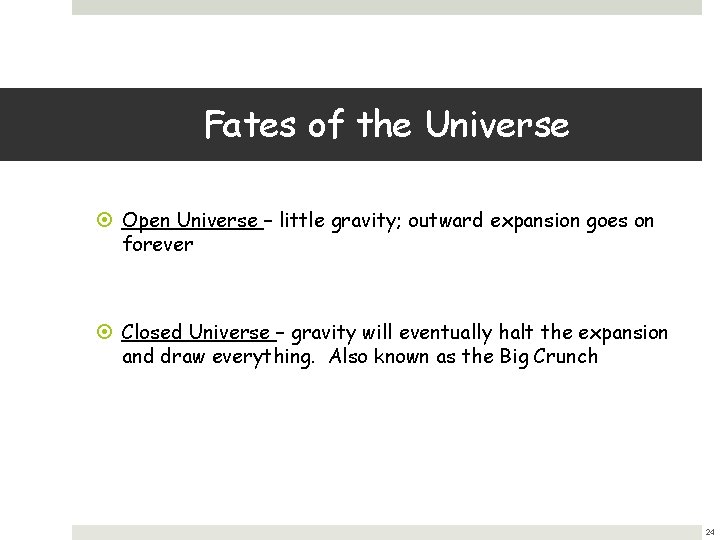
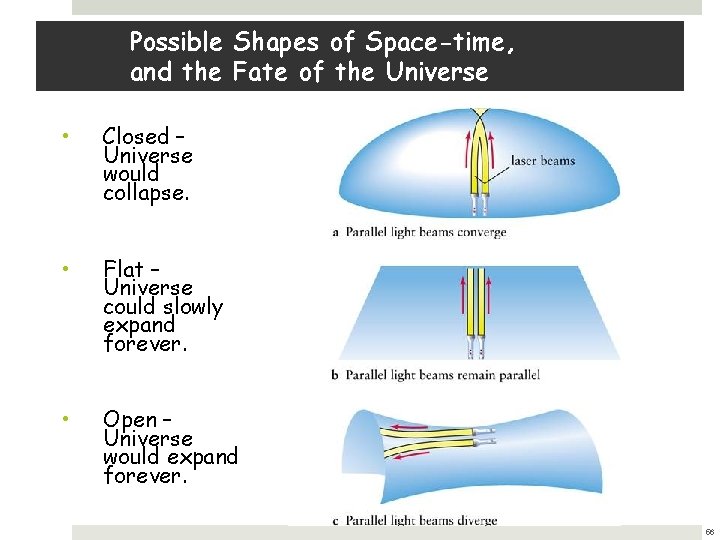
Fates of the Universe Open Universe – little gravity; outward expansion goes on forever Closed Universe – gravity will eventually halt the expansion and draw everything. Also known as the Big Crunch 24
Fates of the Universe Flat Universe – expansion slows down but never stops Accelerating Universe - expansion of the universe will speed up. (Most accepted theory because of dark energy. ) 25
26
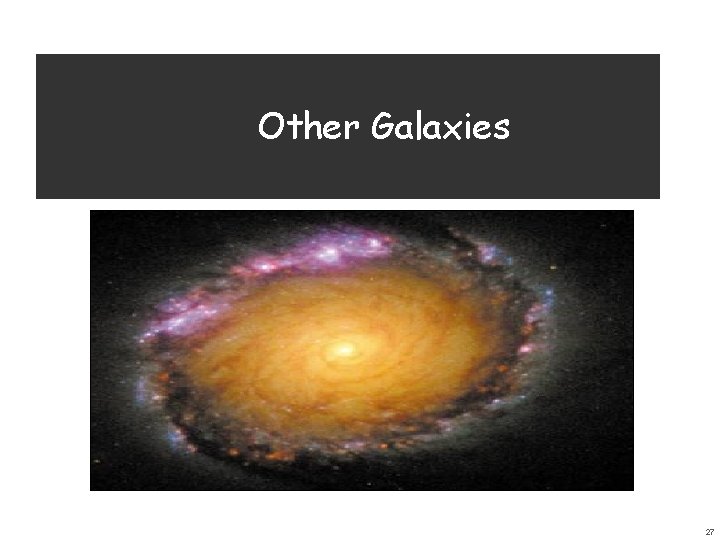
Other Galaxies 27
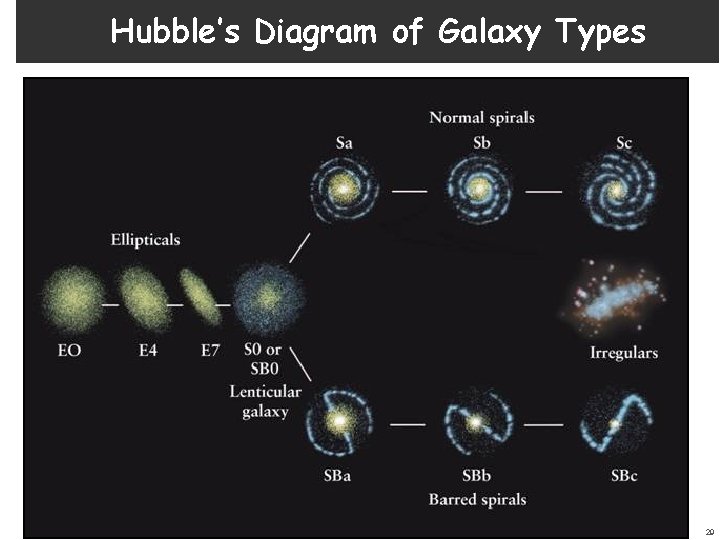
Types of Galaxies 1. Spiral 2. Barred Spiral 3. Elliptical 4. Irregular 28
Hubble’s Diagram of Galaxy Types 29
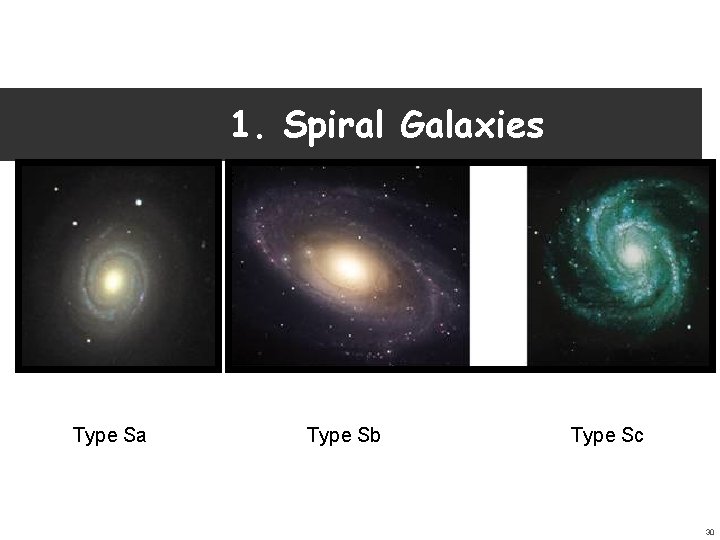
1. Spiral Galaxies Type Sa Type Sb Type Sc 30
31
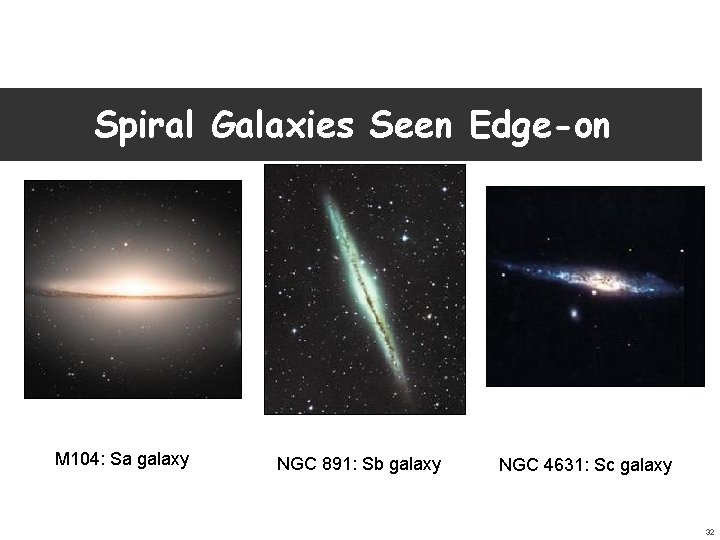
Spiral Galaxies Seen Edge-on M 104: Sa galaxy NGC 891: Sb galaxy NGC 4631: Sc galaxy 32
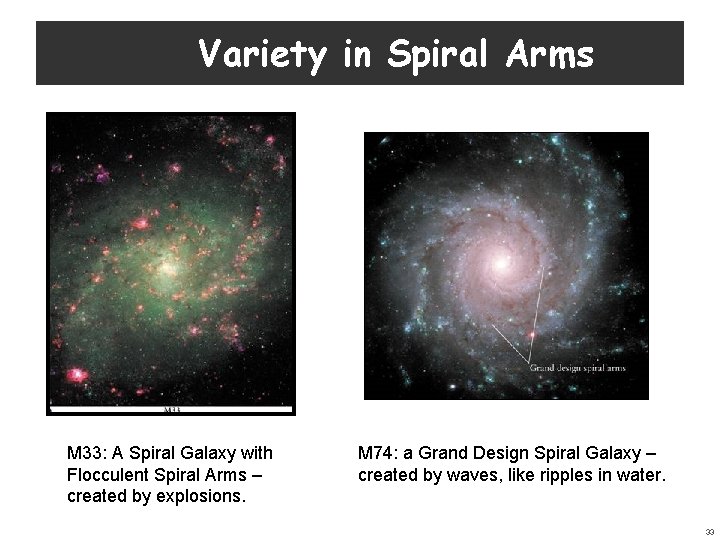
Variety in Spiral Arms M 33: A Spiral Galaxy with Flocculent Spiral Arms – created by explosions. M 74: a Grand Design Spiral Galaxy – created by waves, like ripples in water. 33
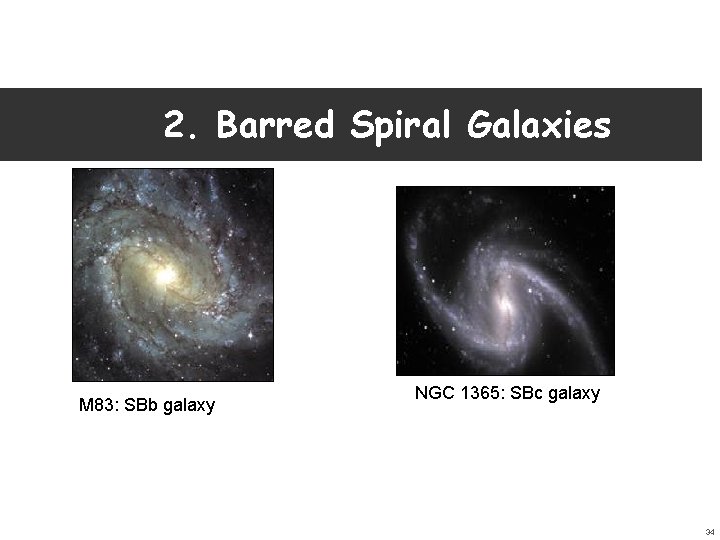
2. Barred Spiral Galaxies M 83: SBb galaxy NGC 1365: SBc galaxy 34
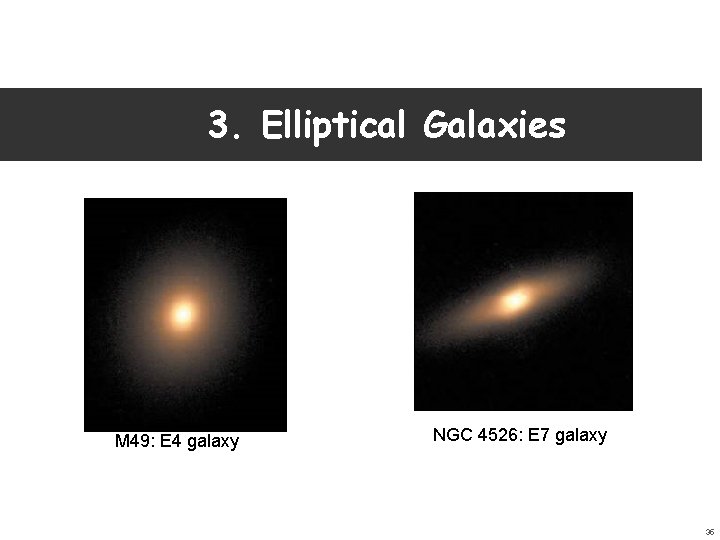
3. Elliptical Galaxies M 49: E 4 galaxy NGC 4526: E 7 galaxy 35
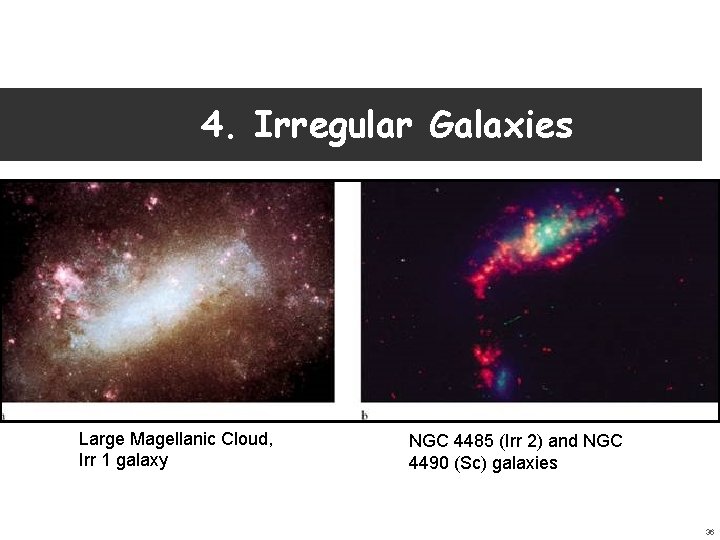
4. Irregular Galaxies Large Magellanic Cloud, Irr 1 galaxy NGC 4485 (Irr 2) and NGC 4490 (Sc) galaxies 36
Galaxies are Clumped in Space Occur in Clusters that are gravitationally bound. Bound by gravity to each other, and can collide. Milky Way belongs to a Cluster called “The Local Group. ” Clusters of galaxies occur in bigger groups called Superclusters (not gravitationally bound). All the Clusters are moving away from each other as the Universe expands. 37
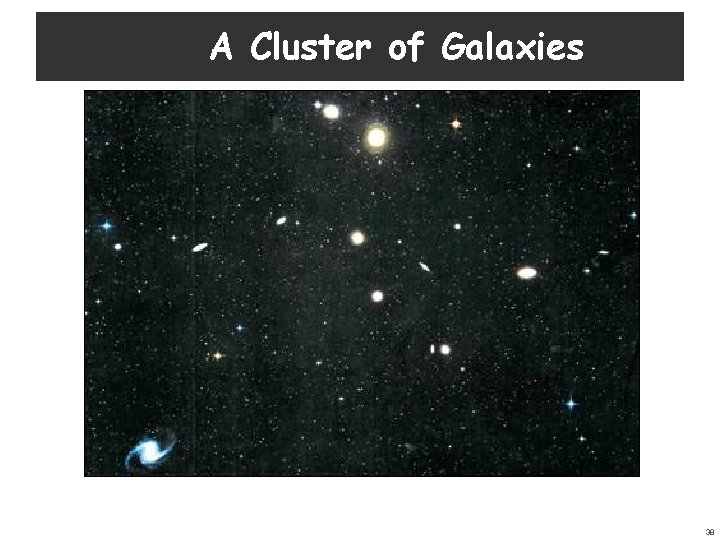
A Cluster of Galaxies 38
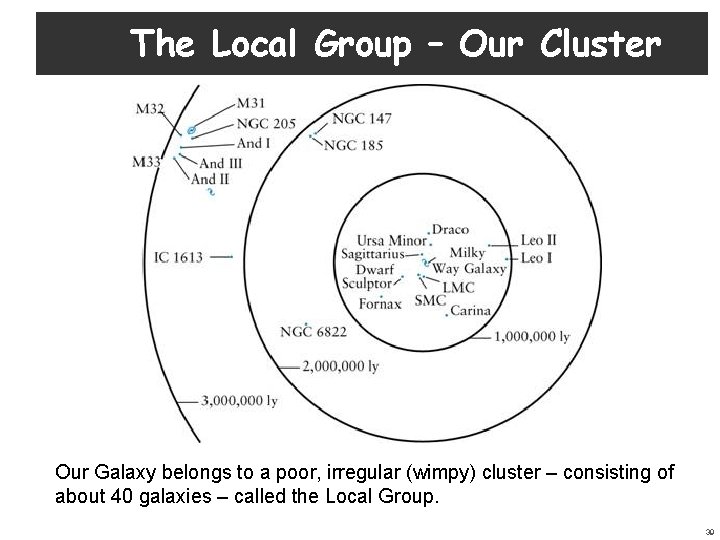
The Local Group – Our Cluster Our Galaxy belongs to a poor, irregular (wimpy) cluster – consisting of about 40 galaxies – called the Local Group. 39
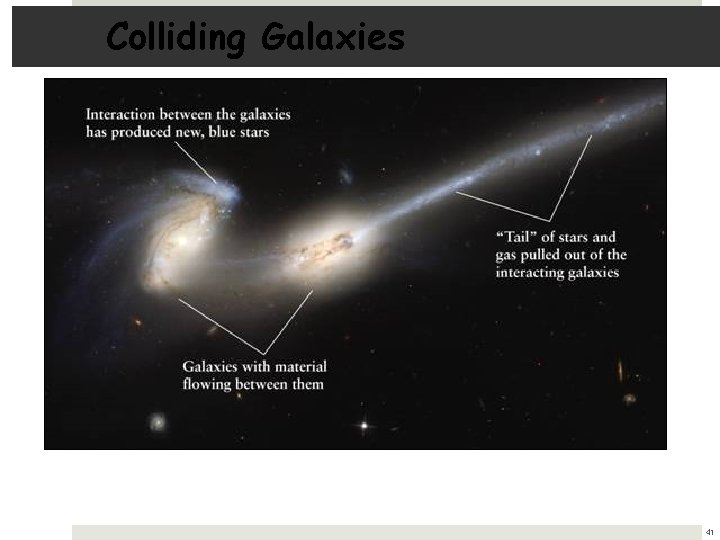
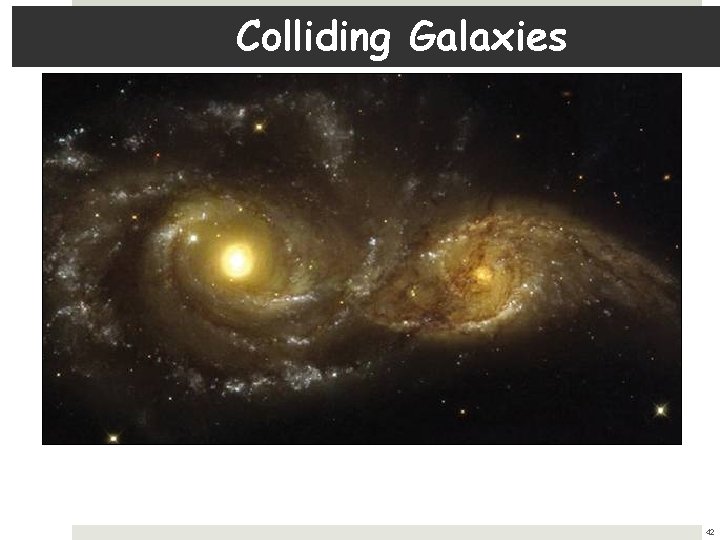
Colliding Galaxies Clustered galaxies can collide. They can pass through each other or combine. The individual stars in the colliding galaxies do not hit each other, but the huge clouds of gas and dust do collide. 40
Colliding Galaxies 41
Colliding Galaxies 42
The Universe is Expanding The Redshift of Superclusters shows us that the Universe is expanding. The farther away a galaxy is from us, the faster it moves away from us. GALAXY SPEED = GALAXY DISTANCE x HUBBLE’S CONSTANT (H 0). 43
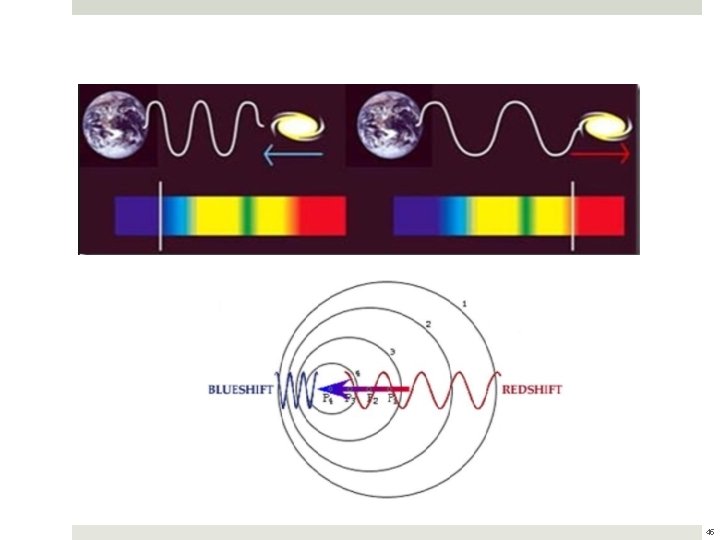
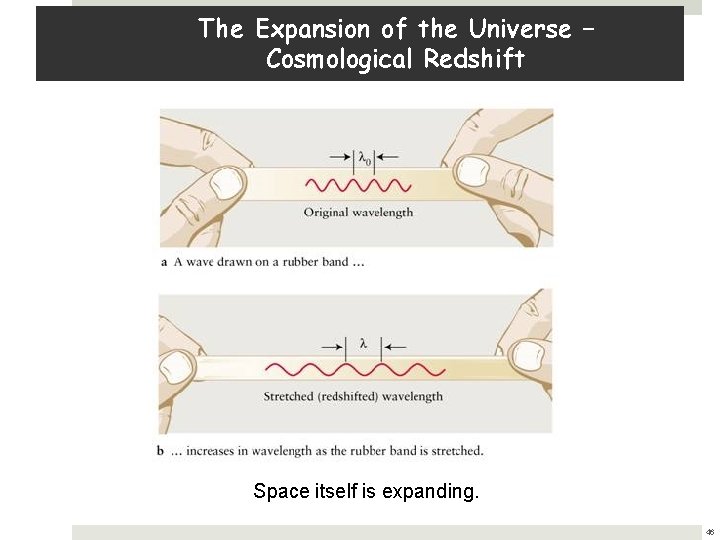
Redshift Explained -As the universe expands the frequency of waves decreases. -Wavelength increases -Coloring of light shifts towards the red color. -Doppler Effect- Frequency decreases and wavelength increases as waves move farther from the source; energy spreads out 44
45
The Expansion of the Universe – Cosmological Redshift Space itself is expanding. 46
Hubble’s Law The farther away a galaxy is from us, the faster it moves away from us: GALAXY SPEED = GALAXY DISTANCE x HUBBLE’S CONSTANT (H 0). 47
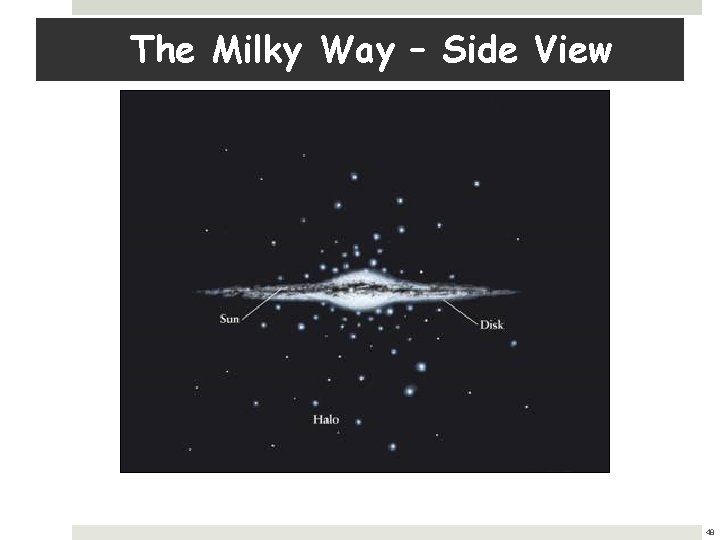
The Milky Way – Side View 48
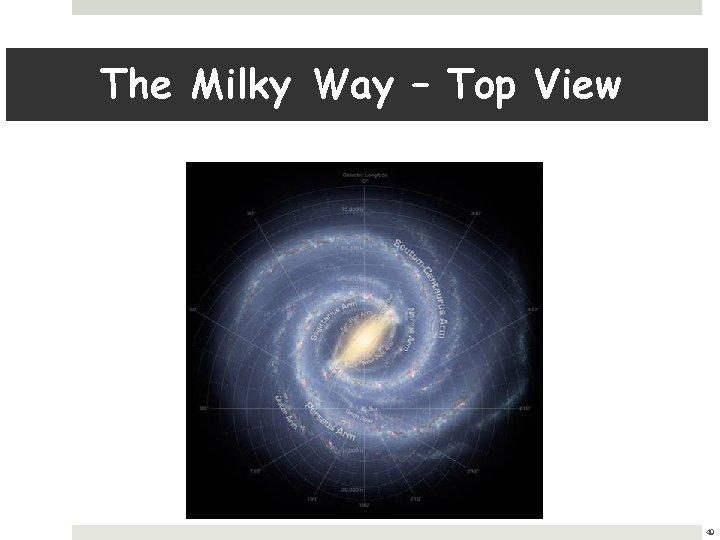
The Milky Way – Top View 49
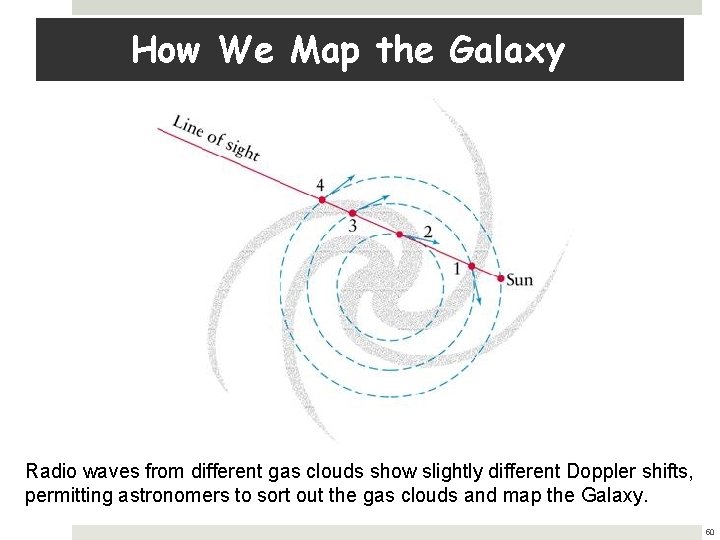
How We Map the Galaxy Radio waves from different gas clouds show slightly different Doppler shifts, permitting astronomers to sort out the gas clouds and map the Galaxy. 50
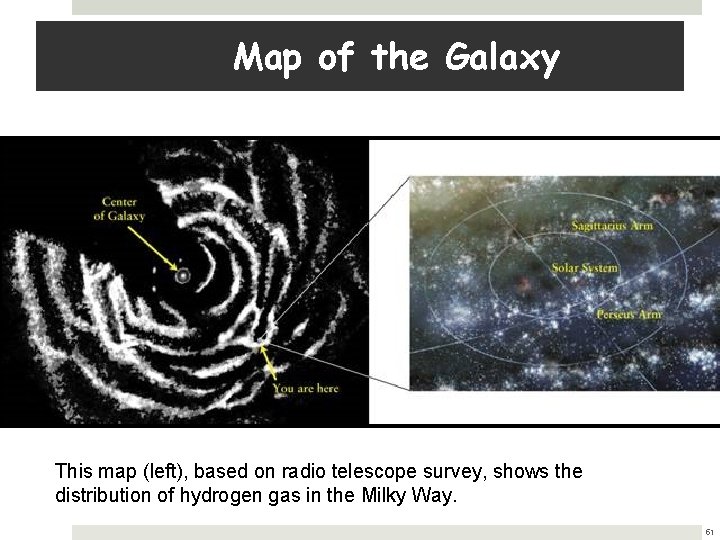
Map of the Galaxy This map (left), based on radio telescope survey, shows the distribution of hydrogen gas in the Milky Way. 51
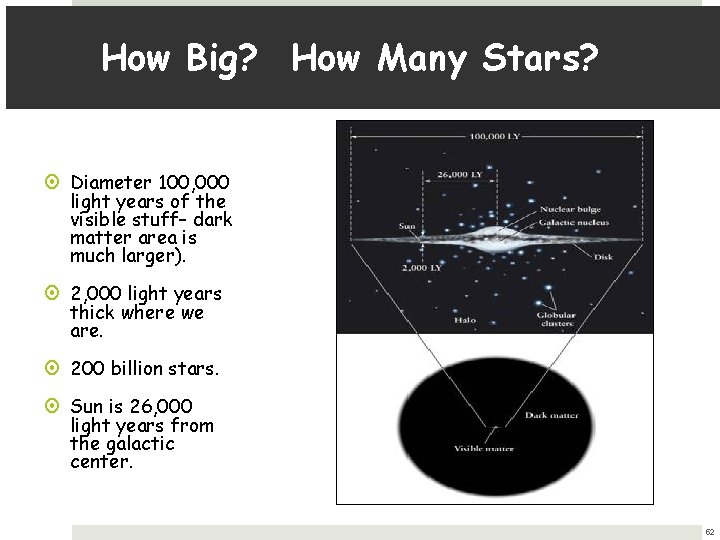
How Big? How Many Stars? Diameter 100, 000 light years of the visible stuff– dark matter area is much larger). 2, 000 light years thick where we are. 200 billion stars. Sun is 26, 000 light years from the galactic center. 52
How Much Dark Matter Does Our Galaxy Have? The stars and other objects that give off radiation account for only 10% of the Galaxy’s total mass. The other 90% of our Galaxy is made of stuff that we can’t see at any wavelength of radiation – so we call it “Dark Matter. ” Dark Matter forms a sphere around the Galaxy, at least 12 times farther from the center than we are. We don’t know what this Dark Matter is, but it does have gravity. 53
Cosmology 54
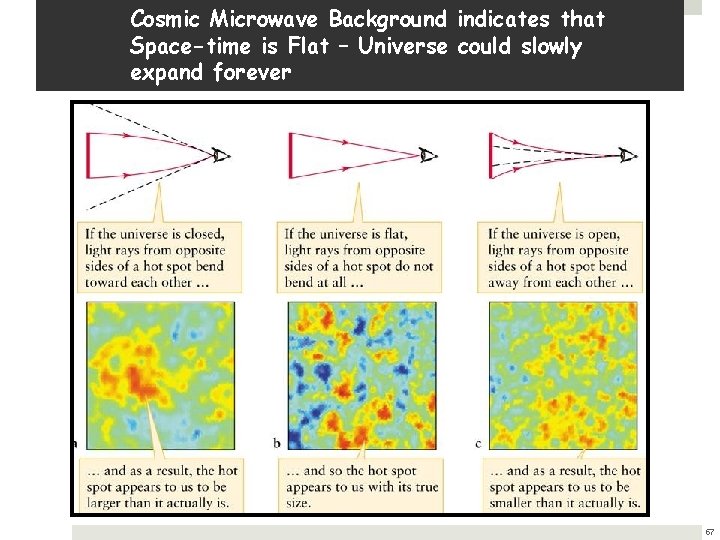
The Fate of the Universe Depends on the shape of space-time. The shape of space-time is determined by how much total matter and energy there is in the Universe. 55
Possible Shapes of Space-time, and the Fate of the Universe • Closed – Universe would collapse. • Flat – Universe could slowly expand forever. • Open – Universe would expand forever. 56
Cosmic Microwave Background indicates that Space-time is Flat – Universe could slowly expand forever 57
Expansion of the Universe is speeding up Very distant Supernovae are not as bright as they should be therefore expansion is speeding up. Dark Energy is causing this acceleration. Dark Energy acts like anti-gravity, pushing the Universe apart. 58