
Formation of the Solar System Lecture 39 Astronomical
- Slides: 28
Formation of the Solar System Lecture 39
Astronomical Constraints on Star Formation
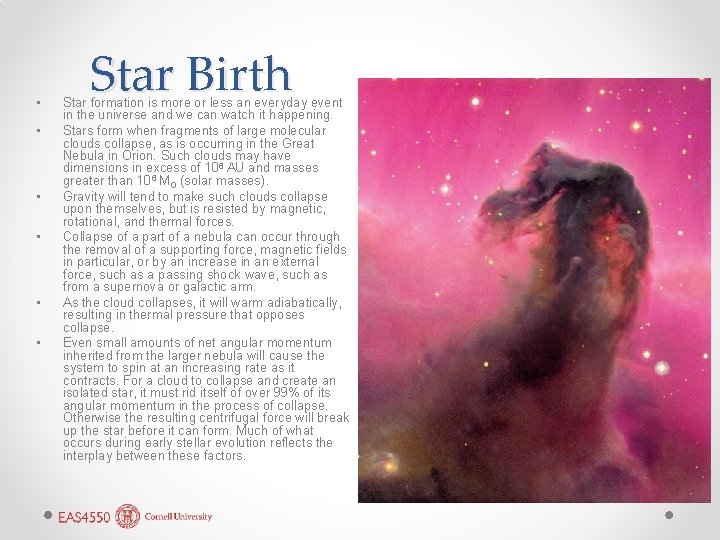
• • • Star Birth Star formation is more or less an everyday event in the universe and we can watch it happening. Stars form when fragments of large molecular clouds collapse, as is occurring in the Great Nebula in Orion. Such clouds may have dimensions in excess of 106 AU and masses greater than 106 MO (solar masses). Gravity will tend to make such clouds collapse upon themselves, but is resisted by magnetic, rotational, and thermal forces. Collapse of a part of a nebula can occur through the removal of a supporting force, magnetic fields in particular, or by an increase in an external force, such as a passing shock wave, such as from a supernova or galactic arm. As the cloud collapses, it will warm adiabatically, resulting in thermal pressure that opposes collapse. Even small amounts of net angular momentum inherited from the larger nebula will cause the system to spin at an increasing rate as it contracts. For a cloud to collapse and create an isolated star, it must rid itself of over 99% of its angular momentum in the process of collapse. Otherwise the resulting centrifugal force will break up the star before it can form. Much of what occurs during early stellar evolution reflects the interplay between these factors.
Protostellar Evolution • Protostellar evolution of moderate-sized stars (i. e. stars similar to the Sun) can be divided into 5 phases, based on the spectra of their electromagnetic emission & other observations. • -I: initial collapse of a molecular cloud to form a nebular disk: no astronomical examples. o Once the cloud becomes optically dense the collapse slows. At this point, the protostellar core has a radius of ~10 AU and a mass of ~1% of final mass. Further collapse brings the radius down to several times that of the eventual star in 106 to 107 years. • 0: protostar deeply embedded in its cocoon of gas and dust and cannot be directly observed. At the beginning, the mass of the protostellar core is still very much smaller than that of the envelope of gas and dust. Angular momentum progressively flattens the envelope into a rotating disk. Material from the surrounding envelope continues to accrete to the disk, but mass is also transferred from the disk to the protostar.
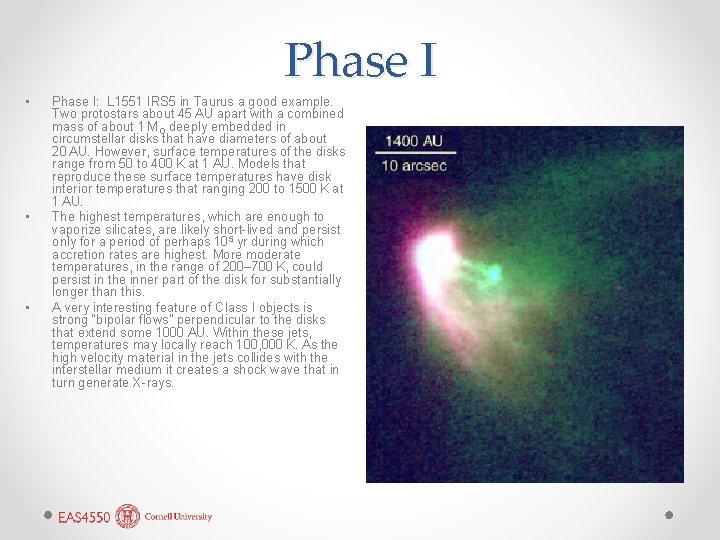
Phase I • • • Phase I: L 1551 IRS 5 in Taurus a good example. Two protostars about 45 AU apart with a combined mass of about 1 M O deeply embedded in circumstellar disks that have diameters of about 20 AU. However, surface temperatures of the disks range from 50 to 400 K at 1 AU. Models that reproduce these surface temperatures have disk interior temperatures that ranging 200 to 1500 K at 1 AU. The highest temperatures, which are enough to vaporize silicates, are likely short-lived and persist only for a period of perhaps 10 5 yr during which accretion rates are highest. More moderate temperatures, in the range of 200– 700 K, could persist in the inner part of the disk for substantially longer than this. A very interesting feature of Class I objects is strong “bipolar flows” perpendicular to the disks that extend some 1000 AU. Within these jets, temperatures may locally reach 100, 000 K. As the high velocity material in the jets collides with the interstellar medium it creates a shock wave that in turn generate X-rays.
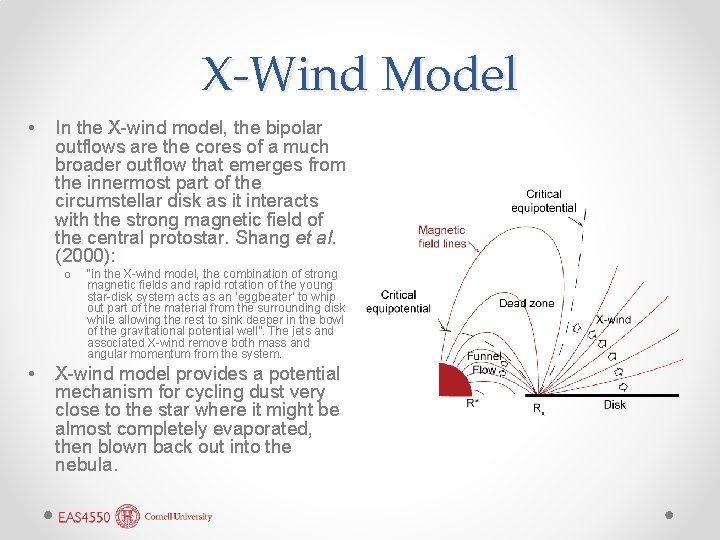
X-Wind Model • In the X-wind model, the bipolar outflows are the cores of a much broader outflow that emerges from the innermost part of the circumstellar disk as it interacts with the strong magnetic field of the central protostar. Shang et al. (2000): o • “in the X-wind model, the combination of strong magnetic fields and rapid rotation of the young star-disk system acts as an ‘eggbeater’ to whip out part of the material from the surrounding disk while allowing the rest to sink deeper in the bowl of the gravitational potential well”. The jets and associated X-wind remove both mass and angular momentum from the system. X-wind model provides a potential mechanism for cycling dust very close to the star where it might be almost completely evaporated, then blown back out into the nebula.
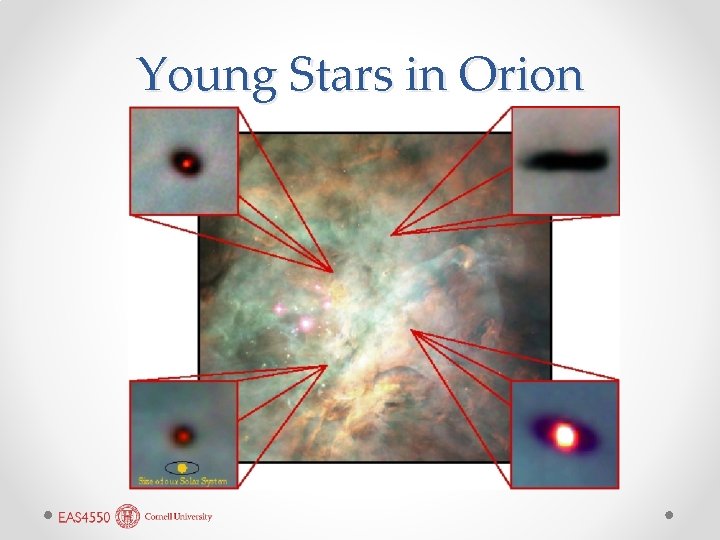
Young Stars in Orion
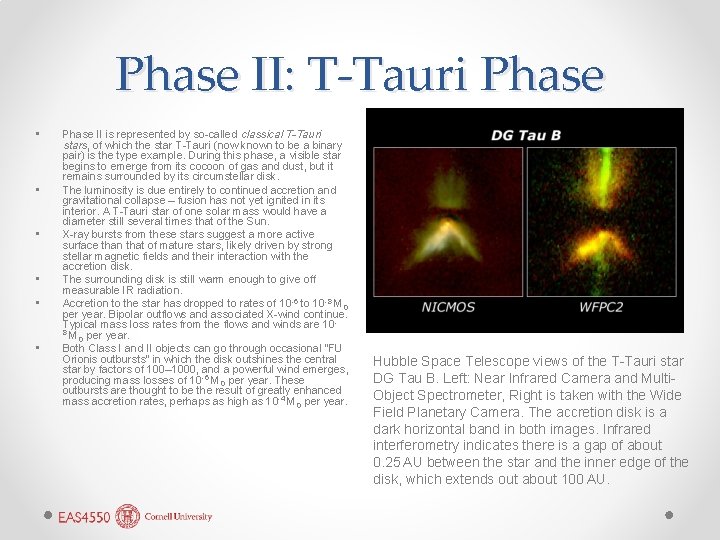
Phase II: T-Tauri Phase • • • Phase II is represented by so-called classical T-Tauri stars, of which the star T-Tauri (now known to be a binary pair) is the type example. During this phase, a visible star begins to emerge from its cocoon of gas and dust, but it remains surrounded by its circumstellar disk. The luminosity is due entirely to continued accretion and gravitational collapse – fusion has not yet ignited in its interior. A T-Tauri star of one solar mass would have a diameter still several times that of the Sun. X-ray bursts from these stars suggest a more active surface than that of mature stars, likely driven by strong stellar magnetic fields and their interaction with the accretion disk. The surrounding disk is still warm enough to give off measurable IR radiation. Accretion to the star has dropped to rates of 10 -6 to 10 -8 MO per year. Bipolar outflows and associated X-wind continue. Typical mass loss rates from the flows and winds are 108 M per year. O Both Class I and II objects can go through occasional “FU Orionis outbursts” in which the disk outshines the central star by factors of 100– 1000, and a powerful wind emerges, producing mass losses of 10 -6 MO per year. These outbursts are thought to be the result of greatly enhanced mass accretion rates, perhaps as high as 10 -4 MO per year. Hubble Space Telescope views of the T-Tauri star DG Tau B. Left: Near Infrared Camera and Multi. Object Spectrometer, Right is taken with the Wide Field Planetary Camera. The accretion disk is a dark horizontal band in both images. Infrared interferometry indicates there is a gap of about 0. 25 AU between the star and the inner edge of the disk, which extends out about 100 AU.
Phase III • • Represented by weak-lined T-Tauri stars, so called because spectral emission and absorption lines are much weaker and excess infrared emission is absent. The inference is that the disk has largely dissipated by this stage. Like classical T-Tauri stars, weak-lined T-Tauri stars are cooler yet more luminous than mature main sequence stars of similar mass, but they are closer to the main sequence on the Hertzsprung-Russell diagram than classical T-Tauris. Weak-lined T-Tauris are particularly luminous in the X-ray part of the spectrum. These X-rays are thought to be produced in hot plasma during magnetic reconnection events above the stellar surface. flares of weak-lined T-Tauris are 100– 1000 times more powerful than solar flares produced in a similar way. Outflows and winds subside to those of typical main sequence stars as accretion ends and the star reaches its final mass. During the weak-lined T-Tauri phase, the star contracts to its final radius and density. At the end of this process, fusion ignites in the core and the luminosity and temperature of the star settles onto the main sequence. The entire process from Phase 0 through Phase III consumes perhaps 10 million years.
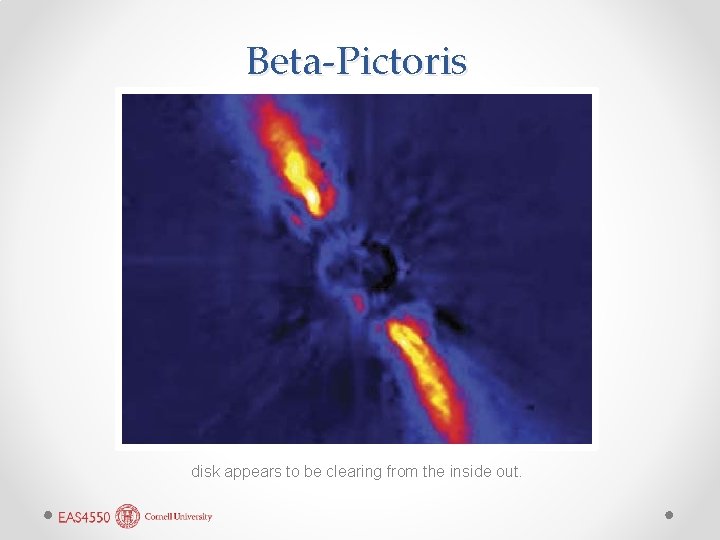
Beta-Pictoris disk appears to be clearing from the inside out.
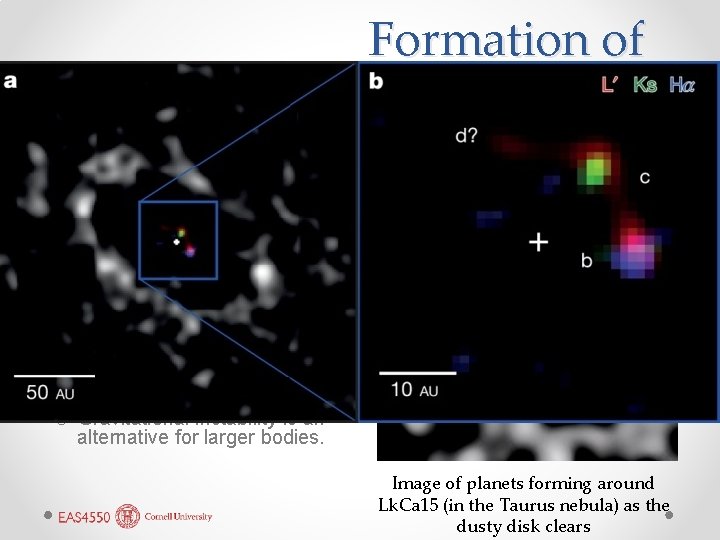
• We have only recently been able to image planets in the process of being formed. • Nonetheless, we rely heavily on models based on principles of chemistry and physics and observations in meteorites. • Basic theory is oligarchic growth: Formation of Planets o Collisions between particles build steadily larger bodies: • from dust to sand to gravel to boulders to asteroids to planets. o Gravitational instability is an alternative for larger bodies. Image of planets forming around Lk. Ca 15 (in the Taurus nebula) as the dusty disk clears
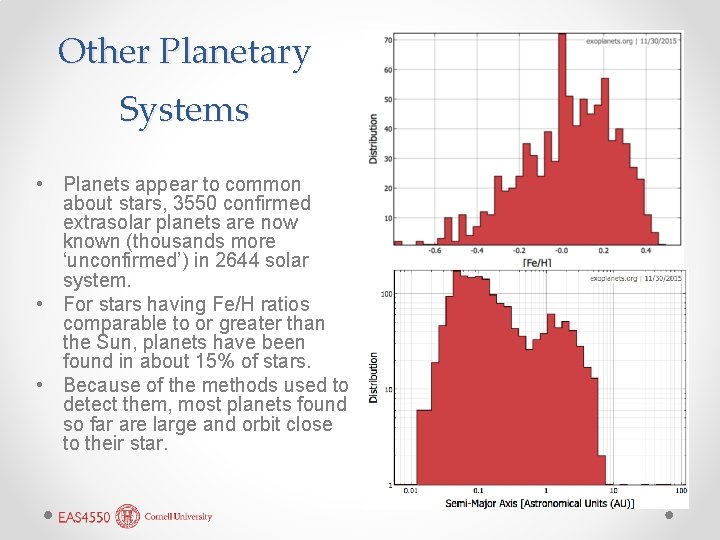
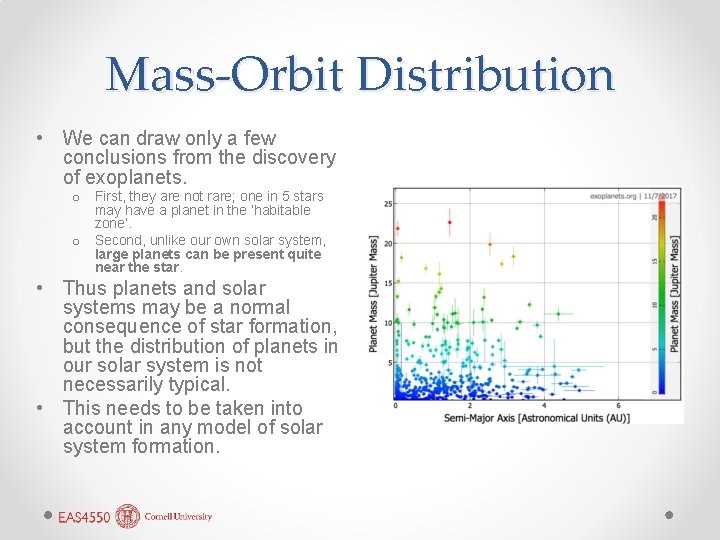
Other Planetary Systems • Planets appear to common about stars, 3550 confirmed extrasolar planets are now known (thousands more ‘unconfirmed’) in 2644 solar system. • For stars having Fe/H ratios comparable to or greater than the Sun, planets have been found in about 15% of stars. • Because of the methods used to detect them, most planets found so far are large and orbit close to their star.
Mass-Orbit Distribution • We can draw only a few conclusions from the discovery of exoplanets. o First, they are not rare; one in 5 stars may have a planet in the ‘habitable zone’. o Second, unlike our own solar system, large planets can be present quite near the star. • Thus planets and solar systems may be a normal consequence of star formation, but the distribution of planets in our solar system is not necessarily typical. • This needs to be taken into account in any model of solar system formation.
Our Solar System The nature of the planets themselves constrains models of solar system formation, so we’ll briefly review what’s out there.
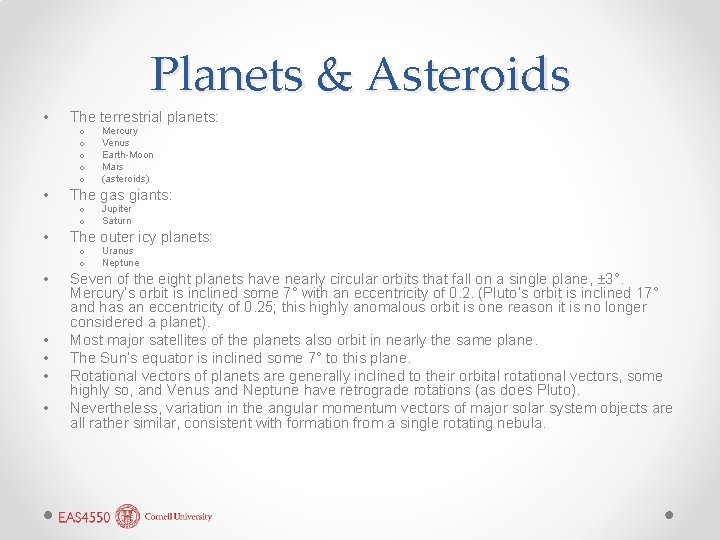
Planets & Asteroids • • The terrestrial planets: o o o Mercury Venus Earth-Moon Mars (asteroids) The gas giants: o o Jupiter Saturn The outer icy planets: o o Uranus Neptune Seven of the eight planets have nearly circular orbits that fall on a single plane, ± 3°. Mercury’s orbit is inclined some 7° with an eccentricity of 0. 2. (Pluto’s orbit is inclined 17° and has an eccentricity of 0. 25; this highly anomalous orbit is one reason it is no longer considered a planet). Most major satellites of the planets also orbit in nearly the same plane. The Sun’s equator is inclined some 7° to this plane. Rotational vectors of planets are generally inclined to their orbital rotational vectors, some highly so, and Venus and Neptune have retrograde rotations (as does Pluto). Nevertheless, variation in the angular momentum vectors of major solar system objects are all rather similar, consistent with formation from a single rotating nebula.
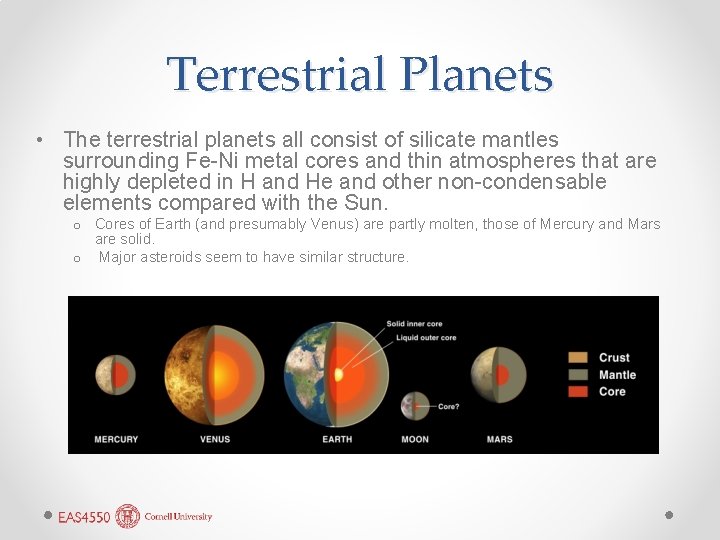
Terrestrial Planets • The terrestrial planets all consist of silicate mantles surrounding Fe-Ni metal cores and thin atmospheres that are highly depleted in H and He and other non-condensable elements compared with the Sun. o Cores of Earth (and presumably Venus) are partly molten, those of Mercury and Mars are solid. o Major asteroids seem to have similar structure.
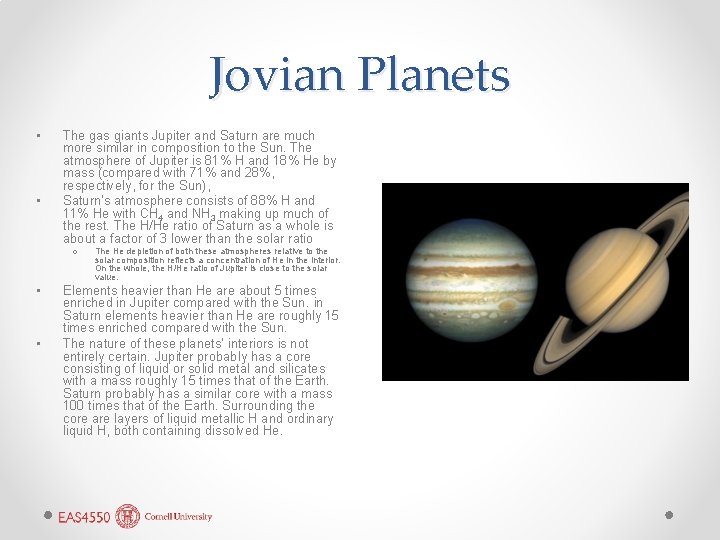
Jovian Planets • • The gas giants Jupiter and Saturn are much more similar in composition to the Sun. The atmosphere of Jupiter is 81% H and 18% He by mass (compared with 71% and 28%, respectively, for the Sun), Saturn’s atmosphere consists of 88% H and 11% He with CH 4 and NH 3 making up much of the rest. The H/He ratio of Saturn as a whole is about a factor of 3 lower than the solar ratio o • • The He depletion of both these atmospheres relative to the solar composition reflects a concentration of He in the interior. On the whole, the H/He ratio of Jupiter is close to the solar value. Elements heavier than He are about 5 times enriched in Jupiter compared with the Sun. in Saturn elements heavier than He are roughly 15 times enriched compared with the Sun. The nature of these planets’ interiors is not entirely certain. Jupiter probably has a core consisting of liquid or solid metal and silicates with a mass roughly 15 times that of the Earth. Saturn probably has a similar core with a mass 100 times that of the Earth. Surrounding the core are layers of liquid metallic H and ordinary liquid H, both containing dissolved He.
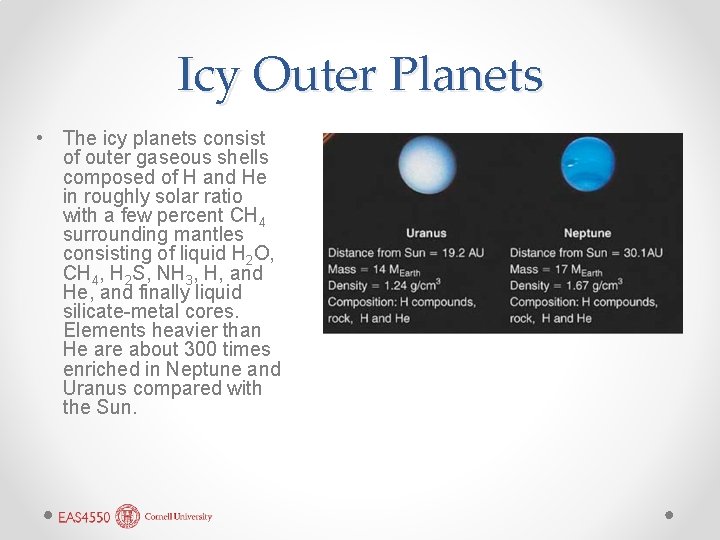
Icy Outer Planets • The icy planets consist of outer gaseous shells composed of H and He in roughly solar ratio with a few percent CH 4 surrounding mantles consisting of liquid H 2 O, CH 4, H 2 S, NH 3, H, and He, and finally liquid silicate-metal cores. Elements heavier than He are about 300 times enriched in Neptune and Uranus compared with the Sun.
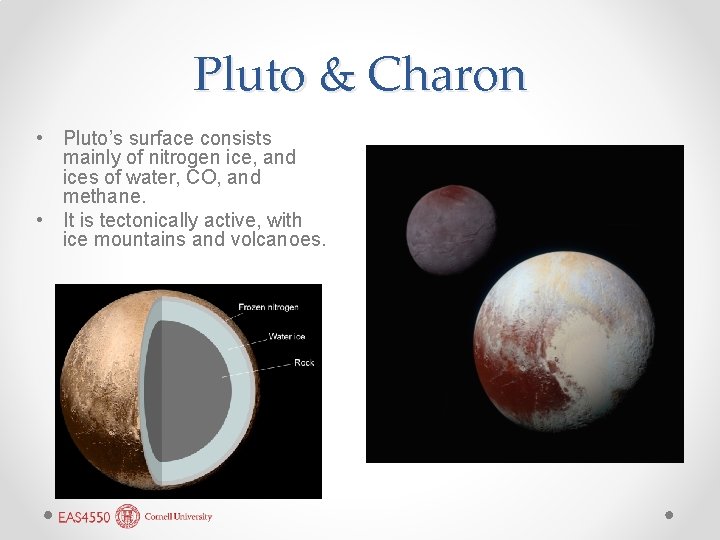
Pluto & Charon • Pluto’s surface consists mainly of nitrogen ice, and ices of water, CO, and methane. • It is tectonically active, with ice mountains and volcanoes.
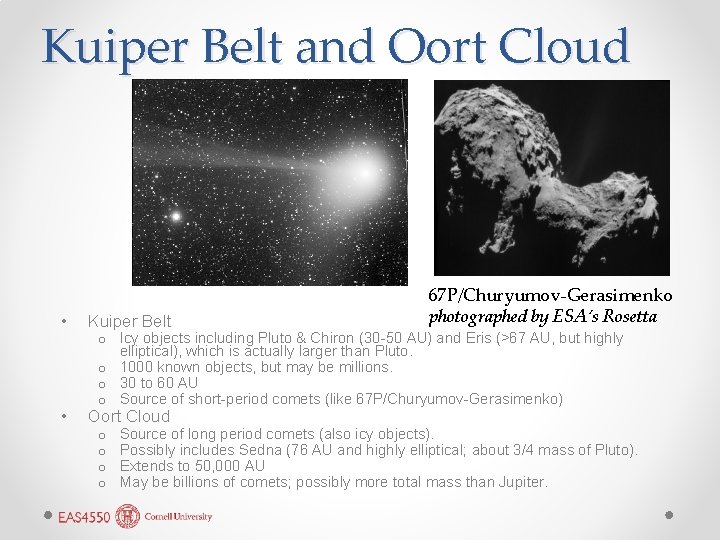
Kuiper Belt and Oort Cloud • Kuiper Belt • Oort Cloud 67 P/Churyumov-Gerasimenko photographed by ESA’s Rosetta o Icy objects including Pluto & Chiron (30 -50 AU) and Eris (>67 AU, but highly elliptical), which is actually larger than Pluto. o 1000 known objects, but may be millions. o 30 to 60 AU o Source of short-period comets (like 67 P/Churyumov-Gerasimenko) o o Source of long period comets (also icy objects). Possibly includes Sedna (76 AU and highly elliptical; about 3/4 mass of Pluto). Extends to 50, 000 AU May be billions of comets; possibly more total mass than Jupiter.
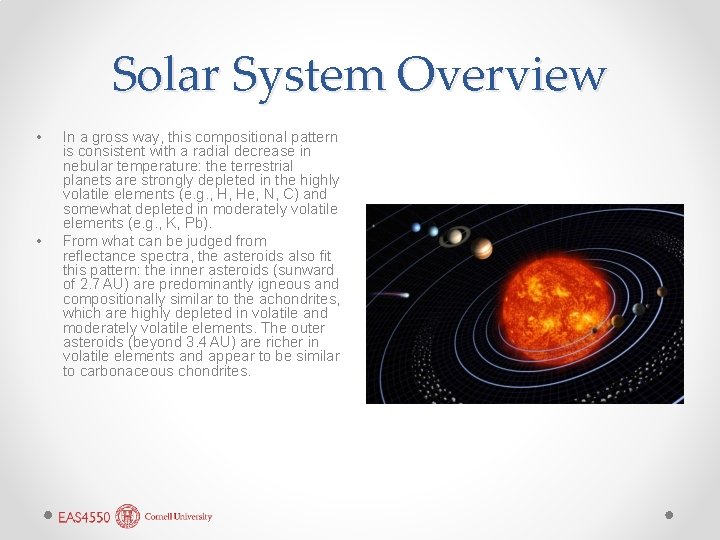
Solar System Overview • • In a gross way, this compositional pattern is consistent with a radial decrease in nebular temperature: the terrestrial planets are strongly depleted in the highly volatile elements (e. g. , H, He, N, C) and somewhat depleted in moderately volatile elements (e. g. , K, Pb). From what can be judged from reflectance spectra, the asteroids also fit this pattern: the inner asteroids (sunward of 2. 7 AU) are predominantly igneous and compositionally similar to the achondrites, which are highly depleted in volatile and moderately volatile elements. The outer asteroids (beyond 3. 4 AU) are richer in volatile elements and appear to be similar to carbonaceous chondrites.
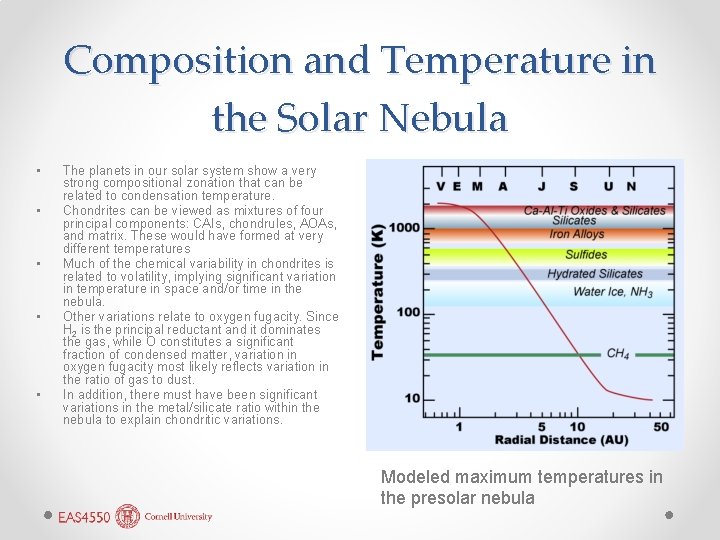
Composition and Temperature in the Solar Nebula • • • The planets in our solar system show a very strong compositional zonation that can be related to condensation temperature. Chondrites can be viewed as mixtures of four principal components: CAIs, chondrules, AOAs, and matrix. These would have formed at very different temperatures Much of the chemical variability in chondrites is related to volatility, implying significant variation in temperature in space and/or time in the nebula. Other variations relate to oxygen fugacity. Since H 2 is the principal reductant and it dominates the gas, while O constitutes a significant fraction of condensed matter, variation in oxygen fugacity most likely reflects variation in the ratio of gas to dust. In addition, there must have been significant variations in the metal/silicate ratio within the nebula to explain chondritic variations. Modeled maximum temperatures in the presolar nebula
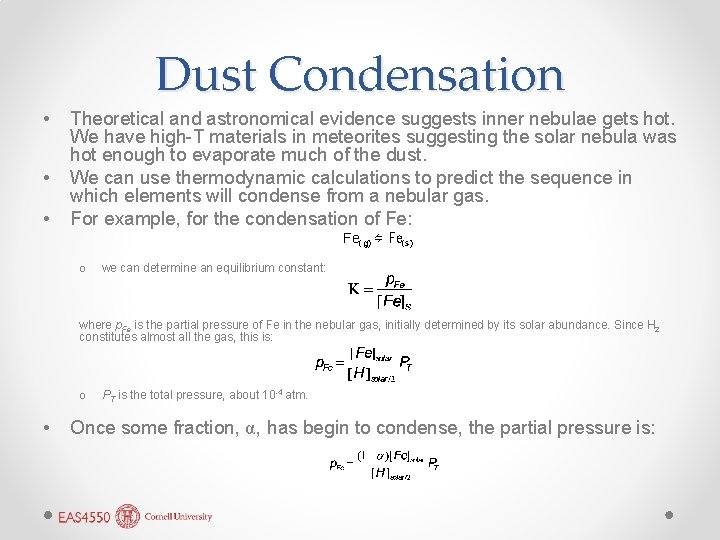
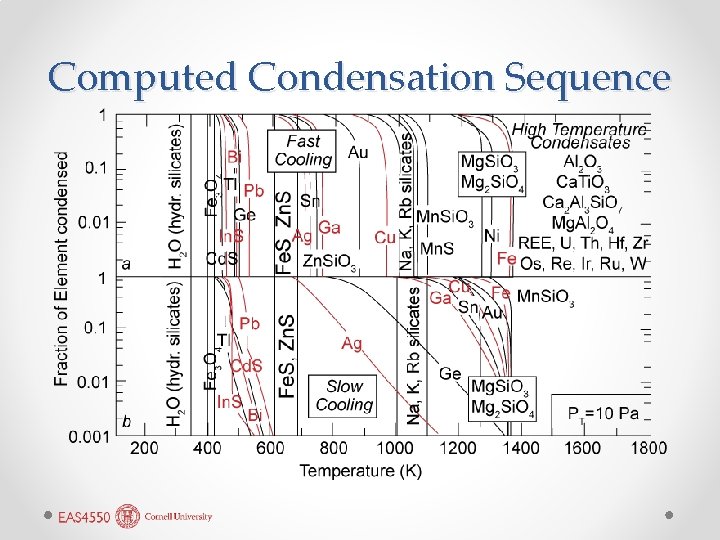
Dust Condensation • • • Theoretical and astronomical evidence suggests inner nebulae gets hot. We have high-T materials in meteorites suggesting the solar nebula was hot enough to evaporate much of the dust. We can use thermodynamic calculations to predict the sequence in which elements will condense from a nebular gas. For example, for the condensation of Fe: Fe(g) ⇋ Fe(s) o we can determine an equilibrium constant: where p. Fe is the partial pressure of Fe in the nebular gas, initially determined by its solar abundance. Since H 2 constitutes almost all the gas, this is: o • PT is the total pressure, about 10 -4 atm. Once some fraction, α, has begin to condense, the partial pressure is:
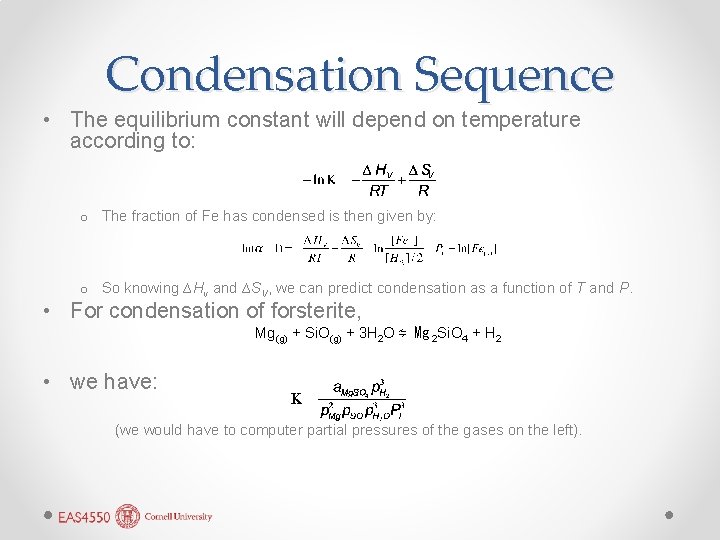
Condensation Sequence • The equilibrium constant will depend on temperature according to: o The fraction of Fe has condensed is then given by: o So knowing ∆Hv and ∆SV, we can predict condensation as a function of T and P. • For condensation of forsterite, Mg(g) + Si. O(g) + 3 H 2 O ⇋ Mg 2 Si. O 4 + H 2 • we have: (we would have to computer partial pressures of the gases on the left).
Equilibrium or Fractional? • As was the case for other processes such as crystallization, melting, and condensation of water vapor, we can imagine that condensation in the solar nebula was either: o An equilibrium process in which solids continuously equilibrated with the gas as they cooled, which we might expect if the process was slow, or o A fractional process in which once grains of solids condensed, they did not continue to equilibrate with the gas – more likely if the process was fast. • The choice affects our calculations.
Computed Condensation Sequence
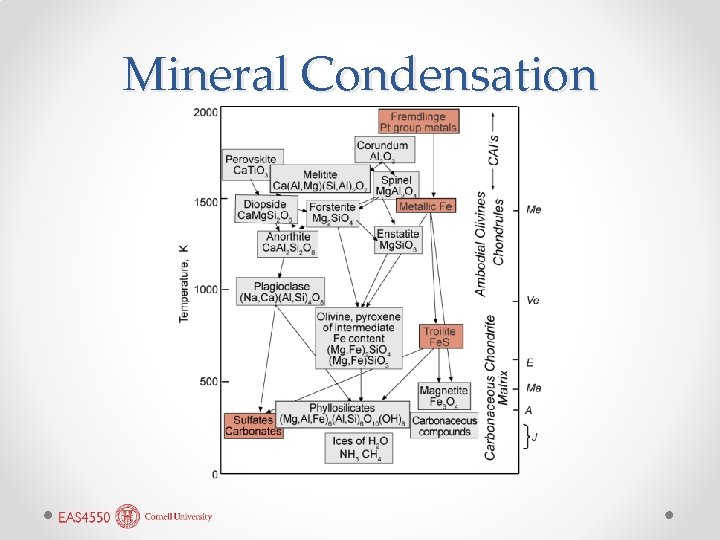
Mineral Condensation
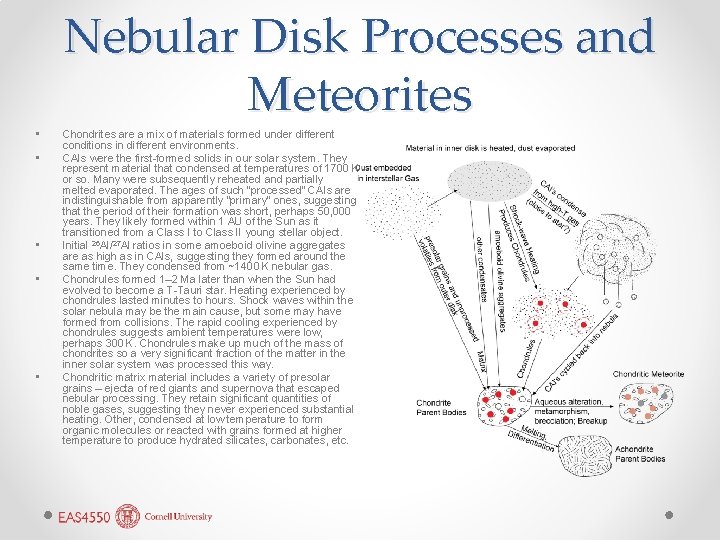
Nebular Disk Processes and Meteorites • • • Chondrites are a mix of materials formed under different conditions in different environments. CAIs were the first-formed solids in our solar system. They represent material that condensed at temperatures of 1700 K or so. Many were subsequently reheated and partially melted evaporated. The ages of such “processed” CAIs are indistinguishable from apparently “primary” ones, suggesting that the period of their formation was short, perhaps 50, 000 years. They likely formed within 1 AU of the Sun as it transitioned from a Class I to Class II young stellar object. Initial 26 Al/27 Al ratios in some amoeboid olivine aggregates are as high as in CAIs, suggesting they formed around the same time. They condensed from ~1400 K nebular gas. Chondrules formed 1– 2 Ma later than when the Sun had evolved to become a T-Tauri star. Heating experienced by chondrules lasted minutes to hours. Shock waves within the solar nebula may be the main cause, but some may have formed from collisions. The rapid cooling experienced by chondrules suggests ambient temperatures were low, perhaps 300 K. Chondrules make up much of the mass of chondrites so a very significant fraction of the matter in the inner solar system was processed this way. Chondritic matrix material includes a variety of presolar grains – ejecta of red giants and supernova that escaped nebular processing. They retain significant quantities of noble gases, suggesting they never experienced substantial heating. Other, condensed at low temperature to form organic molecules or reacted with grains formed at higher temperature to produce hydrated silicates, carbonates, etc.