
Formation of the first galaxies and reionization of
- Slides: 32
Formation of the first galaxies and reionization of the Universe: current status and problems A. Doroshkevich Astro-Space Center, FIAN, Moscow.
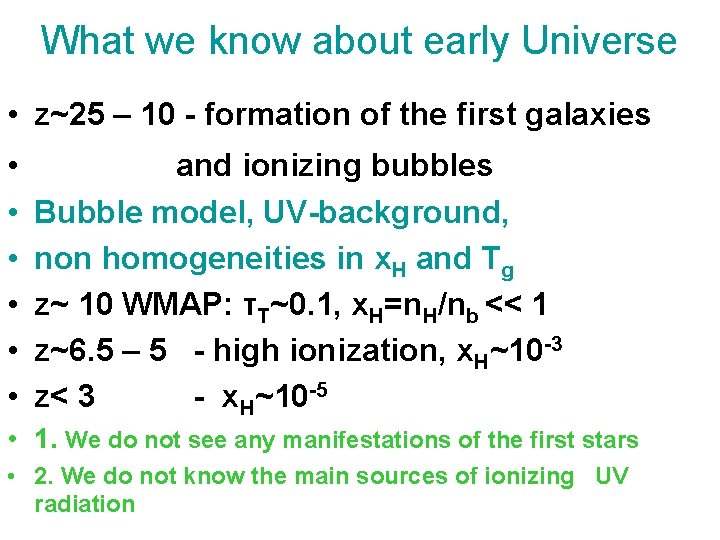
What we know about early Universe • z~25 – 10 - formation of the first galaxies • • • and ionizing bubbles Bubble model, UV-background, non homogeneities in x. H and Tg z~ 10 WMAP: τT~0. 1, x. H=n. H/nb << 1 z~6. 5 – 5 - high ionization, x. H~10 -3 z< 3 - x. H~10 -5 • 1. We do not see any manifestations of the first stars • 2. We do not know the main sources of ionizing UV radiation
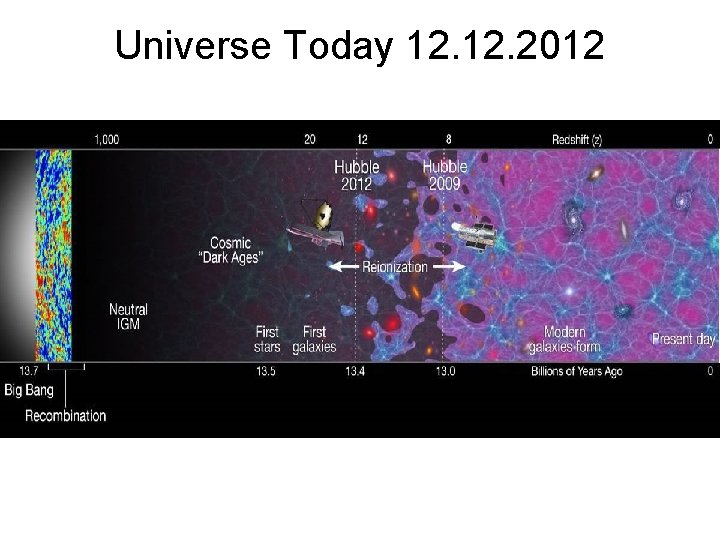
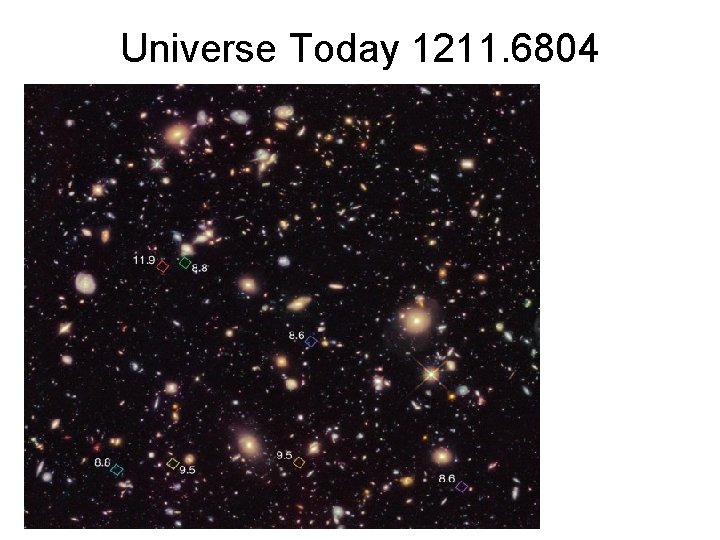
Universe Today 12. 2012
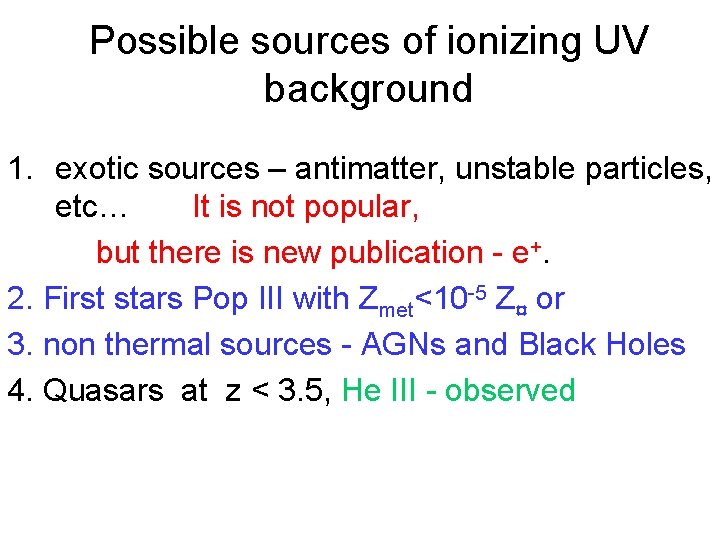
Possible sources of ionizing UV background 1. exotic sources – antimatter, unstable particles, etc… It is not popular, but there is new publication - e+. 2. First stars Pop III with Zmet<10 -5 Z¤ or 3. non thermal sources - AGNs and Black Holes 4. Quasars at z < 3. 5, He III - observed
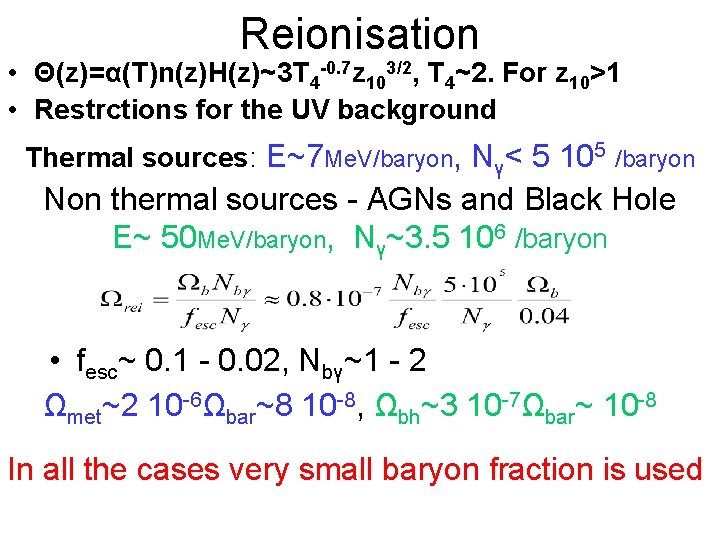
Reionisation • Θ(z)=α(T)n(z)H(z)~3 T 4 -0. 7 z 103/2, T 4~2. For z 10>1 • Restrctions for the UV background Thermal sources: E~7 Me. V/baryon, Nγ< 5 105 /baryon Non thermal sources - AGNs and Black Hole E~ 50 Me. V/baryon, Nγ~3. 5 106 /baryon • fesc~ 0. 1 - 0. 02, Nbγ~1 - 2 Ωmet~2 10 -6Ωbar~8 10 -8, Ωbh~3 10 -7Ωbar~ 10 -8 In all the cases very small baryon fraction is used
Universe Today 1211. 6804
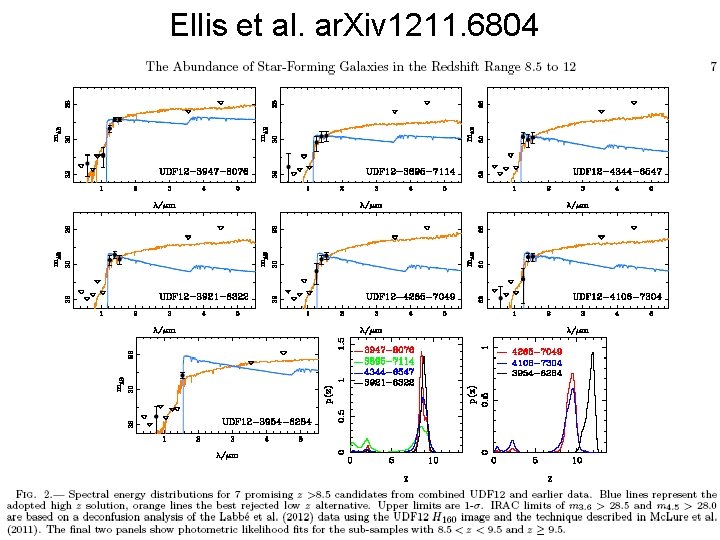
Ellis et al. ar. Xiv 1211. 6804
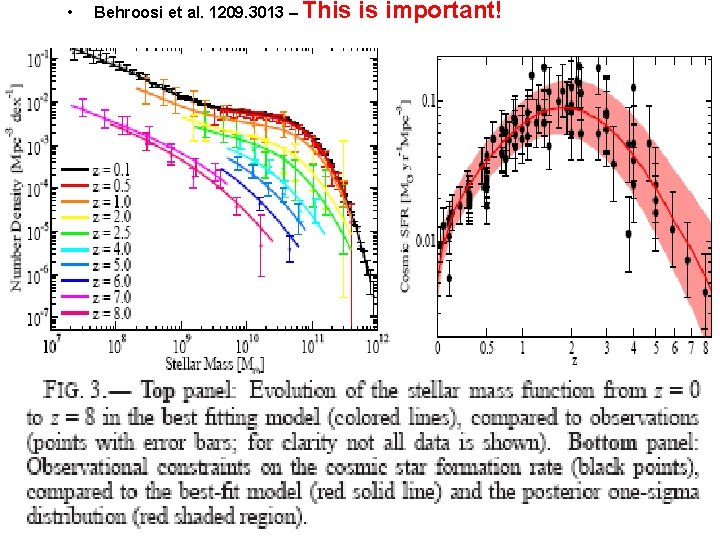
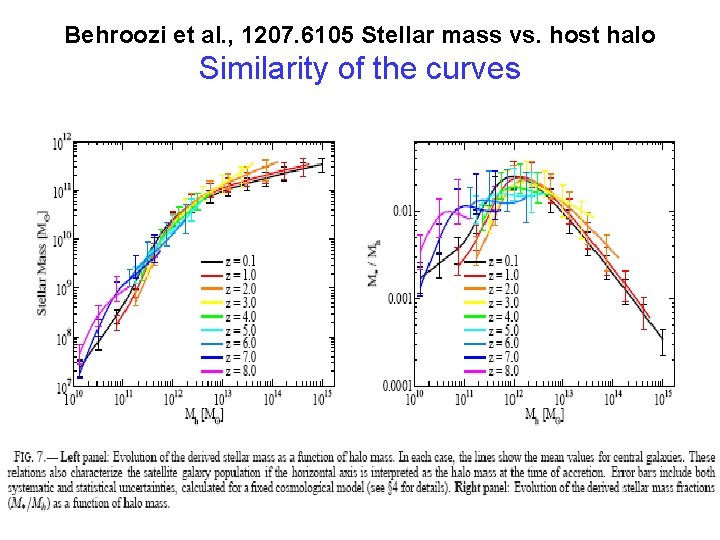
• Behroosi et al. 1209. 3013 – This is important!
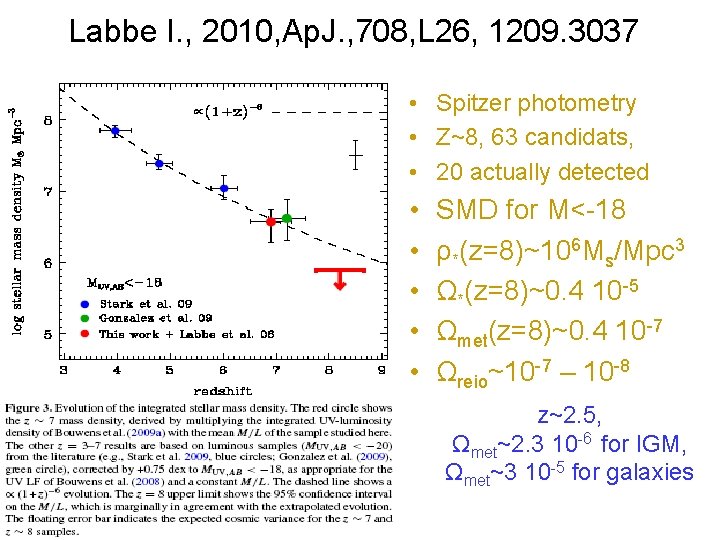
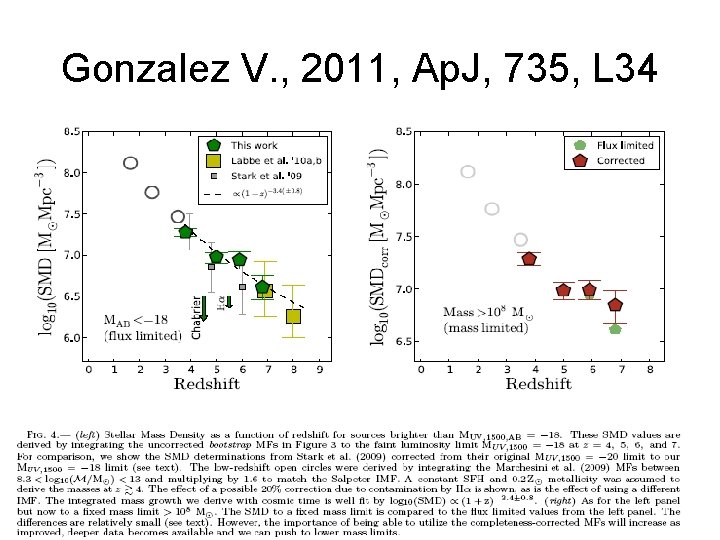
Labbe I. , 2010, Ap. J. , 708, L 26, 1209. 3037 • Spitzer photometry • Z~8, 63 candidats, • 20 actually detected • • • SMD for M<-18 ρ*(z=8)~106 Ms/Mpc 3 Ω*(z=8)~0. 4 10 -5 Ωmet(z=8)~0. 4 10 -7 Ωreio~10 -7 – 10 -8 z~2. 5, Ωmet~2. 3 10 -6 for IGM, Ωmet~3 10 -5 for galaxies
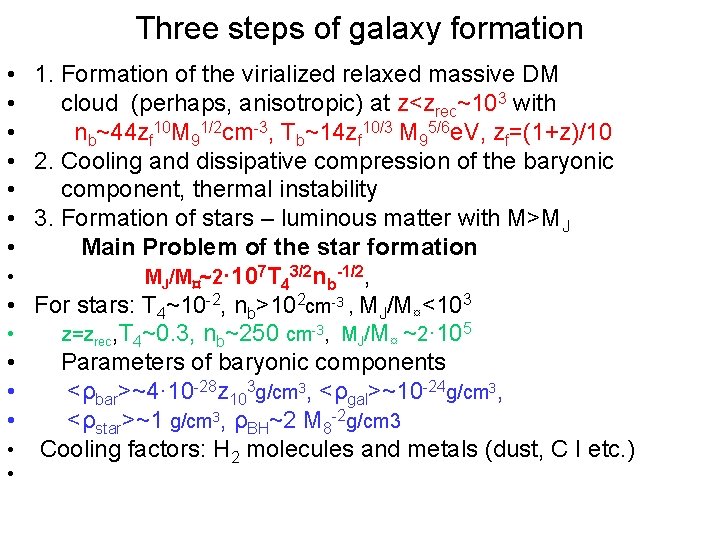
Three steps of galaxy formation • 1. Formation of the virialized relaxed massive DM • cloud (perhaps, anisotropic) at z<zrec~103 with • nb~44 zf 10 M 91/2 cm-3, Tb~14 zf 10/3 M 95/6 e. V, zf=(1+z)/10 • 2. Cooling and dissipative compression of the baryonic • component, thermal instability • 3. Formation of stars – luminous matter with M>MJ • Main Problem of the star formation • MJ/M¤~2· 107 T 43/2 nb-1/2, • For stars: T 4~10 -2, nb>102 cm-3 , MJ/M¤<103 • z=zrec, T 4~0. 3, nb~250 cm-3, MJ/M¤ ~2· 105 • Parameters of baryonic components • <ρbar>~4· 10 -28 z 103 g/cm 3, <ρgal>~10 -24 g/cm 3, • <ρstar>~1 g/cm 3, ρBH~2 M 8 -2 g/cm 3 • Cooling factors: H 2 molecules and metals (dust, C I etc. ) •
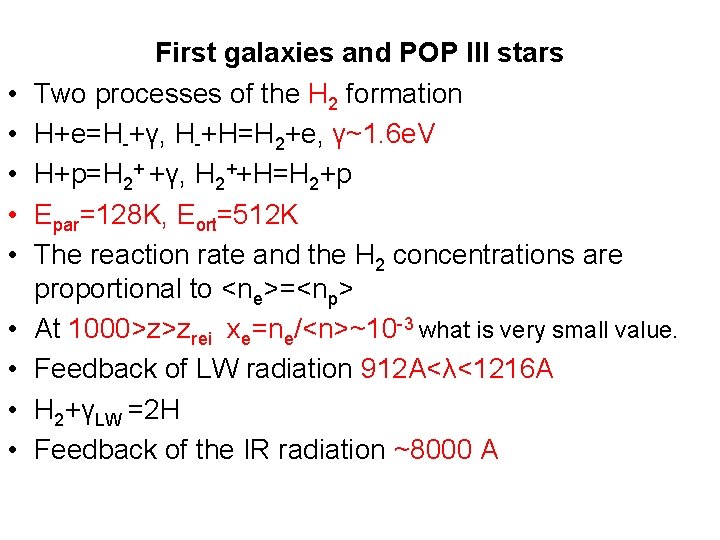
• • • First galaxies and POP III stars Two processes of the H 2 formation H+e=H-+γ, H-+H=H 2+e, γ~1. 6 e. V H+p=H 2+ +γ, H 2++H=H 2+p Epar=128 K, Eort=512 K The reaction rate and the H 2 concentrations are proportional to <ne>=<np> At 1000>z>zrei xe=ne/<n>~10 -3 what is very small value. Feedback of LW radiation 912 A<λ<1216 A H 2+γLW =2 H Feedback of the IR radiation ~8000 A
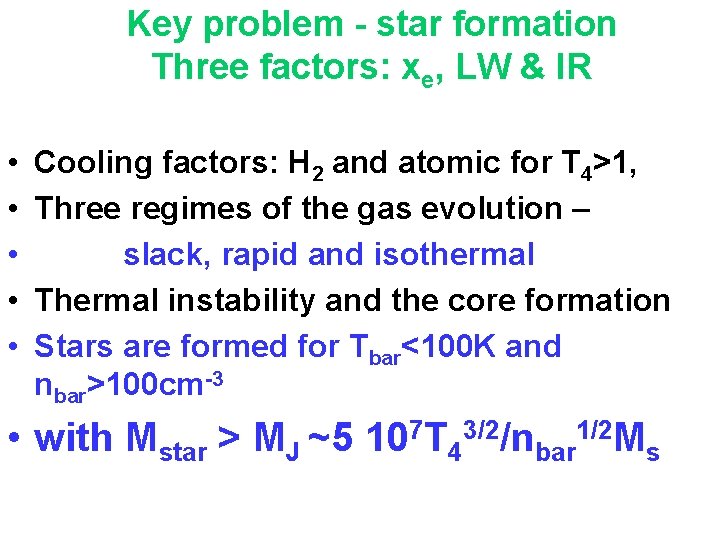
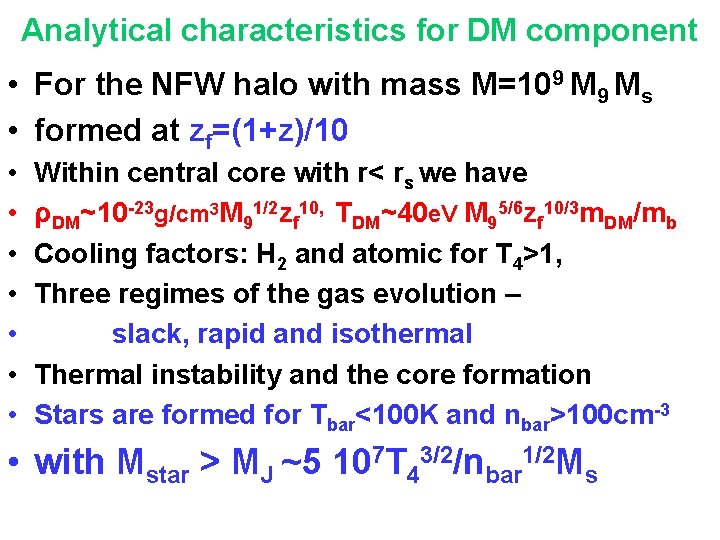
Key problem - star formation Three factors: xe, LW & IR • • • Cooling factors: H 2 and atomic for T 4>1, Three regimes of the gas evolution – slack, rapid and isothermal Thermal instability and the core formation Stars are formed for Tbar<100 K and nbar>100 cm-3 • with Mstar > MJ ~5 107 T 43/2/nbar 1/2 Ms
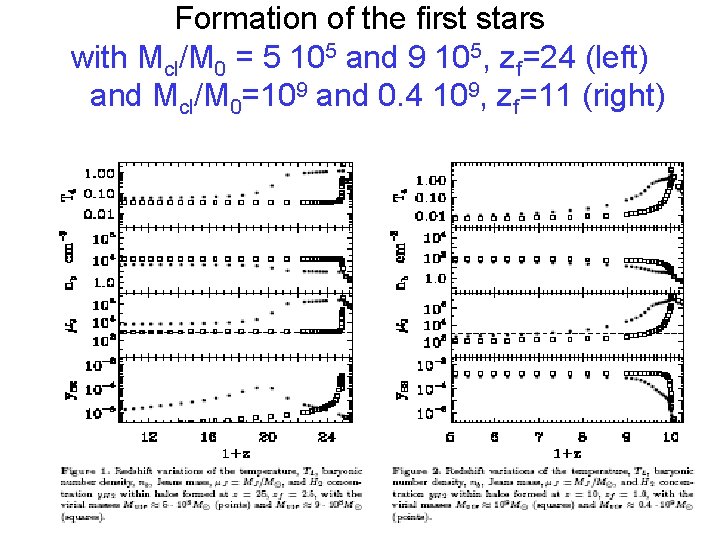
Formation of the first stars with Mcl/M 0 = 5 105 and 9 105, zf=24 (left) and Mcl/M 0=109 and 0. 4 109, zf=11 (right)
Influence of the LW & IR backgrounds • • • Actual limit is JLW 21~1 – 0. 1 for various redshifts For the period of full ionization z~10 we get JLW 21~4 Nbγ This means that at 10>z>8. 5 the H 2 molecules are practically destroyed and star formation is strongly suppressed • This background is mainly disappeared at z~8. 5
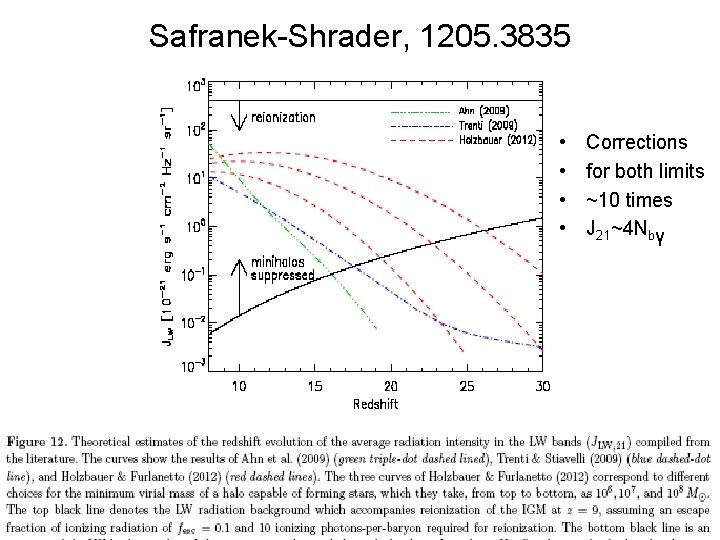
Safranek-Shrader, 1205. 3835 • • Corrections for both limits ~10 times J 21~4 Nbγ
Alternatives for the star radiation • • Hard UV and X-rays from the BH In the case Tb~104 K and thermal ionization but we get the high entropy of baryonic component and increasing of minimal mass, Mgal>MJ≈5 109 T 43/2 zf-3/2 Mo It is not catastrophic ! What is the best way?
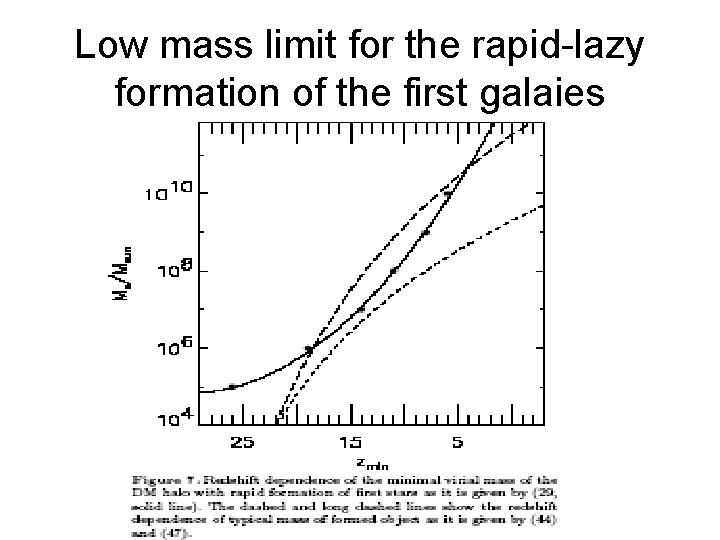
Low mass limit for the rapid-lazy formation of the first galaies
Simulations (2001) • • • The box ~1 Mpc, 128 -256 cells, Ndm~107, mdm~30 M 0, Mgal~106 – 107 M 0 Very useful general presentation (the galaxy and star formation are possible) Restrictions: a. small box → random regions (void or wall) & unknown small representativity • b. low massive halos, weak interaction of halos • c. stars are outer model parameters • d. large mass DM particles in comparison with the mass of halos.
What is mostly interesting • a. realization – it is possible! • b. wide statistics of objects -- what is possible for various redshifts • c. rough characteristics of internal structure of the first galaxies • d. general quantitative analysis of main physical processes
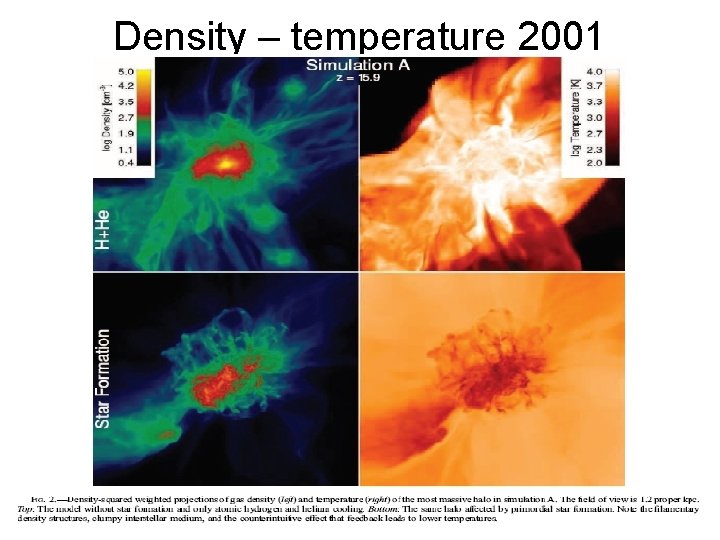
Density – temperature 2001
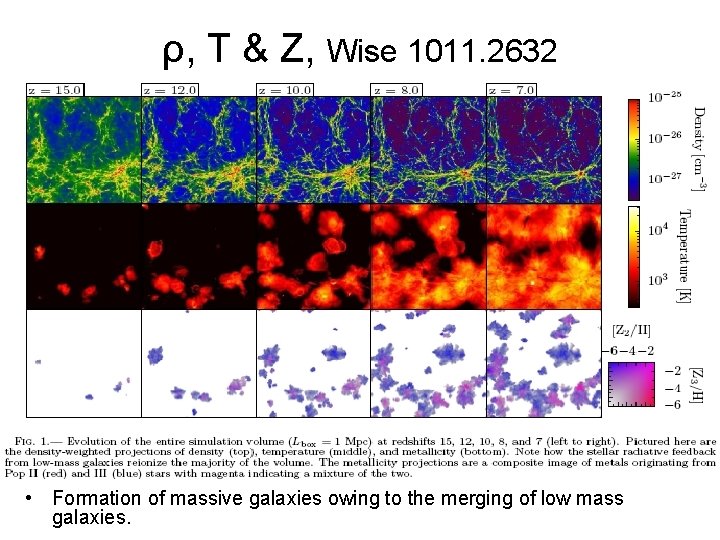
ρ, T & Z, Wise 1011. 2632 • Formation of massive galaxies owing to the merging of low mass galaxies.
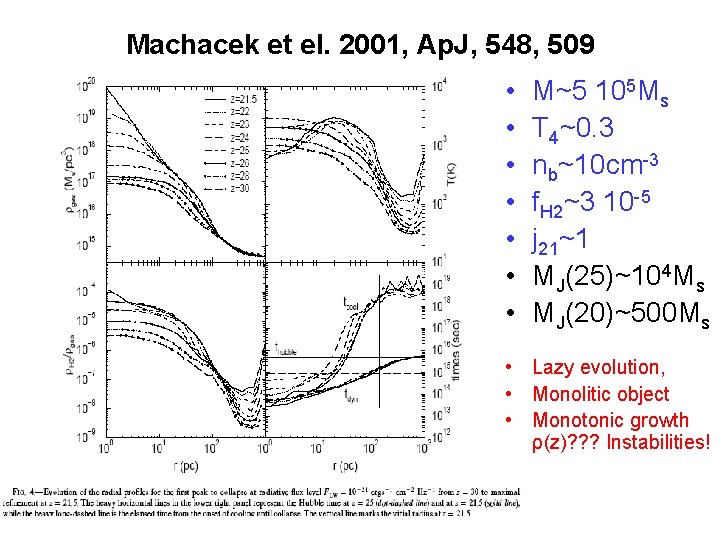
Machacek et el. 2001, Ap. J, 548, 509 • • M~5 105 Ms T 4~0. 3 nb~10 cm-3 f. H 2~3 10 -5 j 21~1 MJ(25)~104 Ms MJ(20)~500 Ms • Lazy evolution, • Monolitic object • Monotonic growth ρ(z)? ? ? Instabilities!
Conclusions • We do not see any manifestations of the first stars • We do not know the main sources of ionizing UV radiation • A. It seems that first stars Pop II & III , SNs, GRBs are approximately effective (~20 – 40%) • B. non thermal sources - BHs remnants and/or AGNs - are more effective (~50% + ? ) • C. We can semi analytically describe the formation and evolution of the first galaxies • Observations: galaxies ↔ background • 10 000 – 20 000 A – James Webb
The Theend
Comments • Importance – instead of the experiment • Complexity, representativity and precision (WMAP). • Modern facilities • Our attempts – simulations versus analysis
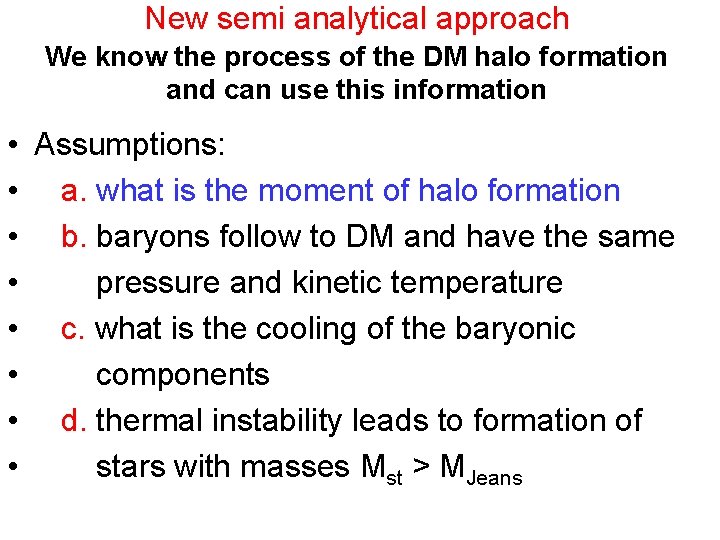
New semi analytical approach We know the process of the DM halo formation and can use this information • Assumptions: • a. what is the moment of halo formation • b. baryons follow to DM and have the same • pressure and kinetic temperature • c. what is the cooling of the baryonic • components • d. thermal instability leads to formation of • stars with masses Mst > MJeans
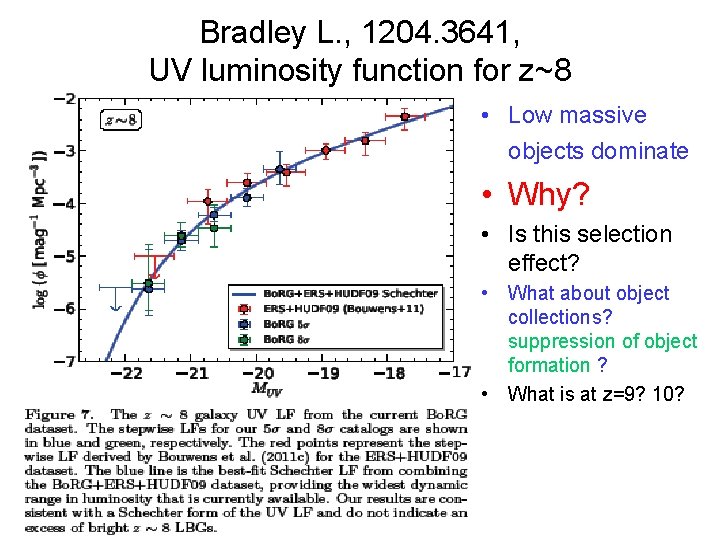
Bradley L. , 1204. 3641, UV luminosity function for z~8 • Low massive objects dominate • Why? • Is this selection effect? • What about object collections? suppression of object formation ? • What is at z=9? 10?
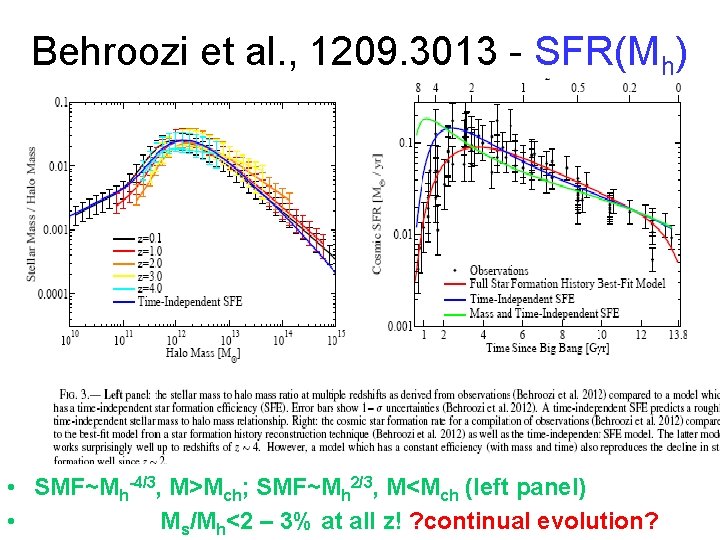
Behroozi et al. , 1209. 3013 - SFR(Mh) • SMF~Mh-4/3, M>Mch; SMF~Mh 2/3, M<Mch (left panel) • Ms/Mh<2 – 3% at all z! ? continual evolution?
Analytical characteristics for DM component • For the NFW halo with mass M=109 M 9 Ms • formed at zf=(1+z)/10 • • Within central core with r< rs we have ρDM~10 -23 g/cm 3 M 91/2 zf 10, TDM~40 e. V M 95/6 zf 10/3 m. DM/mb Cooling factors: H 2 and atomic for T 4>1, Three regimes of the gas evolution – slack, rapid and isothermal Thermal instability and the core formation Stars are formed for Tbar<100 K and nbar>100 cm-3 • with Mstar > MJ ~5 107 T 43/2/nbar 1/2 Ms
Behroozi et al. , 1207. 6105 Stellar mass vs. host halo Similarity of the curves
Gonzalez V. , 2011, Ap. J, 735, L 34
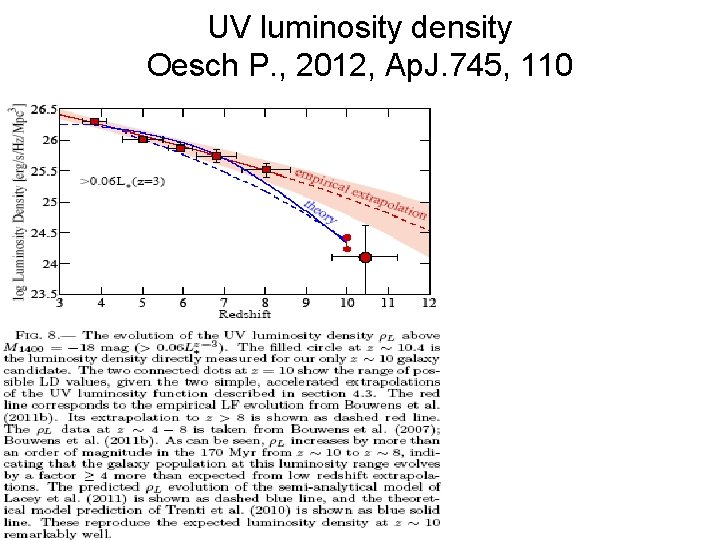
UV luminosity density Oesch P. , 2012, Ap. J. 745, 110