
Formation of the Earth Moon Video A Perfect
- Slides: 27
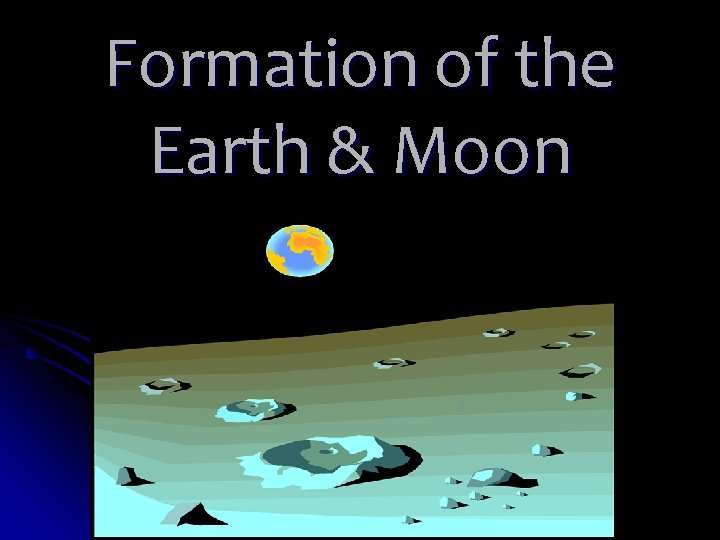
Formation of the Earth & Moon
Video: “A Perfect Planet…The Formation of Earth” http: //youtu. be/_mc. C 8 k. Facrk
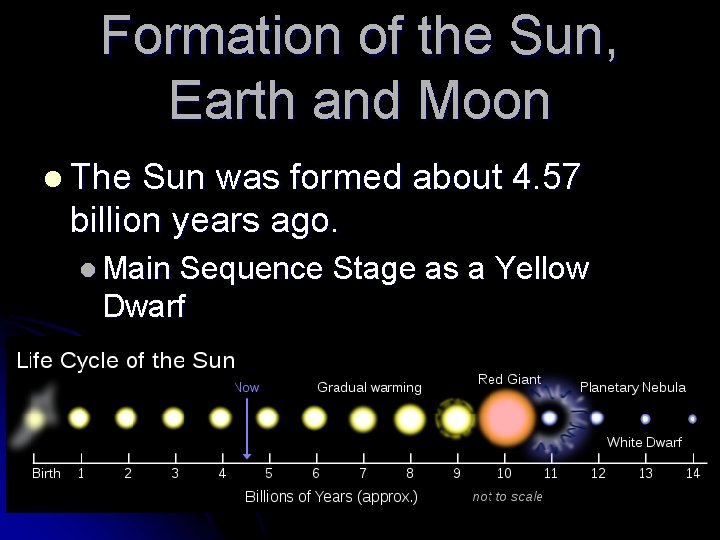
Formation of the Sun, Earth and Moon l The Sun was formed about 4. 57 billion years ago. l Main Sequence Stage as a Yellow Dwarf
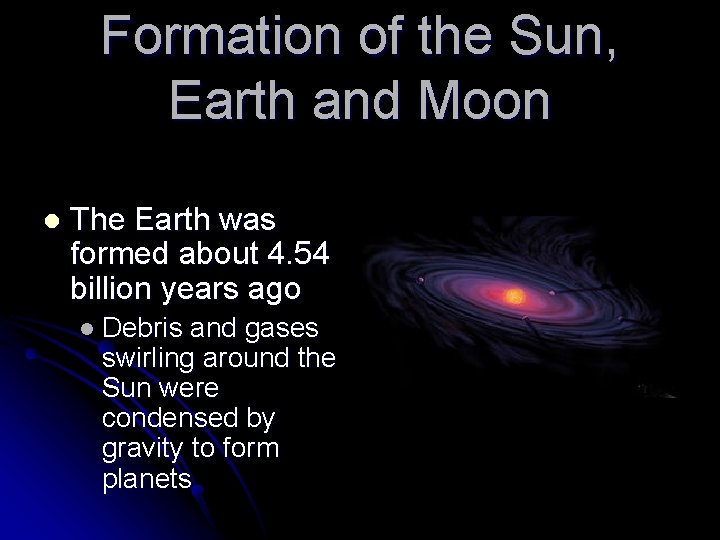
Formation of the Sun, Earth and Moon l The Earth was formed about 4. 54 billion years ago l Debris and gases swirling around the Sun were condensed by gravity to form planets
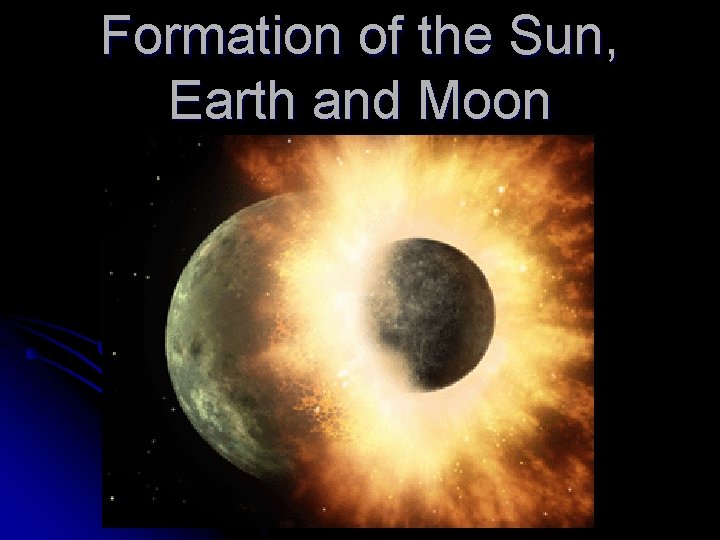
Formation of the Sun, Earth and Moon l Believed that the Earth’s moon was formed about 4. 527 billion years ago l. A collision with another planet-like body caused the formation of the moon l A chunk from the collision has been orbiting the Earth ever since
Formation of the Sun, Earth and Moon
Precambrian Eon l The earliest time of Earth l 4, 500 to 543 million years ago l Includes the three earliest eras l Hadean Era l Archaean Era l Proterozoic Era
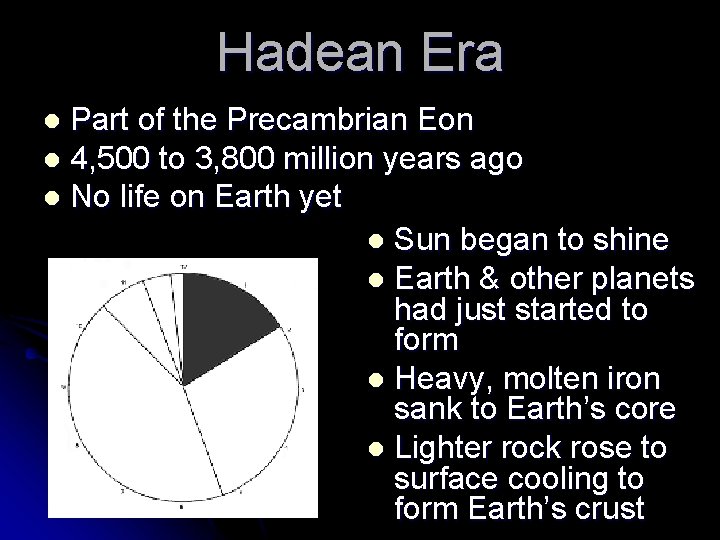
Hadean Era Part of the Precambrian Eon l 4, 500 to 3, 800 million years ago l No life on Earth yet l Sun began to shine l Earth & other planets had just started to form l Heavy, molten iron sank to Earth’s core l Lighter rock rose to surface cooling to form Earth’s crust l
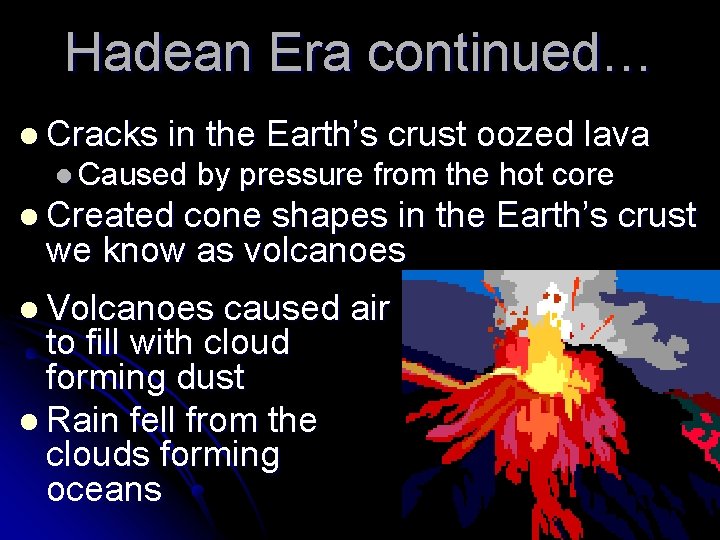
Hadean Era continued… l Cracks in the Earth’s crust oozed lava l Caused by pressure from the hot core l Created cone shapes in the Earth’s crust we know as volcanoes l Volcanoes caused air to fill with cloud forming dust l Rain fell from the clouds forming oceans
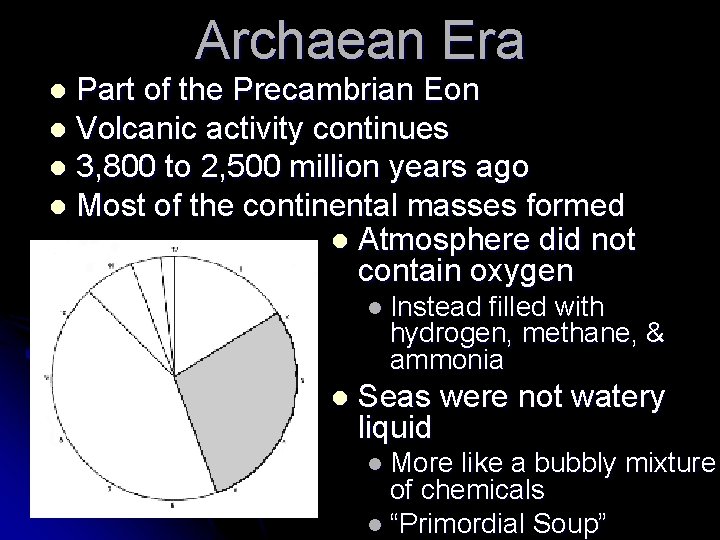
Archaean Era Part of the Precambrian Eon l Volcanic activity continues l 3, 800 to 2, 500 million years ago l Most of the continental masses formed l Atmosphere did not contain oxygen l l Instead filled with hydrogen, methane, & ammonia l Seas were not watery liquid l More like a bubbly mixture of chemicals l “Primordial Soup”
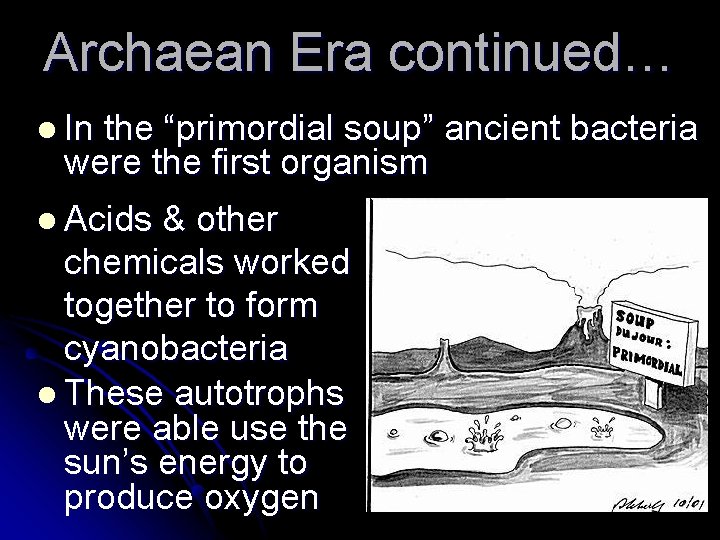
Archaean Era continued… l In the “primordial soup” ancient bacteria were the first organism l Acids & other chemicals worked together to form cyanobacteria l These autotrophs were able use the sun’s energy to produce oxygen
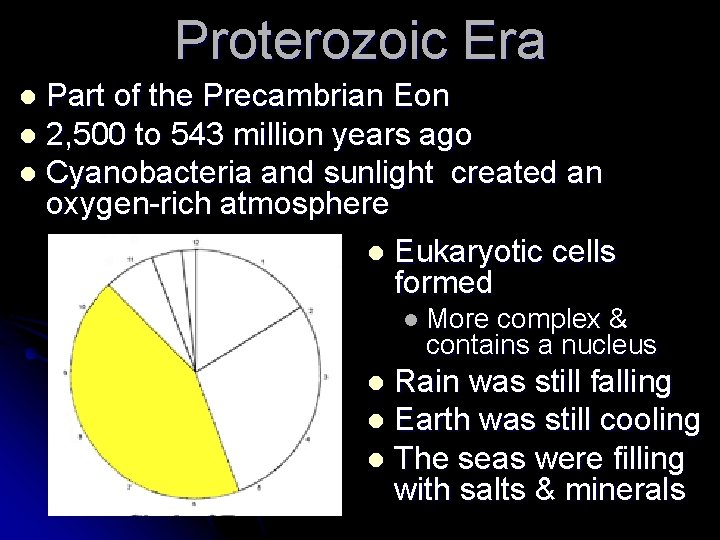
Proterozoic Era Part of the Precambrian Eon l 2, 500 to 543 million years ago l Cyanobacteria and sunlight created an oxygen-rich atmosphere l Eukaryotic cells formed l l More complex & contains a nucleus Rain was still falling l Earth was still cooling l The seas were filling with salts & minerals l
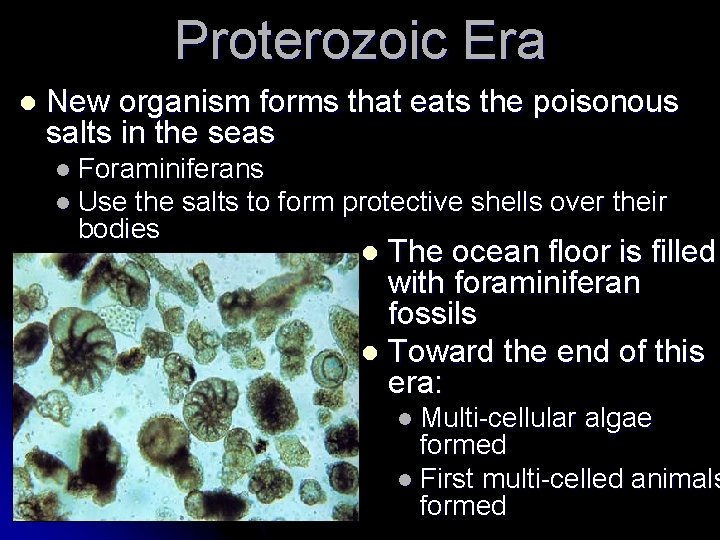
Proterozoic Era l New organism forms that eats the poisonous salts in the seas l Foraminiferans l Use the salts to form protective shells over their bodies The ocean floor is filled with foraminiferan fossils l Toward the end of this era: l l Multi-cellular algae formed l First multi-celled animals formed
Phanerozoic Eon l Most recent eon of Earth l 543 million years ago to present l Includes three most recent eras l. Paleozoic Era l. Mesozoic Era l. Cenozoic Era
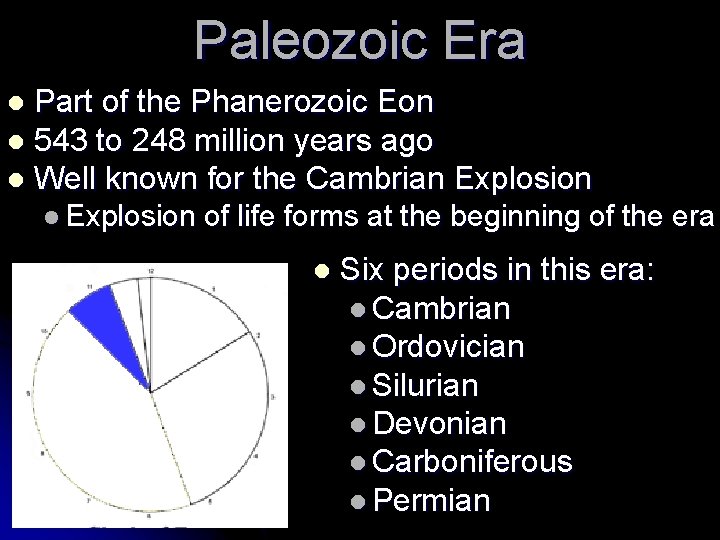
Paleozoic Era Part of the Phanerozoic Eon l 543 to 248 million years ago l Well known for the Cambrian Explosion l l Explosion of life forms at the beginning of the era l Six periods in this era: l Cambrian l Ordovician l Silurian l Devonian l Carboniferous l Permian
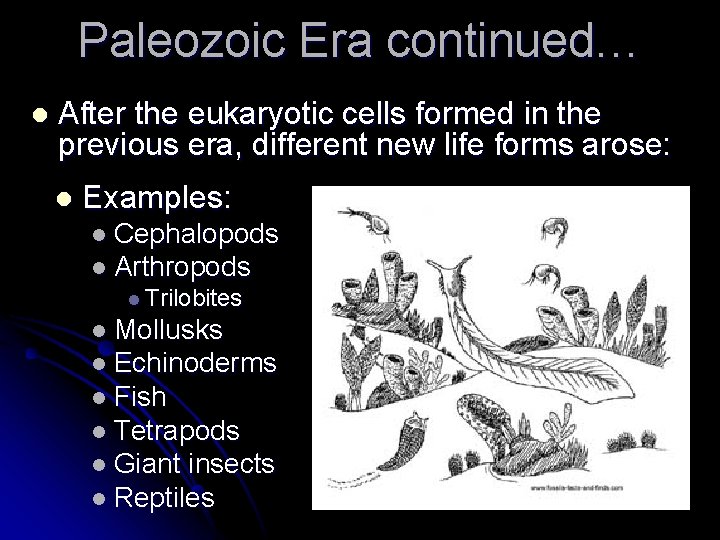
Paleozoic Era continued… l After the eukaryotic cells formed in the previous era, different new life forms arose: l Examples: l Cephalopods l Arthropods l Trilobites l Mollusks l Echinoderms l Fish l Tetrapods l Giant insects l Reptiles
Paleozoic Era continued… l Plants and animals moved onto land in the Silurian Period l They flourished in the Carboniferous Period when huge forests covered the land l Forests were so abundant that there was 35% oxygen in the atmosphere compared to present day of 21% l Giant insects lived in the forests
Paleozoic Era continued… l Tetrapods lived near the water’s edge and dominated the lakes, rivers, & swamps l At the end of the Paleozoic Era there was a mass extinction that cause 95% of these new life forms to become extinct!
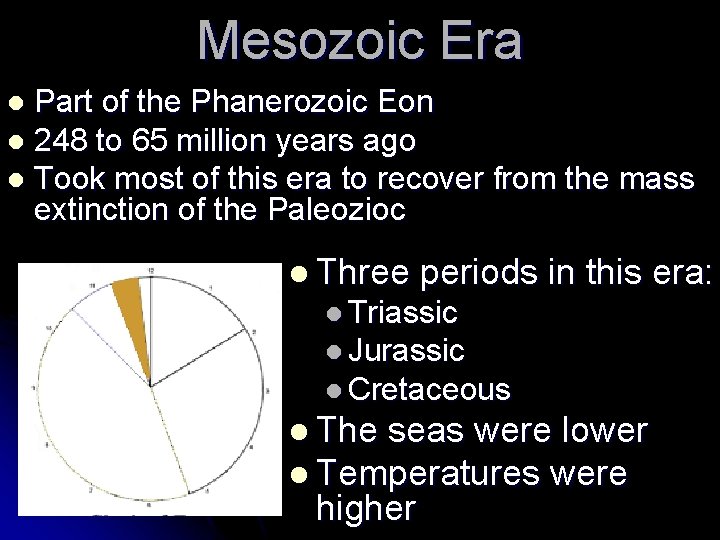
Mesozoic Era Part of the Phanerozoic Eon l 248 to 65 million years ago l Took most of this era to recover from the mass extinction of the Paleozioc l l Three periods in this era: l Triassic l Jurassic l Cretaceous l The seas were lower l Temperatures were higher
Mesozoic Era continued… l Different types of land regions formed l Tropical forests l Marshlands l Deserts All life forms adapted to survive in these new climates l More complex plants developed with new mechanisms for survival l l Stems with tissues for carrying water throughout the plant l Reproduction using seeds
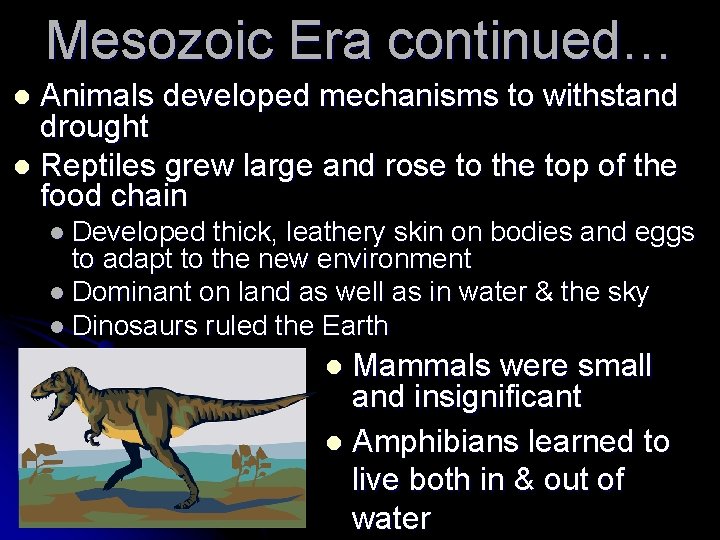
Mesozoic Era continued… Animals developed mechanisms to withstand drought l Reptiles grew large and rose to the top of the food chain l l Developed thick, leathery skin on bodies and eggs to adapt to the new environment l Dominant on land as well as in water & the sky l Dinosaurs ruled the Earth Mammals were small and insignificant l Amphibians learned to live both in & out of water l
Mesozoic Era continued… l Life in the ocean was mostly mollusks, corals, and fish l Both plants and animals reached giant proportions l At the end of this era, another mass extinction occurred l Scientists believe the Earth was hit by a giant meteor or a huge volcano erupted l Put an end to the rule of giant reptiles
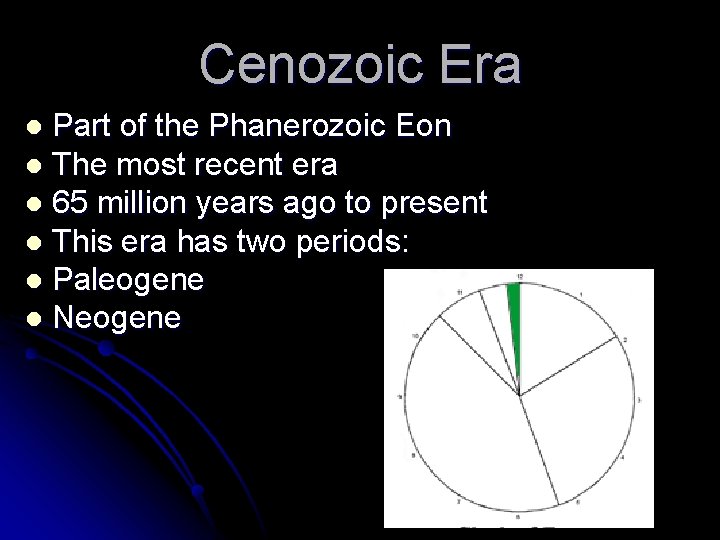
Cenozoic Era Part of the Phanerozoic Eon l The most recent era l 65 million years ago to present l This era has two periods: l Paleogene l Neogene l
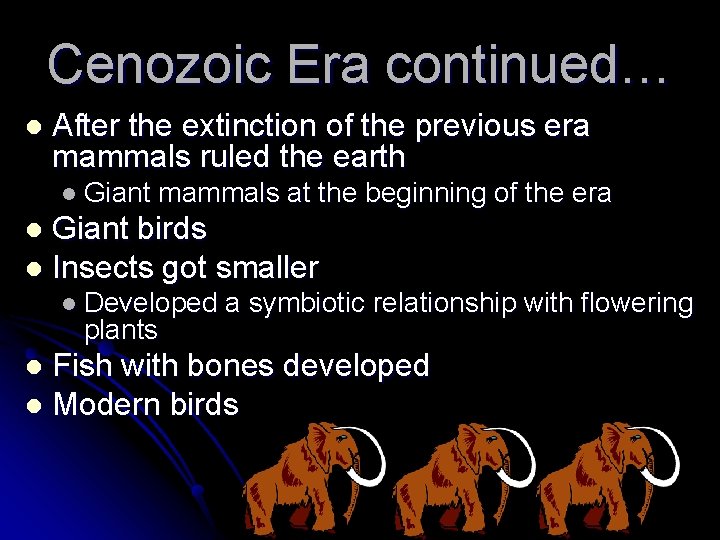
Cenozoic Era continued… l After the extinction of the previous era mammals ruled the earth l Giant mammals at the beginning of the era Giant birds l Insects got smaller l l Developed plants a symbiotic relationship with flowering Fish with bones developed l Modern birds l
Cenozoic Era continued… l Land masses moved around the globe l Rifts that happened built mountains from volcanic activity & plate tectonics l The Great Ice Age occurred l Covered the land with ice l Caused seas to recede l Migration of mammals as a new strategy for survival l Humans just recently developed 1. 5 million years ago l Only the last 7 seconds on the Clock of Eras
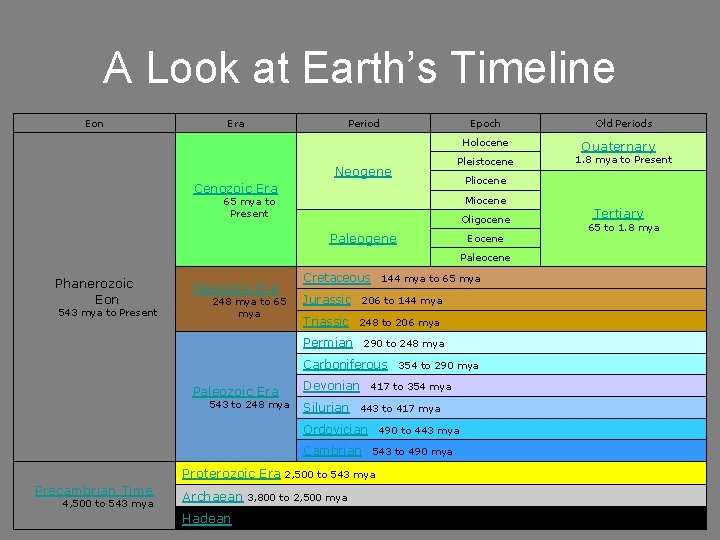
A Look at Earth’s Timeline Eon Era Period Epoch Holocene Neogene Pleistocene Cenozoic Era Oligocene Paleogene Eocene Paleocene Phanerozoic Eon 543 mya to Present Mesozoic Era 248 mya to 65 mya Cretaceous 144 mya to 65 mya Jurassic 206 to 144 mya Triassic 248 to 206 mya Permian 290 to 248 mya Carboniferous 354 to 290 mya Paleozoic Era 543 to 248 mya Devonian 417 to 354 mya Silurian 443 to 417 mya Ordovician 490 to 443 mya Cambrian 543 to 490 mya Proterozoic Era 2, 500 to 543 mya Precambrian Time 4, 500 to 543 mya Archaean 3, 800 to 2, 500 mya Hadean 4, 500 to 3, 800 mya Quaternary 1. 8 mya to Present Pliocene Miocene 65 mya to Present Old Periods Tertiary 65 to 1. 8 mya
Class Discussion l How is the Earth today different from when it first formed? l Are there any similarities?