
Formation of the Earth In the beginning Just
Formation of the Earth In the beginning
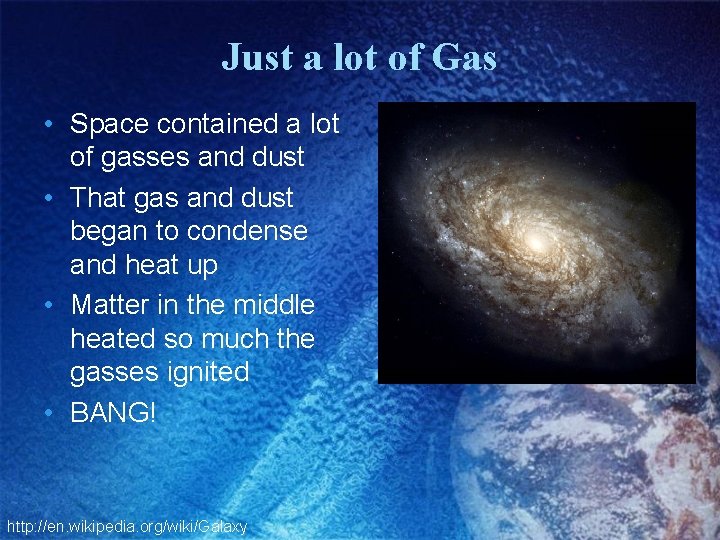
Just a lot of Gas • Space contained a lot of gasses and dust • That gas and dust began to condense and heat up • Matter in the middle heated so much the gasses ignited • BANG! http: //en. wikipedia. org/wiki/Galaxy
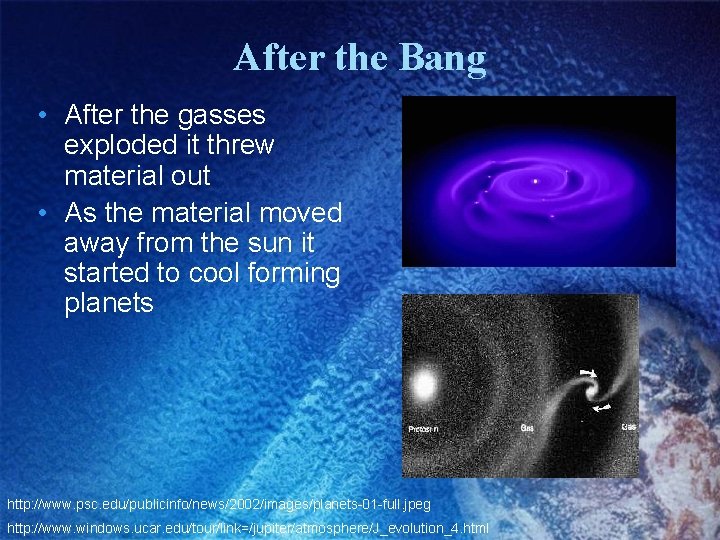
After the Bang • After the gasses exploded it threw material out • As the material moved away from the sun it started to cool forming planets http: //www. psc. edu/publicinfo/news/2002/images/planets-01 -full. jpeg http: //www. windows. ucar. edu/tour/link=/jupiter/atmosphere/J_evolution_4. html

Forming Earth • Earth was formed from the dust and gasses that were left after the bang • Earth started off as a rock. It was hit by meteors over billions of years, which added to the mass of the planet. • As the planet cooled the heavier, more dense metals began to sink to the inner part of the earth http: //www. ccsf. edu/Departments/History_of_Time_and_Life/content/Earth. Layers. htm

Formation of the Earth
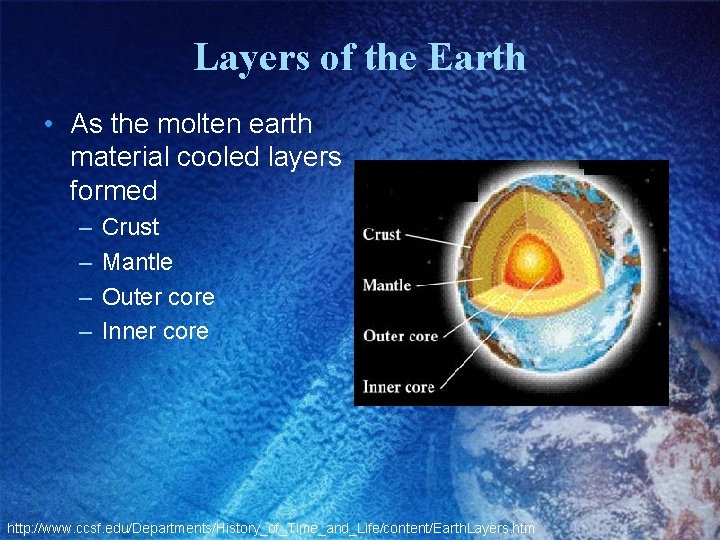
Layers of the Earth • As the molten earth material cooled layers formed – – Crust Mantle Outer core Inner core http: //www. ccsf. edu/Departments/History_of_Time_and_Life/content/Earth. Layers. htm
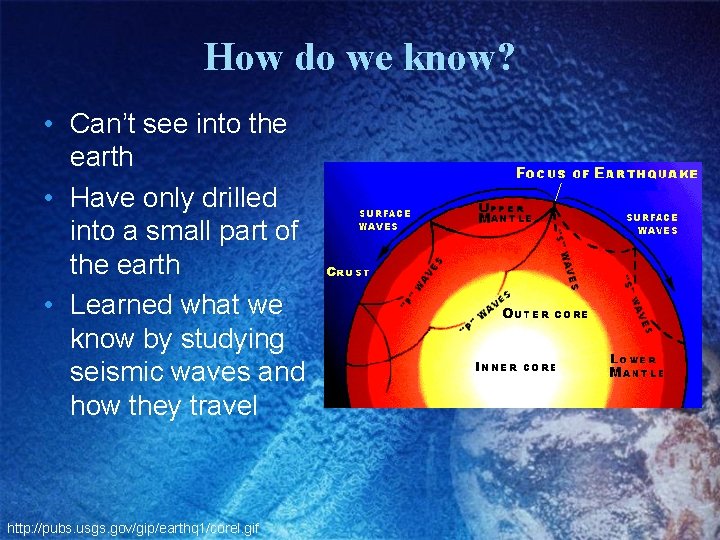
How do we know? • Can’t see into the earth • Have only drilled into a small part of the earth • Learned what we know by studying seismic waves and how they travel http: //pubs. usgs. gov/gip/earthq 1/corel. gif
Outer and Inner Core
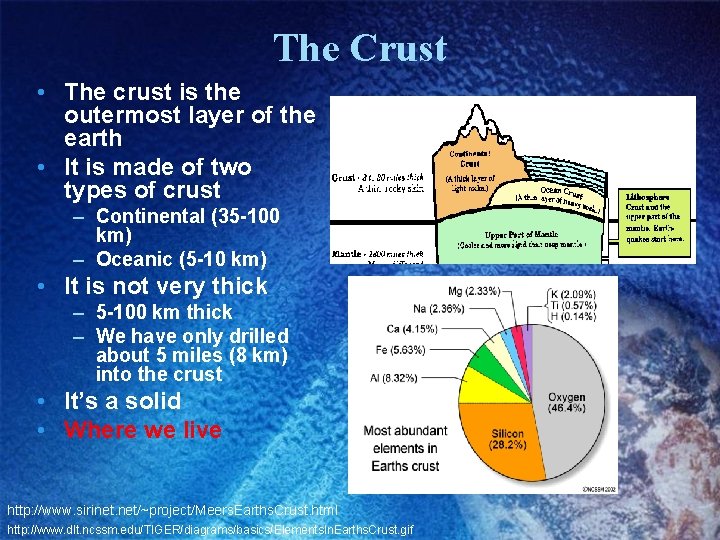
The Crust • The crust is the outermost layer of the earth • It is made of two types of crust – Continental (35 -100 km) – Oceanic (5 -10 km) • It is not very thick – 5 -100 km thick – We have only drilled about 5 miles (8 km) into the crust • It’s a solid • Where we live http: //www. sirinet. net/~project/Meers. Earths. Crust. html http: //www. dlt. ncssm. edu/TIGER/diagrams/basics/Elements. In. Earths. Crust. gif
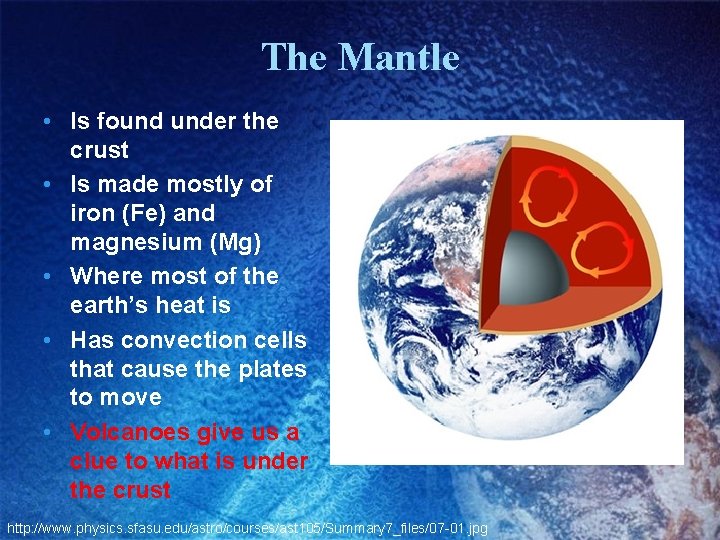
The Mantle • Is found under the crust • Is made mostly of iron (Fe) and magnesium (Mg) • Where most of the earth’s heat is • Has convection cells that cause the plates to move • Volcanoes give us a clue to what is under the crust http: //www. physics. sfasu. edu/astro/courses/ast 105/Summary 7_files/07 -01. jpg
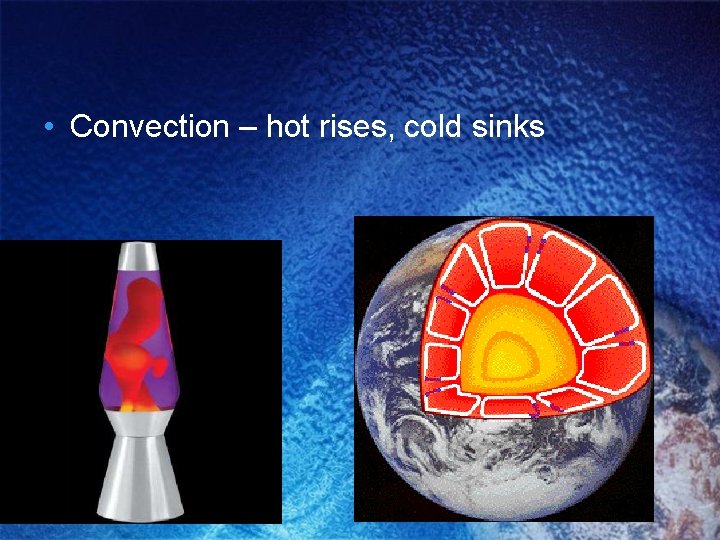
• Convection – hot rises, cold sinks
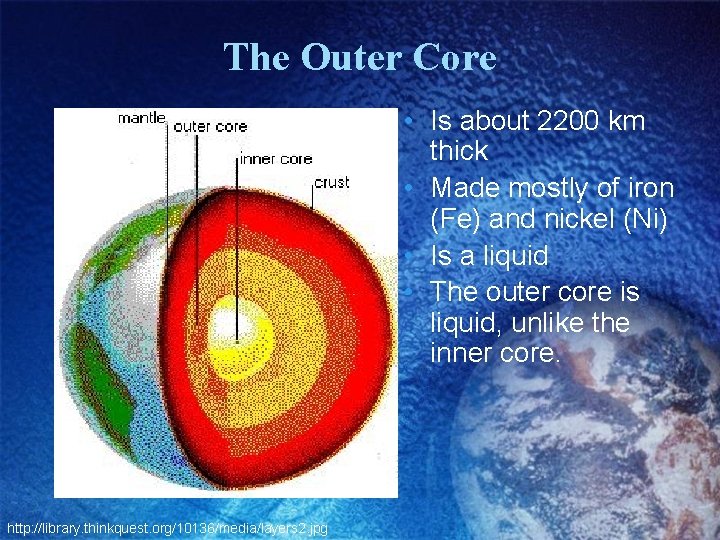
The Outer Core • Is about 2200 km thick • Made mostly of iron (Fe) and nickel (Ni) • Is a liquid • The outer core is liquid, unlike the inner core. http: //library. thinkquest. org/10136/media/layers 2. jpg
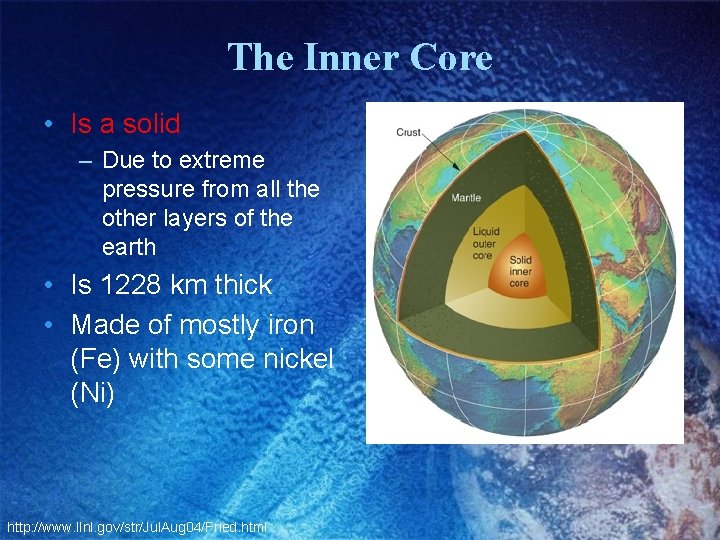
The Inner Core • Is a solid – Due to extreme pressure from all the other layers of the earth • Is 1228 km thick • Made of mostly iron (Fe) with some nickel (Ni) http: //www. llnl. gov/str/Jul. Aug 04/Fried. html
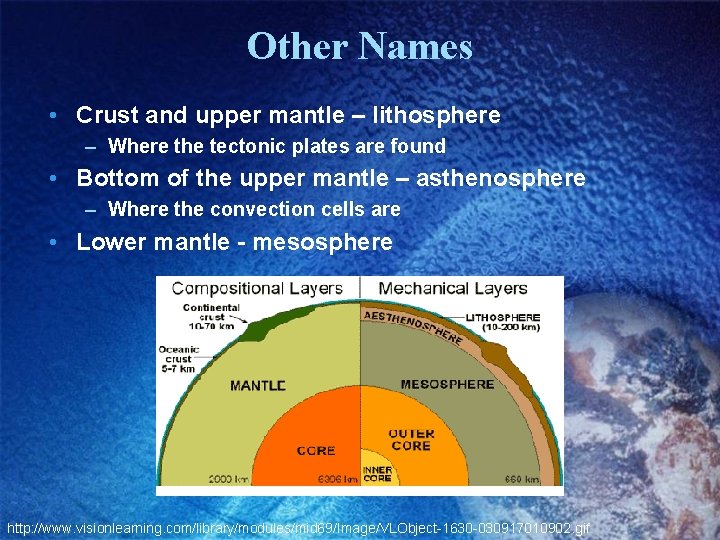
Other Names • Crust and upper mantle – lithosphere – Where the tectonic plates are found • Bottom of the upper mantle – asthenosphere – Where the convection cells are • Lower mantle - mesosphere http: //www. visionlearning. com/library/modules/mid 69/Image/VLObject-1630 -030917010902. gif
Draw the layers of the Earth • Pages 90 and 91 in “Inside the Restless Earth” • Include the following words; Crust, mantle, Outer Core, Inner Core, Lithosphere, Asthenosphere, Mesosphere.
- Slides: 15