
Formation of Giant Planets Giant planet formation Solid


- Slides: 19
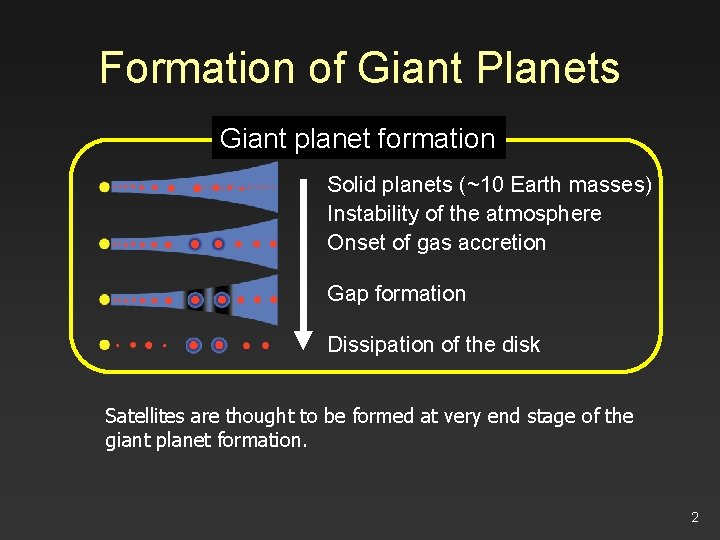
Formation of Giant Planets Giant planet formation Solid planets (~10 Earth masses) Instability of the atmosphere Onset of gas accretion Gap formation Dissipation of the disk Satellites are thought to be formed at very end stage of the giant planet formation. 2
What is Satellite System? – Systems that consist of multiple objects rotating around planets – Generally exist around gas giant planets – Regular satellites and irregular satellites • Regular satellites: – Nearly circular orbits, orbital plane ~= equatorial plane – Occupy most of the total mass of satellites • → Formed from circum-planetary disks? Satellites of outer planets Jupiter and Galilean satellites 3
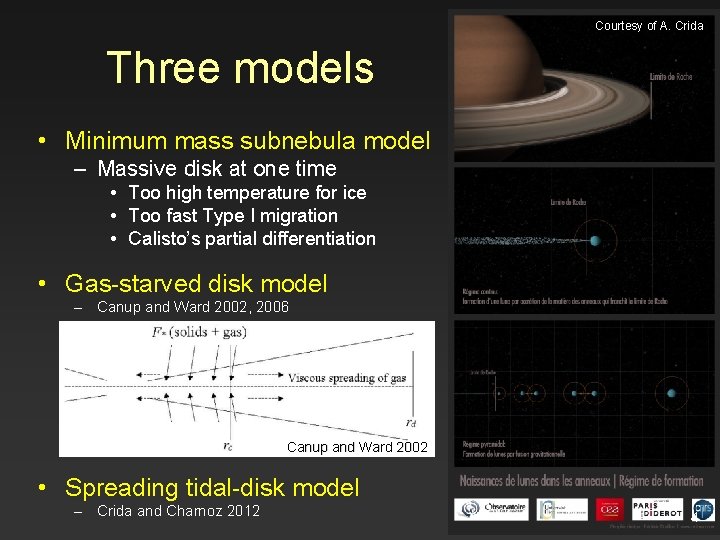
Courtesy of A. Crida Three models • Minimum mass subnebula model – Massive disk at one time • Too high temperature for ice • Too fast Type I migration • Calisto’s partial differentiation • Gas-starved disk model – Canup and Ward 2002, 2006 Canup and Ward 2002 • Spreading tidal-disk model – Crida and Charnoz 2012 4
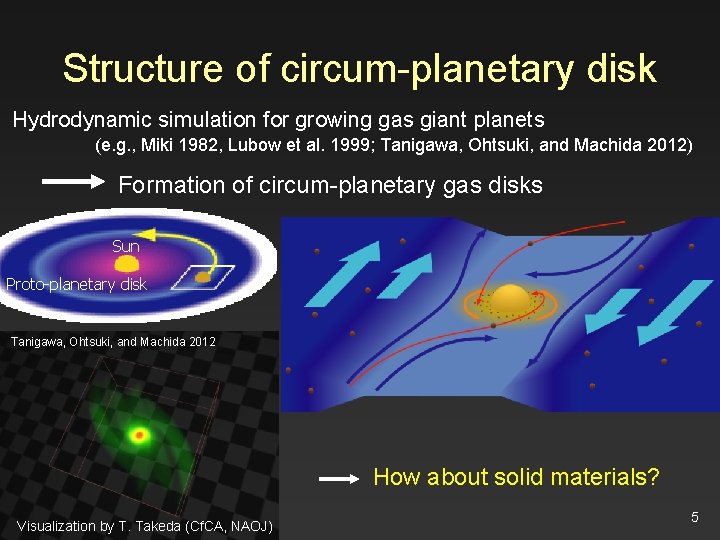
Structure of circum-planetary disk Hydrodynamic simulation for growing gas giant planets (e. g. , Miki 1982, Lubow et al. 1999; Tanigawa, Ohtsuki, and Machida 2012) Formation of circum-planetary gas disks Sun Proto-planetary disk Tanigawa, Ohtsuki, and Machida 2012 How about solid materials? Visualization by T. Takeda (Cf. CA, NAOJ) 5
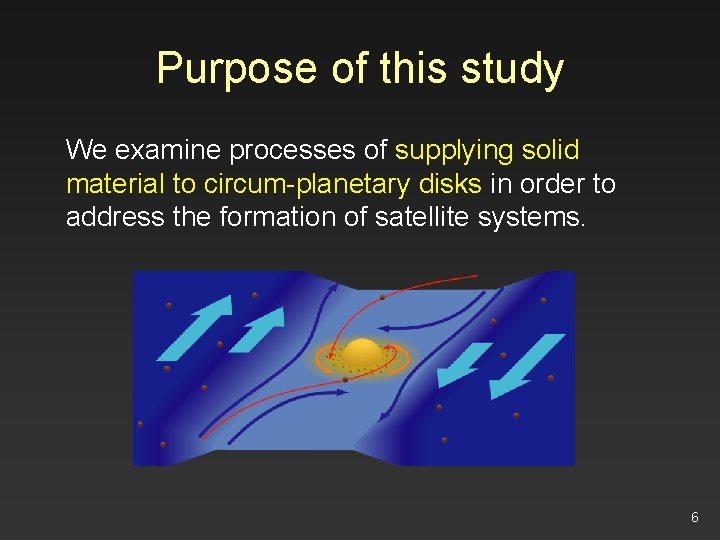
Purpose of this study We examine processes of supplying solid material to circum-planetary disks in order to address the formation of satellite systems. 6
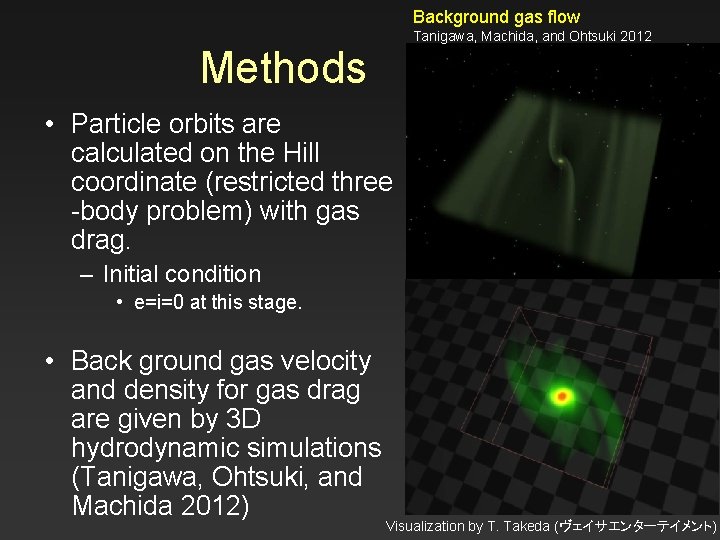
Background gas flow Tanigawa, Machida, and Ohtsuki 2012 Methods • Particle orbits are calculated on the Hill coordinate (restricted three -body problem) with gas drag. – Initial condition • e=i=0 at this stage. • Back ground gas velocity and density for gas drag are given by 3 D hydrodynamic simulations (Tanigawa, Ohtsuki, and Machida 2012) Visualization by T. Takeda (ヴェイサエンターテイメント)
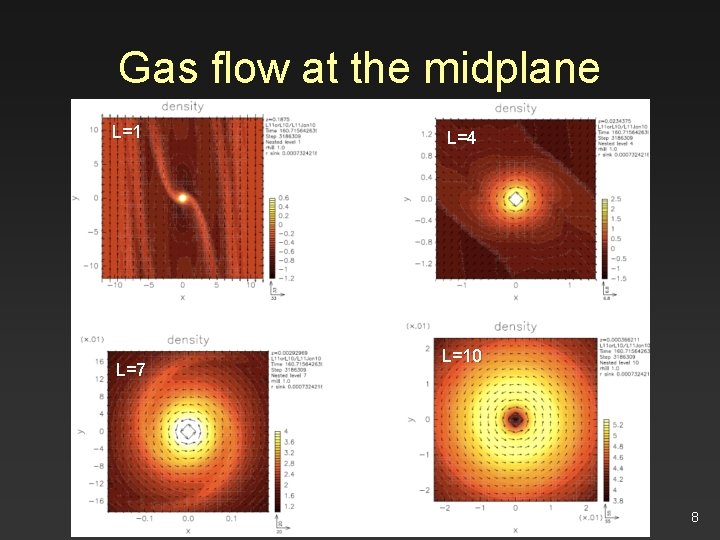
Gas flow at the midplane L=1 L=7 L=4 L=10 8
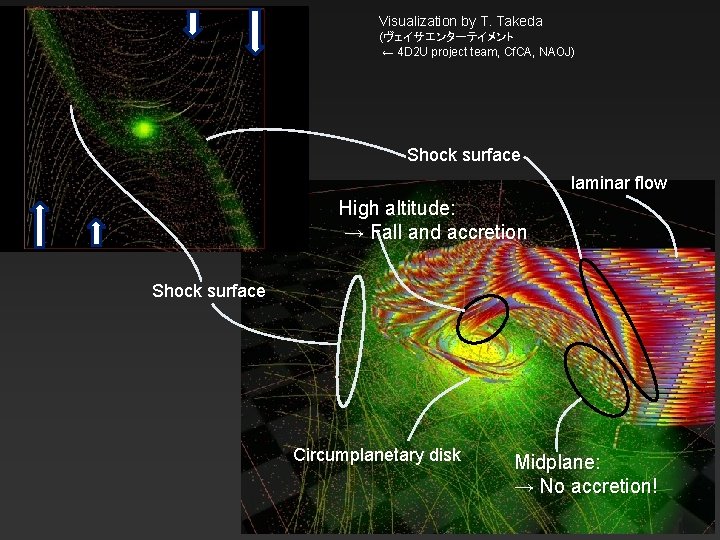
Visualization by T. Takeda (ヴェイサエンターテイメント ← 4 D 2 U project team, Cf. CA, NAOJ) Shock surface laminar flow High altitude: → Fall and accretion Shock surface Circumplanetary disk Midplane: → No accretion! 9
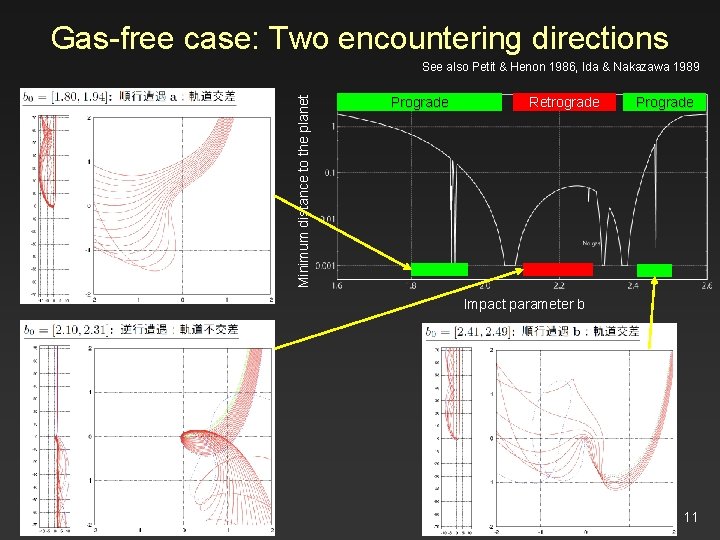
Gas-free case: Two encountering directions Minimum distance to the planet See also Petit & Henon 1986, Ida & Nakazawa 1989 Prograde Retrograde Prograde Impact parameter b 11
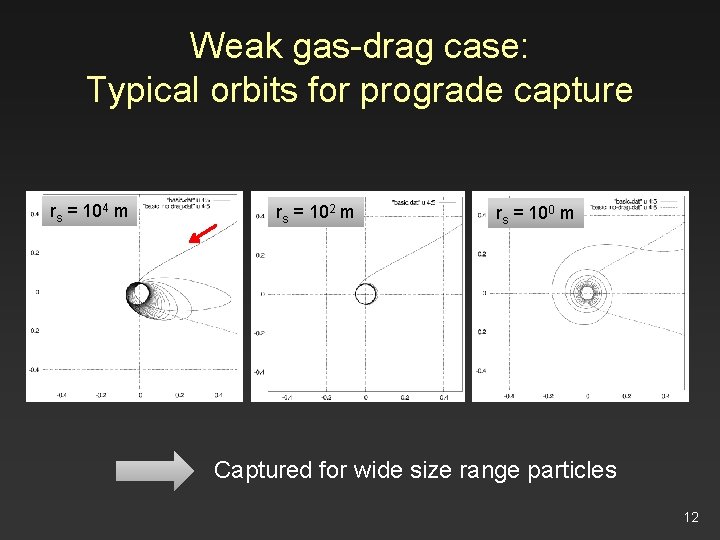
Weak gas-drag case: Typical orbits for prograde capture rs = 104 m rs = 102 m rs = 100 m Captured for wide size range particles 12
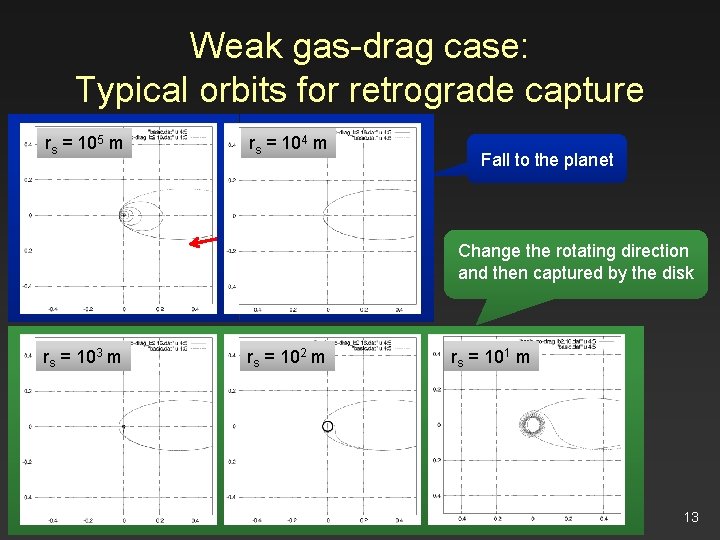
Weak gas-drag case: Typical orbits for retrograde capture rs = 105 m rs = 104 m Fall to the planet Change the rotating direction and then captured by the disk rs = 103 m rs = 102 m rs = 101 m 13
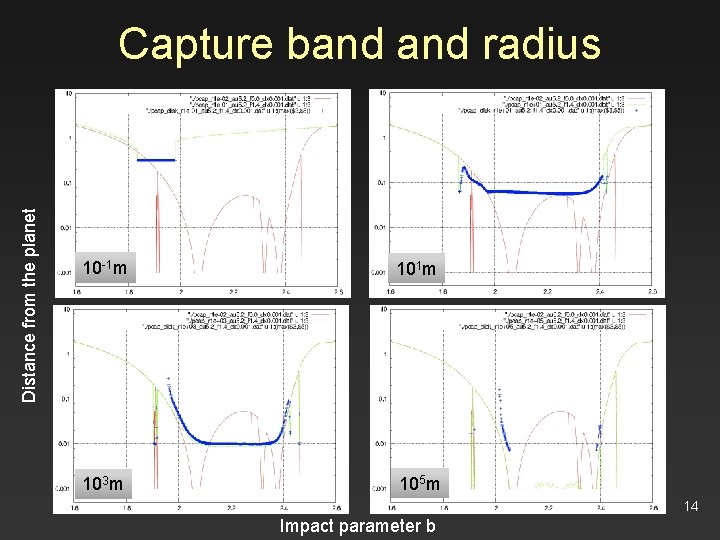
Distance from the planet Capture band radius 10 -1 m 103 m 105 m 14 Impact parameter b
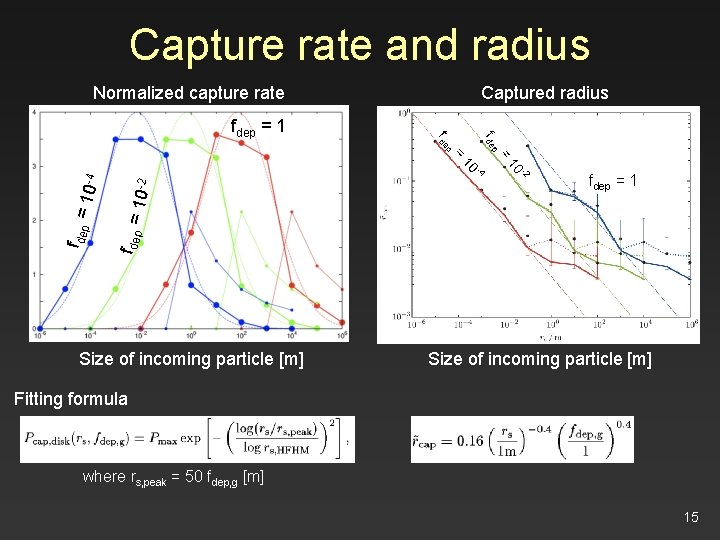
Capture rate and radius Captured radius Normalized capture rate f dep p f de fdep = 1 = = fde = p 10 -2 fde = p 10 -4 -2 10 -4 10 Size of incoming particle [m] fdep = 1 Size of incoming particle [m] Fitting formula where rs, peak = 50 fdep, g [m] 15
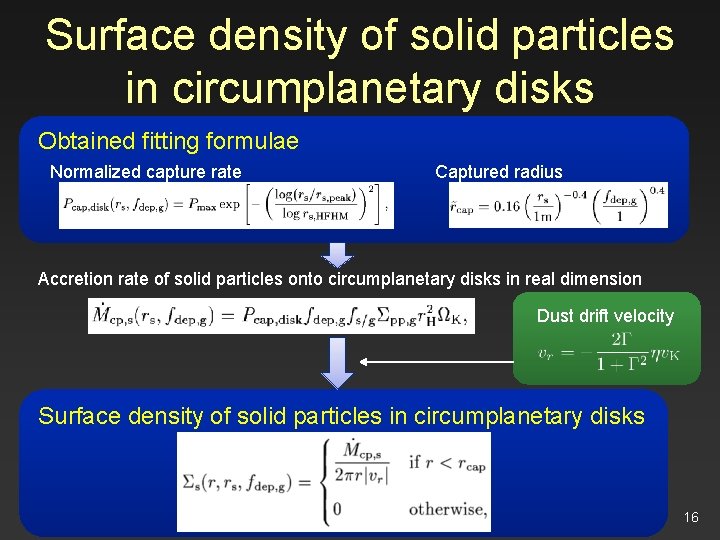
Surface density of solid particles in circumplanetary disks Obtained fitting formulae Normalized capture rate Captured radius Accretion rate of solid particles onto circumplanetary disks in real dimension Dust drift velocity Surface density of solid particles in circumplanetary disks 16
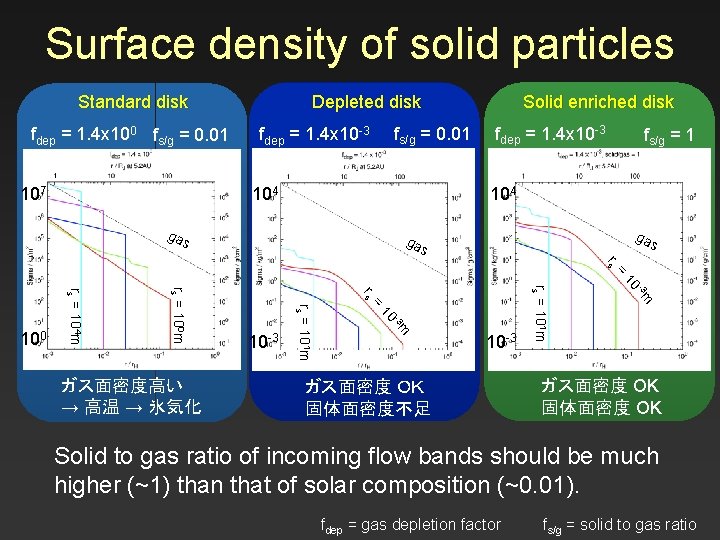
Surface density of solid particles Standard disk fdep = 1. 4 x 100 fs/g = 0. 01 107 Depleted disk fs/g = 0. 01 fdep = 1. 4 x 10 -3 104 Solid enriched disk fdep = 1. 4 x 10 -3 fs/g = 1 104 ga s rs = -3 m -3 10 m ガス面密度 OK 固体面密度不足 10 = 10 -3 rs = 101 m rs ガス面密度高い → 高温 → 氷気化 10 -3 rs = 101 m rs = 100 m rs = 104 m 100 ガス面密度 OK 固体面密度 OK Solid to gas ratio of incoming flow bands should be much higher (~1) than that of solar composition (~0. 01). fdep = gas depletion factor fs/g = solid to gas ratio
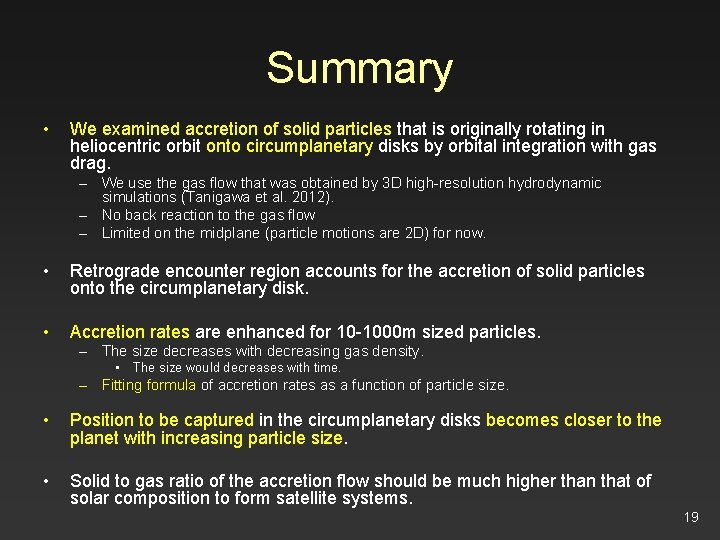
Summary • We examined accretion of solid particles that is originally rotating in heliocentric orbit onto circumplanetary disks by orbital integration with gas drag. – We use the gas flow that was obtained by 3 D high-resolution hydrodynamic simulations (Tanigawa et al. 2012). – No back reaction to the gas flow – Limited on the midplane (particle motions are 2 D) for now. • Retrograde encounter region accounts for the accretion of solid particles onto the circumplanetary disk. • Accretion rates are enhanced for 10 -1000 m sized particles. – The size decreases with decreasing gas density. • The size would decreases with time. – Fitting formula of accretion rates as a function of particle size. • Position to be captured in the circumplanetary disks becomes closer to the planet with increasing particle size. • Solid to gas ratio of the accretion flow should be much higher than that of solar composition to form satellite systems. 19