
Formation of Employment Adjustment System and Japanese Society
- Slides: 11
Formation of Employment Adjustment System and Japanese Society § Japanese Society = Stable – True, but ! – We need to answer to question “How it can be possible? How it can be stable? ” – The answer is Japanese society has a dynamics inside as a precondition to be stable. § Japanese Employment System – Seniority, Company-union and Lifetime-employment →“A Stable system” § My thought – “Stable” employment system in Japan →It was formed after paid cost of “employment adjustment” 2
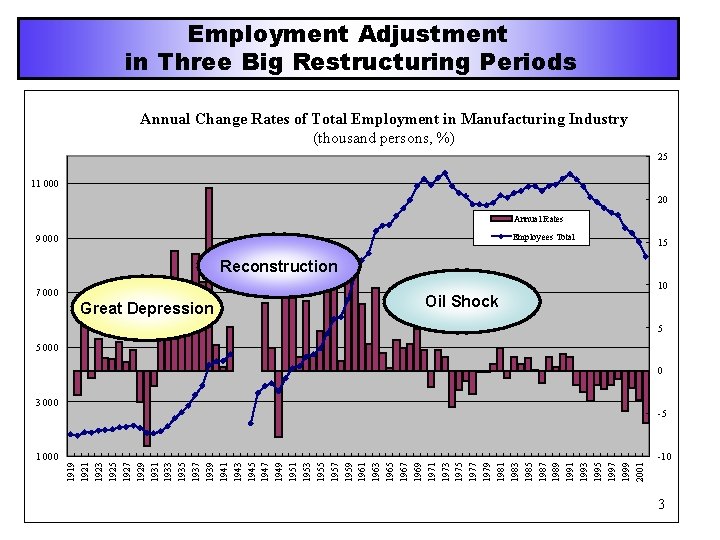
Employment Adjustment in Three Big Restructuring Periods Annual Change Rates of Total Employment in Manufacturing Industry (thousand persons, %) 25 11 000 20 Annual Rates Employees Total 9 000 15 Reconstruction 10 7 000 Great Depression Oil Shock 5 5 000 0 3 000 -5 -10 1919 1921 1923 1925 1927 1929 1931 1933 1935 1937 1939 1941 1943 1945 1947 1949 1951 1953 1955 1957 1959 1961 1963 1965 1967 1969 1971 1973 1975 1977 1979 1981 1983 1985 1987 1989 1991 1993 1995 1997 1999 2001 1 000 3
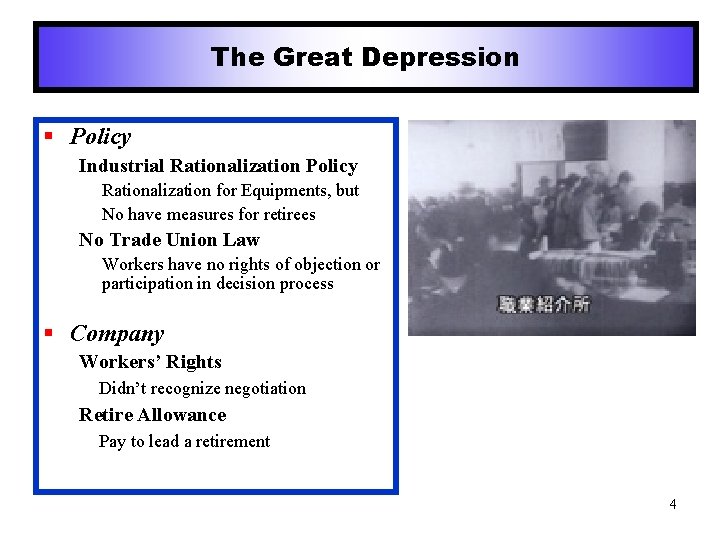
The Great Depression § Policy Industrial Rationalization Policy Rationalization for Equipments, but No have measures for retirees No Trade Union Law Workers have no rights of objection or participation in decision process § Company Workers’ Rights Didn’t recognize negotiation Retire Allowance Pay to lead a retirement 4
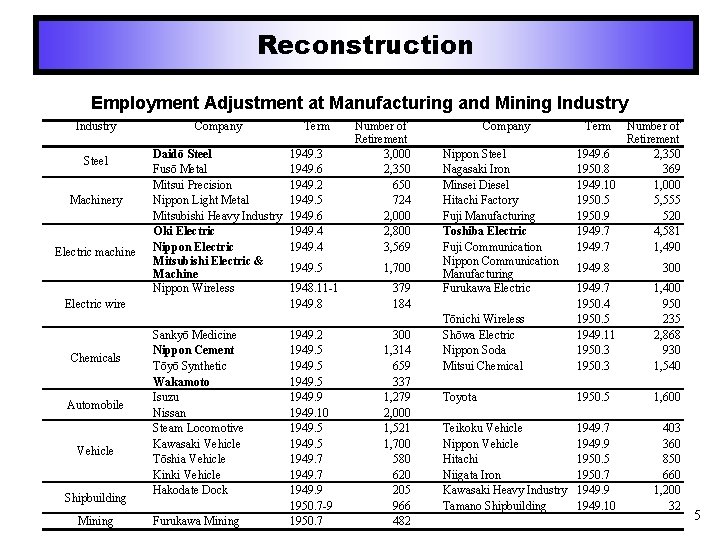
Reconstruction Employment Adjustment at Manufacturing and Mining Industry Steel Machinery Electric machine Company Daidō Steel Fusō Metal Mitsui Precision Nippon Light Metal Mitsubishi Heavy Industry Oki Electric Nippon Electric Mitsubishi Electric & Machine Nippon Wireless Electric wire Chemicals Automobile Vehicle Shipbuilding Mining Sankyō Medicine Nippon Cement Tōyō Synthetic Wakamoto Isuzu Nissan Steam Locomotive Kawasaki Vehicle Tōshia Vehicle Kinki Vehicle Hakodate Dock Furukawa Mining Term 1949. 3 1949. 6 1949. 2 1949. 5 1949. 6 1949. 4 Number of Retirement 3, 000 2, 350 650 724 2, 000 2, 800 3, 569 1949. 5 1, 700 1948. 11 -1 1949. 8 1949. 2 1949. 5 1949. 9 1949. 10 1949. 5 1949. 7 1949. 9 1950. 7 -9 1950. 7 379 184 300 1, 314 659 337 1, 279 2, 000 1, 521 1, 700 580 620 205 966 482 Company Nippon Steel Nagasaki Iron Minsei Diesel Hitachi Factory Fuji Manufacturing Toshiba Electric Fuji Communication Nippon Communication Manufacturing Furukawa Electric Term Number of Retirement 1949. 6 2, 350 1950. 8 369 1949. 10 1, 000 1950. 5 5, 555 1950. 9 520 1949. 7 4, 581 1949. 7 1, 490 1949. 8 300 Tōnichi Wireless Shōwa Electric Nippon Soda Mitsui Chemical 1949. 7 1950. 4 1950. 5 1949. 11 1950. 3 1, 400 950 235 2, 868 930 1, 540 Toyota 1950. 5 1, 600 Teikoku Vehicle Nippon Vehicle Hitachi Niigata Iron Kawasaki Heavy Industry Tamano Shipbuilding 1949. 7 1949. 9 1950. 5 1950. 7 1949. 9 1949. 10 403 360 850 660 1, 200 32 5
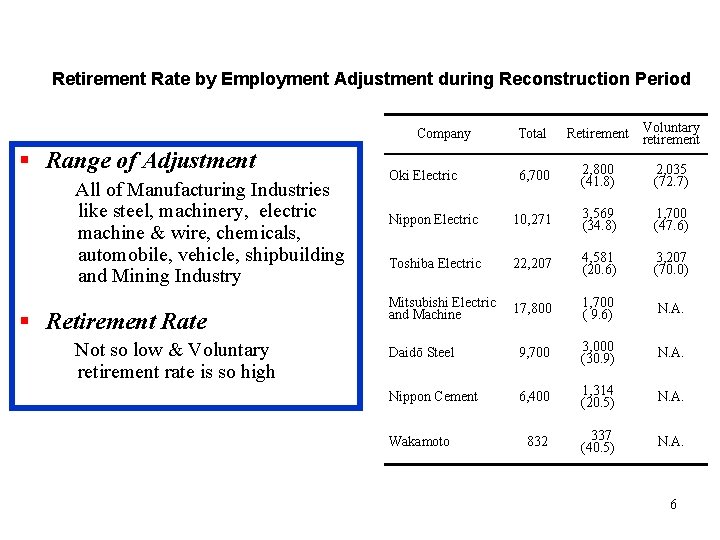
Retirement Rate by Employment Adjustment during Reconstruction Period Company § Range of Adjustment All of Manufacturing Industries like steel, machinery, electric machine & wire, chemicals, automobile, vehicle, shipbuilding and Mining Industry § Retirement Rate Not so low & Voluntary retirement rate is so high Total Voluntary Retirement retirement 6, 700 2, 800 (41. 8) 2, 035 (72. 7) Nippon Electric 10, 271 3, 569 (34. 8) 1, 700 (47. 6) Toshiba Electric 22, 207 4, 581 (20. 6) 3, 207 (70. 0) Mitsubishi Electric and Machine 17, 800 1, 700 ( 9. 6) N. A. Daidō Steel 9, 700 3, 000 (30. 9) N. A. Nippon Cement 6, 400 1, 314 (20. 5) N. A. 832 337 (40. 5) N. A. Oki Electric Wakamoto 6
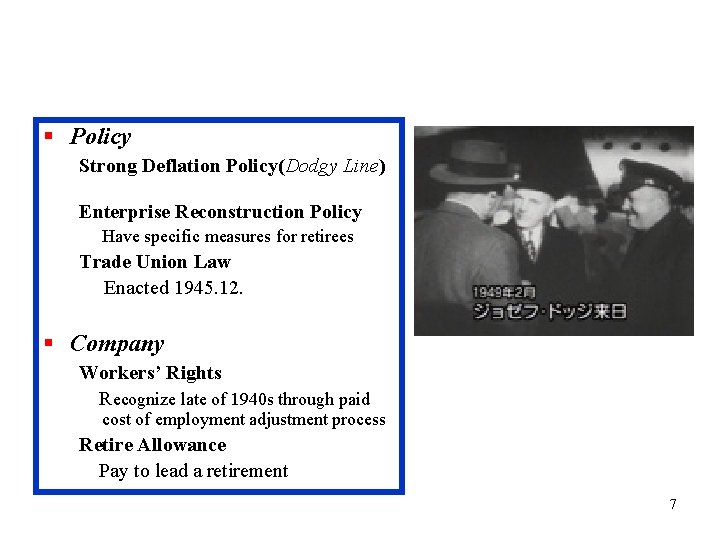
§ Policy Strong Deflation Policy(Dodgy Line) Enterprise Reconstruction Policy Have specific measures for retirees Trade Union Law Enacted 1945. 12. § Company Workers’ Rights Recognize late of 1940 s through paid cost of employment adjustment process Retire Allowance Pay to lead a retirement 7
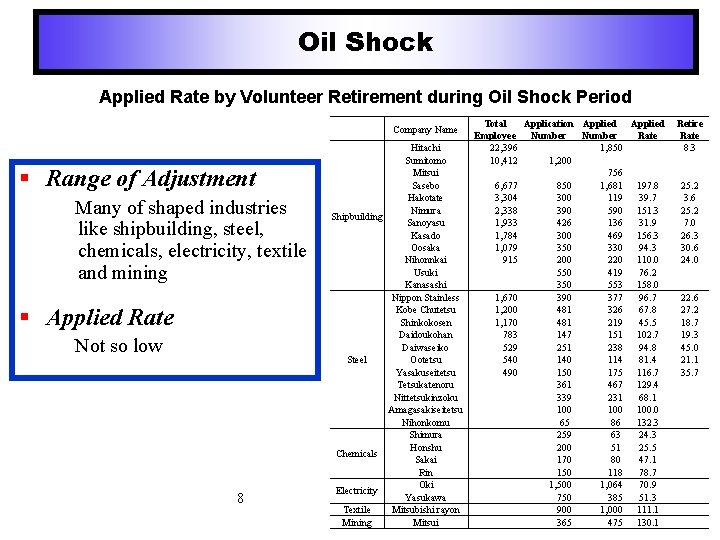
Oil Shock Applied Rate by Volunteer Retirement during Oil Shock Period Company Name § Range of Adjustment Many of shaped industries like shipbuilding, steel, chemicals, electricity, textile and mining § Applied Rate Not so low 8 Hitachi Sumitomo Mitsui Sasebo Hakotate Nimura Shipbuilding Sanoyasu Kasado Oosaka Nihonnkai Usuki Kanasashi Nippon Stainless Kobe Chutetsu Shinkokosen Daidoukohan Daiwaseiko Steel Ootetsu Yasakuseitetsu Tetsukatenoru Nittetsukinzoku Amagasakiseitetsu Nihonkomu Shimura Honshu Chemicals Sakai Rin Oki Electricity Yasukawa Textile Mitsubishi rayon Mining Mitsui Total Application Applied Employee Number Rate 22, 396 1, 850 10, 412 1, 200 756 6, 677 850 1, 681 197. 8 3, 304 300 119 39. 7 2, 338 390 590 151. 3 1, 933 426 136 31. 9 1, 784 300 469 156. 3 1, 079 350 330 94. 3 915 200 220 110. 0 550 419 76. 2 350 553 158. 0 1, 670 390 377 96. 7 1, 200 481 326 67. 8 1, 170 481 219 45. 5 783 147 151 102. 7 529 251 238 94. 8 540 114 81. 4 490 150 175 116. 7 361 467 129. 4 339 231 68. 1 100 100. 0 65 86 132. 3 259 63 24. 3 200 51 25. 5 170 80 47. 1 150 118 78. 7 1, 500 1, 064 70. 9 750 385 51. 3 900 1, 000 111. 1 365 475 130. 1 Retire Rate 8. 3 25. 2 3. 6 25. 2 7. 0 26. 3 30. 6 24. 0 22. 6 27. 2 18. 7 19. 3 45. 0 21. 1 35. 7
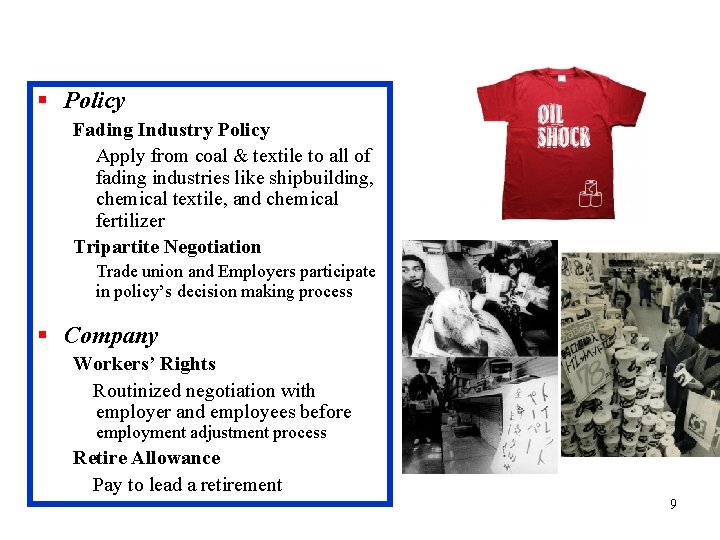
§ Policy Fading Industry Policy Apply from coal & textile to all of fading industries like shipbuilding, chemical textile, and chemical fertilizer Tripartite Negotiation Trade union and Employers participate in policy’s decision making process § Company Workers’ Rights Routinized negotiation with employer and employees before employment adjustment process Retire Allowance Pay to lead a retirement 9
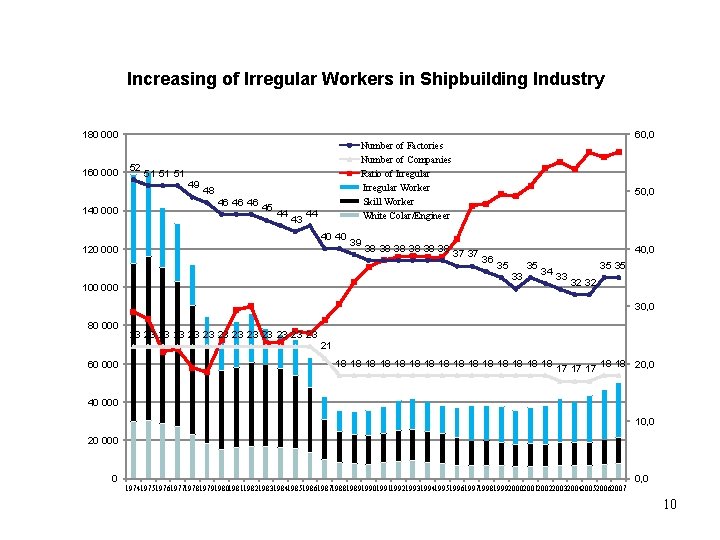
Increasing of Irregular Workers in Shipbuilding Industry 180 000 160 000 60, 0 52 51 51 51 49 140 000 Number of Factories Number of Companies Ratio of Irregular Worker Skill Worker White Colar/Engineer 48 46 46 46 45 44 43 44 40 40 120 000 39 38 38 38 50, 0 37 37 36 40, 0 35 35 33 100 000 34 35 35 33 32 32 30, 0 80 000 23 23 23 23 21 60 000 18 18 18 18 17 17 17 18 18 20, 0 40 000 10, 0 20 000 0 1974197519761977197819791980198119821983198419851986198719881989199019911992199319941995199619971998199920002001200220032004200520062007 0, 0 10
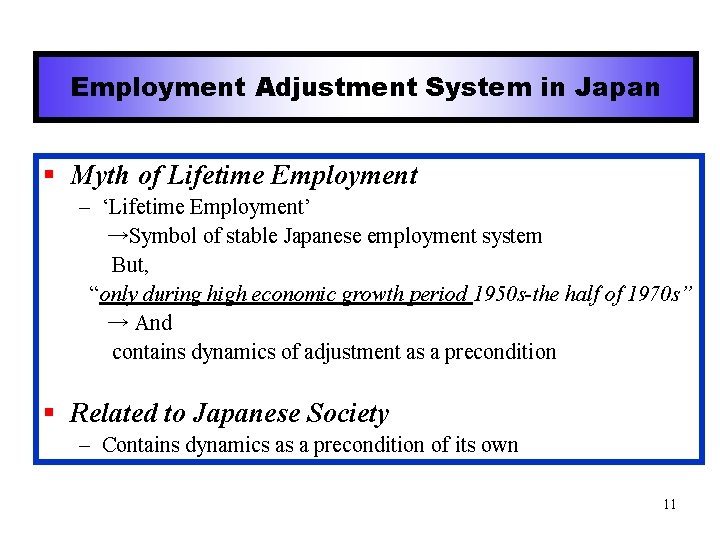
Employment Adjustment System in Japan § Myth of Lifetime Employment – ‘Lifetime Employment’ →Symbol of stable Japanese employment system But, “only during high economic growth period 1950 s-the half of 1970 s” → And contains dynamics of adjustment as a precondition § Related to Japanese Society – Contains dynamics as a precondition of its own 11