
FORMATION EXPLORATION AND EXTRACTION OF THE CANADIAN TAR
- Slides: 1
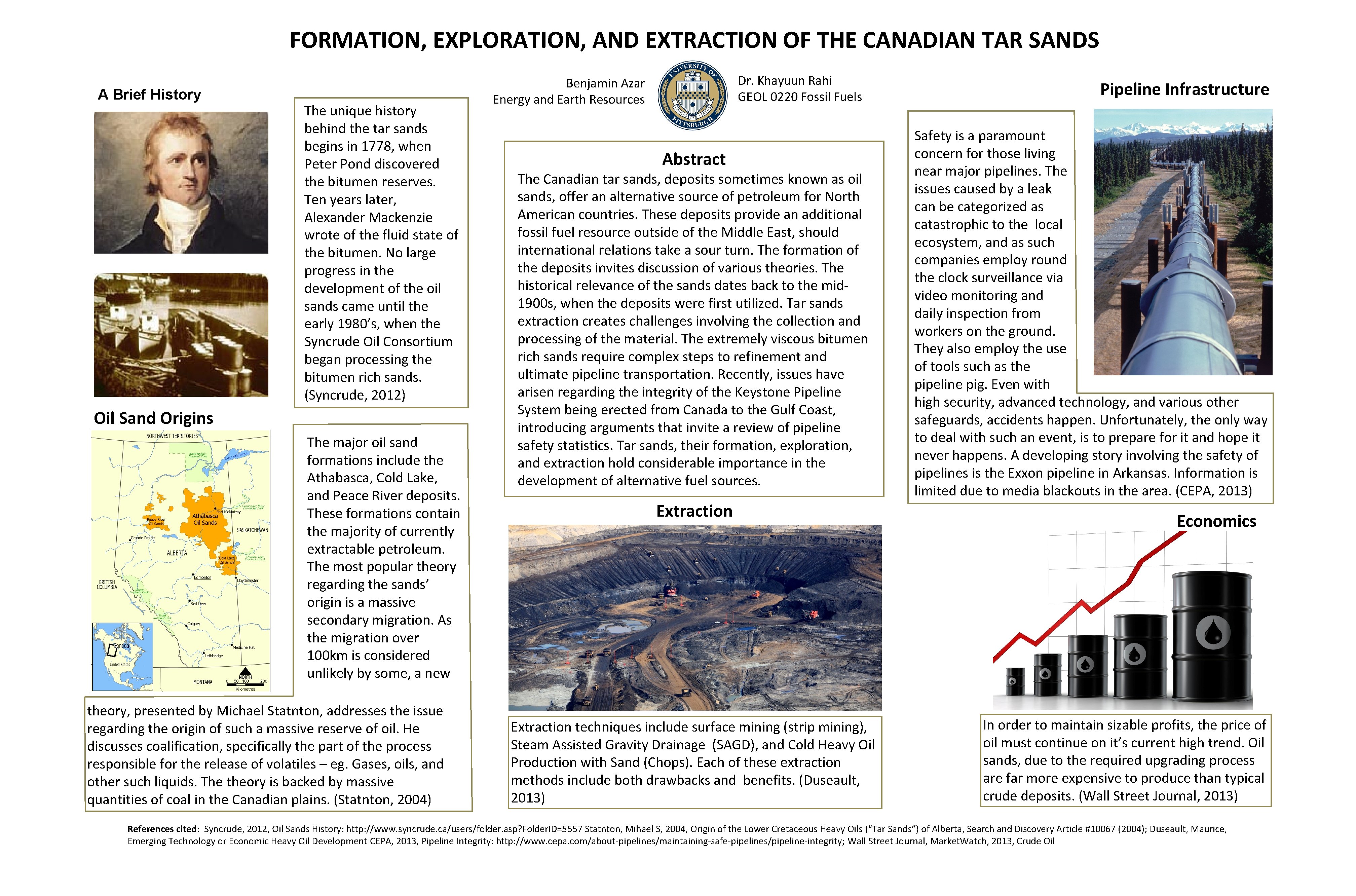
FORMATION, EXPLORATION, AND EXTRACTION OF THE CANADIAN TAR SANDS A Brief History The unique history behind the tar sands begins in 1778, when Peter Pond discovered the bitumen reserves. Ten years later, Alexander Mackenzie wrote of the fluid state of the bitumen. No large progress in the development of the oil sands came until the early 1980’s, when the Syncrude Oil Consortium began processing the bitumen rich sands. (Syncrude, 2012) Oil Sand Origins The major oil sand formations include the Athabasca, Cold Lake, and Peace River deposits. These formations contain the majority of currently extractable petroleum. The most popular theory regarding the sands’ origin is a massive secondary migration. As the migration over 100 km is considered unlikely by some, a new theory, presented by Michael Statnton, addresses the issue regarding the origin of such a massive reserve of oil. He discusses coalification, specifically the part of the process responsible for the release of volatiles – eg. Gases, oils, and other such liquids. The theory is backed by massive quantities of coal in the Canadian plains. (Statnton, 2004) Dr. Khayuun Rahi GEOL 0220 Fossil Fuels Benjamin Azar Energy and Earth Resources Abstract The Canadian tar sands, deposits sometimes known as oil sands, offer an alternative source of petroleum for North American countries. These deposits provide an additional fossil fuel resource outside of the Middle East, should international relations take a sour turn. The formation of the deposits invites discussion of various theories. The historical relevance of the sands dates back to the mid 1900 s, when the deposits were first utilized. Tar sands extraction creates challenges involving the collection and processing of the material. The extremely viscous bitumen rich sands require complex steps to refinement and ultimate pipeline transportation. Recently, issues have arisen regarding the integrity of the Keystone Pipeline System being erected from Canada to the Gulf Coast, introducing arguments that invite a review of pipeline safety statistics. Tar sands, their formation, exploration, and extraction hold considerable importance in the development of alternative fuel sources. Extraction techniques include surface mining (strip mining), Steam Assisted Gravity Drainage (SAGD), and Cold Heavy Oil Production with Sand (Chops). Each of these extraction methods include both drawbacks and benefits. (Duseault, 2013) Pipeline Infrastructure Safety is a paramount concern for those living near major pipelines. The issues caused by a leak can be categorized as catastrophic to the local ecosystem, and as such companies employ round the clock surveillance via video monitoring and daily inspection from workers on the ground. They also employ the use of tools such as the pipeline pig. Even with high security, advanced technology, and various other safeguards, accidents happen. Unfortunately, the only way to deal with such an event, is to prepare for it and hope it never happens. A developing story involving the safety of pipelines is the Exxon pipeline in Arkansas. Information is limited due to media blackouts in the area. (CEPA, 2013) Economics In order to maintain sizable profits, the price of oil must continue on it’s current high trend. Oil sands, due to the required upgrading process are far more expensive to produce than typical crude deposits. (Wall Street Journal, 2013) References cited: Syncrude, 2012, Oil Sands History: http: //www. syncrude. ca/users/folder. asp? Folder. ID=5657 Statnton, Mihael S, 2004, Origin of the Lower Cretaceous Heavy Oils (“Tar Sands”) of Alberta, Search and Discovery Article #10067 (2004); Duseault, Maurice, Emerging Technology or Economic Heavy Oil Development CEPA, 2013, Pipeline Integrity: http: //www. cepa. com/about-pipelines/maintaining-safe-pipelines/pipeline-integrity; Wall Street Journal, Market. Watch, 2013, Crude Oil