
FORMATION AND EVOLUTION OF EARLY TYPE GALAXIES Hierarchical


- Slides: 59
FORMATION AND EVOLUTION OF EARLY TYPE GALAXIES: Hierarchical or Monolithic? Cesare Chiosi C Department of Physics & Astronomy “Galileo Galilei” University of Padova, Italy Castiglione della Pescaia 16 -20 September, 2013 1
…. and collaborators Umberto Buonomo Giovanni Carraro Letizia Cassara’ Tommaso Grassi Emiliano Merlin Cesario Lia Stefano Pasetto Lorenzo Piovan Rosaria Tantalo 2
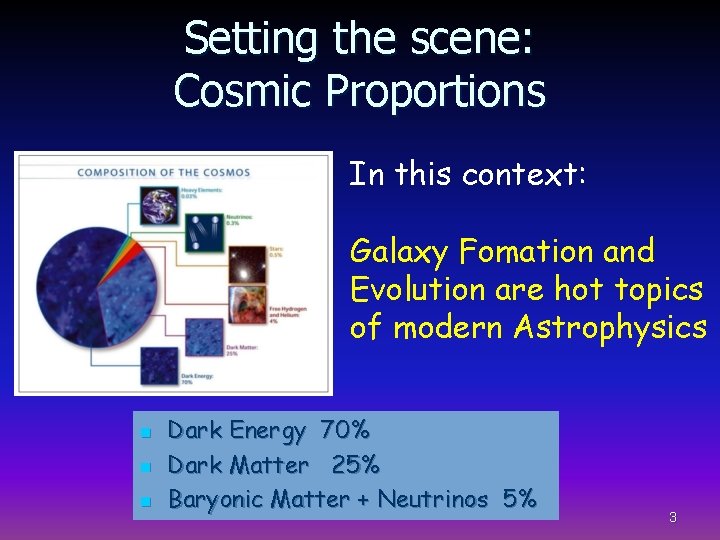
Setting the scene: Cosmic Proportions In this context: Galaxy Fomation and Evolution are hot topics of modern Astrophysics n n n Dark Energy 70% Dark Matter 25% Baryonic Matter + Neutrinos 5% 3
Classical Paradigm of Galaxy Formation (ETGs, in particular) n Cosmological Model of the Universe q Dark Energy + Dark Matter + Baryonic Matter (& Neutrinos) q Hierarchical Clustering of Dark Matter q q Hierarchical mergers of DM+BM haloes to form “visible” galaxies all over the Hubble time Massive galaxies are the end product of repeated mergers and are in place only at recent times. But data do not exactly tell this and …. . 4
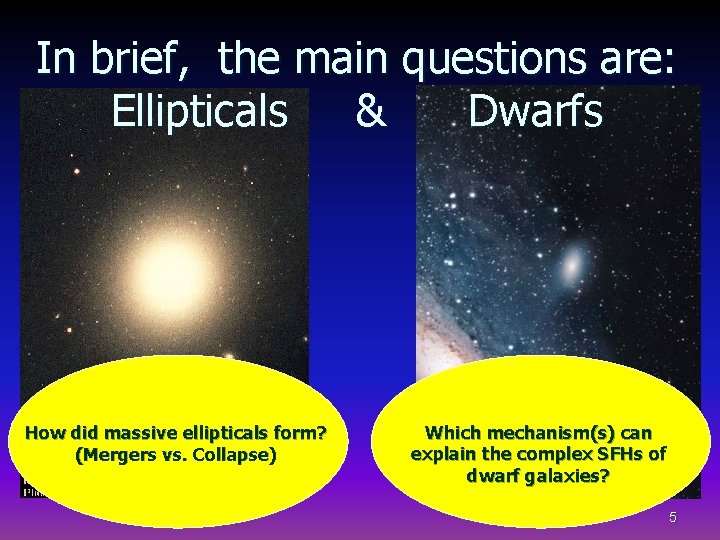
In brief, the main questions are: Ellipticals & Dwarfs How did massive ellipticals form? (Mergers vs. Collapse) Which mechanism(s) can explain the complex SFHs of dwarf galaxies? 5
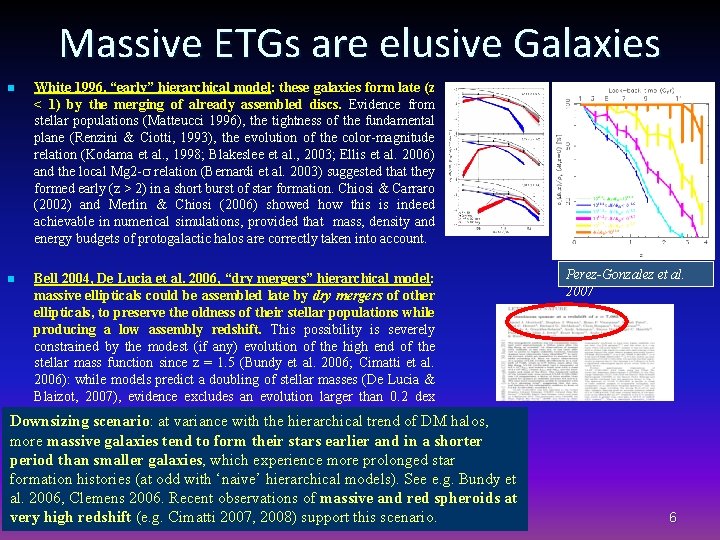
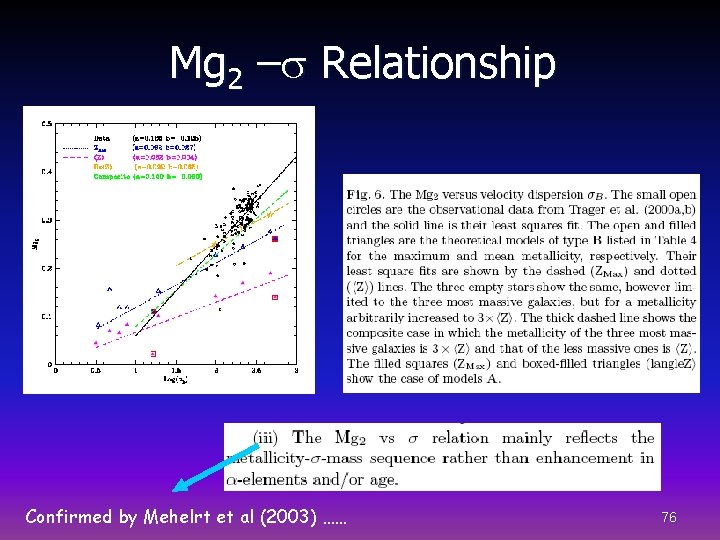
Massive ETGs are elusive Galaxies n White 1996, “early” hierarchical model: these galaxies form late (z < 1) by the merging of already assembled discs. Evidence from stellar populations (Matteucci 1996), the tightness of the fundamental plane (Renzini & Ciotti, 1993), the evolution of the color-magnitude relation (Kodama et al. , 1998; Blakeslee et al. , 2003; Ellis et al. 2006) and the local Mg 2 - relation (Bernardi et al. 2003) suggested that they formed early (z > 2) in a short burst of star formation. Chiosi & Carraro (2002) and Merlin & Chiosi (2006) showed how this is indeed achievable in numerical simulations, provided that mass, density and energy budgets of protogalactic halos are correctly taken into account. n Bell 2004, De Lucia et al. 2006, “dry mergers” hierarchical model: massive ellipticals could be assembled late by dry mergers of other ellipticals, to preserve the oldness of their stellar populations while producing a low assembly redshift. This possibility is severely constrained by the modest (if any) evolution of the high end of the stellar mass function since z = 1. 5 (Bundy et al. 2006; Cimatti et al. 2006): while models predict a doubling of stellar masses (De Lucia & Blaizot, 2007), evidence excludes an evolution larger than 0. 2 dex (Monaco et al. 2006). Downsizing scenario: at variance with the hierarchical trend of DM halos, more massive galaxies tend to form their stars earlier and in a shorter period than smaller galaxies, which experience more prolonged star formation histories (at odd with ‘naive’ hierarchical models). See e. g. Bundy et al. 2006, Clemens 2006. Recent observations of massive and red spheroids at very high redshift (e. g. Cimatti 2007, 2008) support this scenario. Perez-Gonzalez et al. 2007 6
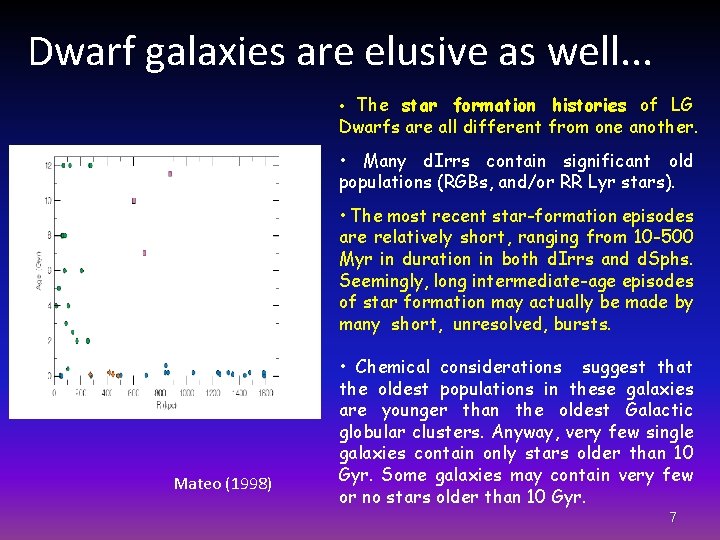
Dwarf galaxies are elusive as well. . . • The star formation histories of LG Dwarfs are all different from one another. • Many d. Irrs contain significant old populations (RGBs, and/or RR Lyr stars). • The most recent star-formation episodes are relatively short, ranging from 10 -500 Myr in duration in both d. Irrs and d. Sphs. Seemingly, long intermediate-age episodes of star formation may actually be made by many short, unresolved, bursts. Mateo (1998) • Chemical considerations suggest that the oldest populations in these galaxies are younger than the oldest Galactic globular clusters. Anyway, very few single galaxies contain only stars older than 10 Gyr. Some galaxies may contain very few or no stars older than 10 Gyr. 7
So…current scenarios are n n Hierarchical: massive ETGs are the end product of subsequent mergers of smaller sub-units over time scales almost equal to the Hubble time. Dry Mergers: fusion of gas-free galaxies to avoid star formation. Wet Mergers: the same but with some stellar activity. Monolithic: ETGs form at high redshift by rapid collapse and undergo a single, prominent star formation episode, ever since followed by quiescence. Revised Monolithic: a great deal of the stars in massive ETGs are formed very early-on at high redshifts and the remaining ones at lower redshifts. 8
Hierarchical or Monolithic ? For long time the preference has gone to the hierarchical scheme that was considered the reference frame for any theory of ETGs formation (the massive ones in particular). The success of this theory is mainly due to the achievements obtained in modelling the large scale gravitational structures of the Universe (filamentary structure, galaxy groups and clusters). However its extension to individual galaxies has never been validated by solid independent arguments. Because of it, the potential capability of the monolithiclike mode has not been fully explored. We intend to show here that this latter scheme works equally well, if not better. 9
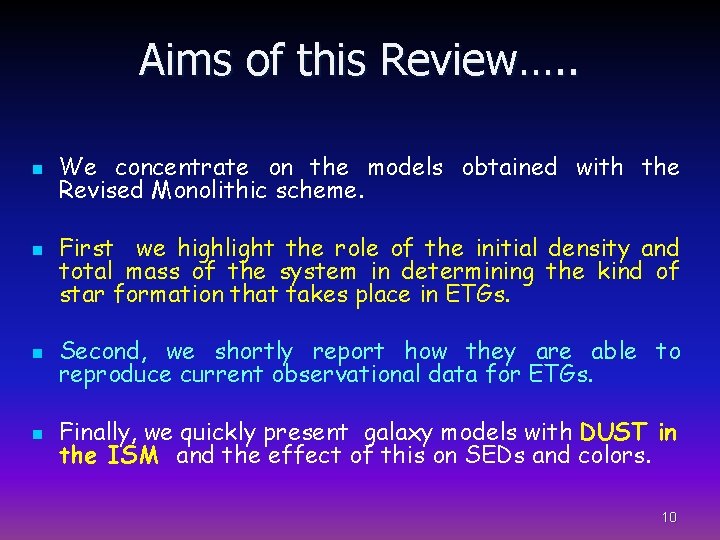
Aims of this Review…. . n n We concentrate on the models obtained with the Revised Monolithic scheme. First we highlight the role of the initial density and total mass of the system in determining the kind of star formation that takes place in ETGs. n Second, we shortly report how they are able to reproduce current observational data for ETGs. n Finally, we quickly present galaxy models with DUST in the ISM and the effect of this on SEDs and colors. 10
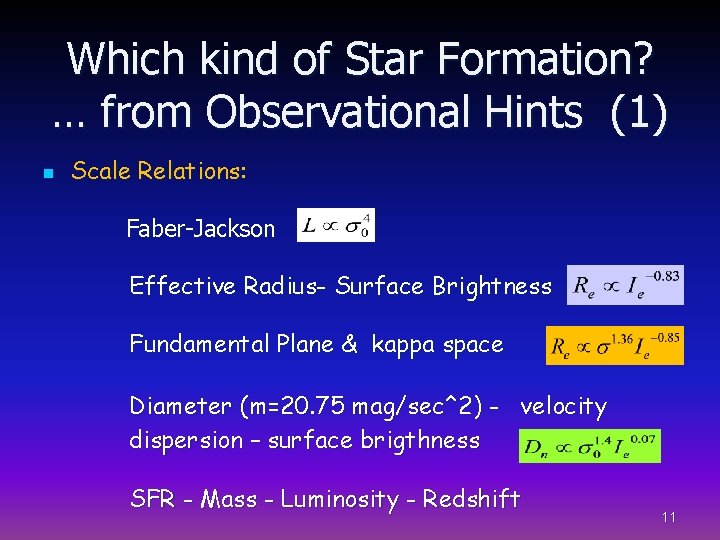
Which kind of Star Formation? … from Observational Hints (1) n Scale Relations: Faber-Jackson Effective Radius- Surface Brightness Fundamental Plane & kappa space Diameter (m=20. 75 mag/sec^2) - velocity dispersion – surface brigthness SFR - Mass - Luminosity - Redshift 11
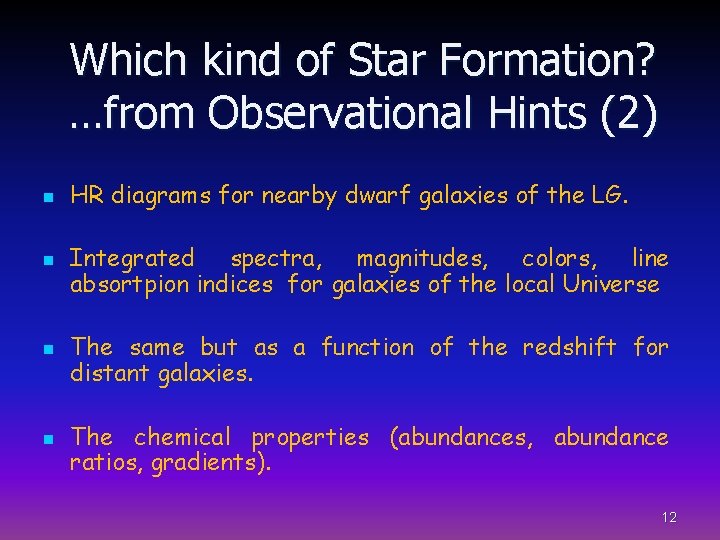
Which kind of Star Formation? …from Observational Hints (2) n n HR diagrams for nearby dwarf galaxies of the LG. Integrated spectra, magnitudes, colors, line absortpion indices for galaxies of the local Universe The same but as a function of the redshift for distant galaxies. The chemical properties (abundances, abundance ratios, gradients). 12
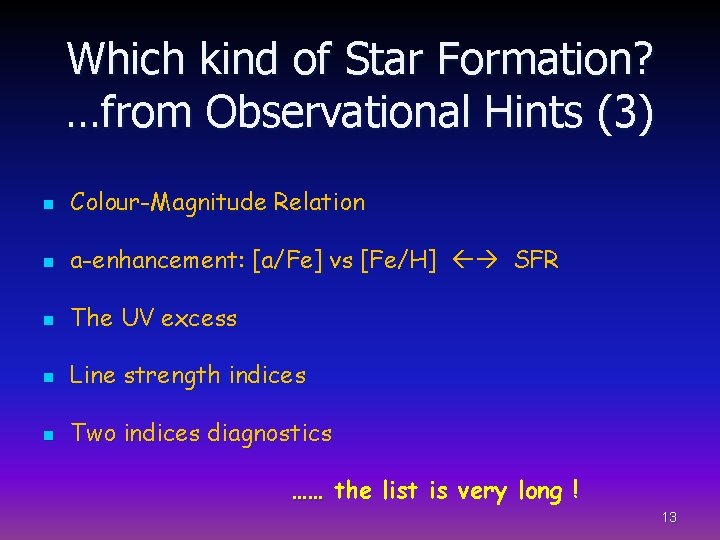
Which kind of Star Formation? …from Observational Hints (3) n Colour-Magnitude Relation n a-enhancement: [a/Fe] vs [Fe/H] SFR n The UV excess n Line strength indices n Two indices diagnostics …… the list is very long ! 13
It follows that …. . n n n Over the years, all the topics mentioned above have been extensively investigated to conclude that: In some way the kind of SF occurring in ETGs depends on their mass and density (which one? ). It is early, short and intense in massive (and high density) ETGs and long, less efficient, and perhaps in bursts, in the low-mass (and low-density) ones. 14
We would like to address and answer the following questions… q Under which physical conditions either a single prominent episode or several episodes of star formations do occur? q Which model best explains the whole pattern of observational data for ETGs? The hierarchical or the monolithic ? Or a complex combination of the two? q Standard semi-analytical galaxy models are not suited to the aim, because they already contain the answer built in. q The numerical NB-TSPH simulations are the right tool provided they include accurate treatments of important physical processes such as SF, heating by energy deposit, cooling by radiative processes, and chemical enrichment, … suitable initial conditions. . 15
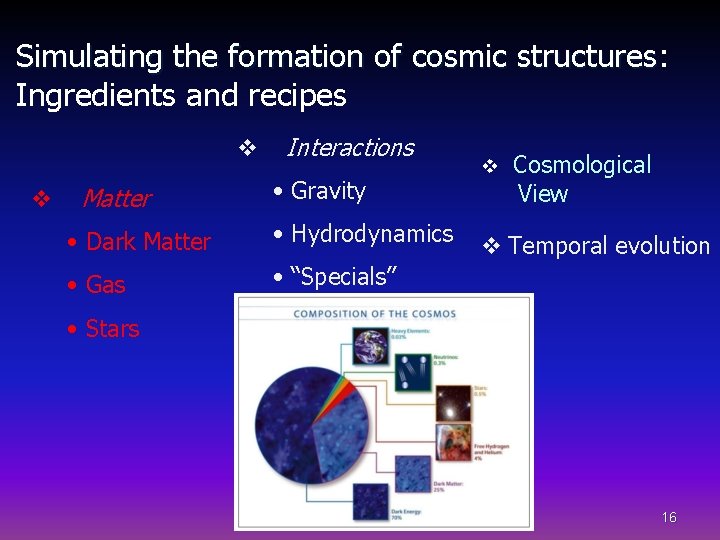
Simulating the formation of cosmic structures: structures Ingredients and recipes v v Matter Interactions • Gravity • Dark Matter • Hydrodynamics • Gas • “Specials” v Cosmological View v Temporal evolution • Stars 16
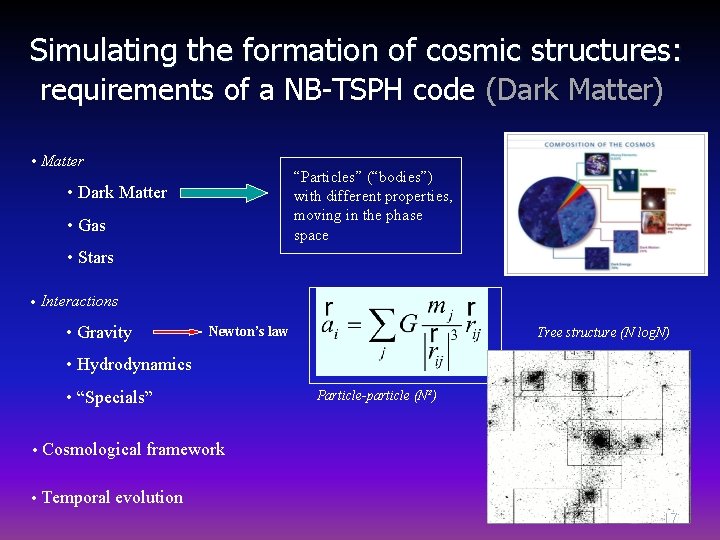
Simulating the formation of cosmic structures: requirements of a NB-TSPH code (Dark Matter) • Matter “Particles” (“bodies”) with different properties, moving in the phase space • Dark Matter • Gas • Stars • Interactions • Gravity Newton’s law Tree structure (N log. N) • Hydrodynamics • “Specials” Particle-particle (N²) • Cosmological framework • Temporal evolution 17
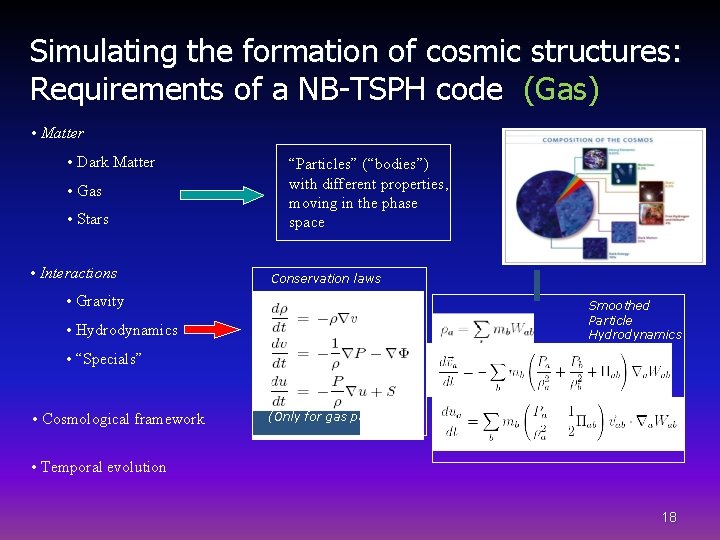
Simulating the formation of cosmic structures: Requirements of a NB-TSPH code (Gas) • Matter • Dark Matter • Gas • Stars • Interactions “Particles” (“bodies”) with different properties, moving in the phase space Conservation laws • Gravity Smoothed Particle Hydrodynamics • Hydrodynamics • “Specials” • Cosmological framework (Only for gas particles) • Temporal evolution 18
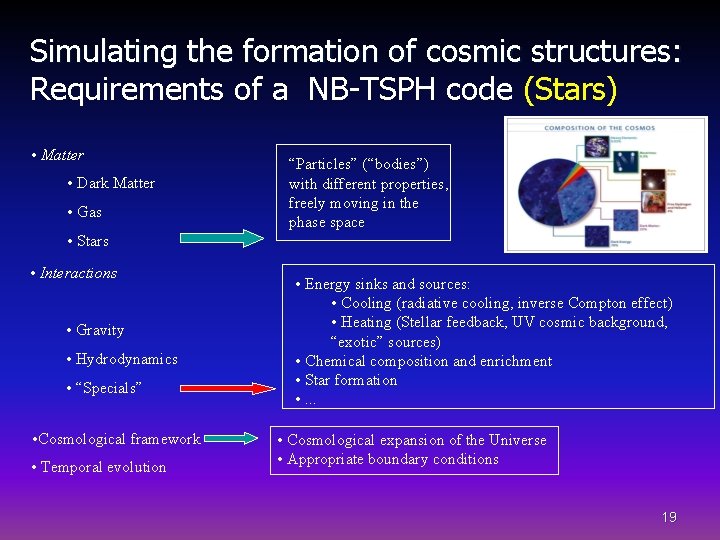
Simulating the formation of cosmic structures: Requirements of a NB-TSPH code (Stars) • Matter • Dark Matter • Gas “Particles” (“bodies”) with different properties, freely moving in the phase space • Stars • Interactions • Gravity • Hydrodynamics • “Specials” • Cosmological framework • Temporal evolution • Energy sinks and sources: • Cooling (radiative cooling, inverse Compton effect) • Heating (Stellar feedback, UV cosmic background, “exotic” sources) • Chemical composition and enrichment • Star formation • . . . • Cosmological expansion of the Universe • Appropriate boundary conditions 19
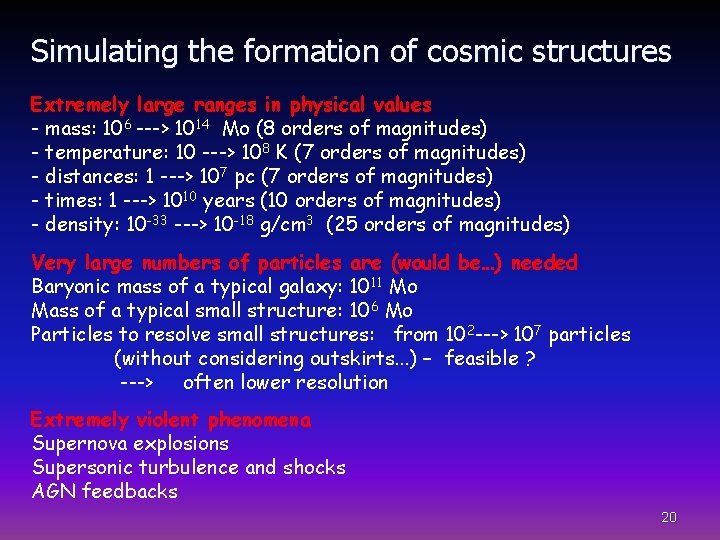
Simulating the formation of cosmic structures Extremely large ranges in physical values - mass: 106 ---> 1014 Mo (8 orders of magnitudes) - temperature: 10 ---> 108 K (7 orders of magnitudes) - distances: 1 ---> 107 pc (7 orders of magnitudes) - times: 1 ---> 1010 years (10 orders of magnitudes) - density: 10 -33 ---> 10 -18 g/cm 3 (25 orders of magnitudes) Very large numbers of particles are (would be…) needed Baryonic mass of a typical galaxy: 1011 Mo Mass of a typical small structure: 106 Mo Particles to resolve small structures: from 10 2 ---> 107 particles (without considering outskirts. . . ) – feasible ? ---> often lower resolution Extremely violent phenomena Supernova explosions Supersonic turbulence and shocks AGN feedbacks 20
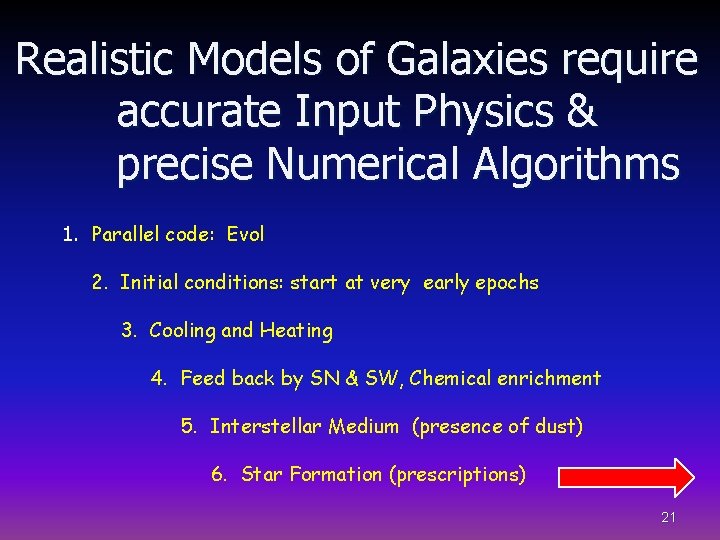
Realistic Models of Galaxies require accurate Input Physics & precise Numerical Algorithms 1. Parallel code: Evol 2. Initial conditions: start at very early epochs 3. Cooling and Heating 4. Feed back by SN & SW, Chemical enrichment 5. Interstellar Medium (presence of dust) 6. Star Formation (prescriptions) 21
7. Gravitational pot 8. Formation Histories (mass and densities) 9. Mass assembling and 3 D structure 10. Stars after assembling 11. Surface and volume mass densities 12. Ages and metals of stars 13. Galactic winds 14. Dust in ISM and photometry 15. Scale Relationships 22
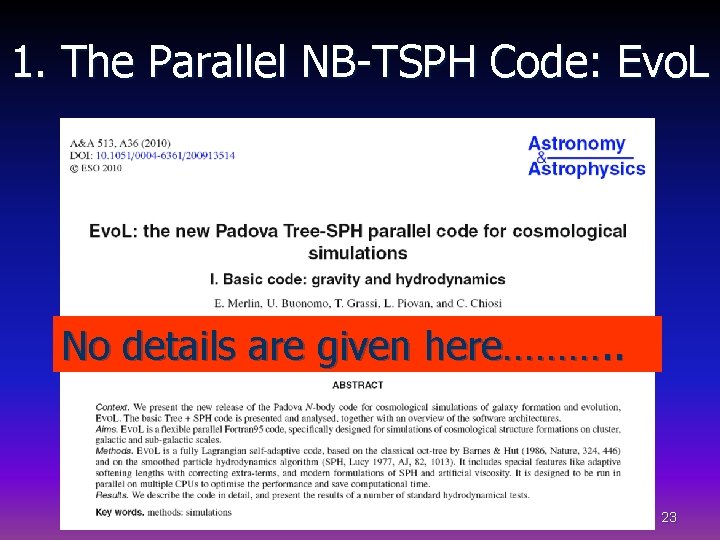
1. The Parallel NB-TSPH Code: Evo. L No details are given here………. . 23
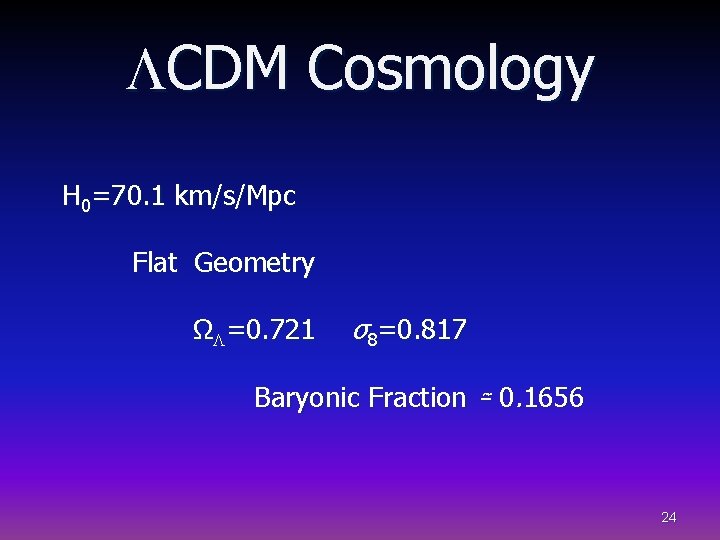
LCDM Cosmology H 0=70. 1 km/s/Mpc Flat Geometry ΩL=0. 721 σ8=0. 817 Baryonic Fraction ≃ 0. 1656 24
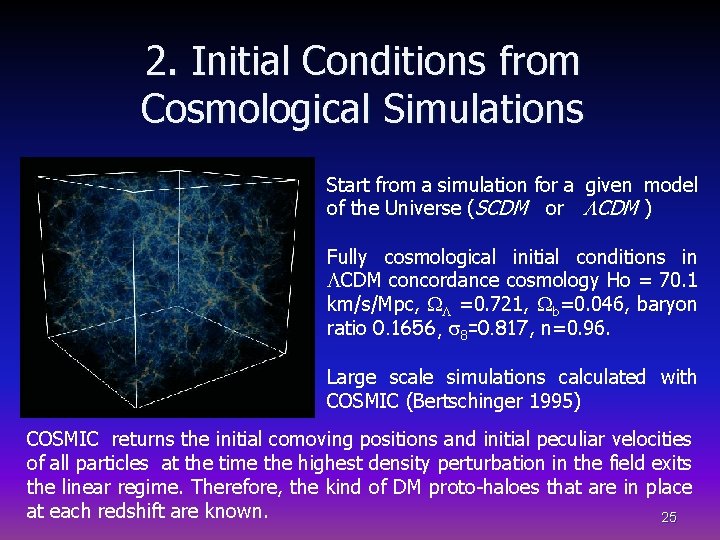
2. Initial Conditions from Cosmological Simulations Start from a simulation for a of the Universe (SCDM or given model LCDM ) Fully cosmological initial conditions in LCDM concordance cosmology Ho = 70. 1 km/s/Mpc, WL =0. 721, Wb=0. 046, baryon ratio 0. 1656, 8=0. 817, n=0. 96. Large scale simulations calculated with COSMIC (Bertschinger 1995) COSMIC returns the initial comoving positions and initial peculiar velocities of all particles at the time the highest density perturbation in the field exits the linear regime. Therefore, the kind of DM proto-haloes that are in place at each redshift are known. 25
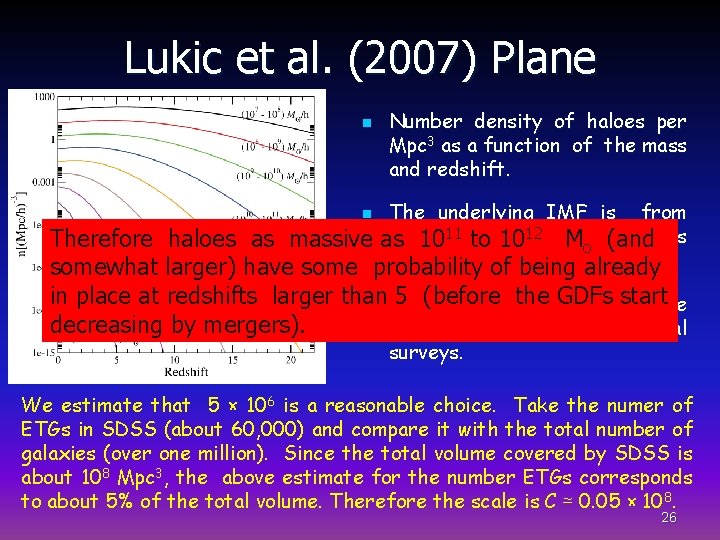
Lukic et al. (2007) Plane n Number density of haloes per Mpc 3 as a function of the mass and redshift. The underlying IMF is from Warren Press as massive as 1011 (2003), to 1012 see Moalso (and & Schechter others. have some probability of and being already n Therefore haloes somewhat larger) in place at redshifts larger than 5 (before theneeded GDFs start n Scale factor is to the decreasing by mergers). volume coverd by typical surveys. We estimate that 5 × 10⁶ is a reasonable choice. Take the numer of ETGs in SDSS (about 60, 000) and compare it with the total number of galaxies (over one million). Since the total volume covered by SDSS is about 108 Mpc 3, the above estimate for the number ETGs corresponds to about 5% of the total volume. Therefore the scale is C ≃ 0. 05 × 108. 26
Initial Conditions n n Instead of searching inside a large scale simulation, the perturbation (proto-halo) best suited to our proposes, we simply suppose that a perturbation of this type is there and derive with COSMIC the position and velocities of the DM+BM particles from a smaller area of the large scale field around the perturbation we are interested in. The box has a size of l=9. 2 comoving Mpc, and is described by grid of 463 particles; impose a constrained density peak to induce a virialized structure at the center of box; impose a gaussian spherical overdensity with average linear density contrast dr/r = b (with b=3, 5, 10) smoothed over a region of 3. 5 comoving Mpc; COSMICS returns the initial comoving positions and peculiar velocities at the moment in which the particle with the highest density is exiting the linear regime. 27
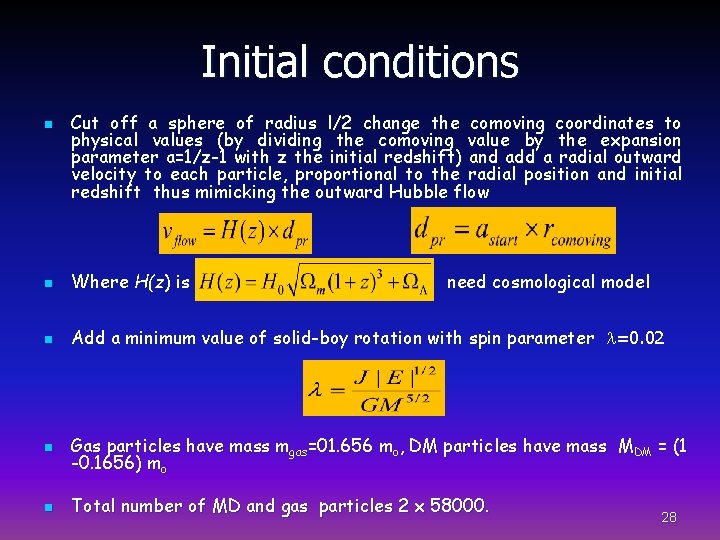
Initial conditions n Cut off a sphere of radius l/2 change the comoving coordinates to physical values (by dividing the comoving value by the expansion parameter a=1/z-1 with z the initial redshift) and add a radial outward velocity to each particle, proportional to the radial position and initial redshift thus mimicking the outward Hubble flow n Where H(z) is n Add a minimum value of solid-boy rotation with spin parameter l=0. 02 n n need cosmological model Gas particles have mass mgas=01. 656 mo, DM particles have mass MDM = (1 -0. 1656) mo Total number of MD and gas particles 2 x 58000. 28
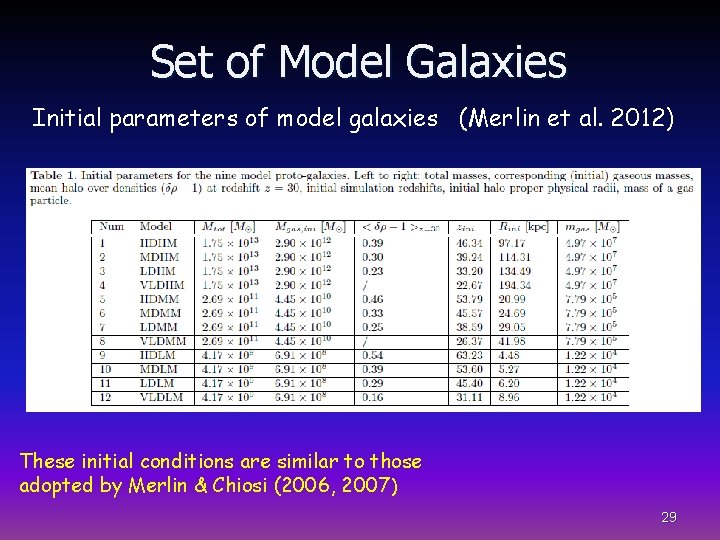
Set of Model Galaxies Initial parameters of model galaxies (Merlin et al. 2012) These initial conditions are similar to those adopted by Merlin & Chiosi (2006, 2007) 29
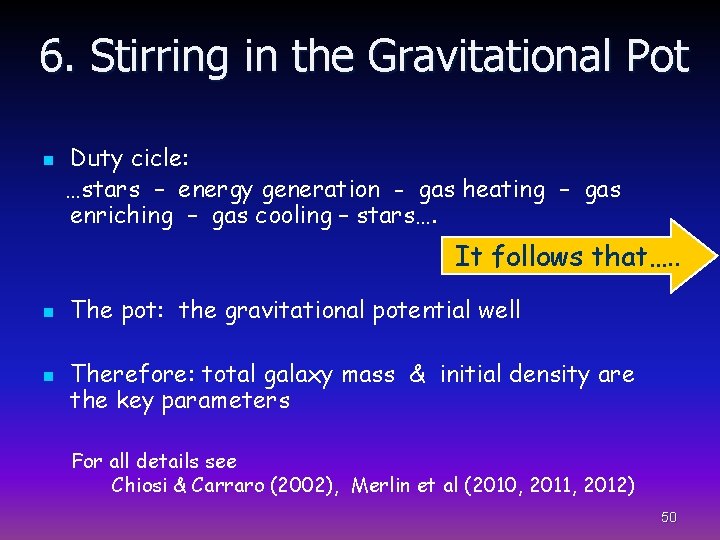
6. Stirring in the Gravitational Pot n Duty cicle: …stars – energy generation - gas heating – gas enriching – gas cooling – stars…. It follows that…. . n n The pot: the gravitational potential well Therefore: total galaxy mass & initial density are the key parameters For all details see Chiosi & Carraro (2002), Merlin et al (2010, 2011, 2012) 50
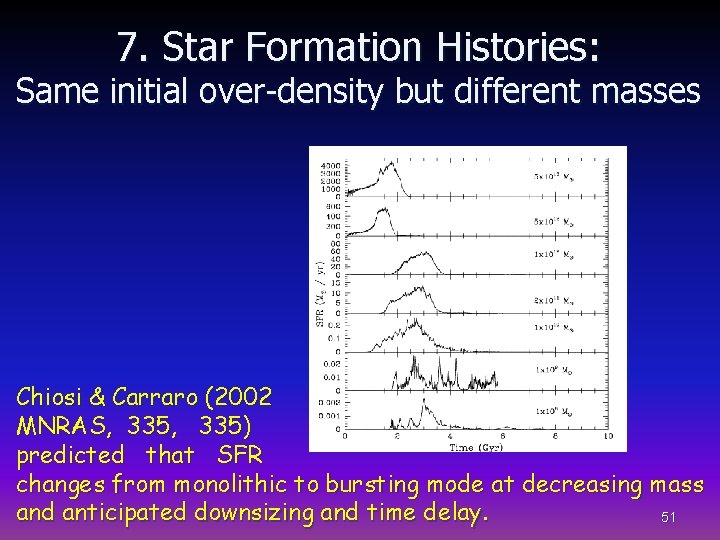
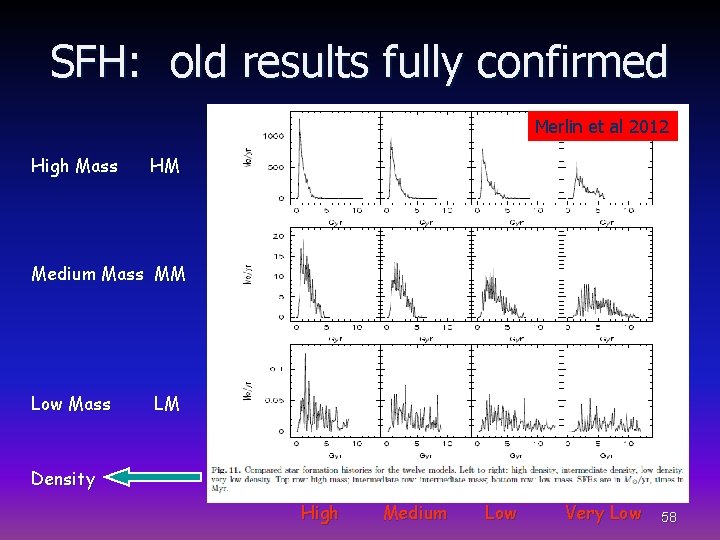
7. Star Formation Histories: Same initial over-density but different masses Chiosi & Carraro (2002 MNRAS, 335) predicted that SFR changes from monolithic to bursting mode at decreasing mass and anticipated downsizing and time delay. 51
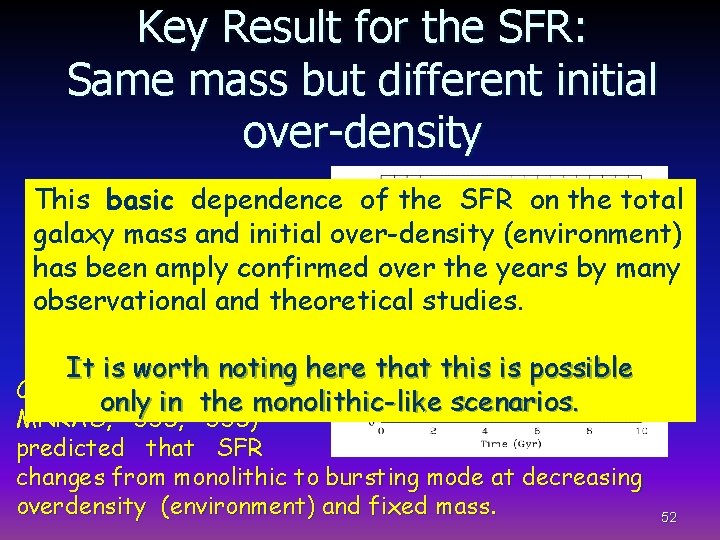
Key Result for the SFR: Same mass but different initial over-density This basic dependence of the SFR on the total galaxy mass and initial over-density (environment) has been amply confirmed over the years by many observational and theoretical studies. It is worth noting here that this is possible Chiosi & Carraro (2002, only in the monolithic-like scenarios. MNRAS, 335) predicted that SFR changes from monolithic to bursting mode at decreasing overdensity (environment) and fixed mass. 52
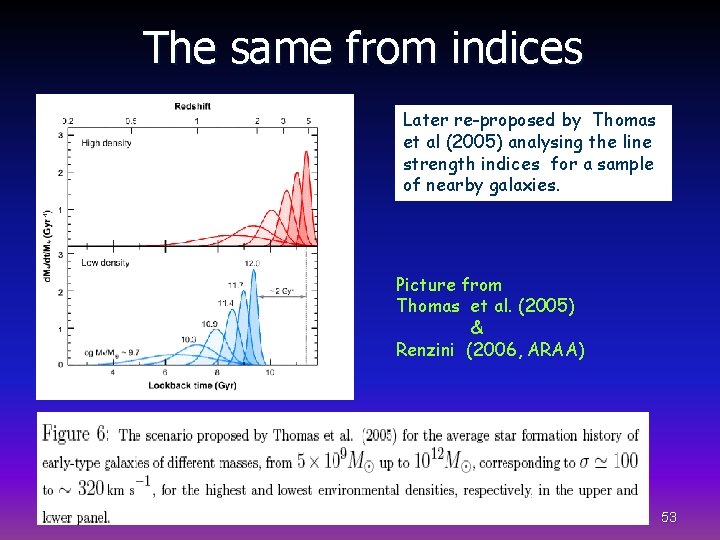
The same from indices Later re-proposed by Thomas et al (2005) analysing the line strength indices for a sample of nearby galaxies. Picture from Thomas et al. (2005) & Renzini (2006, ARAA) 53
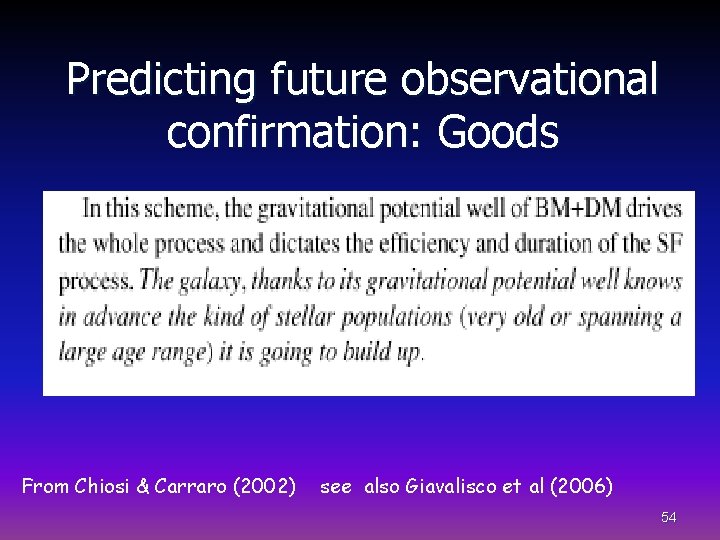
Predicting future observational confirmation: Goods From Chiosi & Carraro (2002) see also Giavalisco et al (2006) 54
SFH: old results fully confirmed Merlin et al 2012 High Mass HM Medium Mass MM Low Mass LM Density High Medium Low Very Low 58
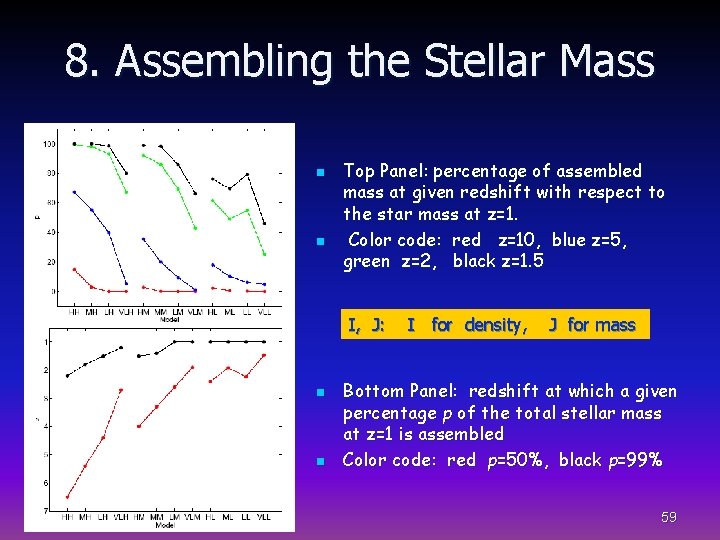
8. Assembling the Stellar Mass n n Top Panel: percentage of assembled mass at given redshift with respect to the star mass at z=1. Color code: red z=10, blue z=5, green z=2, black z=1. 5 I, J: n n I for density, J for mass Bottom Panel: redshift at which a given percentage p of the total stellar mass at z=1 is assembled Color code: red p=50%, black p=99% 59
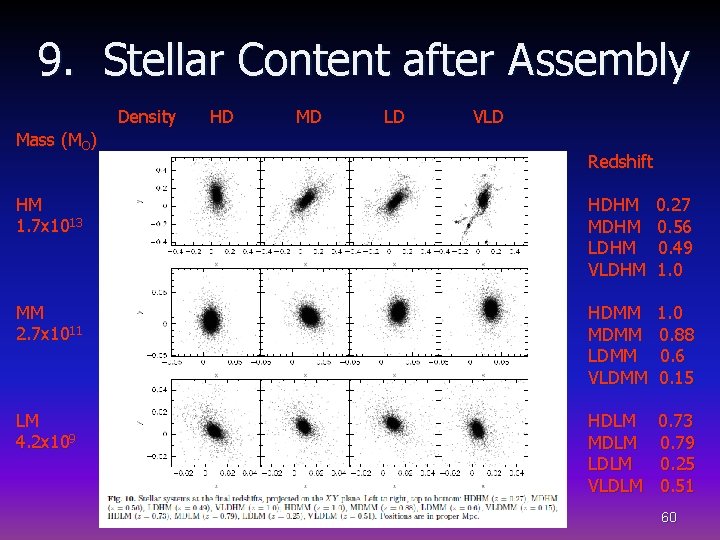
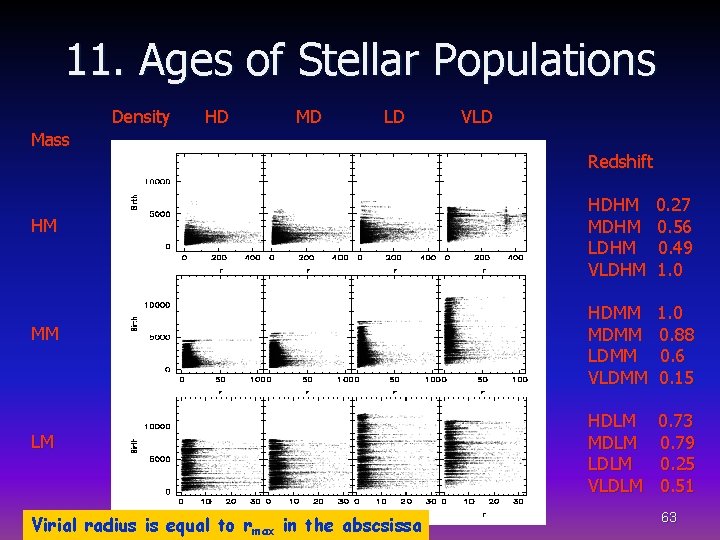
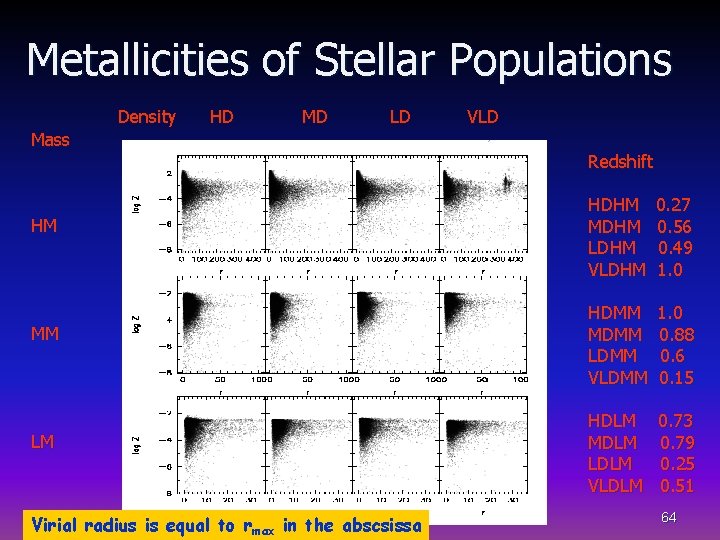
9. Stellar Content after Assembly Density Mass (MO) HD MD LD VLD Redshift HM 1. 7 x 10¹³ HDHM MDHM LDHM VLDHM 0. 27 0. 56 0. 49 1. 0 MM 2. 7 x 10¹¹ HDMM MDMM LDMM VLDMM 1. 0 0. 88 0. 6 0. 15 LM 4. 2 x 10⁹ HDLM MDLM LDLM VLDLM 0. 73 0. 79 0. 25 0. 51 60
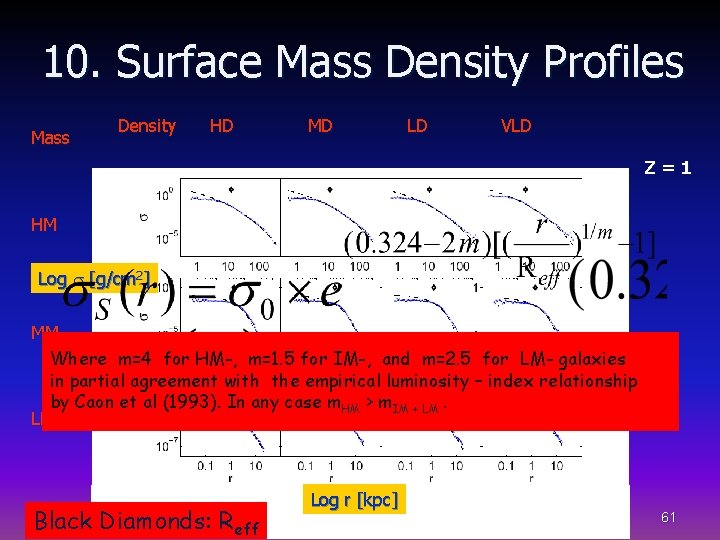
10. Surface Mass Density Profiles Mass Density HD MD LD VLD Z=1 HM Log [g/cm 2] MM Where m=4 for HM-, m=1. 5 for IM-, and m=2. 5 for LM- galaxies in partial agreement with the empirical luminosity – index relationship by Caon et al (1993). In any case m. HM > m. IM + LM. LM Black Diamonds: Reff Log r [kpc] 61
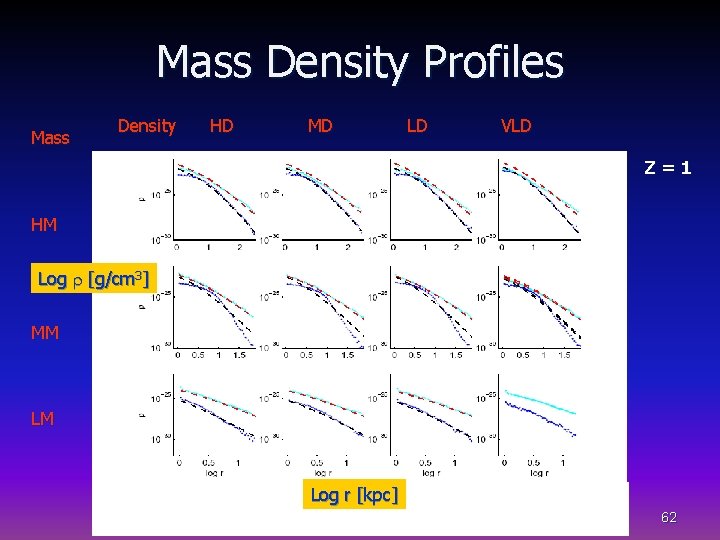
Mass Density Profiles Mass Density HD MD LD VLD Z=1 HM Log r [g/cm 3] MM LM Log r [kpc] 62
11. Ages of Stellar Populations Density HD MD LD Mass HM MM LM Virial radius is equal to rmax in the abscsissa VLD Redshift HDHM MDHM LDHM VLDHM 0. 27 0. 56 0. 49 1. 0 HDMM MDMM LDMM VLDMM 1. 0 0. 88 0. 6 0. 15 HDLM MDLM LDLM VLDLM 0. 73 0. 79 0. 25 0. 51 63
Metallicities of Stellar Populations Density HD MD LD Mass HM MM LM Virial radius is equal to rmax in the abscsissa VLD Redshift HDHM MDHM LDHM VLDHM 0. 27 0. 56 0. 49 1. 0 HDMM MDMM LDMM VLDMM 1. 0 0. 88 0. 6 0. 15 HDLM MDLM LDLM VLDLM 0. 73 0. 79 0. 25 0. 51 64
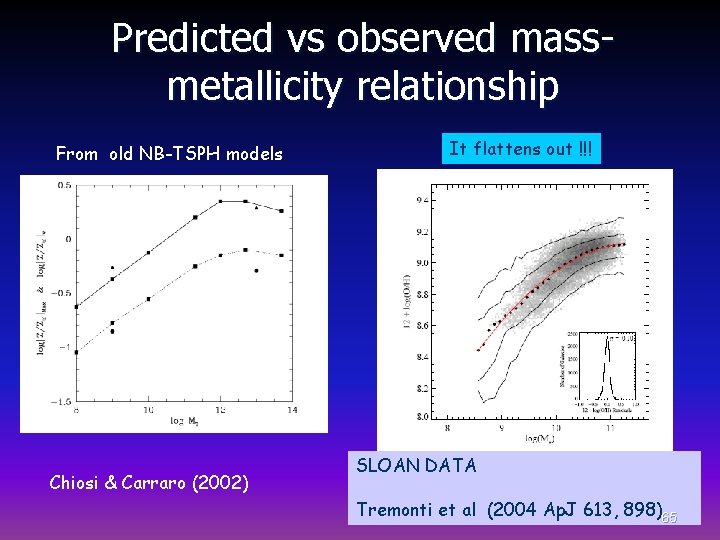
Predicted vs observed massmetallicity relationship From old NB-TSPH models Chiosi & Carraro (2002) It flattens out !!! SLOAN DATA Tremonti et al (2004 Ap. J 613, 898)65
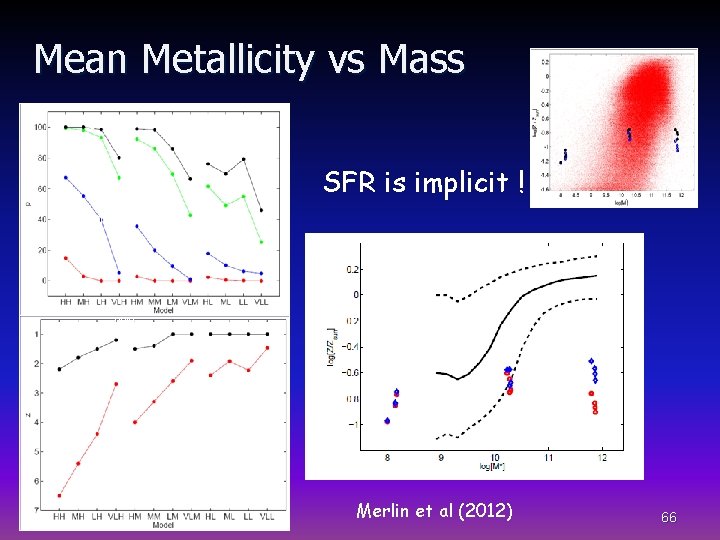
Mean Metallicity vs Mass 5 SFR is implicit ! 10 99% 50% Merlin et al (2012) 66
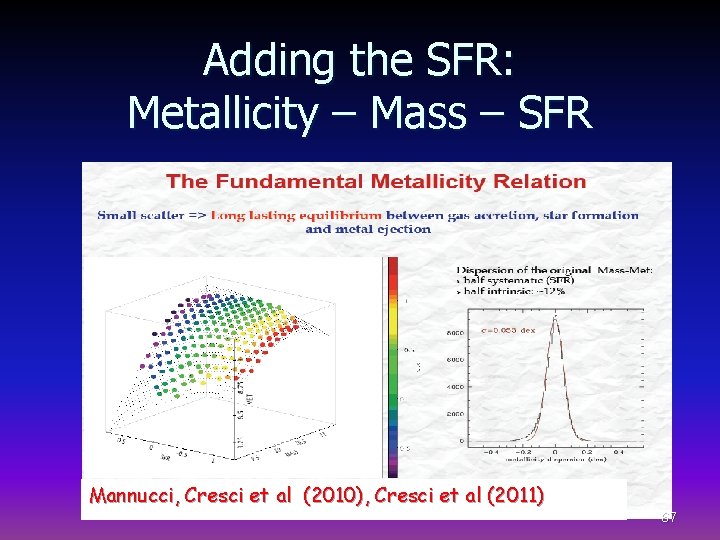
Adding the SFR: Metallicity – Mass – SFR Mannucci, Cresci et al (2010), Cresci et al (2011) 67
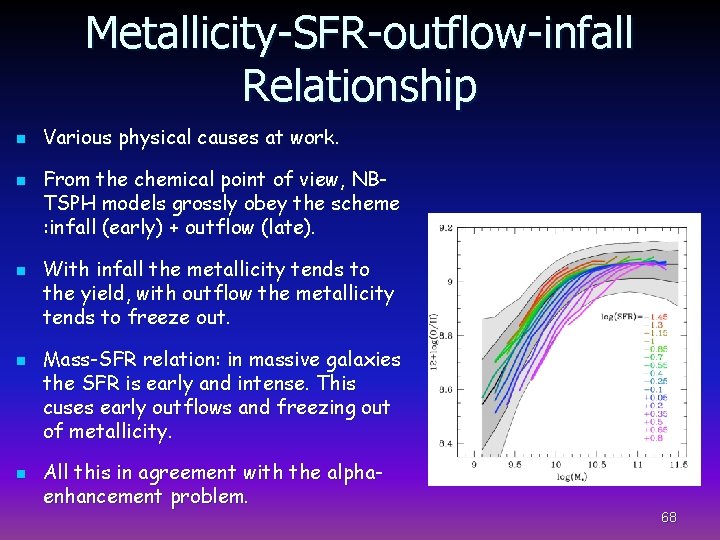
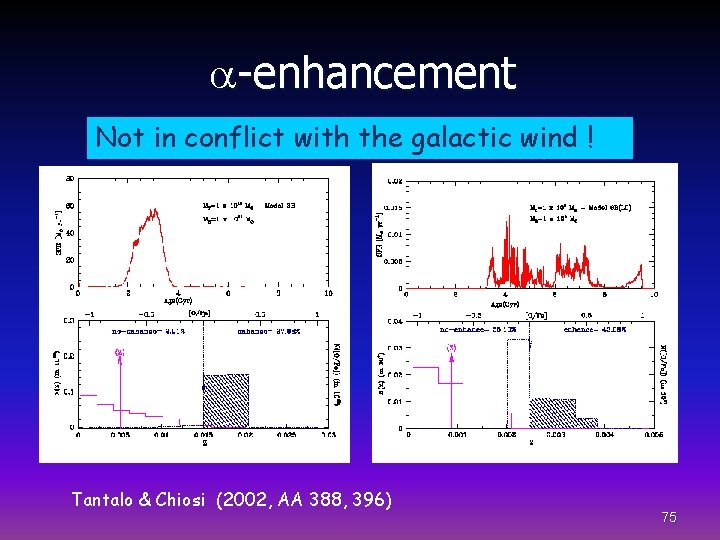
Metallicity-SFR-outflow-infall Relationship n n n Various physical causes at work. From the chemical point of view, NBTSPH models grossly obey the scheme : infall (early) + outflow (late). With infall the metallicity tends to the yield, with outflow the metallicity tends to freeze out. Mass-SFR relation: in massive galaxies the SFR is early and intense. This cuses early outflows and freezing out of metallicity. All this in agreement with the alphaenhancement problem. 68
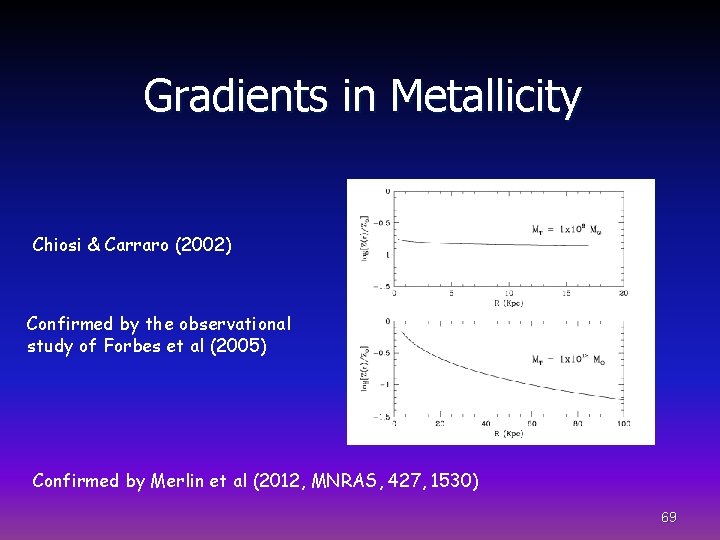
Gradients in Metallicity Chiosi & Carraro (2002) Confirmed by the observational study of Forbes et al (2005) Confirmed by Merlin et al (2012, MNRAS, 427, 1530) 69
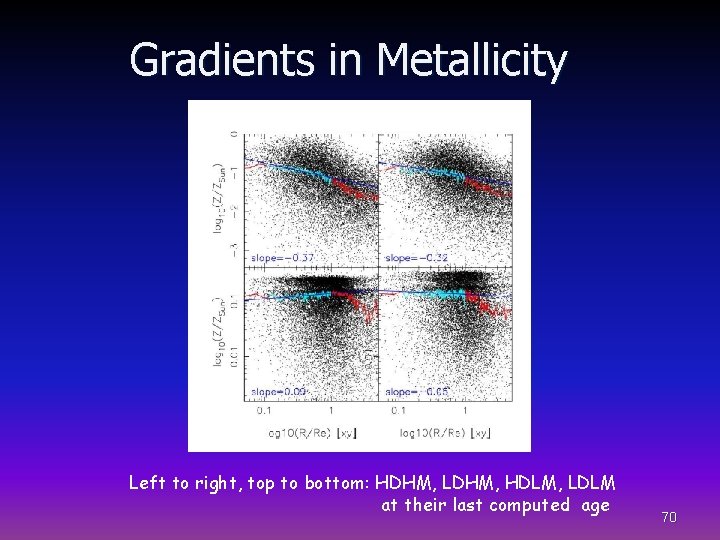
Gradients in Metallicity Left to right, top to bottom: HDHM, LDHM, HDLM, LDLM at their last computed age 70
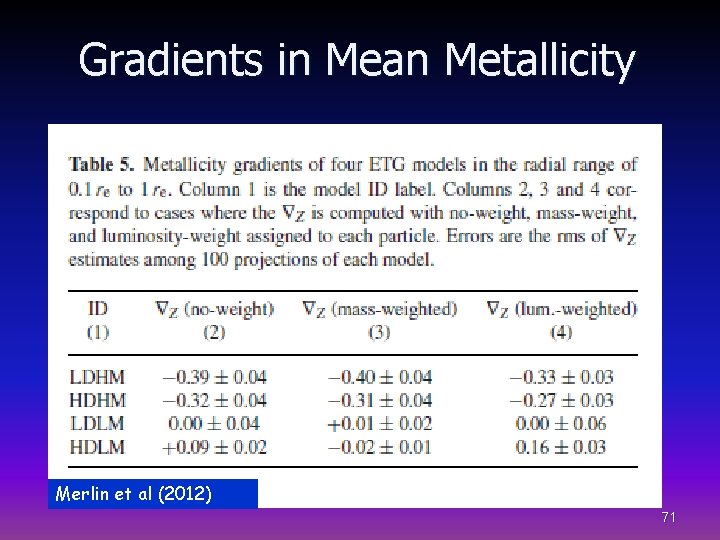
Gradients in Mean Metallicity Merlin et al (2012) 71
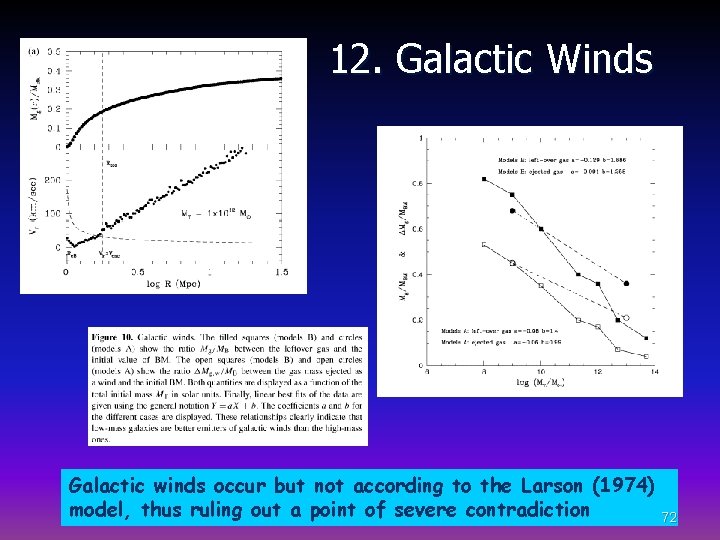
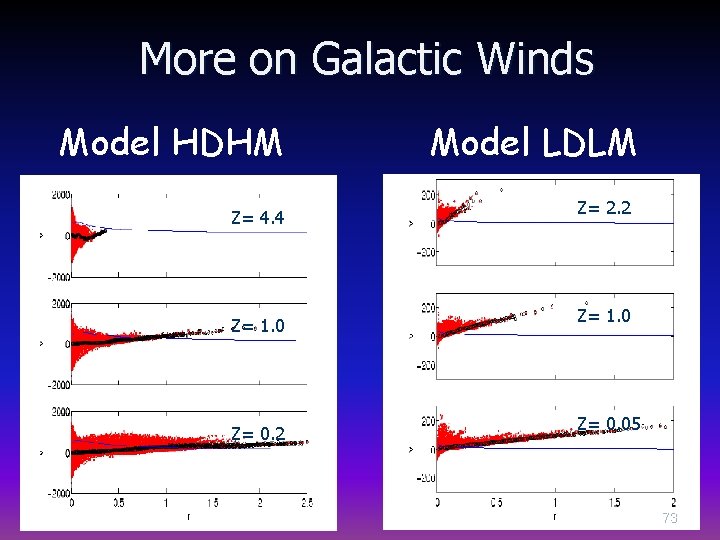
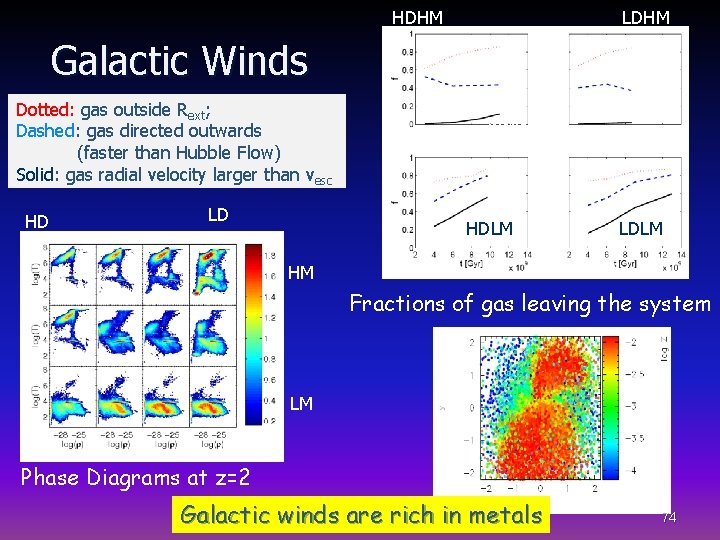
12. Galactic Winds Galactic winds occur but not according to the Larson (1974) model, thus ruling out a point of severe contradiction 72
More on Galactic Winds Model HDHM Z= 4. 4 Z= 1. 0 Z= 0. 2 Model LDLM Z= 2. 2 Z= 1. 0 Z= 0. 05 73
HDHM Galactic Winds Dotted: gas outside Rext; Dashed: gas directed outwards (fasterz=10 than Hubble z=7 Flow) Solid: gas radial velocity larger than vesc LD HD LDHM outside outward escaped HDHM HDLM LDHM LDLM HM Fractions of gas leaving the system LM IDIM Phase Diagrams at z=2 Galactic winds are rich in metals 74
a-enhancement Not in conflict with the galactic wind ! Tantalo & Chiosi (2002, AA 388, 396) 75
Mg 2 – Relationship Confirmed by Mehelrt et al (2003) …… 76
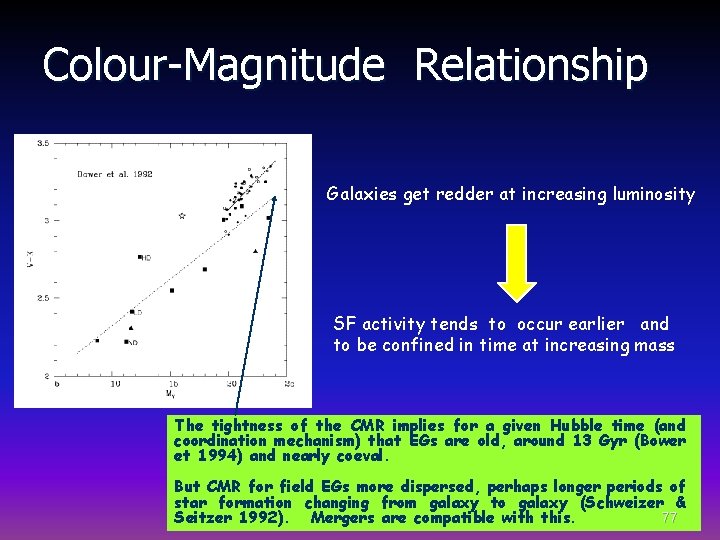
Colour-Magnitude Relationship Galaxies get redder at increasing luminosity SF activity tends to occur earlier and to be confined in time at increasing mass The tightness of the CMR implies for a given Hubble time (and coordination mechanism) that EGs are old, around 13 Gyr (Bower et 1994) and nearly coeval. But CMR for field EGs more dispersed, perhaps longer periods of star formation changing from galaxy to galaxy (Schweizer & 77 Seitzer 1992). Mergers are compatible with this.
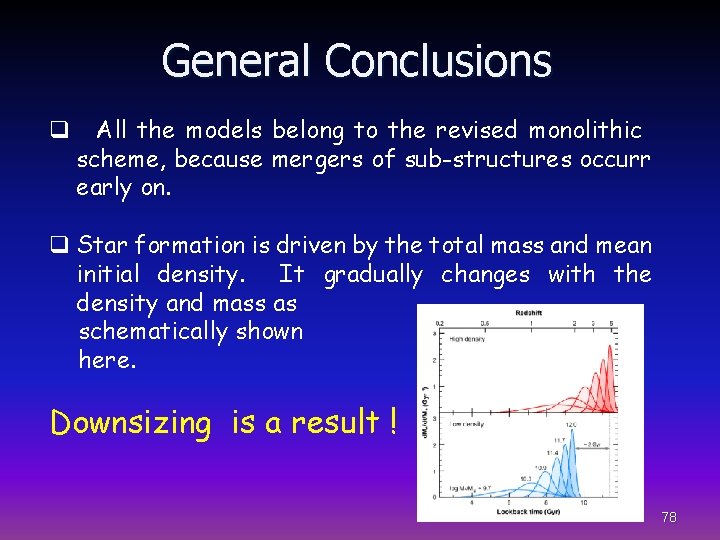
General Conclusions q All the models belong to the revised monolithic scheme, because mergers of sub-structures occurr early on. q Star formation is driven by the total mass and mean initial density. It gradually changes with the density and mass as schematically shown here. Downsizing is a result ! 78
General Conclusions q q q Galaxy formation is complete at redshifts larger than 2. Structural properties, of present day models agree with current data. Some problems with the absolute value of the mean metallicity and the metallicity gradients (easy to solve). Conspicuous galactic winds occur, which is important for ICM enrichment. The mass in stars per unit mass of a galaxy is nearly constant thus implying a universal star forming mechanism. 79
General Conclusions q Important scale relations are reproduced by the models. n Photometric properties of galaxies are matched. n The M* - Re relation is the result of a more subtle game than the simple merging-wind mechanism. q The revised monolithic promises to be the right trail to follow in the forest of galaxy formation and evolution, whereas the classical hierarchical scheme does not seem to be so promising in reproducing the large variety of observational properties of ETGs at the same time. Οπερ έδει δείξαι 122
To take away…. “Non eventus imputari debet cuiusque rei, sed consilium” Lucius Annaeus Seneca, Retor, Contr. , 5, 342 123
HORA EST Thank you for your attention 124